Why Is the NFLPA Worried About the Field Before Cowboys–Ravens in Rio?

Update — October 1, 2026: The game was played at Maracanã on September 27, and Baltimore beat Dallas 34–31. This explainer has been updated to distinguish the pregame field concerns from the completed game; the score does not by itself resolve the separate question of field safety. (Official game record)
Wasn’t Maracanã good enough to host World Cups and an Olympics?
So why, two days before an NFL regular-season game, were player representatives talking about traction, loose grass and reinforced stitching?
That is where this story gets more complicated than “the field looks bad.”
The NFL Players Association said the concern ahead of the September 27 Baltimore Ravens–Dallas Cowboys game was that parts of the playing surface could be loose, patchy and prone to excessive slipping. Its field experts concluded that the surface needed better traction and stability, and reinforcement work was underway before kickoff. (NFLPA)
But the union also made an important distinction: a slick surface is not automatically the most dangerous kind of field.
Too little traction can make players slip and struggle to perform. Too much traction can create a different problem by preventing a cleat from releasing when the player’s body turns.
That distinction explains why this is about far more than whether Maracanã’s grass looks attractive on television.
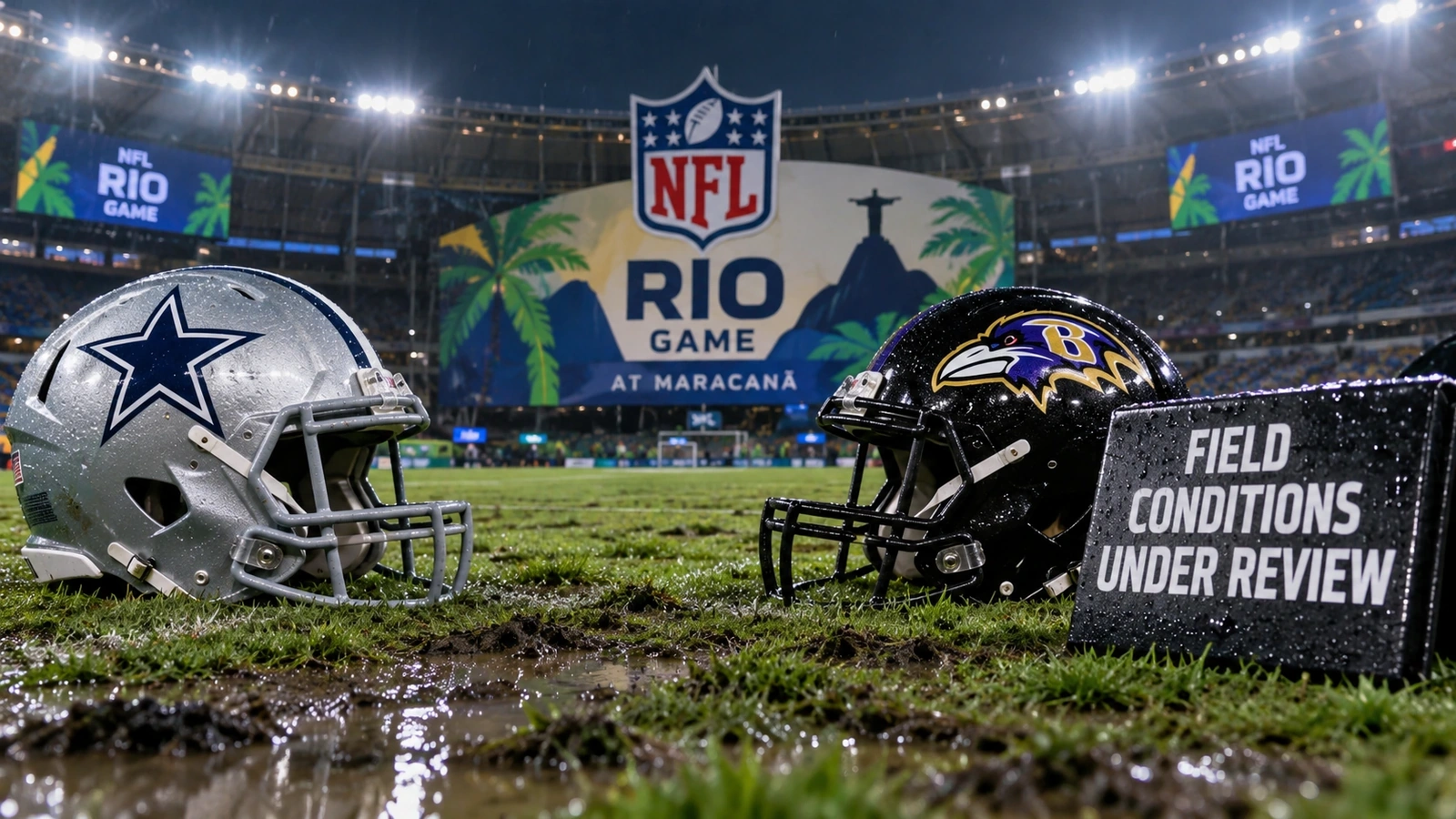
※ Images in this article are AI-generated illustrations created to help explain the story. They are not actual photographs, and depictions of people, places, or events may differ slightly from reality.
The Ravens and Cowboys played at Maracanã Stadium on September 27, 2026 in the NFL’s first regular-season game in Rio de Janeiro. The league and the NFLPA both had field experts in Brazil evaluating the surface ahead of the game. (NFL · NFLPA)
What Exactly Is Wrong With the Maracanã Field?
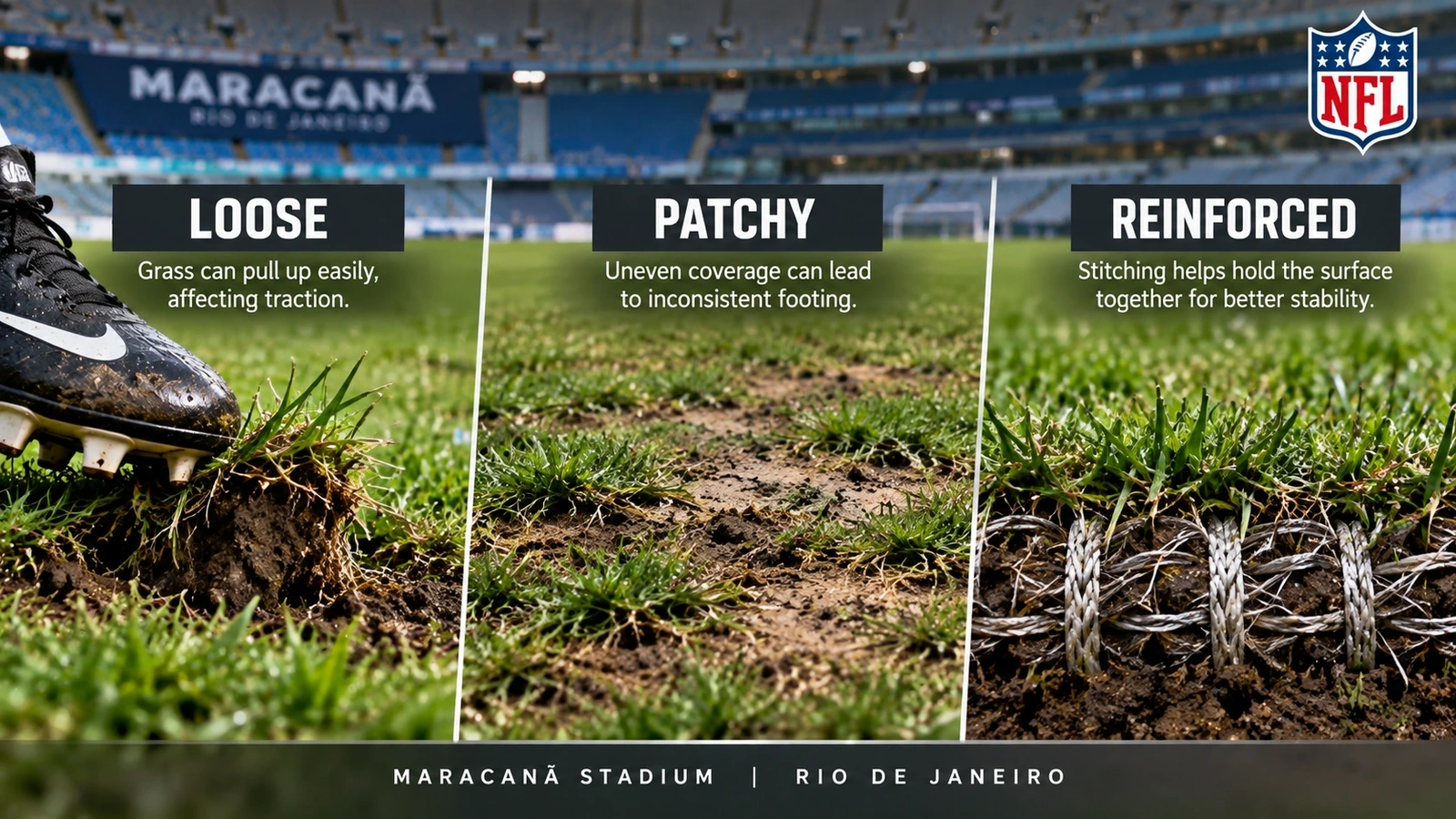
The immediate concern is traction and stability.
NFLPA Executive Director JC Tretter said the union entered the week worried that the field could be loose and patchy enough to produce excessive slipping. After evaluating the surface, NFLPA experts recommended reinforced stitching intended to help the field hold together more effectively. (NFLPA)
The issue did not suddenly appear on Friday.
Soccer players who regularly use Maracanã had already complained about the deteriorating surface before NFL game week. (CBS Sports)
The league’s pregame public position was more confident. NFL field director Nick Pappas told The Associated Press earlier in the week that he expected the surface to be in good shape for Sunday, while noting unusually heavy rainfall over the previous six weeks. The NFL had a crew on site Monday to begin preparing the stadium. (CBS News / AP)
That does not mean the NFLPA declared the field unfit for play.
In fact, Tretter said the kind of slickness being discussed was generally more of a playability and performance problem than a major injury concern.
That distinction matters.
A field can be troublesome enough to affect routes, cuts and tackles without being so unsafe that the game must automatically be moved.
Why Can a Soccer Field Become a Problem for NFL Players?

Because “good grass” is not a single universal condition.
An NFL field needs to remain predictable when very large athletes accelerate, stop, block, push and change direction while wearing cleats. The league therefore measures more than whether the grass looks green or level.
NFL field standards include testing for factors such as hardness and surface stability, while the NFL and NFLPA have developed specialized equipment to study how shoes interact with playing surfaces. One device, known as the BEAST, is designed to reproduce traction forces similar to those generated by football movements. (NFL Football Operations)
The problem is not that Maracanã is a soccer stadium.
Plenty of NFL international games are played in stadiums primarily associated with soccer.
The question is whether this particular surface, in its current condition, can deliver predictable footing under NFL loads for an entire game.
The 2024 NFL game in São Paulo illustrated the difference.
During the Eagles-Packers game at Arena Corinthians, players repeatedly lost their footing. Jalen Hurts said it was difficult to get traction, and players adjusted their cleats as they tried to adapt to the slick surface. (ESPN)
That is the kind of scene the league and union want to avoid in Rio.
Is a Slippery Field Actually Unsafe?
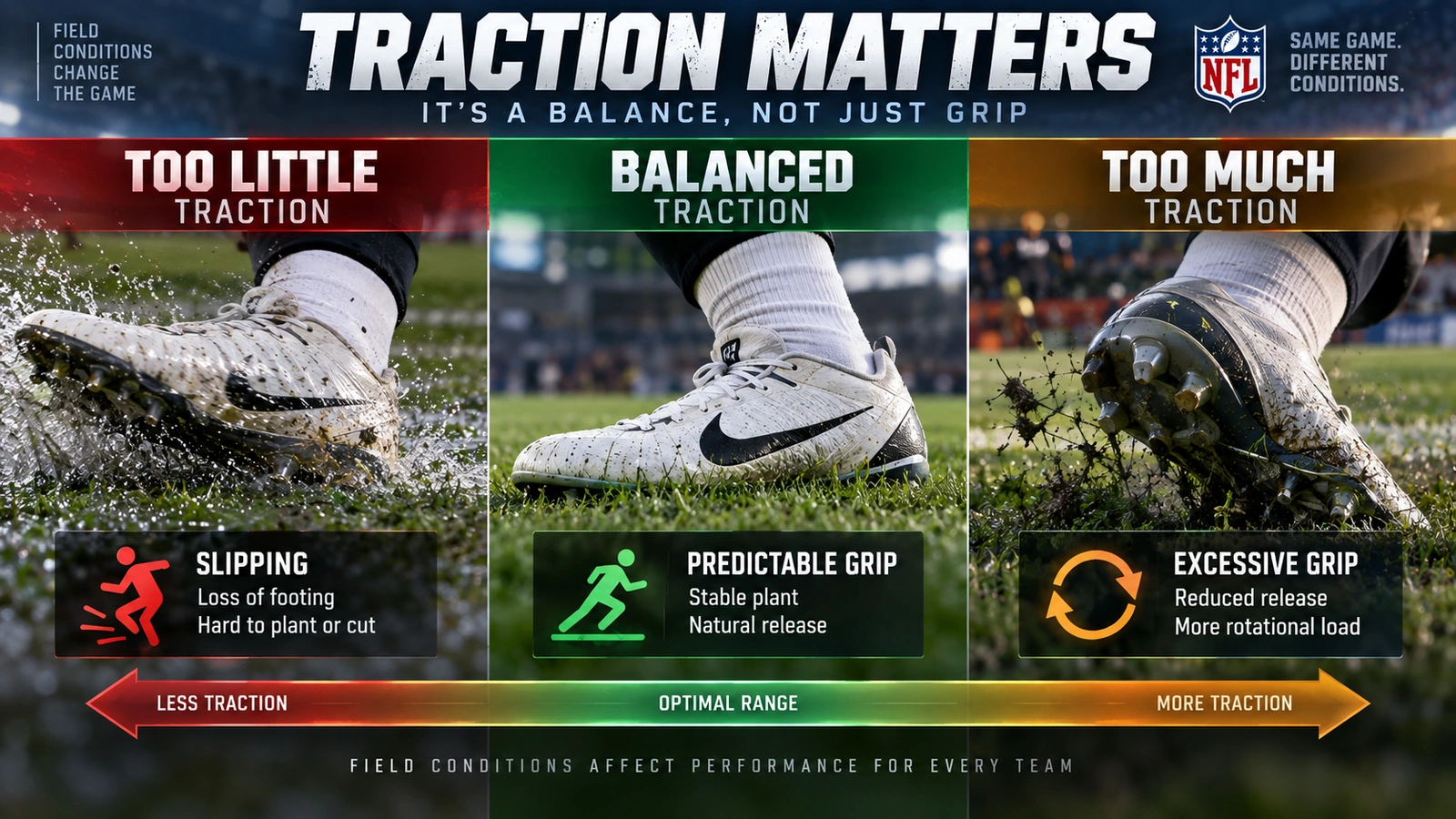
Not necessarily—and this is probably the most easily misunderstood part of the story.
The NFLPA said a thin or slick surface can create slipping and performance problems without posing the same type of injury concern as a field with excessive grip. (NFLPA)
Think of traction as a range rather than a simple “more is better” measurement.
| Traction level | What can happen |
|---|---|
| Too little | A foot slides when a player tries to plant, accelerate or change direction. |
| Predictable grip | The cleat holds long enough for the movement but can still release naturally. |
| Too much | The shoe may remain fixed while the player’s body rotates or changes direction. |
The NFLPA’s Rio statement makes the same distinction in simpler terms: a thin, slick surface may not present the same risks as a surface with too much traction. The NFL and NFLPA also use the BEAST, a testing device designed to simulate cleat-surface forces, because traction has to be measured rather than judged only by appearance. (NFLPA · NFL)
So when the NFLPA says the Rio field needs “better traction,” it does not mean it wants the cleats locked into the ground as tightly as possible.
It wants a stable and predictable middle ground.
That is also why visual appearance alone is an imperfect guide.
A field can look worn but perform acceptably. Another can look smooth on television and still behave unpredictably when a player plants a foot at full speed.
What Does “Reinforced Stitching” Actually Do?
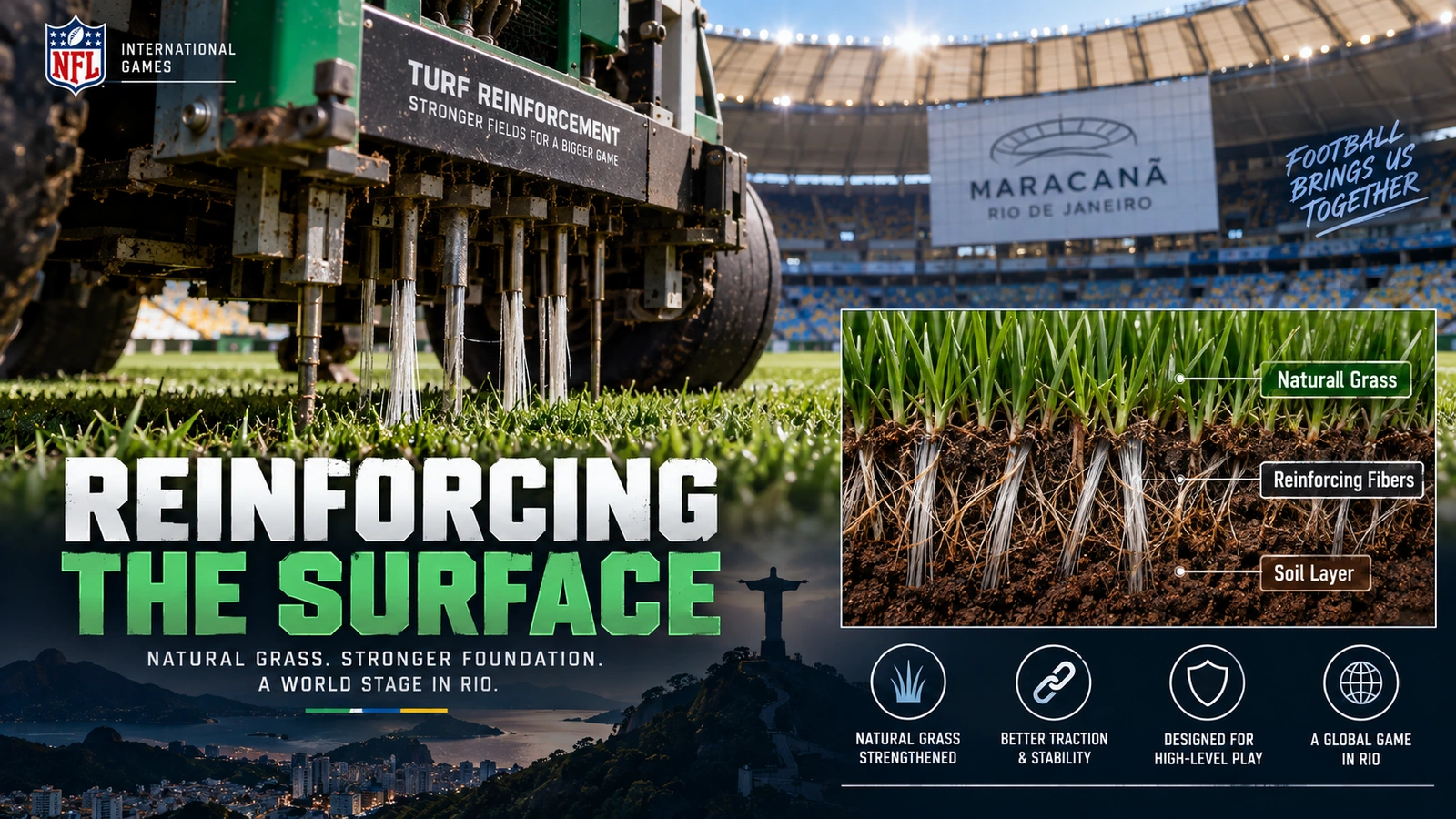
The goal is to keep the playing surface from breaking apart as easily under football movements.
The NFLPA said its experts recommended reinforced stitching after determining that the Maracanã field needed more traction and stability. Equipment was brought in to reinforce as much of the surface as possible before the game. (NFLPA)
Reports from Rio showed crews using fiber-stitching equipment intended to strengthen the grass surface before Sunday. (NBC Sports)
The important word here is reinforce.
This is not the same as replacing the entire field with artificial turf two days before kickoff.
The intervention is designed to make the existing grass structure more stable so players have a more consistent platform beneath their cleats.
Whether the work succeeds is something experts have to evaluate on the actual field—not something that can be determined from television pictures alone.
How Does the NFL Decide Whether a Field Is Good Enough?
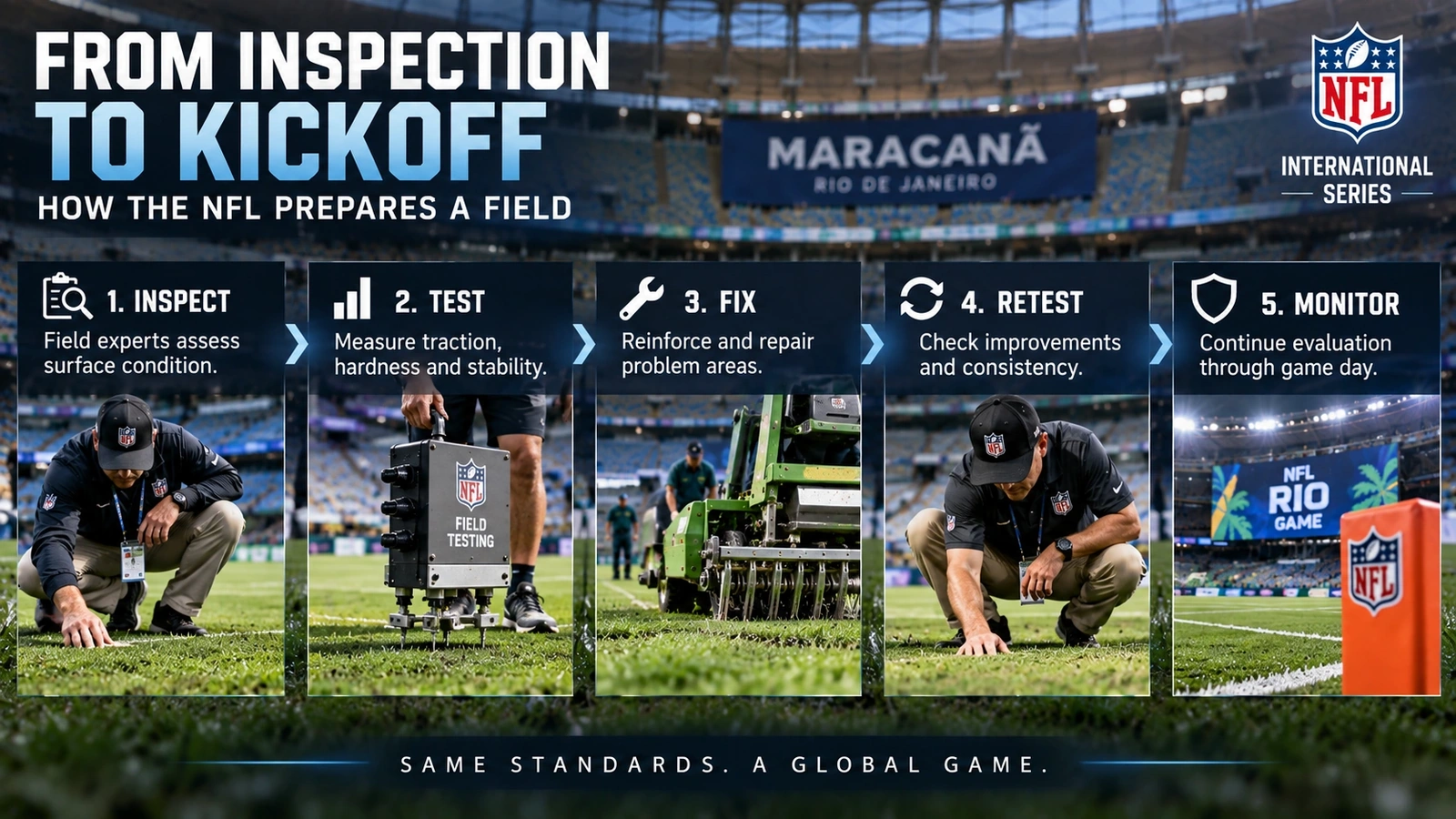
NFL fields are not approved simply because a groundskeeper says they look ready.
The league’s operations standards require playing surfaces to be tested for consistency and safety. Natural fields are evaluated for factors including hardness and surface stability, and problems are supposed to be corrected and retested. (NFL Football Operations)
The NFL and NFLPA have also been moving toward more sophisticated and consistent surface standards.
In late 2025, the league described new testing tools and said all stadiums, including international venues, are scheduled to comply with the updated mandatory playing-surface framework by 2028. (NFL)
Before the Rio game, the NFLPA said union and league field experts had been on site for days and would remain involved through kickoff. (NFLPA)
That meant the field’s condition in photographs taken on Friday did not necessarily establish its condition at kickoff.
The surface is being actively worked on and evaluated.
Why Is This Also a Fight About the NFL’s International Expansion?

Because Rio is not an isolated experiment.
The NFL scheduled a record nine international games in 2026, spread across four continents, seven countries and eight stadiums. Rio is one of the league’s new markets this season. (NFL)
Brazil is especially important to that strategy.
The NFL says the country has more than 36 million fans, and the league has made a multiyear commitment to bring at least three regular-season games to Rio over five years. (NFL)
That is why Tretter’s September 25 statement went beyond Sunday’s grass.
He argued that the Rio preparation reinforced a broader NFLPA concern: international growth cannot come at the expense of playing-surface standards.
The union is not saying the NFL should stop playing abroad.
Its argument is that the standard for the field should travel with the league.
That creates a practical challenge.
NFL clubs control and maintain their own home environments throughout the season. An international venue may primarily host a different sport, operate under a different event calendar and face different weather and maintenance demands.
If the NFL continues adding international games, preparing those surfaces to the same level as regular NFL venues becomes part of the cost of expansion.
Has the NFL Ever Moved a Game Because of the Field?
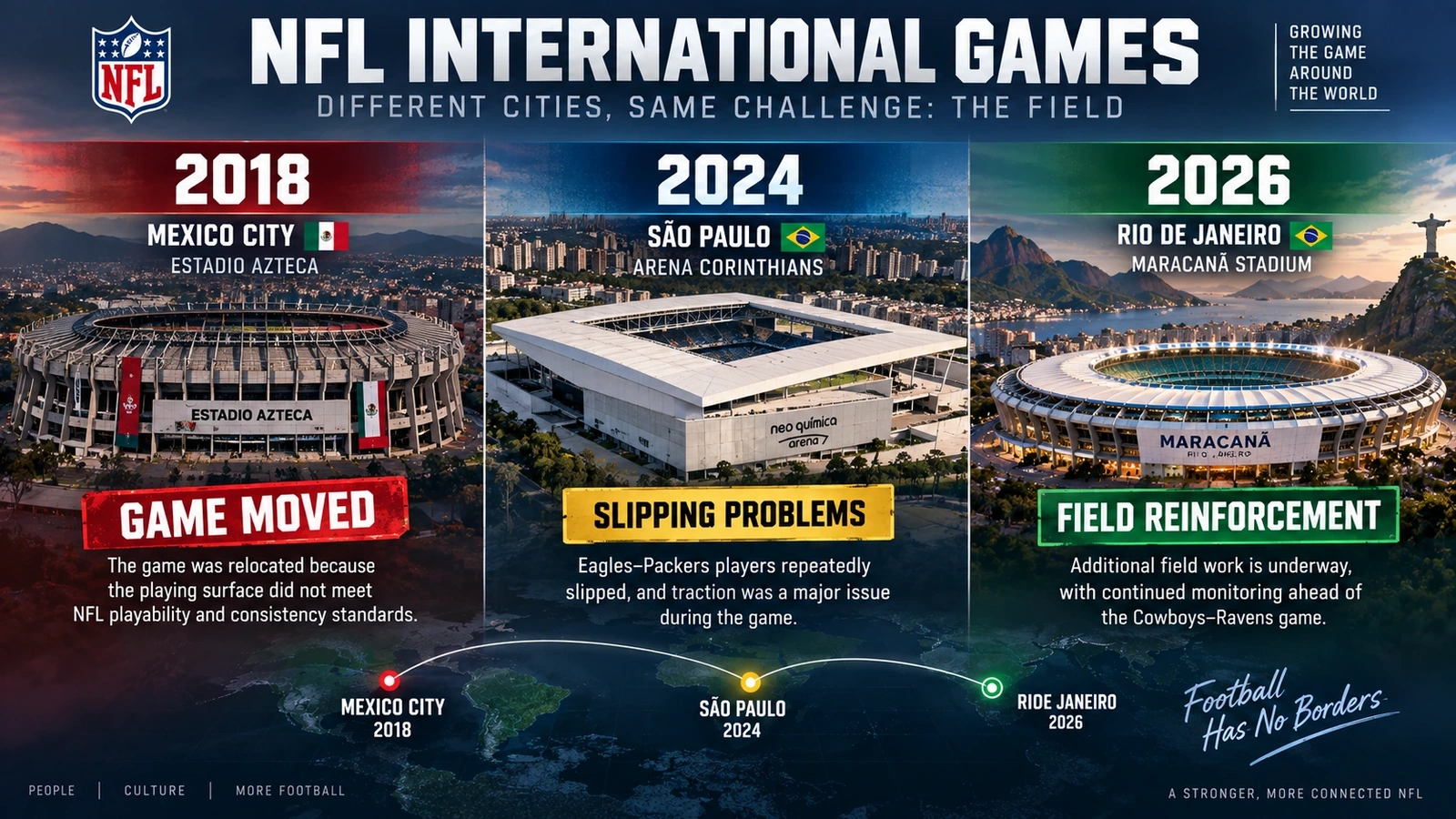
Yes.
The clearest precedent came in 2018, when the NFL moved a scheduled Chiefs-Rams game from Mexico City to Los Angeles six days before kickoff.
After an inspection involving league, team, local and independent experts, the NFL said the Estadio Azteca surface did not meet its standards for playability and consistency. The league specifically cited heavy use and a difficult rainy season as factors in the damage. (NFL)
The Rio situation has not reached that point.
| Year | Venue | What happened |
|---|---|---|
| 2018 | Estadio Azteca, Mexico City | Chiefs-Rams was moved to Los Angeles after the field failed NFL playability and consistency standards. |
| 2024 | Arena Corinthians, São Paulo | Eagles and Packers players repeatedly slipped and criticized the lack of traction during the game. |
| 2026 | Maracanã, Rio de Janeiro | NFL and NFLPA experts ordered reinforcement work and continued monitoring before Cowboys-Ravens. |
The 2024 São Paulo game is especially relevant because it produced exactly the kind of visible slipping that worries players when they hear about a loose field. (ESPN)
But the lesson from 2018 is different.
The NFL has shown that it can move an international game when experts conclude a surface cannot meet league standards.
That precedent is one reason the distinction between “the grass looks rough” and “the field cannot meet the required standard” matters so much.
What Can Game Footage Tell Us About Field Conditions?
When reviewing game footage, player movement can tell viewers more than a pregame photograph.
Watch how players plant when they make sharp cuts.
Watch whether defensive backs lose their footing while changing direction.
Watch whether running backs and receivers repeatedly change cleats.
And watch whether pieces of the surface visibly loosen under blocking and tackling.
One or two slips do not automatically prove that a field is defective. Football players sometimes lose their footing on excellent surfaces too.
The more meaningful question is whether the same type of instability appears repeatedly across different positions and different areas of the field.
That is what turns a bad step into a field-condition story.
The game has now been played: Baltimore defeated Dallas 34–31 on September 27. The result alone does not establish whether the surface met every safety or performance benchmark. (Baltimore Ravens official game record)
Why It Matters in One Sentence
The controversy over Maracanã is not simply about whether the grass looks worn—it is about whether the NFL can give players predictable traction, stability and performance standards wherever the league takes its increasingly global schedule.
Maracanã Field: Key Questions Explained
Q. Why is the NFLPA concerned about the Maracanã field?
NFLPA experts said the surface needed better traction and stability after concerns that loose and patchy grass could cause excessive slipping. Reinforced stitching was recommended before the Cowboys-Ravens game. (NFLPA)
Q. Has the NFLPA said the field is unsafe?
Not exactly. The union said the expected slickness was generally more of a playability and performance concern than a major injury concern, while still insisting that players deserve a stable surface. (NFLPA)
Q. Why can too much traction also be a problem?
If a cleat grips too strongly while the player’s body continues rotating, more force can be transferred into the lower leg and joints. The NFL and NFLPA therefore evaluate traction as a balance rather than assuming more grip is always better. (NFL)
Q. What work was planned for the Maracanã grass before kickoff?
Before kickoff, field crews were reinforcing the surface with stitching intended to improve traction and stability. NFL and NFLPA experts were involved in evaluating the field ahead of kickoff. (NFLPA)
Q. Why not simply move Cowboys-Ravens back to the United States?
The game was played in Rio on September 27. Moving an international regular-season game involves major stadium, travel, ticketing and scheduling complications, although the NFL has relocated a game before when a field failed its standards. (NFL)
Q. Has Brazil had NFL field problems before?
Yes. During the Eagles-Packers game in São Paulo in 2024, players from both teams repeatedly slipped and later discussed difficulty getting traction. (ESPN)
Q. When was Cowboys-Ravens in Rio, and who won?
The teams played at Maracanã Stadium on September 27, 2026. Baltimore won 34–31. (Baltimore Ravens official game record)
Q. Why does this matter for future NFL international games?
The NFL has scheduled a record nine international games in 2026 and plans a multiyear presence in Rio. The NFLPA argues that global expansion should come with playing surfaces that meet the same expectations for safety and performance as domestic NFL venues. (NFLPA)
Did this help make the story clearer? 🙂
WIN keeps unpacking the “why” behind the news—clearly and simply!
Sources
Rio Field Conditions and NFLPA Response
NFLPA — Statement from Executive Director JC Tretter on Field Conditions in Rio
CBS News / AP — NFL Field Director Says He Expects the Rio Surface to Be Ready
NBC Sports — Work Continues on Field for Ravens-Cowboys
CBS Sports — Cowboys-Ravens Field Conditions Draw Concern Ahead of Rio Game
NFL Playing-Surface Standards
NFL Football Operations — Game Operations Manual and Field Testing Standards
NFL — Safety and Consistency in Field Surfaces
Brazil and International Expansion
NFL — Ravens to Face Cowboys in the 2026 NFL Rio Game
NFL — Rio de Janeiro Multiyear Regular-Season Commitment
Earlier Field Issues and Precedent
NFL — Chiefs-Rams Game Moved From Mexico City to Los Angeles in 2018
ESPN — Slippery Field in Brazil Causes Challenges for Eagles and Packers in 2024