How Did Sovereignty Win the Breeders’ Cup Classic a Year After a Fever Forced Him Out?

A year ago, Sovereignty was supposed to compete in one of the biggest races of his life. Then a fever appeared, and his chance was gone before he could even reach the starting gate.
On October 31, 2026, he finally got that chance.
The four-year-old thoroughbred won the $7 million Breeders’ Cup Classic at Keeneland Race Course in Lexington, Kentucky, beating some of the strongest horses in international racing.
But the victory had another unexpected twist: It was also the final race of his career.

※ Images in this article are AI-generated illustrations created to help explain the story. They are not actual photographs, and depictions of people, places, or events may differ slightly from reality.
What makes the story remarkable is that Sovereignty had already established himself as an outstanding racehorse. He won the 2025 Kentucky Derby, Belmont Stakes, and Travers Stakes, yet illness prevented him from competing in that year’s Breeders’ Cup Classic.
His return in 2026 was hardly straightforward, either. Another health problem disrupted his preparation, and his early-season performances raised questions about whether he could regain his best form.
So how did Sovereignty make it back, what made his victory so important, and why would his connections retire him immediately afterward?
What Happened in Sovereignty’s 2026 Breeders’ Cup Classic Victory?
Sovereignty won the Breeders’ Cup Classic on October 31, 2026, defeating The Puma by 1¾ lengths over 1¼ miles on Keeneland’s dirt track. With Junior Alvarado riding and Hall of Fame trainer Bill Mott overseeing his preparation, he completed the race in 2 minutes, 0.36 seconds.
The victory was especially meaningful because Sovereignty had been forced to withdraw from the same championship in 2025. (Breeders’ Cup · NBC Sports)
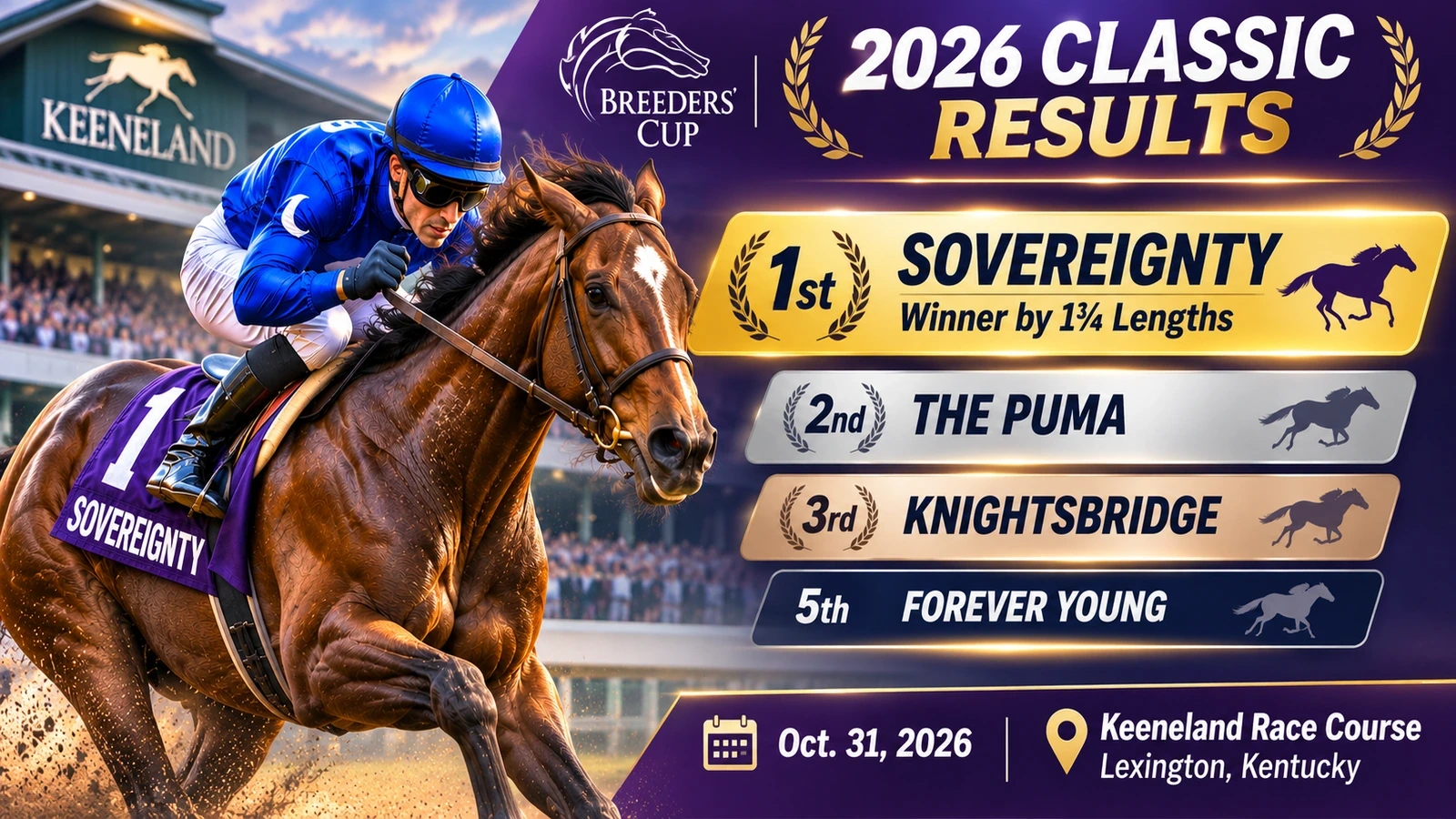
The final results showed just how competitive the field had been.
| Finish | Horse | Key Detail |
|---|---|---|
| 1st | Sovereignty | 2025 Horse of the Year |
| 2nd | The Puma | Strong late finish |
| 3rd | Knightsbridge | Fellow Godolphin runner |
| 4th | T O Password | Japanese contender |
| 5th | Forever Young | Defending Classic champion |
| 6th | Golden Tempo | 2026 Kentucky Derby winner |
| 7th | Napoleon Solo | 2026 Preakness winner |
Magnitude was withdrawn before the race, leaving seven starters—the smallest field in Breeders’ Cup Classic history. (Daily Racing Form · NBC Sports)
The defending champion, Japan’s Forever Young, had attracted considerable attention before the race. He started as a narrow betting favorite but faded to fifth.
Sovereignty did not have to lead from the beginning. His most important move came much later, when he accelerated past the horses ahead of him approaching the final stretch.
That finishing speed had been one of the defining qualities of his earlier championship victories.
Why Was Sovereignty Forced to Miss the 2025 Breeders’ Cup Classic?
Sovereignty missed the November 1, 2025, Breeders’ Cup Classic because he developed a fever shortly before the race. Trainer Bill Mott decided to withdraw him rather than risk racing a horse that was not fully healthy.
The decision was particularly disappointing because Sovereignty was among the leading contenders and had already been installed as the morning-line favorite.
According to the October 29, 2025, report from Daily Racing Form, the horse initially developed a fever earlier that week. His temperature improved after treatment but subsequently rose again, leading Mott to withdraw him. (Daily Racing Form)
In racing, this is called a scratch: a horse entered in a race is officially withdrawn before competing.
A scratch is different from starting a race and failing to finish. Sovereignty never had an opportunity to run against the other contenders that day.
The withdrawal also meant fans missed a much-anticipated meeting between Sovereignty and Forever Young.
Forever Young subsequently won the 2025 Classic, defeating Sierra Leone by half a length. Sovereignty’s absence did not diminish that victory, but it left an important sporting question unanswered: how would the two champions compare in the same race? (Breeders’ Cup)
The answer would have to wait another year.
What Made Sovereignty’s 2026 Comeback So Uncertain?
Sovereignty’s road back was complicated by an uneven start to 2026 and another health setback.
After his dominant 2025 season, he lost his first two races of 2026. He then returned to winning form in the Whitney Stakes on August 8, defeating his rivals by 4¾ lengths.
That victory demonstrated he was still capable of competing at the highest level. It also earned him an automatic place in the Breeders’ Cup Classic through the event’s qualifying program.
But another problem soon interrupted his preparation: an abscess in his left hind foot. The condition forced him to miss his planned start in the Jockey Club Gold Cup, an important preparation race ahead of the Classic. (Breeders’ Cup)
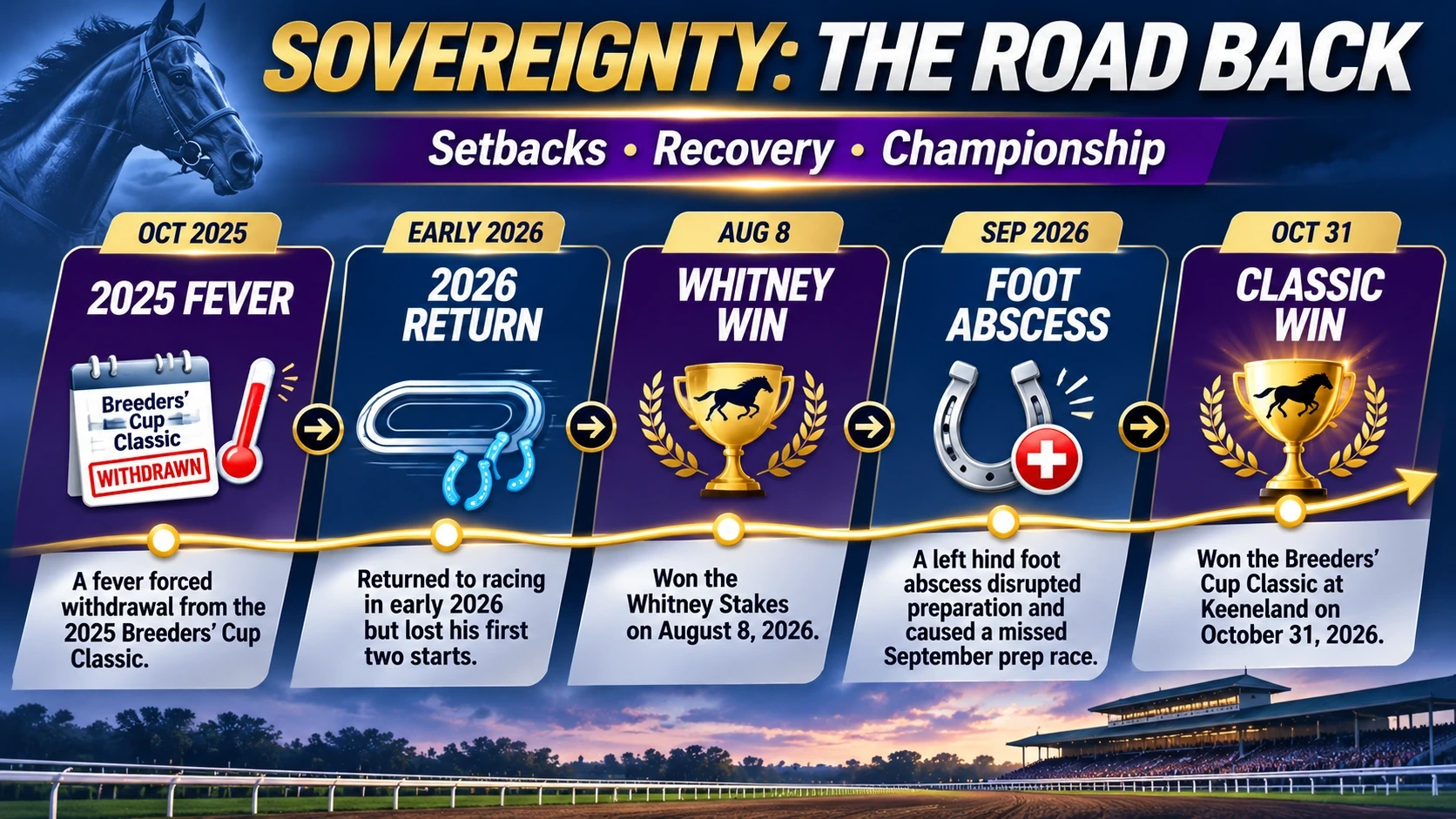
Sovereignty’s Road Back to the Classic
| Period | What Happened |
|---|---|
| May–August 2025 | Won the Kentucky Derby, Belmont Stakes, and Travers Stakes |
| October 2025 | Fever forced withdrawal from the Breeders’ Cup Classic |
| Early 2026 | Returned to racing but lost his first two starts |
| August 8, 2026 | Won the Whitney Stakes |
| September 2026 | Foot abscess interrupted training and caused another withdrawal |
| October 31, 2026 | Won the Breeders’ Cup Classic at Keeneland |
The timeline highlights an important difference between race-day talent and preparation.
A championship horse needs more than speed. It must also be healthy enough to train consistently, recover between workouts, and maintain fitness over the required racing distance.
In Sovereignty’s case, Mott had to prepare him for the year’s biggest race without the final competitive test originally planned for September.
After the victory, Mott explained that the foot problem had occurred early enough for the horse to recover and complete a useful series of workouts before the Classic. (Daily Racing Form)
That patience became central to Sovereignty’s comeback.
How Did Sovereignty Beat Forever Young and the Other Favorites?
Sovereignty won by conserving his effort early and delivering a powerful acceleration in the latter stages of the race.
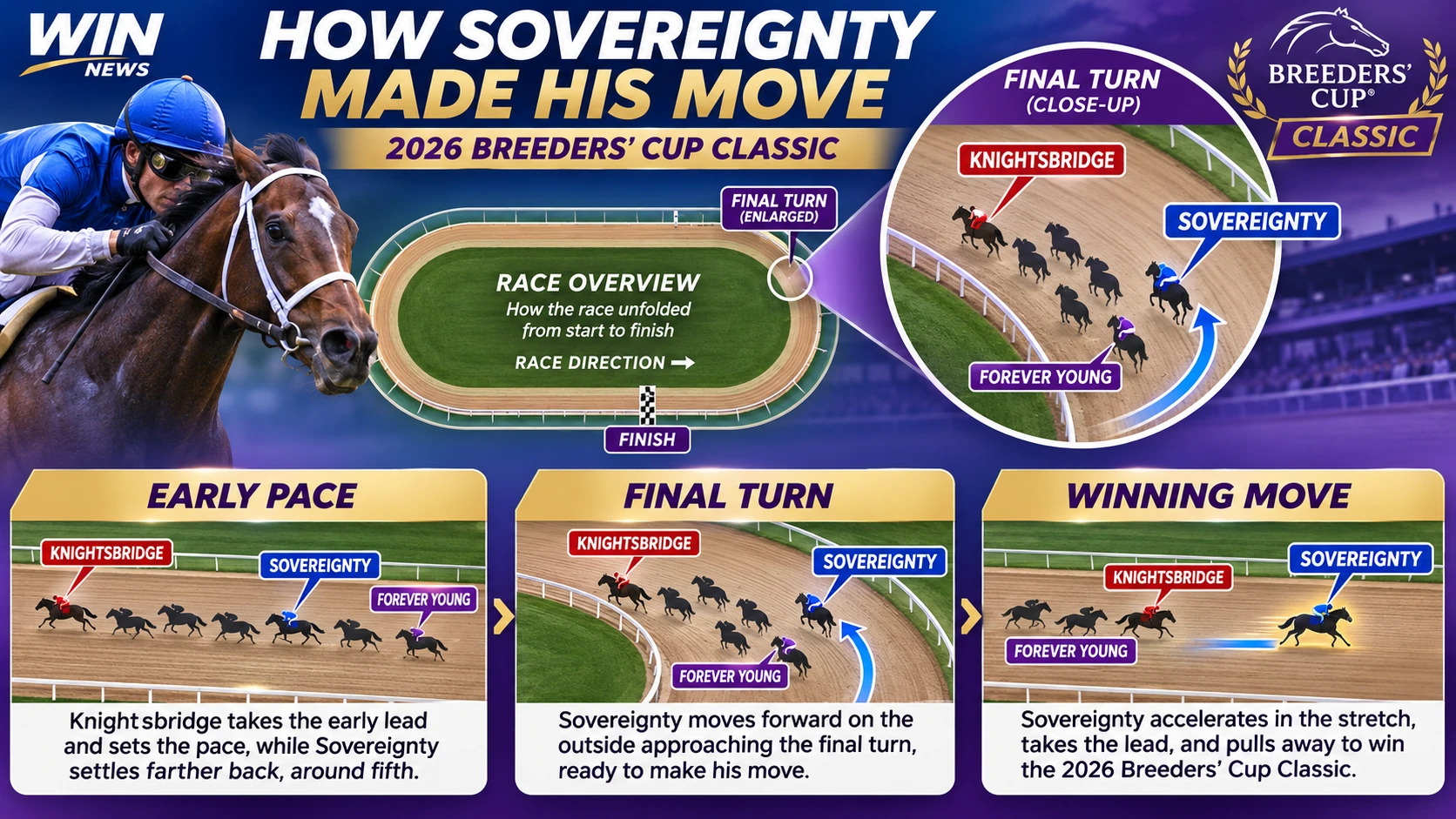
His stablemate Knightsbridge, also trained by Bill Mott and owned by Godolphin, moved to the front and established the early pace.
Junior Alvarado positioned Sovereignty farther back in the field rather than forcing him into an early contest for the lead.
As the runners approached the final turn, Sovereignty moved forward, swept to the outside, and accelerated past Knightsbridge before pulling clear. (Godolphin)
The distinction matters because horse racing is not simply a contest to see which animal can run fastest from the starting gate.
In a 1¼-mile race, spending too much energy early can leave a horse with less acceleration when the finish line approaches.
A jockey must balance position, pace, and timing. A powerful late-running horse can benefit from staying within reach of the leaders without having to match their early speed.
Sovereignty’s finishing ability had already been demonstrated in major victories during 2025. The Classic showed that he still possessed it despite a disrupted season.
Afterward, Alvarado credited the horse’s strength and said he had felt confident about the way Sovereignty was traveling before making his move. (Godolphin)
Forever Young, meanwhile, was prominent earlier in the contest but could not produce the same late response. His trainer Yoshito Yahagi acknowledged that the horse had been in the intended position but failed to accelerate when asked. (Breeders’ Cup)
For Sovereignty, it was the race he had been denied the previous year—and the performance his connections had waited to see.
Why Is the Breeders’ Cup Classic Such an Important Race?
The Breeders’ Cup Classic is one of North America’s most prestigious and valuable thoroughbred races because it brings leading horses together near the end of the racing season.
Unlike the Kentucky Derby, which is restricted to three-year-old thoroughbreds, the Classic accepts horses aged three and older.
That allows established older champions to compete against exceptional younger horses, often from several countries.
The Classic is also a Grade 1 race, the highest classification in the American graded-stakes system, and serves as the centerpiece of the two-day Breeders’ Cup World Championships. (Breeders’ Cup)
Does the Winner Really Receive $7 Million?
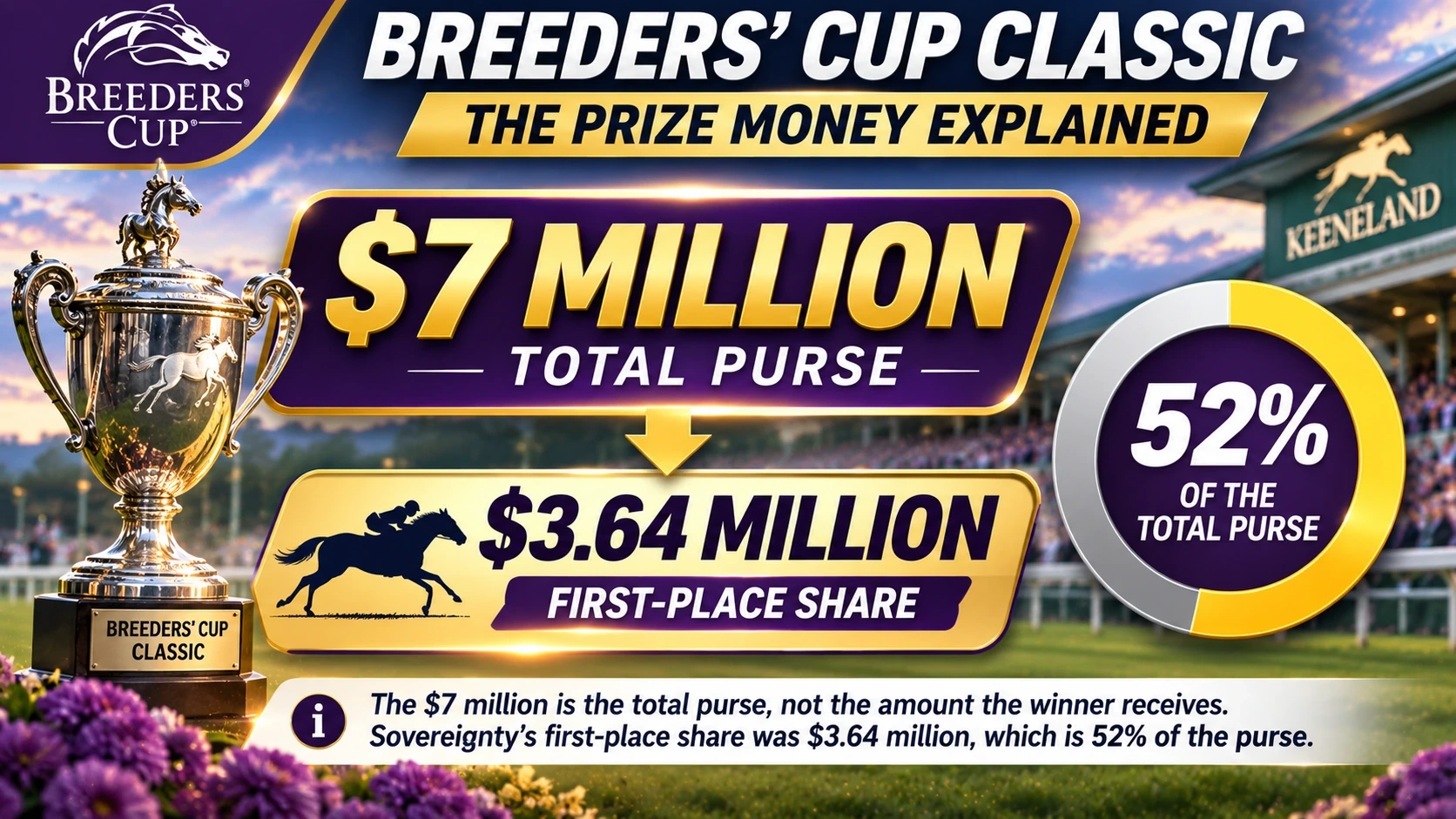
No. The $7 million is the race’s total purse, not the amount awarded to the winner.
Sovereignty’s first-place share was $3.64 million, or 52% of the announced purse. The remaining prize money was allocated among other finishers, with other portions of the purse reserved for travel awards under the event’s distribution rules. (NBC Sports)
The first-place award is paid through the racing connections, principally the ownership group. Trainers and jockeys are compensated through arrangements that can vary by contract.
There is another distinction worth making: prize money and betting payouts are entirely different.
Sovereignty returned $5.94 on a successful $2 win bet. That payment went to bettors who backed him, not to his owner as part of the championship purse. (NBC Sports)
For a horse’s long-term reputation, however, the prestige of winning the Classic can be as significant as the immediate prize money.
And in Sovereignty’s case, that reputation leads directly to the next chapter.
Why Is Sovereignty Retiring Immediately After Such a Big Victory?
Sovereignty’s connections have confirmed that the 2026 Breeders’ Cup Classic was his final race. He is moving into a new career as a breeding stallion at Darley America’s Jonabell Farm in Kentucky.
The announcement does not mean the Classic caused him to retire or that he suffered a new injury during the race. His retirement was a planned transition from racing to breeding, and his place on Darley’s 2027 roster had been announced before the Classic. (Darley America)
On November 1, 2026, Darley announced that Sovereignty would stand for the 2027 breeding season at an advertised fee of $150,000. That fee is associated with breeding services and should not be confused with race winnings or guaranteed earnings. (Darley America)
In thoroughbred racing, a successful stallion can pass desirable racing traits to future generations. Breeders study qualities such as speed, stamina, soundness, and pedigree when deciding which horses to match.
A high-profile championship victory can enhance a stallion’s appeal because it provides further evidence of his ability against elite competition.
Sovereignty finishes his racing career with eight wins from 13 starts, including victories in the Kentucky Derby, Belmont Stakes, Travers Stakes, Whitney Stakes, and Breeders’ Cup Classic.
He also becomes only the seventh horse to win both the Kentucky Derby and Breeders’ Cup Classic. (Breeders’ Cup · Fasig-Tipton)
For trainer Bill Mott and jockey Junior Alvarado, the victory offered a satisfying conclusion to a partnership that had already produced some of the biggest achievements in American horse racing.
For Godolphin, Sovereignty will now represent its breeding operation rather than compete on the racetrack.
His story has shifted from winning championships himself to the possibility of producing future champions.
Bottom Line: What This Story Really Means
Sovereignty’s 2026 Breeders’ Cup Classic victory was more than a successful return to competition.
A fever had denied him the opportunity to compete in 2025. Early defeats and a foot abscess complicated his preparations a year later.
Yet the horse that entered the 2026 Classic with questions about his fitness delivered a decisive performance against some of the world’s strongest thoroughbreds.
The remarkable part is not that an unknown outsider suddenly became a champion. It is that an established champion overcame repeated interruptions and returned to the level he had previously reached.
His retirement adds another dimension. The victory was not the beginning of a new racing campaign, but the conclusion of one.
Sovereignty leaves the track with a Breeders’ Cup Classic title added to his Kentucky Derby and Belmont Stakes victories—and a new role awaiting him in the breeding industry.
Sovereignty: Key Questions Explained
Q. Who won the 2026 Breeders’ Cup Classic?
Sovereignty won the race on October 31, 2026, at Keeneland Race Course in Lexington, Kentucky. Junior Alvarado rode the horse for trainer Bill Mott.
Q. Why did Sovereignty miss the 2025 Breeders’ Cup Classic?
He developed a fever shortly before the race, prompting his trainer to withdraw him for health reasons.
Q. Did Sovereignty win the Kentucky Derby?
Yes. Sovereignty won the 2025 Kentucky Derby, along with the Belmont Stakes and Travers Stakes that year.
Q. Who finished second in the 2026 Classic?
The Puma finished second, 1¾ lengths behind Sovereignty. Knightsbridge finished third.
Q. What happened to Forever Young in the race?
The defending Breeders’ Cup Classic champion finished fifth after failing to sustain his challenge in the closing stages.
Q. How much prize money did Sovereignty win?
The first-place share of the $7 million Classic purse was $3.64 million. That is different from the payout received by people who placed winning bets.
Q. Why is Sovereignty retiring at age four?
His connections confirmed that the Classic would conclude his racing career. He is transitioning to breeding duties at Darley America rather than continuing to compete.
Q. What is Sovereignty’s breeding fee?
Darley announced a $150,000 fee for the 2027 breeding season. The fee relates to breeding services, not the horse’s previous racing prize money.
Q. How many races did Sovereignty win during his career?
Sovereignty retired with eight victories from 13 starts, including five Grade 1 wins.
Did this help make the story clearer? 🙂
WIN keeps unpacking the “why” behind the news—clearly and simply!
Sources
Official Race Results and Championship Details
Breeders’ Cup — 2026 Longines Breeders’ Cup Classic Official Race Report
NBC Sports — Sovereignty Makes Most of His Second Chance to Win the 2026 Classic
Daily Racing Form — Sovereignty Back in Winner’s Circle
Previous Withdrawal and 2026 Recovery
Daily Racing Form — Sovereignty to Scratch From 2025 Breeders’ Cup Classic Due to Fever
Breeders’ Cup — Sovereignty’s 2026 Season and Preparation
Godolphin — Redemption for Sovereignty in Breeders’ Cup Classic Victory
Prize Money, Retirement, and Breeding Career
NBC Sports — 2026 Breeders’ Cup Classic Purse and Prize Money Breakdown
Darley America — 2027 Breeding Fees Announced for Sovereignty and Knightsbridge
Fasig-Tipton — Sovereignty Breeding Rights and Career Achievements