51 Million Americans Voted Early. Are the 2026 Midterms Already Decided?

How can more than 51 million Americans have already voted in an election that hasn’t even reached Election Day?
And if millions of registered Democrats are showing up early, does that tell us which party is winning?
Not quite.
The 2026 midterm elections have produced an extraordinary surge in early voting. By midday October 31, more than 51.3 million ballots had been cast—already exceeding the approximately 45.9 million early ballots recorded throughout the entire early-voting period in 2022. (Scripps News)
But there’s a distinction that’s easy to miss: We know how many ballots have been cast. We don’t know how those people voted.
※ Images in this article are AI-generated illustrations created to help explain the story. They are not actual photographs, and depictions of people, places, or events may differ slightly from reality.
That difference matters enormously as Americans prepare to choose the next Congress on November 3.
The early-voting numbers tell us something important about participation. Understanding what they cannot tell us is just as important.
What Does the 51.3 Million Early Voting Figure Actually Count?
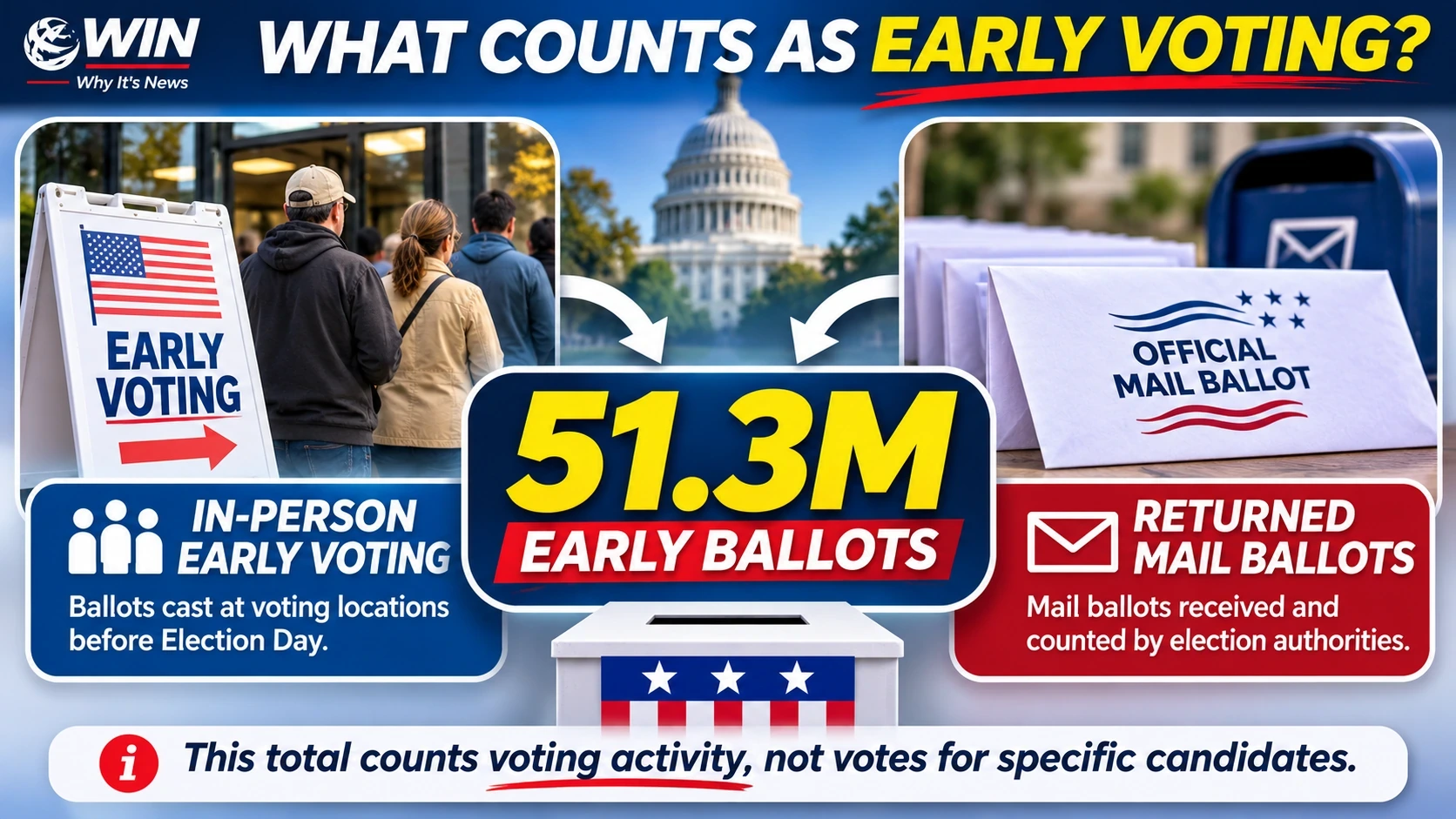
The figure represents ballots cast before Election Day, not votes received by individual candidates.
The University of Florida Election Lab tracks early voting using available state and local election data. Its national total combines two main categories:
- Early in-person voting: Ballots cast at voting locations before Election Day.
- Returned mail ballots: Mail ballots received and reported by election authorities.
A mail ballot that was merely requested or sent to a voter is not the same as one returned and included in the early-vote count.
By October 31, more than 28 million Americans had voted early in person, exceeding the roughly 20.5 million in-person early votes recorded in 2022. (Scripps News)
The numbers kept climbing.
By noon Eastern on November 1, the nationwide early-vote total had exceeded 53.6 million, including more than 29.8 million in-person ballots and over 23.9 million returned mail ballots. (Barron’s)
These are time-stamped snapshots, not final participation totals. States update their figures at different times, and the national count changes as new reports arrive.
Most importantly, the totals describe voting activity. They do not disclose the candidates selected on those ballots. (University of Florida Election Lab)
Why Has Early Voting Surpassed the Entire 2022 Midterm Total?
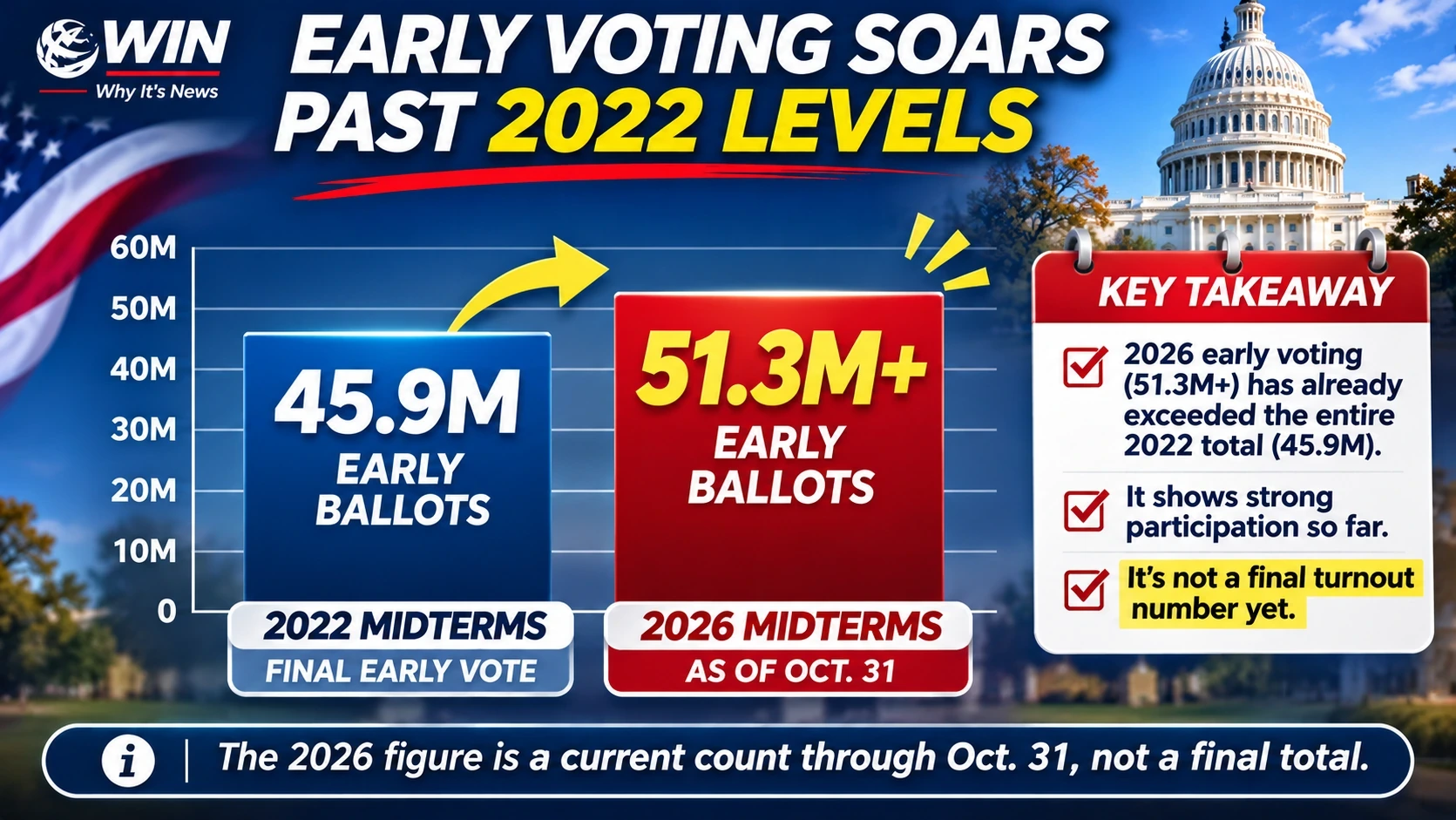
The surge reflects both strong election engagement and a longer-term shift in when Americans cast their ballots.
Early voting became especially prominent during the COVID-19 pandemic, when millions of Americans grew accustomed to voting before Election Day. That change did not disappear when pandemic restrictions ended.
Campaigns also increasingly encourage supporters to vote ahead of time rather than wait until the final day.
Here is the comparison behind the headlines:
| Measure | 2022 Midterms | 2026 Midterms |
|---|---|---|
| Early ballots | About 45.9 million | More than 51.3 million |
| Reporting period | Entire pre-Election Day period | Through midday October 31 |
| In-person early ballots | About 20.5 million | More than 28 million |
| Election status | Completed | November 3 election pending |
Source: University of Florida Election Lab figures reported by Scripps News.
The comparison is striking because the 2026 total had already surpassed the previous midterm’s complete early-voting figure with days remaining.
But it does not automatically mean the final 2026 turnout rate will break a record.
More early voters may simply mean fewer Election Day voters
Imagine a town where 10,000 people voted in the last election, with 4,000 voting early and 6,000 on Election Day.
In the next election, 7,000 vote early and 3,000 vote on Election Day.
Early voting has increased dramatically, but total participation is unchanged.
That is a hypothetical example, not a description of the 2026 election. It illustrates why early-vote growth and overall turnout growth are different measurements.
University of Florida political scientist Michael McDonald has pointed to signs of stronger engagement. MIT election researcher Charles Stewart has been more cautious, noting that some voters may simply be changing when they vote.
Both interpretations are compatible with the current numbers. (Axios)
Democrats Lead in Reported Early Voting. Does That Mean They’re Ahead?
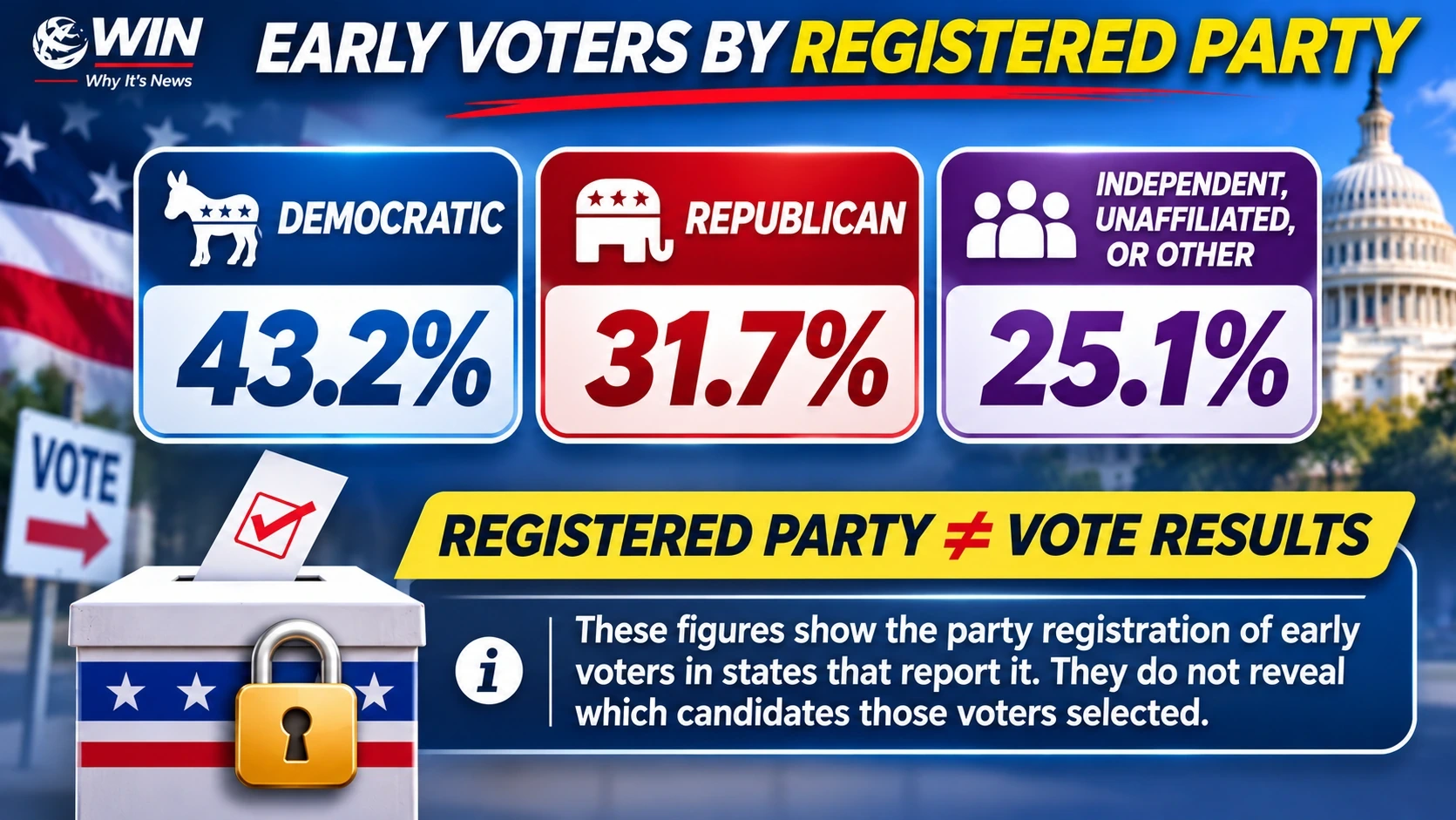
No. The available party-registration figures show which voters have participated early in reporting states, not which candidates they supported.
As of October 31, the University of Florida data reported by Scripps News showed this breakdown among early voters in states providing party-registration information:
| Voter registration | Share of reported early voters |
|---|---|
| Democratic | 43.2% |
| Republican | 31.7% |
| Independent, unaffiliated, or other | 25.1% |
These percentages are not nationwide candidate vote shares. They describe registered party affiliation in the subset of states providing the relevant information. (Scripps News)
There are three reasons the distinction matters.
Party registration is not the same as candidate choice
A registered Republican can vote for a Democratic candidate. A registered Democrat can vote for a Republican. Independent voters can support either party or another candidate.
Election officials do not infer a voter’s actual selections from party registration.
Not every state reports the same information
Some states publish party-registration data for early voters. Others do not register voters by party or do not report that breakdown in the same way.
That makes it misleading to treat the available party percentages as if they represented every voter nationwide.
Early voting patterns differ between parties
Even when one party’s registered voters participate earlier, the opposing party may have a different pattern of voting closer to or on Election Day.
Early-vote participation alone therefore cannot establish the eventual balance of support.
Researchers also disagree about how much the early numbers reveal. McDonald sees signs of strong Democratic and unaffiliated participation, while Stewart emphasizes that shifts in voting schedules make forecasts uncertain. (Axios)
The numbers offer clues about participation, not a reliable declaration of who is winning.
Why Are Some States Seeing Such Large Increases?
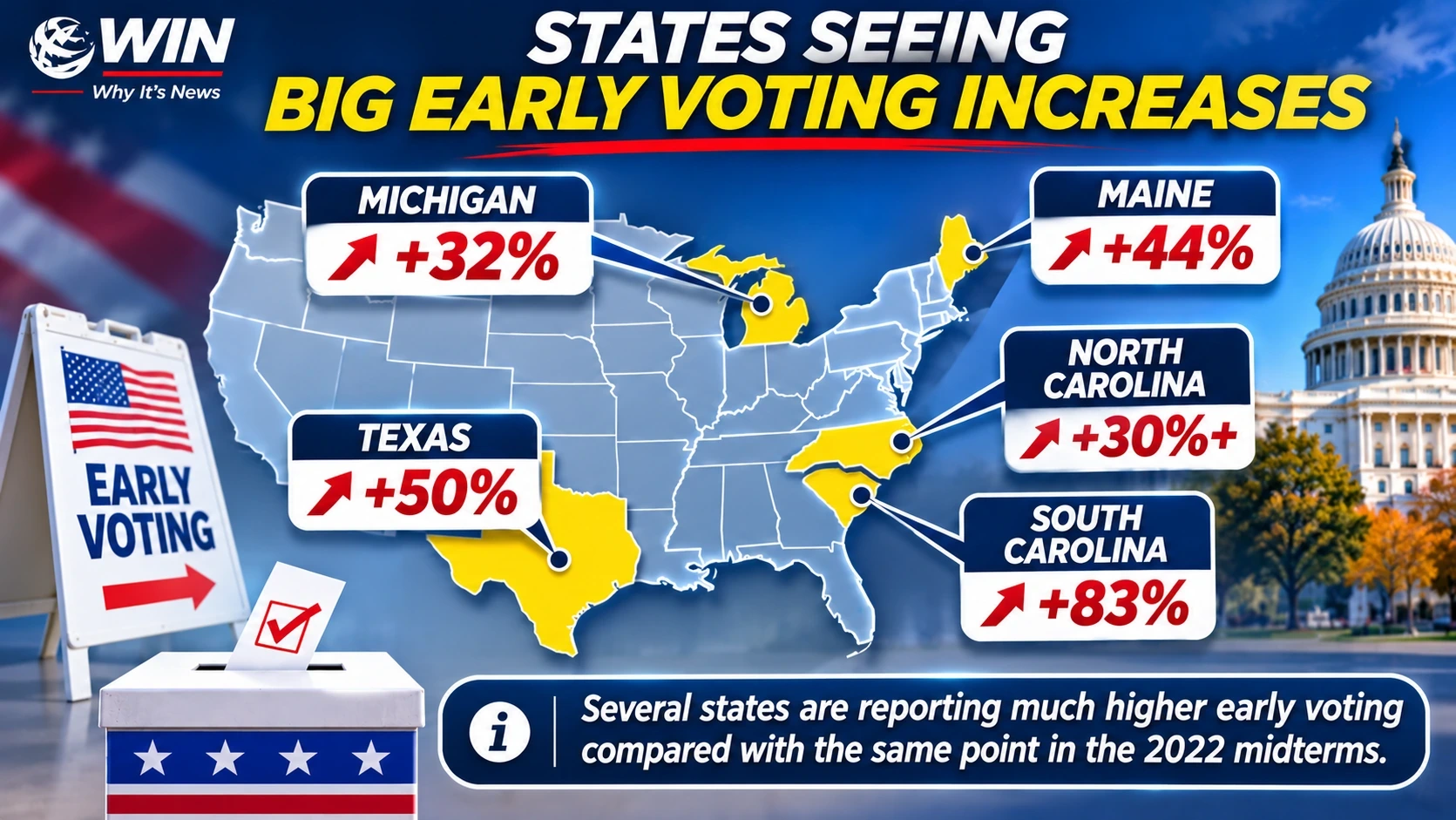
Early voting has increased especially sharply in several states with competitive congressional or statewide contests.
An Associated Press analysis published October 30 compared early voting with the same point in the 2022 midterms and found substantial increases in several states.
The findings included:
- Texas: More than 6.3 million early votes as of October 28, about 50% above the comparable point in 2022.
- South Carolina: Early participation up approximately 83% at the time of the AP comparison.
- Maine: Early participation up approximately 44%.
- Michigan: Early participation up approximately 32%.
- North Carolina: Early participation also running more than 30% above the comparable 2022 period.
These are figures from an earlier October snapshot, not final 2026 totals. (Associated Press)
The increase is not happening for one simple reason
Several factors can influence participation.
Competitive elections may encourage greater involvement. Campaign organizations invest in reaching voters earlier. Changes in voting access can affect how many ballots are cast before Election Day.
Michigan offers a particularly useful example.
Voters there approved expanded in-person early voting in November 2022. The 2026 election is the state’s first midterm general election with that option available statewide, making a straightforward comparison with 2022 more complicated.
A larger early vote can therefore reflect a combination of political interest, campaign activity, and changes in voting opportunities.
It would be an overstatement to assign the entire increase to one party, one issue, or one political figure. (Associated Press · Axios)
What Does the Early Vote Actually Tell Us—and What Remains Unknown?
The early-vote data provides a meaningful picture of public participation. It does not yet provide a picture of final election results.
The easiest way to understand the distinction is to separate the information into two categories.
| What we can observe | What we cannot conclude |
|---|---|
| How many early ballots have been cast | Which candidates received those votes |
| Party registration in reporting states | Nationwide candidate vote shares |
| Changes from comparable previous elections | Final nationwide turnout |
| Where early participation has increased | Which party will control Congress |
A state showing unusually high early participation is an important development. It may indicate heightened public interest or an effective effort to mobilize voters.
But that still leaves two unknowns: who received the votes already cast, and how the remaining electorate will vote.
Why comparing the same dates matters
Election comparisons can also be misleading when they use different points in the voting calendar.
A state reporting 50% more early votes than it had at the same point in 2022 is showing a different measurement from a state whose early-vote total has surpassed its entire 2022 pre-election total.
Both comparisons may be useful. They do not mean the same thing.
The first measures relative progress at a comparable stage. The second compares a current incomplete figure with a historical completed one.
For the 2026 midterms, understanding which comparison is being made matters more than treating every large percentage as evidence of a particular political outcome.
What Happens Next as the 2026 Midterms Reach Election Day?
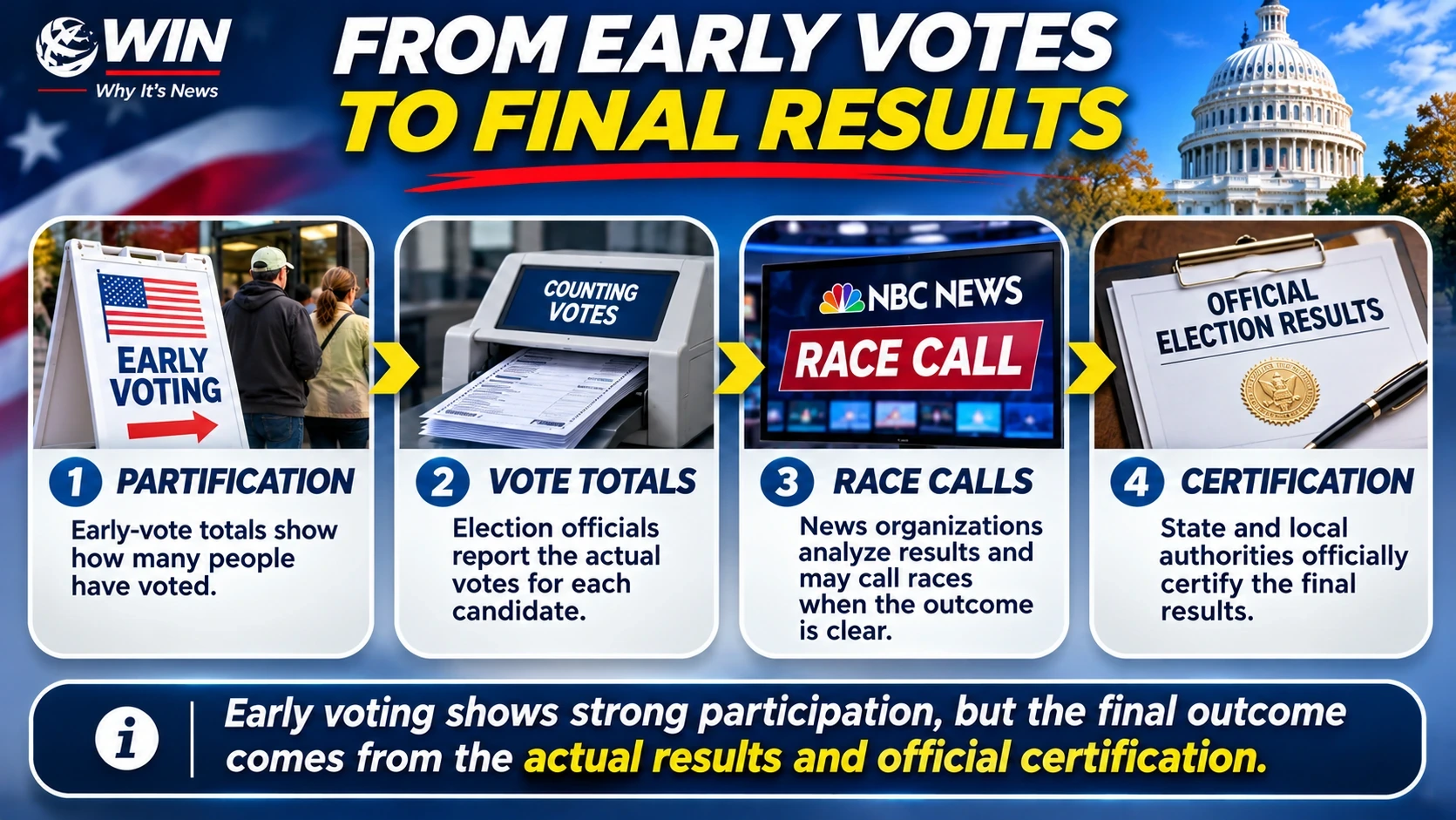
The next decisive information will come from actual candidate vote totals, not from the number of people who participated early.
On November 3, Americans will decide all 435 seats in the U.S. House of Representatives and 35 Senate races, along with numerous state and local contests.
Republicans entered the election controlling both chambers of Congress, including a 53–47 Senate majority. The results will determine whether those congressional majorities continue or change. (Reuters)
Early election-night numbers are not necessarily final
As voting results are released, news organizations will report the votes received by candidates.
That is fundamentally different from the early-vote participation figures circulating before Election Day.
Some reported results may initially include a greater proportion of mail or early in-person ballots. Other jurisdictions can report different categories in a different order.
As additional ballots are tabulated, reported margins can change.
The Associated Press and other election-data organizations analyze available results to determine when a race can be called. Those media calls are separate from the official certification of results by election authorities. (Reuters)
The important questions are therefore not just how many people have already voted, but how the reported results develop across individual races and when the available evidence is sufficient to determine an outcome.
Bottom Line: What This Story Really Means
More than 51 million early ballots had been cast in the 2026 midterm elections by October 31, surpassing the entire early-voting total reported for 2022.
That is an important sign of substantial participation before Election Day.
But early voting turnout is not an election result.
The available figures tell us how many people have cast ballots, how they voted in terms of method, and—in some states—which party they are registered with. They do not tell us which candidates those voters chose.
Nor does a surge in early voting automatically establish how much total turnout will increase. Some Americans may simply be voting earlier than they did previously.
What makes the 2026 figures noteworthy is the scale of participation and the sharp increases in several states. What remains unknown is how those ballots translate into actual results once votes are reported.
The large early-voting total tells us Americans are participating well before November 3. It does not tell us who will control Congress.
2026 Midterm Early Voting: Key Questions Explained
Q. How many Americans voted early in the 2026 midterms?
More than 51.3 million early ballots had been cast by midday October 31, 2026. The count exceeded 53.6 million by noon Eastern on November 1.
Q. Is early voting higher than in the 2022 midterms?
Yes. The October 31 total had already exceeded the approximately 45.9 million early ballots recorded during the full 2022 midterm early-voting period.
Q. Does higher early voting mean total turnout will be higher?
Not necessarily. Increased early participation may reflect greater overall engagement, but it can also reflect voters choosing to cast ballots earlier instead of on Election Day.
Q. Are Democrats winning the 2026 early vote?
More registered Democrats than registered Republicans had cast early ballots in states reporting party-affiliation data as of October 31. That does not establish which party’s candidates received more votes.
Q. Do early-voting statistics show which candidates received votes?
No. Early-voting trackers primarily measure participation. Party-registration information, where available, does not reveal candidate selections.
Q. Why do different early-voting trackers show different national totals?
Trackers may update at different times, cover different reporting jurisdictions, or receive new state data on different schedules. Comparisons should use clearly identified sources and timestamps.
Q. Which states have reported notable early-voting increases?
Texas, South Carolina, Maine, Michigan, and North Carolina were among the states reporting substantial increases compared with comparable points in the 2022 midterm election.
Q. When will the 2026 midterm election results be known?
Election Day is November 3, 2026. Results will be reported as votes are tabulated, while the timing of media race calls and official certification can differ by contest and jurisdiction.
Q. Does the national early-voting total determine control of Congress?
No. Congressional control depends on the outcomes of individual House and Senate races, not the nationwide number of early ballots.
Did this help make the story clearer? 🙂
WIN keeps unpacking the “why” behind the news—clearly and simply!
Sources
National Early Voting Totals and Historical Comparison
University of Florida Election Lab — 2026 Early Voting Tracker
Scripps News — In-Person Early Voting Hits Record Pace for Midterms, October 31, 2026
Barron’s — Early Voting by the Numbers, November 1, 2026
State Trends and Early Voting Interpretation
Associated Press — Early Voting Jumps Across Senate Battlegrounds, October 30, 2026
Axios — Midterm Voters Show Up Early—and in Droves, October 29, 2026
Congressional Stakes and Election-Night Reporting
Reuters — U.S. Midterm Campaign Enters Final Weekend, October 31, 2026
Reuters — How U.S. News Organizations Will Make Midterm Race Calls, November 1, 2026
Keep Reading
Why Can a Strong Polling Lead Still Leave Control of Congress Uncertain?
Early-vote totals measure participation, while election polling measures voter preferences and intentions. The difference helps explain why even a sizable polling lead does not settle individual congressional races.
Why Has Trump’s Approval Rating Fallen to 33%—and Could Republicans Lose Congress?
What Happens When an Early Mail Ballot Is Challenged?
The growing number of ballots cast before Election Day makes questions about ballot processing and eligibility especially relevant. A California lawsuit examines the legal distinction between challenging a voter record and preventing a valid ballot from being counted.
Can the Justice Department Force California Counties to Set Aside Mail Ballots?