Justin Verlander’s Final Start: Why Did His Daughter Come to the Mound—and Why Did It End in Detroit?
Why did a 7-year-old girl suddenly run onto a Major League mound to take Justin Verlander away from his final game?
And after years with Houston, New York and San Francisco, why was one of the most accomplished pitchers of his generation back in a Detroit Tigers uniform at age 43?
The two questions are connected.
Verlander did not want his career to end with an announcement, a video tribute or a ceremonial first pitch. After injuries wiped out nearly all of his final season, he pushed through an accelerated buildup so he could pitch one more real game—for the franchise where his Major League career began more than two decades earlier. (MLB)
On September 26, 2026, he got that chance.
Verlander worked 5 1/3 innings against the Pittsburgh Pirates at Comerica Park, allowing two runs on five hits while striking out six. Then came the moment that turned an ordinary pitching change into a family farewell: his daughter Genevieve sprinted onto the field and hugged him on the mound before manager A.J. Hinch formally took the ball. Detroit later rallied to win 4–3. (AP)

The scene was emotional. But the reason it mattered went far beyond one afternoon.
Why Did Verlander Insist on Pitching One More Real Game?

Because Verlander wanted to finish as a pitcher, not simply as an honored former star.
His 2026 season had barely started before injuries changed the plan. He pitched for Detroit on March 30, then dealt with hip and hamstring problems that kept him out until the final weekend. As September ran out, he threw bullpen sessions and a brief simulated inning while trying to get his body ready for one last appearance. (MLB)
The preparation was unusually compressed. Before the final start, Verlander acknowledged that he had skipped roughly a month of a normal rehabilitation progression because there simply was not enough season left. He also made clear that he did not want to throw a token inning, wave to the crowd and leave. He wanted to compete. (MLB)
That makes the final pitching line surprisingly meaningful:
| Final start | Result |
|---|---|
| Opponent | Pittsburgh Pirates |
| Innings | 5 1/3 |
| Runs allowed | 2 |
| Hits allowed | 5 |
| Walks | 1 |
| Strikeouts | 6 |
| Pitches | 91 |
| Tigers result | 4–3 win |
For someone who had barely pitched all season, 91 pitches was not just ceremony. It was an actual Major League start. (CBS News)
Why Did the Farewell Have to Be in Detroit?

Because Detroit was where the Major League story started.
Verlander debuted for the Tigers on July 4, 2005. In his first full season, 2006, he won American League Rookie of the Year and helped Detroit reach the World Series. He then became the face of the Tigers’ rotation for more than a decade. (mlb.com)
The relationship changed dramatically on August 31, 2017, when Detroit traded him to Houston just before the postseason eligibility deadline. Verlander went on to win championships and major awards elsewhere, but the Tigers remained the franchise most closely associated with the beginning of his career. (mlb.com)
His 2026 return turned that history into a circle.
Before September 26, Verlander had not started a home game for Detroit since August 2017. The final appearance therefore was not simply his last MLB game. It was his first Tigers start at Comerica Park in more than nine years. (MLB)
The career can be viewed in four broad chapters:
| Chapter | What changed |
|---|---|
| Detroit, 2005–2017 | Rookie breakthrough, Cy Young peak, MVP season, two World Series trips |
| Houston era | Championships, another level of late-career dominance, two more Cy Young Awards |
| Late-career movement | Mets, Astros again, then Giants as he continued pitching into his 40s |
| Detroit, 2026 | Return to original franchise and final career start |
That is why the uniform mattered as much as the date.
What Made Justin Verlander’s Career So Unusual?
Longevity alone would have made Verlander unusual. The combination of longevity and elite peaks is what separates the career.
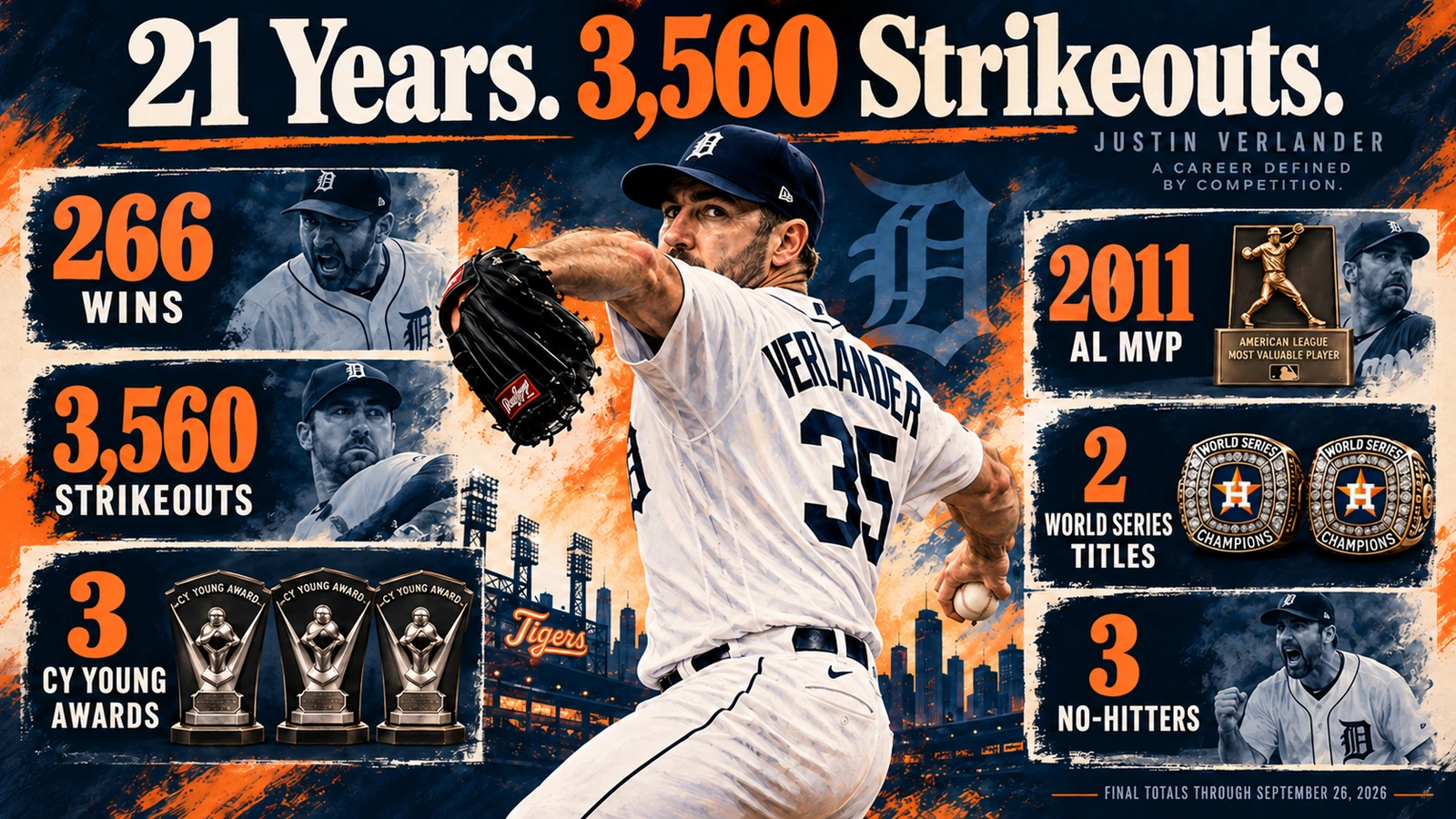
He finished with 266 wins, a 3.33 ERA, 557 starts and 3,560 strikeouts. His final six strikeouts left him eighth on the all-time Major League strikeout list. (AP)
His résumé also includes:
- three American League Cy Young Awards
- the 2011 AL Most Valuable Player Award
- the 2006 AL Rookie of the Year Award
- 10 All-Star selections
- three career no-hitters
- two World Series championships
- an AL pitching Triple Crown in 2011
- more than two decades between his MLB debut and his final start (MLB)
Many pitchers have a brilliant peak. Others last a very long time.
Verlander did both.
Why Does the 2011 Season Still Matter So Much?

Because that was the season when Verlander went from star pitcher to one of the defining pitchers of his era.
He went 24–5 with a 2.40 ERA and 250 strikeouts in 251 innings, leading the American League in wins, ERA and strikeouts—the pitching Triple Crown. He won the Cy Young Award and then the AL MVP. (mlb.com)
Pitchers can win the MVP, but it is uncommon because the award includes everyday position players who appear in far more games.
Verlander’s 2011 season was dominant enough that voters treated a starting pitcher as the league’s most valuable player.
That peak explains something important about the farewell 15 years later: fans were not just saying goodbye to a pitcher who accumulated statistics over time. They were saying goodbye to someone who had, for a period, been at the very top of the sport.
How Did the Houston Years Change His Career?

The 2017 trade could have been the beginning of a gradual decline.
Instead, it became the beginning of another peak.
After joining Houston, Verlander helped the Astros win the 2017 World Series and later added another championship in 2022. During his Astros years he also won two more Cy Young Awards, threw his third career no-hitter and reached 3,000 career strikeouts. (mlb.com)
Then came a bigger test.
Verlander underwent Tommy John surgery in September 2020 and missed the entire 2021 season. For a veteran pitcher already deep into his 30s, returning at an elite level was far from automatic. (MLB)
Yet in 2022, at age 39, he returned with a 1.75 ERA and won his third Cy Young Award before Houston won another World Series. (MLB)
That comeback is one of the reasons his career cannot be understood as a simple rise-and-decline story.
There was a second act.
So Why Did His Daughter Come to the Mound?
Because the Tigers turned the final pitching change into something personal.
The night before his last start, Genevieve had already taken part in the farewell weekend by throwing a ceremonial first pitch to her father. Verlander had talked about how they had been practicing together and how much it meant that she had begun asking to play catch with him at home. (MLB)
The next afternoon, after Verlander recorded the first out of the sixth inning, Hinch came toward the mound—but pointed toward the seats.
Genevieve ran onto the field first.
She hugged her father as the crowd stood. Hinch then joined them and eventually took the baseball. Verlander left holding his daughter’s hand. His wife, Kate Upton, and their young son were waiting near the dugout. (AP)
It was still an official pitching change controlled by the Tigers manager.
But symbolically, the person coming to get Verlander was not a manager ending an outing.
It was his daughter ending a chapter of family life that had revolved around Major League Baseball.
Did the Final Game Change His Legacy?
Not because of the score.
Verlander gave up two solo home runs, left with Detroit trailing and did not receive a decision. The Tigers eventually erased a 3–1 ninth-inning deficit and won 4–3 on Eduardo Valencia’s two-run walk-off homer. (CBS News)
The more meaningful numbers were the final career totals:
| Career measure | Final total |
|---|---|
| Seasons | 21 |
| Starts | 557 |
| Wins | 266 |
| Losses | 159 |
| ERA | 3.33 |
| Strikeouts | 3,560 |
| Cy Young Awards | 3 |
| AL MVP Awards | 1 |
| World Series titles | 2 |
| No-hitters | 3 |
Those six last strikeouts did not transform his résumé.
They completed it.
What Happens Next for Verlander and the Hall of Fame?

Retirement starts another clock.
Under Baseball Hall of Fame rules, a Major League player generally must have been retired for five full seasons before becoming eligible for the Baseball Writers’ Association of America ballot. If Verlander remains retired, that points to 2032 as his first year of eligibility. (National Baseball Hall of Fame)
Eligibility should not be confused with election. Hall of Fame voting still has to take place.
But the résumé voters will eventually examine is now complete: 21 seasons, 266 wins, 3,560 strikeouts, three Cy Young Awards, an MVP, three no-hitters, two championship rings and a career that stretched from a 2005 Detroit debut to a 2026 Detroit goodbye.
That is the larger meaning of September 26.
There are no more projections to make about what Verlander might add.
The numbers have stopped.
Bottom Line: What This Story Really Means
Justin Verlander’s final start became memorable because three different stories came together on the same mound.
It was a real competitive comeback after injuries nearly prevented him from pitching again.
It was a full-circle return to Detroit, the organization where his Major League career began in 2005.
And when his daughter ran out to escort him from the mound, it turned the end of a 21-year professional career into something much more personal than a box score.
Verlander finished with 266 wins, a 3.33 ERA and 3,560 strikeouts. But the final image of his career was not another strikeout.
It was a father leaving the field with his daughter.
Justin Verlander: Key Questions Explained
Q. Did Justin Verlander officially retire?
Yes. Verlander announced in July 2026 that the 2026 season would be his last, and his September 26 start for Detroit was his final Major League pitching appearance. (MLB)
Q. How did Justin Verlander pitch in his final start?
He allowed two runs on five hits over 5 1/3 innings, walked one and struck out six while throwing 91 pitches against Pittsburgh. (CBS News)
Q. Why did Verlander’s daughter come onto the mound?
The Tigers incorporated Genevieve Verlander into the final pitching change. She ran from the stands and hugged her father before manager A.J. Hinch formally removed him from the game. (AP)
Q. Why was Verlander back with the Detroit Tigers?
Detroit was the organization that drafted and developed him and the team with which he began his Major League career. His 2026 return allowed him to finish his playing career with the franchise where it started. (MLB)
Q. What were Justin Verlander’s final career statistics?
He finished 266–159 with a 3.33 ERA and 3,560 strikeouts over 557 starts. (AP)
Q. How many Cy Young Awards did Justin Verlander win?
Three. He won his first with Detroit in 2011 and later won two more during his Houston years. (MLB)
Q. How many no-hitters did Verlander throw?
Three. That places him among a small group of Major League pitchers to have thrown at least three career no-hitters. (MLB)
Q. When can Justin Verlander become eligible for the Baseball Hall of Fame?
If he remains retired, the Hall of Fame’s five-full-season waiting rule puts his first possible BBWAA ballot in 2032. Eligibility does not guarantee election. (National Baseball Hall of Fame)
Did this help make the story clearer? 🙂
WIN keeps unpacking the “why” behind the news—clearly and simply!
Sources
Final Start and Detroit Farewell
Associated Press via CBS News — Verlander Leaves Final Start as Daughter Sprints to the Mound
MLB — Verlander Set for One Last Start at Comerica Park
MLB — Tigers Honor Verlander Before His Final Start
Retirement and Career Record
MLB — Verlander Announces Retirement After the 2026 Season
MLB — 12 Moments That Defined Justin Verlander’s Career
MLB — Looking Back at Verlander’s Three Career No-Hitters