
What Happened on Flydubai FZ1073—and Who Took Control of the Plane?

Did the passengers actually land the plane?
If both pilots were injured, who was flying after the cockpit fight?
And why did a flight from Dubai to Tel Aviv end up on the ground in Saudi Arabia?
Those are the questions that make the September 30 incident aboard Flydubai Flight FZ1073 so unusual. The most important distinction is also the easiest one to lose in dramatic headlines: passengers were reported to have helped stop the violence, but Flydubai says trained company crew who were already traveling on the flight secured the aircraft, diverted it and landed it safely. (Flydubai statement reported by Emirates 24|7)
Israeli Prime Minister Benjamin Netanyahu later said the co-pilot stabbed the captain and apparently tried to crash the aircraft. Reuters and AP reported similar accounts. But the airline and the UAE aviation regulator have been more cautious: they confirmed a cockpit altercation and a security incident while saying the exact cause and motive remain under formal investigation. (Reuters · AP)
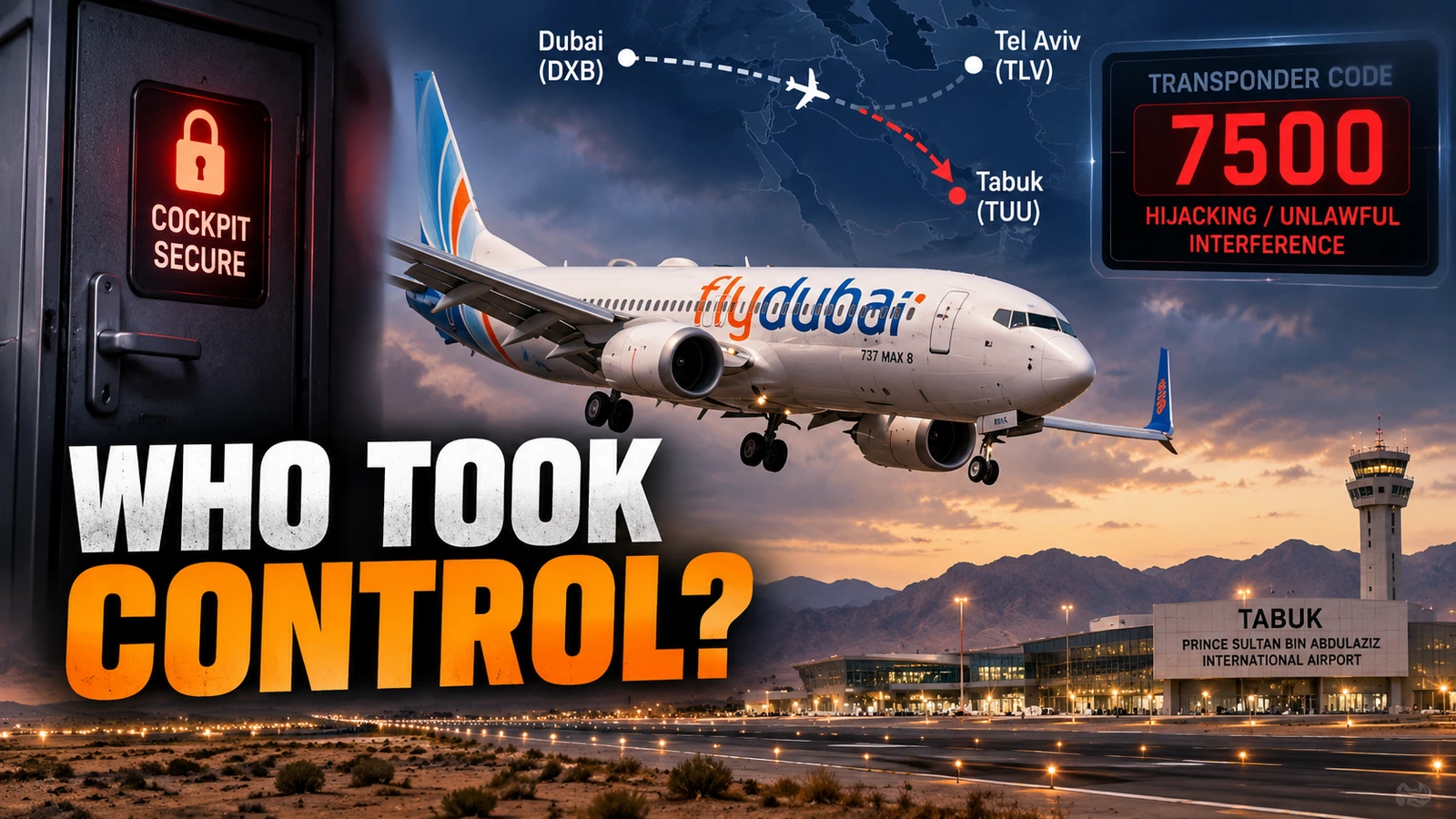
※ Images in this article are AI-generated illustrations created to help explain the story. They are not actual photographs, and depictions of people, places, or events may differ slightly from reality.
That leaves two different stories to understand at the same time: what is already established about how the aircraft survived, and what investigators still have to determine about why the crisis happened at all.
What Exactly Happened on Flydubai Flight FZ1073?
The broad sequence is clear. FZ1073 left Dubai for Tel Aviv, suffered a violent cockpit emergency, descended rapidly, transmitted emergency codes and eventually landed safely at Prince Sultan bin Abdulaziz International Airport in Tabuk, Saudi Arabia.
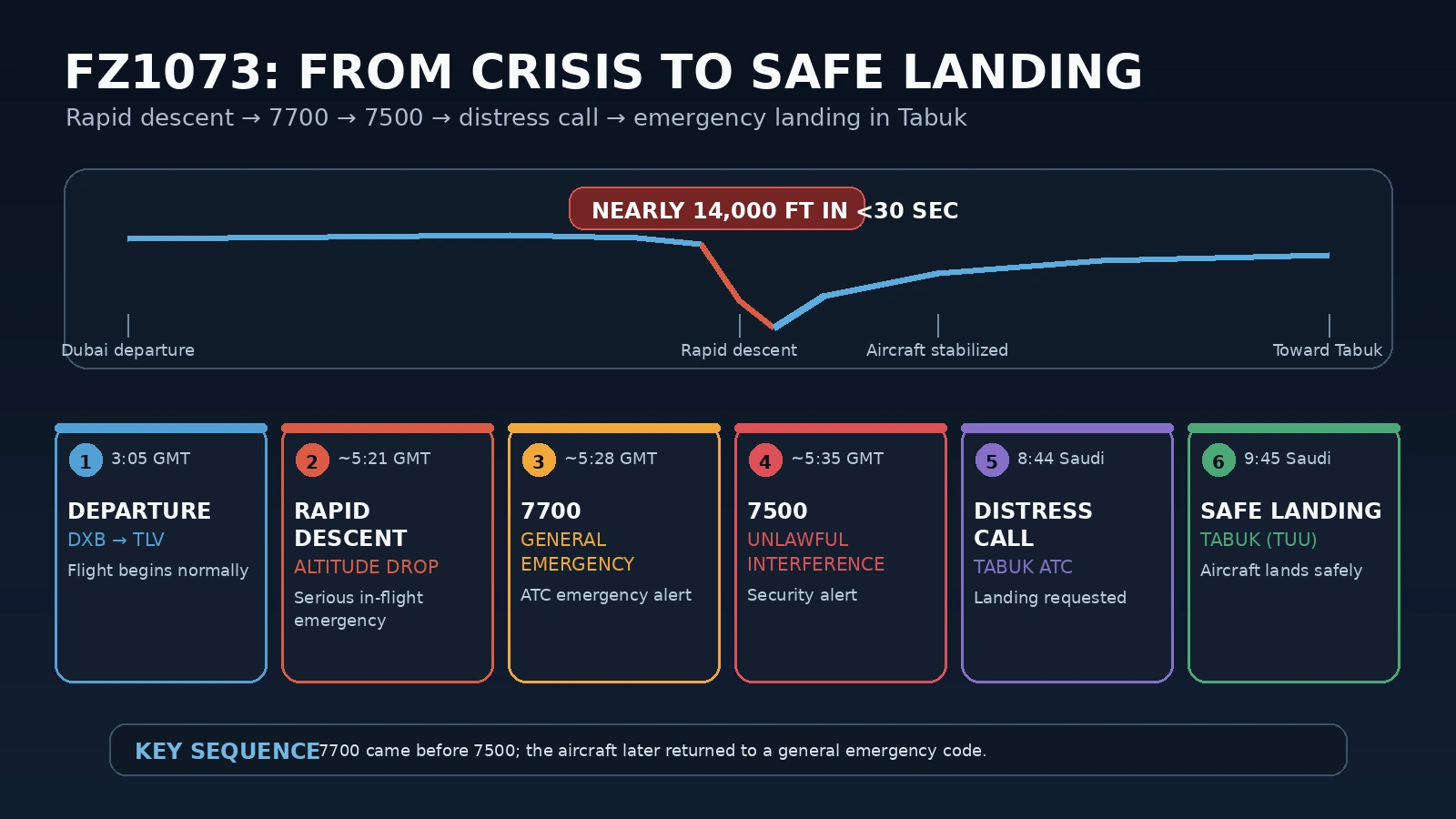
Public flight-tracking data cited by Reuters showed the aircraft descending by nearly 14,000 feet in less than 30 seconds before the first emergency transmission. A later timeline based on Flightradar24 data showed the aircraft first squawking 7700, then 7500, before returning to a general emergency code as it headed for Tabuk. (Reuters · Al Jazeera timeline)
Saudi airport authorities said Tabuk air traffic control received a distress call at 8:44 a.m. local time and the aircraft landed safely at 9:45 a.m. Both the captain and first officer were injured and taken to a hospital. (Saudi Gazette, citing the airport operator)
A simple timeline makes the sequence easier to separate from the later claims about motive:
| Approximate time | What happened | What it tells us |
|---|---|---|
| 3:05 a.m. GMT | FZ1073 departed Dubai for Tel Aviv | The flight began normally |
| About 5:21 a.m. GMT | Tracking data showed a sharp descent | The aircraft entered a serious in-flight emergency |
| About 5:28 a.m. GMT | Transponder changed to 7700 | General emergency declared |
| About 5:35 a.m. GMT | Transponder changed to 7500 | Unlawful interference indicated |
| 8:44 a.m. Saudi time | Tabuk received the distress call | The crew requested an emergency landing |
| 9:45 a.m. Saudi time | Aircraft landed in Tabuk | The emergency ended without a passenger fatality |
The dramatic descent is therefore not a rumor. Neither are the emergency signals or the landing in Saudi Arabia.
What remains less settled is exactly what happened inside the cockpit during those minutes.
Did One Pilot Really Try to Crash the Plane?
That is the most serious claim in the story, but it needs a label: it is an allegation publicly made by Israeli officials, not yet a final investigative finding.
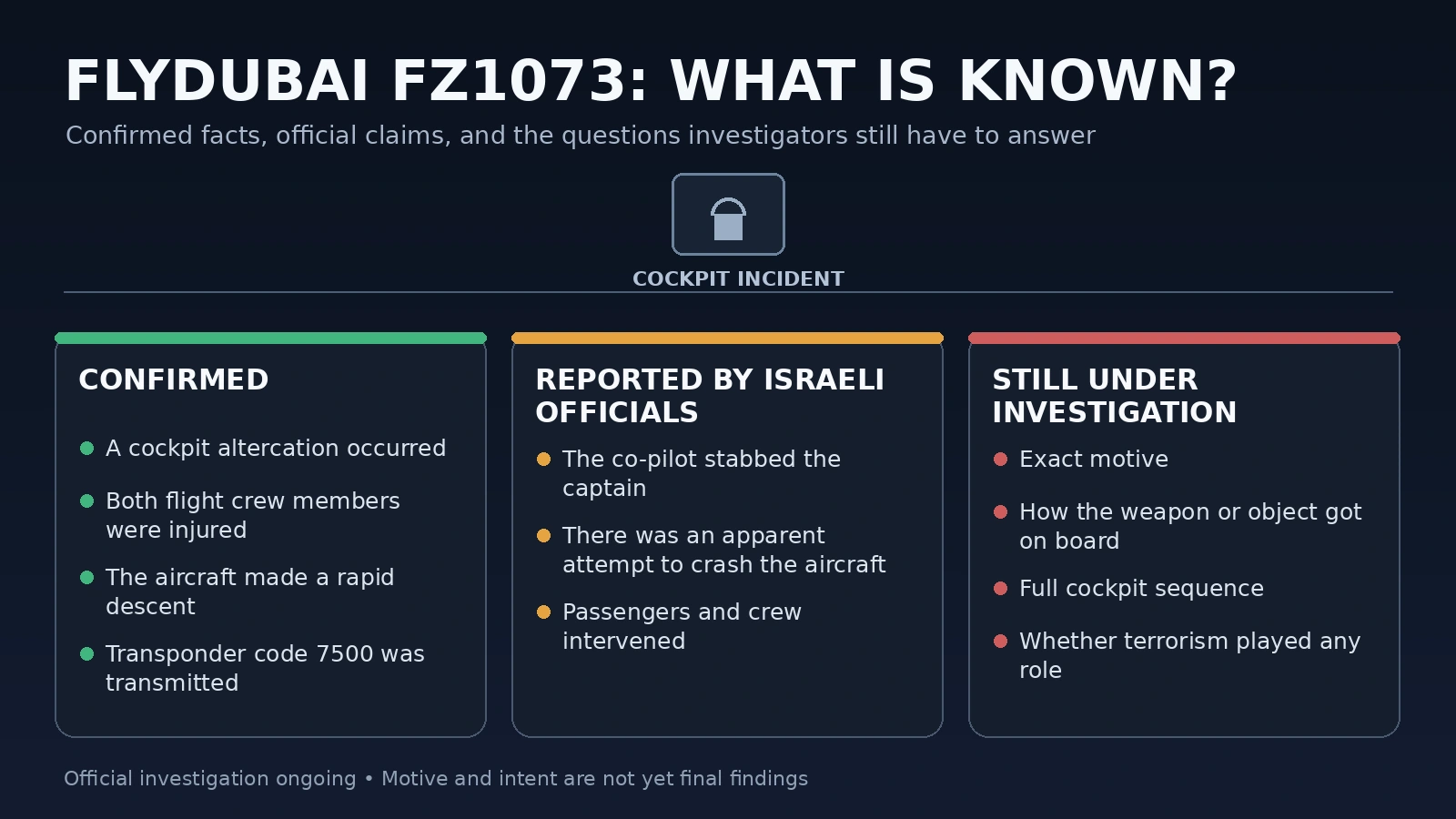
Flydubai has confirmed that an altercation occurred on the flight deck. The UAE General Civil Aviation Authority, or GCAA, called it a “security incident,” confirmed injuries to crew members and said investigators are examining both the operational and security aspects of what happened. (GCAA statement reported by Emirates 24|7)
Netanyahu went further. He said the co-pilot stabbed the captain and apparently tried to bring the plane down, and that passengers and crew intervened. Reuters reported that account, while AP also reported a stabbing and an apparent crash attempt. (Reuters · AP)
Here is the distinction that matters:
| Question | Current status |
|---|---|
| Was there a cockpit altercation? | Confirmed by Flydubai |
| Were flight crew members injured? | Confirmed by Saudi and UAE aviation authorities |
| Did the aircraft make a sudden, extreme descent? | Confirmed by flight-tracking data |
| Did the flight transmit 7500? | Confirmed by flight-tracking data |
| Did the co-pilot stab the captain? | Reported by Israeli officials and major news organizations; investigation ongoing |
| Was the goal to deliberately crash the aircraft? | Alleged by Israeli officials; not yet a final investigative finding |
| Was the motive terrorism? | Not established |
| How did a weapon get into the cockpit? | Not publicly established |
That last line is especially important. Flydubai explicitly said the underlying reasons and motives were still unknown and urged against premature speculation.
Who Actually Regained Control of the Aircraft?
Passengers appear to have played a major role in stopping the physical threat. But the strongest airline statement available says trained Flydubai crew traveling on the flight took control of the aircraft and landed it.
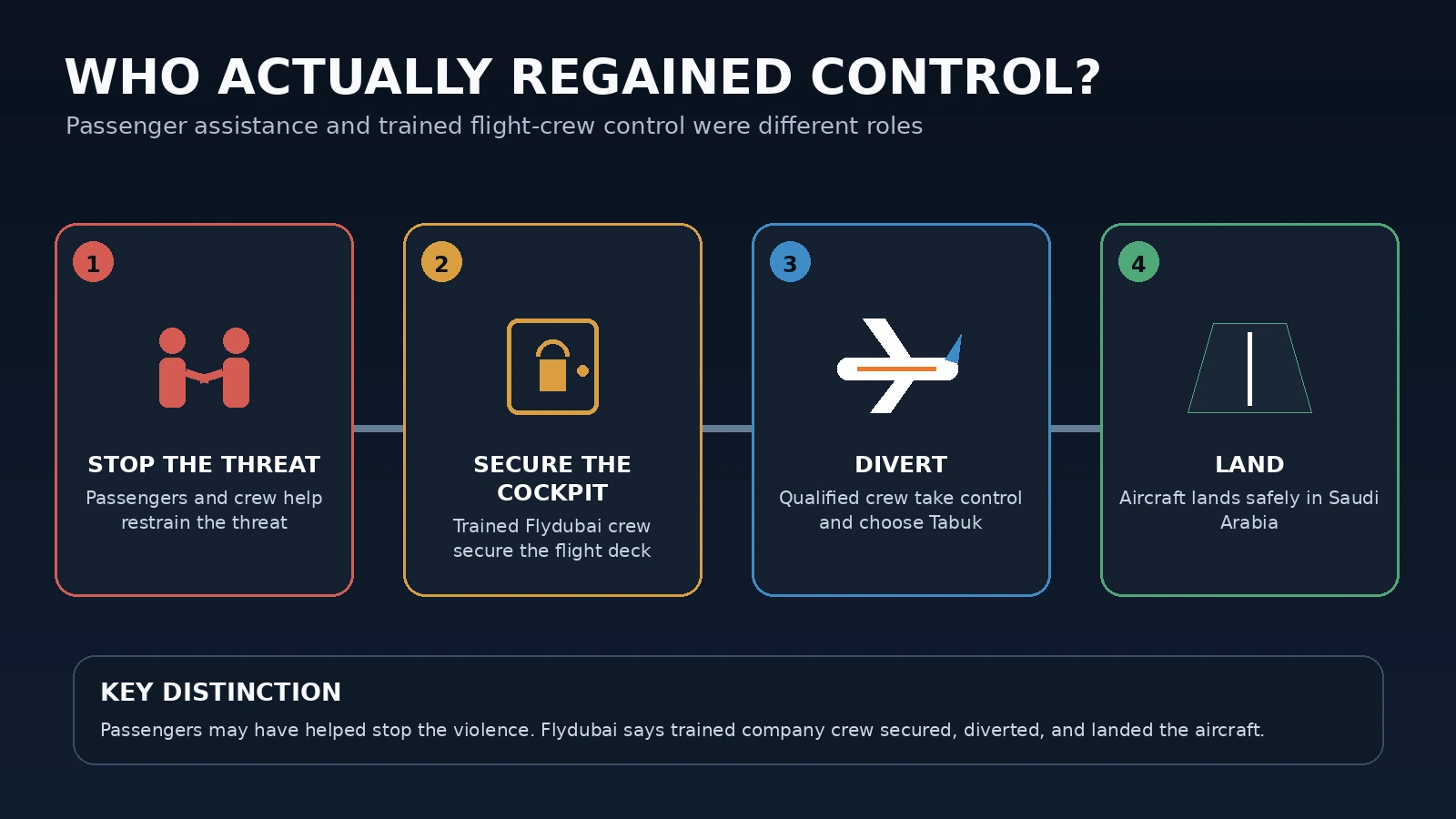
Flydubai said the aircraft was “successfully secured” by on-duty Flydubai crew who were traveling on the flight, and that those crew members diverted and landed the aircraft safely at Tabuk. (Flydubai statement reported by Emirates 24|7)
Reuters reported that passengers helped hold down the co-pilot while other pilots landed the aircraft. AP likewise reported that passengers and crew gained access to the cockpit, subdued the attacker and enabled other crew members to land safely. (Reuters · AP)
That is a very different picture from “passengers flew the plane.”
Flydubai later described the personnel who took over as a replacement crew already on board the flight. The airline has not publicly released a full crew roster or a minute-by-minute explanation of who entered the cockpit at what moment, so it would be premature to fill in those gaps. (Emirates 24|7)
It also means one of the most extraordinary parts of the story may have been simple circumstance: qualified airline personnel were apparently available on board when the operating flight deck crew could no longer safely continue.
What Do Squawk 7700 and Squawk 7500 Actually Mean?
They are emergency transponder codes, and the difference matters.
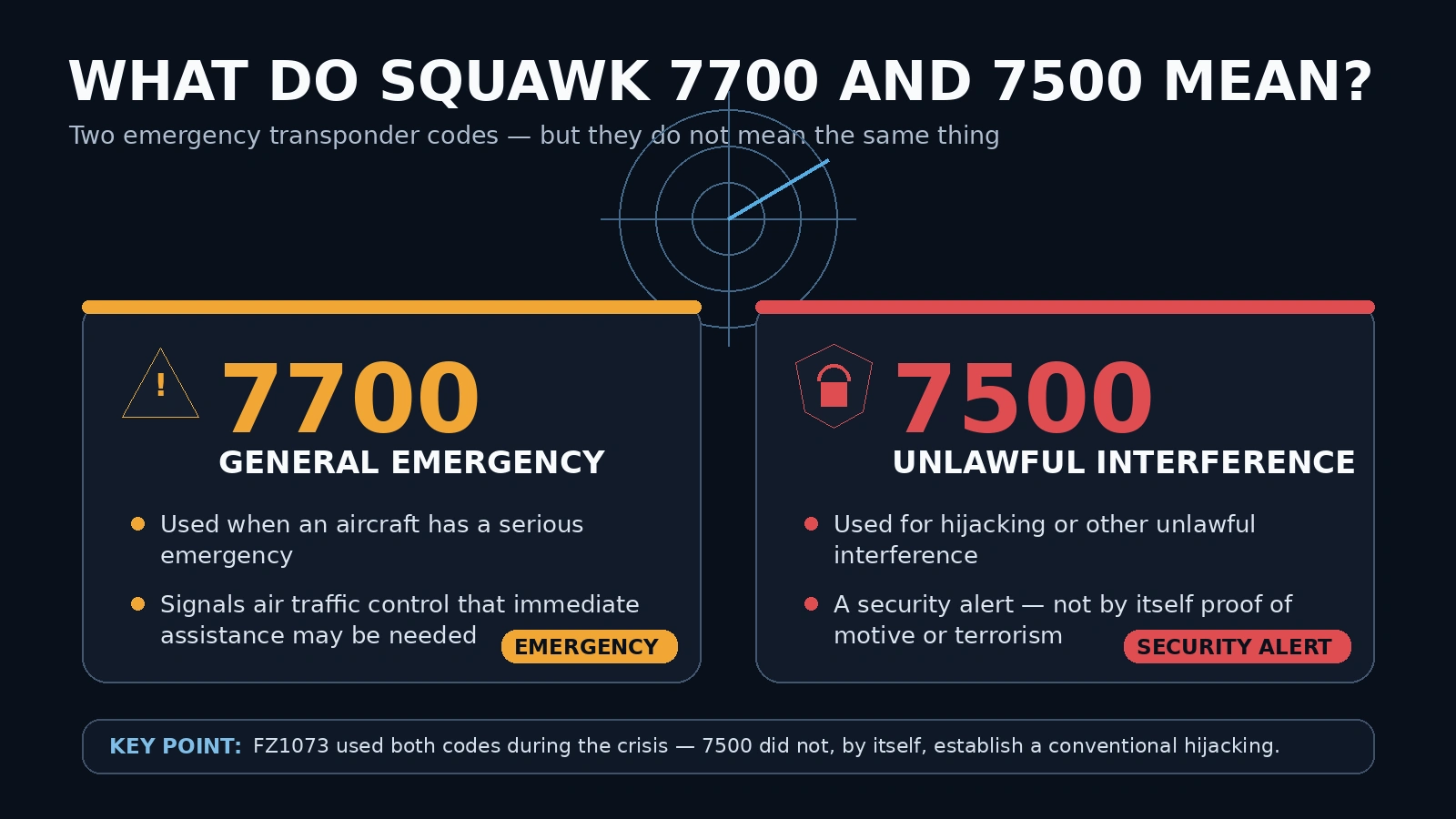
The U.S. Federal Aviation Administration describes 7700 as the general emergency code. It describes 7500 as the code used when an aircraft is being subjected to hijacking or other unlawful interference. (FAA)
That means 7500 is not a verdict.
It tells air traffic control that something involving unlawful interference may be happening aboard the aircraft. It does not, by itself, explain who is responsible, what the motive is, whether someone is trying to seize the aircraft for a new destination, or whether the event fits the public’s familiar image of a hijacking.
That is why early headlines could sound contradictory. Israeli officials initially said the incident was not believed to be a conventional hijacking, yet the aircraft had transmitted the international code associated with unlawful interference.
Both can be true.
A violent attempt to interfere with control of the aircraft can justify a 7500 alert without matching the classic scenario of an outsider commandeering a plane and ordering it to fly somewhere else.
Why Did a Tel Aviv-Bound Flight Land in Saudi Arabia?
Because once an aircraft is in a serious emergency, the safest suitable landing becomes more important than the original destination or the diplomatic relationship between the countries involved.
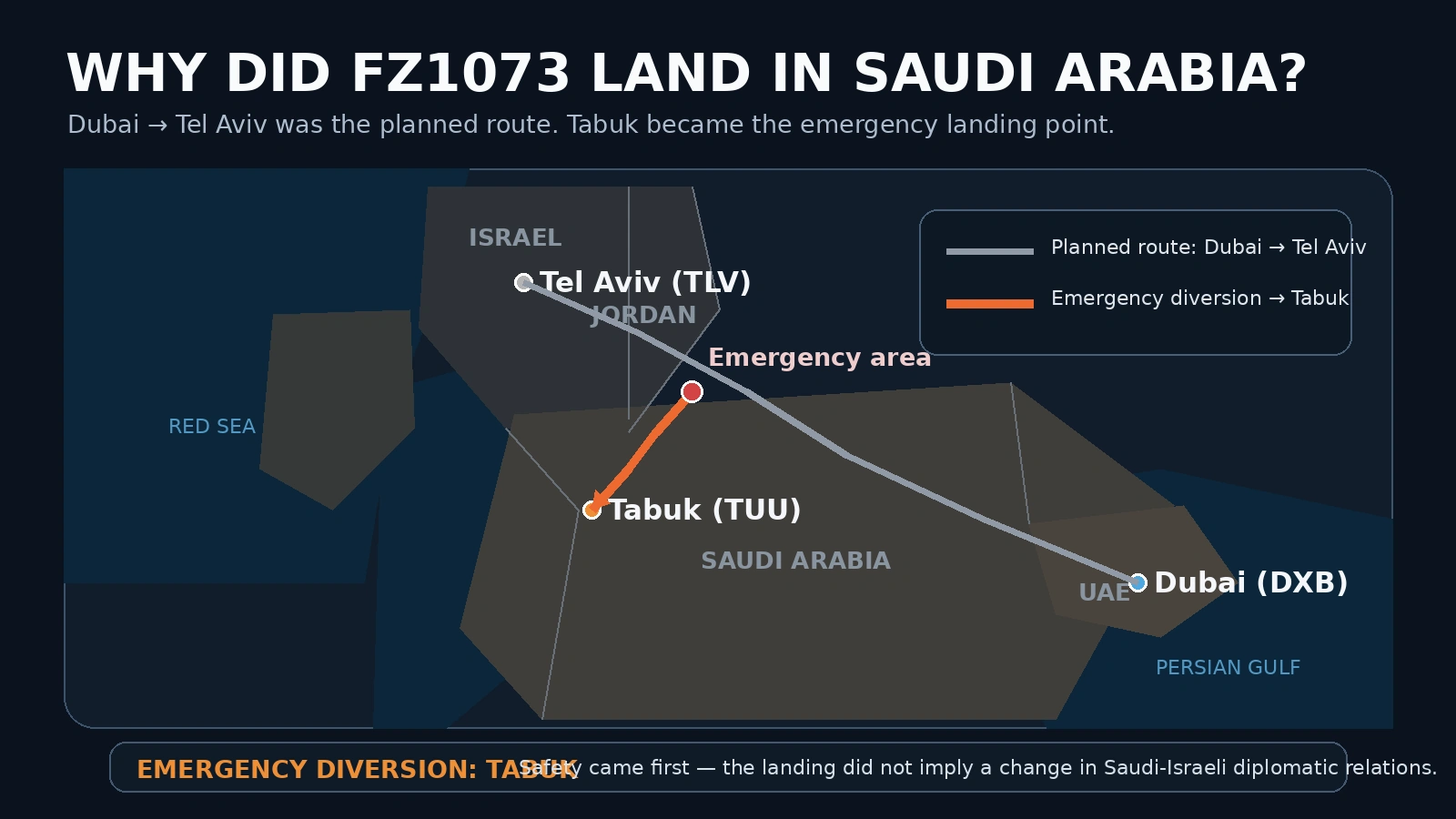
Saudi Arabia and Israel do not have formal diplomatic relations. But the aircraft was in a distress situation, and international civil aviation rules are built around helping aircraft reach safety.
Article 25 of the Chicago Convention says contracting states undertake to provide practical assistance to aircraft in distress within their territory. That principle is about aviation safety, not diplomatic recognition. (ICAO Chicago Convention, Article 25)
The distinction became even clearer after the landing. Reuters reported that Saudi Arabia declined an Israeli request to send military aircraft to collect the passengers. The passengers instead continued their journey on Flydubai replacement aircraft. (Reuters · Saudi Gazette)
So the emergency landing did not mean Saudi-Israeli relations had suddenly changed.
It meant an aircraft in distress was allowed to land, the injured received medical care, and the passengers were later moved onward through a civilian airline arrangement.
Was This a Boeing 737 MAX Problem?
There is currently no public evidence that the emergency was caused by a Boeing 737 MAX design or mechanical failure.
The aircraft was reported as a Boeing 737 MAX 8, which may immediately remind some readers of the model’s earlier safety controversies. But the official descriptions released so far center on a cockpit altercation and a security incident, not a flight-control defect. (AP · GCAA statement)
That does not mean investigators will ignore the aircraft’s systems. The UAE regulator says it is reviewing operational as well as security aspects.
But as of now, connecting this incident to the historical 737 MAX technical failures would go beyond the evidence.
The dramatic altitude loss appears in the public record as part of the cockpit emergency. No regulator has announced that a technical defect caused it.
How Could a Weapon and a Cockpit Fight Happen on a Modern Airliner?
This is where the investigation becomes more important than the early headlines.
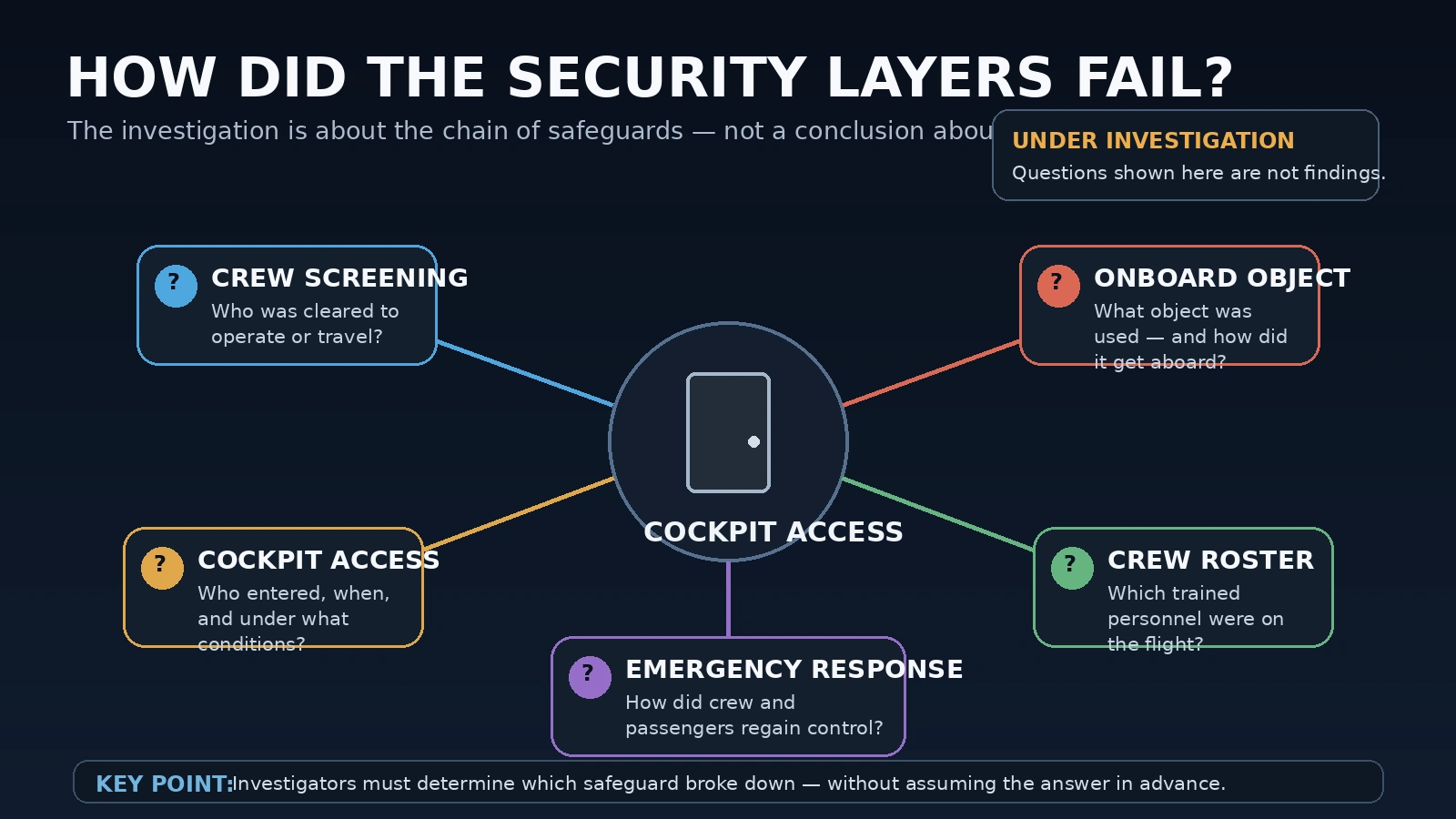
Commercial aviation normally relies on multiple layers: airport screening, employee and crew security procedures, restricted cockpit access, trained cabin crew and emergency protocols.
What the public does not yet know is which layer failed here—or whether the early description of the weapon and attack will be confirmed exactly as reported.
Among the obvious questions investigators may have to answer are:
- What object was used in the attack, and how did it get on board?
- Who had authorized access to the flight deck?
- How was the cockpit door opened during the emergency?
- What roles did the operating pilots, traveling Flydubai crew and passengers each play?
- Did any security or crew-screening procedure fail?
- Were there warning signs before departure?
- Why was additional trained Flydubai crew available on the flight?
The GCAA says its investigation is specifically reviewing the incident’s operational and security dimensions. That is important because it signals a broader inquiry than simply asking who started the fight. (GCAA statement)
Until those findings are released, claims about exactly how airport screening failed—or about a terrorist motive—remain speculation.
What Happens Next?
The immediate passenger emergency is over. The investigation is not.
Flydubai said late September 30 that it was suspending flights to and from Israel while authorities investigate the FZ1073 incident. Emirates also suspended its Flydubai codeshare service on the Tel Aviv route. (Gulf News)
Saudi authorities handled the emergency landing and the injured pilots. The UAE GCAA says its teams are working with relevant authorities to determine the cause and circumstances. Israel’s Ministry of Transport also said its investigation would involve the defense establishment. (GCAA statement · Al Jazeera timeline) The overlap means the case may involve aviation-safety, criminal and national-security questions at the same time.
The key things to watch are not the most dramatic claims circulating online.
They are the official answers to five basic questions:
- What exactly happened between the two pilots?
- What caused the sudden descent?
- Who entered the cockpit and in what sequence?
- How did the weapon or object involved get on board?
- What security changes, if any, do regulators or the airline order afterward?
Those answers will determine whether FZ1073 is ultimately treated mainly as an extraordinary act of individual violence, a broader aviation-security failure, or something else.
Bottom Line: What This Story Really Means
Flydubai FZ1073 survived because the crisis did not end with the two injured pilots in the cockpit. Passengers and crew were reported to have helped stop the violent confrontation, while Flydubai says additional trained company crew already traveling on the aircraft secured it, diverted to Tabuk and landed safely.
The 7500 transponder code shows that an unlawful-interference alert was transmitted, but it does not by itself prove a conventional hijacking or establish a terrorist motive. The airline and UAE aviation regulator have confirmed the cockpit altercation, crew injuries and security emergency; investigators still have to establish the exact motive, the full sequence inside the cockpit and how the security breach became possible.
The most remarkable part of the story is therefore not simply that the plane plunged.
It is that control was regained before the emergency became a crash.
Flydubai FZ1073: Key Questions Explained
Q. What happened on Flydubai Flight FZ1073?
Flydubai says an altercation occurred on the flight deck during the September 30 flight from Dubai to Tel Aviv. The aircraft descended rapidly, transmitted emergency codes and diverted to Tabuk, Saudi Arabia, where it landed safely.
Q. Did passengers land the Flydubai plane?
No, not according to Flydubai’s statement. Passengers were reported to have helped restrain the person involved in the cockpit violence, but Flydubai says on-duty company crew traveling on the flight secured, diverted and landed the aircraft.
Q. What does squawk 7500 mean?
Squawk 7500 is the transponder code used to indicate hijacking or other unlawful interference with an aircraft. It is a security alert, not by itself proof of a specific motive or a conventional hijacking.
Q. Why did FZ1073 also squawk 7700?
Code 7700 signals a general emergency. Tracking data showed FZ1073 using 7700, then 7500, and later returning to a general emergency code during the crisis.
Q. Why did the flight land in Saudi Arabia instead of continuing to Israel?
The aircraft was in a serious emergency and diverted to Tabuk in northwestern Saudi Arabia. International aviation rules prioritize assistance to aircraft in distress even when the countries involved do not have normal diplomatic relations.
Q. Did the co-pilot try to crash the plane?
Israeli Prime Minister Benjamin Netanyahu said the co-pilot stabbed the captain and apparently tried to crash the aircraft. That claim has been widely reported, but the formal investigation has not yet issued its final findings on motive or intent.
Q. Was the Flydubai incident caused by a Boeing 737 MAX technical problem?
No technical cause has been publicly identified. The official statements so far describe a cockpit altercation and a security incident, while investigators continue reviewing operational and security factors.
Q. How did a weapon get into the cockpit?
That has not been publicly established. The answer is one of the major security questions investigators will need to resolve.
Q. Are Flydubai flights to Israel still operating?
Flydubai said late September 30 that it was suspending flights to and from Israel while the incident is investigated.
Did this help make the story clearer? 🙂
WIN keeps unpacking the “why” behind the news—clearly and simply!
Sources
Incident, Cockpit Altercation and Passenger Response
Reuters — Passengers foil bid to crash Dubai-Tel Aviv flight, Israel says
Associated Press — What to know about the terrifying FlyDubai flight bound for Israel
Al Jazeera — FZ1073 emergency timeline based on flight-tracking data
Flydubai Statement Reported by Emirates 24|7 — Cockpit altercation and trained crew response
Emirates 24|7 — Flydubai says replacement crew diverted and landed FZ1073
Official Aviation and Airport Confirmation
UAE General Civil Aviation Authority Statement Reported by Emirates 24|7
Saudi Gazette — Tabuk airport emergency landing and injured pilots
Saudi Gazette — Passengers depart Tabuk on replacement aircraft
Emergency Codes and International Aviation Rules
FAA — Distress and Urgency Procedures
ICAO — Convention on International Civil Aviation, Article 25
Follow-Up and Route Suspension
Gulf News — Flydubai suspends flights to Israel after FZ1073 security incident
Reuters — Saudi Arabia declines Israeli military pickup request