Why Did a Court Block Minnesota’s AI Fake-Nude Ban—and What Does Free Speech Have to Do With It?

A law meant to stop AI tools from creating realistic fake nude images sounds like one of the least likely places to find a free-speech fight.
So why did a federal appeals court stop Minnesota from enforcing it?
And did the court just decide that AI-generated fake nudes are protected by the First Amendment?
No. That is the most important distinction in this story.
On October 2, 2026, the U.S. Court of Appeals for the Eighth Circuit granted xAI an injunction while the company appeals an earlier ruling in its lawsuit against Minnesota Attorney General Keith Ellison. The immediate result is that Minnesota’s challenged AI “nudification” law is on hold while the appeal proceeds. The appellate court did not issue a final ruling declaring the law unconstitutional. (Reuters)
※ Images in this article are AI-generated illustrations created to help explain the story. They are not actual photographs, and depictions of people, places, or events may differ slightly from reality.
That leaves a more interesting question than the headline alone suggests.
Minnesota says it is trying to stop a technology that can be used to humiliate real people and generate abusive sexual imagery. xAI says the state wrote the law so broadly that it restricts constitutionally protected expression as well as harmful conduct.
The fight is therefore not simply over whether fake sexual images can cause harm.
It is over how far a government can go in restricting an AI tool before the restriction itself becomes a speech problem.
What Did the Appeals Court Actually Do?
The Eighth Circuit paused enforcement during the appeal; it did not strike Minnesota’s law from the books.
That procedural difference matters because an injunction pending appeal is temporary relief. It prevents enforcement while an appeals court considers whether the lower court handled the request for an injunction correctly.
The publicly reported October 2 order was extremely short: the court granted xAI’s request for an injunction pending appeal. The reported order did not lay out a full constitutional analysis explaining whether Minnesota ultimately wins or loses on the First Amendment question. (Reuters)
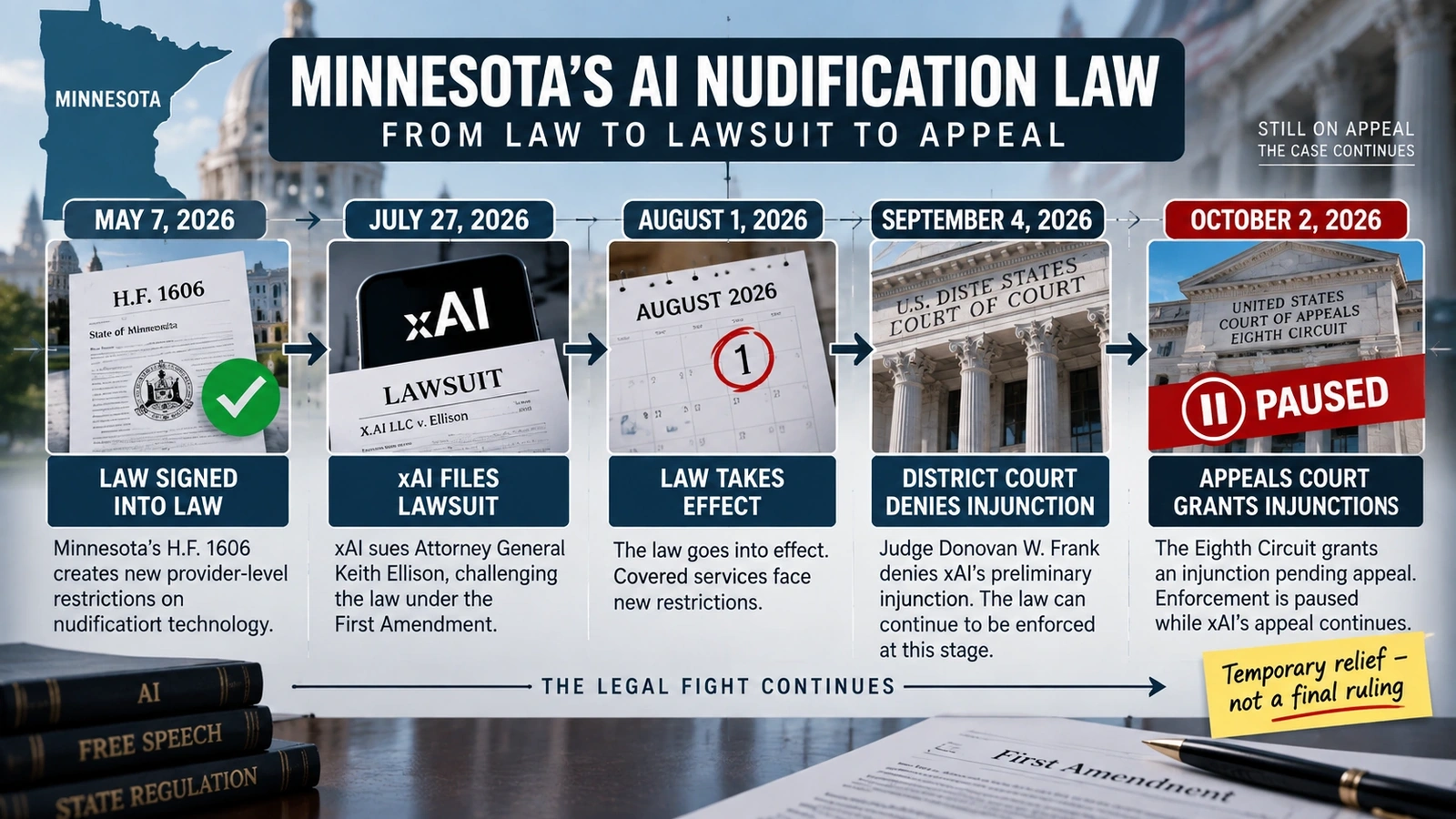
The sequence is easier to understand as a timeline:
| Date | What happened | What it meant |
|---|---|---|
| May 7, 2026 | Minnesota’s H.F. 1606 was signed into law | The state created a new provider-level restriction on nudification technology |
| July 27 | xAI sued Attorney General Keith Ellison | xAI challenged the law under the First Amendment |
| July 31 | District court denied emergency temporary relief | The law was still scheduled to take effect |
| August 1 | The law took effect | Covered services faced the new restrictions |
| September 4 | District court denied a preliminary injunction | Minnesota could continue enforcing the law |
| October 2 | Eighth Circuit granted an injunction pending appeal | Enforcement was paused while xAI’s appeal continues |
The September 4 ruling is especially important. U.S. District Judge Donovan W. Frank did not decide that Minnesota’s law was constitutional. He denied xAI’s preliminary-injunction request because the company had not adequately shown irreparable harm and because the balance of harms and public interest favored the state at that stage. He explicitly described the constitutional questions as complex and left them for later consideration. (U.S. District Court opinion)
So the October 2 appeals-court order changed who has the temporary advantage.
It did not finish the case.
What Does Minnesota’s AI Nudification Law Actually Ban?
The unusual part of Minnesota’s law is that it regulates the provider of the technology, not merely the person who misuses an image after it has been created.
Minnesota Statute § 325E.91 covers websites, apps, software, programs, and other services. It generally prohibits their owners or controllers from allowing users to use the service to “nudify” an image or video, and it also restricts advertising or promoting covered services. (Minnesota Session Laws)
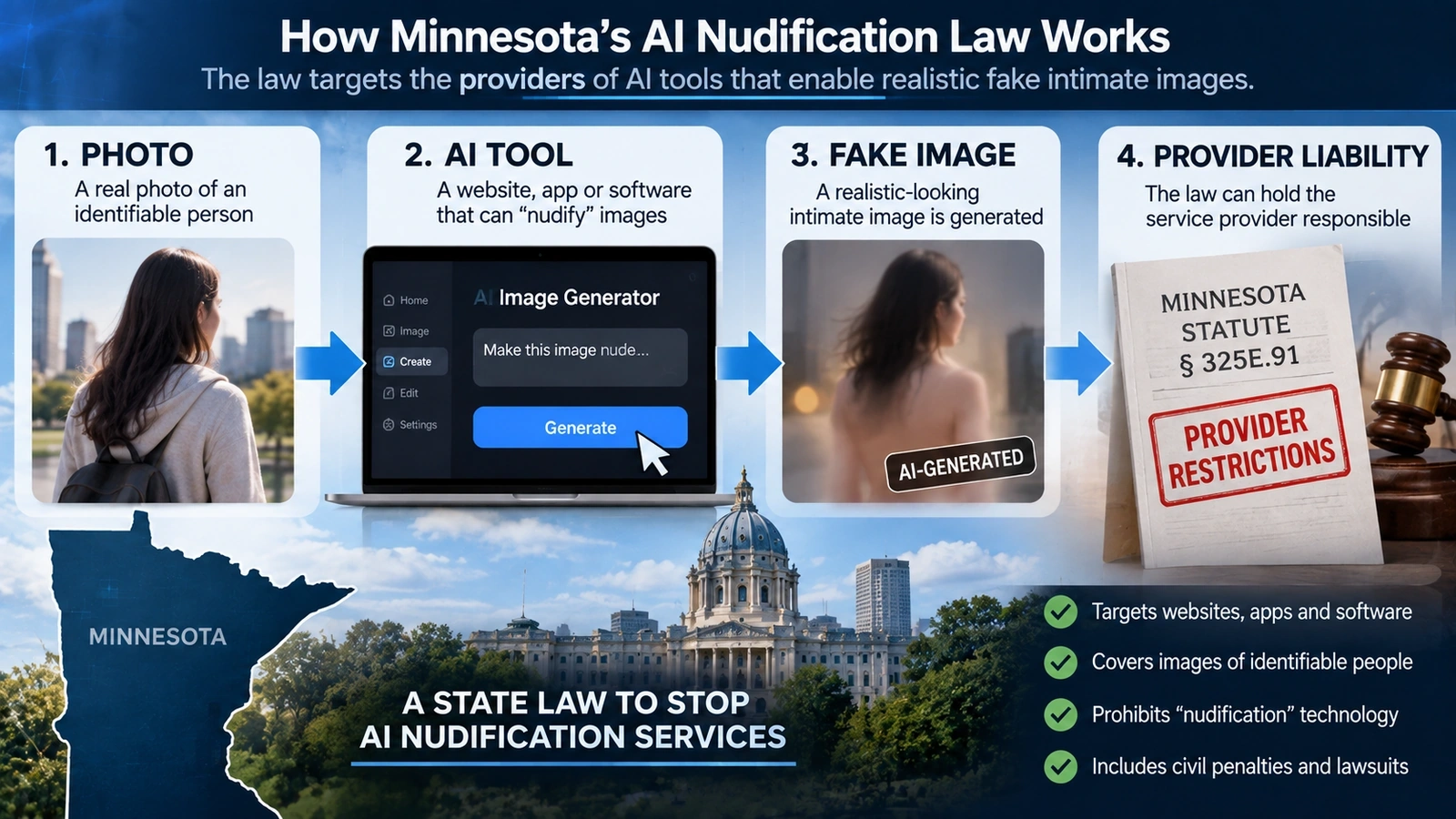
The law uses a specific definition.
A covered image must depict an identifiable person and add an “intimate part” that was not shown in the original image or video. The result must also be realistic enough that a reasonable person could believe the depicted body part belongs to that person. (Minnesota Session Laws)
That means this is not a general ban on every AI-generated sexual image.
But the law is broader than many people may assume from the phrase “nonconsensual deepfake porn.”
| Question | What H.F. 1606 says |
|---|---|
| Must the image involve an identifiable real person? | Yes |
| Must it add an intimate body part not shown in the original? | Yes |
| Must the result look realistic? | Yes |
| Is the central prohibition aimed at the technology provider? | Yes |
| Does the provider-level prohibition expressly require proof that the platform intended the misuse? | No such intent requirement appears in the operative prohibition |
| Does the operative prohibition expressly make lack of consent an element? | No |
| Is there an exemption? | Yes, for services requiring substantial human technical or artistic skill |
The statute also gives an affected individual a right to sue for remedies that can include compensatory damages of up to three times actual damages, punitive damages, injunctions, and attorney fees. The attorney general may seek a civil penalty of up to $500,000 for each unlawful access, download, or use covered by the statute. (Minnesota Session Laws)
That potential liability is a major reason the case matters to AI companies.
Why Is This a First Amendment Case at All?
Because the First Amendment does more than protect newspapers, political speeches, or people standing on a sidewalk with protest signs.
It can also apply when a government law restricts the creation or distribution of expressive material.
xAI argues that Minnesota’s statute restricts what people can create using Grok Imagine and therefore burdens protected expression. Its lawsuit challenges the law both on its face and as applied to the company. Minnesota, meanwhile, disputes the strength of xAI’s First Amendment interest and has argued that the statute can constitutionally address the harms created by nudification technology. (U.S. District Court opinion)
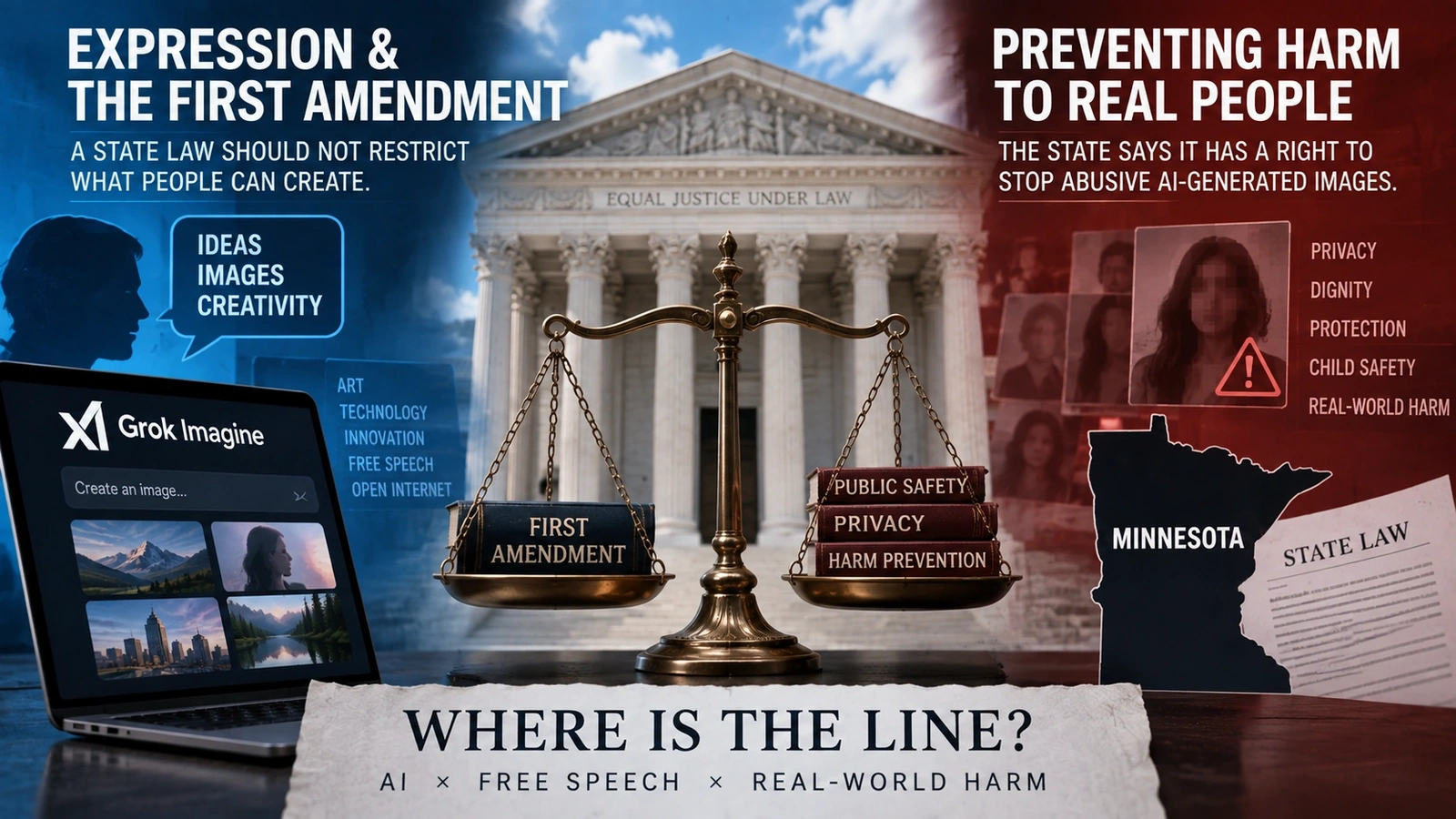
Here is the simplest way to picture the disagreement.
Minnesota focuses on what the technology can do to a real person.
xAI focuses on what the government is forbidding a tool and its users from creating.
Those are different legal frames applied to the same technology.
Minnesota lawmakers heard testimony about harms suffered by people whose images were manipulated with AI tools, and the state argued in court that the technology can facilitate harassment and child sexual-abuse material. The district court described the harm from AI nudification as undisputed when weighing the public interest at the preliminary-injunction stage. (Minnesota Attorney General · U.S. District Court opinion)
But recognizing a serious harm does not automatically answer every constitutional question about how broadly a state may write a law to prevent it.
That is where the First Amendment dispute begins.
Why Does the “Technical Skill” Exemption Matter So Much?
Minnesota’s law does not treat every image-editing tool the same way.
The statute says its prohibition does not apply when a service requires a user to exercise substantial individualized technological or artistic skill and judgment in shaping the output. (Minnesota Session Laws)
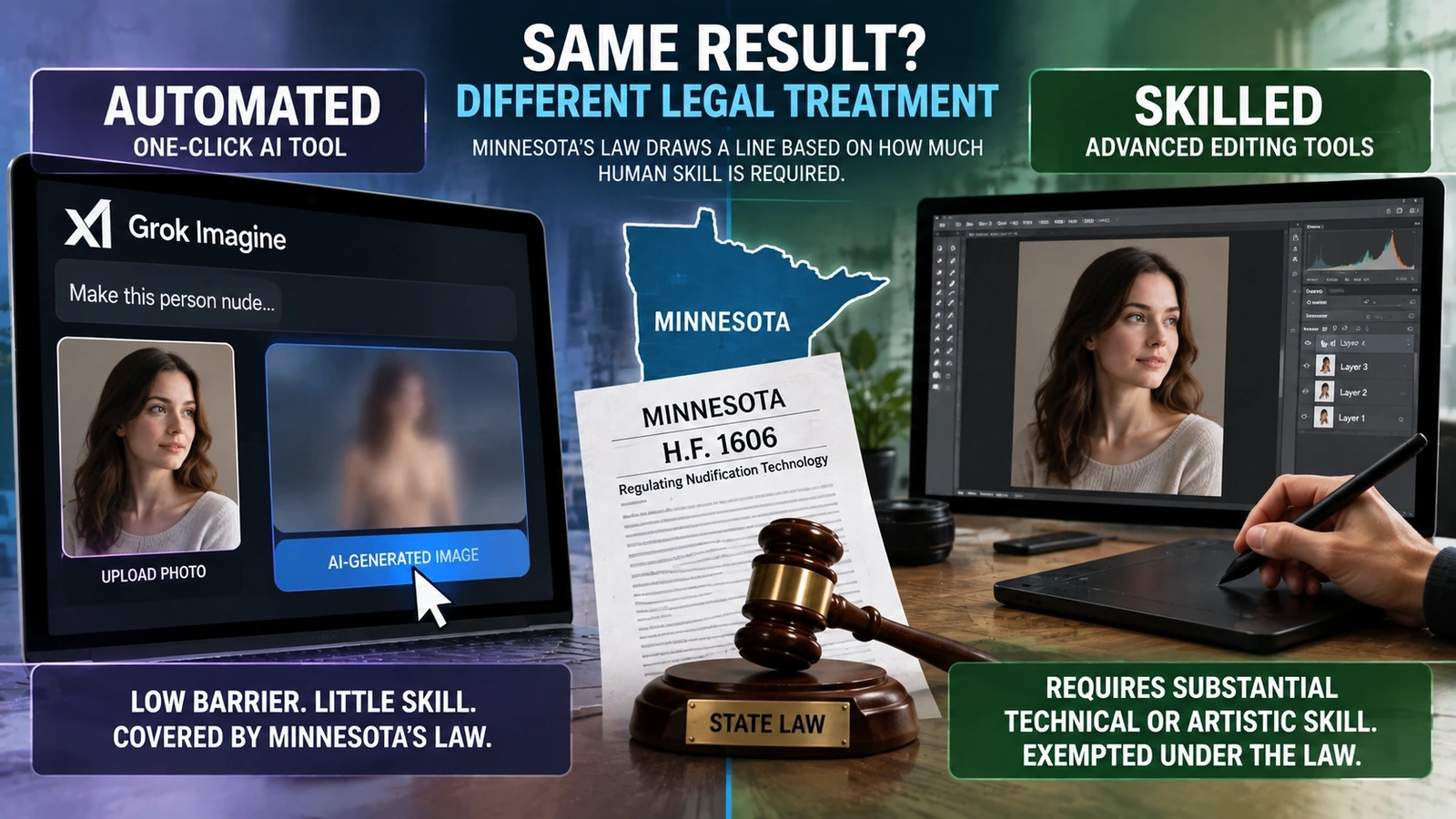
Imagine two tools that could theoretically produce a similar visual result.
One asks the user to upload a photograph and type a short instruction.
The other requires extensive manual editing, masking, compositing, drawing, and other individualized work.
Minnesota’s statute explicitly creates a distinction based on the amount of human skill required.
That does not automatically mean that every professional image editor falls outside the law or that every generative-AI system falls inside it. Real cases could turn on how a particular product actually works.
But the distinction is constitutionally important because xAI argues that the state is regulating the same general category of imagery differently depending on the method used to create it.
That is the kind of line courts may eventually have to examine much more closely.
Did the Court Decide That AI Fake Nudes Are Protected Speech?
No. Neither the September 4 district-court order nor the October 2 appellate action amounts to a final ruling that AI-generated fake nude images are constitutionally protected.
The district judge specifically declined to resolve the central constitutional dispute when denying xAI’s preliminary injunction. Instead, the court relied on other parts of the injunction test, including irreparable harm, delay, the balance of harms, and the public interest. (U.S. District Court opinion)
That distinction corrects two opposite misunderstandings.
The September ruling did not mean:
Minnesota proved its law constitutional.
And the October appeals-court order does not mean:
xAI proved the law unconstitutional.
The actual position is less dramatic.
The constitutional fight is still open.
The appeals court has simply decided that the law should not be enforced while the current appeal is being considered. (Reuters)
That is why reading a court headline such as “ban blocked” without looking at the procedural stage can be misleading.
Why Did Minnesota Write Such a Broad Provider-Level Law?
Minnesota’s basic policy argument is that remedies aimed only at the individual who creates or distributes a fake image may come too late.
By the time a victim knows the image exists, it may already have been downloaded, copied, shared through group chats, posted on other platforms, or viewed by large numbers of people.

Minnesota lawmakers heard testimony from residents about harms they said they suffered after their images were manipulated with AI tools. The state’s attorney general has also pointed to lawsuits and other evidence involving alleged sexualized images of children created with AI systems. (Minnesota Attorney General)
The law therefore tries to intervene earlier in the chain:
not only after a harmful image is shared, but at the point where an easily accessible service makes the image possible.
xAI says that approach goes too far and places the burden on the technology provider even when the provider has policies and safeguards against abuse. The company has told the court that its policies prohibit nudifying real people, depicting real people in intimate contexts, and sexualizing or exploiting children. Minnesota argues that platform policies alone do not adequately solve the underlying problem. (U.S. District Court opinion)
That is the larger policy conflict hiding underneath the constitutional lawsuit:
Should the law mainly punish the person who misuses AI?
Or can it force the company providing the AI tool to prevent the capability itself?
What Happens Next in xAI v. Ellison?
The case now moves forward in the Eighth Circuit, where xAI is appealing the district court’s refusal to grant preliminary relief.
The appellate case is X.AI LLC v. Keith Ellison, No. 26-2806. The underlying federal district-court case remains X.AI LLC v. Ellison, No. 0:26-cv-03425. (Eighth Circuit docket · Reuters)
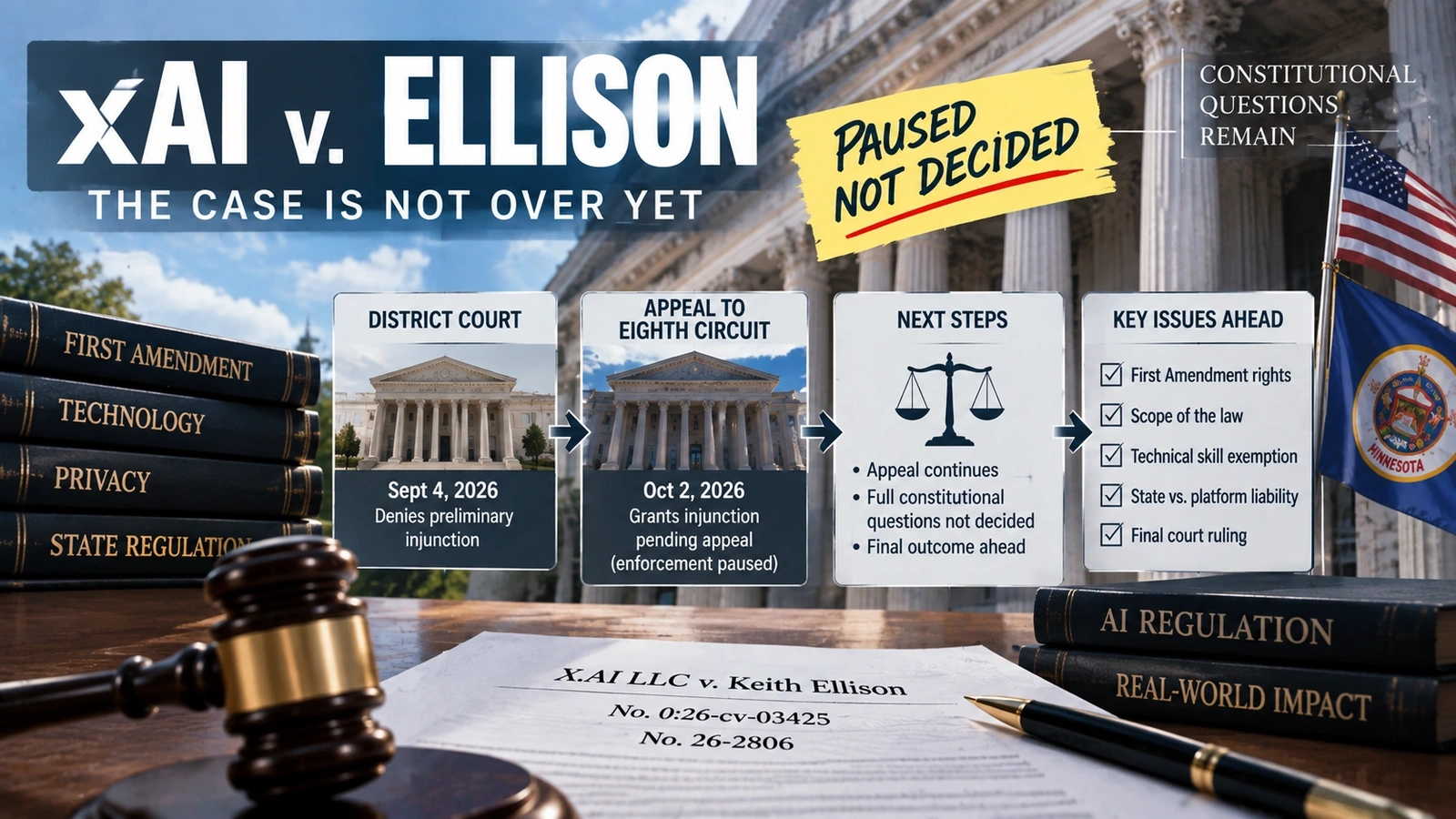
Several things remain legally distinct.
First, the appeals court can decide whether xAI should have received preliminary protection while the constitutional challenge continues.
Second, the courts must eventually confront the deeper questions: whether xAI can assert the relevant First Amendment rights, what level of constitutional scrutiny applies, how the state’s technical-skill exemption should be treated, and whether the law reaches substantially more expression than Minnesota may constitutionally restrict.
Third, even a decision in this preliminary-injunction appeal would not necessarily be the final word on every part of the underlying case.
That means the next important headline may again sound more final than it really is.
The question to keep asking is:
Did the court decide who ultimately wins—or did it only decide what happens while the lawsuit continues?
Bottom Line: What This Story Really Means
Minnesota’s AI nudification law was paused, not erased.
The Eighth Circuit gave xAI temporary protection while the company appeals a lower court’s refusal to block the law. The October 2 order does not establish that Minnesota violated the First Amendment, and it does not establish a constitutional right to create abusive fake sexual images.
The deeper case is about where government regulation should draw the line.
Minnesota wrote a provider-level law because lawmakers believe easily accessible nudification technology can create serious harm before victims have any realistic chance to stop the images from spreading.
xAI argues that Minnesota crossed the constitutional line by restricting a broad category of image creation, including situations that may go beyond nonconsensual abuse.
The court battle will determine whether Minnesota targeted a harmful technology narrowly enough—or regulated expression too broadly in the process.
Minnesota Nudification Law: Key Questions Explained
Q. Did a federal court strike down Minnesota’s AI nudification law?
No. The Eighth Circuit temporarily blocked enforcement while xAI’s appeal proceeds. The constitutionality of the law has not been finally decided.
Q. What does “injunction pending appeal” mean?
It is temporary court protection while an appeal is being considered. It can change what happens during the lawsuit without deciding who ultimately wins.
Q. What is Minnesota’s nudification law?
Minnesota Statute § 325E.91 restricts covered websites, applications, software, and other services from enabling realistic alteration or generation of intimate body parts on images of identifiable people.
Q. Why is xAI suing Minnesota?
xAI argues that the statute violates the First Amendment by restricting protected expressive activity and reaching more broadly than Minnesota may constitutionally regulate.
Q. Does the law apply only when the depicted person did not consent?
The operative provider prohibition does not expressly make lack of consent an element. That breadth is one of the issues that has fueled the constitutional challenge.
Q. Why does the law have a “technical skill” exemption?
The statute exempts services that require substantial individualized technological or artistic skill from the user. The distinction appears designed to focus on readily accessible automated nudification technology, but it is also one of the features relevant to xAI’s constitutional challenge.
Q. Can Minnesota fine an AI company under the law?
The statute allows the attorney general to seek civil penalties of up to $500,000 for each unlawful access, download, or use covered by the law, along with other available remedies.
Q. Did the district court previously rule that Minnesota’s law was constitutional?
No. The September 4 district-court ruling denied xAI a preliminary injunction without resolving the central First Amendment merits.
Q. What should people watch next?
Watch for the Eighth Circuit’s treatment of xAI’s appeal and, eventually, for a fuller court analysis of the First Amendment claims. The biggest unresolved question is not whether harmful fake sexual imagery exists, but how broadly a state may regulate the technology used to create it.
Did this help make the story clearer? 🙂 WIN keeps unpacking the “why” behind the news—clearly and simply!
Sources
October 2 Appeals-Court Action and Case Status
Reuters — U.S. Appeals Court Blocks Minnesota Law Barring “Nudified” Photos in xAI Lawsuit
Eighth Circuit Case Docket — X.AI LLC v. Keith Ellison, No. 26-2806
Minnesota Law and District-Court Proceedings
Minnesota Revisor of Statutes — 2026 Chapter 72, H.F. 1606
U.S. District Court — September 4, 2026 Preliminary-Injunction Opinion
Minnesota Attorney General — September 4 xAI Case Statement
Legislative Background and Reported Harms
Minnesota Attorney General — August 18 Opposition to xAI’s Preliminary-Injunction Request
Minnesota House — New Law Bans Access to Nudification Technology
Keep Reading
How Can a Court Change What Happens Now Without Finally Deciding the Case?
A similar procedural distinction appeared when the Supreme Court temporarily restored the expanded SAVE system. That explainer shows how a stay can change the immediate legal landscape while the underlying case is still being litigated.
What Is the SAVE Voter Database—and What Did the Supreme Court Actually Allow?