Why Has Trump’s Approval Rating Fallen to 33%—and Could Republicans Lose Congress?

What happens when a president’s approval rating falls to roughly one in three Americans?
Does it mean voters are ready to turn against his party? And if so, could Republicans lose control of Congress in just a few weeks?
Those questions are suddenly much more important for President Donald Trump.
A major national poll released October 18, 2026, found that only 33% of American adults approve of Trump’s job performance, while 66% disapprove. The same survey showed Democratic candidates leading Republicans by eight percentage points among likely voters in the race for the House of Representatives. (ABC News)
The numbers look alarming for Republicans. But they don’t mean Democrats have already won anything.
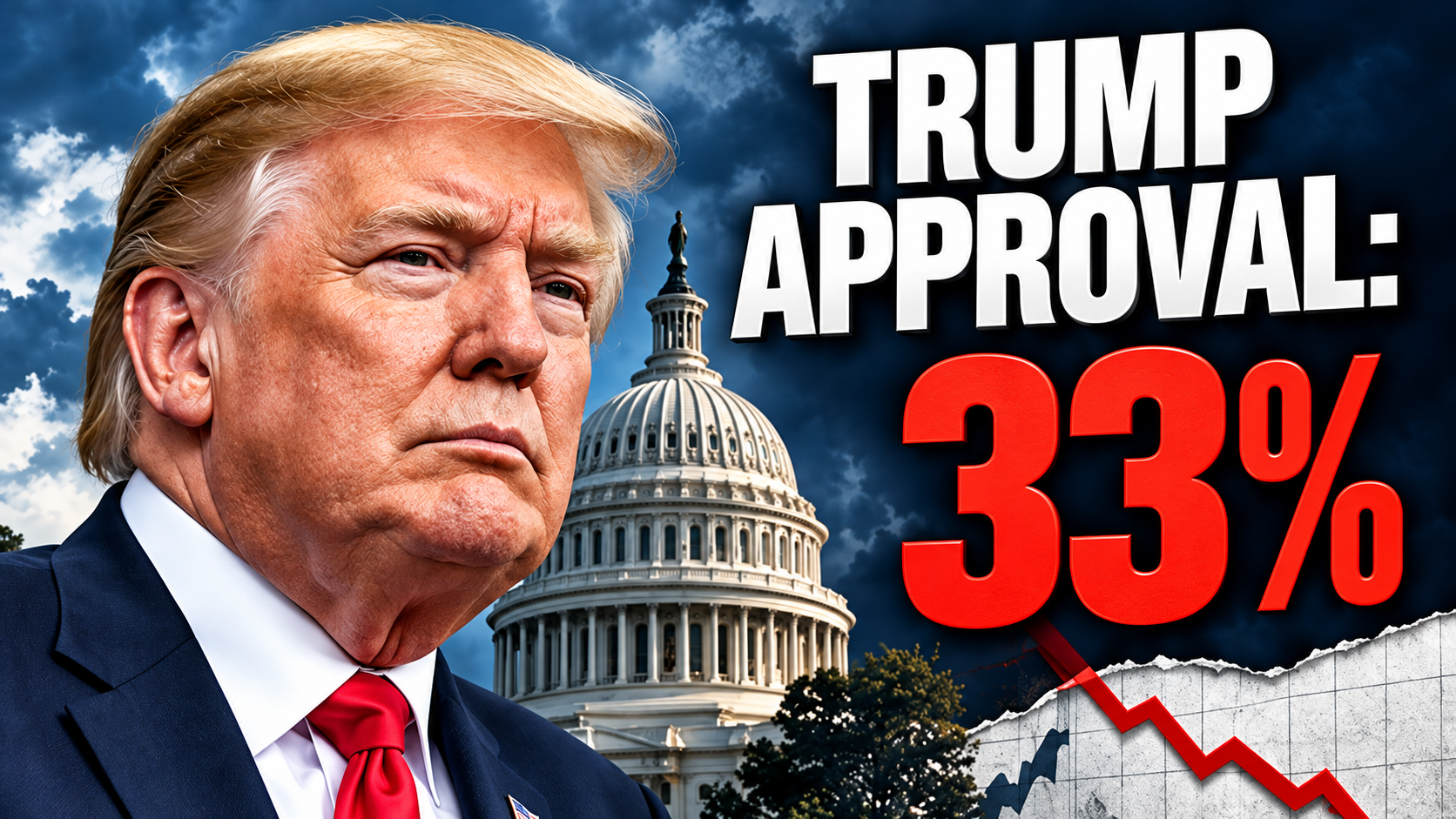
※ Images in this article are AI-generated illustrations created to help explain the story. They are not actual photographs, and depictions of people, places, or events may differ slightly from reality.
Here’s the distinction that matters: A president’s national popularity, voters’ preferences for Congress, and the actual results in individual districts are three different things.
Understanding how they connect—and where they don’t—explains why this poll is politically significant without being an election prediction.
What Does Trump’s 33% Approval Rating Actually Tell Us?
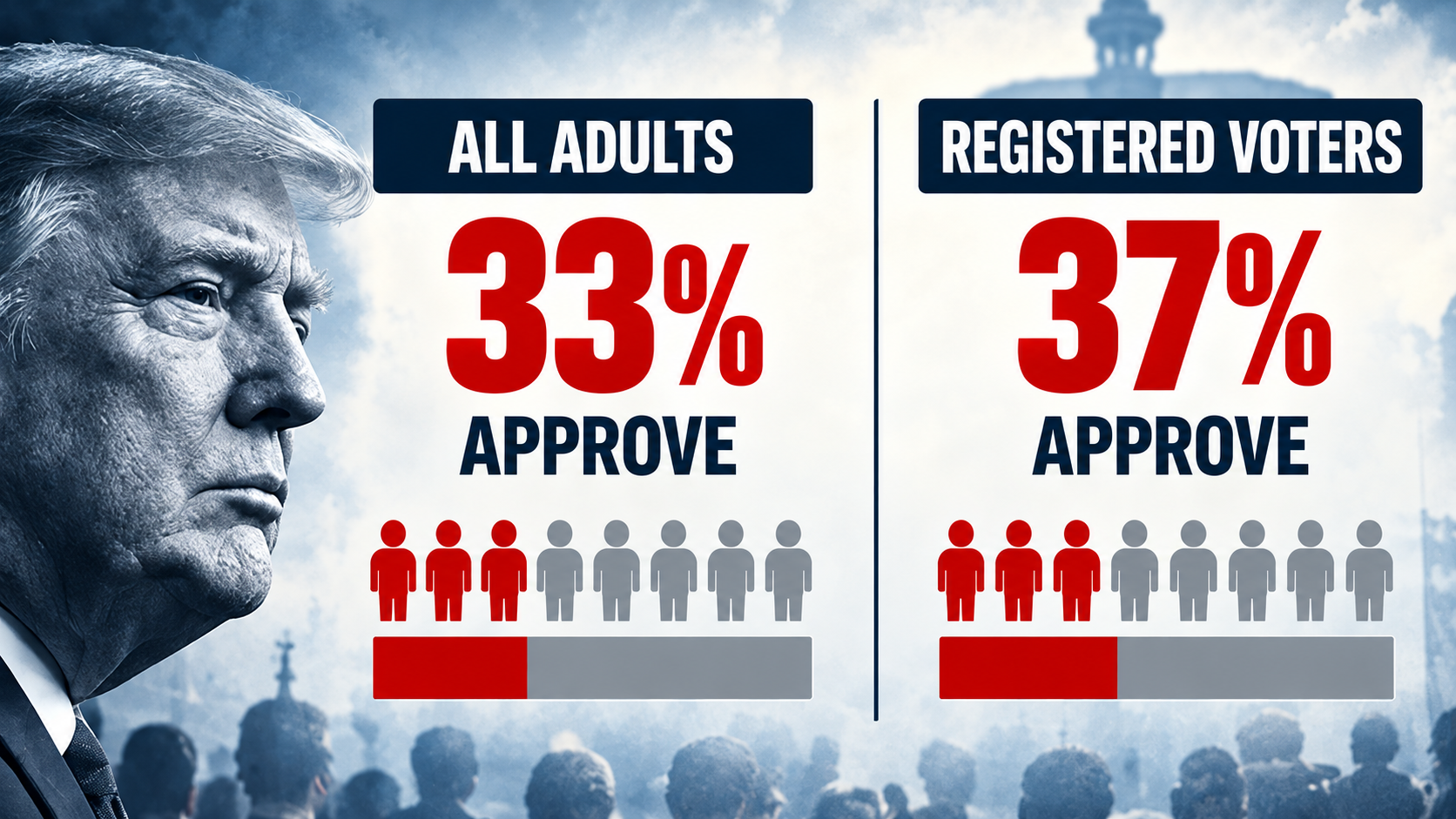
The 33% figure measures Trump’s job approval among American adults. It is not his share of the presidential vote, his support among likely midterm voters, or a direct prediction of how Republicans will perform in November.
The ABC News/Washington Post/Ipsos survey was conducted October 9–13, 2026, among 2,545 U.S. adults. The October 18 report highlighted Trump’s approval and the congressional race.
The survey used Ipsos’ probability-based KnowledgePanel, designed to represent the U.S. adult population. The reported margin of sampling error was approximately two percentage points for the full sample. (Ipsos · ABC News)
Three numbers that should not be confused
| Poll finding | Result | Who was measured? |
|---|---|---|
| Trump job approval | 33% approve, 66% disapprove | All U.S. adults |
| Trump job approval among registered voters | 37% approve, 63% disapprove | Registered voters |
| Preferred House candidate | Democrats 52%, Republicans 44% | Likely voters |
The distinction between all adults and registered voters is especially important.
Someone who does not vote still has an opinion about the president. But that person’s opinion will not directly affect the November election unless they are eligible and cast a ballot.
Among registered voters, Trump’s approval was somewhat higher at 37%. That doesn’t erase the political warning, but it demonstrates why polling populations matter.
The new 33% reading is also a record low for Trump in this ABC News/Washington Post polling series across his two presidencies.
After the January 6, 2021, attack on the U.S. Capitol, the same polling series measured his approval at 38%. The latest result is below even that figure. (ABC News)
Still, a national approval rating cannot reveal exactly what will happen in hundreds of separate congressional elections.
So what is driving the dissatisfaction?
Why Have Everyday Costs Become Such a Big Political Problem?
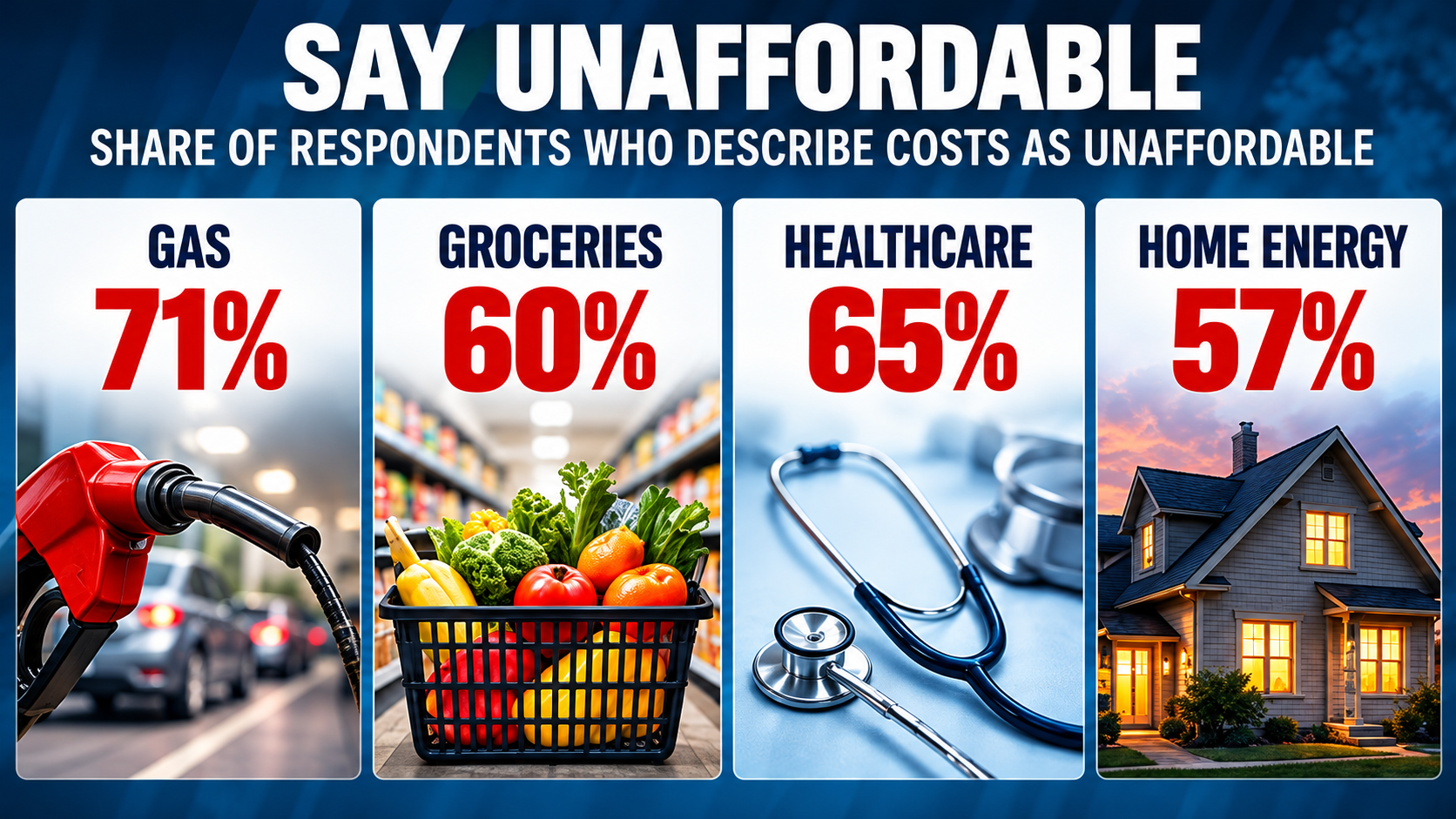
The cost of living is one of Trump’s biggest weaknesses in the new poll. Americans are expressing dissatisfaction not just with the economy in general, but with the everyday purchases that determine whether their income feels sufficient.
The numbers are striking.
According to the October survey, the shares of Americans who consider specific expenses unaffordable include:
| Household expense | Americans calling it unaffordable |
|---|---|
| Gasoline | 71% |
| Groceries | 60% |
| Healthcare | 65% |
| Home energy and utilities | 57% |
| Rent or mortgage payments | 50% |
The gasoline number offers one of the clearest signs of how quickly public perceptions have changed.
In February 2026, 28% described gasoline as unaffordable. By October, that figure had climbed to 71%.
That is a 43-percentage-point increase in the share of Americans reporting an affordability problem—not a 43% increase in gasoline prices. (ABC News)
Why does the Iran war matter to household budgets?
The U.S. military conflict with Iran has added pressure to energy markets, making an already difficult affordability debate more complicated.
When energy prices rise, households feel the effects directly at the gas pump and through heating, cooling, and transportation costs.
Businesses can also face higher transportation and operating expenses, some of which may eventually reach consumers.
But it would be too simplistic to attribute every household price increase solely to the Iran conflict or to one presidential decision.
Energy prices respond to global supply, demand, transportation risks, and numerous other factors. The broader cost-of-living problem extends beyond gasoline.
The survey found that 75% of Americans rated the national economy negatively. Nearly half—48%—said they were not as well off financially as when Trump returned to the presidency in January 2025.
Trump’s approval on handling the cost of living was just 21%, while 77% disapproved.
On the economy overall, 28% approved of his performance and 70% disapproved. (ABC News)
Those are different measures, but together they show how deeply negative economic perceptions have become.
Isn’t Trump still arguing that his economic policies are working?
Yes. Trump and Republican candidates continue to defend their economic approach, emphasizing tax policy, investment, and their argument that Democratic control would produce worse outcomes.
At an October 17 campaign rally in Kentucky, Trump attacked the prospect of Democratic control and attempted to energize Republican voters ahead of the midterms. (AP · Republican Party Event Listing)
Democrats, meanwhile, have focused their campaign messaging on expensive healthcare, fuel, groceries, and the costs they associate with administration policies.
Neither side’s campaign argument establishes what caused every economic change.
But politically, one fact stands out: Voters do not need to agree on the causes of higher prices to hold the party in power responsible for their financial frustration.
That helps explain why the economic numbers are receiving so much attention before November.
Why Do Independents Matter More Than Trump’s Republican Base?
Trump remains popular with many Republicans. His biggest electoral problem may be what is happening outside that core group.
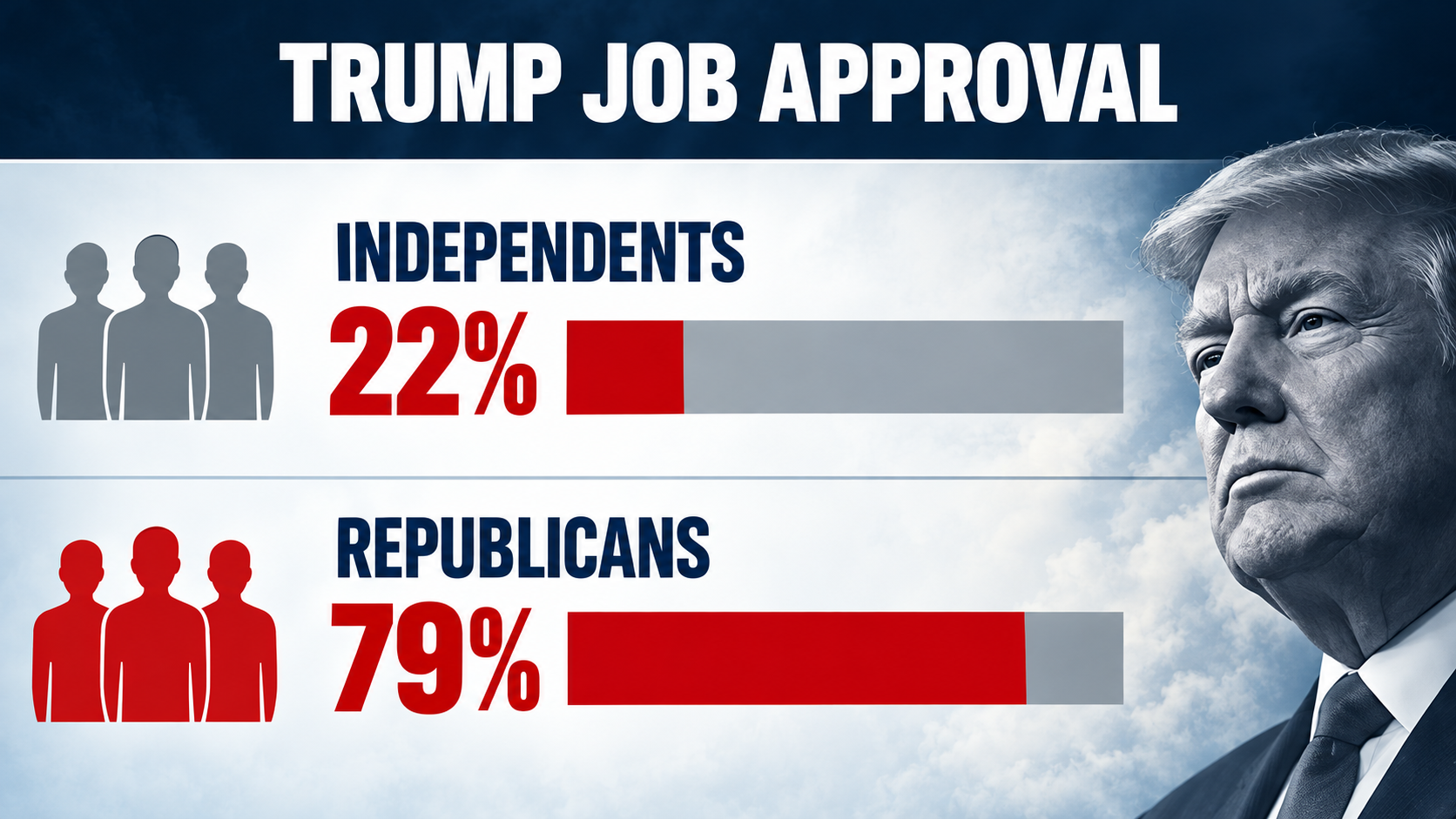
In the latest poll, 79% of Republicans approved of his performance.
That remains a substantial majority. But it is below the 88% approval recorded among Republicans near the beginning of his second term.
There is also a difference between approving of a president and enthusiastically supporting him.
Only 39% of Republicans strongly approved of Trump in the latest poll, compared with 63% in February 2025.
Among independents, the picture was more negative: just 22% approved of his performance, while 76% disapproved. (ABC News)
Why is that important?
Because competitive elections are often decided not by the most loyal members of either party, but by voters who are less firmly attached to one side—or who are deciding whether to vote at all.
Are independents actually moving toward Democrats?
In this survey, independent likely voters favored Democratic House candidates over Republicans by 56% to 35%.
That is a 21-point Democratic advantage.
But there is an important limitation.
Disapproving of Trump does not automatically mean someone likes the Democratic Party.
Some independents may support an individual Republican candidate despite disapproving of the president. Others may dislike both parties, remain undecided, or decide not to participate.
An AP-NORC poll released shortly before the ABC News survey also found widespread frustration with Trump and a desire for political change, while showing that neither major party was particularly popular. (AP)
That distinction matters because dissatisfaction creates an opportunity for the opposition, not an automatic victory.
Could Republican voters stay home?
That is another concern.
The ABC News/Washington Post/Ipsos survey found that 72% of Democratic voters said they were absolutely certain to vote, compared with 65% of Republican voters.
This is a measure of stated voting certainty, not actual turnout.
Elections can still produce participation patterns that differ from what survey respondents predict.
Republican campaigns are actively working to mobilize supporters, and Trump’s rallies are part of that effort.
The question is whether the party can turn loyalty into actual ballots while attracting enough voters beyond its core base.
If Democrats Lead by Eight Points, Why Isn’t the House Already Decided?
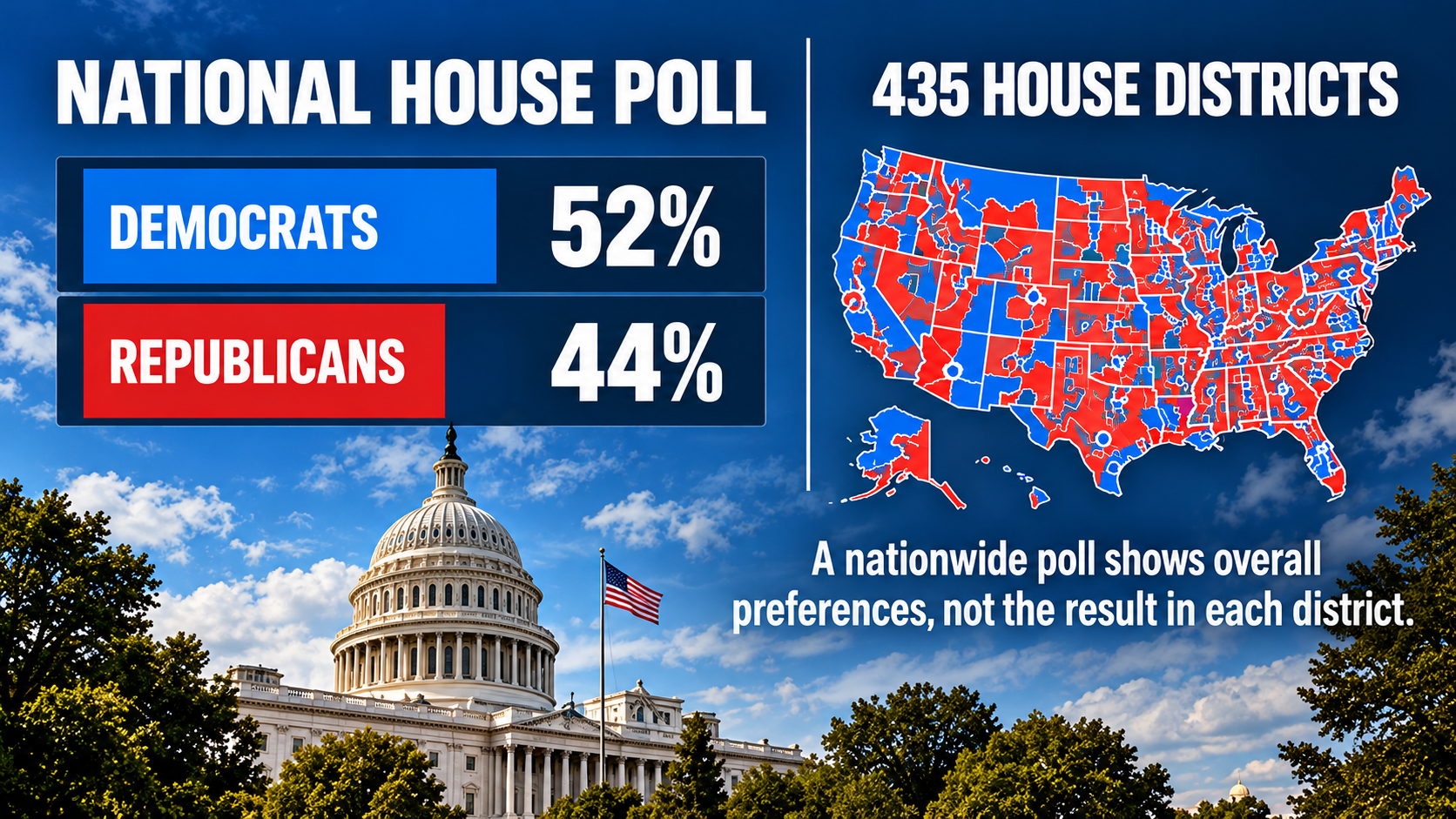
An eight-point national lead is a meaningful advantage, but the House is decided district by district—not by a single nationwide vote.
This may be the most important distinction in the entire story.
The October poll asked voters which party’s candidate they would support in their congressional district.
Among likely voters, Democrats led 52% to 44%.
Among registered voters, the result was 50% to 42%, also an eight-point lead.
In a comparable July survey, the Democratic advantage among registered voters was only three points. (ABC News)
That suggests the national electoral environment has become more favorable to Democrats.
But America’s House elections do not operate like a national popular-vote contest.
What is a generic congressional ballot?
A generic congressional ballot is a polling question about which party’s candidate a voter prefers for Congress.
It typically does not ask voters to choose between the actual named candidates in their district.
That makes it useful for measuring the national political mood.
It does not account for every local candidate, campaign organization, district boundary, or issue that might influence a particular race.
Here’s an easy way to see the difference:
| National polling | Actual House election |
|---|---|
| Measures broad party preference | Elects an individual representative |
| Uses a national sample | Counts votes within each district |
| Produces a nationwide percentage | Produces separate district winners |
| Helps identify political trends | Determines which party holds a majority |
All 435 voting seats in the House are contested in the 2026 election. Each district elects one representative. (USA.gov)
Imagine a simplified election with 10 districts.
One party could win seven districts by very narrow margins, while the other party wins three districts by enormous margins.
The second party might receive nearly as many—or even more—votes overall, yet still win fewer seats.
That is an illustration, not a prediction of the 2026 election.
It shows why national vote share and congressional seat count can produce different results.
Why are district maps so important?
The boundaries of congressional districts determine which communities and voters participate in each House election.
When those boundaries are drawn to favor a political party, the practice is commonly called gerrymandering.
District boundaries are not the only reason a party can dominate certain seats. Voters’ geographic distribution and political preferences also matter.
But map design can make some districts far less competitive than others.
Reuters reported in October that analysts estimated only around 40 to 50 of the 435 House races were truly competitive, a reflection of polarization and redistricting. (Reuters)
That means a national swing does not necessarily translate into an equally dramatic change in House seats.
The party that wins enough close districts wins control, even if the broader national picture looks different.
Has a large Democratic polling lead translated into a House victory before?
Yes, but the relationship has not been identical in every election.
Before the 2018 midterms, a fall ABC News/Washington Post poll found Democrats ahead by 11 points among registered voters. Democrats subsequently won control of the House.
Before the 2022 midterms, the same polling series found registered voters nearly evenly divided. Republicans went on to win a House majority. (ABC News)
Those examples show why polling margins attract attention.
They do not establish a rule that a particular margin will produce a particular number of seats.
Candidate quality, turnout, campaign spending, district boundaries, and late changes in voter preferences can all affect the result.
An eight-point lead gives Democrats reason for optimism.
It does not tell us exactly how many House seats they will win.
Could Republicans Lose the Senate, Too?
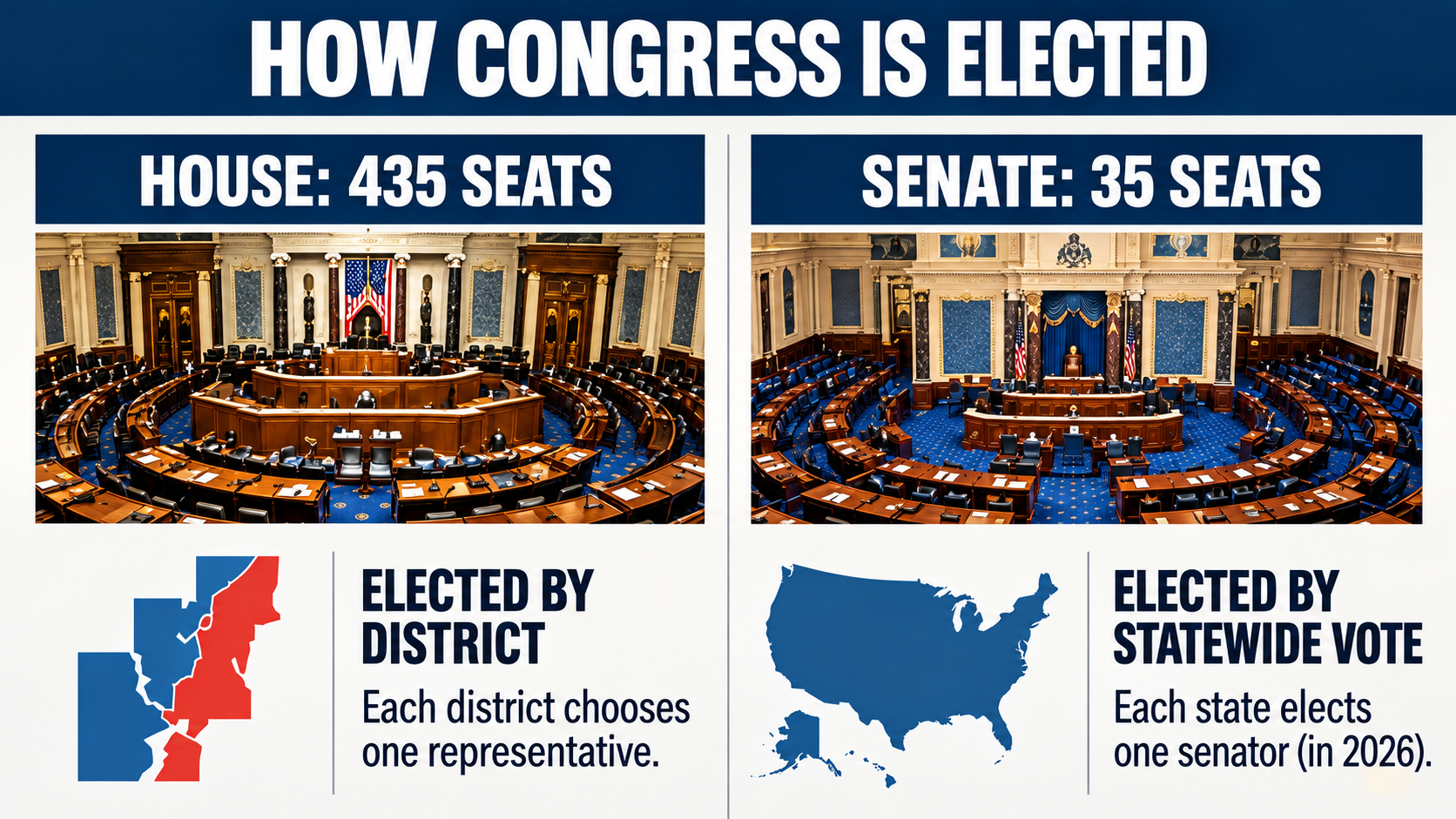
Republicans could lose the Senate, but the latest national House poll cannot tell us whether that will happen.
The Senate is elected differently from the House.
House members serve two-year terms, so all 435 voting seats are contested every two years.
Senators serve six-year terms, with elections staggered so that only a portion of the chamber is contested in each election cycle.
On November 3, 2026, voters will decide 35 Senate seats alongside all 435 House seats. (USPS)
Unlike House members, senators are generally elected by voters across an entire state.
That creates a different political map.
A Democrat might perform well in a competitive suburban House district while a Republican Senate candidate wins statewide. The reverse is also possible.
Why might the Senate be harder for Democrats to win?
Republicans entered the election cycle with a larger Senate advantage than their House advantage.
For Democrats to gain Senate control, they would need to defend seats they already hold while winning enough Republican-held seats to change the majority.
Some potential Democratic targets are in states that supported Trump strongly in the 2024 presidential election.
Those states may be difficult to win even when national approval of the president is low.
Reuters identified several obstacles to a broad Democratic victory, including the limited number of competitive House districts, the difficult Senate map, Republican campaign resources, and uncertainty over turnout. (Reuters)
The Senate also has races in states where particular candidates may have stronger personal reputations than their party’s national standing suggests.
In North Carolina, for example, former Democratic Governor Roy Cooper has emphasized affordability and healthcare while running against Republican Michael Whatley. Reuters reported that Cooper’s established state-level profile was an important part of his campaign’s strength. (Reuters)
So Republicans face risks in both chambers, but the challenges are not identical.
A Democratic House victory could happen without a Democratic Senate victory.
That possibility leads to a more practical question: What would divided control actually mean for Trump’s presidency?
What Would a Democratic Congress Actually Change for Trump?
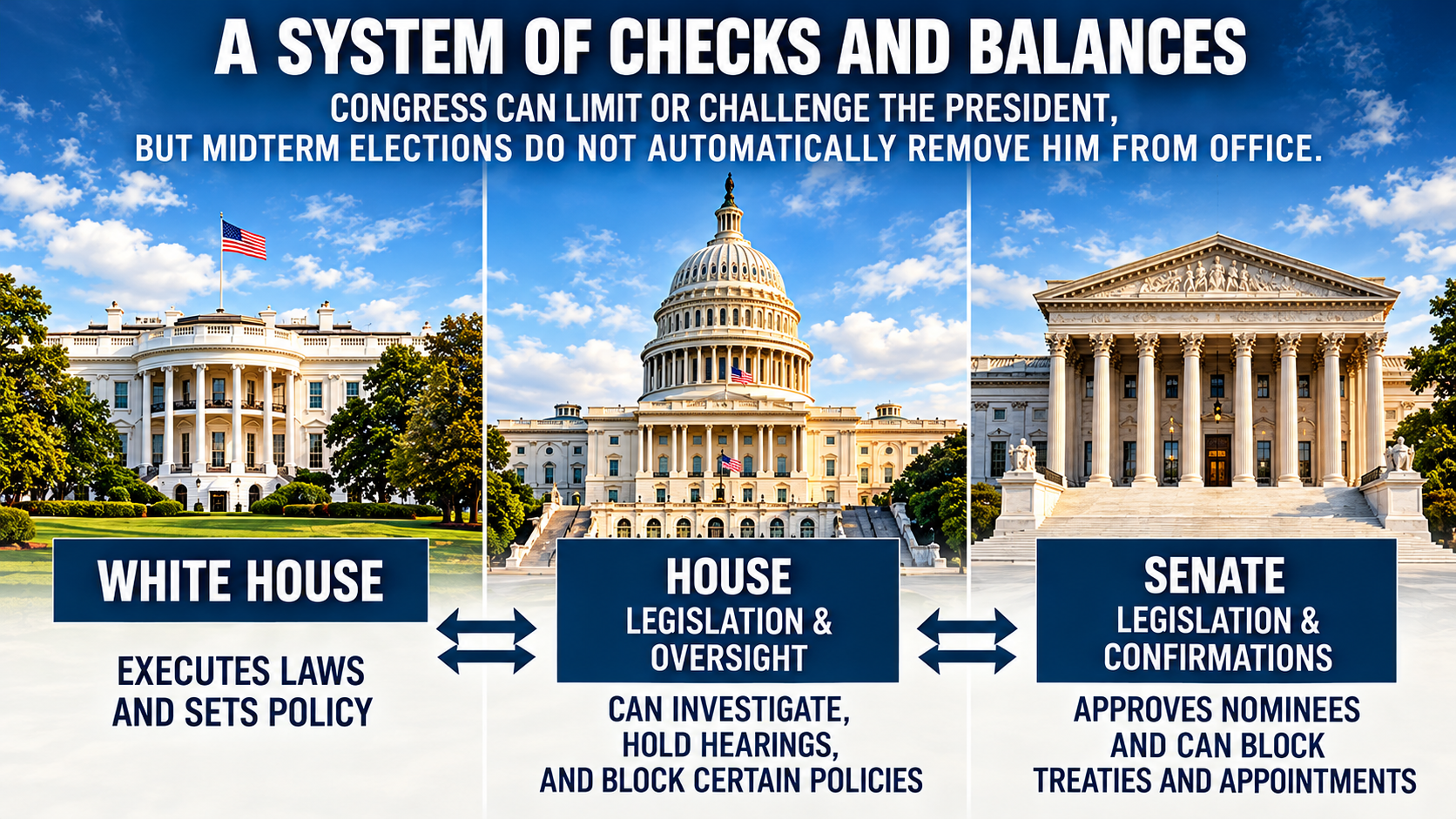
If Democrats win the House, Trump would remain president—but his ability to advance legislation and avoid congressional scrutiny could change substantially.
The presidency and Congress are separate parts of the federal government.
Winning one does not automatically give a political party control of the other.
Here’s how different outcomes could affect the final two years of Trump’s term:
| Election outcome | What could change |
|---|---|
| Republicans retain both chambers | Greater ability to advance Republican legislation and maintain committee leadership |
| Democrats win the House only | More Democratic-led investigations and greater difficulty passing legislation requiring House approval |
| Democrats win the Senate only | Greater Democratic influence over Senate legislation and presidential nominations |
| Democrats win both chambers | Broader congressional opposition to Trump’s agenda, while Trump retains presidential veto authority |
These are institutional possibilities, not guaranteed outcomes. Even a single party’s majority does not ensure every proposed law will pass.
What could a Democratic House investigate?
The House has oversight powers that allow congressional committees to examine how the federal government operates.
Committees can conduct hearings, request information, and use investigative authorities subject to applicable law and congressional rules.
Democratic lawmakers have already discussed a possible agenda focused on healthcare affordability, economic policy, and oversight of the Trump administration if they win control.
In an October report, AP described House Democratic plans for the opening months of a potential new majority, including legislative proposals and investigations. Republicans criticized those plans and defended their own economic and governing priorities. (AP)
A Democratic House would not, however, have unlimited authority.
It could pass legislation, but proposals would generally still need Senate approval and the president’s signature—or enough votes in Congress to override a veto.
Could Congress remove Trump from office?
Not simply because his party loses an election.
A congressional election does not remove a sitting president.
The Constitution provides a separate impeachment process. The House can approve articles of impeachment, while conviction and removal require a two-thirds vote of senators present at the impeachment trial. (U.S. Senate)
Winning the House is therefore not the same as having the votes to remove a president.
Why would Senate control matter?
The Senate has a particularly important role in confirming many presidential nominees, including federal judges and senior executive-branch officials.
The Constitution gives the president the power to nominate such officials, but Senate confirmation is generally required for covered positions. (U.S. Senate)
If Republicans retain the Senate, Trump could still have more room to advance nominations even if Democrats control the House.
If Democrats win the Senate, that process could become more difficult.
For ordinary Americans, these institutional questions are not merely political theater.
They can influence which laws move forward, how federal programs are funded, what investigations Congress conducts, and who fills important government positions.
However, a Democratic congressional majority would not automatically lower gasoline prices, reduce healthcare bills, or reverse every Trump administration policy.
Those outcomes would depend on subsequent legislative decisions, presidential actions, market conditions, and other factors.
What Could Still Change Before November 3?
A little more than two weeks remained before Election Day when the October 18 poll was released. That is a short period, but not an insignificant one.
Several developments could still affect the final results.
1. Whether economic dissatisfaction changes
The survey shows that affordability is an unusually important source of public frustration.
Changes in fuel prices, economic conditions, or voters’ expectations could affect the campaign’s final days.
But polling cannot establish how many individual voters will change their minds in response to those developments.
2. Whether Democratic enthusiasm becomes actual turnout
Survey respondents may say they are certain to vote, yet not all will necessarily cast ballots.
Republicans may also succeed in mobilizing voters who were less enthusiastic when surveyed.
Early voting, mail voting, and Election Day participation all contribute to the eventual result.
The latest poll measures intentions and attitudes. Election officials count actual ballots.
3. What happens in competitive districts
A national eight-point advantage is important, but the closest House districts deserve particular attention.
Candidates in competitive states and districts face different local issues, demographic patterns, fundraising conditions, and campaign dynamics.
That is why the outcome may depend on a relatively small number of races rather than a uniform national swing.
4. Whether Republican and Democratic candidates can separate themselves from national politics
Democrats are trying to connect Republican candidates to Trump and his administration’s record.
Republicans, meanwhile, are emphasizing local candidates, crime, taxes, and other issues they believe are more favorable to their party.
Both parties are making strategic choices about how prominently Trump should feature in their campaigns. (AP)
Those choices matter because a voter can disapprove of Trump while preferring a particular Republican representative—or approve of Trump while choosing a Democratic candidate for local reasons.
5. Whether the final polls agree
One survey is valuable evidence, but no single poll should be treated as a guaranteed forecast.
The ABC News/Washington Post/Ipsos survey is especially useful because it includes presidential approval, economic attitudes, and congressional voting preferences in the same research.
Other surveys, using different dates, populations, questions, and methodologies, may produce different estimates.
The important distinction is between a broad, repeated trend and a number from one particular poll.
The election itself is scheduled for Tuesday, November 3, 2026, according to the Federal Election Commission. (FEC)
Until ballots are counted, control of the House and Senate remains undecided.
Bottom Line: What This Story Really Means
Trump’s 33% approval rating is a significant warning sign for Republicans—but not a verdict on the upcoming election.
The October ABC News/Washington Post/Ipsos poll shows widespread dissatisfaction with the president, particularly on everyday costs and economic management.
It also shows Democrats leading Republicans by eight percentage points among likely voters in the national House vote-preference question.
The two results reinforce the same broad political concern: many Americans are unhappy with the direction of the country, and that dissatisfaction could hurt candidates associated with the president.
But the House is not elected through a single national vote, and the Senate follows an entirely different electoral map.
Republicans can still compete through local candidates, turnout efforts, campaign resources, and districts where their party remains strong.
Democrats, meanwhile, must turn favorable national sentiment into actual victories in individual races.
The real question isn’t whether 33% is a bad number for Trump. It is. The question is whether enough voters in enough competitive districts and states will act on that dissatisfaction to change who controls Congress.
That answer will come from the election, not from the poll.
Trump Approval Rating and 2026 Midterms: Key Questions Explained
Q. Is Trump’s approval rating really 33%?
Yes. The October 2026 ABC News/Washington Post/Ipsos poll found 33% approval among all U.S. adults. Among registered voters, his approval rating was 37%.
Q. Is 33% Trump’s lowest approval rating ever?
It is his lowest reading in the ABC News/Washington Post polling series across his two presidential terms. Different polling organizations can produce different results.
Q. When was the poll conducted?
Ipsos surveyed 2,545 U.S. adults from October 9 through October 13, 2026. The major report detailing Trump’s approval rating and congressional preferences was published October 18.
Q. Why is Trump’s approval rating so low?
The poll shows substantial dissatisfaction with the cost of living, the economy, and Trump’s handling of the Iran conflict, among other issues. These findings help explain the political environment, but they do not prove that any one issue caused each respondent’s disapproval.
Q. Does an eight-point Democratic lead mean Democrats will win the House?
No. The lead measures national party preference among surveyed likely voters. House control is determined by separate elections in 435 congressional districts.
Q. What percentage of independents approve of Trump?
Only 22% of independents approved of Trump’s performance in the October ABC News/Washington Post/Ipsos survey, while 76% disapproved.
Q. Could Republicans lose both the House and Senate in 2026?
Yes, that is possible, but neither outcome is certain. The House and Senate are elected differently, and each chamber has its own competitive races and political challenges.
Q. Would Trump lose the presidency if Democrats won Congress?
No. Trump would remain president. A Democratic majority could constrain legislation and increase oversight, but congressional election results do not automatically remove a sitting president.
Q. What would a Democratic-controlled House mean for Trump’s policies?
It could make new legislation harder to pass and increase investigations of the administration. The president would still retain his constitutional powers, and the Senate’s composition would also matter.
Q. When are the 2026 midterm elections?
The regularly scheduled federal general election is Tuesday, November 3, 2026. All 435 voting House seats and 35 Senate seats are being contested.
Did this help make the story clearer? 🙂
WIN keeps unpacking the “why” behind the news—clearly and simply!
Sources
October 2026 Poll Results and Methodology
ABC News — Democrats Lead Republicans in House Vote Choice as Trump’s Approval Hits Record Low
Ipsos — ABC News/Washington Post/Ipsos October 2026 Poll and Methodology
AP-NORC — Voters Express Frustration With Trump and Desire for Change
Congressional Election Outlook and Campaign Dynamics
Reuters — Six Reasons Democrats May Fall Short of a Midterm Landslide
Reuters — Roy Cooper’s North Carolina Campaign and the Democratic Midterm Strategy
AP — Trump and the Midterm Campaign Advertising Battle
AP — House Democrats Outline a Potential First 100 Days
AP — Trump Campaign Rally in Highland Heights, Kentucky
Republican Party — October 17 Kentucky Rally Event Listing
Election Rules and Congressional Powers
USA.gov — Congressional Elections and Midterm Elections
U.S. Postal Service — Key Elections in 2026
Federal Election Commission — Federal Election Dates and Voting Information