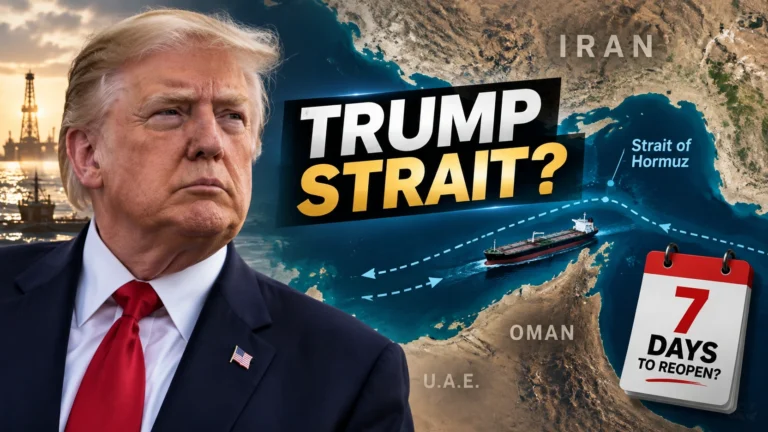
Why Is Israel’s Next Election Also a Fight Over October 7?

Three years after the deadliest attack in Israel’s history, families are still asking a question that might seem impossible to leave unanswered:
How did it happen, and who was responsible for failing to prevent it?
Israel has investigated parts of the disaster. Its military has acknowledged serious failures. Yet the country still has not established the independent national commission that many bereaved families and opposition leaders have demanded.
Now that unresolved question has become part of an election.
On October 24, 2026, thousands of Israelis gathered in Tel Aviv to demand a state commission of inquiry into the Hamas-led attack of October 7, 2023. The demonstration took place just three days before Israel’s October 27 parliamentary election. (AP · The Times of Israel)
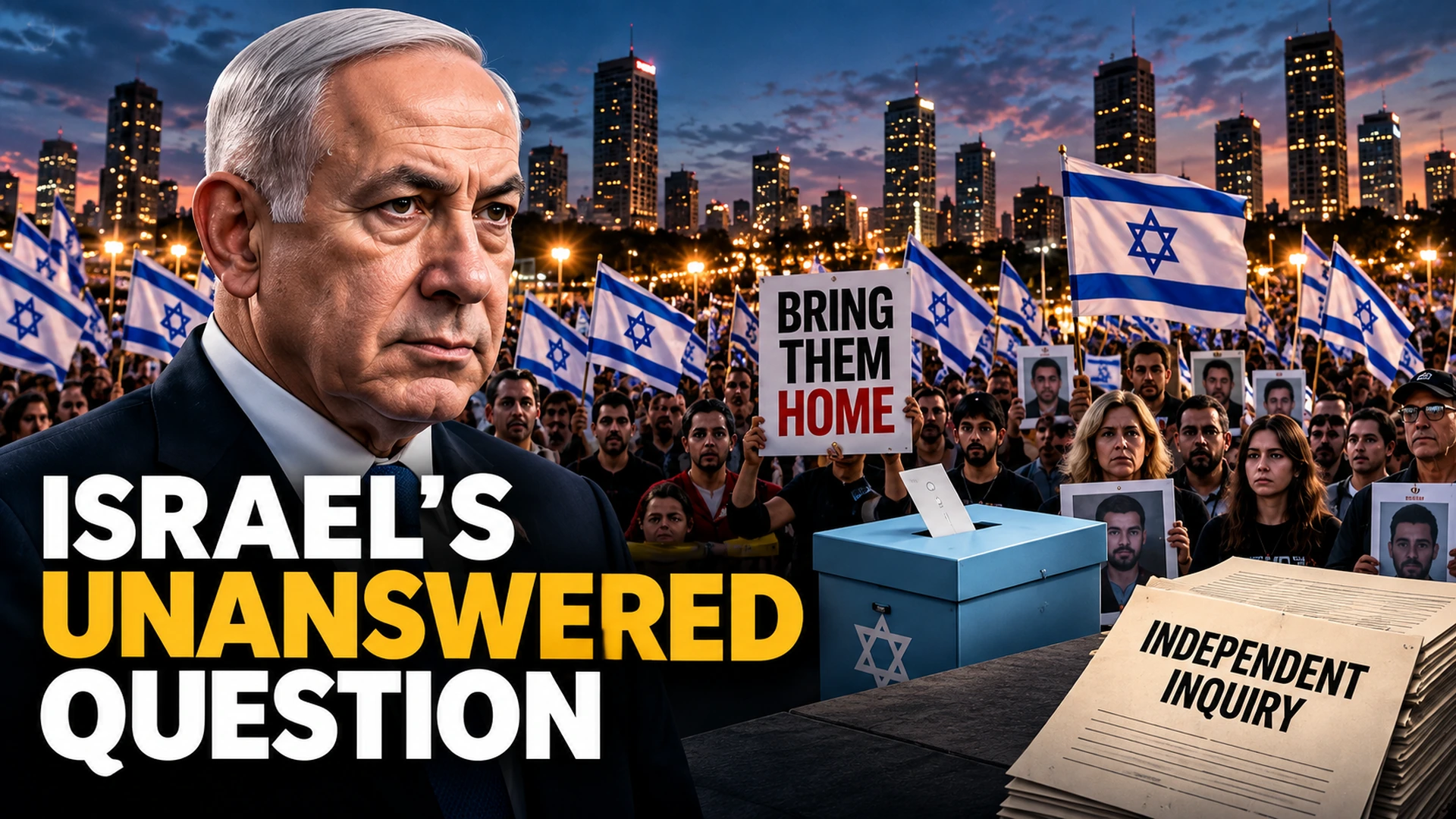
※ Images in this article are AI-generated illustrations created to help explain the story. They are not actual photographs, and depictions of people, places, or events may differ slightly from reality.
Prime Minister Benjamin Netanyahu has resisted the traditional independent commission, arguing that its judicial appointment process would produce a politically biased investigation. His opponents say a government involved in the events being investigated should not have decisive control over who conducts the inquiry.
The disagreement reaches beyond the prime minister’s personal responsibility. It concerns intelligence failures, military preparedness, civilian leadership, and public trust.
And because Israel’s election will determine who can form the next government, voters may also influence whether an independent investigation finally begins.
Why Did Thousands Gather at Hostages Square Just Before the Election?
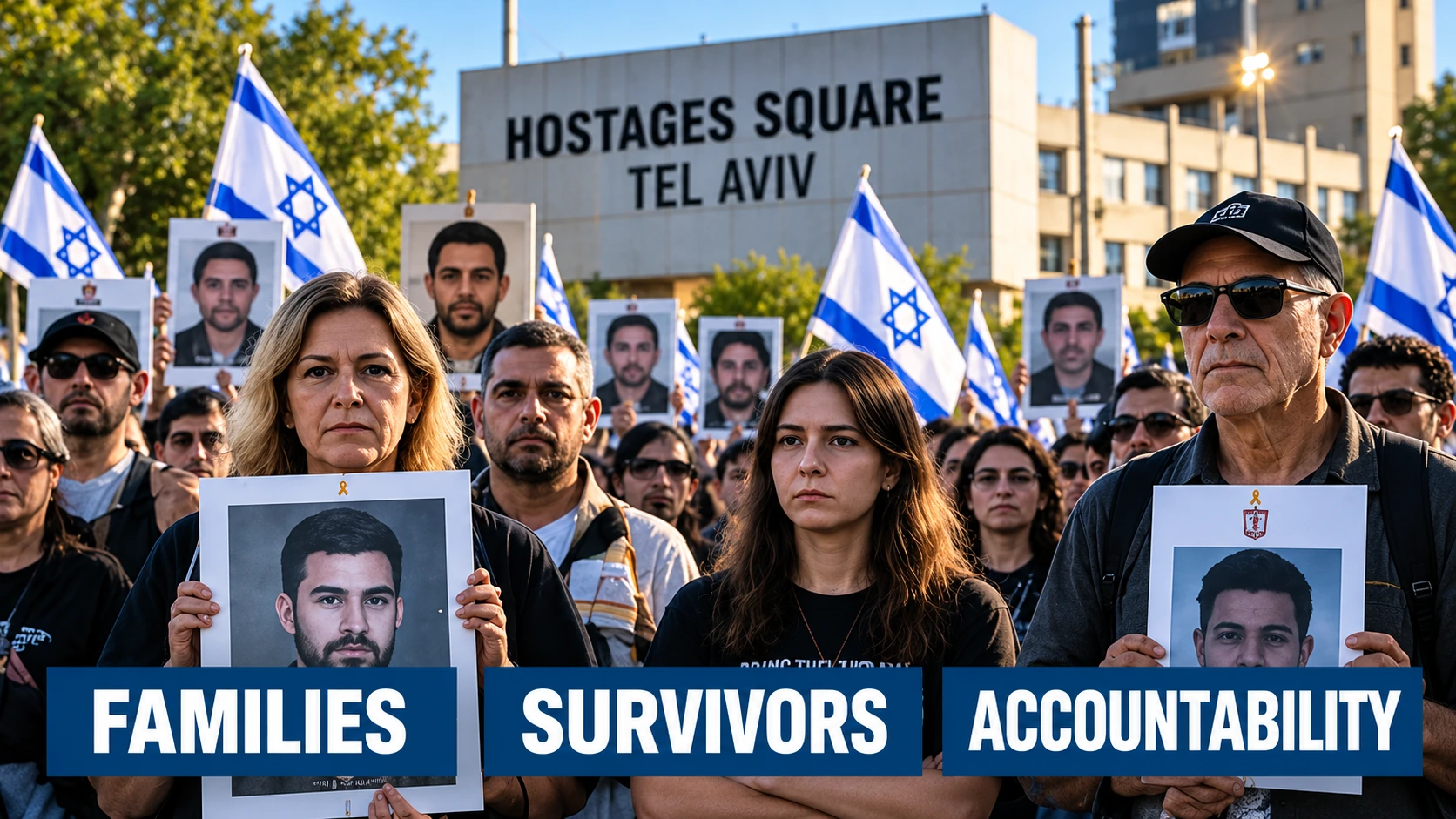
The October 24 demonstration was organized by people directly affected by the October 7 attack, including survivors, former hostages, and families who lost loved ones.
The rally took place at Hostages Square, the public plaza near the Tel Aviv Museum of Art that became a gathering place for families campaigning for the return of people abducted during the attack.
Its organizer, the October Council, sought to put an independent investigation at the center of the final days of the election campaign.
Former military chief and Yashar party leader Gadi Eisenkot attended, along with other opposition figures, including Yair Golan, Avigdor Liberman, Naftali Bennett, and Yair Lapid.
The organizers estimated that more than 100,000 people participated. Police did not provide a comparable official crowd estimate, so the exact attendance remains uncertain. (The Times of Israel · Ynet)
The timing was deliberate.
The demonstration was not simply another memorial gathering. Participants were linking their demand for an investigation to the political decisions that would follow the election.
For many families, the issue is intensely personal: They want a credible account of what authorities knew before the attack, what decisions were made, and why so many people were left exposed.
But the rally also carried an unmistakable political message. Several opposition leaders have promised to establish the traditional state commission if they participate in forming the next government.
That brings up a question Americans may find surprising: Why has the dispute continued for three years?
What Has Already Been Investigated About October 7?
There have been investigations into the October 7 failures. What remains unresolved is a comprehensive independent state inquiry covering the political and security leadership.
On October 7, 2023, Hamas and other armed groups crossed from Gaza into southern Israel, attacking communities, military facilities, and a music festival.
According to figures cited in a U.S. Library of Congress legal analysis, the attack resulted in 1,183 fatalities and the seizure of 251 hostages.
Israel’s subsequent military campaign devastated Gaza, causing extensive Palestinian civilian casualties and displacement. The attack and the war that followed remain central to Israel’s political divisions. (Library of Congress)
In February 2025, an Israeli military investigation acknowledged that the armed forces had severely underestimated Hamas and failed to protect civilians.
The findings described major problems involving intelligence assessments, readiness, and assumptions about the threat from Gaza. (Reuters)
But an internal military investigation cannot fully settle the separate question of how civilian leaders made decisions before and during the crisis.
That difference helps explain why families have continued to demand a broader inquiry.
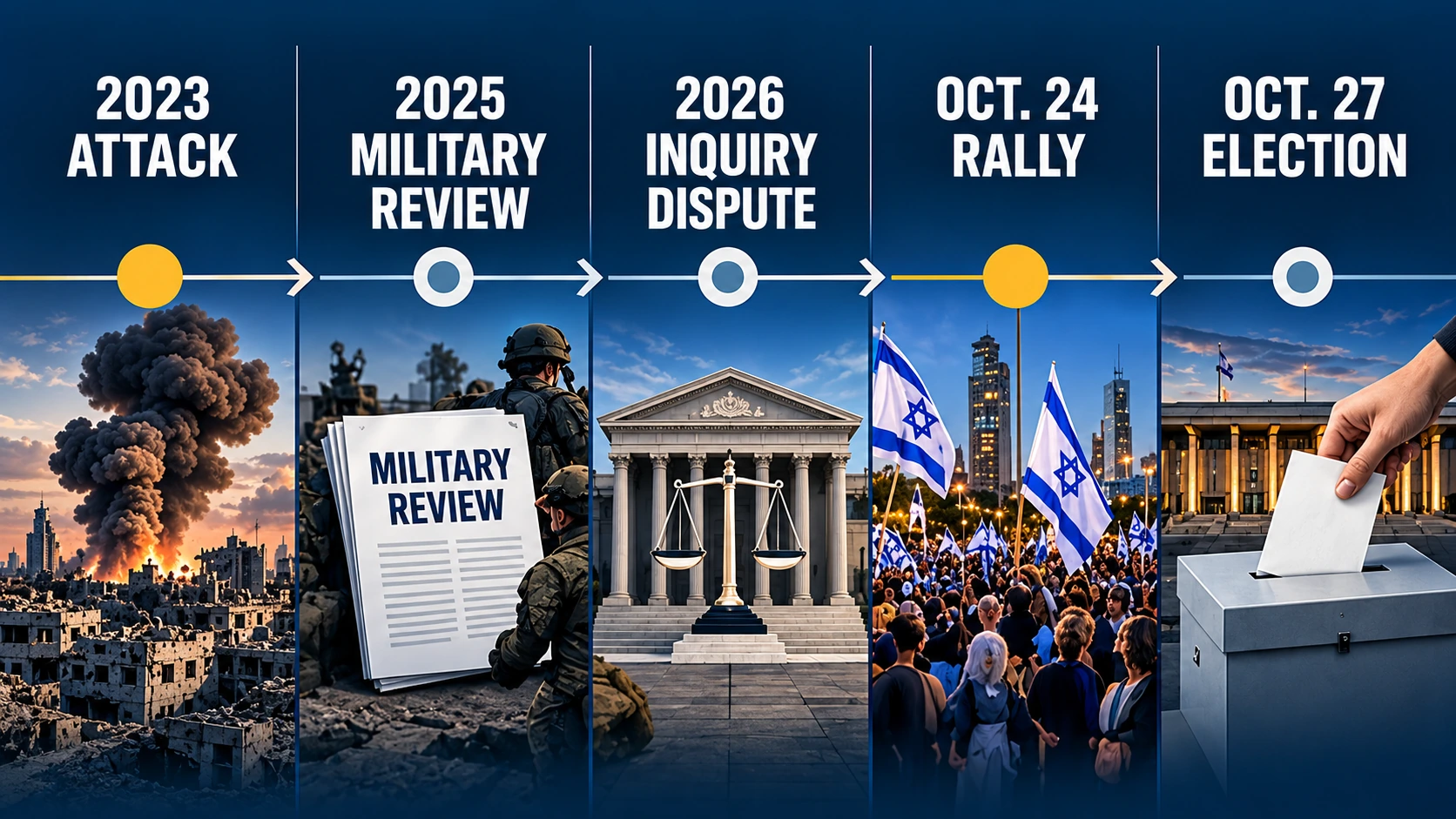
How the investigation dispute developed
| Date | What happened |
|---|---|
| October 7, 2023 | Hamas-led attackers struck southern Israel, exposing major security failures. |
| February 27, 2025 | An Israeli military investigation acknowledged significant failures in protecting civilians. |
| July 6, 2026 | The Knesset approved an alternative state-national commission bill in its first reading; the Knesset reported the vote on July 7. |
| September 23, 2026 | Israel’s High Court deferred a decision on the inquiry dispute until after the election. |
| October 24, 2026 | Thousands rallied in Tel Aviv demanding the traditional independent state commission. |
| October 27, 2026 | Israelis are scheduled to elect a new Knesset. |
The July legislative proposal was not enacted before the parliamentary term ended. In September, the High Court gave the government until January 15, 2027, to update it on how the October 7 failures would be investigated. (Knesset · The Times of Israel)
This timeline reveals something important.
Israel is not choosing between examining October 7 and forgetting about it entirely. The dispute concerns the authority, independence, and scope of a future national investigation.
What Makes a State Commission of Inquiry Different?
A traditional Israeli state commission of inquiry is an independent investigative body created under a specific legal framework.
The government generally decides to establish it, but the president of Israel’s Supreme Court appoints its members.
The government defines the broad subject of the investigation. The commission then conducts its work independently and has legal powers to require testimony and documents.
That arrangement is intended to prevent the officials under investigation from selecting the people who will judge their conduct. (Israeli Judicial Authority · Library of Congress)
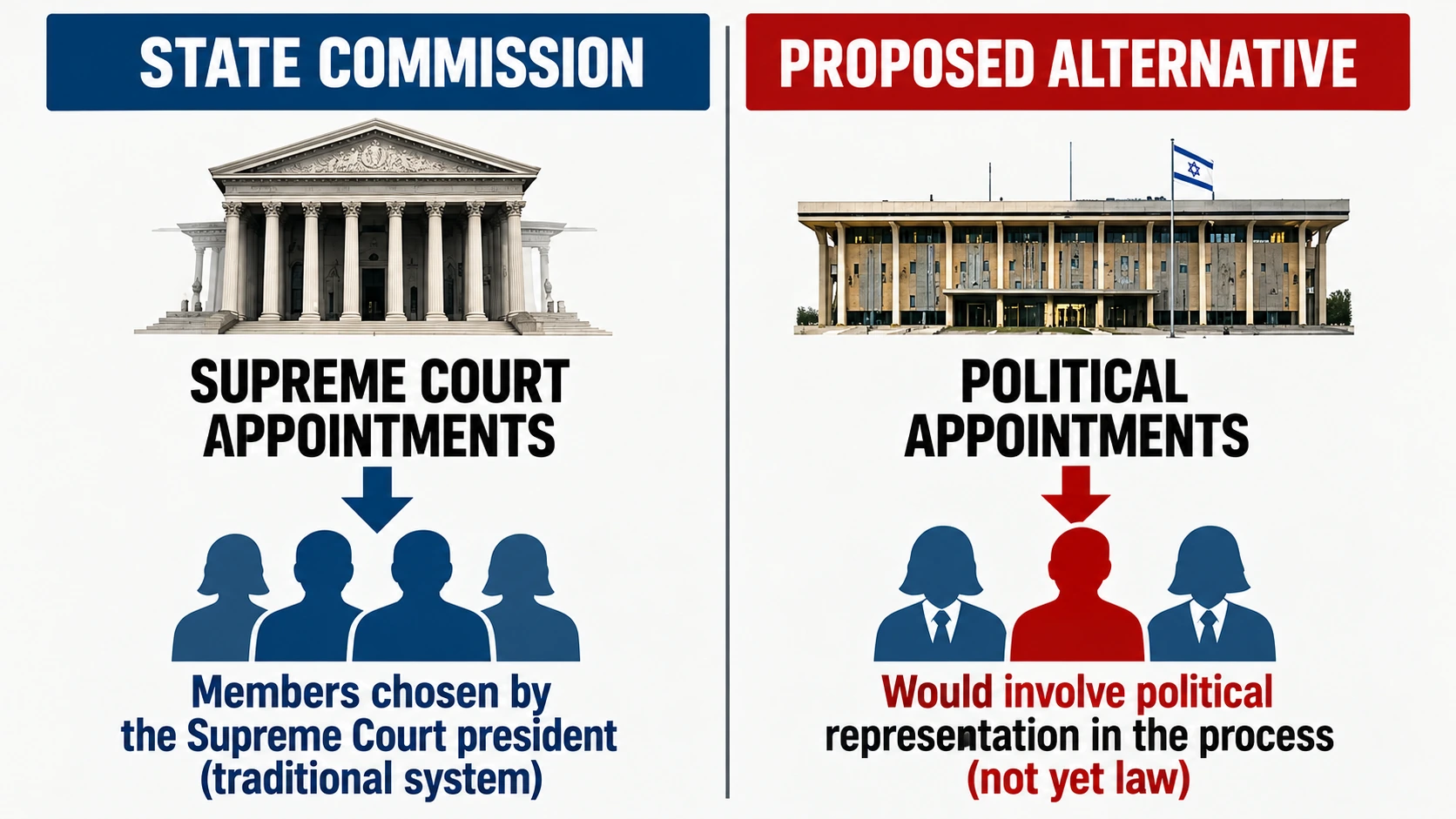
Two different approaches to investigating the same disaster
| Question | Traditional state commission | Proposed alternative commission |
|---|---|---|
| Who establishes it? | Government decision or, in certain cases, a Knesset committee | Special legislation |
| Who chooses its members? | President of the Supreme Court | Political appointment mechanism involving lawmakers |
| Who directs the inquiry? | An independent commission within its legal mandate | A commission whose mandate would be more directly shaped by political authorities |
| What is the central concern? | Supporters emphasize independence; opponents question perceived judicial bias | Supporters emphasize political representation; critics warn of political influence |
| October 2026 status | Existing legal mechanism, not established for October 7 | Proposed legislation not enacted |
The proposed alternative included provisions intended to give representatives of the governing coalition and opposition roles in choosing the commission.
Its supporters argued that a politically balanced arrangement could produce an investigation accepted by a broader cross-section of Israelis.
Critics, including legal scholars at the Israel Democracy Institute, warned that political appointments and government influence over the commission’s mandate could compromise independence. (Knesset · Israel Democracy Institute)
The distinction is especially important because an inquiry is not simply a public discussion.
A state commission can compel witnesses to testify, examine official records, establish findings, and recommend changes in institutions or public leadership.
Its recommendations can carry substantial political weight, even though they do not automatically remove an official from office or constitute criminal convictions.
Think of the difference between a company investigating an operational failure internally and an outside panel examining decisions made by the company’s senior leadership.
Both may uncover useful information. But who selects the investigators can affect public confidence in the findings.
Why Has Netanyahu Opposed the Traditional Commission?
Netanyahu’s principal objection concerns the judicial appointment process.
He has argued that an investigative panel whose members are chosen by the Supreme Court president would lack the political neutrality necessary to gain broad public acceptance.
He and his allies have instead supported an arrangement involving representation from different political camps.
In January 2026, Netanyahu argued that his proposed model would allow both government and opposition representatives to participate in selecting investigators and would give the commission broad authority to ask questions.
His critics rejected the premise that political selection would make the investigation more credible. (The Times of Israel)
The disagreement can be understood as two competing views of legitimacy.
One emphasizes a commission whose investigators are selected outside the political system.
The other emphasizes an appointment process that includes political representation and aims to avoid perceptions of judicial bias.
For the families demanding the traditional commission, however, the central concern is that officials responsible for national security decisions should not have substantial influence over the investigators examining those decisions.
It is also important to separate political criticism from established legal findings.
The absence of a state commission’s findings does not itself establish that Netanyahu or any particular official committed a crime.
Nor does the military’s acknowledgment of its own failures resolve every question about decisions made at the political level.
An independent commission could investigate failures across the government, intelligence services, and military, and assess how their decisions interacted.
That is why the choice of investigative mechanism has become politically contentious.
Why Does Israel’s Election Matter So Much to This Investigation?
Israel’s October 27 election could affect whether the next government establishes an independent commission. But the election does not automatically create one.
Israeli voters do not directly elect the prime minister in a separate presidential-style contest.
They vote for party lists, and seats in the 120-member Knesset are distributed through a proportional system.
A party list must receive at least 3.25% of valid votes to qualify for parliamentary seats. A governing coalition needs the support of a majority in the Knesset—at least 61 seats—to secure a vote of confidence. (Library of Congress · Knesset)
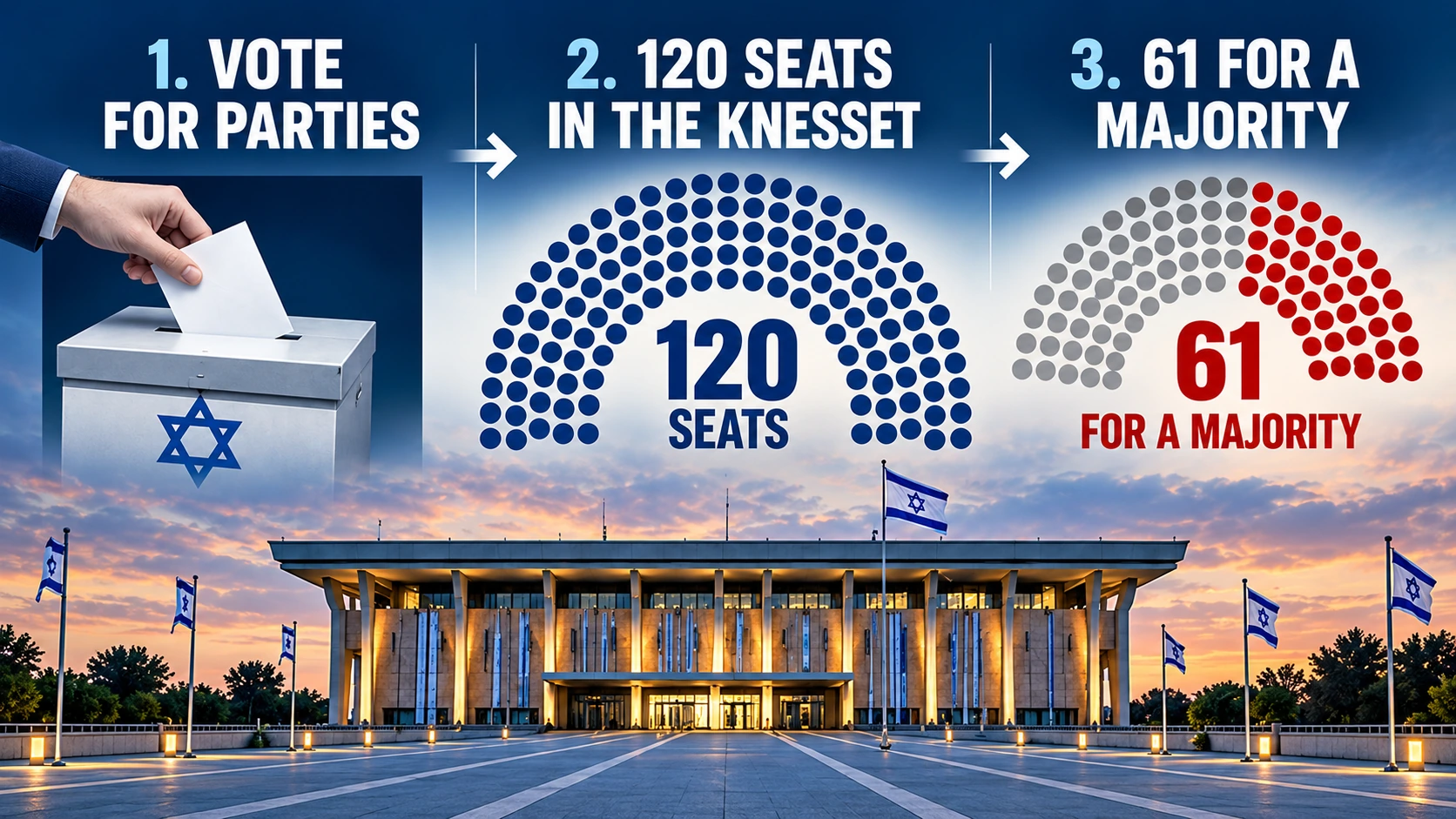
This system means the party receiving the most votes does not necessarily form the government.
A leader must assemble sufficient parliamentary support, often through negotiations involving several parties.
Netanyahu’s Likud party has governed alongside right-wing and ultra-Orthodox partners. Opposition figures include Eisenkot, Bennett, Lapid, Golan, and Liberman, whose parties represent different political positions and priorities.
Several opposition parties have committed themselves to establishing a state commission of inquiry if they enter government. But those promises would still have to be translated into decisions by a government capable of functioning together. (AP · Ynet)
And the October 7 investigation is not the only issue dividing voters.
The election also involves military-service exemptions for ultra-Orthodox men, judicial powers, economic pressures, the direction of Israeli security policy, and the consequences of the war in Gaza.
For that reason, a vote for a particular party cannot always be interpreted as a vote exclusively for or against a specific investigation.
Still, the composition of the next governing coalition could determine whether the traditional commission is established, replaced by another approach, or delayed further.
Could the Court Order an Investigation After the Election?
Legal pressure will continue regardless of the election result.
Israel’s High Court has considered petitions seeking to require the government to establish a state commission of inquiry.
In April 2026, the court criticized the government’s failure to adopt an appropriate mechanism for investigating the October 7 disaster and drawing lessons from it.
The legal question is complicated because the government normally has broad discretion to decide whether to establish a commission. Judicial intervention in that decision has historically been limited.
Israel’s attorney general supported an independent state commission as the appropriate investigative mechanism, but also argued that the decision should be taken by the government formed after the election.
On September 23, 2026, the court postponed further consideration and gave the government until January 15, 2027, to provide an update. (Library of Congress · The Times of Israel)
That means two separate developments matter after October 27.
First, which parties can form a governing coalition, and what investigative commitments become part of its governing program.
Second, whether the government establishes a credible investigation before the court again addresses the petitions.
Neither the election nor the court’s September decision guarantees a particular outcome.
Why Should Americans Care About Israel’s Investigation Debate?
For Americans, Israel’s election is about more than another country’s domestic politics.
The United States and Israel maintain extensive security cooperation. American decisions about military assistance, weapons sales, regional diplomacy, and Iran are closely connected to the policies of Israel’s government.
A July 2026 Congressional Research Service report described the relationship as a longstanding strategic partnership involving substantial U.S. assistance and cooperation on regional security. (Congressional Research Service)
The October 7 investigation could also influence how Israeli institutions assess intelligence warnings, military readiness, and civilian oversight.
Those findings would matter beyond Israel because American policymakers work closely with Israeli counterparts on regional security.
An investigation would not automatically change U.S. policy. Nor would a change of government necessarily produce an immediate change in Israel’s military or diplomatic priorities.
But decisions made by Israel’s next government could affect its relations with Washington, its approach to Gaza and the Palestinians, and its broader security posture.
For American readers, the practical questions are therefore whether Israel’s next coalition changes course on the investigation—and whether any resulting findings lead to concrete institutional reforms.
Bottom Line: What This Story Really Means
Israel’s October 27 election is taking place under the shadow of October 7, 2023.
Three years after the attack, Israel has uncovered important military failures but has not established the comprehensive independent state commission demanded by many survivors, bereaved families, and opposition figures.
The controversy is not simply about whether an investigation should happen.
It is about who gets to investigate the country’s leadership, how independent that investigation will be, and whether its conclusions can command public confidence.
Netanyahu argues that the traditional process for selecting investigators would produce a biased commission. His opponents and many affected families argue that political control over the process would undermine its credibility.
The election could change who makes that decision. Coalition negotiations and pending court proceedings will help determine what happens afterward.
And for the people who lost loved ones on October 7, the question remains whether the country will produce a full, credible account of how the disaster became possible.
Israel Election 2026: Key Questions Explained
Q. When is Israel’s next election?
Israel’s parliamentary election is scheduled for October 27, 2026. Voters will elect representatives to the 120-member Knesset.
Q. What happened at the October 24 protest in Tel Aviv?
Thousands gathered at Hostages Square to demand an independent investigation into the October 7, 2023, security failures. Opposition political figures also attended.
Q. Has Israel already investigated the October 7 attack?
Yes. Military and other official investigations have examined aspects of the failures. However, a comprehensive independent state commission covering the broader political and security leadership has not been established.
Q. Who appoints the members of an Israeli state commission of inquiry?
The president of Israel’s Supreme Court appoints the members after the commission is established under the applicable legal framework. This is intended to preserve independence from political authorities.
Q. Why does Netanyahu oppose the traditional commission?
Netanyahu argues that investigators appointed through the Supreme Court leadership would be politically biased. He has favored an alternative process involving representation from both the governing coalition and opposition.
Q. Did Netanyahu’s alternative commission proposal become law?
No. A proposal advanced through the Knesset in 2026, but it was not enacted before the parliamentary term ended.
Q. How many Knesset seats are needed to form a government?
A governing coalition needs the support of at least 61 members of the 120-seat Knesset to obtain a majority vote of confidence.
Q. Would an independent commission automatically remove Netanyahu from office?
No. A state commission may make findings and recommendations, including personal recommendations concerning officials, but these do not automatically constitute criminal convictions or remove someone from office.
Q. Can Israel’s Supreme Court force the government to investigate October 7?
The court can review the government’s handling of the issue, but the government’s discretion over establishing inquiries raises complex legal questions. Further consideration has been deferred until after the election.
Q. What is the next important date after the election?
January 15, 2027, is the deadline the High Court set for a government update on how the October 7 failures will be investigated. Political decisions by a newly formed government could come earlier.
Did this help make the story clearer? 🙂
WIN keeps unpacking the “why” behind the news—clearly and simply!
Sources
October 24 Protest and Election Developments
AP — Israelis Hold Final Rally Against Netanyahu Before Election
The Times of Israel — Mass Rally Demands October 7 Inquiry Ahead of Election
Ynet — Tens of Thousands Gather for October 7 State Inquiry
AP — Key Parties in Israel’s October 27 Election
October 7 Investigations and the Legal Dispute
Reuters — Israeli Military Inquiry Finds Failures to Protect Civilians
Library of Congress — Legal Dispute Over the October 7 Commission of Inquiry
Israeli Judicial Authority — State Commissions of Inquiry
Knesset — First Reading of the Proposed State-National Commission Bill
Israel Democracy Institute — State Commissions and Politically Appointed Alternatives
The Times of Israel — High Court Delays Inquiry Decision Until After Election
Election System and U.S. Relations
Library of Congress — Israel’s October 27, 2026 Election Explained
Israeli Knesset — Distribution of Parliamentary Seats
Congressional Research Service — Israel: Major Issues and U.S. Relations
Keep Reading
How did October 7 change the international debate over Netanyahu’s leadership?
The inquiry debate concerns Israel’s internal accountability, while Netanyahu’s recent U.N. address highlights the international criticism that followed the October 7 attack and the war in Gaza.
Why Did U.N. Delegates Walk Out on Netanyahu—and What Did the Protest Actually Mean?