Why Is DoorDash Trying to Buy Instacart—and Could Delivery Get More Expensive?

DoorDash already delivers groceries. So why would it consider spending billions of dollars to buy Instacart, a company that does much of the same thing?
At first, the idea seems a little strange. You can open DoorDash, order dinner, and add groceries from a nearby supermarket. Instacart also lets you order groceries from stores around your neighborhood. Both companies connect customers with people who shop for or deliver their orders.
But buying Instacart could give DoorDash something much more valuable than another delivery app: deeper relationships with grocery retailers, a substantial shopping technology business, and greater influence over how Americans order everyday essentials.
On October 26, 2026, reports emerged that DoorDash was in advanced negotiations to acquire Instacart in a transaction potentially valued at about $17 billion. Semafor separately reported that the talks were exclusive. Neither report established that an acquisition agreement had been signed. (Reuters · Semafor)
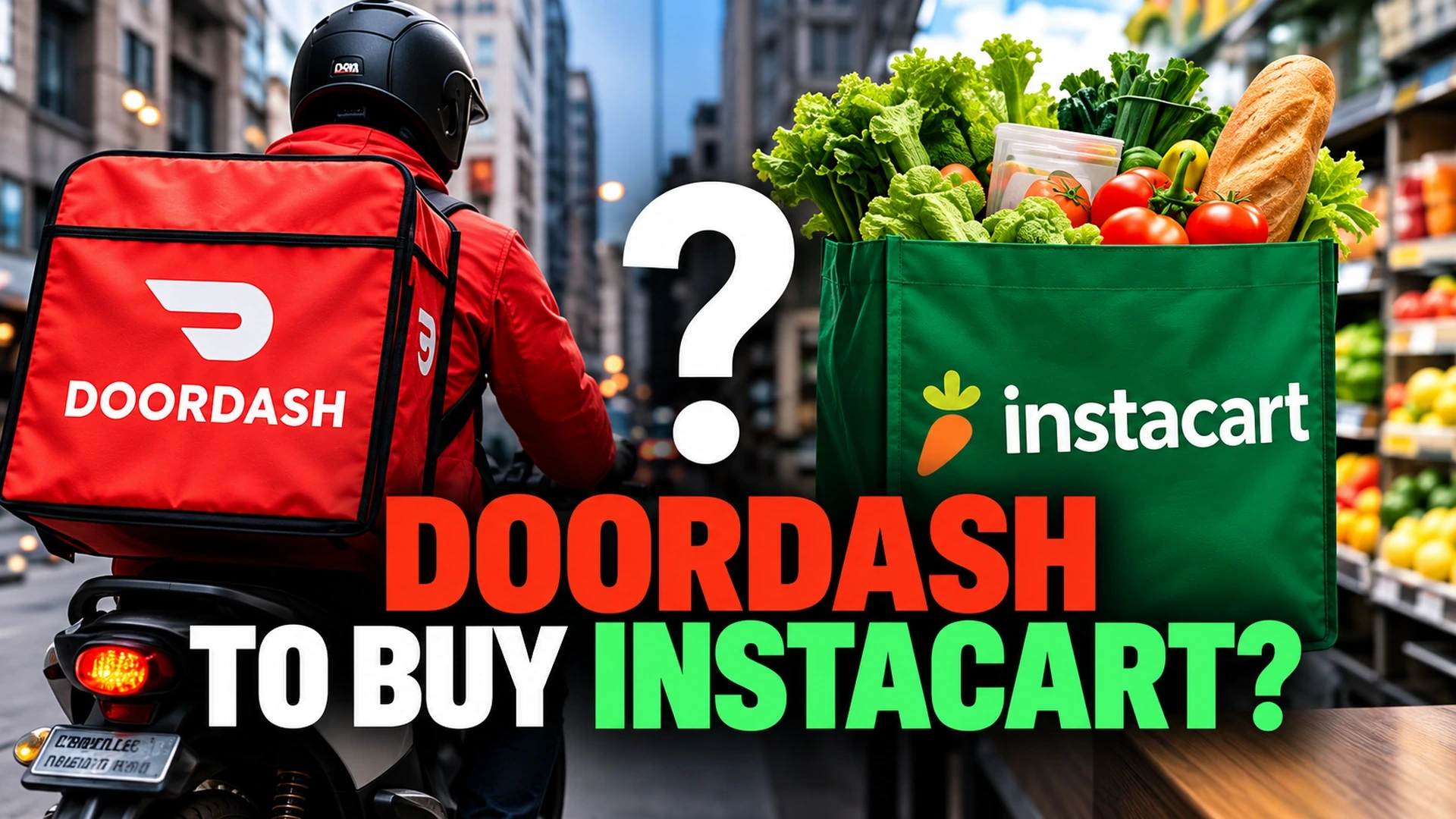
※ Images in this article are AI-generated illustrations created to help explain the story. They are not actual photographs, and depictions of people, places, or events may differ slightly from reality.
That distinction matters. Nothing has changed about the ownership of either company simply because acquisition talks have been reported.
Still, the possibility raises a question for millions of households that rely on delivery services: Would combining two major platforms make shopping easier and cheaper—or eventually leave customers with fewer choices and higher fees?
The answer depends on why DoorDash wants Instacart, how the companies compete today, and what a potential merger would actually change.
How Close Is DoorDash to Buying Instacart?
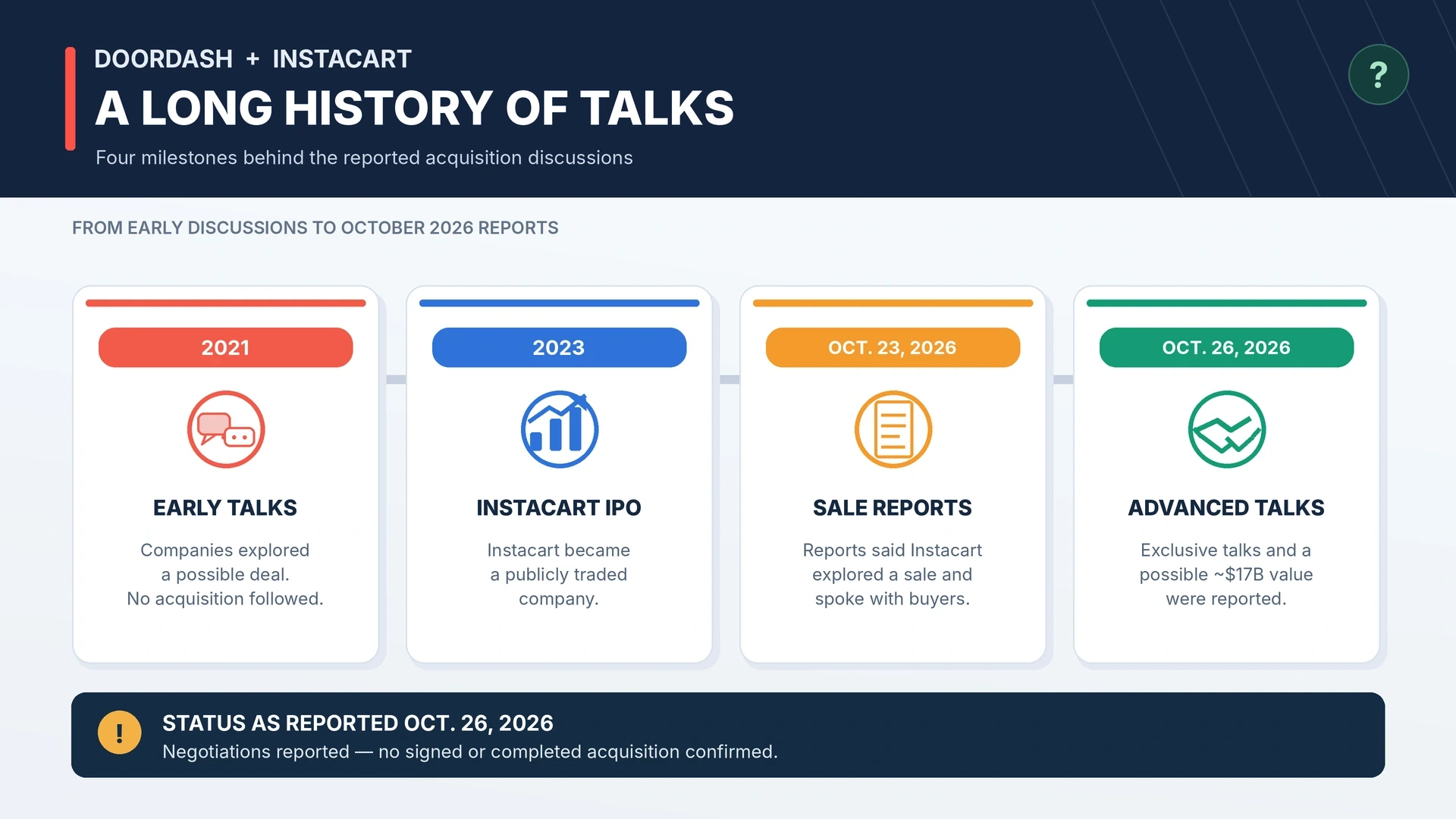
DoorDash and Instacart are reportedly negotiating a possible acquisition, but the transaction is not confirmed. Advanced talks can lead to an agreement, but they can also end without one.
According to Reuters, a person familiar with the negotiations said a transaction could value Instacart at approximately $17 billion and might be finalized as early as Wednesday, October 28. That was a possibility reported by the source—not an announced closing date.
Semafor reported exclusive talks but said the actual price and transaction structure could not be established from its reporting. (Reuters · Semafor)
How Did the Companies Get Here?
| Date | What happened |
|---|---|
| 2021 | DoorDash and Instacart reportedly explored a potential deal, but discussions did not produce an acquisition. |
| September 2023 | Instacart became a publicly traded company. |
| October 23, 2026 | The Information reported that Instacart was exploring a sale and had held discussions with DoorDash and Uber. |
| October 26, 2026 | Reports described advanced DoorDash-Instacart negotiations, with Semafor reporting exclusive talks and Reuters citing a possible $17 billion valuation. |
The earlier discussions are especially interesting.
In 2021, Instacart was attracting valuations dramatically higher than those being discussed today. The Information reported that previous potential transaction values had reached roughly $40 billion to $50 billion.
Those negotiations did not result in a deal, with valuation disagreements and regulatory concerns among the reported obstacles. (The Information)
This helps explain why the current negotiations are attracting attention: DoorDash may now have an opportunity to acquire a major grocery-delivery competitor at a substantially lower valuation than was discussed five years ago.
But the price is not the only reason an acquisition might make sense.
Why Does DoorDash Want Instacart When It Already Delivers Groceries?
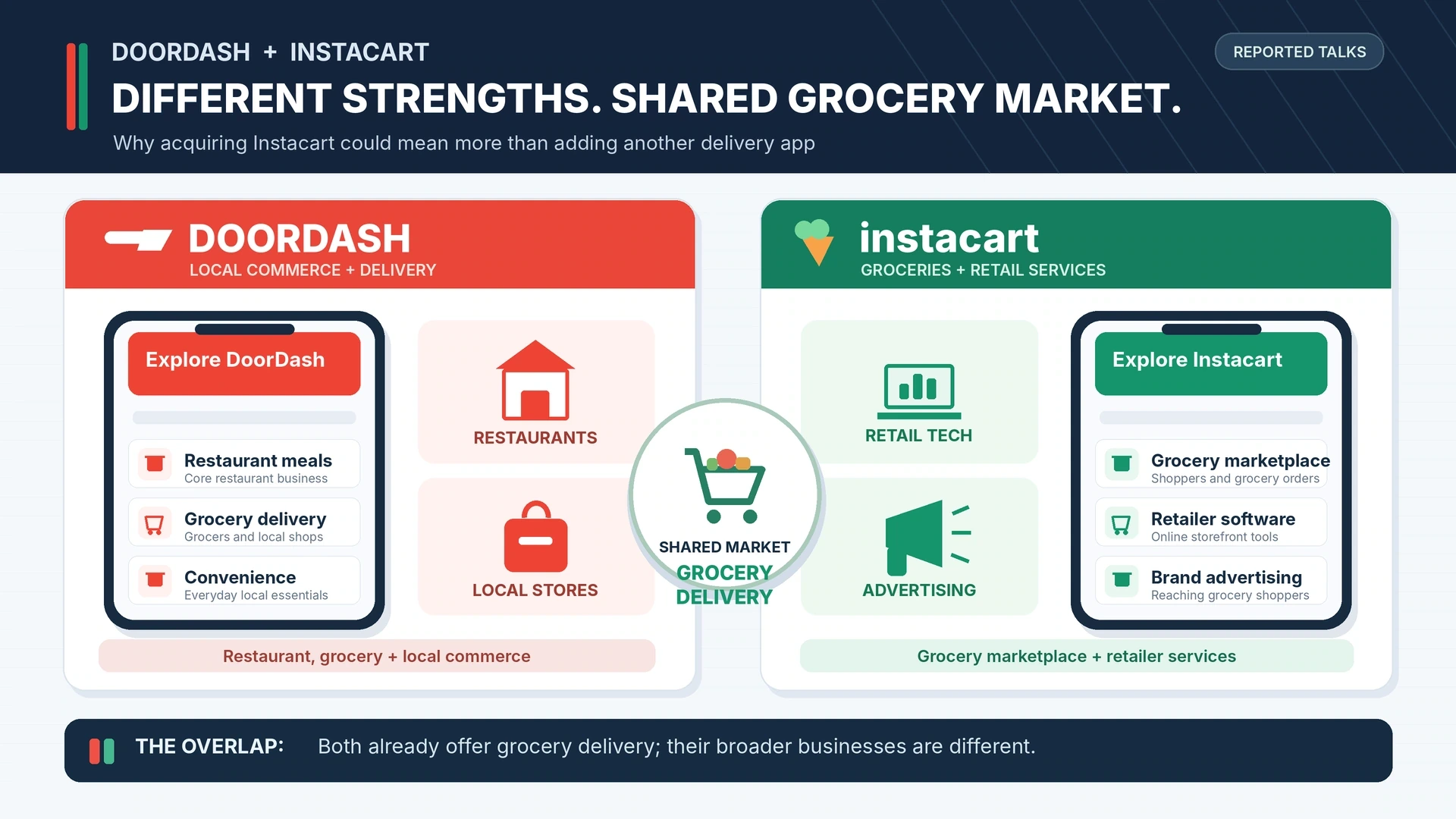
DoorDash could gain Instacart’s grocery relationships and technology while expanding a business it has already been trying to grow.
DoorDash built its name around restaurant deliveries, but it has spent years expanding into groceries, convenience stores, and other forms of local shopping.
Instacart began with a different focus: helping people shop at supermarkets without visiting the stores themselves.
Over time, Instacart also developed technology that retailers can use to manage online shopping, along with advertising tools that help consumer brands reach shoppers.
That creates an unusual combination of overlap and complementary businesses.
| Business area | DoorDash | Instacart |
|---|---|---|
| Original strength | Restaurant delivery | Grocery shopping and delivery |
| Grocery operations | Grocery and retail delivery marketplace | Established grocery-focused marketplace |
| Retailer relationships | Restaurants, grocery stores, and other merchants | Grocery chains and a growing range of retailers |
| Additional services | Delivery logistics, memberships, advertising, and merchant technology | Retailer e-commerce software, advertising, and shopping technology |
Both companies already compete for grocery orders. But Instacart also operates businesses that reach beyond its consumer app.
DoorDash’s second-quarter 2026 results illustrate how important its move into groceries has become.
The company reported that DashPass subscribers generated approximately 75% of orders in its U.S. grocery and retail categories during the quarter. That demonstrates how its existing membership program is already encouraging customers to shop for more than restaurant meals. (DoorDash Investor Relations)
The attraction for DoorDash is therefore not simply adding grocery delivery.
It could be about controlling more of the relationship between customers, supermarkets, brands, and the technology connecting them.
What Would DoorDash Actually Get for a Reported $17 Billion?
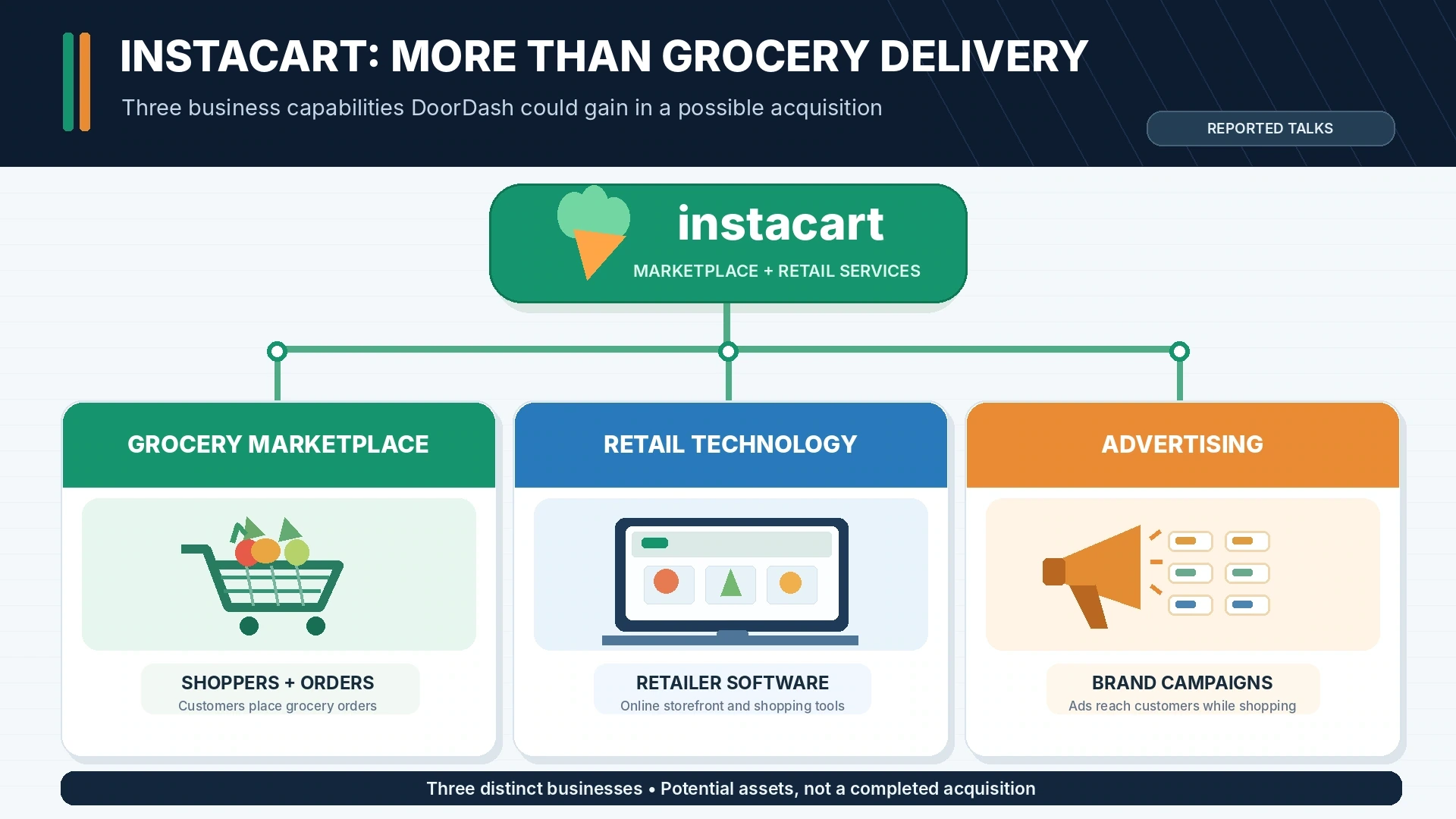
Instacart is more than an app that dispatches shoppers to grocery stores.
It operates a marketplace where consumers place orders, technology services for retailers, and an advertising business that connects brands with people making purchasing decisions.
That last part can be easy to overlook.
Consider someone opening a grocery app to buy breakfast cereal. The shopper may be choosing between several brands while already planning to make a purchase. An advertiser could pay to make one brand more visible at that moment.
For consumer goods companies, this can be an attractive place to advertise because the customer is close to checkout rather than simply browsing entertainment or social media.
Instacart’s financial results show how significant the business has become.
Instacart’s Second-Quarter 2026 Results
| Metric | Reported result |
|---|---|
| Gross transaction value | $10.35 billion |
| Orders | 90.3 million |
| Total revenue | $1.04 billion |
| Advertising and other revenue | $297 million |
| GAAP net income | $111 million |
Source: Instacart’s August 6, 2026 earnings release.
Gross transaction value represents the value of transactions handled through the platform, not the amount Instacart keeps as revenue.
That difference matters. A marketplace can process billions of dollars in purchases while retaining only a portion through fees and other services.
Instacart’s $297 million in advertising and other revenue also shows that the company has a meaningful revenue stream outside its core transaction business.
For DoorDash, an acquisition could potentially create opportunities to combine advertising capabilities, improve merchant technology, and encourage more customers to use its services for everyday purchases.
The potential prize is not just more deliveries. It is a larger share of the businesses surrounding those deliveries.
Of course, whether the companies could successfully integrate those operations is a separate question.
If Instacart Is Profitable, Why Would It Consider Selling?
A profitable company can still decide that selling to a larger competitor offers a better future than remaining independent.
Instacart reported positive net income and 14% year-over-year revenue growth for the second quarter of 2026. That does not fit the picture of a company being forced into a sale by immediate financial collapse. (Instacart Investor Relations)
Instead, the strategic question is how Instacart can compete as powerful companies expand further into online groceries.
Walmart and Amazon already have extensive retail operations, large customer bases, and distribution networks. DoorDash and Uber have also been competing more aggressively for grocery deliveries.
An independent platform must keep investing to attract customers, maintain retailer relationships, improve technology, and compete on price.
A sale could give Instacart shareholders an immediate opportunity to receive a takeover premium while placing the business inside a larger delivery company.
That is a possible financial rationale, not a confirmed explanation from Instacart’s management.
Why Would Shareholders Care About the Reported Price?
Reuters reported that Instacart had a market value of approximately $13 billion before the latest advanced-deal reports and that discussions involved a potential valuation of about $17 billion. (Reuters)
An acquirer often pays more than a target company’s unaffected stock market value to persuade shareholders to sell.
This additional amount is called a takeover premium.
But the final benefit to shareholders would depend on the price per share, whether payment involves cash or stock, and any conditions attached to the agreement.
The reported $17 billion is not a confirmed cash payment, an agreed purchase price, or money that has already changed hands.
Instacart’s shareholders are also not the only people who would have a stake in the outcome.
The most immediate question for customers is whether combining the companies would change the amount they pay at checkout.
Could a DoorDash-Instacart Merger Make Grocery Delivery More Expensive?
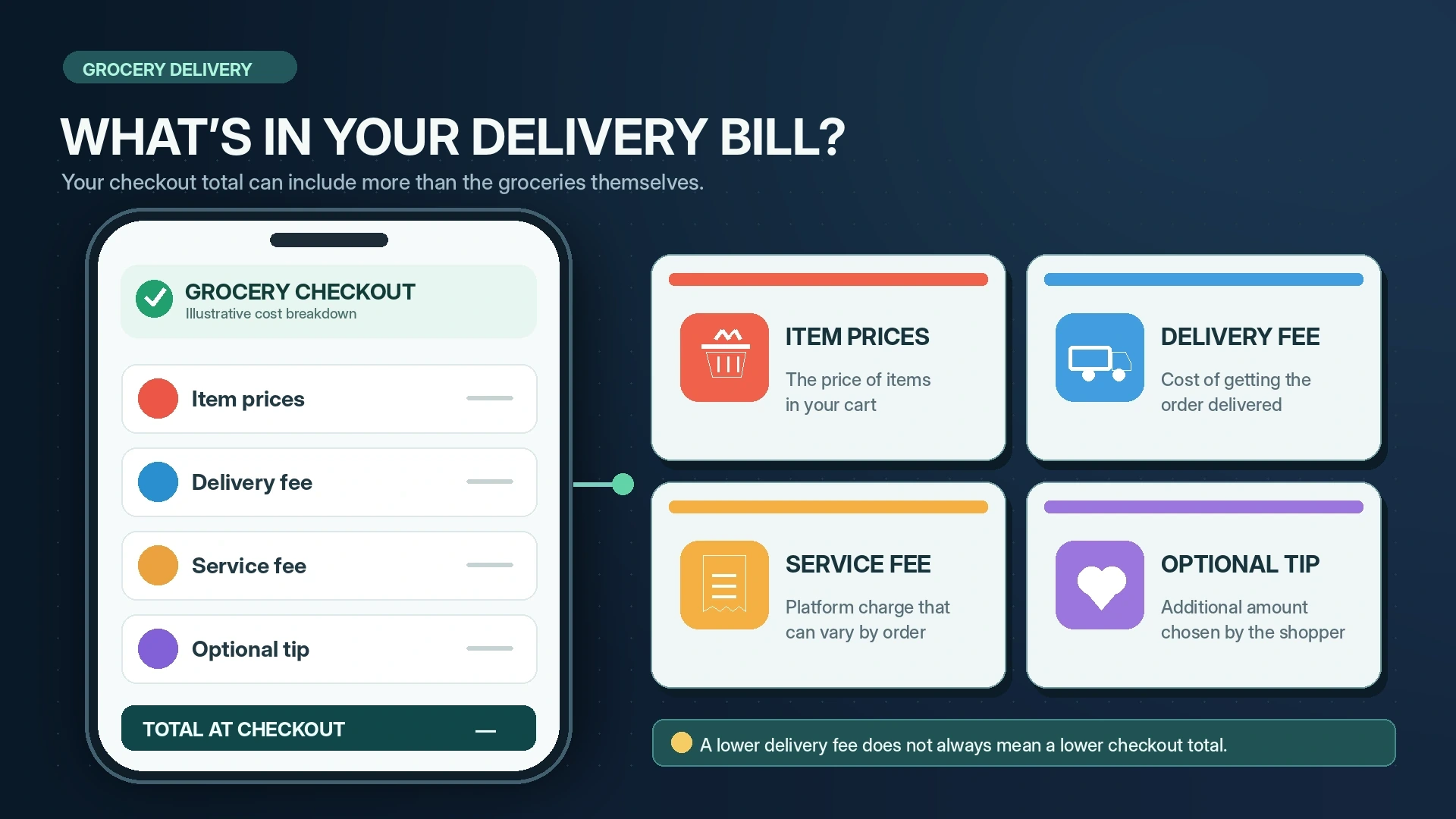
A merger could eventually affect delivery prices, but higher fees would not be an automatic or immediate consequence.
The concern is straightforward: when two competing companies combine, customers may have fewer independent alternatives.
If fewer platforms compete for the same grocery order, the surviving businesses could face less pressure to offer discounts or keep fees low.
But combining delivery operations might also improve efficiency, allowing a company to make deliveries at lower cost.
Neither outcome is guaranteed.
To understand what might change, it helps to separate the different parts of a delivery bill.
| Part of your bill | What determines it |
|---|---|
| Grocery item prices | Retailer pricing policies and available promotions |
| Delivery fee | Platform rules, store, order characteristics, and delivery conditions |
| Service fee | Platform pricing structure and applicable order factors |
| Tip | Customer’s optional payment to the shopper or driver |
| Membership benefits | Eligibility rules and discounts under a subscription program |
These charges are not interchangeable.
For example, a $0 delivery fee does not necessarily mean the entire delivery costs nothing beyond the groceries.
Instacart explains that delivery fees and service fees are separate. Its Instacart+ membership can eliminate delivery fees on qualifying orders while reduced service fees may still apply.
DoorDash similarly offers reduced fees through DashPass, subject to qualifying order and merchant conditions. (Instacart Help Center · DoorDash Help Center)
Grocery Prices Can Differ Even Before Delivery Fees
Another detail often surprises customers: the price displayed in a grocery delivery app is not always identical to the store’s shelf price.
Instacart states that retailers set item prices on its marketplace. Some use everyday in-store prices, while others may charge different prices through the platform.
The company provides retailer-specific pricing information in its app. (Instacart Item Pricing)
That means a shopper comparing DoorDash and Instacart should consider the final checkout total, not just the advertised delivery fee.
A cheaper delivery fee might be offset by higher item prices, a different service fee, or fewer available promotions.
Could a Bigger Company Reduce Costs Instead?
Possibly.
A larger delivery operation might be able to combine technology, reduce duplicated expenses, or use an extensive courier network more efficiently.
DoorDash has already been adjusting its fee structure independently of the reported Instacart negotiations. In July 2026, it announced changes designed to connect service fees more closely to factors such as delivery distance and order size. The company said its analysis suggested many recent orders would have faced the same or lower fees under the revised structure. (DoorDash)
Whether an acquisition would create additional savings—and whether those savings would reach consumers—would depend on decisions made after a deal.
There is no announced combined fee schedule or confirmed merger-related price change.
For now, predicting that grocery bills will rise by a particular percentage would be speculation.
Would the Merger Reduce Competition—or Help DoorDash Challenge Amazon and Walmart?
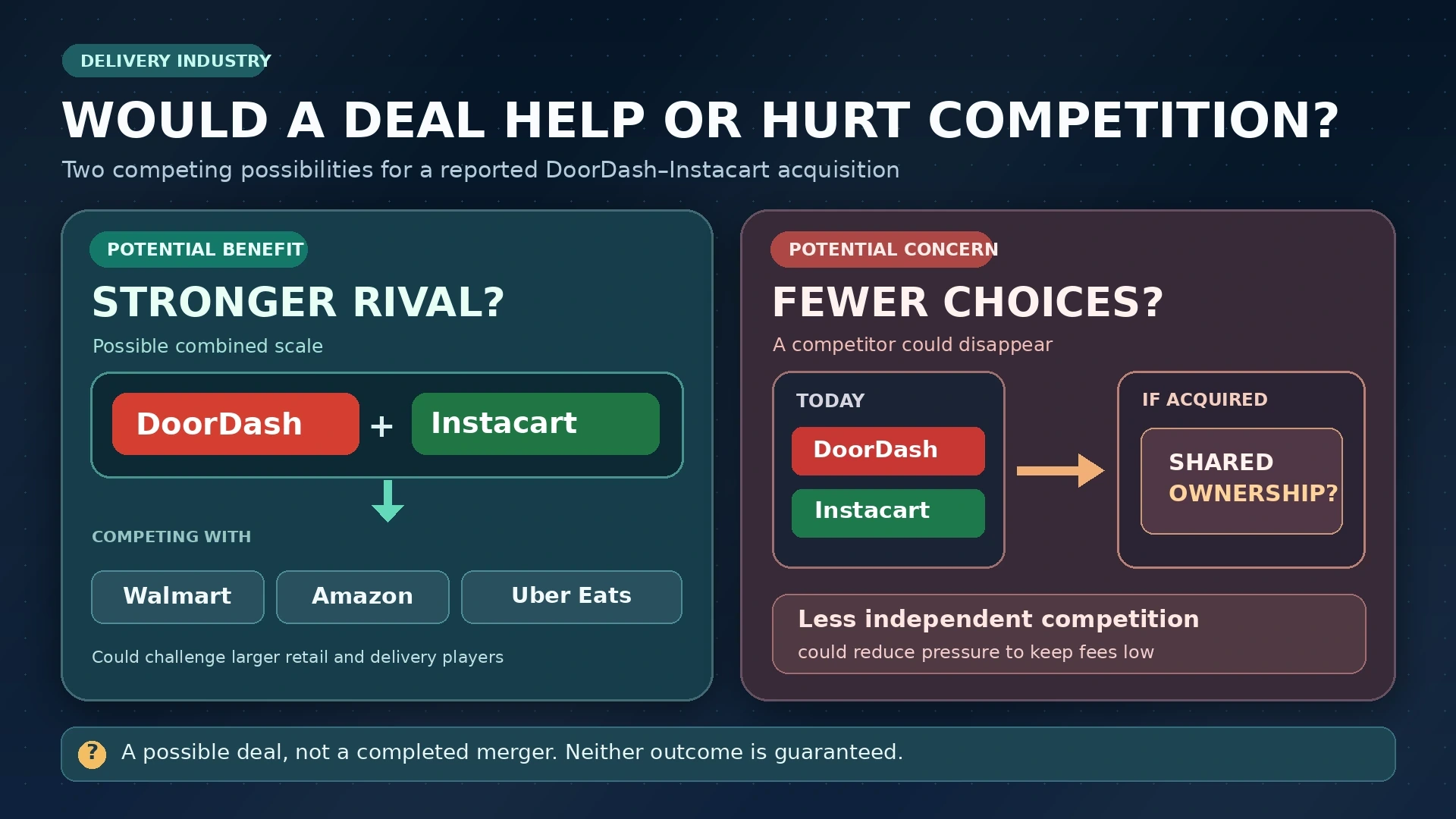
This is the central competition question: Would the acquisition create a stronger challenger to retail giants, or remove an important independent competitor?
Both possibilities deserve consideration.
From DoorDash’s perspective, acquiring Instacart could help it compete with companies that already enjoy considerable advantages in grocery retail.
Walmart operates its own enormous store network. Amazon combines online retail with delivery infrastructure and grocery operations.
DoorDash and Instacart rely heavily on connections between retailers, customers, and delivery workers.
Combining their strengths could give the businesses more resources to challenge those larger competitors.
Yet there is another side to the argument.
DoorDash and Instacart already compete for some of the same grocery orders. If one acquires the other, that independent rivalry could disappear.
Why Antitrust Review Could Matter
Under Section 7 of the Clayton Act, U.S. competition law prohibits acquisitions whose effects may substantially lessen competition or tend to create a monopoly.
The Federal Trade Commission and Department of Justice examine potential competitive harm, including whether a transaction would make it harder for customers or businesses to find meaningful alternatives. (FTC)
For a potential DoorDash-Instacart combination, important questions could include:
- How closely do the two platforms compete for grocery orders in particular markets?
- Would grocery stores have fewer independent delivery partners?
- Could smaller delivery platforms still compete effectively?
- Would customers retain meaningful choices on prices and service?
- Could combining retailer technology and platform relationships make it harder for rivals to enter or expand?
These are possible areas of inquiry, not findings that the proposed transaction violates antitrust law.
Why the Definition of the Market Matters
Imagine a neighborhood where residents can order groceries through Instacart, DoorDash, and Uber Eats.
If DoorDash acquires Instacart, two of those alternatives could become part of one corporate group.
That might weaken competition within that neighborhood.
Now imagine the same neighborhood also has substantial delivery choices through Walmart, Amazon, supermarket websites, and other providers.
That broader set of alternatives could affect the assessment.
The real analysis would require evidence about customer behavior, competitive constraints, and which services actually compete.
A large merger is not automatically illegal. But the existence of large competitors does not automatically make every consolidation harmless either.
No antitrust outcome has been established for the reported negotiations.
What Could Change for Grocery Stores, Delivery Workers, and Customers?
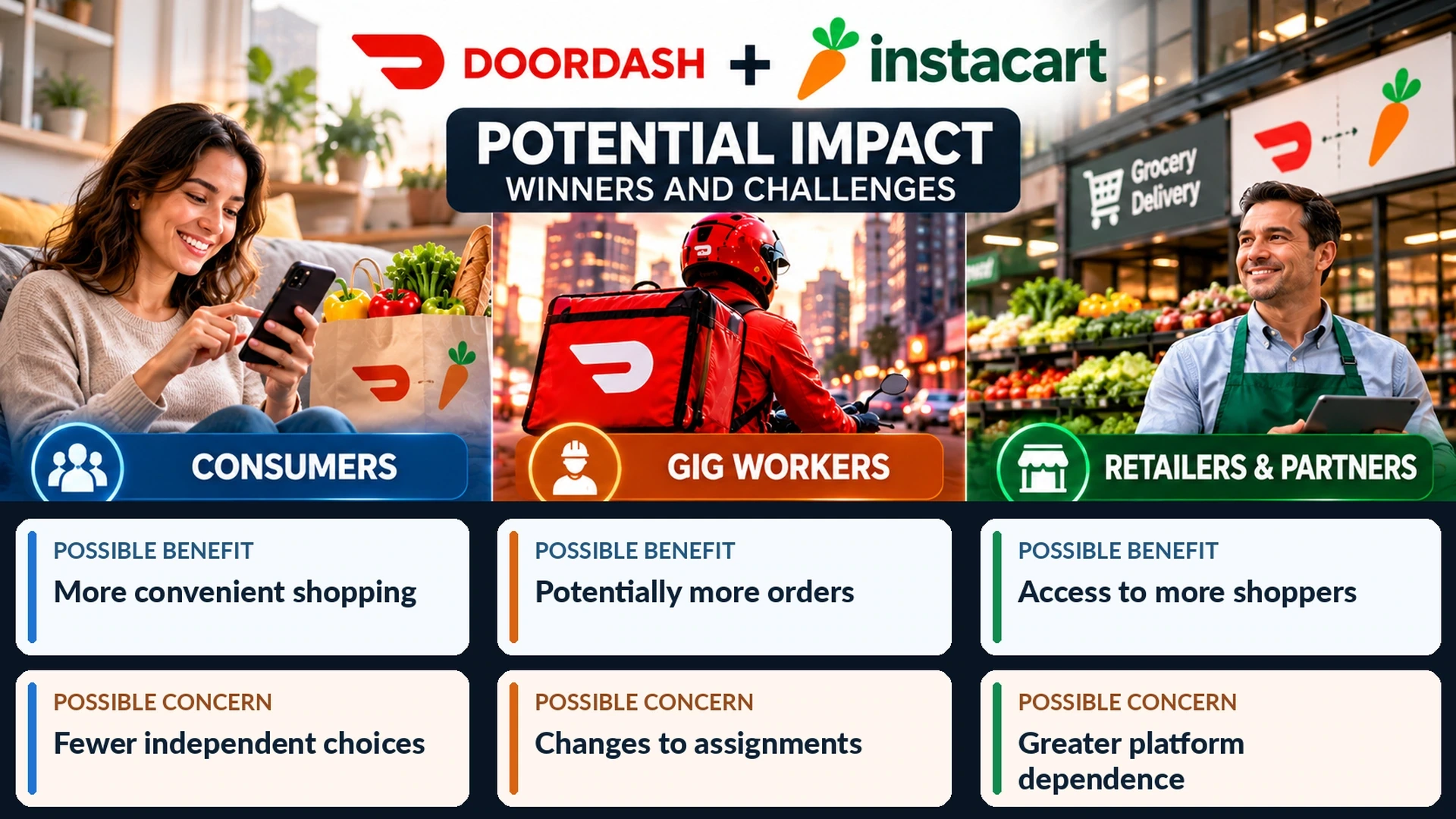
The effects of an acquisition would extend beyond investors and executives.
Delivery platforms connect several groups whose interests do not always align.
For Customers: More Convenience, but Potentially Less Choice
A combined business might eventually make it easier to order meals, groceries, and household products through connected services.
It might also create opportunities for more convenient membership benefits.
But those changes have not been announced.
Customers could instead find that two previously independent services are managed by the same company, making it more important to compare available alternatives.
For Grocery Stores: Broader Reach, but Greater Dependence
Supermarkets use delivery platforms to reach customers beyond their physical stores.
A larger network might help a retailer attract more online orders or improve fulfillment.
On the other hand, an independent grocery store may prefer having multiple competing delivery partners.
If fewer platforms control access to substantial numbers of customers, retailers could have less negotiating leverage over fees, promotions, and business arrangements.
The result would depend on the actual agreements and alternatives available to individual retailers.
For Delivery Workers: Operational Changes Are Possible
DoorDash couriers and Instacart shoppers do not always perform identical tasks.
A restaurant delivery might involve picking up an already prepared meal.
A grocery shopping order can involve selecting numerous products, communicating with customers about substitutions, and delivering the completed order.
A combined company would have to consider those differences when deciding whether and how to integrate operations.
That might create opportunities for more flexible work or better coordination. It could also change how assignments are distributed across the platforms.
There is no announced merger-related plan establishing changes to worker pay, job availability, or how orders would be assigned.
Those questions cannot be answered from the acquisition reports alone.
What Happens Next—and When Would Customers Notice a Difference?
The first development to watch is whether DoorDash and Instacart announce an actual acquisition agreement.
If they do, the announcement should provide more reliable information about the transaction price, payment structure, conditions, and expected timetable.
A signed agreement would be a major milestone, but signing a deal and completing an acquisition are two different events.
A transaction may require regulatory review and other closing conditions before ownership changes.
The possible sequence is straightforward:
| Stage | What it means |
|---|---|
| Acquisition talks | Companies are discussing a possible transaction. |
| Signed agreement | The companies formally agree to terms, subject to conditions. |
| Regulatory process | Applicable competition and other legal requirements are addressed. |
| Closing | Ownership changes after the required conditions are satisfied. |
| Integration | The companies decide how to organize products, technology, and operations. |
As of the October 26 reports, the publicly reported transaction remained at the negotiation stage.
That means customers should not assume that their accounts, subscriptions, grocery prices, or delivery options are changing because of the news.
If an agreement is announced, three practical details will matter most: how the companies plan to combine their services, whether independent choices remain available, and whether checkout prices or membership terms actually change.
The reported purchase price has grabbed investors’ attention.
For households, the more important number may eventually be the total at the bottom of a grocery receipt.
Bottom Line: What This Story Really Means
DoorDash’s reported interest in Instacart is about much more than purchasing another grocery delivery app.
DoorDash has already expanded beyond restaurants. Instacart could add established grocery relationships, retailer technology, advertising operations, and additional customers.
Together, those capabilities might allow a combined company to compete more effectively against Walmart, Amazon, and other major delivery providers.
But that same transaction could also eliminate competition between DoorDash and Instacart in services where they currently overlap.
For consumers, the real question is whether greater efficiency would translate into lower costs and better service—or whether fewer independent delivery platforms would eventually mean weaker price competition.
Neither result is inevitable.
More importantly, the acquisition itself remains unconfirmed. The reported $17 billion figure is a potential transaction valuation, not a completed purchase.
Until an agreement is announced and the terms become clear, the most useful response is to distinguish what has actually happened from what might happen next.
DoorDash Instacart Acquisition: Key Questions Explained
Q. Has DoorDash officially bought Instacart?
No. Reports on October 26, 2026, described advanced acquisition discussions, but did not establish that a final purchase agreement had been signed or that the acquisition had closed.
Q. How much could DoorDash pay for Instacart?
Reuters reported that the transaction under discussion could value Instacart at approximately $17 billion. The final price and payment structure had not been officially confirmed.
Q. Why would DoorDash buy another grocery delivery service?
Instacart offers more than grocery deliveries. Its retailer relationships, e-commerce technology, and advertising operations could help DoorDash expand its broader local-commerce business.
Q. Is Instacart losing money?
Not according to its latest reported quarterly results. Instacart reported $111 million in GAAP net income for the second quarter of 2026, alongside year-over-year revenue growth.
Q. Did Uber also try to buy Instacart?
Instacart reportedly held discussions with Uber during its exploration of a possible sale. Reuters reported on October 26 that Instacart’s talks with Uber were no longer active.
Q. Will DoorDash and Instacart delivery fees increase?
No merger-related fee increase has been announced. Future fees would depend on the companies’ decisions, competitive conditions, and any applicable regulatory requirements.
Q. Do DoorDash and Instacart charge the same prices for groceries?
Not necessarily. Grocery prices, service fees, delivery fees, and promotions can differ between platforms and retailers. Comparing the complete checkout total gives consumers a better picture of the cost.
Q. Could the government block a DoorDash-Instacart merger?
Potentially. U.S. antitrust authorities can challenge mergers that may substantially reduce competition. Whether this particular transaction would face a challenge depends on its final terms and competitive effects.
Q. Would DashPass and Instacart+ become one subscription?
There is no announced plan to combine those memberships. Any future changes would depend on whether a deal is completed and how the companies choose to operate their services.
Q. What should customers watch for next?
The most important development would be an official acquisition announcement. Details about regulatory review, platform integration, pricing, and membership benefits would help clarify the practical impact.
Did this help make the story clearer? 🙂 WIN keeps unpacking the “why” behind the news—clearly and simply!
Sources
Acquisition Negotiations and Transaction Status
Reuters — DoorDash in Talks to Buy Instacart in Roughly $17 Billion Deal, Source Says
Semafor — DoorDash in Exclusive Talks to Acquire Instacart
The Information — DoorDash Nears Deal to Buy Instacart in $17 Billion Deal
Company Financial Results and Business Strategy
DoorDash — Second Quarter 2026 Financial Results
Instacart — Second Quarter 2026 Financial Results
Consumer Fees, Grocery Prices, and Competition Law
DoorDash — Updating Fees to Better Match Delivery Effort
DoorDash — DashPass Membership Benefits
Instacart — Delivery Fees and Service Fees
Instacart — Item Pricing and Retailer Pricing Policies
Federal Trade Commission — Mergers and U.S. Antitrust Law
Keep Reading
Can Delivery-Worker Pay Rules Change What Customers Pay?
A potential acquisition could change competition among delivery platforms. An earlier New York City case explores a different influence on delivery costs: the rules governing how delivery workers are paid.
Why Is DoorDash Paying $131.5 Million—and Does Waiting for an Order Count as Paid Work?