Anthropic Reported $16.8 Billion in Q3 Revenue—Is It Really Profitable?

Sixteen-point-eight billion dollars in just three months.
For a company selling artificial intelligence, that sounds like an extraordinary amount of money. But if Anthropic is bringing in that much revenue, shouldn’t it already be making a substantial profit?
There is an important detail in the latest numbers.
On October 14, 2026, Anthropic reportedly told prospective investors that its third-quarter revenue had reached $16.8 billion, up approximately 45% from the previous quarter. The company also said it was profitable—but on an adjusted basis. (Reuters · Financial Times)
That distinction changes the question.
It would be wrong to say Anthropic had reported no profit. It would also be premature to treat its adjusted profit as proof of its final net earnings under standard accounting rules.
※ Images in this article are AI-generated illustrations created to help explain the story. They are not actual photographs, and depictions of people, places, or events may differ slightly from reality.
Anthropic is preparing for a potential initial public offering, or IPO, that could make its shares available to ordinary stock-market investors.
That makes the difference between revenue, adjusted profit, cash flow, and future spending more than an accounting technicality.
The real question is whether Claude, Anthropic’s AI platform, can keep generating enough money to support the enormous computing infrastructure behind it.
How Did Anthropic Reach $16.8 Billion in Quarterly Revenue?
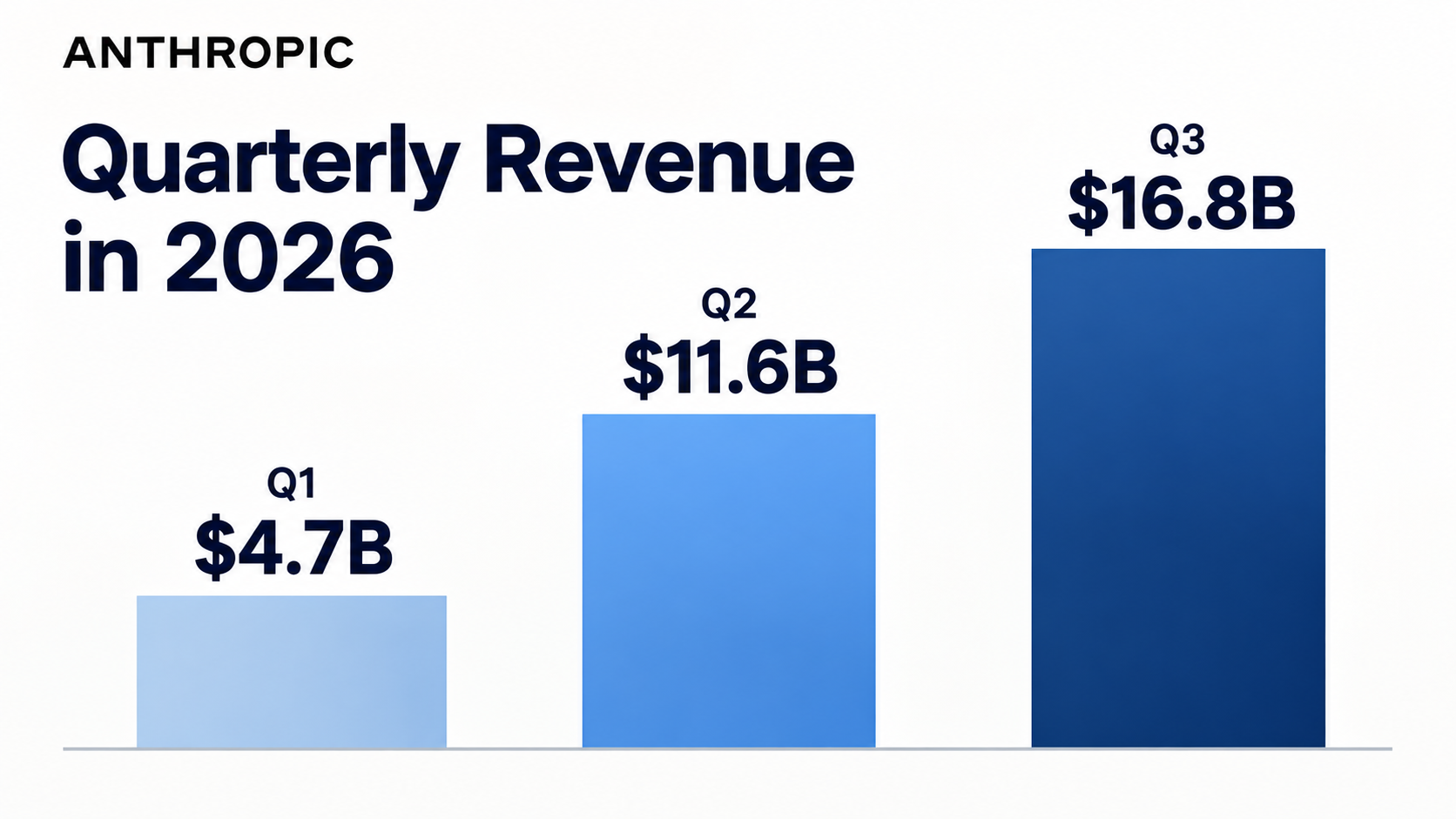
Anthropic’s reported third-quarter revenue was more than three times its first-quarter revenue. The increase is striking even by the standards of fast-growing technology companies.
The figures came from people who attended a private investor presentation at Anthropic’s San Francisco headquarters on October 14. They were reported by Reuters, the Financial Times, and Bloomberg, rather than released as a conventional public-company quarterly earnings statement. (Reuters · Bloomberg)
Here is the reported progression:
| Period | Revenue | Growth from prior quarter |
|---|---|---|
| Q1 2026 | $4.7 billion | — |
| Q2 2026 | $11.6 billion | About 147% |
| Q3 2026 | $16.8 billion | About 45% |
The growth percentages are calculated from the quarterly revenue figures reported by Reuters. Small differences in rounded figures across publications can produce slightly different percentages.
Together, those three quarters represent approximately $33.1 billion in reported revenue over the first nine months of 2026.
For perspective, Reuters reported that Anthropic generated approximately $4.6 billion in revenue during all of 2025, based on information from its confidential IPO prospectus. (Reuters)
That means the company reported more revenue in the third quarter of 2026 alone than it did throughout the previous year.
But where is all that money coming from?
What Is Anthropic Actually Selling Besides the Claude Chatbot?

Anthropic makes money from more than people paying to chat with Claude.
Its business reaches software developers, corporate employees, companies building AI-powered applications, and organizations purchasing large amounts of computing-intensive AI services.
The distinction matters because individual subscriptions and large business contracts work very differently.
According to Anthropic’s published product information, its principal commercial channels include:
| Revenue channel | What customers pay for |
|---|---|
| Claude subscriptions | Paid access and higher usage limits for individual users |
| Claude Code | AI assistance for software development |
| Team and Enterprise plans | Organizational access, management features, and, on some plans, usage |
| Claude API and cloud platforms | AI processing billed according to consumption or commercial agreements |
The API business is particularly important.
An API, or application programming interface, lets another company use Anthropic’s AI models inside its own product or workflow.
For example, a software business might use Claude to review documents, assist customer-service employees, or help developers write code.
That business can generate charges based on how much processing its application uses.
Some customers purchase access directly from Anthropic. Others use Claude through cloud platforms such as Amazon Web Services, Google Cloud, and Microsoft’s cloud ecosystem.
Anthropic said in February 2026 that more than 500 business customers were spending over $1 million with the company on an annualized basis. It also reported that Claude Code’s annualized revenue had exceeded $2.5 billion. (Anthropic)
Those were figures from February, not a breakdown of the newly reported third-quarter revenue.
They do, however, help explain why Anthropic’s business has been growing so rapidly.
It is selling AI not just as a personal assistant, but as a tool embedded in how companies perform their work.
And that creates the next problem: the more customers use the technology, the more computing work Anthropic has to support.
Does “Adjusted Profit” Mean Anthropic Is Actually Profitable?
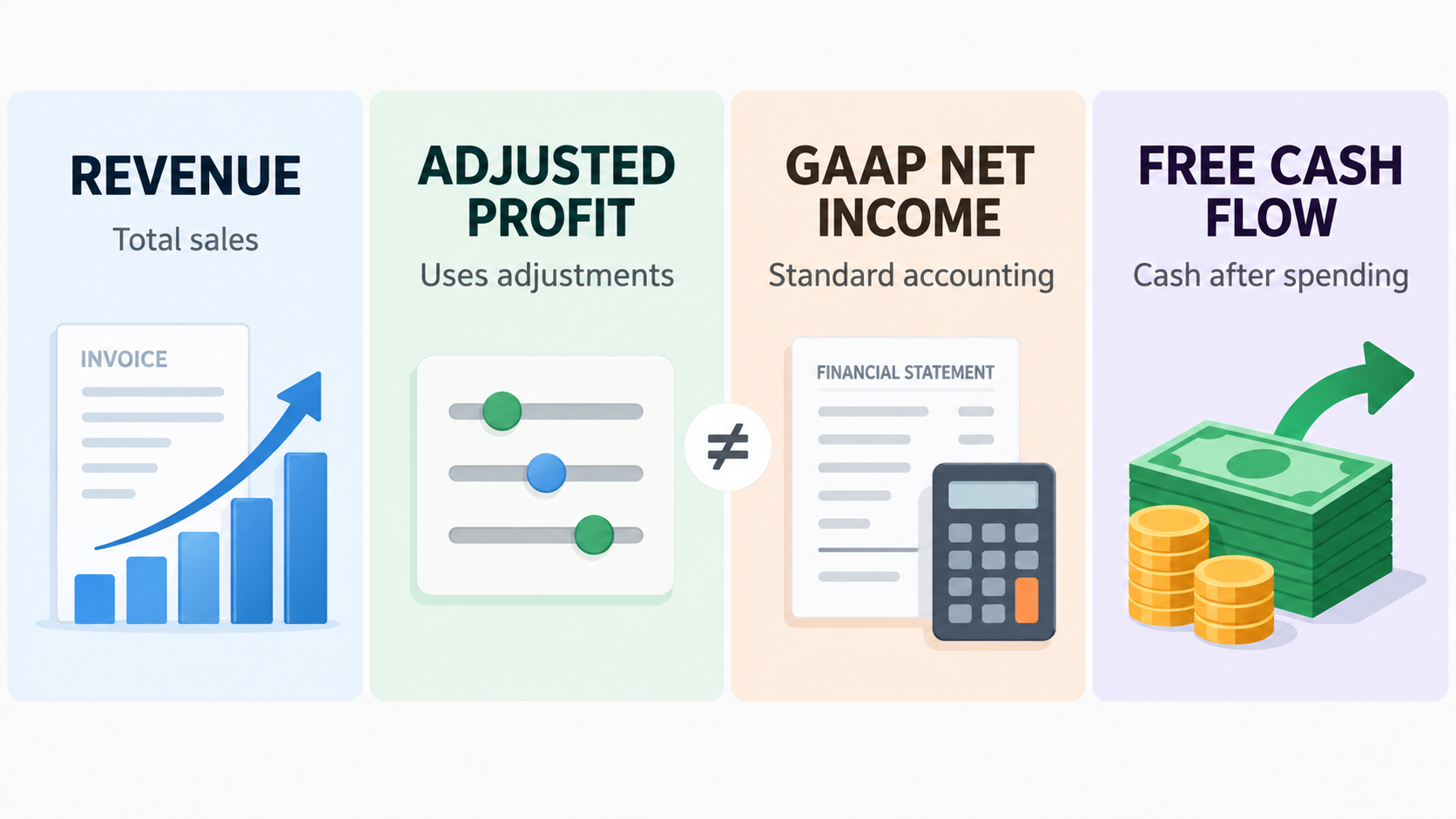
Anthropic reported that it was profitable on an adjusted basis in the third quarter. That is meaningful progress, but it does not establish the company’s GAAP net income.
GAAP stands for Generally Accepted Accounting Principles—the standard framework used for U.S. corporate financial reporting.
Adjusted profit is a different way of measuring performance. Companies may exclude certain expenses or accounting items to show what they consider the underlying results of their operations.
Sometimes that helps investors understand a business.
But the exclusions matter.
For example, stock-based compensation can be a substantial expense at technology companies. Employees may receive part of their compensation in shares or options rather than cash.
Excluding that expense can make adjusted operating profit look stronger than results that include it. This is a general accounting example; Anthropic’s specific adjustment schedule was not publicly verified from the October 14 presentation.
The Securities and Exchange Commission requires companies making applicable non-GAAP disclosures to explain their adjustments and reconcile them with comparable GAAP measures. (SEC)
The important question is not whether an adjusted measure is automatically misleading. It is what the calculation includes, what it excludes, and whether it can be compared consistently over time.
What Did Anthropic Report About Its Margins?
Bloomberg reported that Anthropic told prospective investors it had an approximately 85% gross margin, an adjusted operating margin above 11%, and positive free cash flow as of the third quarter. The Information later clarified that the 11% adjusted operating margin referred to the year through the third quarter, not the third quarter alone. Public reports did not provide a complete reconciliation of the company’s adjusted results. (Bloomberg · The Information)
These are three different measures.
| Measure | Reported position through Q3 2026 | What it tells us |
|---|---|---|
| Gross margin | Approximately 85%, as reported | Revenue remaining after costs included in the reported margin calculation |
| Adjusted operating margin | Above 11% for the year through Q3 | Profitability after a broader set of operating expenses, using adjustments |
| Free cash flow | Reportedly positive | Cash generation after relevant capital spending |
| GAAP net income | Not established by public reports of the meeting | Whether the company earned a bottom-line profit under standard accounting |
Gross margin is not the same as operating margin. Operating margin is not the same as net profit. And positive free cash flow does not automatically mean positive GAAP net income.
Consider a simplified example.
Suppose a business earns $100 in revenue and spends $80 on its operations. Before any adjustments, that leaves $20.
If its chosen adjusted calculation excludes $10 of additional accounting expenses, the resulting profit measure could be higher than the one that includes those expenses.
The business has not necessarily received any more money. It is presenting a different accounting view.
That is why investors will want to see Anthropic’s full financial statements and a detailed explanation of its adjustments.
At this stage, the defensible conclusion is that Anthropic reported an adjusted operating profit—not that every measure of profitability has been independently established.
Why Does Running an AI Business Cost So Much?

AI companies face an unusual combination of expenses: they must spend heavily to create their products and continue paying for computing resources whenever customers use them.
There are two major technical activities behind the business.
Training is the process of developing or improving an AI model using enormous amounts of computing power.
Inference is what happens after the model has been trained—when a customer asks a question, analyzes a document, or requests a piece of code and the system generates a response.
Training can require major investments in advanced processors and computing infrastructure.
Inference creates an ongoing operating burden. The company must keep providing enough processing capacity to handle customer demand.
Think of a factory that is expensive to build but also requires substantial resources every time it produces another item.
An AI model can be reused across many customers, but using it is not free.
Every response consumes computing resources. Longer tasks, more complicated reasoning, and workloads that involve many steps can require more processing.
That is why the economics of an AI service depend on both sides of the equation:
How much can the company charge for useful AI work, and how much does providing that work cost?
Anthropic is also committing substantial resources to future infrastructure. Reuters reported in September that information from its confidential IPO prospectus described at least $518 billion in cloud, computing, and infrastructure obligations over the next decade. That is not a third-quarter expense or an amount already paid in cash. (Reuters)
Spending on infrastructure does not automatically indicate poor financial management. Capacity is essential to serving more customers.
But a company can run into trouble if it commits to expensive capacity based on demand that arrives more slowly than expected.
This makes Anthropic’s improving adjusted operating margins encouraging—but not the end of the profitability discussion.
If Revenue Increased 45%, Why Are Investors Talking About Slower Growth?
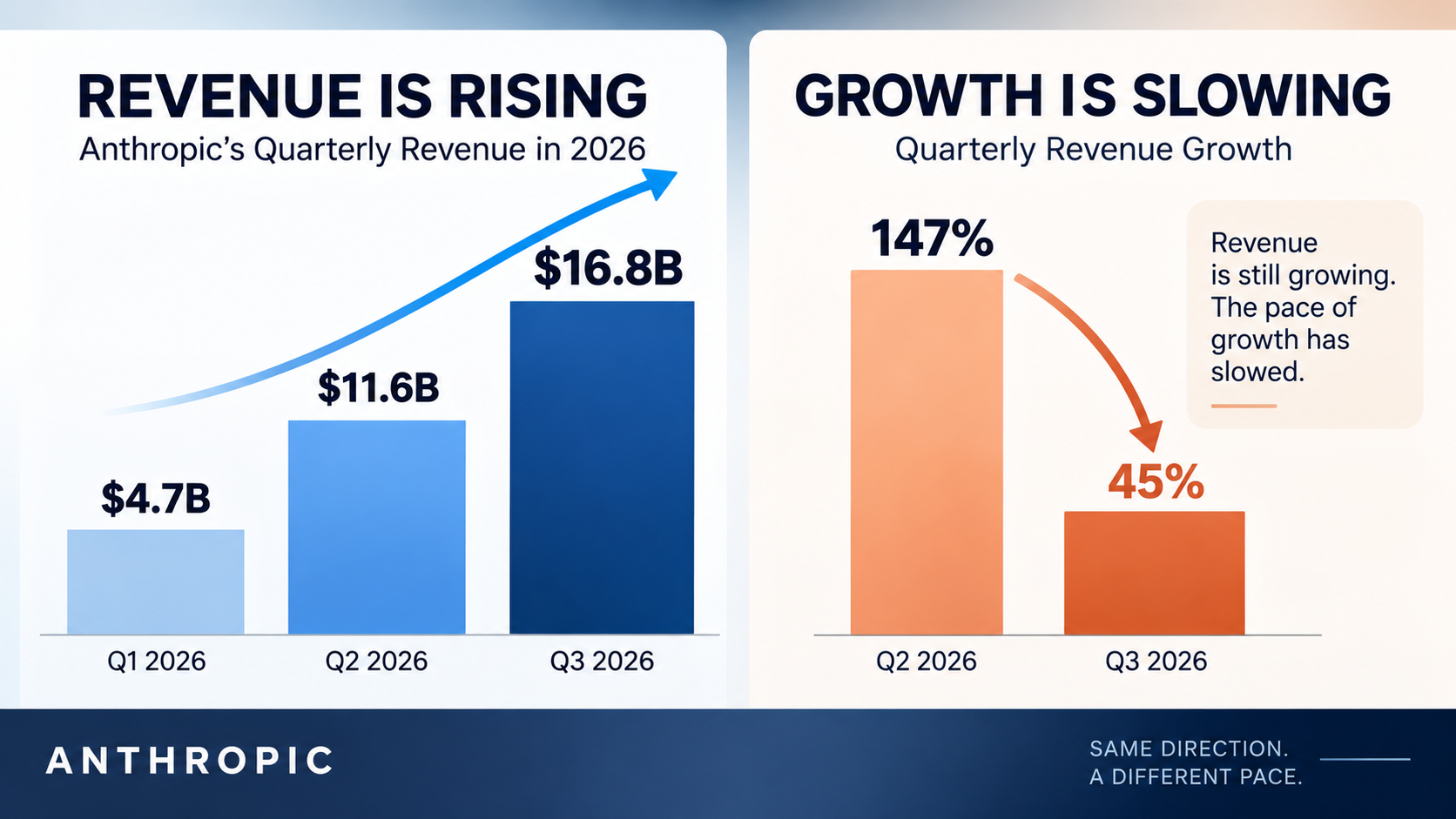
Anthropic’s revenue is still growing rapidly. What has slowed is the percentage increase from one quarter to the next.
That distinction is easy to miss.
From the first to the second quarter of 2026, reported revenue jumped from $4.7 billion to $11.6 billion—an increase of approximately 147%.
From the second to the third quarter, it rose from $11.6 billion to $16.8 billion—an increase of approximately 45%.
In dollar terms, the third quarter added another $5.2 billion in revenue over the previous quarter.
That is substantial growth.
But the percentage growth rate was much lower than in the preceding three-month period.
The difference matters because investors considering extremely high valuations often assume that a business will continue expanding rapidly for years.
When a company becomes much larger, maintaining the same percentage growth rate becomes increasingly difficult.
An increase of 100% requires a $1 billion business to add another $1 billion.
For a $20 billion business, the same percentage increase requires another $20 billion.
Anthropic is moving into a world where its financial performance must justify increasingly large expectations.
Slowing growth does not automatically mean a company is failing. It means investors have to reconsider how much future expansion is reasonable to assume.
There is also a competitive question.
Claude competes with AI offerings from OpenAI, Google, and other developers. Large business customers can compare performance, pricing, security, and the cost of operating each model.
That competition can encourage adoption while also creating pressure on prices and profit margins.
The Financial Times reported that investors were assessing Anthropic’s slower quarterly growth alongside competitive pressures and changes in customer demand. (Financial Times)
So the concern is not that $16.8 billion is a weak revenue figure.
It is whether future growth and profits will be sufficient to support the expectations attached to Anthropic’s proposed stock-market debut.
What Does a $110 Billion Annual Revenue Run Rate Actually Mean?
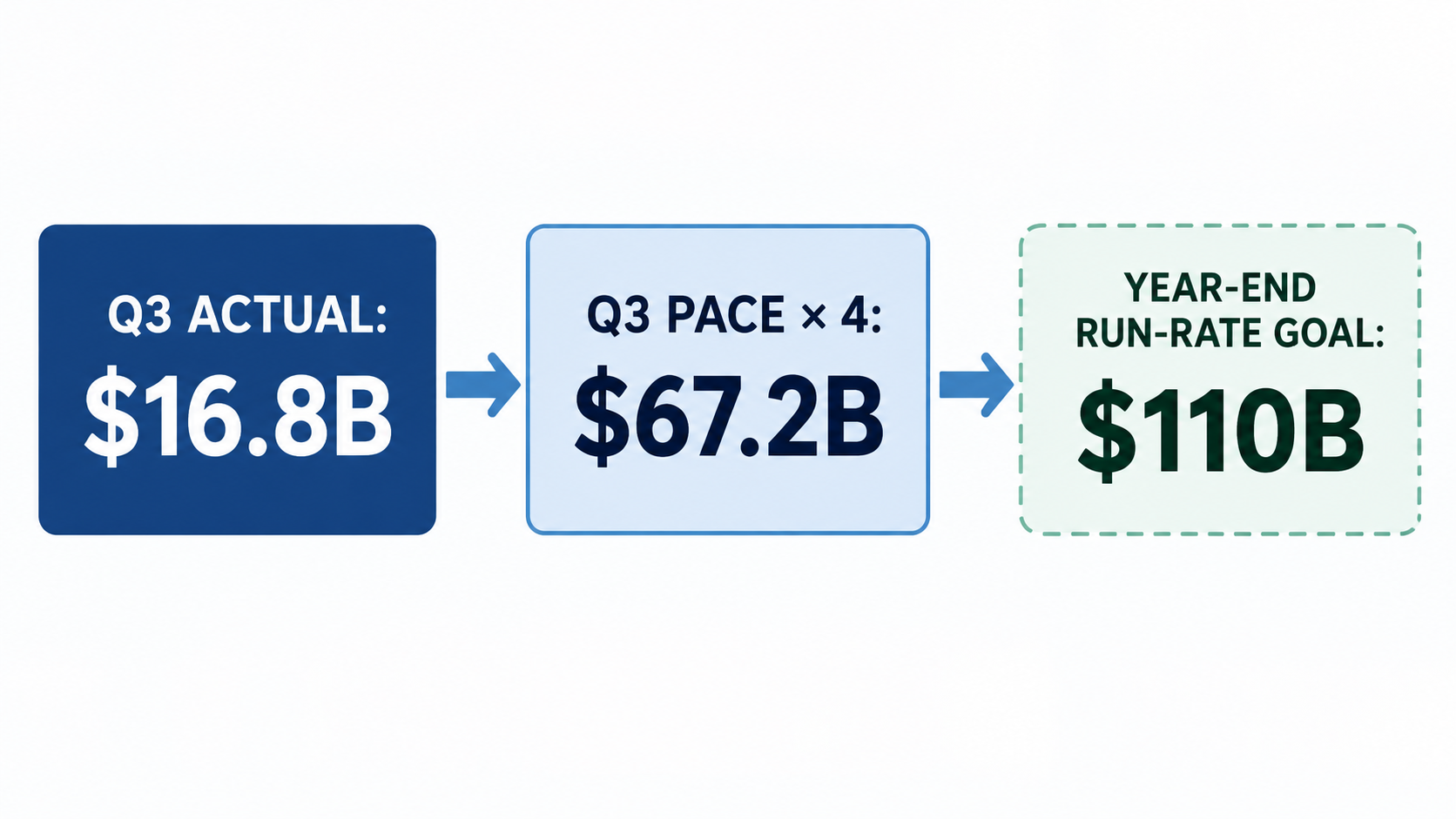
A revenue run rate estimates what a company’s annual revenue would look like if a recent sales pace continued for a full year.
It is not the same as revenue the company has already earned.
Reuters reported that Anthropic was targeting an annual revenue run rate of approximately $110 billion by the end of 2026. That figure describes a projected future pace, not completed annual revenue. (Reuters)
The simplest way to see the difference is through the reported third-quarter number.
| Figure | Meaning |
|---|---|
| $16.8 billion | Revenue reported for Q3 2026 |
| $67.2 billion | Four times Q3 revenue, assuming that quarterly pace continued for a full year |
| $110 billion | Reported target for the annualized revenue pace at year-end |
The $67.2 billion figure is arithmetic, not Anthropic’s officially reported annual revenue or its most recent monthly run rate.
Likewise, the $110 billion target does not mean the company has already collected that amount.
A company can report a rapidly increasing run rate while still having much lower actual revenue over the completed calendar year.
There is another complication.
AI companies can differ in how they present revenue from cloud distribution arrangements.
Financial Times reporting has highlighted differences between how gross and net revenue figures can be used for AI businesses. That makes it especially important to examine the underlying definitions before comparing two companies’ headline numbers. (Financial Times)
The useful question is not simply which company has the larger number.
It is whether those numbers measure the same thing.
Why Does Anthropic’s IPO Make These Financial Details So Important?
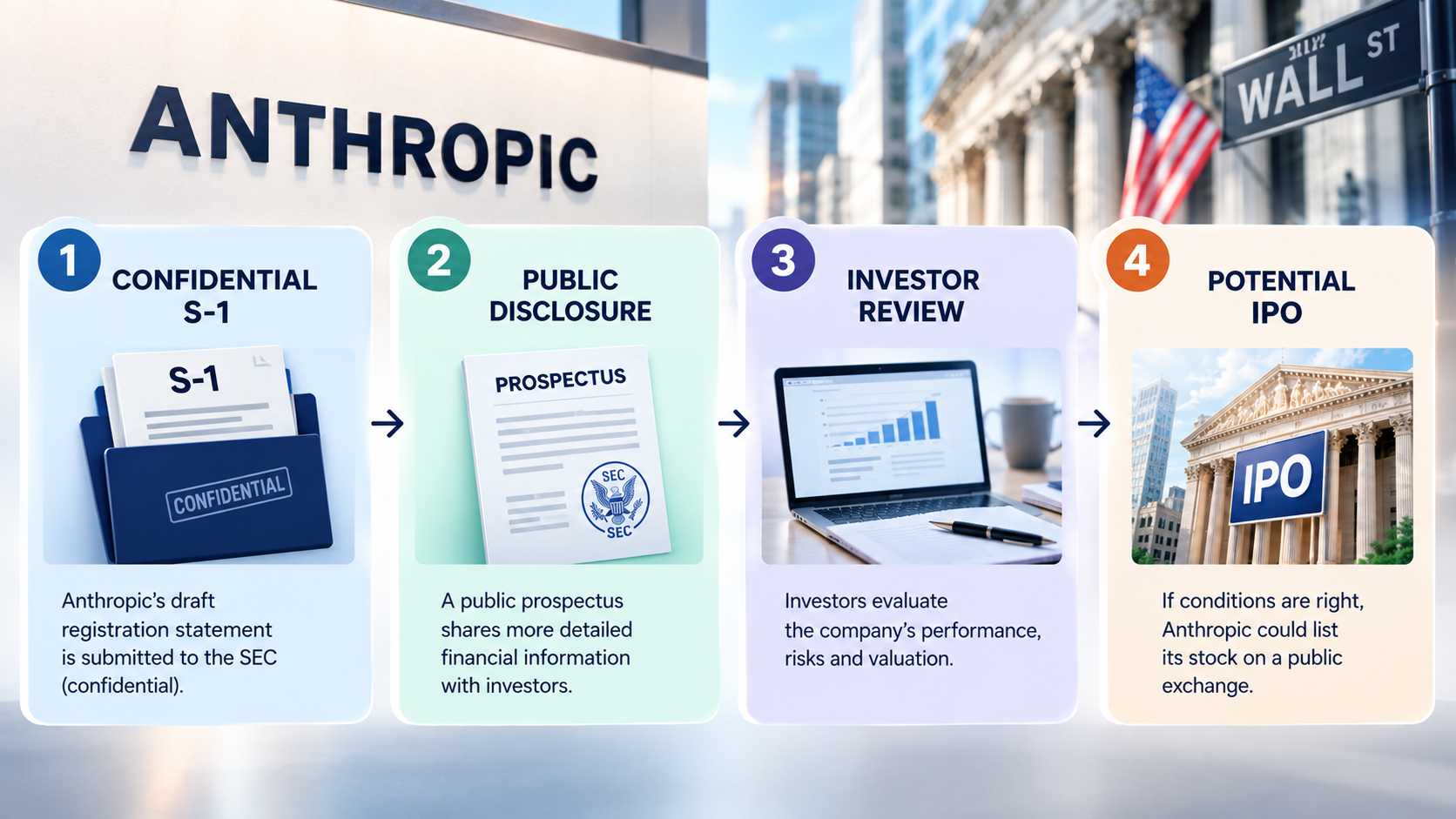
Anthropic’s potential IPO would expose the company to a much broader group of investors and far more detailed financial scrutiny.
An IPO is an initial public offering—the process through which a company offers shares to public investors and can become publicly traded.
Anthropic announced on June 1, 2026, that it had confidentially submitted a draft Form S-1 registration statement to the SEC. The company emphasized that any offering would depend on market conditions and other factors. It had not set a share price or offering size in that announcement. (Anthropic)
The private investor presentation on October 14 was part of the company’s preparations for a potential listing.
It was not itself the completion of an IPO.
Reports have pointed to a possible November listing and valuations potentially reaching around $2 trillion. Those were reported expectations and potential transaction terms—not a finalized IPO price or a guaranteed market value. On October 15, Reuters also reported that some investors were revisiting those valuation expectations in light of slower revenue growth. (Reuters)
What Will a Public Prospectus Reveal?
A public registration statement normally gives investors a much more detailed view of a company’s business.
The SEC explains that a registration statement’s prospectus includes information about financial condition, operating results, business risks, and management, as well as required financial statements. (SEC)
For Anthropic, several questions will matter:
| Investor question | Why it matters |
|---|---|
| What is the GAAP net income or loss? | Shows the bottom line under standard accounting |
| Which costs were excluded from adjusted profit? | Explains how the adjusted margin was calculated |
| How are cloud-partner sales recognized? | Helps investors compare revenue consistently |
| How much cash is committed to future computing capacity? | Reveals obligations beyond current operating results |
| Can growth and margins be sustained? | Helps assess whether the proposed valuation is justified |
There is no single financial number that answers all of those questions.
A rapidly growing business can be a successful product company while still carrying enormous financial risks.
An IPO can provide a fuller view of those risks.
And investors may discover that the more important question is not whether AI can generate revenue.
Anthropic has already presented compelling evidence that it can.
The harder question is how much of that revenue the company can retain as lasting profit.
What Could All of This Mean for Claude Users and the Broader AI Market?
For Claude users, the immediate answer is straightforward: a strong revenue report does not by itself change what they pay.
Anthropic’s October 14 investor presentation was about the company’s financial performance. It was not an announcement that consumer subscriptions or API prices would increase because of those results.
Over time, however, the economics of AI services can affect the choices companies make.
If computing becomes cheaper and competition intensifies, providers may find ways to offer more AI processing for the same price.
If advanced models remain costly to develop and operate, companies may continue experimenting with usage limits, subscription tiers, and consumption-based pricing.
Those are possible business responses, not confirmed changes resulting from this investor meeting.
For the broader AI industry, Anthropic’s numbers illustrate a larger transition.
The conversation is moving from whether people and businesses will pay for generative AI to whether AI providers can deliver those services profitably at enormous scale.
That matters beyond Anthropic and its potential shareholders.
AI businesses purchase or rent chips, data-center capacity, networking equipment, and electricity. Their spending decisions can influence demand across technology and infrastructure industries.
But revenue growth at one AI company is not proof that every company supplying the industry will earn attractive returns.
Different businesses face different costs, competitive pressures, and investment risks.
Bottom Line: What This Story Really Means
Anthropic’s reported $16.8 billion in third-quarter revenue demonstrates extraordinary commercial growth for its Claude AI business.
And the company did report a profit on an adjusted basis, with reports describing an adjusted operating margin above 11% for the year through Q3 and positive free cash flow.
Those are meaningful developments.
But adjusted operating profit is not the same as confirmed GAAP net income, and the October 14 investor presentation did not give the public a complete, independently comparable picture of every financial measure.
There is also a second distinction: Anthropic’s sales are still rising rapidly, but the percentage rate of growth has slowed from the extraordinary pace earlier in 2026.
That leaves investors with three connected questions.
Can Anthropic keep winning paying customers? Can it provide increasingly powerful AI at a sustainable cost? And can its actual earnings justify the valuation investors may be asked to accept in an IPO?
The $16.8 billion figure answers part of the first question.
The full financial disclosures surrounding a potential public offering should help answer the other two.
Anthropic Earnings: Key Questions Explained
Q. How much revenue did Anthropic report for the third quarter of 2026?
Anthropic reportedly told prospective investors that its revenue reached $16.8 billion in Q3 2026, an increase of approximately 45% from the previous quarter.
Q. Is Anthropic profitable in 2026?
Anthropic reported adjusted profitability in the third quarter, and the Financial Times reported that this was its second consecutive profitable quarter on that basis. That does not by itself establish its GAAP net income for the quarter.
Q. What does Anthropic’s 11% operating margin mean?
An adjusted operating margin above 11% was reported for 2026 through the third quarter, not for Q3 alone. This adjusted profitability measure should not be confused with GAAP net income.
Q. How does Claude Code make money for Anthropic?
Claude Code is an AI-powered software development tool available through Anthropic’s paid offerings and usage-based services. In February 2026, Anthropic said Claude Code had exceeded $2.5 billion in annualized revenue.
Q. Why is Anthropic’s revenue growth slowing?
The percentage growth rate fell because third-quarter revenue increased less rapidly than second-quarter revenue had. Sales still rose significantly, from $11.6 billion in Q2 to $16.8 billion in Q3.
Q. Does Anthropic’s $110 billion revenue target mean it will earn that much in 2026?
No. The reported $110 billion figure refers to a targeted annualized revenue pace by year-end. It is not confirmed revenue for the full 2026 calendar year.
Q. Is Anthropic’s positive free cash flow the same as net profit?
No. Free cash flow concerns cash generated after certain expenditures, while net income is calculated using accounting rules that include noncash items and other expenses. The two measures can differ substantially.
Q. Can ordinary investors buy Anthropic stock now?
As of October 15, 2026, Anthropic was preparing for a potential IPO rather than trading as a publicly listed company. Its June confidential filing did not establish an offering price, share count, or guaranteed listing date.
Q. Will Claude subscriptions become more expensive because of Anthropic’s earnings?
The October 14 financial presentation did not establish such a change. Future subscription and API prices will depend on the company’s pricing decisions, competitive conditions, and operating costs.
Q. What should investors watch before Anthropic’s IPO?
The most useful disclosures will include GAAP earnings, explanations of adjusted financial measures, cash flow, infrastructure commitments, revenue-recognition policies, and the proposed offering valuation.
Did this help make the story clearer? 🙂 WIN keeps unpacking the “why” behind the news—clearly and simply!
Sources
October 14 Investor Presentation and Quarterly Revenue
Reuters — At Anthropic’s Pre-IPO Meeting: Surging Revenue and Adjusted Profitability
Financial Times — Anthropic Tells Investors Quarterly Revenue Rose Nearly 50%
Bloomberg — Anthropic Revenue Hits $16.8 Billion in Third Quarter
The Information — Anthropic Reports $16.8 Billion in Third-Quarter Revenue
Claude Business Model and Infrastructure Commitments
Anthropic — Series G Funding Announcement and Claude Business Growth
Claude — Official Plans and Pricing
Reuters — Anthropic’s IPO Prospectus Shows AI Ambitions and Surging Costs
Accounting Standards and Revenue Comparisons
SEC — Non-GAAP Financial Measures: Interpretations and Disclosure Requirements
Financial Times — Why OpenAI’s Revenue Numbers Really Matter
IPO Process and Public Financial Disclosures
Anthropic — Confidential Draft S-1 Submission to the SEC
SEC — What Is a Registration Statement?
Reuters — Investors Reassess Anthropic IPO Valuation Expectations
Keep Reading
Why Are Data Centers Becoming an Electricity-Bill Issue?
Anthropic’s growth depends on expensive computing capacity. The earlier WIN explainer shows why state regulators are asking who should pay for the grid and water infrastructure needed to serve large data centers.
Why Are Texas and California Putting New Limits on Data Centers—and Who Pays for the Power?
When Does It Make More Sense to Own AI Computing Instead of Renting It?
Claude’s usage-based business makes customers think about the cost of each task. A separate WIN article explains the trade-off between paying cloud AI providers and purchasing hardware for suitable local workloads.
Why Would a Company Buy a $20,000 Mac Instead of Paying for AI in the Cloud?