Messi’s Farewell vs. Ronaldo’s Suspension: Why Did Their National-Team Stories Take Such Different Turns?

For nearly 20 years, Lionel Messi and Cristiano Ronaldo were compared through goals, trophies, and records. In October 2026, their rivalry produced a very different question.
Why did one legend receive an emotional national-team farewell while the other faced a suspension from his country’s soccer federation?
On October 6, Messi played his final game for Argentina, scoring once and setting up two more goals in a 3-0 victory over Benin. Days later, Ronaldo’s dispute with Portugal coach Jorge Jesus led to formal disciplinary proceedings and a provisional suspension. (CONMEBOL · AFP · Reuters)
Then came another uncomfortable question for Ronaldo.
Portugal had won three consecutive games without him taking the field. His younger replacement, Gonçalo Ramos, had scored in all three.
Had Portugal become a better team without its greatest international goalscorer?
That conclusion would be too simple. But the results reveal a difficult problem facing even the biggest stars: What happens when a player’s reputation remains enormous, but the team’s tactical needs begin to change?
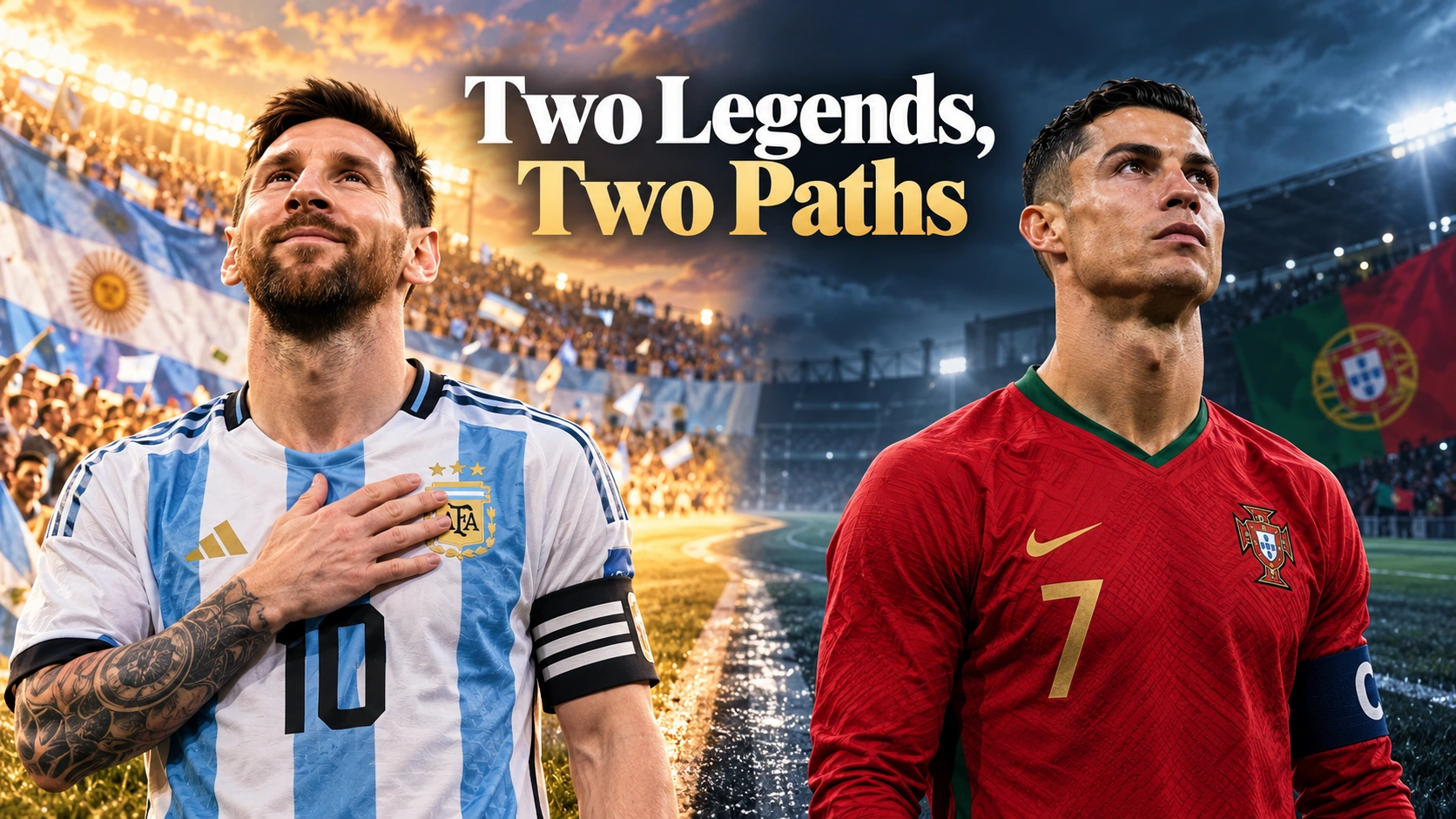
※ Images in this article are AI-generated illustrations created to help explain the story. They are not actual photographs, and depictions of people, places, or events may differ slightly from reality.
The two players’ international careers have not ended in the same way. Messi has formally retired from Argentina duty. Ronaldo has not retired from Portugal duty, and his suspension is not a final ruling.
Understanding that difference is where the story begins.
What Actually Happened Between Ronaldo and Portugal?
The immediate dispute concerned Ronaldo’s playing time, communication with coach Jorge Jesus, and what the two believed had been agreed upon. It eventually escalated into Ronaldo leaving the national-team camp.
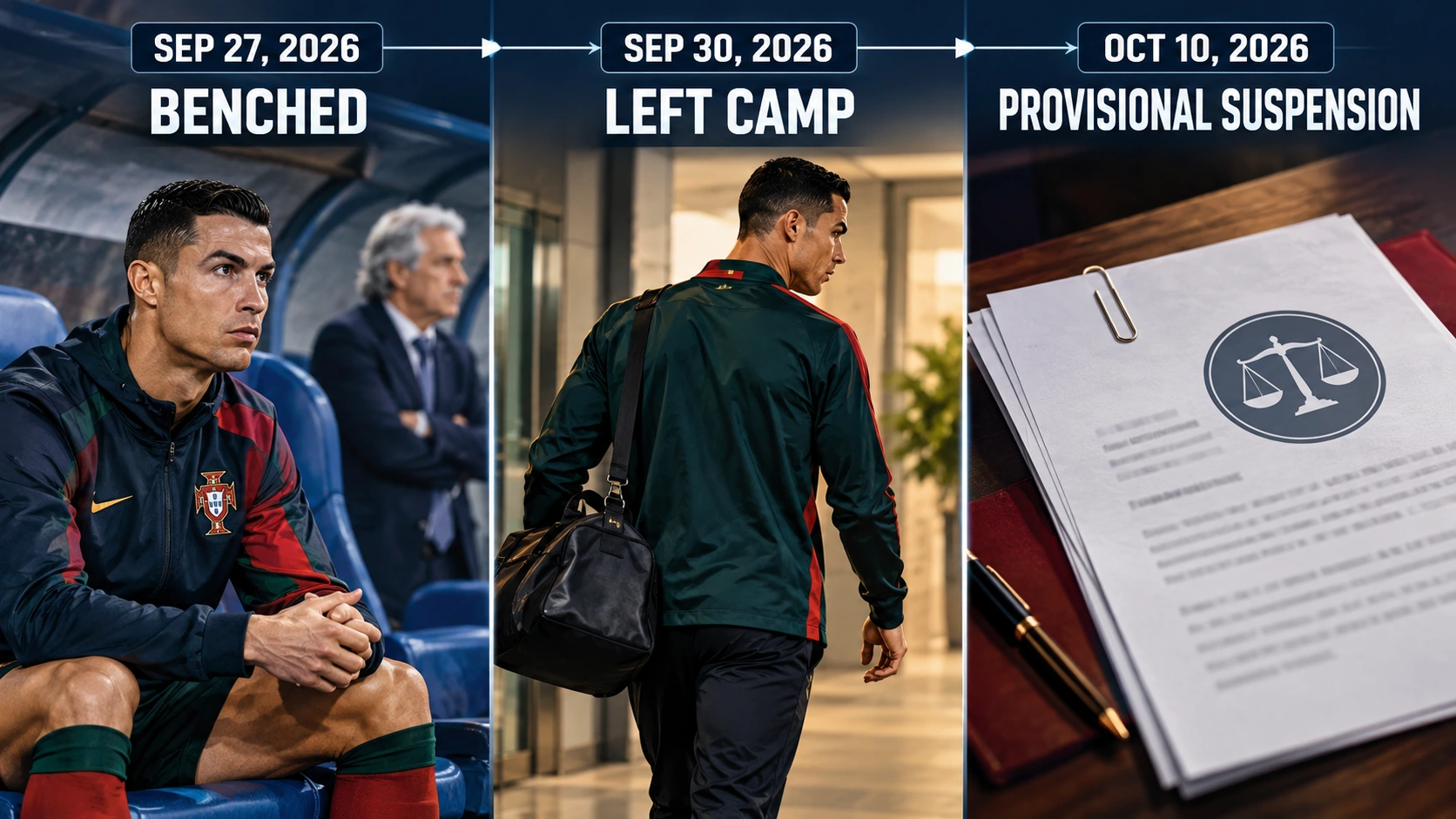
The situation unfolded over several days.
On September 24, Ronaldo started Portugal’s UEFA Nations League victory against Wales. Three days later, he remained on the bench throughout Portugal’s 2-1 victory over Norway.
According to Ronaldo, he had been told he could expect playing time and had warmed up during the match. He later accused Jesus of failing to honor agreements about his role and how the situation would be explained publicly.
Jesus offered a different account. He maintained that the final decision about substitutions belonged to the coach and that changing the plan during a match was a tactical judgment.
Ronaldo left the Portugal camp in Copenhagen on September 30, ahead of the match against Denmark. (Associated Press · The Guardian)
How Did a Disagreement Become a Suspension?
Leaving a national-team camp raised a separate question from whether Ronaldo deserved to start a match.
On October 9, the Portuguese Football Federation’s disciplinary authorities initiated proceedings. The decision was made public on October 10, with a provisional suspension imposed while the matter was examined.
The proceedings were classified as urgent.
A provisional suspension is not the same as a completed disciplinary case or a permanent international ban. The federation’s disciplinary body must still determine what consequences, if any beyond the provisional measure, are warranted. (The Guardian · The Irish Times)
Ronaldo subsequently acknowledged that his conduct carried consequences, apologized for aspects of his departure, and expressed his willingness to represent Portugal again.
That distinction matters.
He was not announcing his retirement. He was explaining why he had left, while leaving the possibility of a return open.
Did Portugal Really Become Better Without Ronaldo?
The results are real. The claim that Ronaldo’s absence alone caused the improvement is not established.
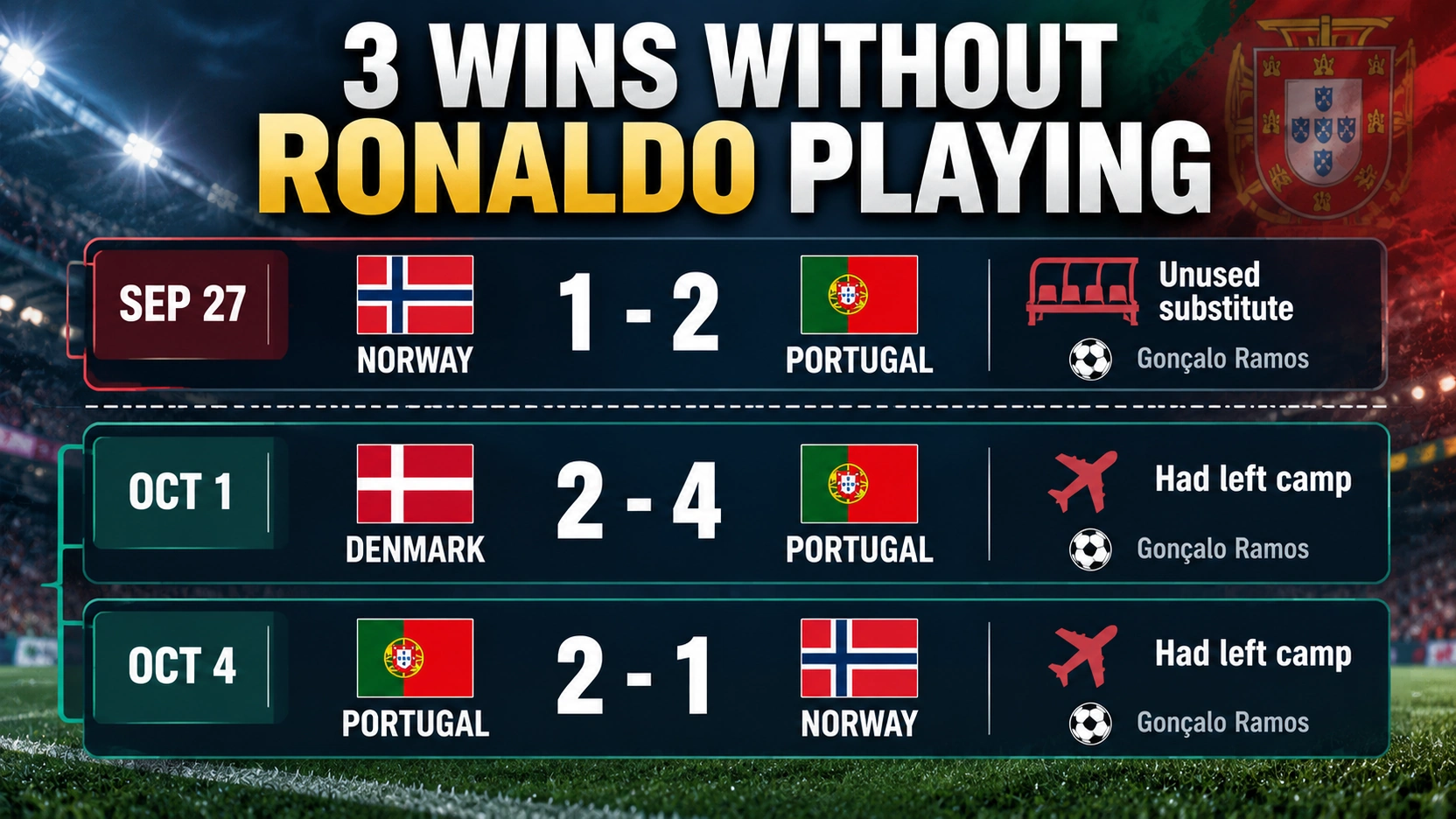
Portugal won three consecutive Nations League games without Ronaldo playing, scoring eight goals across those matches.
Here is the actual sequence, based on UEFA’s match results:
| Date | Portugal result | Ronaldo’s status |
|---|---|---|
| September 24 | Beat Wales 1-0 | Started |
| September 27 | Beat Norway 2-1 | Unused substitute |
| October 1 | Beat Denmark 4-2 | Had left camp |
| October 4 | Beat Norway 2-1 | Had left camp |
(UEFA)
So the accurate description is three straight wins without Ronaldo playing, including two after he left the squad.
There was another notable development.
Gonçalo Ramos, the younger center-forward, scored in each of those three matches. Against Denmark, Portugal also received goals from João Cancelo, Vitinha, and João Félix.
That was encouraging evidence of Portugal’s attacking depth. (FBref · UEFA)
Why Don’t Three Victories Settle the Debate?
Because soccer results depend on far more than one player’s presence.
Different opponents, starting lineups, formations, substitutions, and individual performances can all affect a result. Three games are too small a sample to establish whether Portugal will consistently be stronger without Ronaldo.
There is also a difference between two questions:
- Can Portugal win without Ronaldo? Clearly, yes.
- Is Portugal necessarily a better team without Ronaldo? That requires more evidence.
Nevertheless, the winning streak changes the discussion.
Portugal no longer has to treat a Ronaldo-free attack as an untested possibility. The team has recent competitive evidence that another arrangement can succeed.
And once a coach sees that, the decision becomes less about a player’s legendary status and more about what each lineup can deliver.
Why Can One Star Striker Change the Way an Entire Team Plays?
That is why Ronaldo’s place in Portugal’s starting lineup is a tactical issue, not merely a popularity contest.
A center-forward influences more than who takes the final shot. His position, movement, and defensive responsibilities shape what the other ten players can do.
The Attacking Tradeoff
At his best, Ronaldo offered something extraordinarily valuable: the ability to convert difficult attacking situations into goals.
A team could direct much of its attacking play toward him because his finishing, positioning, and ability to score in different ways could justify that investment.
But every attacking system involves choices.
Imagine a team whose central striker stays close to the penalty area, waiting for crosses, passes behind the defense, or rebounds.
That can be effective. It can also mean other attackers must provide more of the movement, creativity, and ball progression.
Players such as Bruno Fernandes, João Félix, and Rafael Leão have their own ways of influencing a game. A coach must decide whether concentrating chances around a central scorer makes better use of those abilities than a more fluid attacking system.
The question isn’t whether Ronaldo can still score. He continued scoring for Al-Nassr in October, even after the national-team dispute. (Sky Sports)
The question is whether the overall arrangement produces the best chances against a particular opponent.
The Defensive Tradeoff
There is another part of the job many casual viewers overlook: defending without the ball.
In modern soccer, a forward can help initiate a coordinated press by closing down a defender or directing where the opponent passes next.
FIFA’s coaching material explains that the forward nearest the ball can trigger the team’s pressing movement. The purpose is not necessarily to win possession personally. It can be to force a hurried pass that teammates are ready to intercept. (FIFA Training Centre)
That creates a chain reaction.
If the forward presses at the right moment, teammates can move together to close passing lanes.
If the forward remains deeper or does not engage, the coach may need a different defensive structure. Midfielders may have more space to cover, or the entire team may choose to defend closer to its own goal.
Neither approach is automatically wrong.
A coach might deliberately protect an exceptional scorer from heavy defensive work if the attacking benefits are large enough.
But as players age and teams evolve, that tradeoff has to be reconsidered.
This is the tactical problem behind the argument over Ronaldo. A coach must weigh what Ronaldo contributes against the different movement, pressing, and attacking options another forward can provide.
Why Is Jorge Jesus’s Role in This Dispute So Surprising?
Jorge Jesus was not an unfamiliar manager who suddenly arrived and decided he did not like Cristiano Ronaldo.
He had recently coached Ronaldo to a league championship.
In May 2026, Jesus led Al-Nassr to the Saudi Pro League title. Ronaldo scored twice in the decisive final-day victory over Damac.
It was a significant achievement for both coach and player. (Reuters · FIFA)
Just weeks later, Jesus was appointed Portugal’s national-team coach, replacing Roberto Martínez after the 2026 World Cup.
He included Ronaldo in his first squad and started him against Wales in September. (FIFA · UEFA)
So why did their relationship deteriorate?
The key distinction is between being trusted as an important player and being guaranteed a particular role.
At Al-Nassr, Ronaldo was a central figure in a club team built around its own players, competitions, and strategy. With Portugal, Jesus had a different group of attackers and a different set of tactical choices.
Success together at club level did not mean the same starting role had to continue internationally.
Was This Really About Tactics or Respect?
The public disagreement suggests that both issues became intertwined.
Ronaldo’s account emphasizes a breakdown of trust. He believed expectations had been established and then changed, and he objected to how the situation was handled.
Jesus’s position emphasizes managerial authority. He regarded the decision not to use Ronaldo against Norway as his responsibility, based on how the match developed. (Associated Press · The Guardian)
Those explanations are not identical, and the private conversations cannot be reconstructed with certainty from their public statements.
It would therefore be misleading to claim that Ronaldo left simply because he refused to sit on the bench, or that Jesus intentionally humiliated him.
What is clear is that a disagreement about one player’s role grew into a national-team disciplinary matter.
And this was not the first time Ronaldo’s relationship with a coach had become a public controversy.
Has Ronaldo Faced This Situation Before?
Yes. There are two important precedents, although neither proves that every dispute had the same cause.
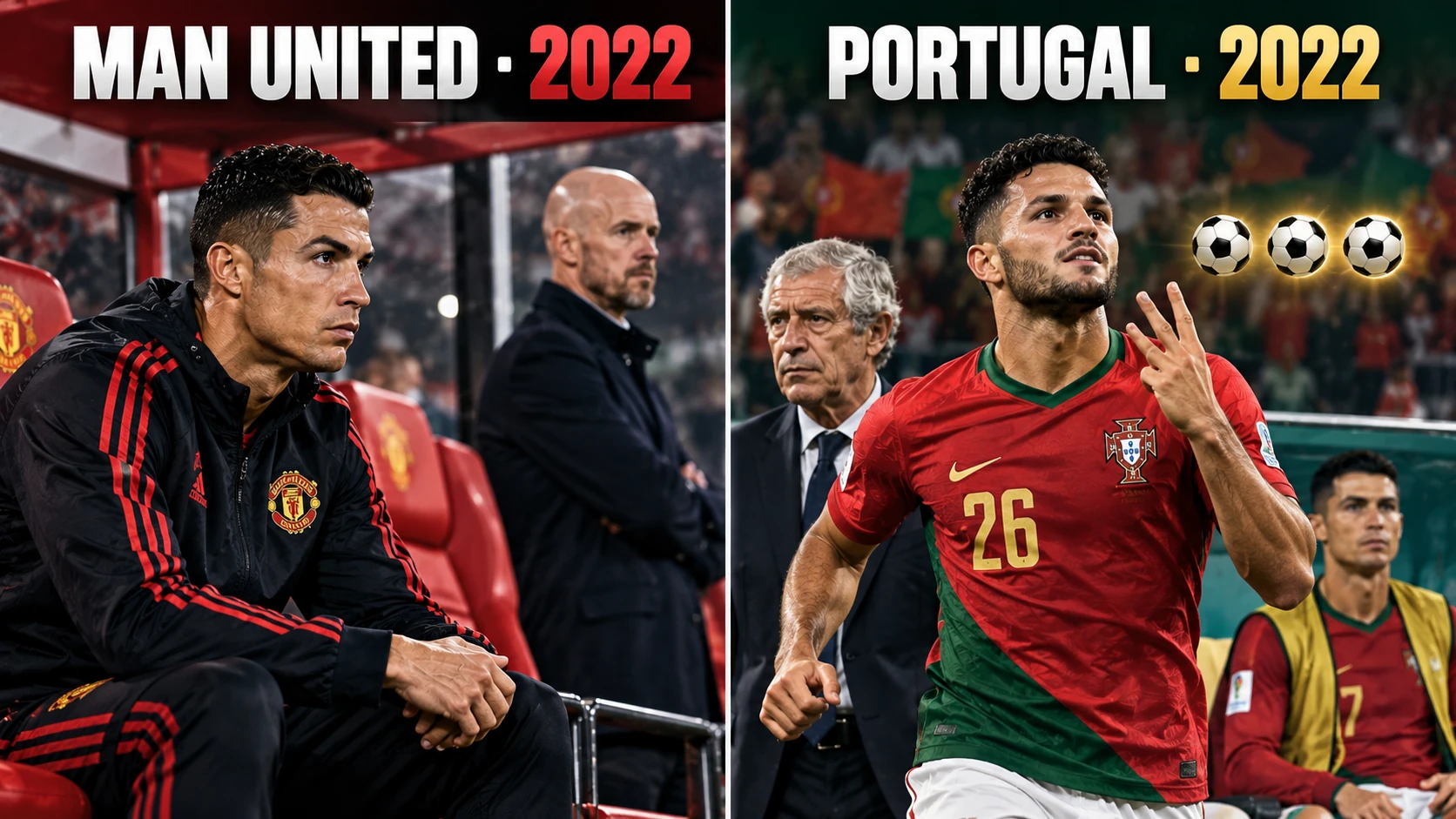
Manchester United: The Dispute With Erik ten Hag
In October 2022, Ronaldo was an unused substitute during Manchester United’s victory over Tottenham Hotspur.
He left before the final whistle.
Manager Erik ten Hag subsequently confirmed that Ronaldo had refused to enter the match as a substitute. Ronaldo was left out of the following game against Chelsea. (BBC Sport)
The episode reflected a conflict between a manager’s expectations and a superstar’s response to a reduced role.
But it is important not to oversimplify it.
The controversy involved behavior and team discipline, not just whether Ronaldo’s playing style suited a particular tactical system.
The relationship ultimately ended in November 2022, when Manchester United announced Ronaldo’s departure by mutual agreement. (Manchester United)
Qatar 2022: The Decision That Changed Portugal’s Attack
Only weeks later, another coach faced a major decision.
During the 2022 World Cup, Portugal coach Fernando Santos left Ronaldo out of the starting lineup for the round-of-16 match against Switzerland.
Gonçalo Ramos started in his place.
Portugal won 6-1, and Ramos scored a hat trick. (Asian Football Confederation)
That match became one of the clearest examples of Portugal succeeding with a different center-forward.
It is worth distinguishing the two managers, however.
Fernando Santos made the 2022 World Cup decision. Jorge Jesus is the coach involved in the current 2026 dispute.
The situations are not identical, and one spectacular victory in 2022 did not establish that Ronaldo could never help Portugal again.
What the two periods have in common is the difficult decision every coach eventually faces with an aging superstar: whether the player should remain an automatic starter or become one option among several.
That leads to the comparison with Messi.
Why Did Messi Get a Farewell While Ronaldo Faced a Suspension?
Messi chose to retire from international soccer. Ronaldo still wanted to represent Portugal.
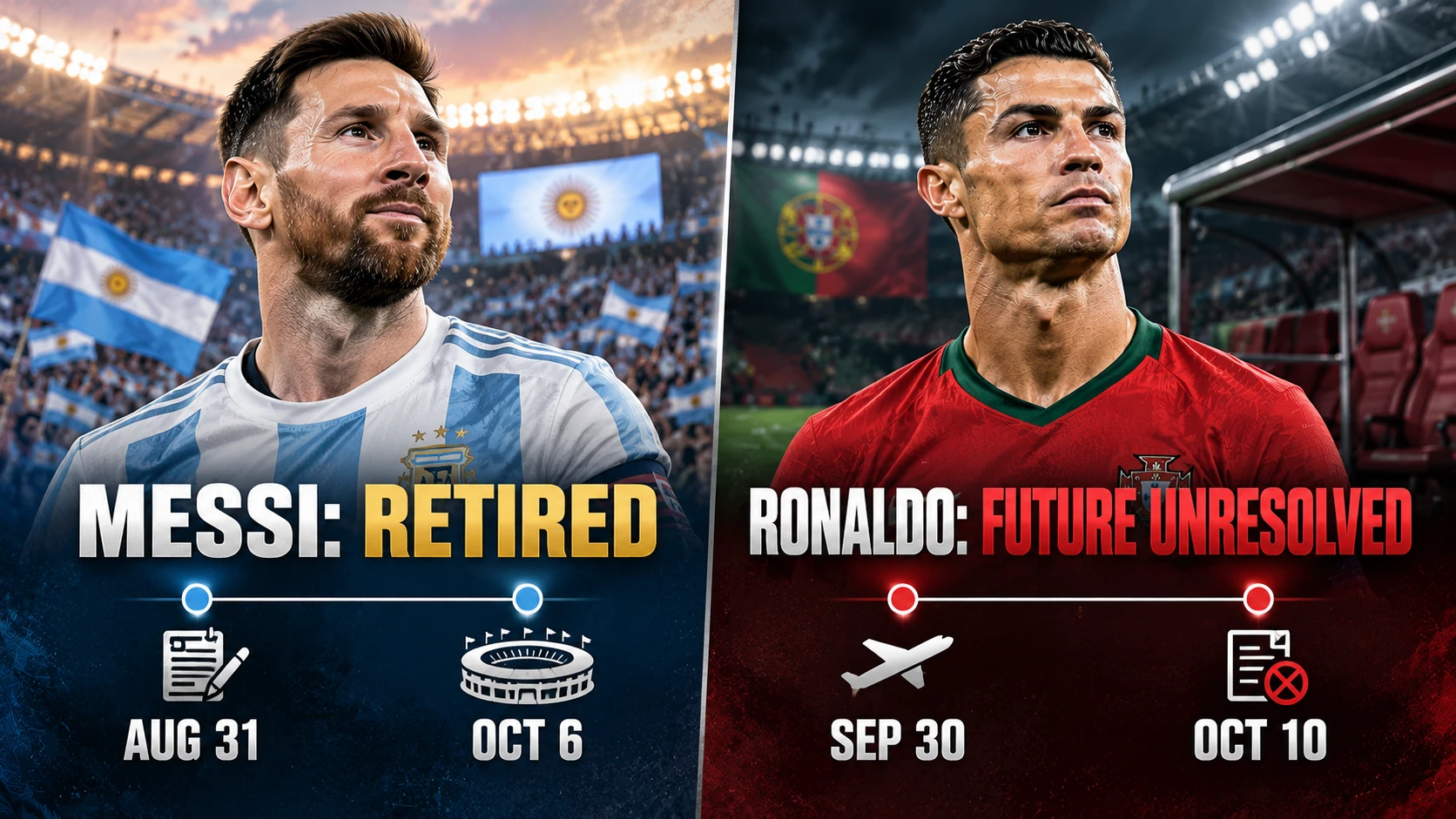
The most important difference is that Messi and Ronaldo were not making the same decision about their national-team careers.
Messi announced his international retirement on August 31, 2026.
His final appearance followed on October 6 at Buenos Aires’s Monumental Stadium, where he scored a penalty and assisted goals by Nicolás Otamendi and Nico Paz in Argentina’s 3-0 win over Benin.
CONMEBOL records his international career as spanning 208 appearances and 126 goals, alongside the World Cup triumph of 2022 and Copa América titles in 2021 and 2024. (CONMEBOL · Argentine Football Association)
It was a public celebration of a decision already made.
Ronaldo’s story was different. There was no planned farewell ceremony because he had not announced that he was finished with Portugal.
Instead, the question was whether he would return after a disagreement with his coach and the federation’s disciplinary process.
That makes the contrast striking, but it does not establish that one player’s personality produced a beautiful ending while the other’s personality ruined his career.
Messi’s Relationship With Argentina Wasn’t Always Peaceful
The celebration in Buenos Aires can make Messi’s national-team journey look effortless in retrospect.
It wasn’t.
In 2016, after Argentina lost another Copa América final, Messi announced that he was retiring from international soccer.
He later reversed that decision and returned.
The years that followed brought the breakthroughs he had long sought: Argentina’s Copa América victory in 2021, its World Cup title in 2022, and another Copa América championship in 2024. (FIFA · CONMEBOL)
His eventual farewell was the conclusion to a long journey that had included disappointment, criticism, and a previous retirement announcement.
Ronaldo’s career has also included enormous national-team achievements, especially Portugal’s European Championship victory in 2016 and its Nations League success.
Those accomplishments do not disappear because of a dispute in 2026.
Does Messi’s Different Playing Style Explain Everything?
Not by itself.
Messi and Ronaldo have different attacking strengths. Messi has been particularly influential as both a creator and a scorer, while Ronaldo built much of his later career around elite penalty-area finishing and movement.
Both have required teammates and coaches to make tactical adjustments.
The important question for either player is what the whole team gains from those adjustments.
For Messi, Argentina’s planned farewell followed his decision that the time had come to end his international career.
For Ronaldo, Portugal is still deciding what role he could play if he returns.
These are fundamentally different circumstances, even if the contrast is impossible for soccer fans to ignore.
Is Ronaldo’s Portugal Career Actually Over?
No permanent end to Ronaldo’s international career has been established as of October 17, 2026.
The Portuguese Football Federation imposed a provisional suspension, but that is not equivalent to an announcement of retirement or a final decision that he will never be selected again.
Ronaldo has expressed his desire to remain available. Federation president Pedro Proença has also spoken in favor of having him return, while acknowledging that the disciplinary authorities must make their decision independently. (The Irish Times · Reuters)
Portugal’s next scheduled Nations League games are against Denmark on November 14 and Wales on November 17. (Jorge Jesus Official)
Those matches will provide an important test of whether the situation has been resolved.
Three separate questions remain.
Will the Disciplinary Case Be Resolved?
The federation’s disciplinary process must determine the appropriate outcome.
A final sanction could affect Ronaldo’s availability, but the provisional suspension alone does not settle how long he will be unavailable or whether he will eventually return.
Can Ronaldo and Jesus Agree on His Role?
Even if Ronaldo becomes eligible for selection, the relationship between player and coach will need to function.
That does not necessarily require agreement about every tactical decision. It does require a working understanding of who makes those decisions and how disagreements are handled.
A place in the squad is also different from a guaranteed place in the starting lineup.
Would Portugal Be Better With Ronaldo as a Starter, Substitute, or Neither?
That is ultimately a selection question.
Ronaldo’s experience, finishing, and history with Portugal remain relevant. So do Ramos’s recent goals, the movement of Portugal’s other attackers, and Jesus’s preferred system.
A coach could reasonably consider different arrangements for different opponents.
The decision does not have to be a referendum on Ronaldo’s entire career.
The challenge is finding a role that helps Portugal now, rather than choosing a lineup solely to honor what Ronaldo accomplished before.
Bottom Line: What This Story Really Means
Messi’s farewell and Ronaldo’s suspension have created one of the most striking contrasts in their two-decade rivalry.
But the deeper story is not simply that one legend aged gracefully and the other did not.
Messi made a formal decision to retire from Argentina duty, and his country organized a celebration of his international career.
Ronaldo remains interested in playing for Portugal, but his future has become entangled in a disagreement over his role, the coach’s authority, and a pending disciplinary process.
Portugal’s three victories without Ronaldo playing demonstrate that the national team has other successful attacking options. They do not prove that Ronaldo can no longer contribute.
The dispute also raises a question far larger than Messi versus Ronaldo.
How should a team treat a legendary player when the best tactical decision today may be different from the decision that made him a legend?
Respecting an extraordinary career does not require guaranteeing a starting position forever. And adapting to a smaller role does not erase the achievements that made the player famous.
Messi has already completed his international farewell.
Ronaldo’s next chapter is still uncertain—and it may depend less on how many more goals he scores than on whether he and Portugal can agree on how he fits into the team.
Messi and Ronaldo: Key Questions Explained
Q. Has Lionel Messi retired from professional soccer completely?
No. Messi retired from Argentina’s national team after his October 6, 2026 farewell match. His retirement from international duty does not mean he has stopped playing club soccer for Inter Miami.
Q. Why was Cristiano Ronaldo suspended by Portugal?
Portugal’s soccer federation initiated disciplinary proceedings following Ronaldo’s departure from the national-team camp on September 30. The disagreement centered on his playing role and disputed expectations involving coach Jorge Jesus.
Q. Is Ronaldo permanently banned from the Portuguese national team?
No permanent ban has been established. The suspension announced in October 2026 was provisional, with the disciplinary proceedings still relevant to his future eligibility.
Q. Did Portugal really win three games without Ronaldo?
Yes. Portugal defeated Norway on September 27, Denmark on October 1, and Norway again on October 4 without Ronaldo playing. However, only the latter two victories occurred after he left camp.
Q. How many goals did Gonçalo Ramos score during those three games?
Ramos scored once in each match, giving him three goals across Portugal’s three consecutive victories without Ronaldo on the field.
Q. Who is Jorge Jesus, and did he coach Ronaldo before?
Jorge Jesus became Portugal’s national-team coach in July 2026. He had previously coached Ronaldo at Al-Nassr, where they won the 2025–26 Saudi Pro League title together.
Q. Why does defensive pressing matter when selecting a striker?
Pressing can determine how a team disrupts the opponent’s passing and wins back possession. A striker’s movement without the ball affects how much defensive work teammates must perform and what shape the team can maintain.
Q. Has Ronaldo been benched for Gonçalo Ramos before?
Yes. At the 2022 World Cup, Portugal coach Fernando Santos started Ramos instead of Ronaldo against Switzerland. Ramos scored a hat trick in Portugal’s 6-1 victory.
Q. Could Ronaldo return for Portugal’s November 2026 matches?
A return remains possible, but it is not guaranteed. His availability depends on the disciplinary process, and his selection and playing time would also depend on the coaching staff’s decisions.
Did this help make the story clearer? 🙂
WIN keeps unpacking the “why” behind the news—clearly and simply!
Sources
Ronaldo’s Departure and Disciplinary Proceedings
Associated Press — Ronaldo Says He Is Still Available After Leaving Portugal, October 6, 2026
Reuters — Ronaldo Provisionally Suspended Following National-Team Walkout, October 10, 2026
The Guardian — Portugal Suspends Ronaldo After National-Team Walkout, October 10, 2026
The Irish Times — Portugal’s Provisional Suspension and Disciplinary Process, October 10, 2026
Portugal’s Results and Coaching Background
UEFA — Portugal’s 2026 Nations League Matches and Lineups
FBref — Gonçalo Ramos’s 2026 Portugal Match Logs
FIFA — Jorge Jesus Appointed Portugal Head Coach, July 9, 2026
Reuters via CNA — Ronaldo’s Brace Secures Al-Nassr’s League Title, May 21, 2026
Jorge Jesus — Official Portugal Fixture List
Messi’s Farewell and International Career
CONMEBOL — Lionel Messi Said Goodbye to the Argentina National Team, October 7, 2026
Argentine Football Association — Argentina Defeats Benin in Messi’s Farewell, October 6, 2026
AFP — Messi Describes His Final Argentina Match as the Saddest Day, October 7, 2026
Earlier Ronaldo Controversies and Tactical Context
BBC Sport — Erik ten Hag Confirms Ronaldo Refused to Come On, October 21, 2022
Manchester United — Official Statement on Ronaldo’s Departure, November 22, 2022
Asian Football Confederation — Ramos Hat Trick Sends Portugal Through, December 7, 2022
FIFA Training Centre — Team Organization and Defensive Pressing
Keep Reading
Could Portugal’s Disciplinary Rules Still End Ronaldo’s International Career?
This story examines the contrast between Messi’s farewell and Ronaldo’s changing role. The earlier WIN explainer looks at the specific Portuguese federation rules and why the possible length of a suspension matters at age 41.