Why Is the U.S. Talking Elections With Delcy Rodríguez After Capturing Maduro?
Didn’t the United States just remove Nicolás Maduro from power?
So why is President Donald Trump now talking about Venezuela’s next election with Delcy Rodríguez, Maduro’s former vice president and oil minister?
The answer is that Maduro’s capture did not automatically transfer Venezuela’s courts, ministries, military or electoral institutions to the opposition. Venezuela’s Supreme Court ordered Rodríguez to assume presidential duties, and she has remained the country’s acting leader while Washington has dealt directly with her government. (Reuters)
On September 26, Trump publicly confirmed that elections came up in his meeting with Rodríguez in New York. Rodríguez had already told the U.N. General Assembly that Venezuela would hold elections—but she did not announce a date. (Reuters via Investing.com · EFE)

That leaves the question at the center of the story: Is Washington working with Rodríguez as a bridge to an election, or could an open-ended transition leave her in power much longer than originally expected?
How Did Delcy Rodríguez End Up Running Venezuela?

Rodríguez became acting president because Venezuela’s own Supreme Court ordered the vice president to take over presidential duties after U.S. forces captured Maduro in January. She was formally sworn in on January 5. (Reuters · Reuters)
That distinction matters. U.S. forces captured Maduro and took him out of Venezuela, but Washington did not install an opposition government in Caracas. The existing Venezuelan state apparatus continued operating, with Rodríguez—already vice president and oil minister—at its center.
Maduro, meanwhile, was taken to the United States to face federal criminal charges and pleaded not guilty. The charges against him remain allegations unless proven in court. (Reuters)
The sequence is easier to follow as a timeline:
| Date | What happened | Why it matters |
|---|---|---|
| January 3, 2026 | U.S. forces captured Maduro | His removal created an immediate leadership crisis |
| January 4 | Venezuela’s Supreme Court ordered Rodríguez to assume presidential duties | The transfer was routed through Venezuelan institutions |
| January 5 | Rodríguez was formally sworn in as acting president | She became the practical head of government |
| April 6 | AP reported her initial 90-day acting period had expired without a publicly reported Assembly extension | Questions grew over the constitutional basis for an extended acting presidency |
| September 22 | Trump and Rodríguez met in New York | Elections, economic reconstruction and debt became part of the same high-level dialogue |
| September 23–26 | Rodríguez promised elections at the U.N.; Trump later confirmed they had discussed them | Elections moved from a distant expectation to an explicit negotiating issue, but no date was set |
There is also a legal wrinkle that is easy to miss. In April, the Associated Press reported that the initial 90-day period referenced for Rodríguez’s temporary role had expired without a publicly reported National Assembly vote extending it. AP later reported that the 180-day interim period expired on July 3 with no clear public resolution of what would follow. That does not by itself settle who should legally hold office; it means the constitutional basis of the prolonged interim arrangement remains contested and politically important. (AP · AP)
Why Didn’t the U.S. Simply Put the Opposition in Power?
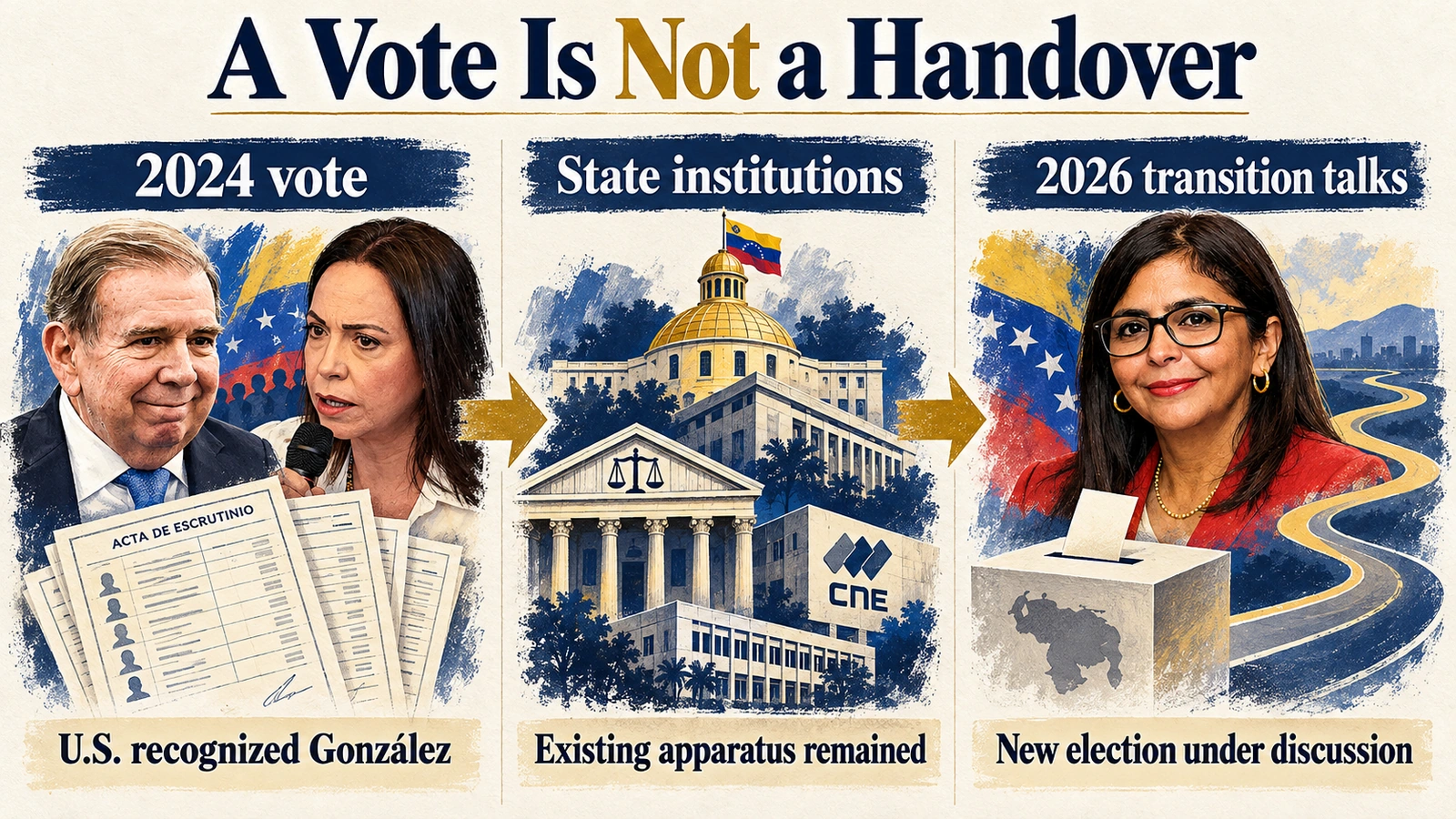
Because recognizing an election winner and controlling a country’s institutions are two different things.
Venezuela’s 2024 presidential election remains a crucial part of the background. The National Electoral Council declared Maduro the winner but did not publish the detailed polling-station results needed for independent verification. The Carter Center concluded that the election did not meet international standards and could not be considered democratic. (Carter Center)
The opposition collected tally sheets from more than 80% of polling stations. The Carter Center’s final report said those records were consistent and showed opposition candidate Edmundo González with 67.1% of the vote and Maduro with 30.4% in the tally sheets available to the opposition. The United States recognized González as the winner in August 2024. (Carter Center · Reuters)
Yet when U.S. forces captured Maduro in January 2026, the ministries, courts, legislature, security institutions and oil bureaucracy did not suddenly move under González or opposition leader María Corina Machado. Rodríguez and other officials from the existing governing structure remained in place.
Washington therefore faced two separate questions: Who had the strongest democratic claim from the disputed 2024 election? And who actually controlled the machinery of the Venezuelan state after Maduro’s capture? Those questions pointed to different people.
The Trump administration chose to negotiate with Rodríguez’s government while calling for institutional change and a future election. Critics—including opposition figures—have argued that this approach risks sidelining the forces that challenged Maduro. The administration’s stated position is different: it says Venezuela needs political reform, but also enough economic and institutional stability for an elected government to survive. (EFE · White House)
That is a policy choice, not a settled fact about the only possible path Venezuela could take.
Why Are Elections, Oil and Debt All Being Negotiated at Once?
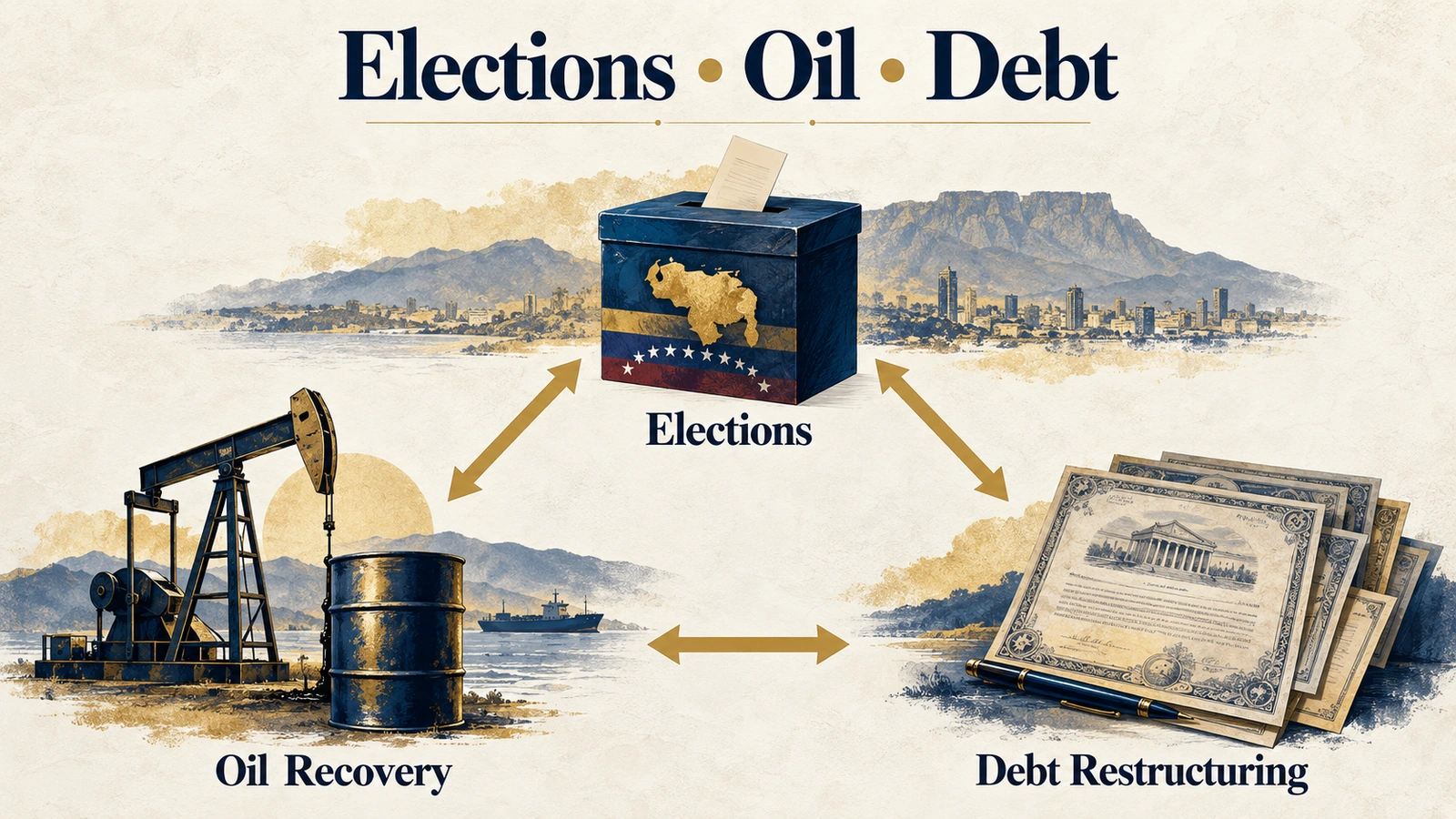
Because Venezuela’s political crisis and economic crisis are now being handled as parts of the same transition.
Venezuela has extraordinary oil resources but a damaged oil industry. The U.S. Energy Information Administration says the country held about 303 billion barrels of proven crude reserves in 2023—roughly 17% of the world’s total—while producing only about 0.8% of global crude oil. Much of the oil is extra-heavy crude that requires significant investment and technical capacity to produce efficiently. (U.S. Energy Information Administration)
That oil also has a direct U.S. connection. Gulf Coast refineries are well suited to process the type of heavy crude Venezuela produces. (U.S. Energy Information Administration)
Debt is the second problem. Reuters reported that Venezuela is preparing to restructure sovereign and state oil company debt that analysts estimate at $150 billion to $200 billion. Rodríguez’s New York delegation met with multilateral lenders and discussed energy, debt and mining as part of the same effort to reopen Venezuela to financing and investment. (Reuters)
Then comes the political track. The White House has described its own Venezuela strategy as moving through stabilization and economic reconstruction toward democratic transition. Secretary of State Marco Rubio similarly argued that Washington wants elections but does not want a newly elected government to inherit an economic and social collapse severe enough to undermine the new political order. (White House · EFE)
That is the administration’s stated rationale. It is not proof that elections must wait for a particular economic benchmark, and critics dispute the sequencing. But it explains why meetings that appear to be about oil or debt keep returning to the election question.
A simple way to see the structure is this:
| Track | Immediate problem | What Washington says it wants |
|---|---|---|
| Elections | No agreed election date or fully trusted electoral framework | A future free and fair vote and a durable democratic system |
| Oil | Huge reserves but years of underinvestment and reduced output | More production, investment and U.S. energy access |
| Debt | $150–$200 billion in estimated sovereign and PDVSA obligations | Restructuring that could reopen financing and investment |
The three tracks are politically linked because a government trying to run an election also needs functioning institutions, public finances and an economy that can operate after the vote.
What Did Trump and Rodríguez Actually Commit To?
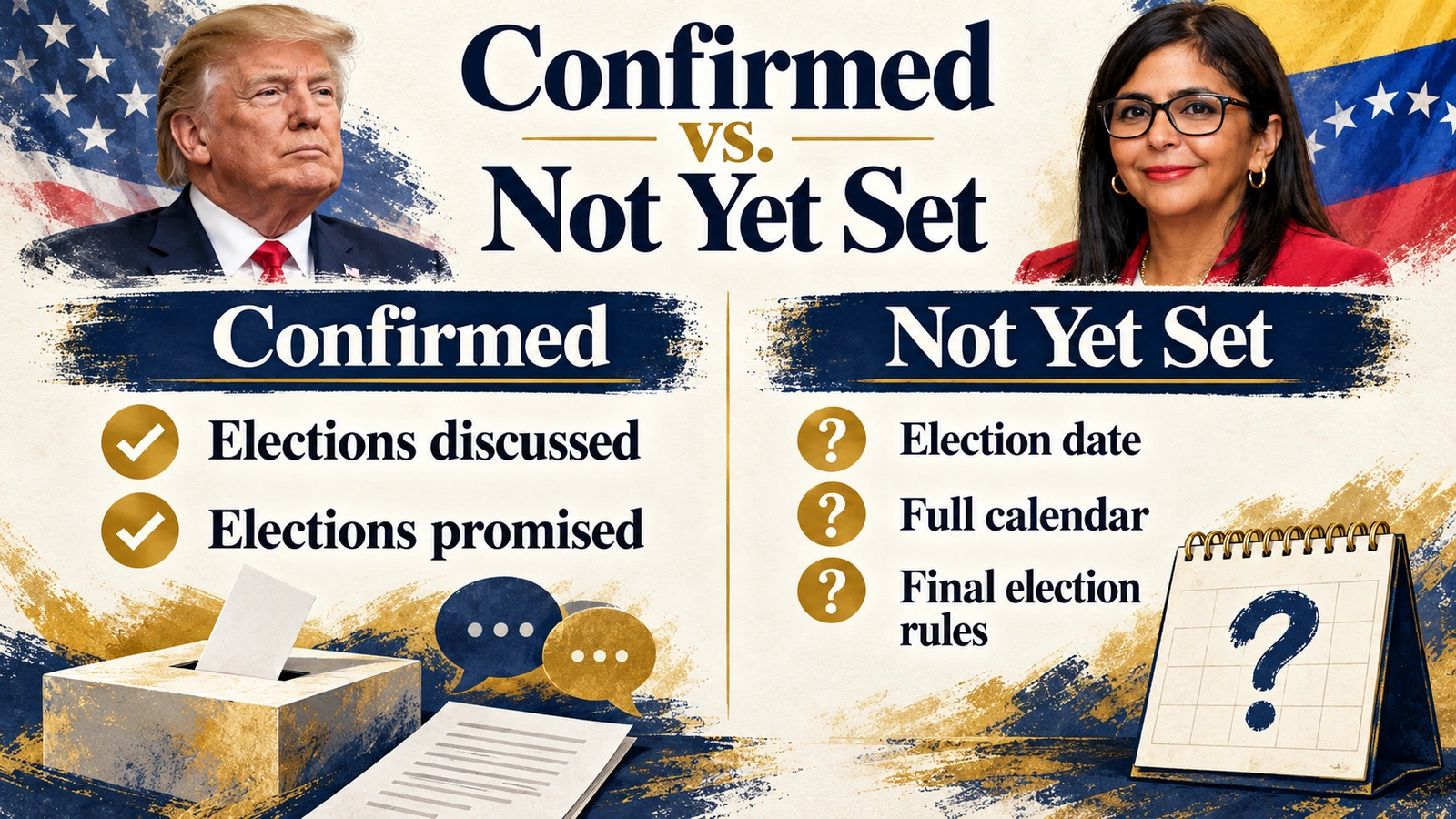
The clearest confirmed fact is surprisingly narrow: Trump and Rodríguez discussed elections, and Rodríguez says elections will be held. There is still no publicly fixed election date.
Trump confirmed on September 26 that the topic came up in their meeting earlier that week. Rubio had already said the two sides discussed elections, economic reconstruction and debt. Rodríguez, speaking at the U.N., said Venezuela would hold elections and referred to dialogue with opposition sectors, but she offered no timetable. (Reuters via Investing.com · EFE)
Reuters reported on September 26 that Rodríguez returned from the U.S. visit without a firm election date and without the major concrete business agreements her delegation had hoped to showcase. (Reuters via Investing.com)
| Confirmed | Not yet publicly settled |
|---|---|
| Trump and Rodríguez discussed elections | The election date |
| Rodríguez publicly promised an election | The full election calendar |
| Debt restructuring and economic reconstruction were discussed | Final terms for a comprehensive debt restructuring |
| Institutional reforms are under discussion | The final composition and independence of election authorities |
| Washington says elections are an end goal | Which candidates will be able to compete under what conditions |
This distinction matters because a promise to hold an election is not the same thing as an election schedule—and an election schedule is not the same thing as a credible election process.
What Would Have to Change Before a Credible Election?

A credible election would require more than choosing a day on the calendar. The institutions that administer the vote—and the rules governing participation and verification—are at least as important.
That lesson comes directly from 2024. The Carter Center’s central criticism was not merely that there was a political dispute over who won. It said Venezuela’s electoral authority failed to publish disaggregated polling-station results, making the announced result impossible to independently verify. (Carter Center)
Some institutional changes have started. Venezuela’s National Assembly approved a reform on September 1 that changed the committee involved in selecting Supreme Court justices. Reuters reported that the broader U.S.-backed dialogue between the government and opposition factions also includes reform of the National Electoral Council. (Reuters)
But “opposition” is not one unified negotiating bloc. Rodríguez has referred to talks with sectors of the opposition, while prominent opposition figures have criticized the current transition and their place in it.
For a future vote, four questions matter more than the announcement alone:
- Who runs the electoral authority?
- Who is allowed to run and campaign?
- Can parties, observers and citizens verify polling-station results?
- Will all major political forces accept the rules before the vote takes place?
Those are process questions, not predictions about who would win.
Why Does the 2024 Election Still Matter So Much?
The 2024 election matters because the present transition is partly an attempt to resolve a legitimacy crisis that was never fully settled inside Venezuela.
The Carter Center did not validate the official result and said the process could not be considered democratic. The United States recognized González as the winner. Yet Maduro remained in control until the January 2026 U.S. operation, and Rodríguez’s government emerged from the same state structure that had been in place under him. (Carter Center · Reuters)
That creates an unusual situation.
Washington is simultaneously dealing with the evidence contained in the opposition-collected 2024 tally sheets and the practical reality that Rodríguez controls the government now operating in Caracas.
That is why a future election is not simply another regular presidential contest. It is being asked to do something much larger: produce a political arrangement that Venezuelans and outside governments can treat as legitimate after years of disputed authority.
Why Should Americans Care About Venezuela’s Election Timeline?
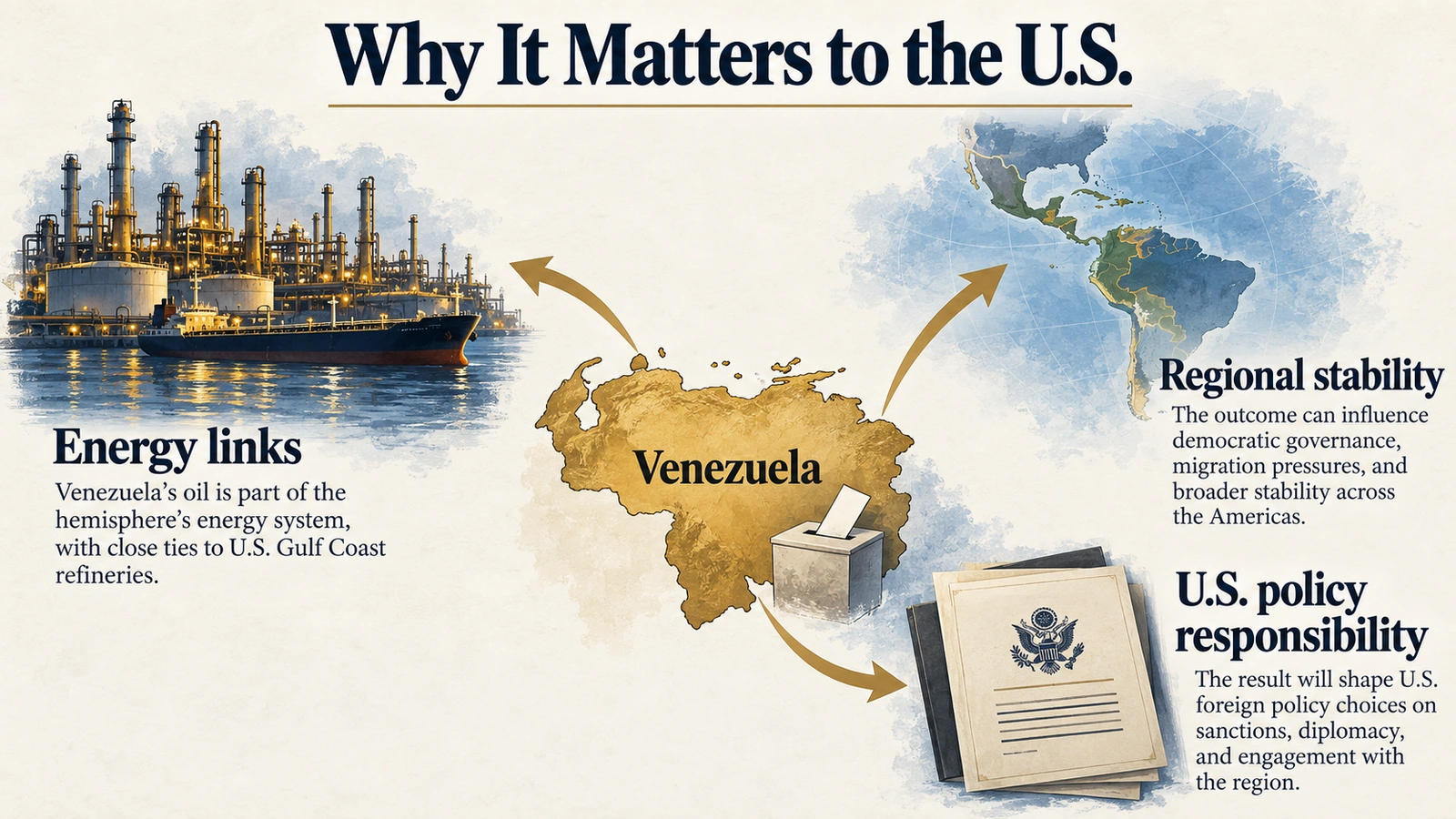
Because the United States is not just watching this transition from the sidelines.
U.S. forces captured Maduro. The Trump administration is directly negotiating with Rodríguez’s government over economic reconstruction, energy, debt and political transition. That gives Washington a direct role in what comes next—and makes the credibility of the eventual election relevant to assessments of U.S. policy. (Congressional Research Service · Reuters)
Energy is the most direct economic link. Venezuela’s heavy crude is compatible with U.S. Gulf Coast refining infrastructure, and Washington has made expanded Venezuelan production part of its economic strategy. That does not mean a Venezuelan election will determine U.S. gasoline prices by itself. Global oil prices depend on many producers, shipping routes, demand conditions and geopolitical events. (U.S. Energy Information Administration)
There is also a broader foreign-policy question. The administration argues that its intervention and economic strategy are intended to lead toward democratic transition. The timing of economic agreements, institutional reforms and an eventual vote will provide concrete evidence for assessing how that strategy is unfolding.
The important point is not to assume either outcome in advance.
What Happens Next?
There are several concrete developments to watch, and none requires guessing who will ultimately govern Venezuela.
First is an actual election calendar. Rodríguez has promised a vote, Trump says elections were discussed, and U.S. officials say elections are an end goal. But there is still no firm publicly announced date. (Reuters via Investing.com)
Second is electoral and judicial reform. Changes to the Supreme Court selection process have begun, while reform of the National Electoral Council remains part of the transition discussion. (Reuters)
Third is who participates. A credible process will depend not only on dialogue with some opposition groups but on whether major political forces can compete under rules they regard as meaningful.
Fourth is economic sequencing. Venezuela is trying to restructure enormous debts, attract investment and rebuild energy production at the same time it is being pressed to move toward elections. Progress in one area could affect the timing and politics of the others, but no public formula says one specific debt or oil target must be reached before voting can occur.
And finally there is the unresolved question surrounding Rodríguez herself. Her government is operating as the country’s acting authority, but the temporary constitutional framework that originally put her there has already become a subject of dispute. The longer there is no election date, the more important that legal and political question becomes.
Bottom Line: What This Story Really Means
The United States did not replace Nicolás Maduro with Venezuela’s opposition after capturing him. Venezuela’s existing institutions put Delcy Rodríguez, Maduro’s former vice president, in charge, and the Trump administration chose to work with the government she controls while pressing for institutional reform and an eventual election.
That is why elections, oil and debt now appear in the same conversations. Washington says economic stabilization and political transition need to reinforce each other; critics worry that economic cooperation could move faster than democratic change.
As of September 28, the most important fact is simple: Venezuela has a public promise of elections, but it still does not have a firm public election date. The next phase can be assessed by whether a calendar, credible election rules, broad political participation and verifiable vote reporting actually emerge.
Venezuela Elections: Key Questions Explained
Q. Did Trump and Delcy Rodríguez actually discuss elections?
Yes. Trump confirmed on September 26 that elections were discussed during their New York meeting, and Secretary of State Marco Rubio had previously said the same. (Reuters via Investing.com · EFE)
Q. Has Venezuela set a date for the next presidential election?
No. Rodríguez has promised elections, but no firm public election date has been announced. (Reuters via Investing.com)
Q. Why is Delcy Rodríguez Venezuela’s acting president?
Venezuela’s Supreme Court ordered Rodríguez, then vice president, to assume presidential duties after U.S. forces captured Maduro in January 2026. She was formally sworn in on January 5. (Reuters)
Q. Is Rodríguez’s extended acting presidency constitutionally settled?
No clear public resolution has removed the controversy. AP reported in April that her initial 90-day period had expired without a publicly reported legislative extension, and later reported that the 180-day interim period expired on July 3. That makes the legal basis for an open-ended acting presidency an unresolved part of the transition. (AP · AP)
Q. What happened in Venezuela’s 2024 presidential election?
The electoral authority declared Maduro the winner but did not publish the detailed polling-station results needed for independent verification. The Carter Center concluded that the election did not meet international standards, while opposition-collected tally sheets showed a large lead for Edmundo González. (Carter Center)
Q. Did the United States recognize Edmundo González as the 2024 winner?
Yes. The United States recognized González as the winner in August 2024, citing the opposition’s published voting records and the lack of transparent official results. (Reuters)
Q. Why are oil and debt part of the election discussion?
The Trump administration says Venezuela needs economic stabilization and reconstruction alongside political transition. Venezuela also faces an estimated $150 billion to $200 billion debt restructuring and is trying to rebuild an oil sector sitting on the world’s largest proven crude reserves. (Reuters · U.S. Energy Information Administration)
Q. What should people watch next in Venezuela?
The clearest signals will be a firm election calendar, changes to the electoral and judicial institutions, rules for candidate participation, transparent vote-reporting requirements and evidence that major opposition forces can compete under the final framework.
Did this help make the story clearer? 🙂
WIN keeps unpacking the “why” behind the news—clearly and simply!
Sources
Election Talks and the September U.N. Visit
Reuters via Investing.com — Trump Says He Spoke With Venezuela’s Rodríguez About Elections
EFE — Trump Says He Discussed Elections With Delcy Rodríguez
EFE — Rodríguez Tells the U.N. That Venezuela Will Hold Elections
Reuters via Investing.com — Rodríguez Returns From U.S. Visit With No Firm Election Date
Maduro’s Capture and Rodríguez’s Acting Presidency
Reuters — Venezuela’s Supreme Court Orders Rodríguez to Become Acting President
Reuters — Rodríguez Is Formally Sworn In
AP — Rodríguez Remains in Office After Initial 90-Day Period Expires
AP — Rodríguez’s 180-Day Interim Period Expires
Congressional Research Service — Venezuela’s Post-Maduro Political Transition and U.S. Policy
The 2024 Election and Electoral Institutions
Carter Center — Final Report on Venezuela’s 2024 Presidential Election
Reuters — U.S. Recognizes Edmundo González as the 2024 Election Winner
Reuters — Venezuela’s Assembly Approves Court Selection Reform
Oil, Debt and the U.S. Transition Strategy
Reuters — Venezuelan Delegation Seeks Debt and Energy Deals in New York
U.S. Energy Information Administration — Venezuela Country Analysis
White House — Administration Statement on Its Venezuela Oil and Transition Strategy
Keep Reading
How Does Trump Describe U.S. Power in the Western Hemisphere?
The Venezuela transition is part of a broader debate over how the Trump administration views American power, sovereignty and military influence in the region. That context helps explain why other governments are watching Washington’s role in Venezuela so closely.
Did Trump Threaten Macron and Lula? What Their U.N. Speeches Actually Said