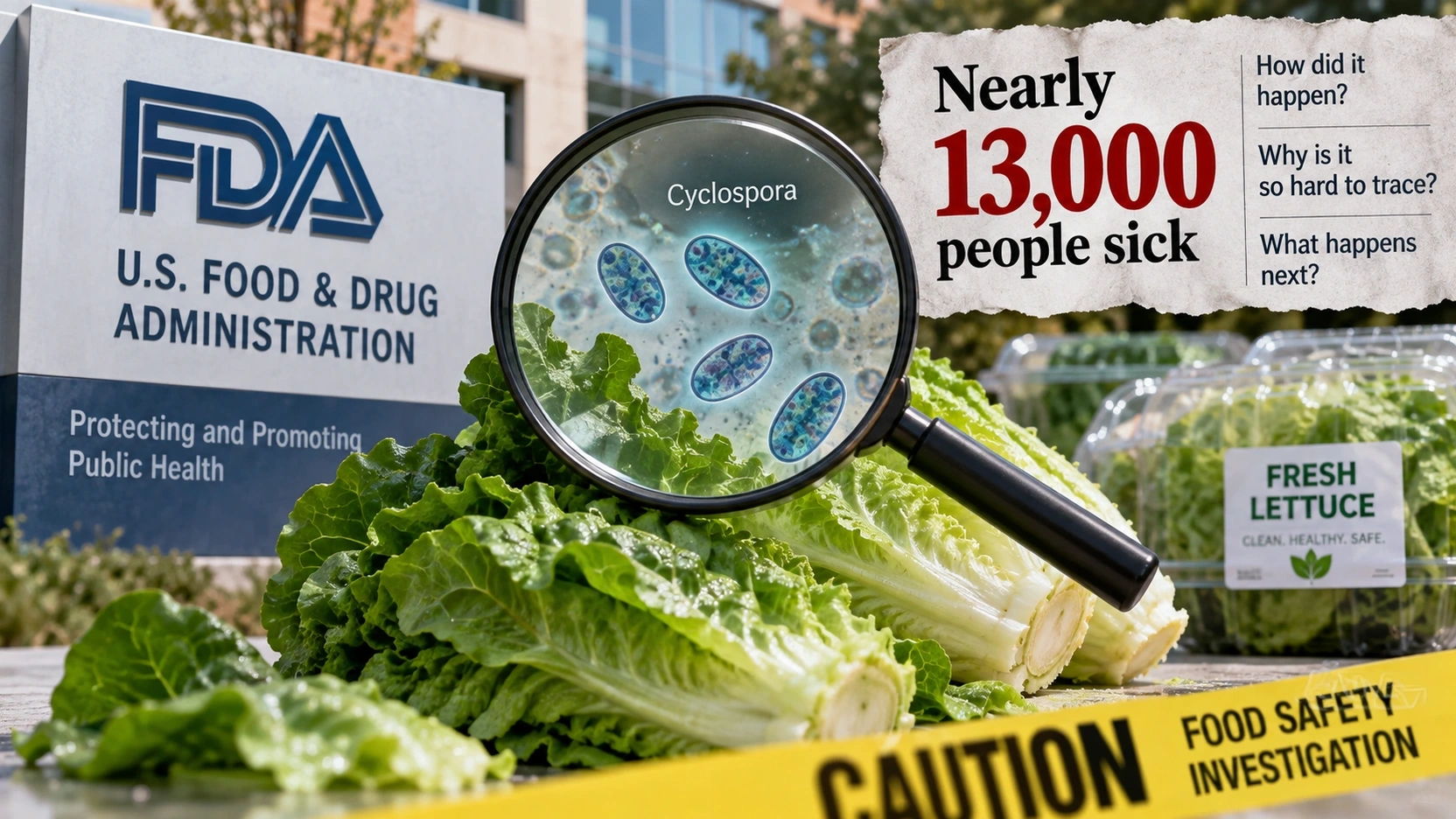
How Did a Lettuce Outbreak Sicken Nearly 13,000 People—and Why Is Cyclospora So Hard to Trace?

How can investigators find the parasite in the same growing and processing environment—and still say they do not know exactly how the lettuce became contaminated?
That sounds like a contradiction. It isn’t.
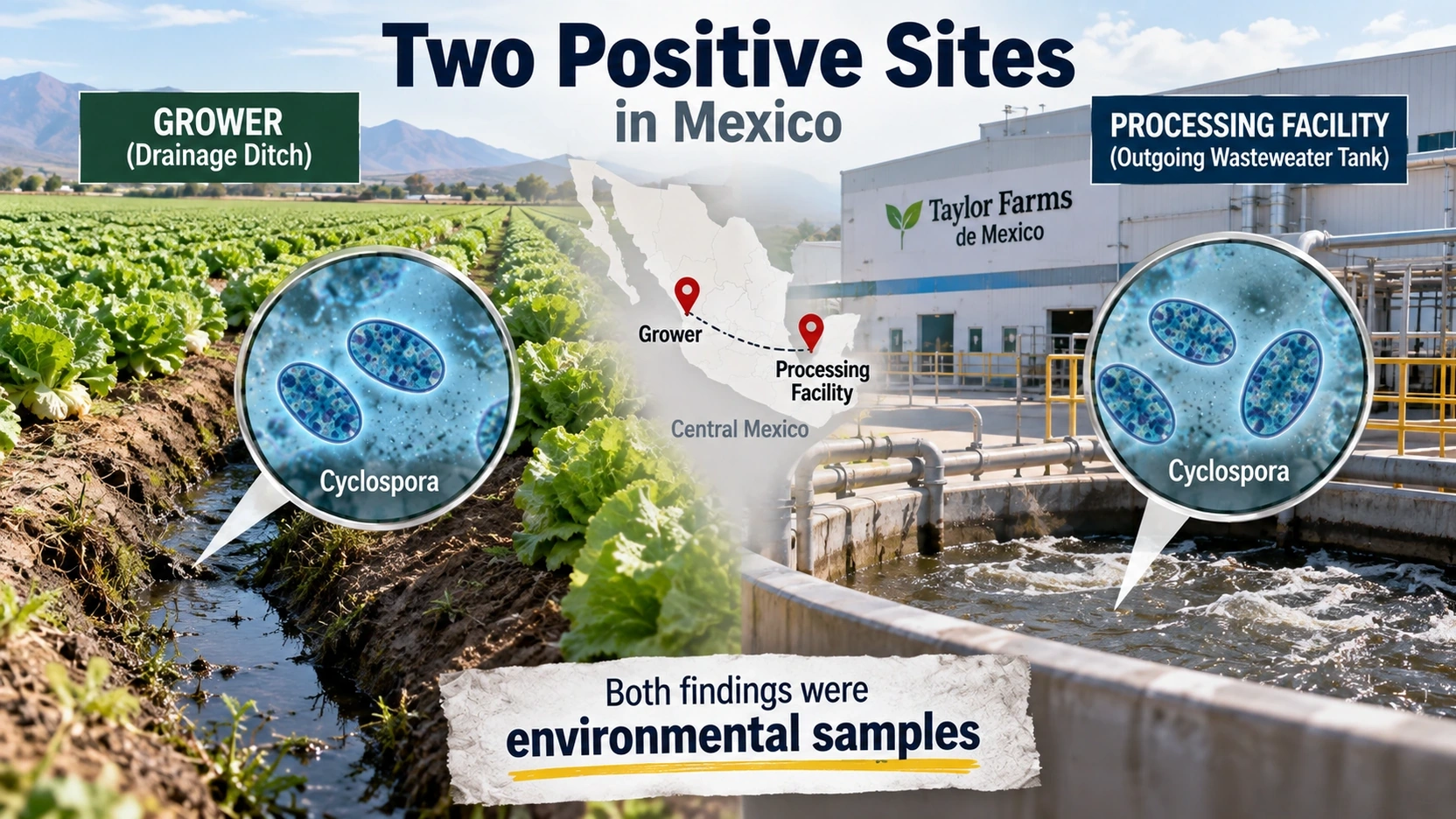
On October 2, the FDA said two environmental samples collected during inspections in Mexico tested positive for Cyclospora: one from a tank holding outgoing wastewater at the Taylor Farms de Mexico processing facility, and another from a drainage ditch at an iceberg-lettuce grower identified through the agency’s traceback investigation. Those findings strengthen the link to the lettuce supply chain, but they do not show the exact step that moved the parasite onto lettuce eaten by consumers. (FDA)
There is another important distinction. The dangerous lettuce is not newly appearing in stores. CDC declared the outbreak over on September 11, and federal officials say the recalled product is no longer available in stores or restaurants. The October 2 news is about what investigators found afterward. (CDC)
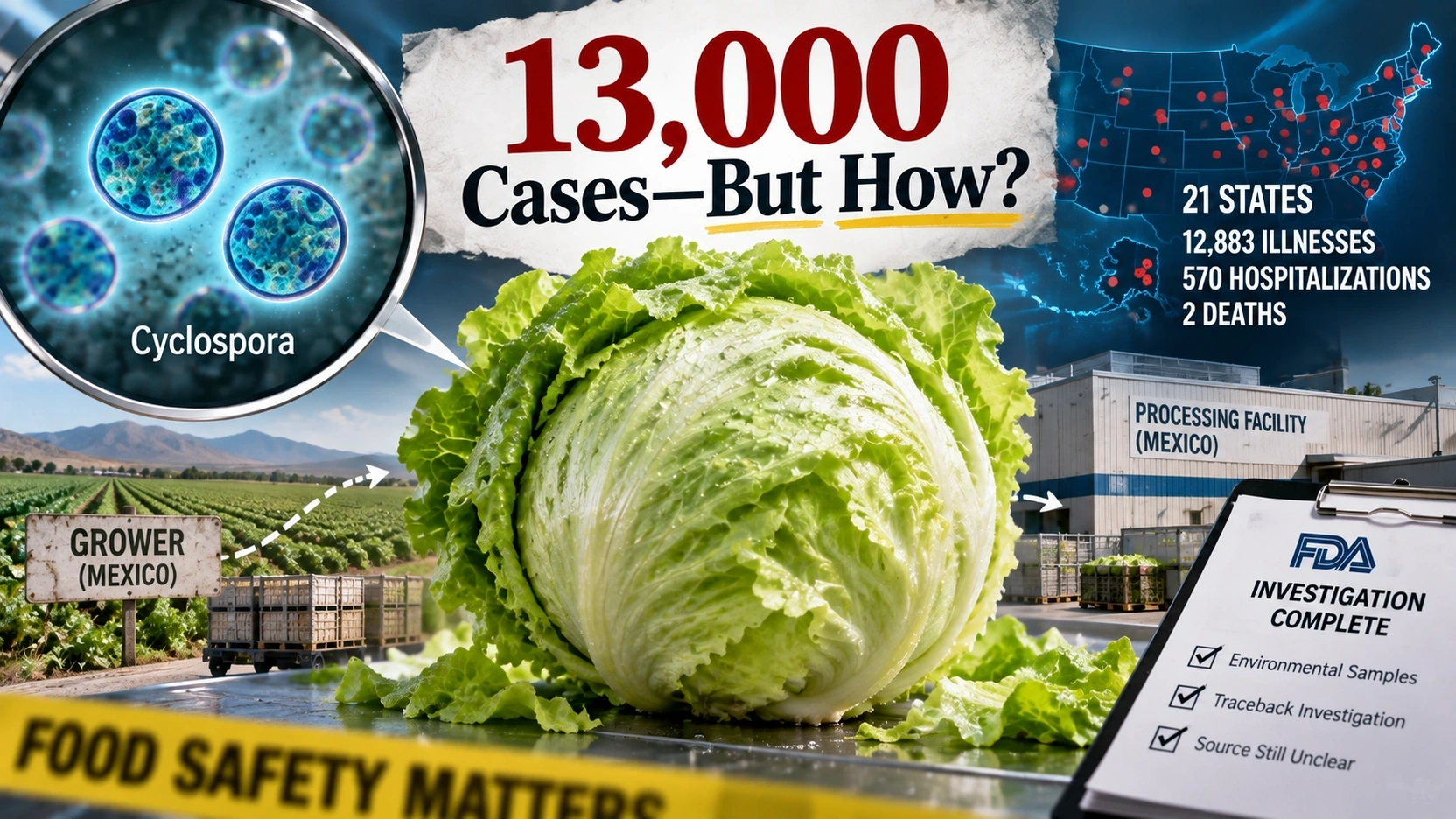
※ Images in this article are AI-generated illustrations created to help explain the story. They are not actual photographs, and depictions of people, places, or events may differ slightly from reality.
The outbreak ultimately included 12,883 laboratory-confirmed illnesses in 21 states, at least 570 hospitalizations and two deaths. Illnesses tied to the outbreak began as early as June 14 and continued through August 17. (CDC)
So the real mystery is no longer which food was linked to the outbreak. It is how a microscopic parasite moved through a fresh-produce system on a scale large enough to make almost 13,000 confirmed people sick.
What Exactly Did the FDA Find in Mexico?
The FDA found Cyclospora in two environmental locations connected to the traced lettuce supply chain, not in a final product sample that by itself proved how consumers were exposed. (FDA)
That difference is central to the story.
| Finding | What it supports | What it does not prove |
|---|---|---|
| Cyclospora in outgoing wastewater at the processing facility | The parasite was present in the processing environment | That wastewater directly contaminated the lettuce |
| Cyclospora in a drainage ditch at a traced grower | The parasite was present in the growing environment | The exact route from the ditch to harvested lettuce |
| Epidemiology and supply-chain traceback converged on Taylor Farms de Mexico lettuce | The recalled iceberg lettuce was strongly linked to illnesses | The precise contamination event |
FDA inspectors sampled water, soil, sediment and lettuce while examining several growers and a processing facility in Mexico. The agency said the environmental positives added to the epidemiological and traceback evidence already connecting the outbreak with recalled shredded iceberg lettuce from Taylor Farms de Mexico. (FDA)
But finding the organism nearby is not the same as reconstructing the moment of contamination.
That is why the investigation can be strong about what food was associated with the illnesses while remaining uncertain about exactly how that food became contaminated.
If Cyclospora Was There, Why Can’t the FDA Say How It Got Onto the Lettuce?
Because a positive environmental sample answers “Was Cyclospora present here?” It does not automatically answer “Did this exact material contaminate this exact lettuce, and at what point?”
Fresh-produce investigators have to reconstruct a chain involving farms, water, sanitation systems, harvesting, transportation and processing. FDA guidance identifies agricultural water, sanitation and worker hygiene among the areas that matter when controlling Cyclospora, but the agency has not concluded which specific pathway caused this outbreak. (FDA)
The FDA said that there is not enough evidence to conclusively determine how contamination occurred. It has completed genotyping of the two positive environmental samples and is continuing to analyze how those results relate to genotyping of samples from patients. (FDA)
Genotyping is useful because investigators can compare selected genetic markers from parasites found in different places. If the environmental parasites are closely related to those found in sick patients, that can make the connection stronger.
But even a genetic match would not necessarily recreate the physical route the parasite took from an environmental source to a piece of lettuce.
Why Is Cyclospora So Difficult to Trace?
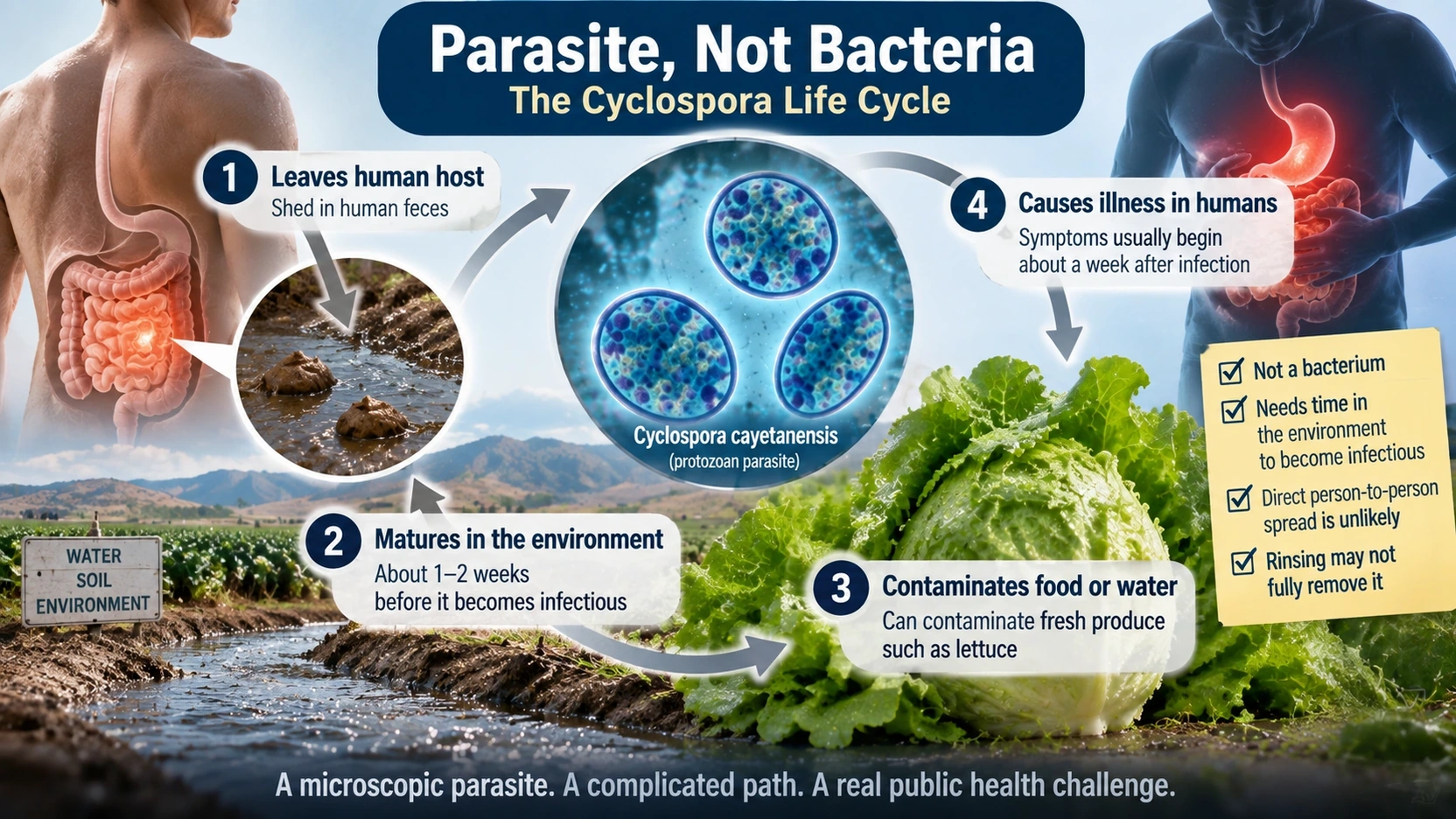
Cyclospora cayetanensis is not a bacterium like Salmonella or E. coli. It is a microscopic parasite with a more complicated life cycle.
Humans are the only known host for the species that causes cyclosporiasis. The parasite is shed in human feces, but it generally must remain in the environment for roughly one to two weeks before becoming infectious. That is one reason direct person-to-person transmission is considered unlikely. (FDA)
The delay does not stop there.
Symptoms typically begin around a week after infection, although the timing can vary. And because patients may wait before seeking care, getting tested and being reported to health departments, investigators can end up asking people to remember what they ate weeks earlier. (FDA)
That creates a difficult sequence:
eat contaminated food → wait for symptoms → seek care → get the correct test → report the case → remember earlier meals → compare those meals with other patients → trace suppliers backward.
CDC has said that identifying whether a person belongs to a Cyclospora outbreak can take as long as six weeks. (CDC)
There is also a practical food-safety problem. FDA says standard chlorine-based sanitizers are not considered effective against Cyclospora, and rinsing fresh produce does not reliably eliminate the parasite. (FDA)
That makes prevention upstream—before contamination reaches the finished food—especially important.
How Did the Outbreak Grow to 12,883 Confirmed Cases?
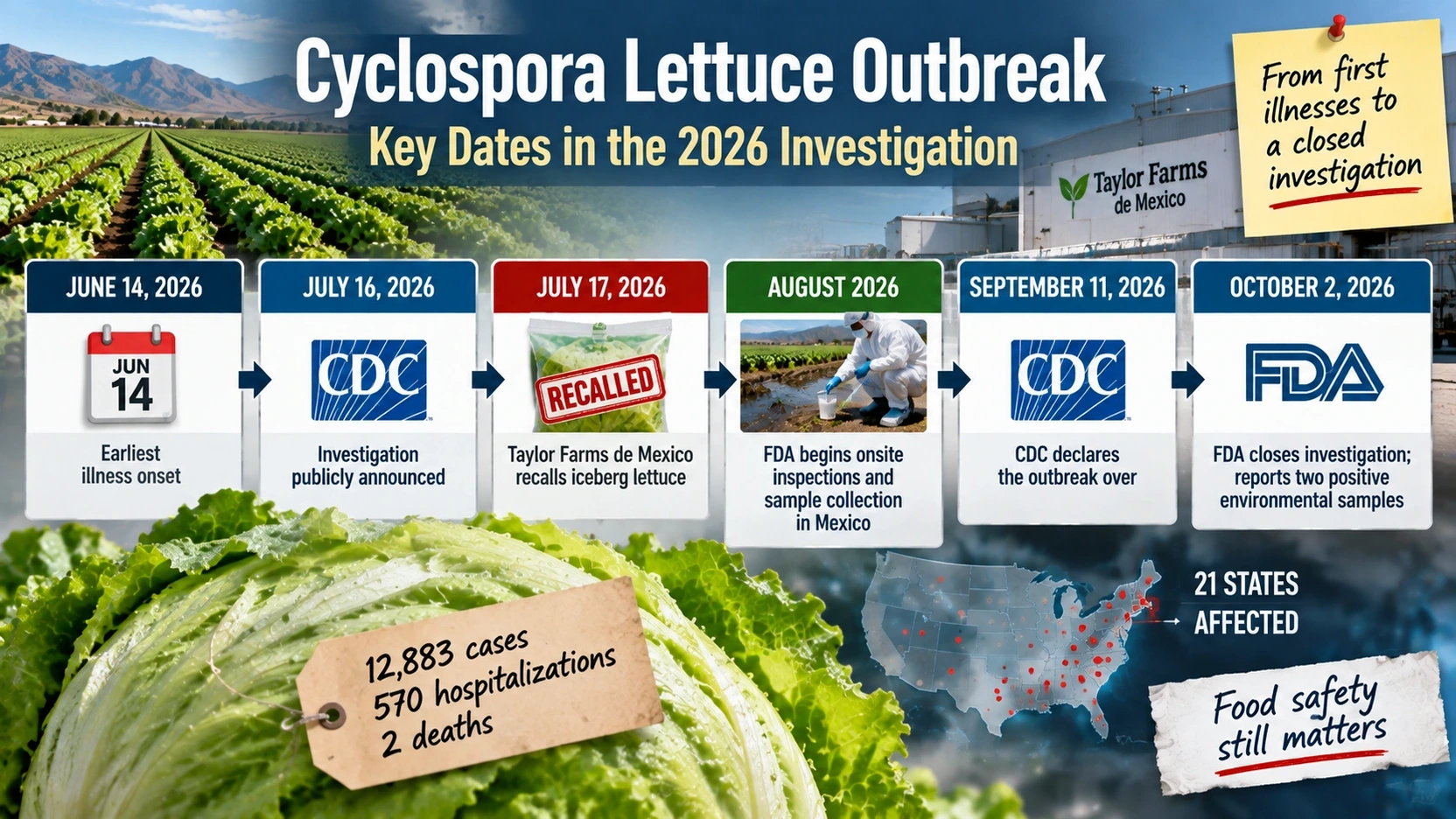
The final number was large partly because Cyclospora cases kept being identified and linked after the contaminated lettuce had already been removed.
Most illnesses began before Taylor Farms de Mexico recalled the implicated iceberg lettuce on July 17. Because reporting and outbreak classification take time, the official case total continued climbing afterward. (CDC)
| Date | What happened |
|---|---|
| June 14 | Earliest illness onset ultimately included in the final outbreak count |
| July 16 | Federal agencies publicly announced the investigation |
| July 17 | Taylor Farms de Mexico recalled iceberg lettuce sourced from central Mexico |
| August | FDA began onsite inspections and sample collection in Mexico |
| September 11 | CDC declared the outbreak over |
| October 2 | FDA closed its outbreak investigation and disclosed two positive environmental samples |
The final CDC count was 12,883 confirmed illnesses across 21 states, 570 hospitalizations and two deaths. CDC also cautioned that the actual number of infections was probably higher because people with mild illness may recover without being tested. (CDC)
Early in the investigation, many known illnesses involved people who had eaten at Taco Bell locations supplied with implicated shredded lettuce. But the investigation later expanded beyond that initial cluster and linked illnesses more broadly to processed iceberg lettuce from Taylor Farms de Mexico. (CDC)
That is why this should not be understood simply as a “Taco Bell outbreak.” The restaurant exposures helped investigators find the pattern; the supply-chain investigation then moved further upstream.
Why Did Some Earlier Tests Say No Cyclospora Was Found?
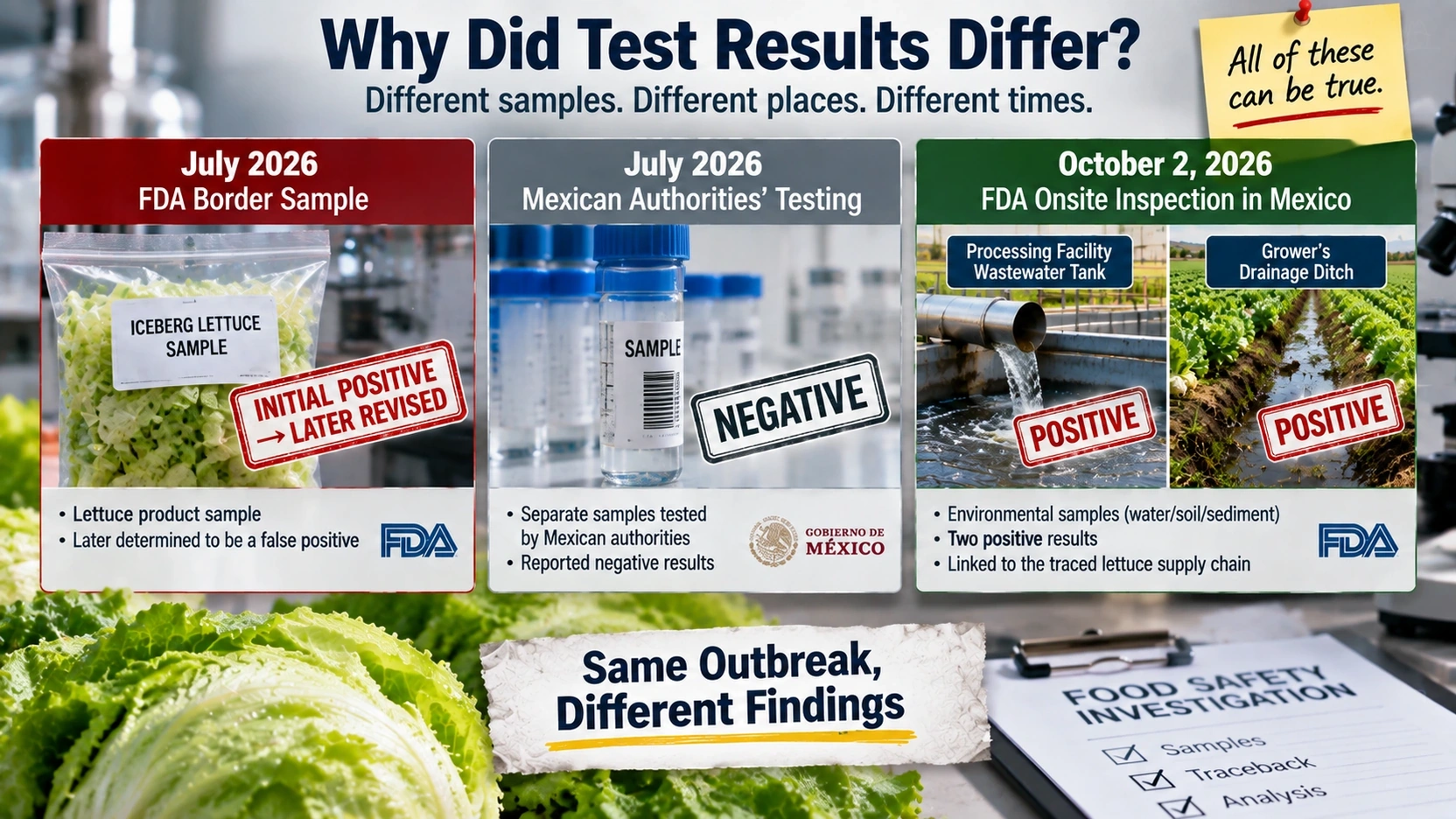
Because the tests were not all testing the same thing at the same place and time.
That distinction resolves much of the apparent contradiction.
| Testing event | Result | Important distinction |
|---|---|---|
| July FDA border sample | Initially reported positive, then reclassified as a false positive | This was a lettuce-product sample |
| Mexican authorities’ July testing | Reported negative results in samples they tested | These were separate samples collected during a different investigation |
| FDA onsite environmental sampling disclosed October 2 | Two positive results | These came from wastewater and a grower’s drainage ditch, not the recalled retail lettuce itself |
FDA said on July 19 that it had re-reviewed an earlier lettuce sample and determined that what had been reported as a positive result did not represent a true positive. The agency explicitly said that correction did not change the epidemiological and traceback evidence supporting the recall. (FDA)
Mexican food-safety authorities separately reported negative results from samples they analyzed in July. (Mexico’s Secretariat of Health)
Then came the later FDA onsite inspection. Those samples were collected from the growing and processing environment, and two tested positive.
So “an earlier test was negative” and “a later environmental test was positive” can both be true.
A negative sample tells investigators what was—or was not—detected in that particular sample. It does not prove that a parasite was absent everywhere in a farm or processing network.
Is the Recalled Lettuce Still a Danger to Shoppers?
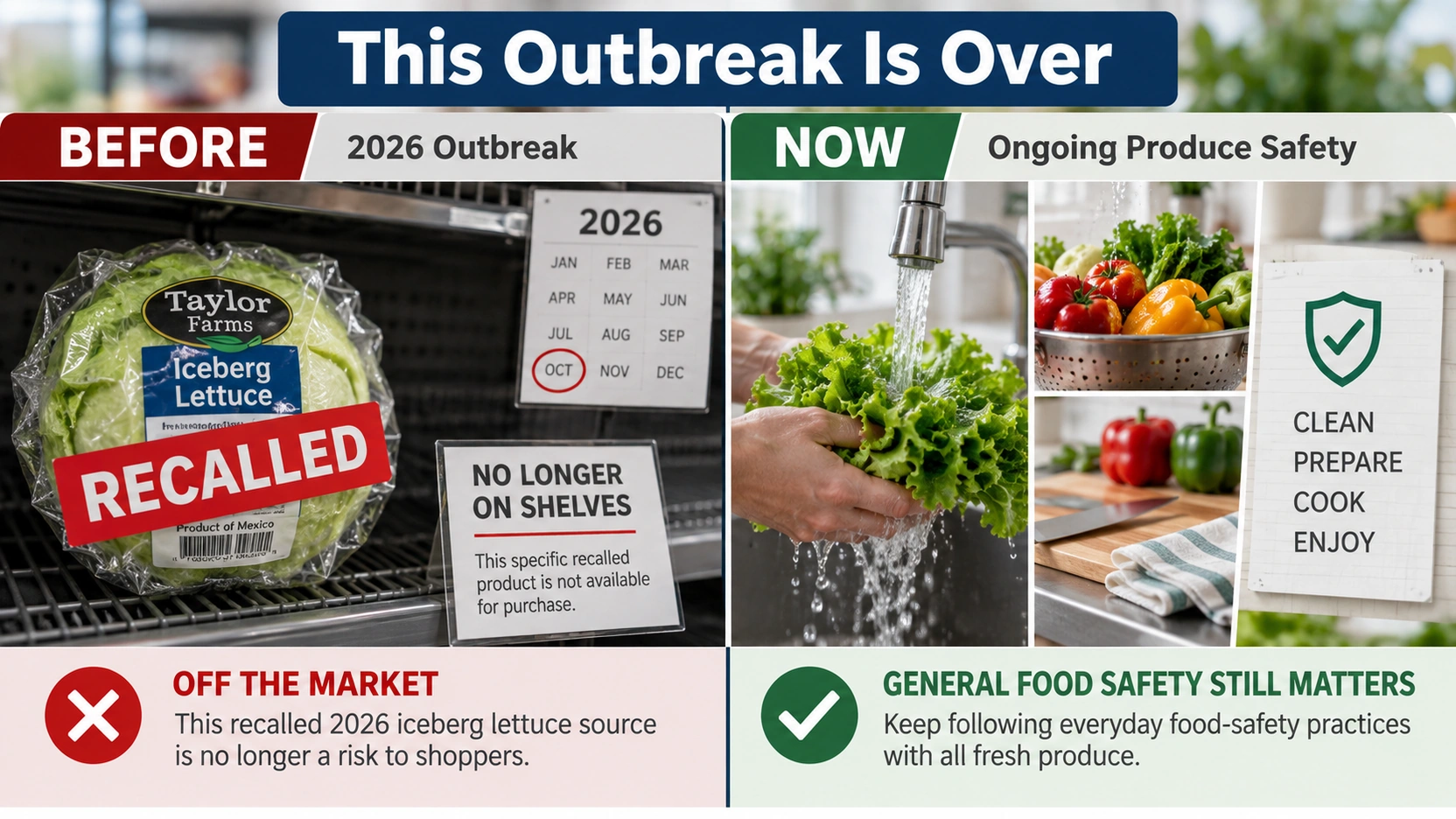
CDC says there is no current risk of becoming sick from this specific recalled source. The outbreak was declared over on September 11, 2026, and the implicated lettuce is no longer available in stores or restaurants. (CDC)
That does not mean Cyclospora has disappeared as a food-safety concern.
The parasite can cause watery diarrhea, loss of appetite, weight loss, stomach cramps, bloating, nausea and fatigue. Untreated illness can last for weeks and symptoms can sometimes disappear and return. (FDA)
Consumers should also understand a limitation of ordinary produce washing: FDA says rinsing is still an appropriate food-safety step, but it may not reliably remove Cyclospora, and routine chlorine-based sanitizers are not considered effective against it. (FDA)
That is why a case like this puts so much attention on farms, agricultural water, sanitation and processing controls rather than treating kitchen washing as the main solution.
What Happens After the Investigation Is Closed?
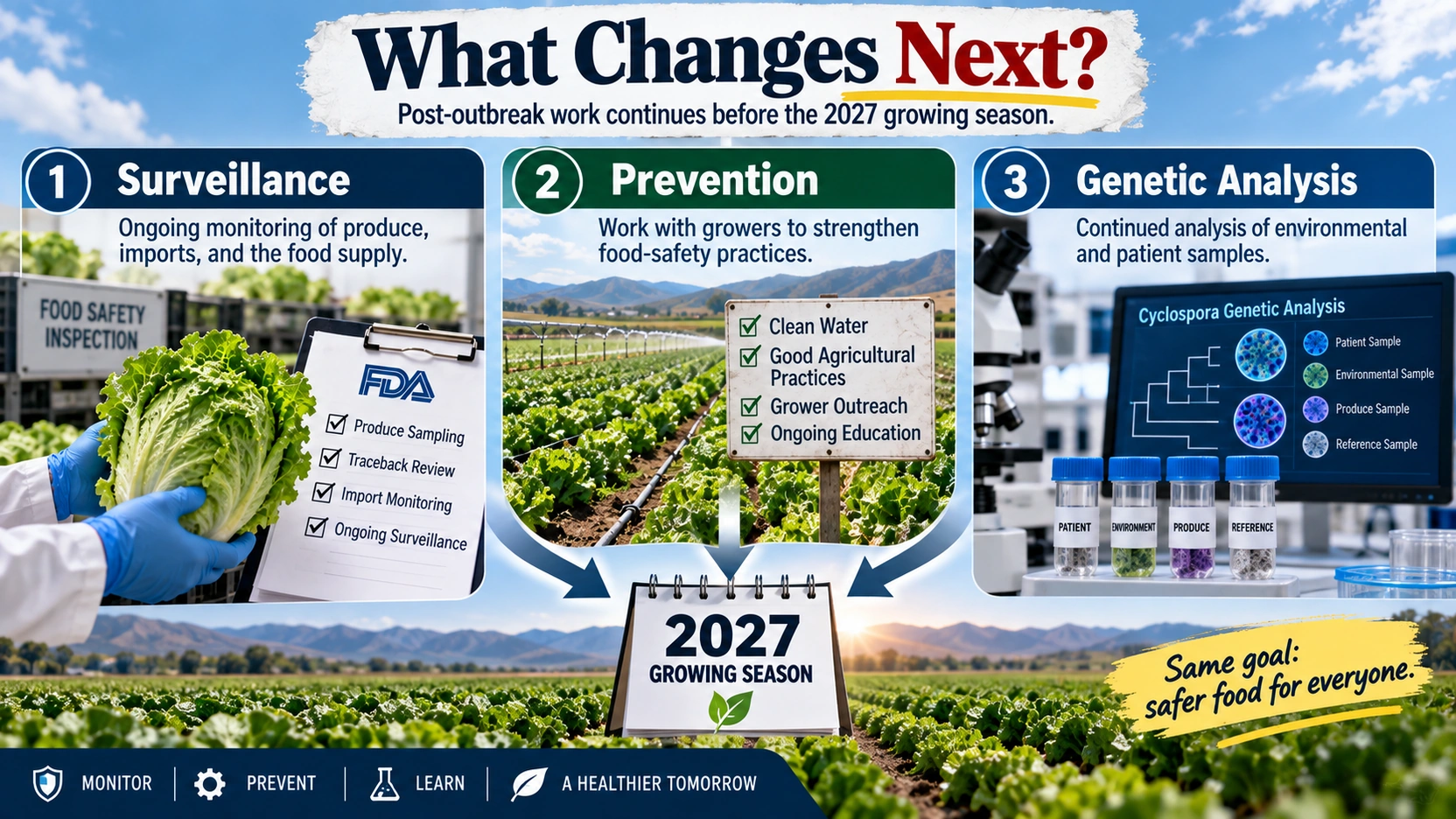
“Investigation closed” does not mean every scientific question has been answered.
FDA says it is continuing post-outbreak work, including analysis of how the genetic profiles from the two positive environmental samples relate to clinical samples from people who became sick. (FDA)
The agency also announced 10 planned Cyclospora-related activities to be carried out before the 2027 growing season. They include increased surveillance of produce historically linked to Cyclospora, additional outreach to growers, an updated prevention and research plan, and a forthcoming investigation report with recommendations. (FDA)
Taylor Farms, meanwhile, said the independent grower associated with one positive sample is no longer in its supplier program and that its central Mexico facility remains closed while enhanced food-safety measures are implemented. (AP · Reuters)
The next important evidence will therefore not be another rising case count from this outbreak.
It will be whether the remaining laboratory work and post-outbreak investigation can narrow the gap between knowing where the parasite was found and understanding exactly how it reached the food supply.
Bottom Line: What This Story Really Means
The nearly 13,000-case lettuce outbreak is no longer an active consumer warning. The recalled iceberg lettuce is off the market, and CDC declared the outbreak over in September.
What changed on October 2 is that FDA finally disclosed direct environmental evidence from the Mexican supply chain: Cyclospora was detected in wastewater at a processing facility and in a drainage ditch at a traced lettuce grower.
That makes the connection between the outbreak and the lettuce supply chain stronger.
But it does not answer the last—and perhaps most important—question: how did the parasite actually move from that environment onto lettuce eaten by thousands of people?
That gap is exactly why Cyclospora outbreaks can be so frustrating to investigate. A long incubation period, delayed case reporting, a complicated environmental life cycle and difficult produce sampling can leave investigators with strong evidence about the source while the precise contamination event remains unresolved.
Cyclospora Outbreak: Key Questions Explained
Q. How many people became sick in the 2026 iceberg lettuce Cyclospora outbreak?
CDC’s final count was 12,883 laboratory-confirmed illnesses in 21 states, including at least 570 hospitalizations and two deaths.
Q. Did the FDA find Cyclospora on the recalled lettuce?
The FDA’s October 2 positive findings were environmental samples, not final positive retail-lettuce samples. The parasite was detected in wastewater at a processing facility and in a drainage ditch at a traced grower.
Q. Where was the contaminated lettuce traced?
Federal investigators linked the outbreak to processed iceberg lettuce from Taylor Farms de Mexico and growers in central Mexico.
Q. Why can’t the FDA say exactly how the lettuce became contaminated?
Detecting Cyclospora in the growing and processing environment proves the parasite was present there, but it does not establish the exact physical route by which it reached the lettuce.
Q. Is the 2026 lettuce outbreak still ongoing?
No. CDC declared the outbreak over on September 11, 2026, and says the recalled product is no longer available in stores or restaurants.
Q. Can washing lettuce completely remove Cyclospora?
Not reliably. FDA recommends rinsing fresh produce, but says washing alone cannot guarantee removal and that Cyclospora is resistant to standard chlorine-based sanitizers.
Q. Can Cyclospora easily spread directly from one person to another?
Direct person-to-person spread is considered unlikely because the parasite generally needs about one to two weeks in the environment after being shed before it becomes infectious.
Q. Why did earlier tests come back negative or get corrected?
They involved different samples and different testing events. One FDA lettuce result was reclassified as a false positive in July, Mexican authorities reported negative samples from their testing, and the later FDA positives came from environmental samples collected during onsite inspections.
Q. What is the FDA doing next?
FDA is continuing genetic analysis and post-outbreak work and has announced 10 prevention-related activities it plans to pursue before the 2027 growing season, including more surveillance and grower outreach.
Did this help make the story clearer? 🙂 WIN keeps unpacking the “why” behind the news—clearly and simply!
Sources
Outbreak Size, Recall and Timeline
CDC — Cyclospora Outbreak Linked to Iceberg Lettuce
CDC — Investigation Update: Cyclospora Outbreak, July 2026
FDA — Taylor Fresh Foods Recalls Iceberg Lettuce from Central Mexico Because of Possible Health Risk
FDA Environmental Findings and Traceback
FDA — Investigation of Multistate Outbreak of Cyclospora Illnesses: Iceberg Lettuce
Associated Press — Cyclospora Found at Mexican Farm Linked to Lettuce Outbreak
Reuters — U.S. FDA Closes Cyclospora Lettuce Parasite Probe
Cyclospora Biology and Food-Safety Challenges
FDA — Cyclosporiasis and Fresh Produce
Post-Outbreak Prevention
FDA — FDA Commits to Series of Actions Following Summer 2026 Cyclospora Outbreaks