Why Did a Federal Judge Halt Trump’s Border Wall Project in Big Bend—and What Happens Next?

Did a federal judge just declare President Donald Trump’s border wall illegal?
No. But the judge did something significant: she stopped border-barrier construction across the Big Bend Sector while a constitutional lawsuit continues.
That distinction matters.
The October 2 order is a preliminary injunction, not the final judgment in the case. Yet it goes beyond simply asking contractors to pause for a few days. U.S. District Judge Kathleen Cardone also temporarily suspended the effect of the federal waivers the government had been relying on to bypass numerous legal requirements for the project. (AP · Reuters)
That raises a more complicated question.
If Congress gave the Department of Homeland Security extraordinary power to waive environmental and other laws for border construction, how can a federal judge stop the project anyway?
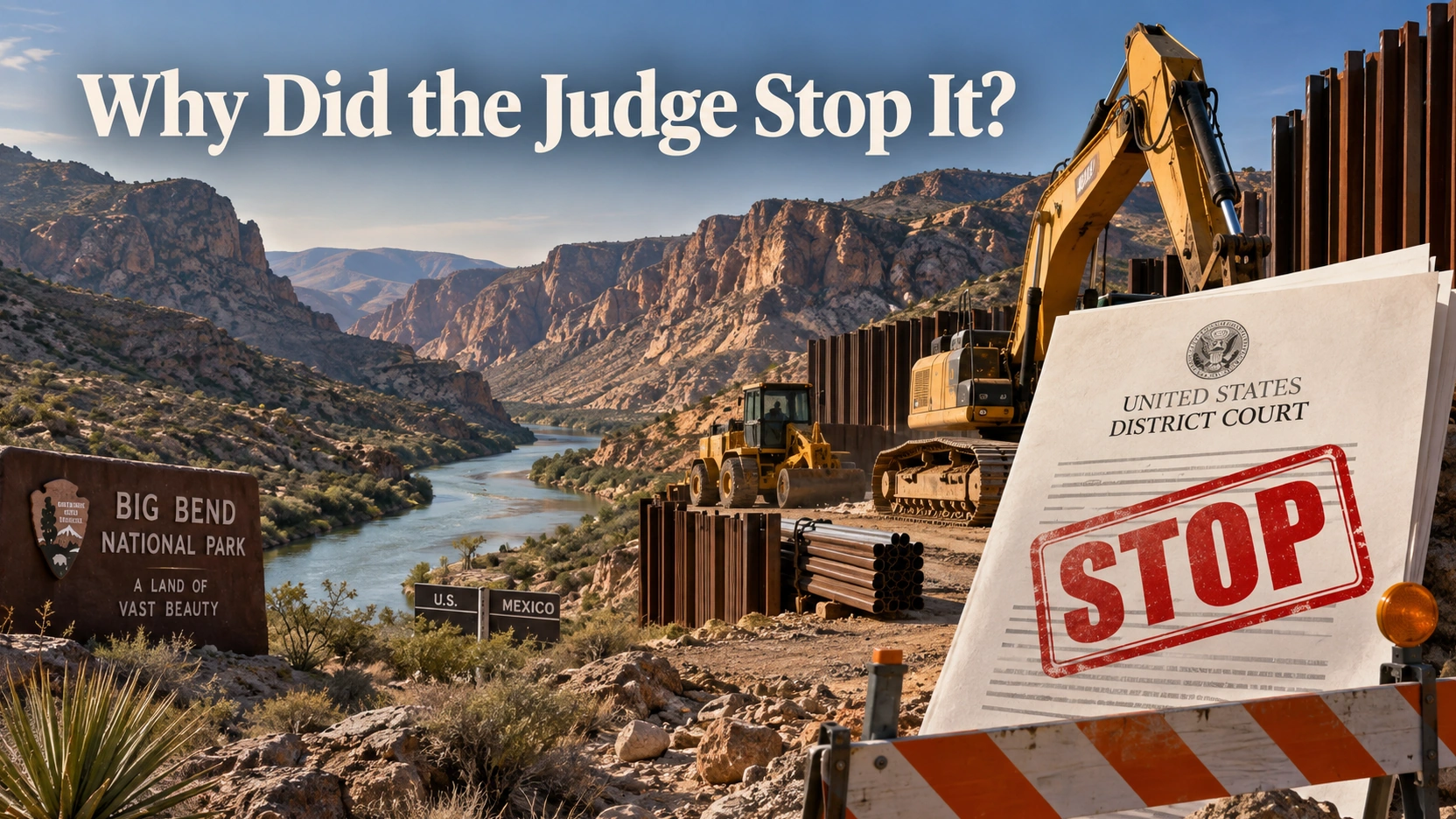
※ Images in this article are AI-generated illustrations created to help explain the story. They are not actual photographs, and depictions of people, places, or events may differ slightly from reality.
The answer lies in an unusual border-security law, an unusually broad waiver power—and a lawsuit arguing that the executive branch went beyond what the Constitution allows.
What Did the Judge Actually Order?
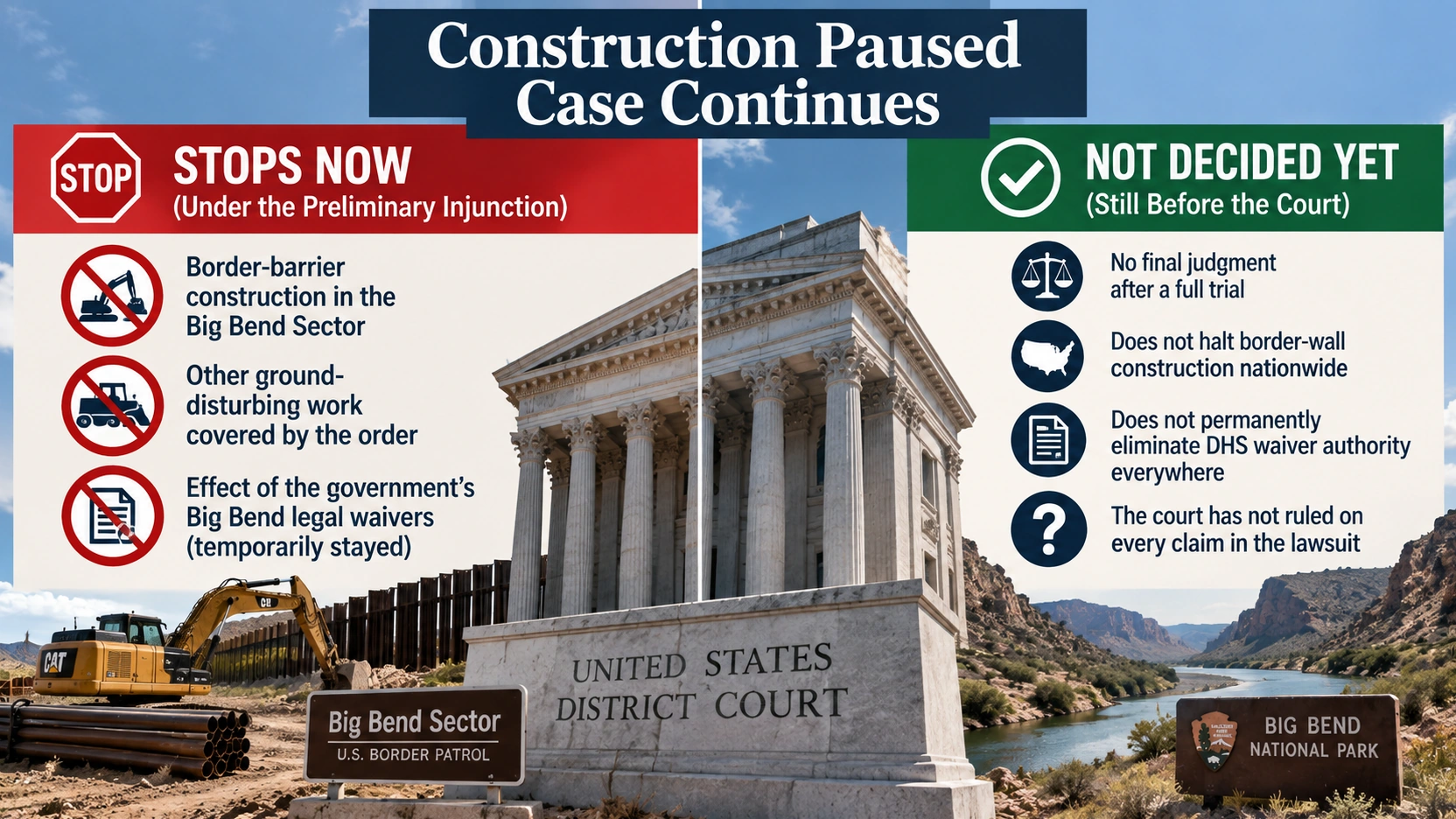
The immediate effect is straightforward: the federal government cannot currently conduct border-barrier construction or other ground-disturbing work covered by the order in the Big Bend Sector unless it complies with applicable law.
Cardone also stayed the effect of the government’s Big Bend legal waivers for the duration of the injunction. She concluded that the plaintiffs were likely to succeed on at least one claim, faced a risk of serious and irreparable harm, and had satisfied the other requirements for preliminary relief. (AP · Reuters)
But the court did not finally decide every constitutional question raised in the lawsuit.
| What the court did | What the court did not do |
|---|---|
| Issued a preliminary injunction | Issue a final judgment after a full trial |
| Halted covered construction in the Big Bend Sector | Halt border-wall construction nationwide |
| Temporarily stayed the Big Bend waivers | Permanently eliminate DHS waiver authority everywhere |
| Found the plaintiffs likely to succeed on at least one claim | Declare that every claim made by the plaintiffs is correct |
| Kept the dispute alive in federal court | End the litigation |
That last distinction is crucial.
A preliminary injunction asks a judge whether work should be allowed to continue while the court decides who is legally right. It is not the same thing as the final answer.
Why Is Big Bend Different From Other Parts of the Border?
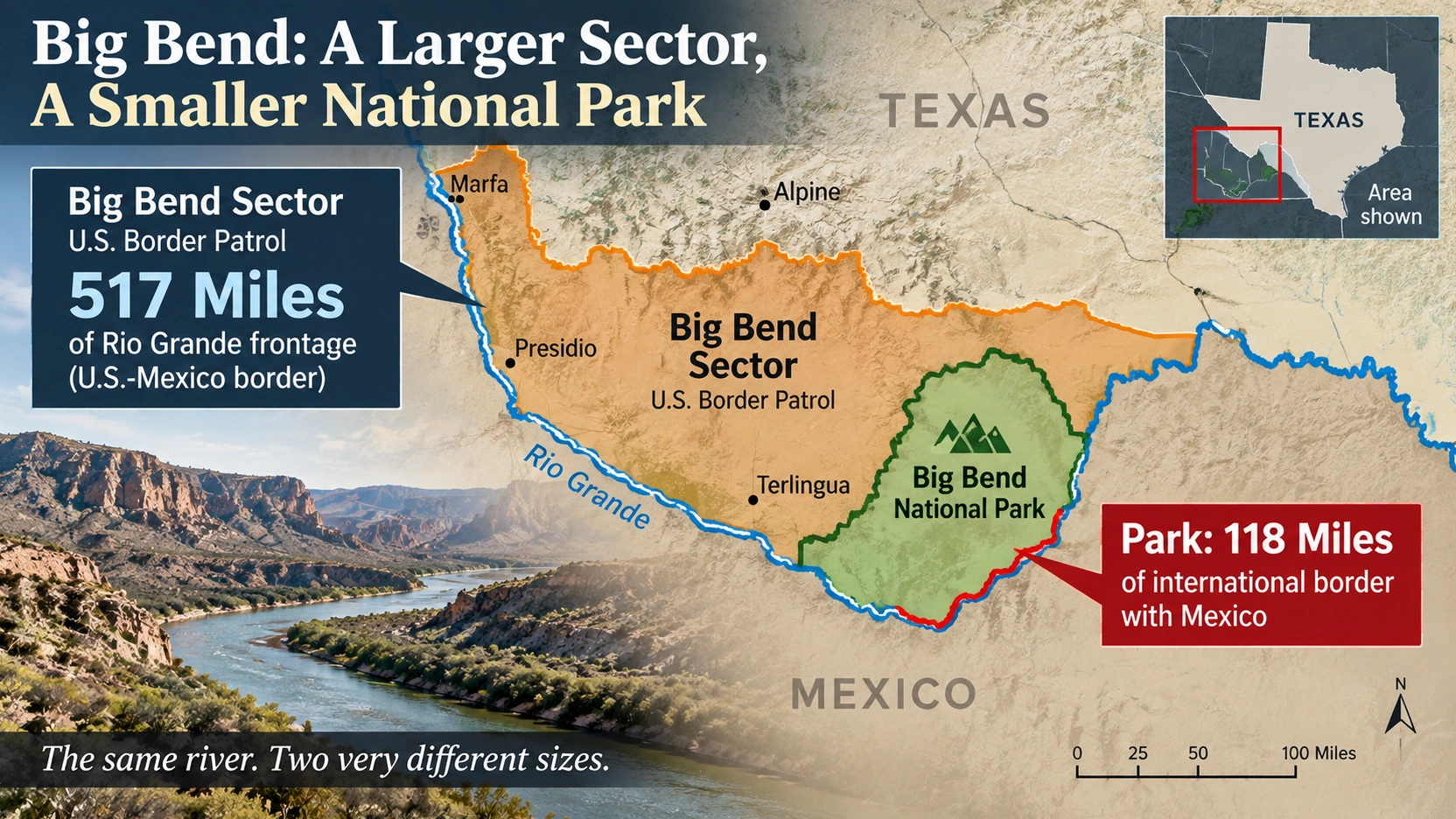
Because “Big Bend” can refer to several different geographic areas, headlines can make this dispute sound simpler than it is.
The U.S. Border Patrol’s Big Bend Sector is responsible for about 517 miles of Rio Grande frontage, nearly one-quarter of the Southwest border. Big Bend National Park, however, is one part of that much larger enforcement region. (U.S. Customs and Border Protection)
The park itself covers about 801,000 acres and shares approximately 118 miles of international border with Mexico along the Rio Grande. Its landscape includes desert, mountains and major river canyons, including Santa Elena, Mariscal and Boquillas canyons. (National Park Service)
That geography helps explain why the fight has attracted people who do not usually line up on the same side of a border-policy dispute.
Environmental groups have focused on wildlife habitat, river access and protected land. Local businesses have raised concerns about tourism and recreation. Landowners have worried about access and construction on or near private property.
And some border-security supporters have questioned whether large physical barriers make sense in terrain that is already exceptionally remote and difficult to cross. (The Texas Tribune)
The disagreement, in other words, is not simply “open border versus closed border.”
It is also about what kind of border infrastructure makes sense in this particular place.
What Was the Government Actually Planning to Build?

This is another place where the phrase “border wall” can be misleading.
The Trump administration’s broader border program includes combinations of tall steel barriers, vehicle barriers, roads, lighting, cameras and detection technology. But CBP has said its plans inside Big Bend National Park did not call for the same 30-foot steel wall used in some other border areas.
Inside the park, the agency described plans involving road construction or improvements, detection technology and vehicle barriers at selected locations. Taller physical wall segments have been planned or constructed elsewhere in the broader Big Bend region. (Reuters · The Texas Tribune)
That distinction does not eliminate the environmental dispute.
A new road through previously undeveloped terrain can require grading, vegetation clearing and heavy equipment. Cameras and sensors may require access routes and supporting infrastructure. Vehicle barriers can still alter access and habitat even if they are much shorter than a 30-foot wall.
So opponents are challenging more than the height of a fence.
They are challenging the construction system around it.
How Can DHS Waive Environmental Laws in the First Place?
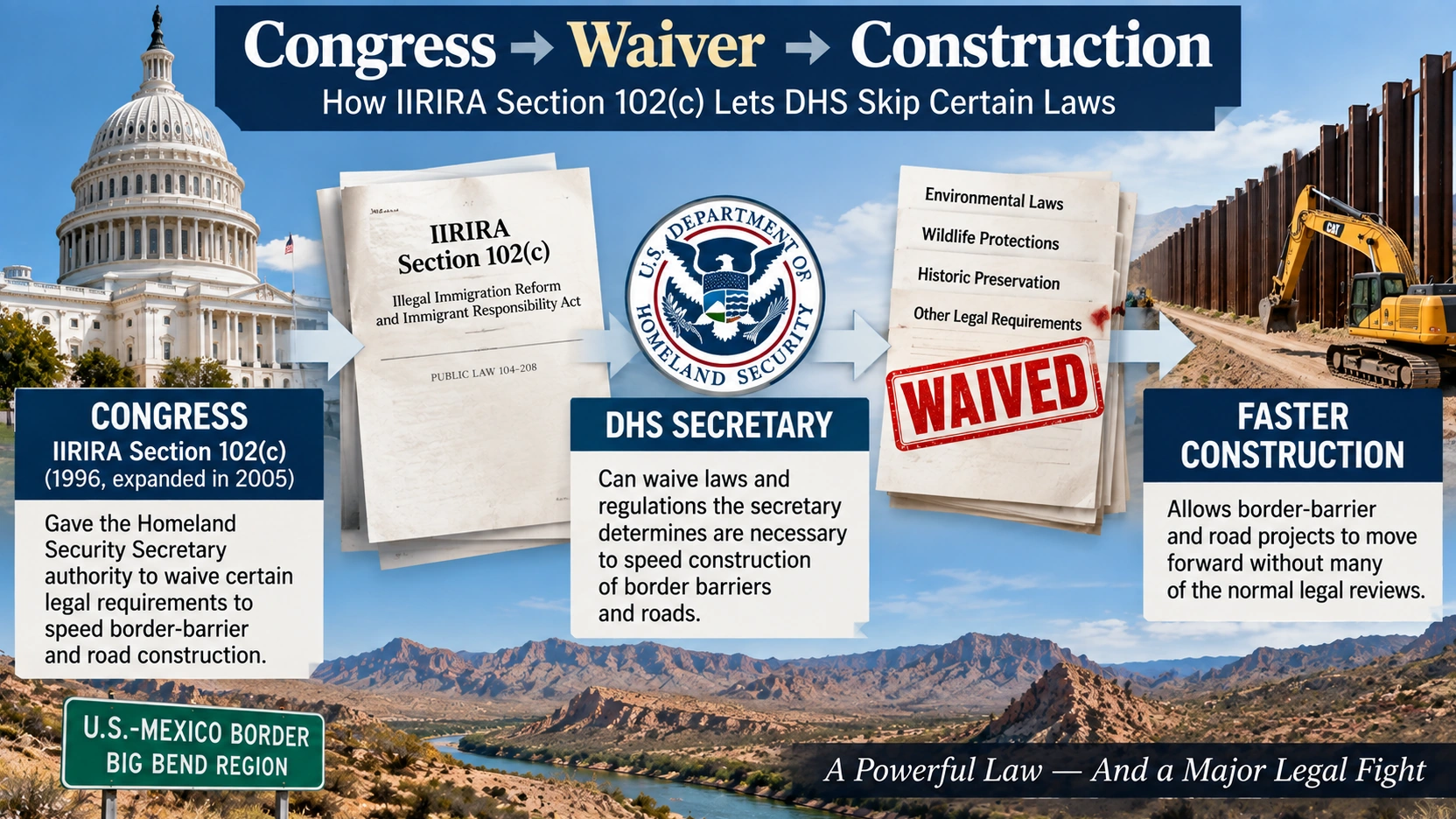
The waiver power did not originate with Trump.
Congress created the underlying authority in Section 102 of the Illegal Immigration Reform and Immigrant Responsibility Act of 1996, commonly called IIRIRA. Congress later broadened the waiver language through the REAL ID Act of 2005.
Under Section 102(c), the Homeland Security secretary can waive legal requirements the secretary determines are necessary to speed construction of certain border barriers and roads. Federal administrations have used that authority before. (U.S. Department of Justice)
For Big Bend, DHS published waiver determinations in the Federal Register. The June 9 determination said the department needed additional barriers and roads in the Big Bend Sector and invoked Section 102(c) to waive a long list of legal requirements related to the project. (Federal Register)
Those included laws that would normally trigger environmental review, wildlife protections, historic-preservation procedures and other regulatory requirements.
Here is the easiest way to understand the mechanism:
| Normal federal project | Project using an IIRIRA Section 102(c) waiver |
|---|---|
| Agency may have to complete environmental reviews | Selected requirements can be waived |
| Wildlife consultations may be required | Covered requirements can be set aside |
| Historic sites may require formal review | Covered historic-preservation requirements can be waived |
| Lawsuits may challenge compliance with those statutes | Ordinary statutory challenges become much harder |
| Construction can be delayed by review requirements | Waiver is intended to accelerate construction |
That sounds enormously powerful because it is.
But it does not automatically answer the next question: Are there constitutional limits on how far that waiver authority can be stretched?
That is where the Big Bend lawsuit enters the picture.
So How Could a Federal Judge Block the Project Anyway?
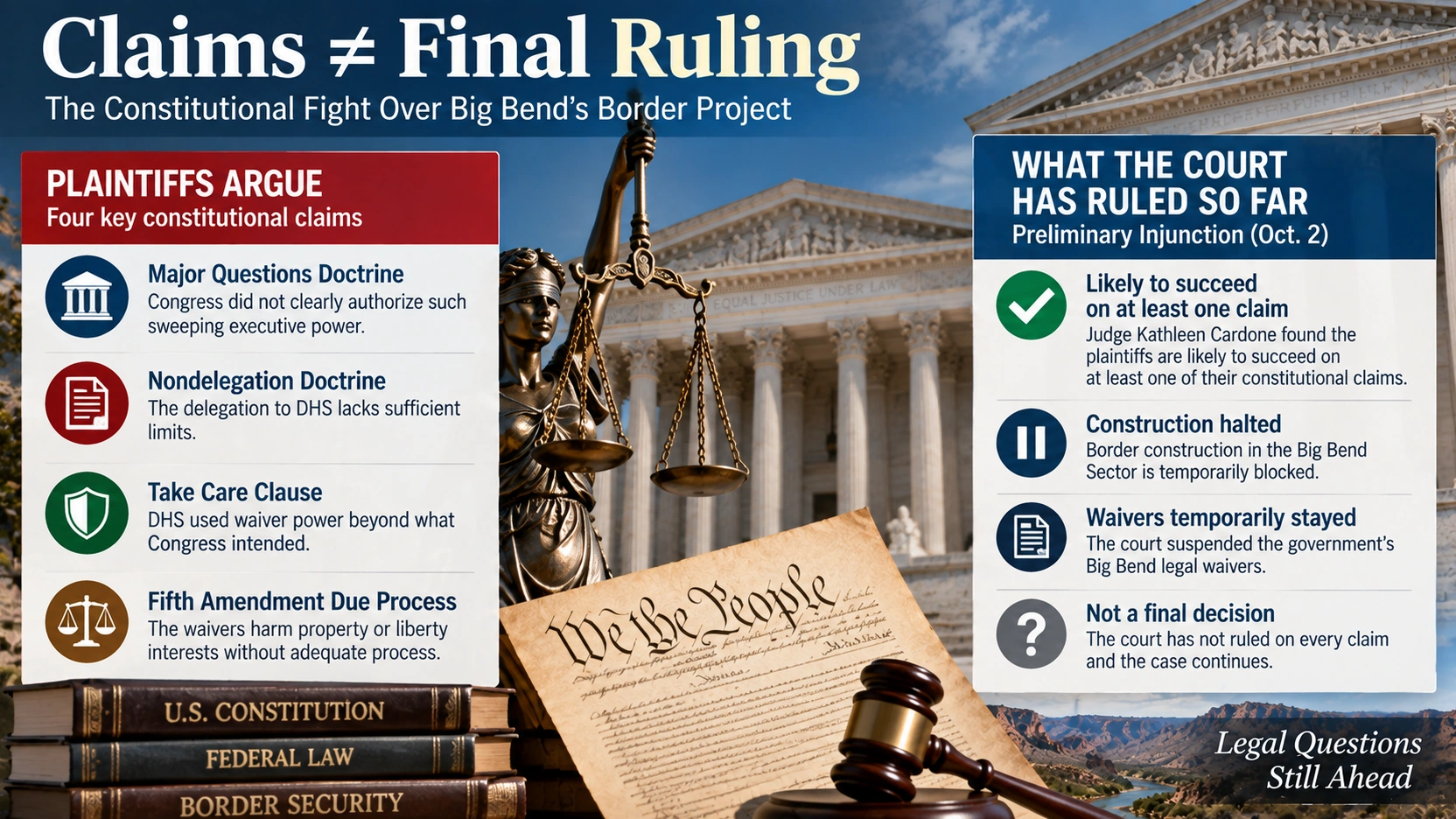
Because the plaintiffs are not simply saying, “DHS violated an environmental law it already waived.”
They are attacking the legality of the waiver itself.
The lawsuit by Friends of the Ruidosa Church, Big Bend river guide and landowner Danny William Miller Jr., and the Center for Biological Diversity argues that DHS’s use of Section 102(c) goes beyond constitutional limits. (Federal Court Complaint)
The complaint raises several distinct theories:
| Plaintiffs’ argument | What they are claiming |
|---|---|
| Major questions doctrine | Congress did not clearly authorize such sweeping executive power for a project of this scale |
| Nondelegation doctrine | If Congress did authorize power this broad, the delegation itself lacks sufficient limits |
| Take Care Clause | DHS allegedly used waiver power beyond the boundaries Congress placed on border construction |
| Fifth Amendment due process | Plaintiffs argue the waivers interfere with property or liberty interests without adequate process |
These are the plaintiffs’ claims. They are not yet four final rulings by the court.
Cardone’s short October 2 order said the plaintiffs were likely to succeed on at least one claim. It did not say that all four theories had prevailed. (AP · The Texas Tribune)
That is why saying “the judge ruled the border wall unconstitutional” goes too far.
A more accurate description is:
The judge found enough legal and constitutional risk to stop the Big Bend construction while the case proceeds, and she temporarily neutralized the waivers that had allowed the government to move faster.
Why Was Construction Already Paused Before This Ruling?
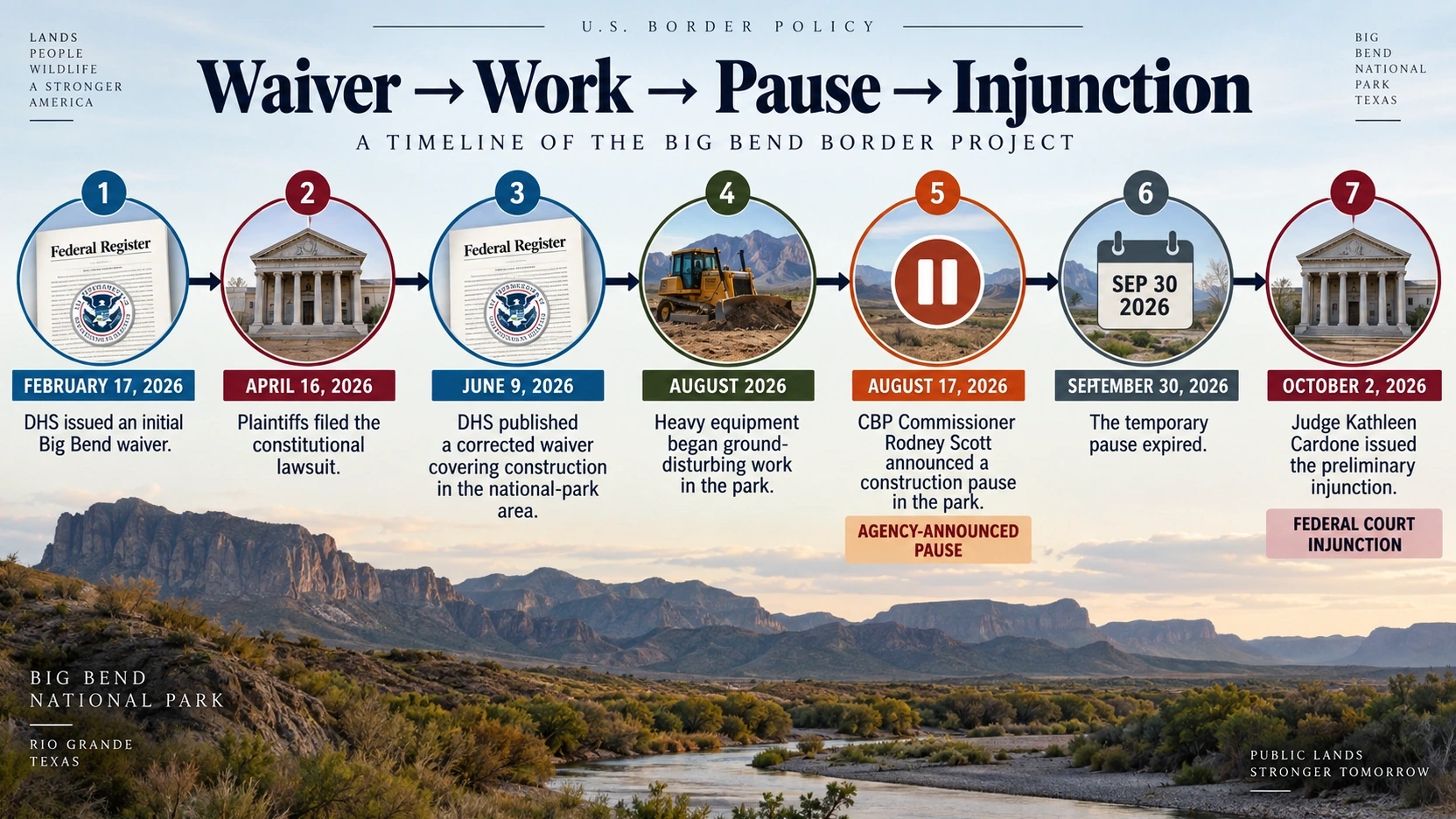
Because the government had already faced substantial opposition before October 2.
The sequence helps explain why the injunction matters:
| Date | What happened | Why it matters |
|---|---|---|
| Feb. 17, 2026 | DHS issued an initial Big Bend waiver | Expanded the administration’s ability to accelerate barrier construction |
| April 16 | Plaintiffs filed the constitutional lawsuit | Began the case now before Judge Cardone |
| June 9 | DHS published a corrected waiver covering construction in the national-park area | Brought Big Bend National Park more directly into the dispute |
| August | Heavy equipment began ground-disturbing work in the park | Turned a planning dispute into an active construction fight |
| Aug. 17 | CBP Commissioner Rodney Scott announced a construction pause in the park | Agency voluntarily stopped work while reassessing the project |
| Sept. 30 | The temporary pause had expired | Construction could again move toward resumption |
| Oct. 2 | Cardone issued the preliminary injunction | The pause became a judicial restriction rather than an agency choice |
(Federal Register · The Texas Tribune · AP)
That last change is important.
An agency can reverse its own voluntary pause.
A federal court order cannot simply be ignored because the executive branch changes its mind. The government must comply with the injunction unless the issuing court or a higher court changes it.
Does This Stop Trump’s Border Wall Everywhere?
No. The October 2 injunction is about the Big Bend litigation, not the entire U.S.-Mexico border.
The Trump administration’s broader border-security program spans multiple sectors, contracts and types of infrastructure. The Big Bend ruling does not automatically cancel work in Arizona, California or other Texas border sectors.
Even within West Texas, different lawsuits have focused on different projects, properties and legal theories.
This is why headlines saying simply “judge stops Trump border wall” can create the wrong impression.
The ruling is broad within the Big Bend Sector, but it is geographically and legally tied to this particular case.
That makes it important without making it nationwide.
Why Has the Fight Become Bigger Than an Environmental Case?
Because the underlying constitutional question could matter far beyond one national park.
Congress sometimes gives the executive branch discretion to act quickly. Presidents and cabinet secretaries rely on that delegated power constantly.
But the Big Bend lawsuit asks a harder question:
Can Congress give an agency power to set aside dozens of laws, and if it can, how much freedom does the executive branch have when using that power?
The government’s answer is essentially that Congress already made that policy choice.
Section 102(c) gives the Homeland Security secretary unusually broad waiver authority specifically so border barriers and roads are not stalled by the normal legal process. DHS argues that it is exercising an authority Congress expressly created. (U.S. Department of Justice)
The plaintiffs’ answer is that even congressionally created authority has constitutional boundaries—and that DHS has pushed this particular authority far beyond what Congress originally contemplated. (Federal Court Complaint)
That is why the dispute is now about separation of powers as much as wildlife, roads or fencing.
What Happens Next?
The most important thing to watch is the next round of court proceedings.
CBP said after the injunction that it remains confident in its legal authority and is working with the Justice Department on its next steps. (AP)
Several paths are possible.
The government can continue defending the waivers before Cardone. It can ask that the injunction be narrowed or lifted. It can seek appellate review. It could also modify parts of the construction program in ways that change the legal dispute.
Meanwhile, the district court still has to address the merits of the constitutional claims in greater depth.
So there are really two questions moving forward at the same time:
- Will the injunction remain in place?
- When the court reaches the deeper constitutional issues, how much of DHS’s waiver authority will survive?
Until those questions are resolved, contractors cannot treat the October 2 order as merely another temporary administrative pause.
It is a federal judicial command.
Bottom Line: What This Story Really Means
The Big Bend decision did not permanently strike down Trump’s border wall program.
It did something narrower—but still consequential.
A federal judge temporarily stopped border construction across the Big Bend Sector and suspended the legal waivers DHS had relied on to accelerate that work. The court concluded that the plaintiffs had shown a sufficient likelihood of winning at least one of their claims and a sufficient risk of irreversible harm to justify an injunction while the lawsuit continues.
The central question is no longer simply whether a wall, road or vehicle barrier should be built in a national park.
It is how far the executive branch can go when Congress has given it extraordinary power to waive laws in the name of border security.
Big Bend Border Wall: Key Questions Explained
Q. Did a federal judge permanently cancel Trump’s border wall in Big Bend?
No. Judge Kathleen Cardone issued a preliminary injunction while the lawsuit continues. It is a powerful temporary order, but it is not the final judgment in the case.
Q. Does the ruling stop border-wall construction across the entire U.S.-Mexico border?
No. The injunction applies to the Big Bend dispute and does not automatically halt construction in other Border Patrol sectors.
Q. Did the government plan to build a 30-foot wall through all of Big Bend National Park?
No. CBP said its park plan involved roads, surveillance technology and strategically placed vehicle barriers rather than a continuous 30-foot steel wall. Taller barriers have been part of projects elsewhere in the broader Big Bend region.
Q. How can DHS waive environmental laws?
Congress gave the Homeland Security secretary broad waiver authority under Section 102(c) of IIRIRA. The authority was expanded in 2005 and allows legal requirements to be waived when the secretary determines that doing so is necessary to speed qualifying border-barrier and road construction.
Q. If DHS can waive those laws, why can a judge still intervene?
The plaintiffs are challenging the legality and constitutionality of the waiver power as it was used here, rather than merely accusing DHS of violating laws that had already been waived.
Q. Did the judge rule that all of the plaintiffs’ constitutional arguments are correct?
No. The preliminary order says the plaintiffs are likely to succeed on at least one claim. That is not the same as a final ruling adopting every theory in their lawsuit.
Q. Why is Big Bend such a controversial place for border construction?
Big Bend National Park contains more than 800,000 acres and shares about 118 miles of border with Mexico along the Rio Grande. Its remote desert, mountain and canyon terrain, protected landscapes, recreation economy and private-property issues have produced unusually broad local concern over major physical construction.
Q. What should people watch next?
Watch for further court rulings, any effort by the Justice Department to challenge or narrow the injunction, and whether the administration changes its Big Bend construction plans.
Did this help make the story clearer? 🙂 WIN keeps unpacking the “why” behind the news—clearly and simply!
Sources
October 2 Injunction and Current Case Status
Associated Press — Judge Temporarily Blocks Border Wall Construction in Texas’ Big Bend Region
Reuters — Judge Bars Building of Texas-Mexico Border Barrier in Big Bend National Park
The Texas Tribune — Judge Halts Border Barrier Construction in Big Bend
Justia — Friends of the Ruidosa Church et al. v. Mullin et al., No. 3:26-cv-01099
DHS Waiver Authority and Constitutional Challenge
Federal Register — June 9, 2026 Big Bend Determination and Waiver
Federal Court Complaint — Friends of the Ruidosa Church et al. v. Mullin et al.
U.S. Department of Justice — Background on IIRIRA Section 102(c) Waiver Authority
Big Bend Geography and Border Infrastructure
U.S. Customs and Border Protection — Big Bend Sector Texas
National Park Service — Big Bend National Park Statistics
National Park Service — Visiting a Border Area at Big Bend
Keep Reading
What Happens When Another Trump Construction Project Runs Into a Federal-Court Challenge?
Big Bend turns on DHS’s unusual waiver power. Trump’s proposed Washington arch raises a different but related question: whether existing federal authority is enough to move a major construction project forward on federal land while a court challenge is still unresolved.
Why Does Trump Say His Giant D.C. Arch Should House Drones and Snipers?
How Can a Temporary Court Order Change a Federal Policy Before the Final Ruling?
The Big Bend injunction pauses construction while the merits are still being litigated. In the SAVE database case, the Supreme Court used the opposite procedural tool—a stay—to temporarily restore a federal program before the underlying dispute was finally resolved.
What Is the SAVE Voter Database—and What Did the Supreme Court Actually Allow?