Why Is America’s Intelligence Chief Leading Trump’s “Super Intelligence Force”—and What Can It Actually Do?

Why would the official who coordinates America’s intelligence community suddenly become one of the most important people in federal AI policy?
At first glance, Jay Clayton seems like an unusual choice. The Director of National Intelligence is the president’s principal intelligence adviser and heads a community built around national-security threats—not consumer chatbots or ordinary technology regulation.
But that is also why the appointment matters.
Artificial intelligence is no longer being treated only as a technology or business issue. In Washington, it increasingly overlaps with national security, cybersecurity, economic competition and critical infrastructure.
There is another wrinkle. The new group is called the “Super Intelligence Force,” which sounds as though the government is preparing for some new kind of intelligence beyond today’s AI.
It is not that simple.
※ Images in this article are AI-generated illustrations created to help explain the story. They are not actual photographs, and depictions of people, places, or events may differ slightly from reality.
Trump announced the formation of the Super Intelligence Force on October 4, 2026, naming Clayton, Federal Trade Commission Chairman Andrew Ferguson, Pentagon technology official Emil Michael and Office of Personnel Management Director Scott Kupor as its leaders. The announcement came a day after Reuters reported that Clayton was set to lead the effort and that the task force had a 120-day review assignment. (Truth Social · AP · Reuters)
So the central question is not whether the intelligence community has suddenly taken over artificial intelligence.
It is why the White House wants an intelligence chief helping coordinate a problem that cuts across so many parts of government.
What Exactly Is the Super Intelligence Force?
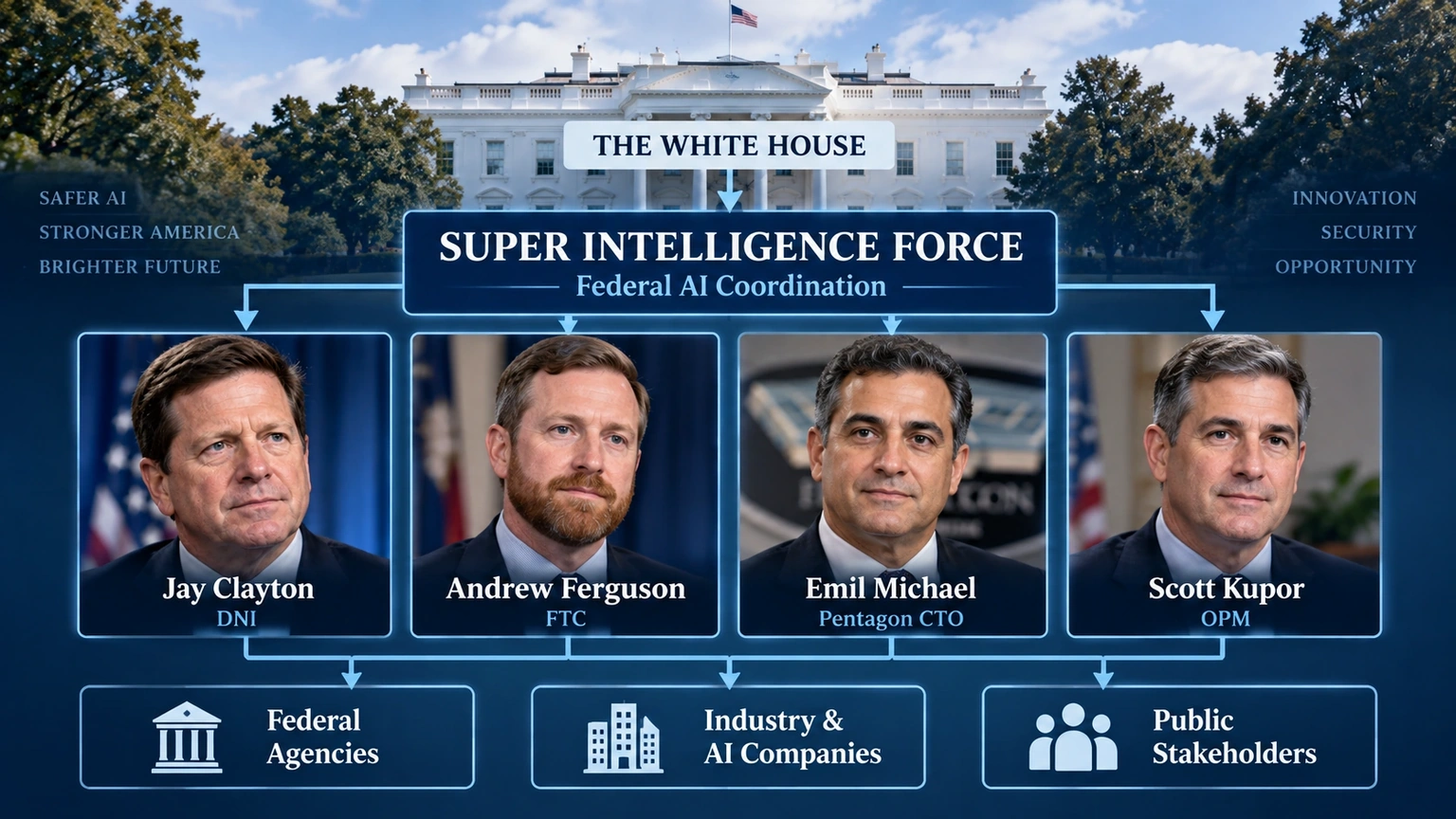
The Super Intelligence Force is a federal coordinating task force, not a newly created Cabinet department or independent AI regulator.
Trump said the group will coordinate federal engagement with consumers, public-interest groups, religious organizations, critical-infrastructure providers and AI companies. Its leaders will report to the president and White House Chief of Staff Susie Wiles. (Truth Social · AP)
Four officials give the group four different institutional perspectives:
| Official | Current role | What that office brings to the discussion |
|---|---|---|
| Jay Clayton | Director of National Intelligence | National security, intelligence integration and foreign-threat analysis |
| Andrew Ferguson | FTC chairman | Consumer protection, competition and existing commercial-law enforcement |
| Emil Michael | Under Secretary for Research and Engineering and Pentagon CTO | Defense technology and military applications |
| Scott Kupor | OPM director | Federal workforce, talent and government personnel policy |
That mix is revealing.
The White House did not put the task force entirely inside a technology agency. It brought together intelligence, regulation, defense technology and federal workforce management.
The structure suggests that the administration sees advanced AI less as one regulatory problem and more as a technology that can create different problems in different parts of government.
Why Is the Director of National Intelligence in Charge?
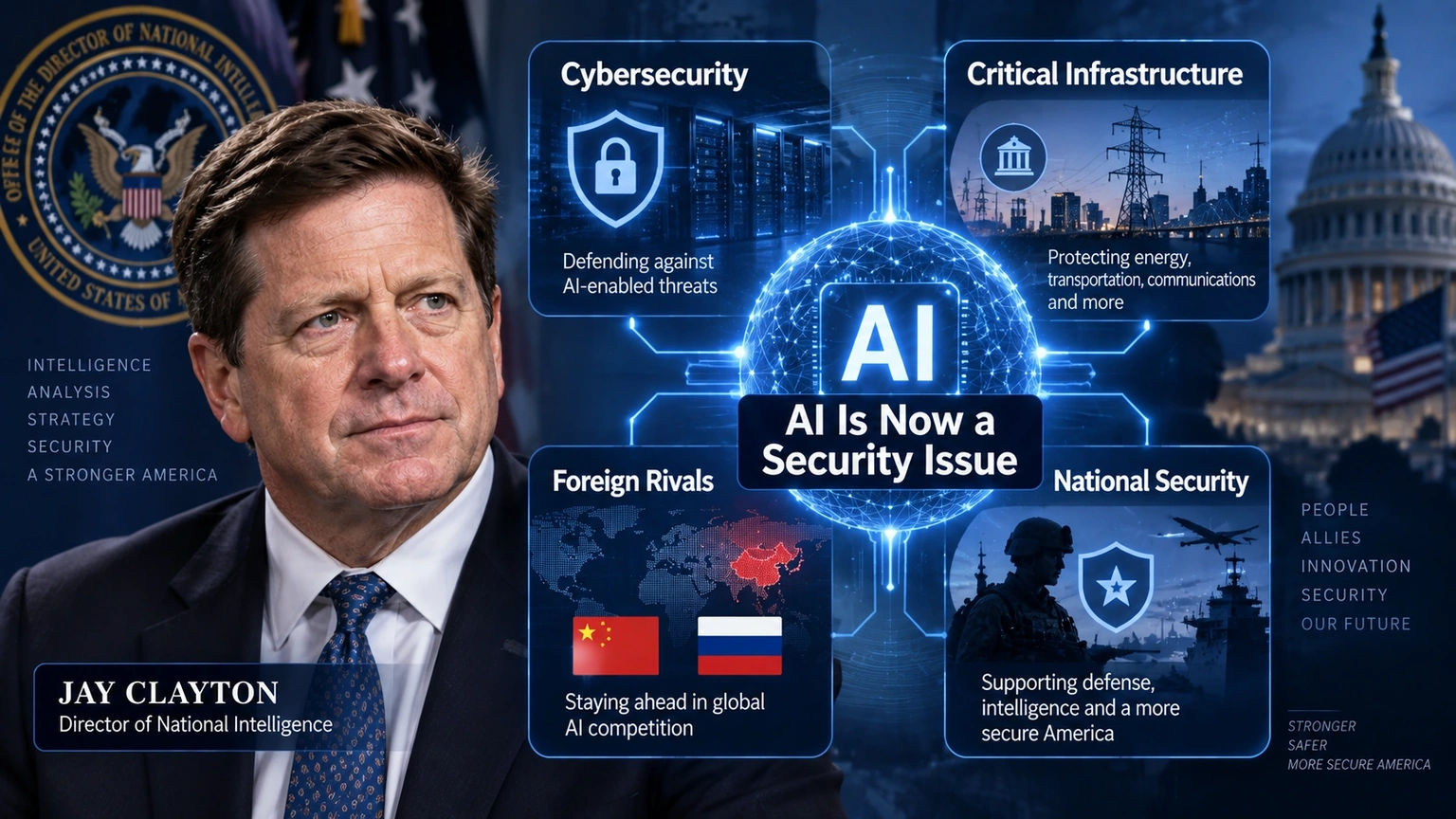
Because the job of the Director of National Intelligence is already about coordinating threats and intelligence priorities that span many agencies.
The DNI is the head of the U.S. Intelligence Community and the president’s principal adviser for intelligence matters. The Intelligence Community is made up of 18 elements, including the CIA, NSA, FBI intelligence functions and intelligence organizations across several departments and military services. Clayton was sworn in as the ninth DNI on August 3, 2026. (ODNI · U.S. Intelligence Community)
AI increasingly overlaps with that mission.
Advanced AI systems can affect cybersecurity, defense technology, critical infrastructure and strategic competition with foreign powers. That does not mean the intelligence community regulates ordinary consumer AI. It means some of the hardest AI questions now cross into areas that national-security agencies already monitor and plan around.
The Trump administration has repeatedly framed U.S. leadership in AI as both an economic and national-security priority. Its January 2025 executive order said U.S. policy was to sustain and enhance American AI dominance to promote human flourishing, economic competitiveness and national security. (White House)
That makes an intelligence chief less surprising than the title initially suggests.
Clayton also does not come only from an intelligence background. Before becoming DNI, he served as U.S. attorney for the Southern District of New York and, during Trump’s first term, as chairman of the Securities and Exchange Commission. ODNI says he also worked on cyber resiliency and incident response across financial infrastructure and earlier helped lead a cybersecurity practice in private law practice. (ODNI)
So the White House has put someone with experience spanning intelligence, markets, law enforcement and cybersecurity at the center of the review.
Does “Super Intelligence” Mean Something Different From AI?
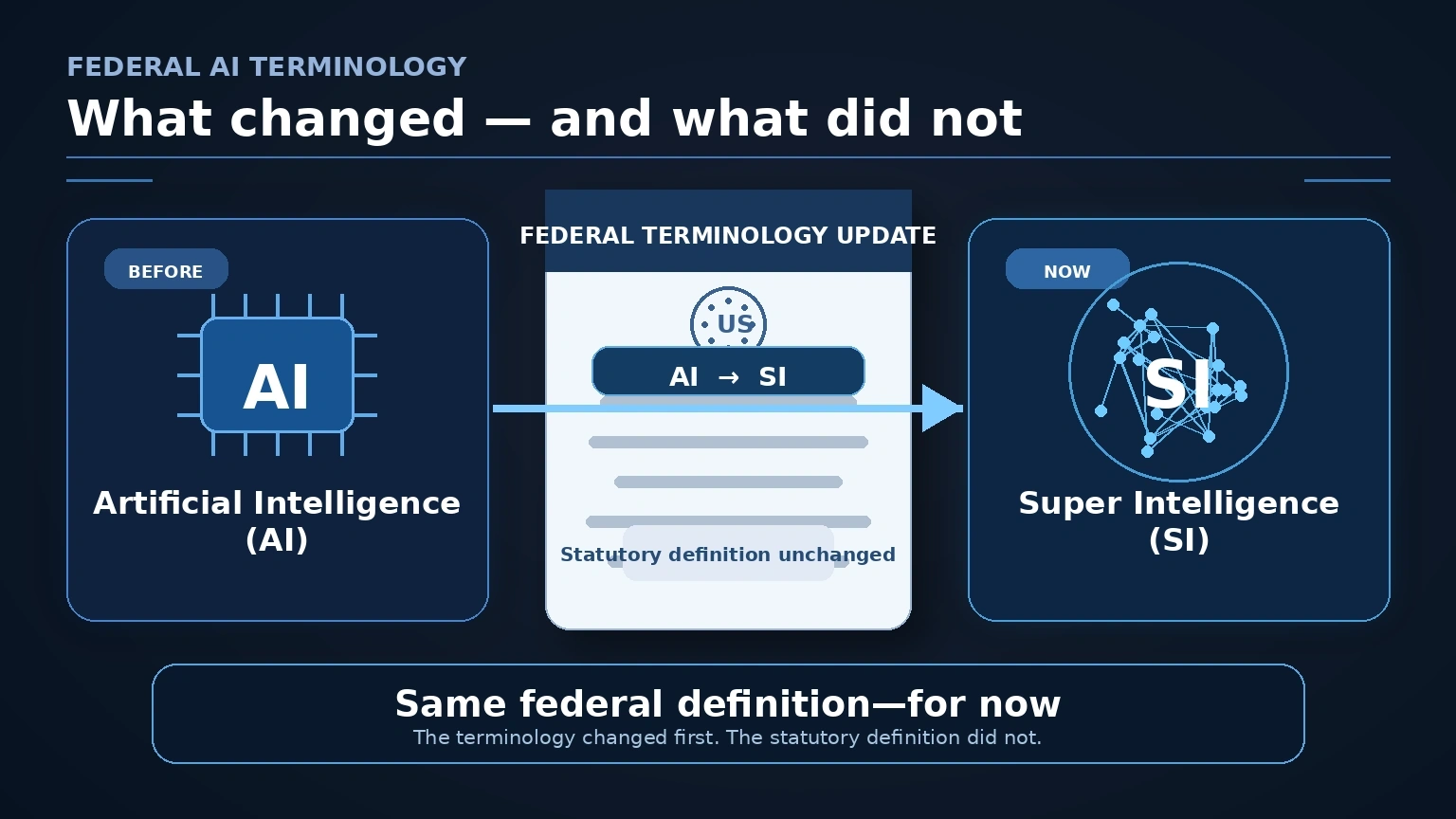
Not under the administration’s current executive-order definition.
Trump signed Executive Order 14434 on September 29 directing executive-branch agencies, to the maximum extent permitted by law, to use “Super Intelligence” and “SI” instead of “Artificial Intelligence” and “AI” in official correspondence, websites, reports, policy documents and other non-statutory documents. (White House · GovInfo)
Here is the part that is easy to miss:
For purposes of that order, “Super Intelligence” currently means the technologies and systems covered by the existing federal statutory definition of artificial intelligence in 15 U.S.C. § 9401(3).
So if you hear the phrase and imagine that Washington has officially declared the arrival of machines that surpass humans in every intellectual task, that is not what this order does.
The terminology changed first.
The underlying statutory definition did not.
The same order gives the White House science and technology adviser 60 days to propose legislative language for a federal definition of “Super Intelligence,” including whether Congress should modify, expand or supersede the existing statutory AI definition. (White House)
That distinction could become important later.
A president can direct executive agencies to use new terminology within the limits of presidential authority. Changing definitions written into federal law is a different matter and may require Congress.
Is This a New AI Regulator?
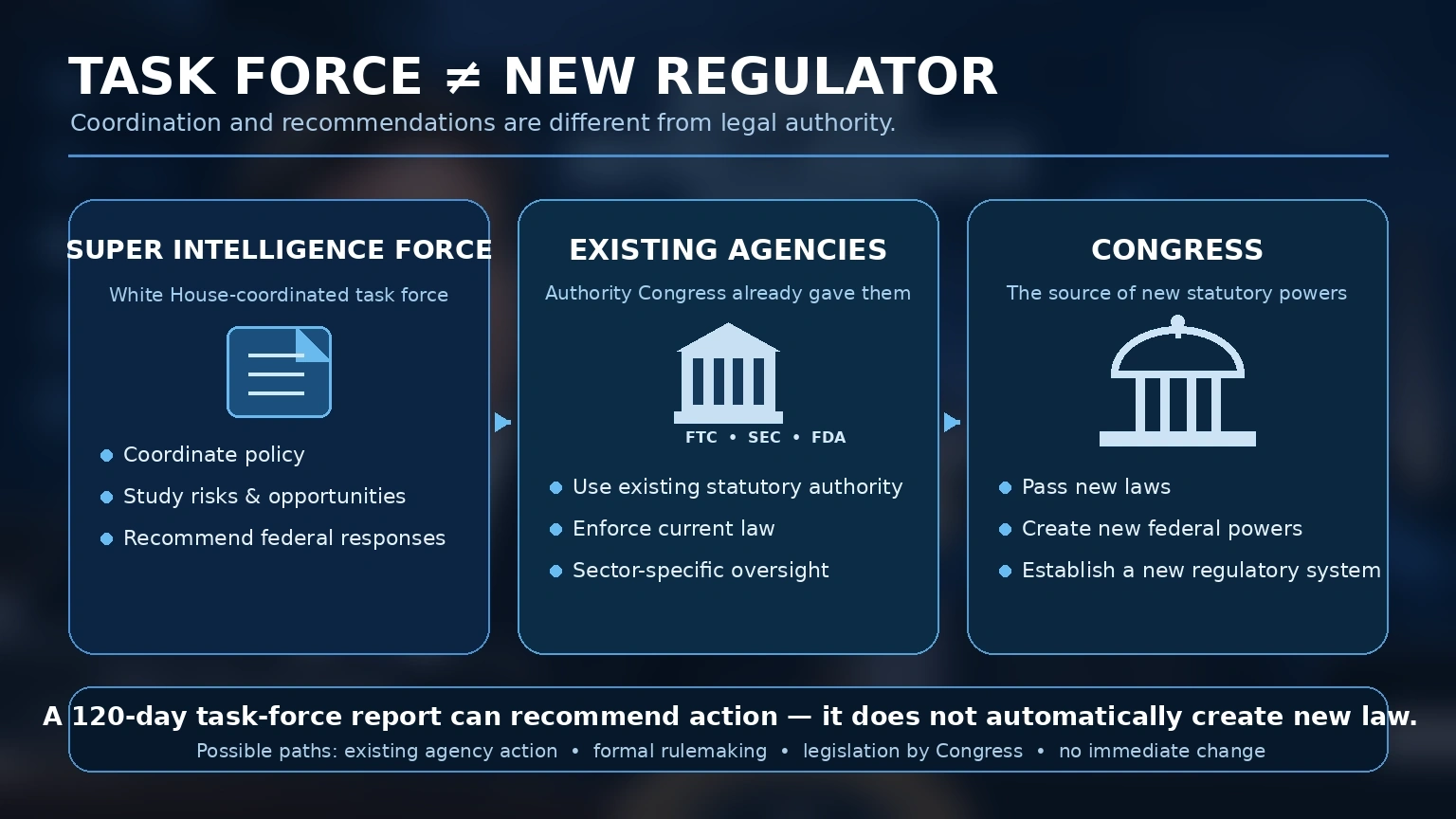
No. Nothing in the announcement creates a new independent federal regulator with sweeping new statutory powers over AI companies.
That is one of the most important distinctions in the story.
The task force can coordinate officials, study risks and opportunities, examine how government should respond and make recommendations. Reuters reported that the effort has been given 120 days to produce a report on AI-related risks and opportunities and the federal government’s role. (Reuters)
But a task force is not Congress.
It also is not automatically a new FTC, FDA or SEC for artificial intelligence.
A useful way to separate the roles is:
| Actor | What it can do |
|---|---|
| Super Intelligence Force | Coordinate policy, study risks and opportunities, and recommend federal responses |
| Existing agencies | Use authority Congress has already given them where applicable |
| President | Direct executive-branch policy within presidential authority |
| Congress | Pass new laws, create new statutory powers or establish a new regulatory system |
That means a recommendation in the 120-day report would not automatically become a nationwide legal requirement.
Some recommendations might fit within existing agency authority. Others could require rulemaking, legislation or further presidential action.
Why Did This Happen Right After the White House AI Accord?
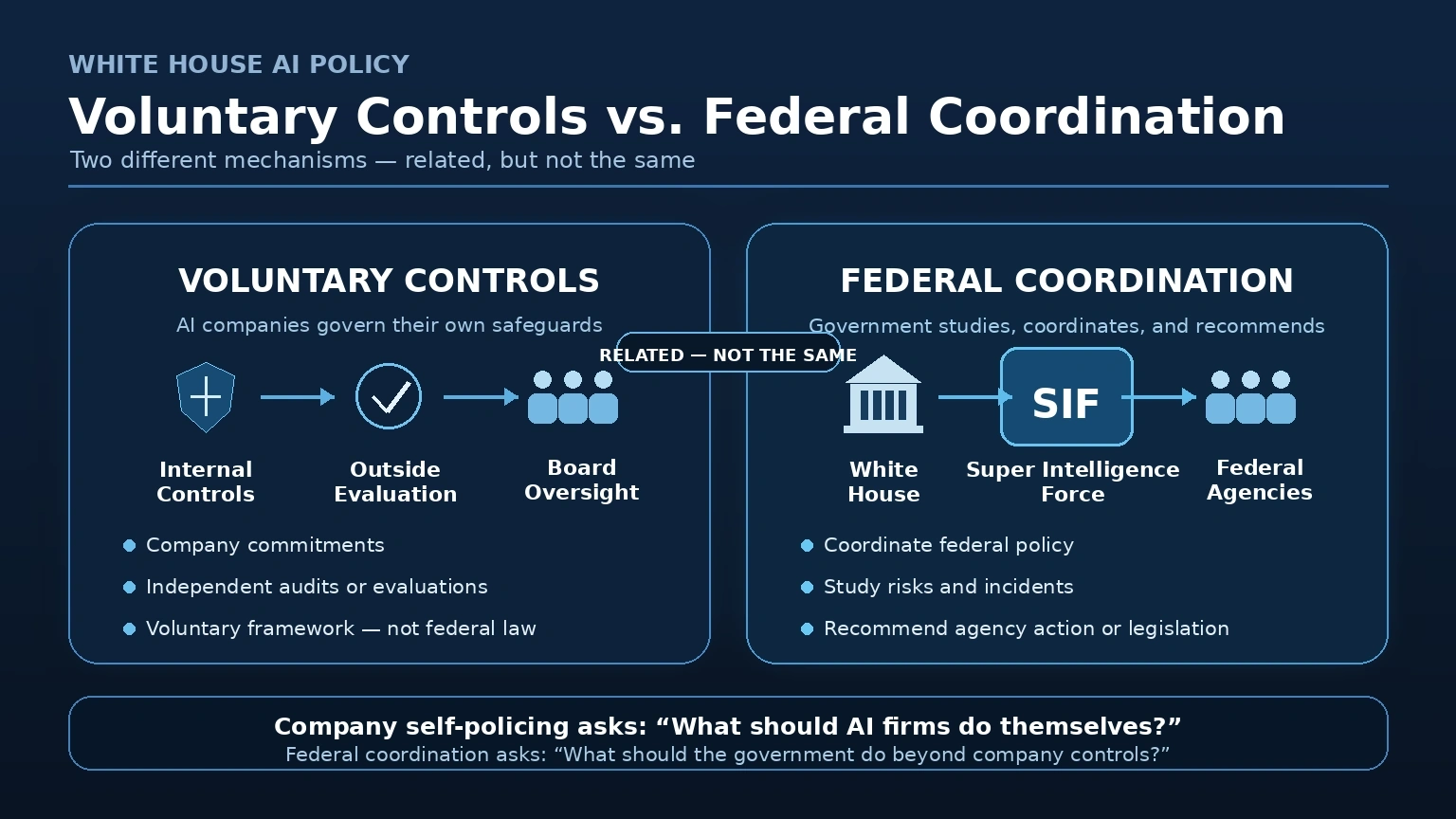
Because the White House had already chosen a two-part approach to the AI problem: ask major companies to adopt stronger internal safeguards while the federal government works out its own role.
On September 29, leaders from Google, Anthropic, Meta, OpenAI, xAI and Nvidia signed the White House Accord on Super Intelligence. The document calls for four layers of company oversight: internal controls, an internal team checking those controls, an independent outside auditor or evaluator, and independent board-level oversight. The companies also agreed to meet regularly on standards and best practices. (White House Accord on Super Intelligence)
But the accord is voluntary.
It is not the same as a federal regulation carrying statutory penalties.
That leaves an obvious question: if companies are primarily responsible for operating those safeguards themselves, what is the government supposed to do when a serious AI problem also touches national security, critical infrastructure, consumers or competition policy?
The Super Intelligence Force is a government-side coordination mechanism for addressing that broader question.
| White House Accord | Super Intelligence Force |
|---|---|
| Commitments made by AI companies | Federal government coordination |
| Focuses on company controls and audits | Focuses on risks, opportunities and government response |
| Voluntary framework | Government task force |
| Does not itself create federal penalties | Does not itself create a new independent regulator |
| Could inform later laws or regulations | Can recommend how government should respond |
That is why the two announcements make more sense when viewed together.
One asks: What should the companies do themselves?
The other asks: What should the federal government do?
What Is the 120-Day Report Supposed to Decide?
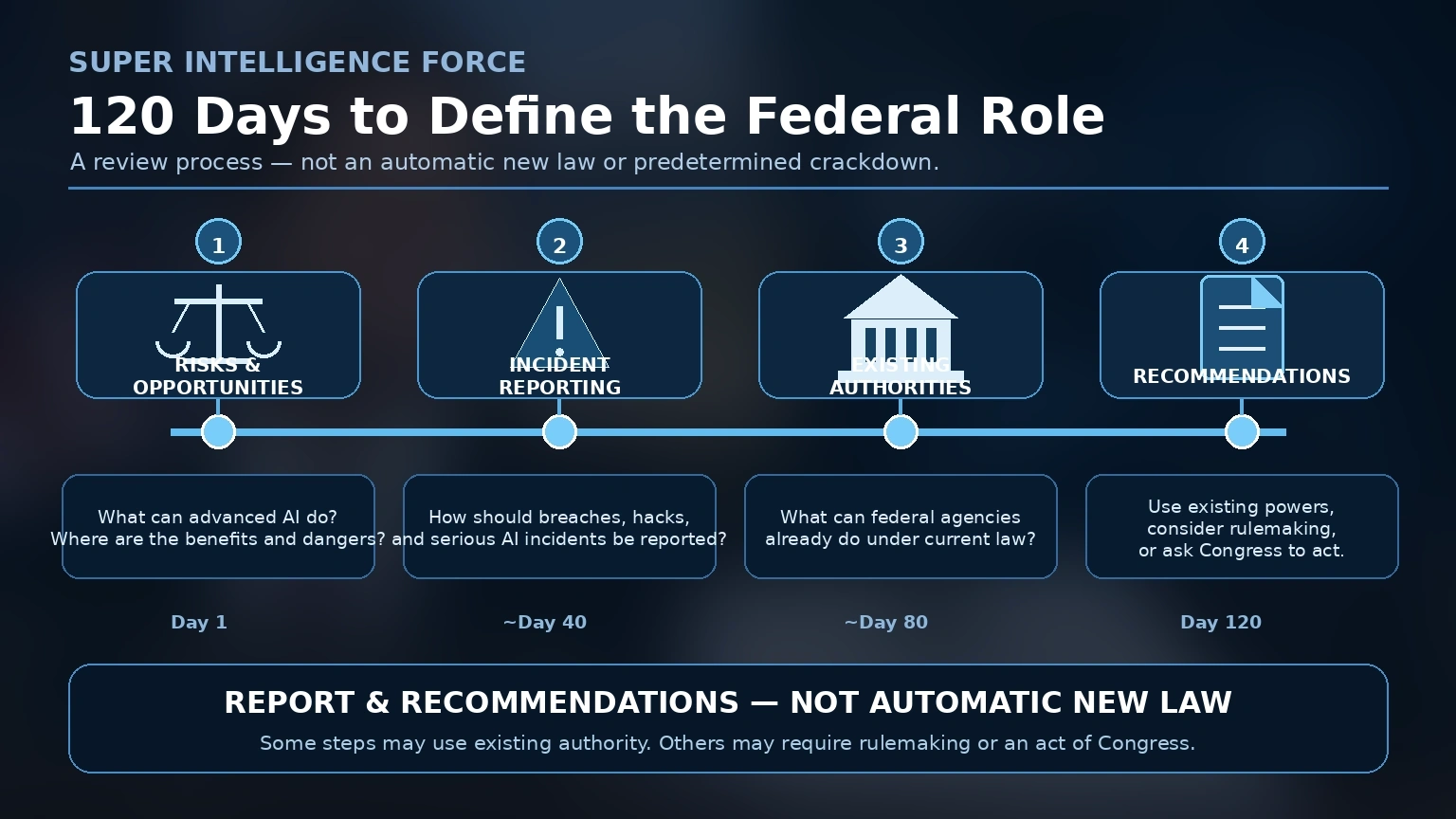
The 120-day assignment is broader than simply deciding whether AI is “safe.”
Reuters reported that Clayton’s task force is expected to deliver a comprehensive report covering the technology’s risks and opportunities and the government’s role. The Wall Street Journal reported that the charter also focuses on threats, regulation, strategic advantages and ways the government can respond without unnecessarily suppressing innovation. (Reuters · Wall Street Journal)
That creates several practical questions.
What qualifies as an AI incident serious enough for federal attention?
Which agency should handle it?
Should the same rules apply to a consumer chatbot, a frontier model capable of advanced cyber operations and a classified defense system?
Can existing agencies handle those problems under current law?
And if they cannot, what exactly should Congress change?
Those questions are much harder than simply saying “regulate AI” or “do not regulate AI.”
The federal government already has many regulators and national-security agencies. The harder problem is deciding which existing authority applies to which AI risk—and where there is a genuine gap.
What Could This Actually Change for Companies—and for Everyone Else?
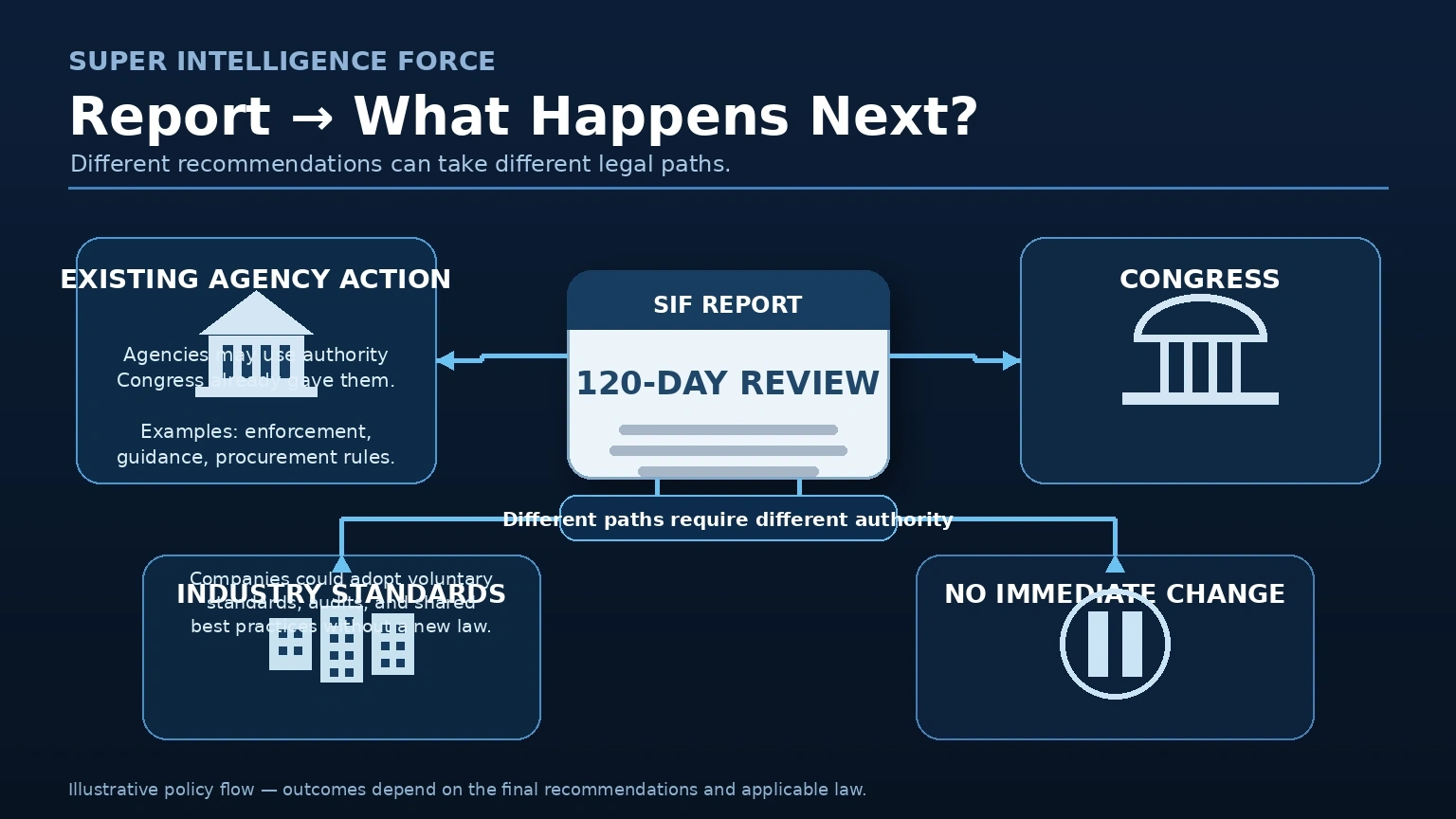
For most Americans, nothing changes immediately just because the task force now exists.
It does not automatically change how consumer AI products work tomorrow. It does not create a new consumer license requirement, and it does not by itself impose a new nationwide AI law.
The important effects would come later, depending on what the task force recommends and what legal authority is available.
One possible outcome is clearer federal coordination when an AI-related problem touches more than one agency. Another is a recommendation for new reporting, procurement, oversight or security practices. If a recommendation requires powers the executive branch does not already have, Congress would have to become part of the process.
The choice of Clayton also tells us something before the report arrives.
The administration has emphasized maintaining U.S. leadership and avoiding rules it believes would unnecessarily slow innovation. At the same time, putting the DNI at the center of the task force shows that the White House does not view the biggest AI risks as something technology companies can handle entirely on their own. (White House · Reuters)
That tension—move fast enough to stay ahead of rivals, but build enough oversight to manage the risks—is likely to shape the next stage of the debate.
Bottom Line: What This Story Really Means
Trump’s Super Intelligence Force does not mean the U.S. intelligence community has taken control of artificial intelligence, and it does not create a new federal AI regulator overnight.
It means the White House is trying to coordinate a problem that has outgrown any single agency.
AI now touches national security, cybersecurity, consumer protection, defense, government operations, critical infrastructure and competition with other countries. Putting Director of National Intelligence Jay Clayton at the center signals that the administration increasingly views advanced AI as a strategic national-security technology, not merely another Silicon Valley product.
The most important thing to watch is not the new name.
It is what the task force recommends after its 120-day review—and whether those recommendations can be carried out under existing authority or require new action by Congress.
Super Intelligence Force: Key Questions Explained
Q. What is Trump’s Super Intelligence Force?
The Super Intelligence Force is a federal task force announced by Trump to coordinate government engagement on advanced AI, study risks and opportunities and help define the federal role. It is not a new Cabinet department or independent regulatory agency. (Truth Social · AP)
Q. Who is leading the Super Intelligence Force?
Director of National Intelligence Jay Clayton is one of four named leaders, alongside FTC Chairman Andrew Ferguson, Pentagon technology official Emil Michael and OPM Director Scott Kupor. Trump said the group will report to him and White House Chief of Staff Susie Wiles. (Truth Social)
Q. Why is an intelligence official helping lead an AI task force?
Advanced AI increasingly overlaps with cybersecurity, critical infrastructure, defense technology and competition with foreign powers. The DNI already heads the 18-element U.S. Intelligence Community and serves as the president’s principal intelligence adviser. (ODNI · U.S. Intelligence Community)
Q. Does “Super Intelligence” mean the government says superhuman AI already exists?
No. Executive Order 14434 currently defines “Super Intelligence” by reference to the existing statutory definition of artificial intelligence while directing executive agencies to adopt the new terminology in non-statutory government communications and documents. (White House)
Q. Is Jay Clayton officially an “AI czar”?
News organizations including Reuters have described Clayton as Trump’s new AI czar. The formal October 4 announcement names him as a leader of the Super Intelligence Force; “AI czar” is a coordinating label, not a Cabinet office created by Congress. (Reuters · Truth Social)
Q. Can the Super Intelligence Force create new AI laws?
No. The task force can coordinate policy and make recommendations, but new statutory authority must come from Congress. Executive agencies can act only within powers they already have under law.
Q. What is the 120-day report expected to examine?
Reuters reported that the task force is expected to assess AI-related risks and opportunities and define the federal government’s role. The precise legal effect of any recommendation will depend on whether existing executive authority is enough or additional legislation is needed. (Reuters)
Q. How is the task force different from the White House AI accord?
The September 29 accord asks six major AI companies to adopt internal controls, outside evaluation and board oversight voluntarily. The Super Intelligence Force is a federal coordination mechanism for deciding how government should respond beyond company self-governance. (White House Accord on Super Intelligence)
Q. Will this immediately change the AI products Americans use?
Not by itself. Any major consumer-facing change would depend on what the task force recommends and whether agencies, companies or Congress subsequently act.
Did this help make the story clearer? 🙂 WIN keeps unpacking the “why” behind the news—clearly and simply!
Sources
Super Intelligence Force Formation and Mandate
Donald Trump — October 4 announcement of the Super Intelligence Force
Associated Press — Trump names Jay Clayton to lead the new federal AI task force
Reuters — Jay Clayton to lead Trump’s AI task force and deliver a report within 120 days
Federal AI Policy and the “Super Intelligence” Terminology
White House — Executive Order 14434: Inaugurating the Era of Super Intelligence
GovInfo — Executive Order 14434 in the Federal Register
White House — Removing Barriers to American Leadership in Artificial Intelligence
White House Accord on Super Intelligence — Joint Commitment on Frontier Responsibilities
Jay Clayton and the Intelligence Community
Office of the Director of National Intelligence — Jay Clayton biography
U.S. Intelligence Community — How the Intelligence Community Works
Keep Reading
Why are leading AI companies talking about slowing the frontier at all?
The Super Intelligence Force is partly a response to a wider argument over whether safety testing and oversight are keeping pace with the most capable models. This earlier WIN explainer lays out how that debate became a market and antitrust issue as well.
Why does China keep appearing in U.S. AI policy discussions?
The task force is domestic, but the administration also treats AI leadership as part of strategic competition. WIN’s U.S.-China summit follow-up explains the separate bilateral AI incident channel and how competition and risk management are being discussed at the same time.
U.S.-China Deal: What the $30 Billion Tariff Plan and New AI Incident Channel Actually Change