Why Is Pope Leo XIV Having Lung Surgery—and Does a Nodule Mean Cancer?

When Pope Leo XIV announced that doctors had found a nodule in his lung, one question immediately came to mind: Does the pope have lung cancer?
Not necessarily.
A lung nodule is a finding, not a cancer diagnosis. Most lung nodules are not cancerous. But the pope’s situation has an added complication: His doctors have recommended surgery rather than simply watching the nodule over time.
Why would they make that decision?
The answer involves something that often gets lost in medical headlines. Finding an abnormal spot, deciding whether to remove it, and determining whether it is cancer are three different steps.
For now, the Vatican has confirmed the first two. The third remains unanswered. (Vatican)
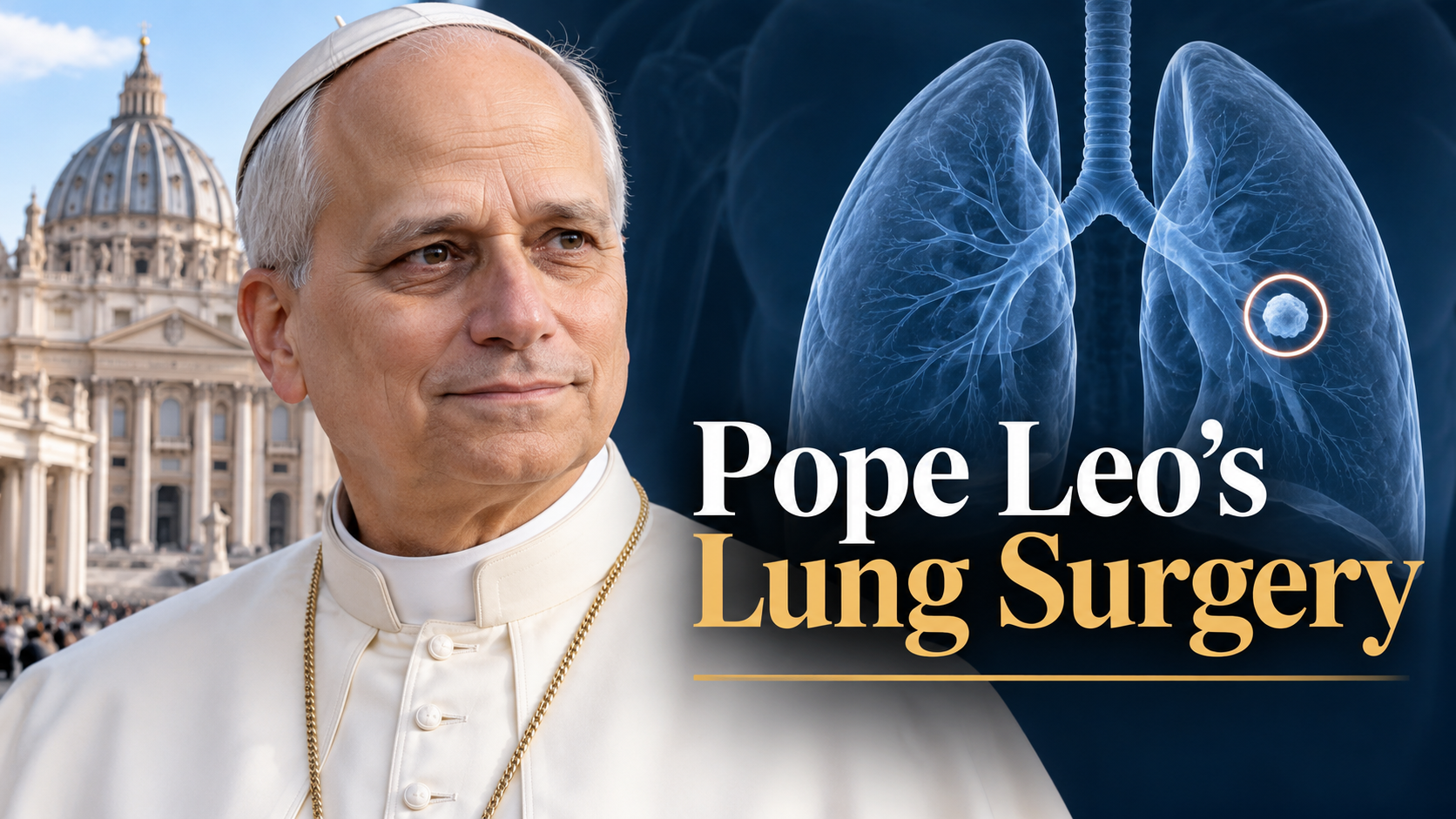
※ Images in this article are AI-generated illustrations created to help explain the story. They are not actual photographs, and depictions of people, places, or events may differ slightly from reality.
That distinction is especially important because Leo described the nodule as having been detected at a very early stage. Those words sound reassuring, but they do not reveal precisely what doctors found.
Here is what the announcement tells us—and what it doesn’t.
What Did Pope Leo XIV Actually Announce?
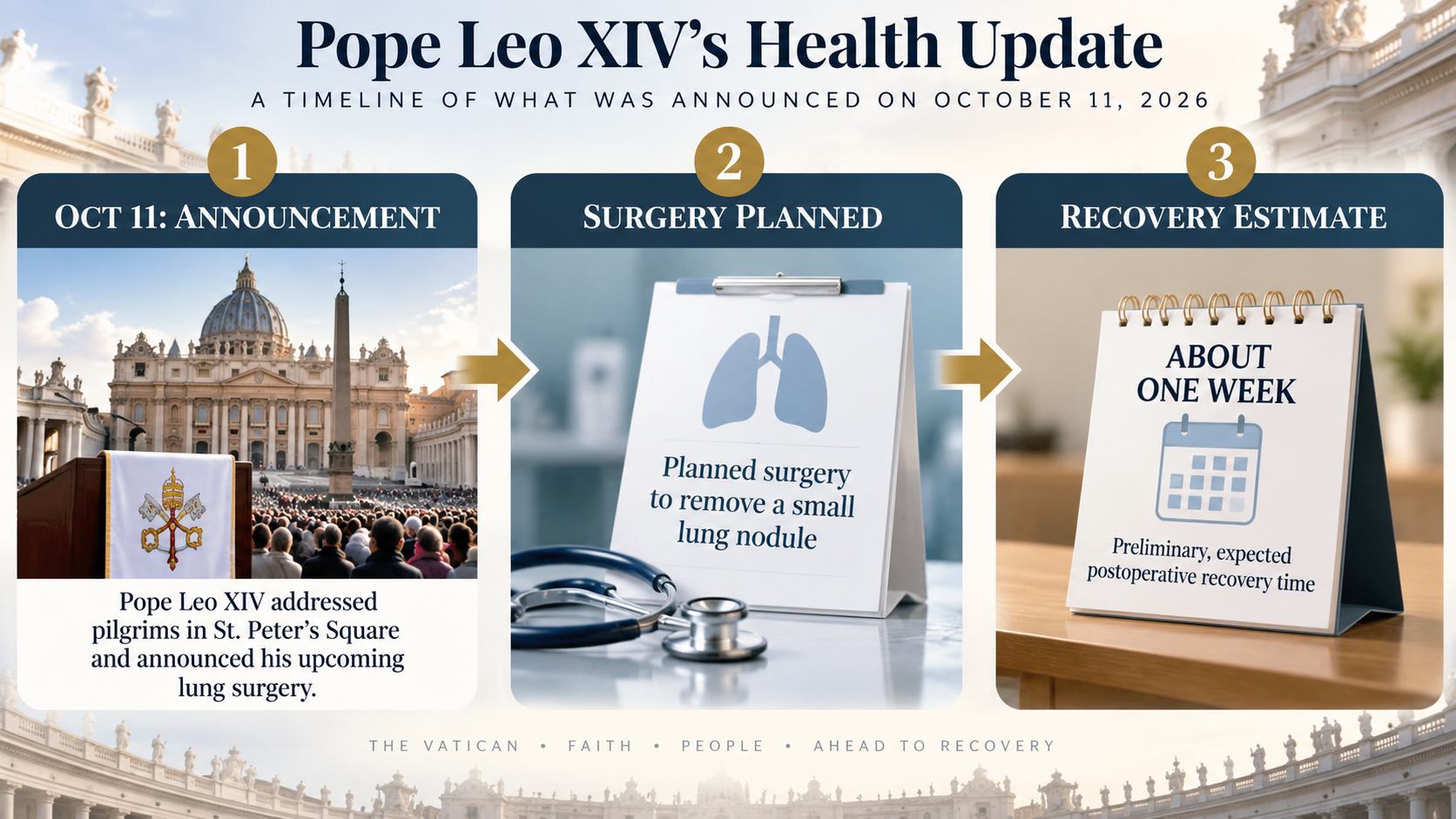
On October 11, 2026, Pope Leo XIV told pilgrims gathered in St. Peter’s Square that doctors had discovered a small, localized lung nodule during recent medical examinations.
The 71-year-old pope said doctors had recommended removing it and that he had agreed to the procedure. He described the finding as detected at a very early stage and well localized. (Vatican)
The Vatican subsequently said the operation was expected early in the week at Rome’s Gemelli Hospital. Officials estimated approximately one week of postoperative recovery, but that is a preliminary estimate, not a guarantee of when he will resume his full schedule. (USCCB · AP)
What the Vatican did not disclose is equally important.
| What has been confirmed | What remains undisclosed |
|---|---|
| Doctors found a localized lung nodule | Whether the nodule is benign or malignant |
| The pope agreed to surgical removal | The nodule’s exact size and imaging characteristics |
| Surgery is planned for the coming days | The specific surgical technique |
| Officials anticipate roughly a week of postoperative recovery | The final diagnosis and actual recovery outcome |
The pope did not publicly announce a lung cancer diagnosis. Nor did the Vatican release a detailed imaging report or a pathology result.
That leaves the biggest medical question unresolved: What exactly is the nodule?
Does a Lung Nodule Mean Pope Leo XIV Has Cancer?
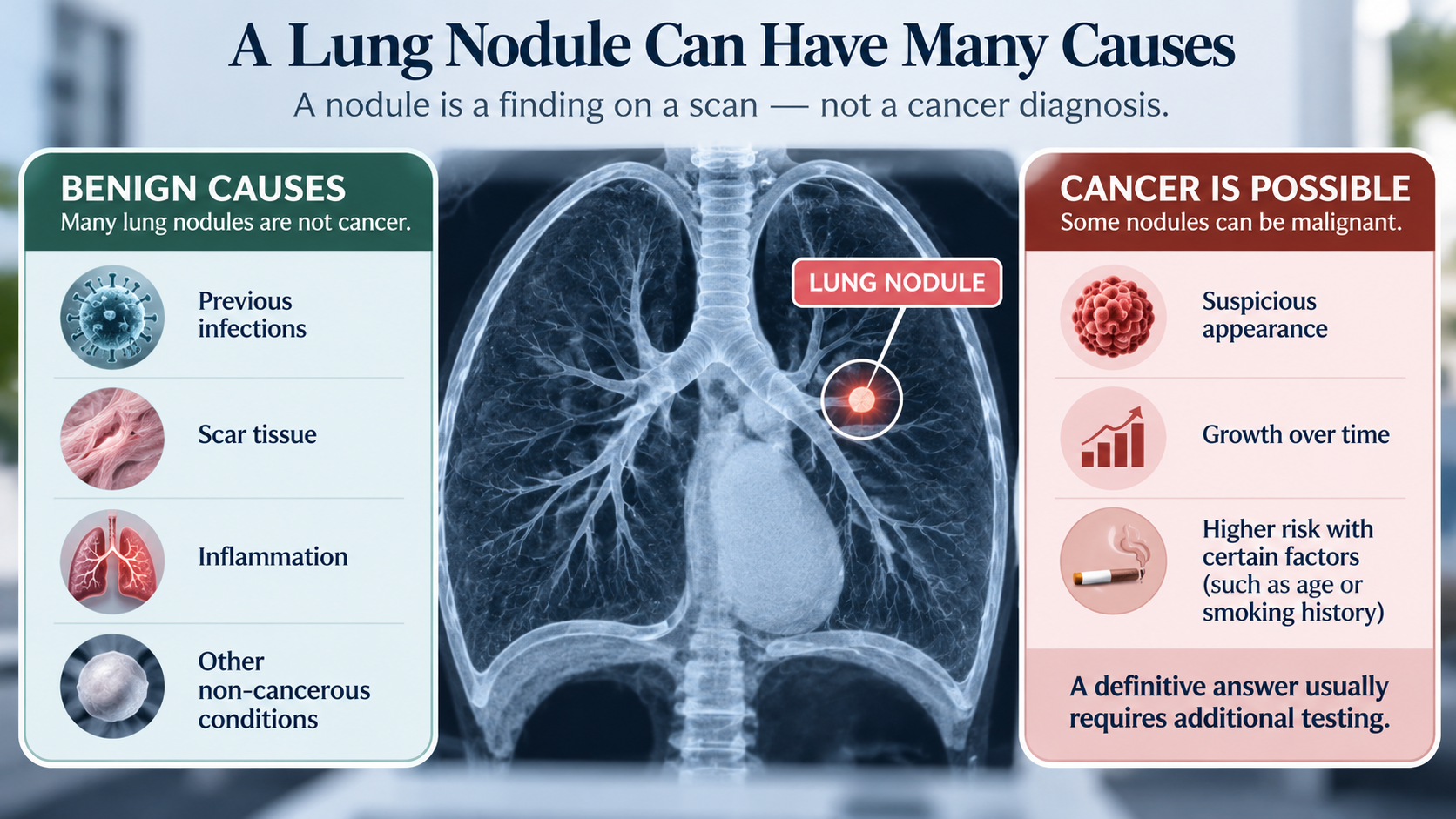
No. A lung nodule does not automatically mean lung cancer.
A pulmonary nodule is a small, relatively dense area of tissue that appears as a spot on a chest X-ray or CT scan.
The important word is nodule. It describes what doctors see, not necessarily what caused it.
According to the American Lung Association, lung nodules can develop for several reasons, including previous infections, scar tissue, inflammation, and cancer.
Many are discovered by accident while doctors are looking for something unrelated.
How common are harmless lung nodules?
They are very common.
The American Thoracic Society says fewer than 5% of lung nodules overall turn out to be cancerous. That statistic covers a broad mix of nodules and patients; it is not the estimated risk for a particular nodule chosen for surgical removal. (American Thoracic Society)
Age, nodule size, appearance, growth, smoking history, and other medical factors can change an individual’s risk substantially.
That means it would be misleading to conclude that Pope Leo personally has less than a 5% chance of cancer.
His exact risk cannot be determined from the limited information released by the Vatican.
Can doctors tell the difference just by looking at a scan?
Sometimes imaging offers strong clues, but it does not always provide a definitive answer.
Radiologists study several characteristics:
| Feature | Why doctors examine it |
|---|---|
| Size | Larger nodules can carry greater concern |
| Shape and edges | Irregular or spiculated edges may raise suspicion |
| Growth over time | A changing nodule may require further evaluation |
| Internal appearance | Solid and ground-glass nodules can require different approaches |
| Patient history | Age, tobacco exposure, and previous illnesses affect risk |
None of these characteristics proves cancer on its own. (American Lung Association)
For Leo, the Vatican has not released the details needed to apply those criteria.
So the statement that his nodule is “localized” describes where doctors found it, but it is not enough to diagnose the finding.
If Most Lung Nodules Are Benign, Why Would Doctors Recommend Surgery?
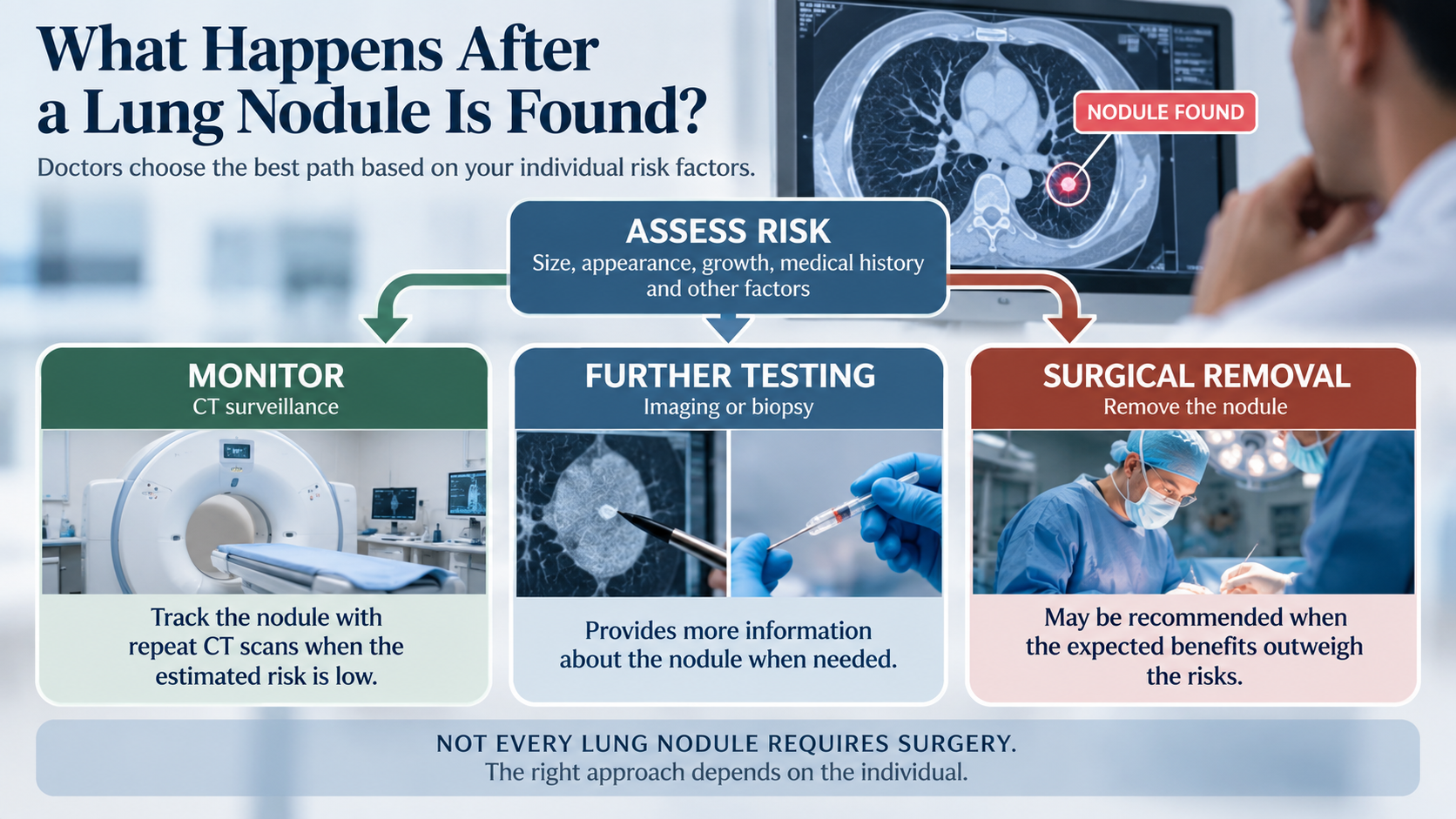
Doctors recommend surgery when they believe removing a nodule offers a better balance of benefits and risks than continued observation or other testing.
That does not necessarily mean cancer has been confirmed.
For many patients, especially those with small and low-risk nodules, the safest approach is to monitor the spot with repeat CT scans.
Other patients may need additional imaging or a biopsy—a procedure in which doctors remove a small tissue sample for examination.
And in selected cases, surgical removal may be appropriate.
Three different paths after a lung nodule is discovered
| Possible approach | What it accomplishes | When it may be considered |
|---|---|---|
| CT surveillance | Tracks the nodule for changes | When the estimated risk is sufficiently low |
| Additional tests or biopsy | Provides more information about the nodule | When imaging and clinical factors justify further evaluation |
| Surgical removal | Removes the lesion and can provide tissue for diagnosis | When the expected benefits justify an operation |
These are general clinical pathways, not a reconstruction of Pope Leo’s private medical decisions. (American Thoracic Society · American College of Radiology)
Why not simply take a small biopsy first?
A biopsy can sometimes answer the question without removing the entire nodule. But that is not always the best option.
The nodule may be difficult to reach, too small to sample reliably, or positioned in a way that makes a needle procedure less useful or more hazardous.
In some circumstances, removing the nodule can accomplish two things: eliminate the abnormal tissue and provide a specimen for diagnosis.
Stephen Liu, a lung cancer specialist at Georgetown University, explained that surgery can provide a definitive diagnosis when there is sufficient concern and removal is considered safe. (Reuters)
But there is an important limitation in applying that explanation to the pope.
The Vatican has not disclosed whether Leo previously underwent a biopsy or which specific clinical findings led his doctors to recommend surgery.
The operation therefore tells us that his medical team believes intervention is appropriate. It does not tell us the diagnosis.
What Does the Pope Mean When He Says the Nodule Was Found at an “Early Stage”?
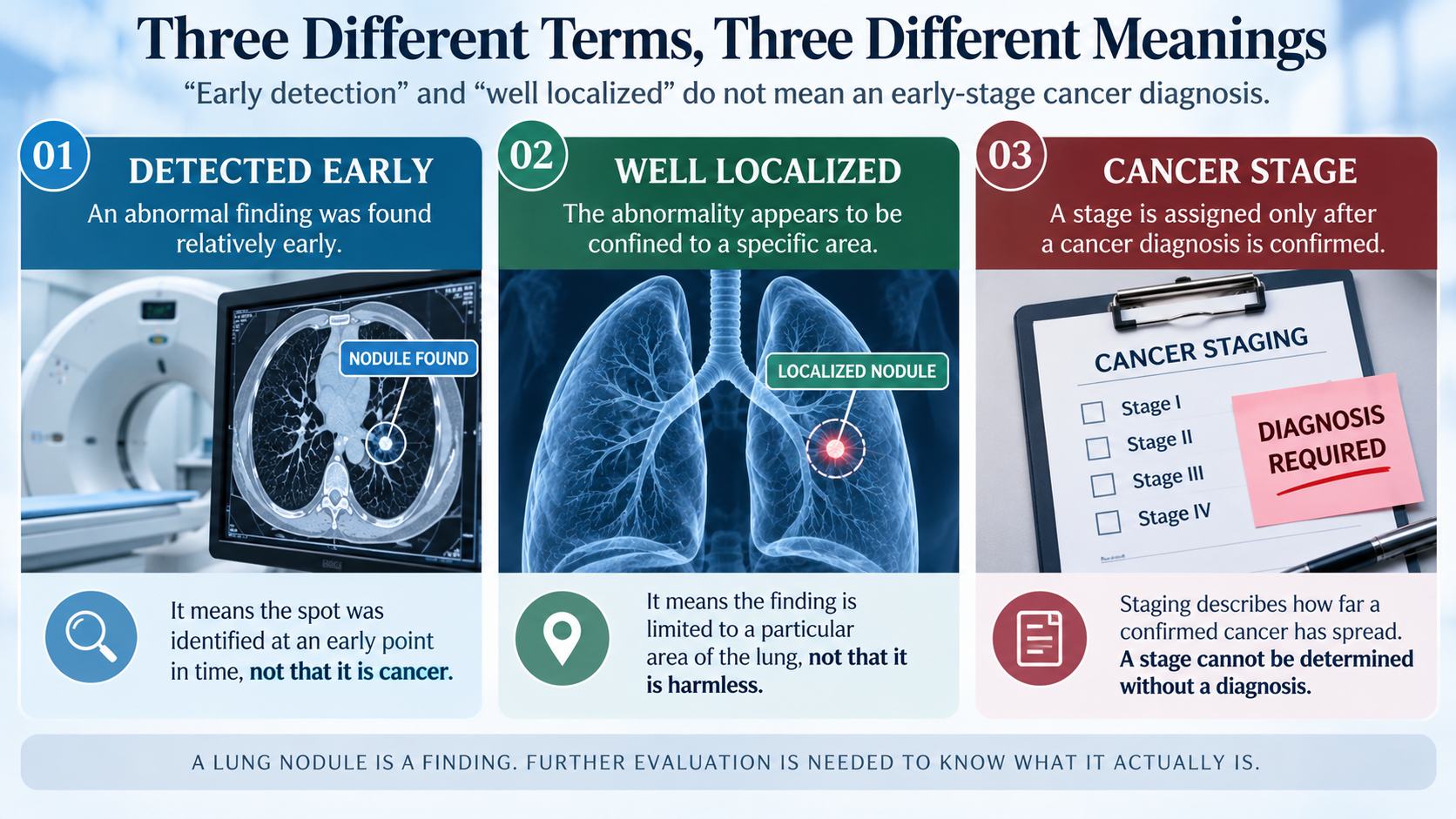
This is one of the easiest parts of the story to misunderstand.
When Pope Leo said the nodule had been detected at a very early stage, he did not publicly announce that he had Stage 1 lung cancer.
Early detection and early-stage cancer are not interchangeable medical terms.
A small abnormality might be found early in the course of observation. It might also appear confined to a particular area of the lung.
Neither description establishes that the abnormality is malignant.
Here is the difference:
| Medical wording | What it means | What it does not prove |
|---|---|---|
| Detected early | An abnormal finding was identified relatively early | That the finding is cancer |
| Well localized | The observed abnormality is confined to a particular area | That the lesion is harmless or that spread has been definitively excluded |
| Early-stage lung cancer | A cancer diagnosis has been established and its extent has been assessed | That every small lung nodule is cancer |
Cancer staging generally requires diagnostic evaluation to establish what type of cancer is present and how far it has spread.
The pope’s remarks did not provide that information.
The cautious reading of his announcement is straightforward: Doctors discovered a localized abnormality, decided removal was advisable, and are preparing to operate.
Anything more specific about malignancy or cancer stage would go beyond what has been publicly confirmed. (Vatican · American Lung Association)
What Will Doctors Learn From the Surgery?
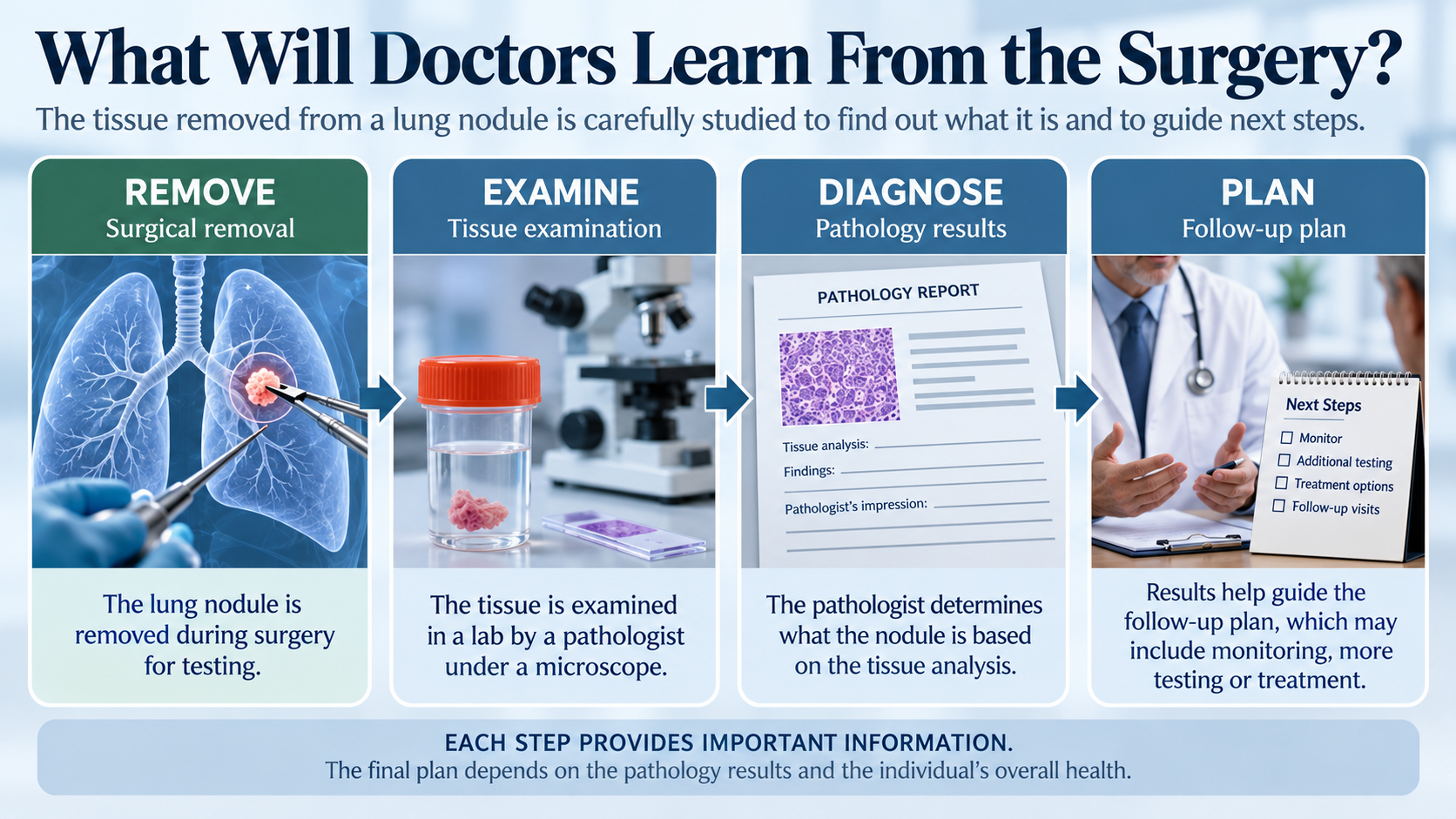
Removing a lung nodule can give doctors an opportunity to examine the tissue directly.
That examination, known as pathology, can help determine whether the abnormality is benign or cancerous and, if cancer is present, what kind of cancer it is.
The result matters because an image alone cannot always answer those questions.
The American Lung Association’s explanation of lung biopsy procedures describes how tissue is examined under a microscope to help establish a diagnosis.
Does removing the nodule mean removing an entire lung?
No. Lung nodule surgery does not automatically involve removing an entire lung.
Depending on the medical circumstances, surgery may remove a small portion of lung tissue or a larger anatomical section.
The choice depends on the lesion’s location, size, suspected nature, and the patient’s overall condition.
However, the Vatican has not specified the type or extent of Pope Leo’s planned operation.
It would therefore be premature to describe his procedure as a wedge resection, a segmentectomy, or a lobectomy.
Could the surgery itself resolve the problem?
Potentially, but not necessarily.
If the nodule is benign and is completely removed, no cancer treatment would be necessary for that particular finding.
If cancer is diagnosed, doctors may need additional information about its type, extent, and whether any further treatment or surveillance is warranted.
Removal of an abnormal spot and completion of all treatment are not necessarily the same thing.
For Pope Leo, no surgical outcome or pathology result has yet been announced.
Why Is the Pope’s Health Receiving So Much Attention?
Pope Leo XIV is not simply a public official taking temporary medical leave.
He leads the Roman Catholic Church, a global religious institution whose leadership carries spiritual, administrative, and diplomatic responsibilities.
Leo became pope in May 2025 after the death of Pope Francis. Born in Chicago, he is the first U.S.-born pope.
For American Catholics, that makes his health particularly personal. For the wider Church, the question is whether an illness could interrupt major religious events, international visits, or the pope’s regular public duties.
There is also a recent history behind the concern.
Why does Pope Francis’s health keep coming up?
Francis experienced several serious health difficulties during his later years, including extended hospitalizations.
His final hospitalization began with a respiratory illness that developed into double pneumonia. He died on April 21, 2025, at age 88.
The health of a pope can therefore become an international story long before there is any suggestion of a change in Church leadership.
Leo’s announcement is different in an important respect: He personally disclosed the medical finding and the planned surgery before the procedure took place.
His predecessor’s hospital stays were not always announced in advance, and uncertainty about his condition sometimes fueled public speculation. (AP)
That more direct disclosure gives Catholics and other observers a clearer starting point for understanding the current situation.
It does not, however, eliminate the need to wait for clinical information.
Could the Surgery Affect Pope Leo’s Upcoming Schedule?
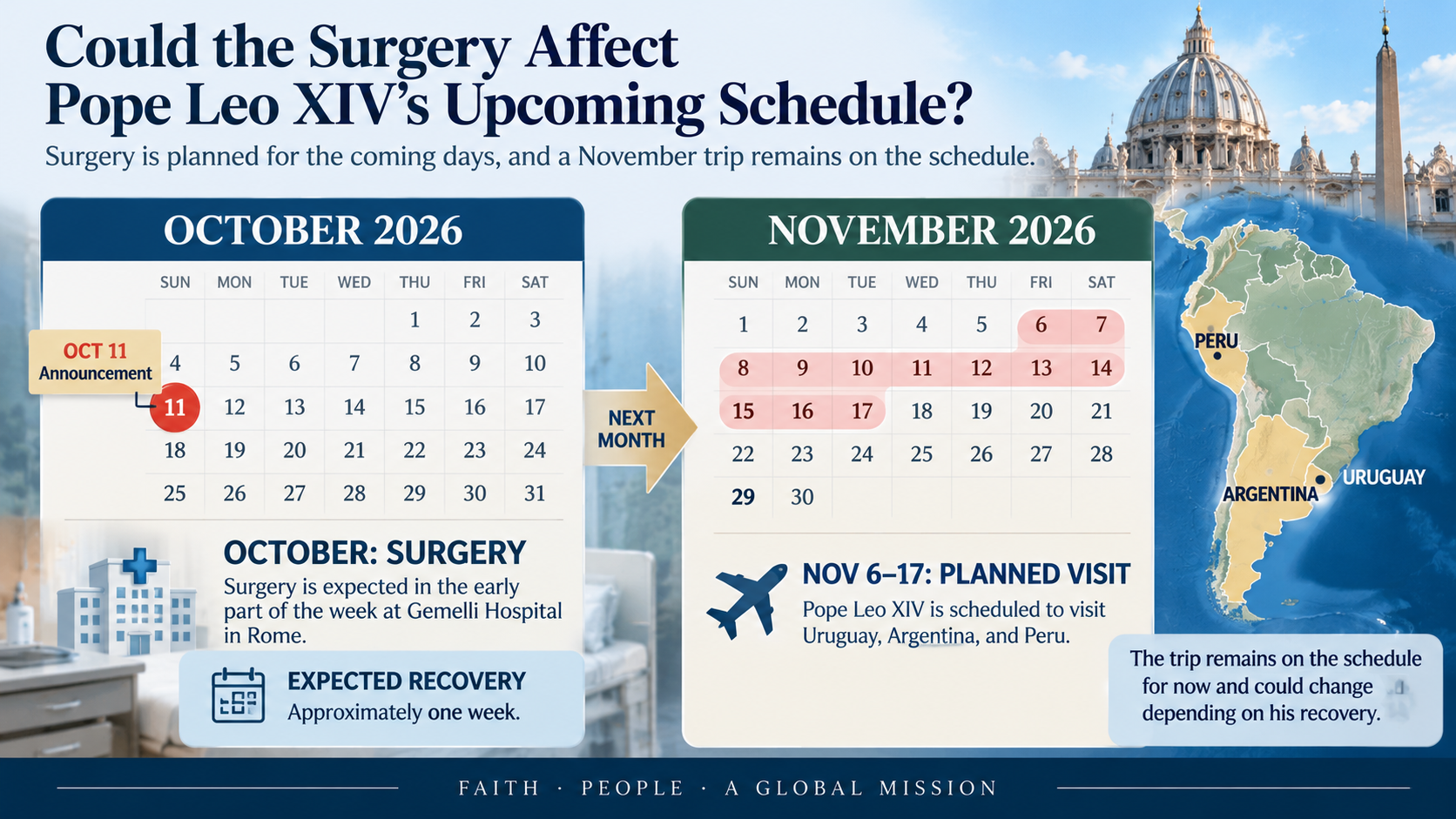
The immediate concern is recovery from the operation. The next question is whether Leo will be well enough to resume his demanding public schedule.
As of the October 11 announcement, the Vatican expected a postoperative recuperation period of approximately one week. That estimate is not the same as a confirmed date for a return to all public duties. (USCCB)
Leo is also scheduled to visit Uruguay, Argentina, and Peru from November 6 through November 17. That is a significant international trip involving religious services, travel, and public appearances. (Vatican)
He referred to the planned visit during his Sunday remarks, indicating that he still expected to travel. (Reuters)
The calendar helps explain why the timing matters.
| Upcoming event | Current public status |
|---|---|
| October 11 | Lung nodule and surgery plan announced |
| Early part of the following week | Surgery expected |
| Approximately one week after surgery | Preliminary estimate for postoperative recuperation |
| November 6–17 | Planned visit to Uruguay, Argentina, and Peru |
A preliminary estimate does not establish that the pope will return to every duty on a particular day.
Whether his schedule changes will depend on the procedure, his recovery, and whatever his doctors recommend afterward.
At the time of the announcement, there was no confirmed cancellation of the November trip.
What Should We Watch for Next?
The next meaningful updates will come from medical and Vatican officials, not speculation about the word “nodule.”
Three developments would provide a clearer picture.
First is confirmation that the planned surgery has taken place, along with an official statement on the procedure and the pope’s immediate condition.
Second is whether the Vatican releases additional information about the nodule itself, including any pathology findings. Those results could answer the question that currently remains open: whether the growth is benign or malignant.
Third is the pope’s actual recovery, including any changes to his public appearances and November travel plans.
Even after surgery, not every medical detail will necessarily be released. A patient, including a pope, may choose to keep parts of a diagnosis private.
Until more information becomes available, the confirmed facts should not be stretched into conclusions about cancer or long-term health.
Bottom Line: What This Story Really Means
Pope Leo XIV is preparing for surgery after doctors discovered a small, localized nodule in his lung.
The announcement is significant, but the Vatican has not said that the pope has lung cancer.
Most lung nodules are benign. Some require closer investigation, and some are removed surgically because doctors believe doing so is the best option for an individual patient.
The decision to operate does not establish a cancer diagnosis, just as the phrase “detected early” does not establish a cancer stage.
For now, the most important medical questions concern the results of the operation, any subsequent tissue diagnosis, and the pope’s recovery.
This is a story about a potentially important health finding and a planned medical intervention—not a confirmed cancer diagnosis.
Pope Leo XIV Lung Surgery: Key Questions Explained
Q. Does Pope Leo XIV have lung cancer?
The Vatican has not publicly confirmed a lung cancer diagnosis. It has announced that doctors discovered a localized lung nodule and recommended its surgical removal.
Q. When did Pope Leo XIV announce his surgery?
He announced the plan on October 11, 2026, during his Sunday Angelus remarks in St. Peter’s Square.
Q. When will the pope’s lung surgery take place?
The Vatican said the procedure was planned for the early part of the week following the October 11 announcement. An exact date was not included in the initial public disclosure.
Q. Where is Pope Leo XIV expected to undergo surgery?
The operation is planned at Gemelli Hospital in Rome, a medical center that has treated previous popes.
Q. Are lung nodules usually cancerous?
No. Most lung nodules are benign. Their significance depends on imaging features, medical history, and individual risk factors.
Q. Why would doctors remove a lung nodule instead of monitoring it?
Surgery may be recommended when the expected benefits of removing or diagnosing a suspicious lesion outweigh the risks of continued observation or other tests. The Vatican has not disclosed the specific reasons behind Leo’s medical team’s decision.
Q. Does finding a lung nodule early mean it is Stage 1 cancer?
No. Early detection describes when an abnormality was identified. A confirmed cancer stage requires a cancer diagnosis and an assessment of the disease’s extent.
Q. How long will Pope Leo XIV need to recover?
The Vatican initially estimated approximately one week of postoperative recuperation. The actual recovery period will depend on the procedure and his condition afterward.
Q. Will Pope Leo XIV cancel his November trip to South America?
No cancellation was confirmed in the initial announcement. His planned November 6–17 visit to Uruguay, Argentina, and Peru remained on the schedule, although his recovery could affect those plans.
Did this help make the story clearer? 🙂
WIN keeps unpacking the “why” behind the news—clearly and simply!
Sources
Official Vatican Announcement and Surgery Plans
Vatican — Pope Leo XIV’s Angelus Address, October 11, 2026
Vatican News — Pope Leo to Undergo Surgery to Remove Nodule in His Lung
Associated Press — Pope Leo XIV to Undergo Surgery to Remove a Lung Nodule
Medical Explanation and Diagnosis
American Thoracic Society — What Is a Lung Nodule?
American Lung Association — Lung Nodules: Causes, Evaluation, and Treatment
American College of Radiology — Incidentally Detected Indeterminate Pulmonary Nodule
American Lung Association — Lung Biopsy
Recovery, Papal Duties, and Upcoming Travel
Reuters — Pope Leo Says He Will Undergo Surgery for Small Growth on Lung
Vatican — November 6–17 Apostolic Journey to Uruguay, Argentina, and Peru