Why Is Bumble Going Private—and What Went Wrong With Dating Apps?

Wasn’t Bumble supposed to be the future of dating?
For years, the app stood out because it gave women more control over starting conversations. It became a recognizable name in online dating, attracted investors, and reached a valuation of roughly $14 billion, including debt, during its 2021 stock market debut. (Bloomberg)
Now the company has agreed to be sold for $1.3 billion.
On October 13, 2026, Bumble announced an agreement to be acquired by Ithaca Holdings, a technology holding company. Under the deal, public shareholders would receive $6.05 in cash per Class A share. (Bumble Inc.)
That raises two questions. Why would a once-celebrated dating app leave the stock market? And does this mean people are giving up on online dating?
Bumble isn’t shutting down. It’s changing ownership because its business has struggled to turn online interest into sustainable growth.
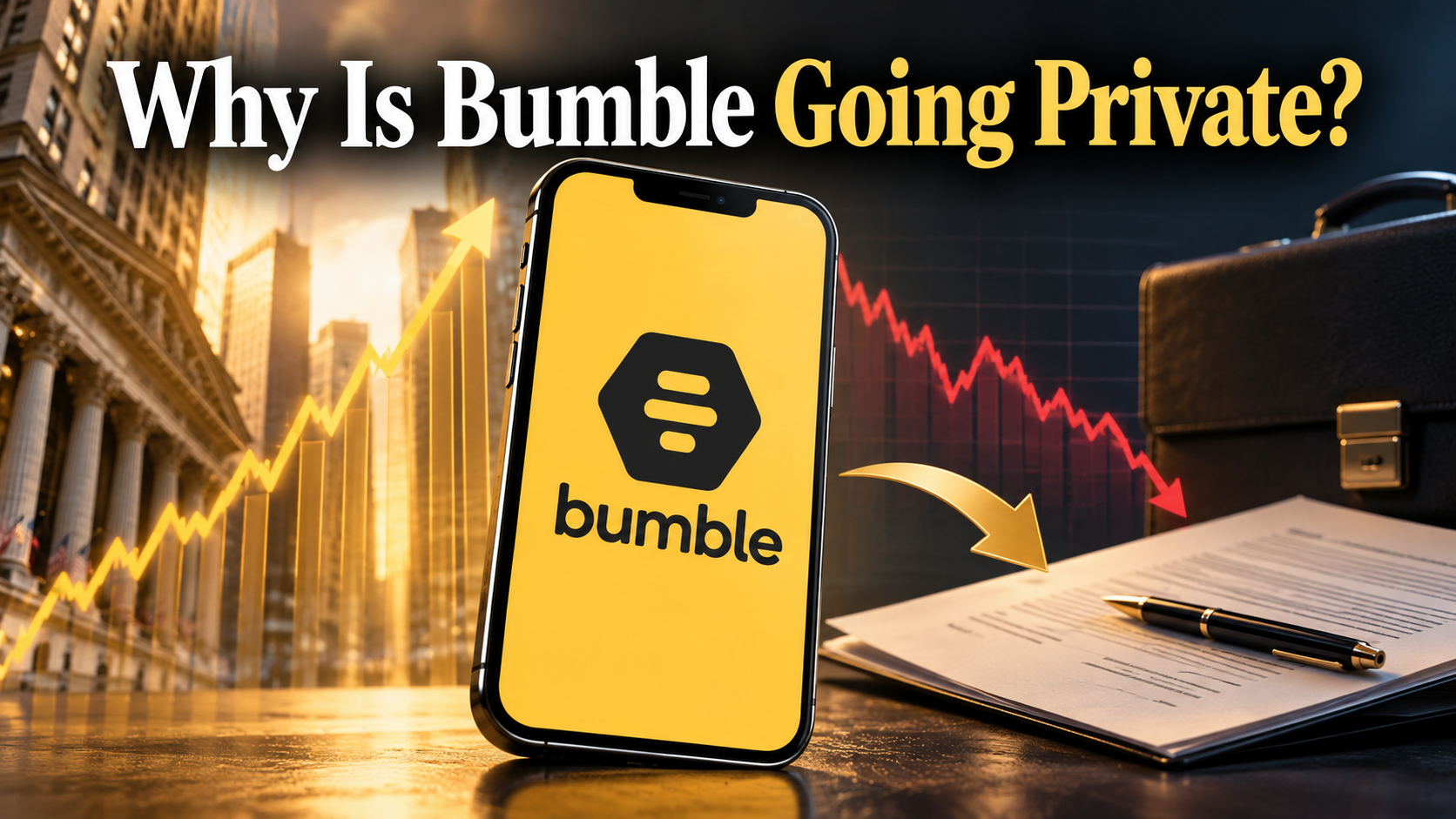
※ Images in this article are AI-generated illustrations created to help explain the story. They are not actual photographs, and depictions of people, places, or events may differ slightly from reality.
The company’s problems also reveal something larger about the dating-app industry: attracting people to a platform is one challenge. Convincing them to keep using it—and paying for it—is another.
What Does Bumble’s $1.3 Billion Buyout Actually Mean?
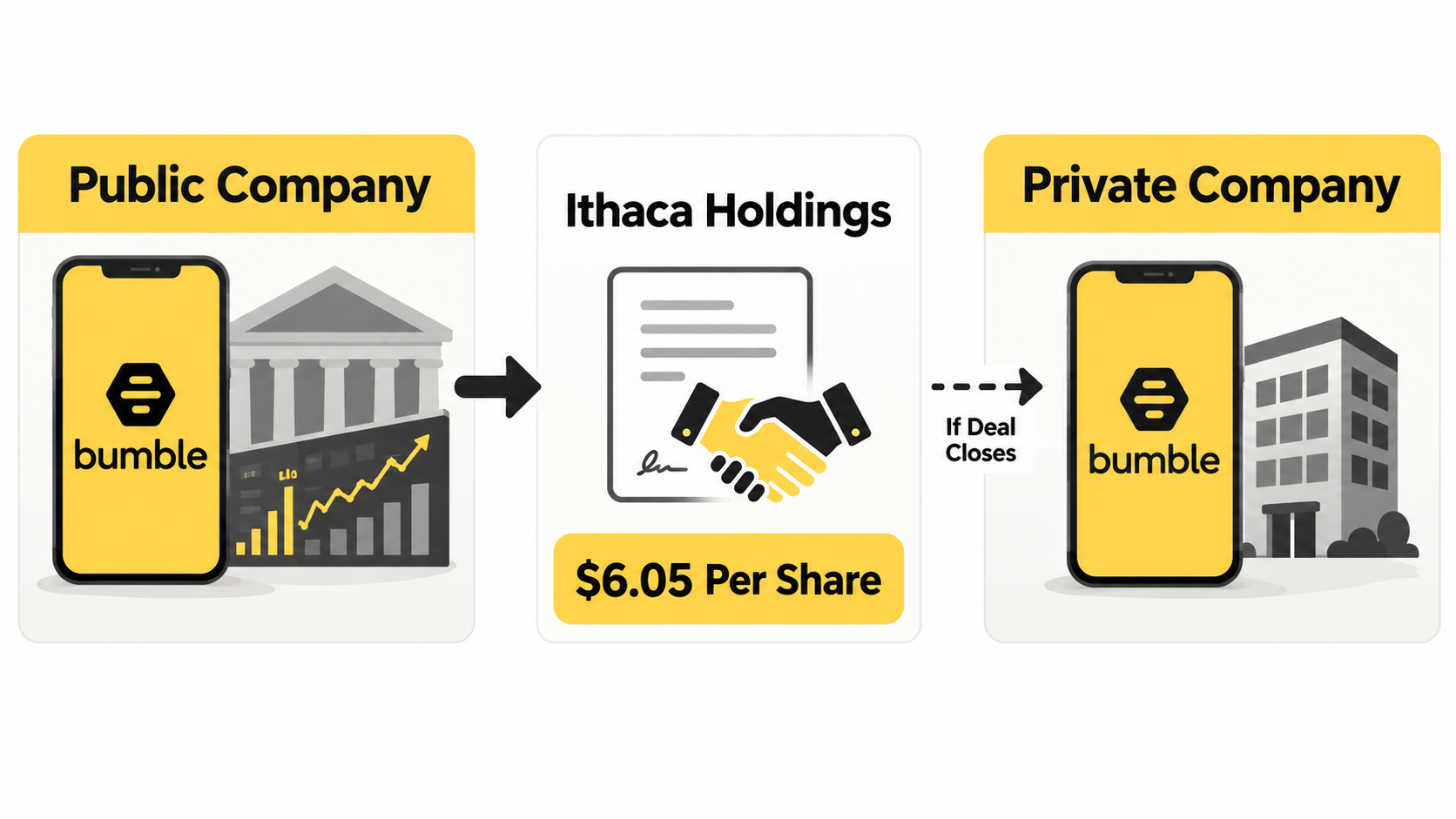
Bumble has agreed to become a privately held company. If the acquisition closes, its shares will no longer trade publicly, and Ithaca Holdings will take control of the business.
That is different from shutting down the app.
Bumble users would still be able to use the dating platform unless the new owners separately announce product or service changes. The acquisition announcement itself did not say that Bumble would close.
The distinction matters because headlines about a company “going private” can sound more dramatic than the transaction actually is.
Here is what the agreement involves.
| Key detail | What it means |
|---|---|
| Buyer | Ithaca Holdings |
| Announced deal value | $1.3 billion |
| Cash price | $6.05 per Class A common share |
| Announced premium | About 138% above the October 9 unaffected closing price |
| Ownership | Bumble would become privately held after closing |
| App service | No shutdown announced as part of the deal |
| Status as of October 14 | Definitive agreement announced; closing not yet confirmed |
The acquisition price also needs some context.
A 138% premium sounds extraordinary. But that percentage is measured against Bumble’s depressed stock price before the deal became public.
For example, a shareholder holding 100 eligible Class A shares would receive $605 before applicable taxes or fees if the transaction closes on the announced terms.
That does not mean investors who purchased Bumble shares near their 2021 highs will recover their original investment.
The company’s announcement says an independent board committee reviewed strategic alternatives. Bumble’s board approved the agreement, with founder Whitney Wolfe Herd recusing herself from its deliberations and vote. Affiliates of Blackstone and Wolfe Herd subsequently provided the shareholder approval required for the transaction through written consent. (Bumble Inc.)
The sale is a major corporate decision, but it does not yet establish whether Bumble’s business turnaround will succeed.
How Did Bumble Go From a Stock Market Darling to a Buyout?

Bumble’s decline did not happen overnight. It developed over several years as the company struggled to maintain the growth that investors once expected.
To understand the change, it helps to remember why Bumble initially attracted so much attention.
Founded in 2014 by Whitney Wolfe Herd, Bumble offered a recognizable alternative to other dating apps. Its defining rule was that women had to initiate conversations in heterosexual matches.
At a time when online dating could feel overwhelming or uncomfortable, that was more than a technical feature. It was part of Bumble’s identity.
The business expanded, and Bumble went public in February 2021.
Its initial public offering priced shares at $43. After trading began, the stock surged and its first-day valuation reached roughly $14 billion including debt. That was a market-based valuation after the stock began trading, not the price paid to acquire the company. (Bumble SEC Prospectus · Bloomberg)
But investors were placing considerable value on expectations of future growth.
When growth weakened, Bumble’s stock became much less attractive.
The turning points
| Period | What happened | Why it mattered |
|---|---|---|
| 2014 | Bumble launched | Established a women-first dating identity |
| February 2021 | Bumble went public | Investors placed a high value on its growth potential |
| March 2025 | Wolfe Herd returned as CEO | The founder resumed leadership during a difficult period |
| August 2026 | First-message rules changed | Bumble moved away from a defining product requirement |
| October 13, 2026 | $1.3 billion sale agreement announced | A potential exit from public markets |
Wolfe Herd returned as CEO in March 2025 as Bumble attempted to rebuild engagement and improve its product. The company also pursued a broader redesign involving AI-assisted matching and new ways for members to connect. (Reuters · Bumble Inc.)
The important distinction is that Bumble’s early stock market valuation reflected investor expectations, while its later financial performance revealed how difficult those expectations were to meet.
A company can have a well-known brand and millions of customers while still disappointing investors.
Bumble became an example of exactly that problem.
Why Were Bumble’s Paying Users and Revenue Falling?
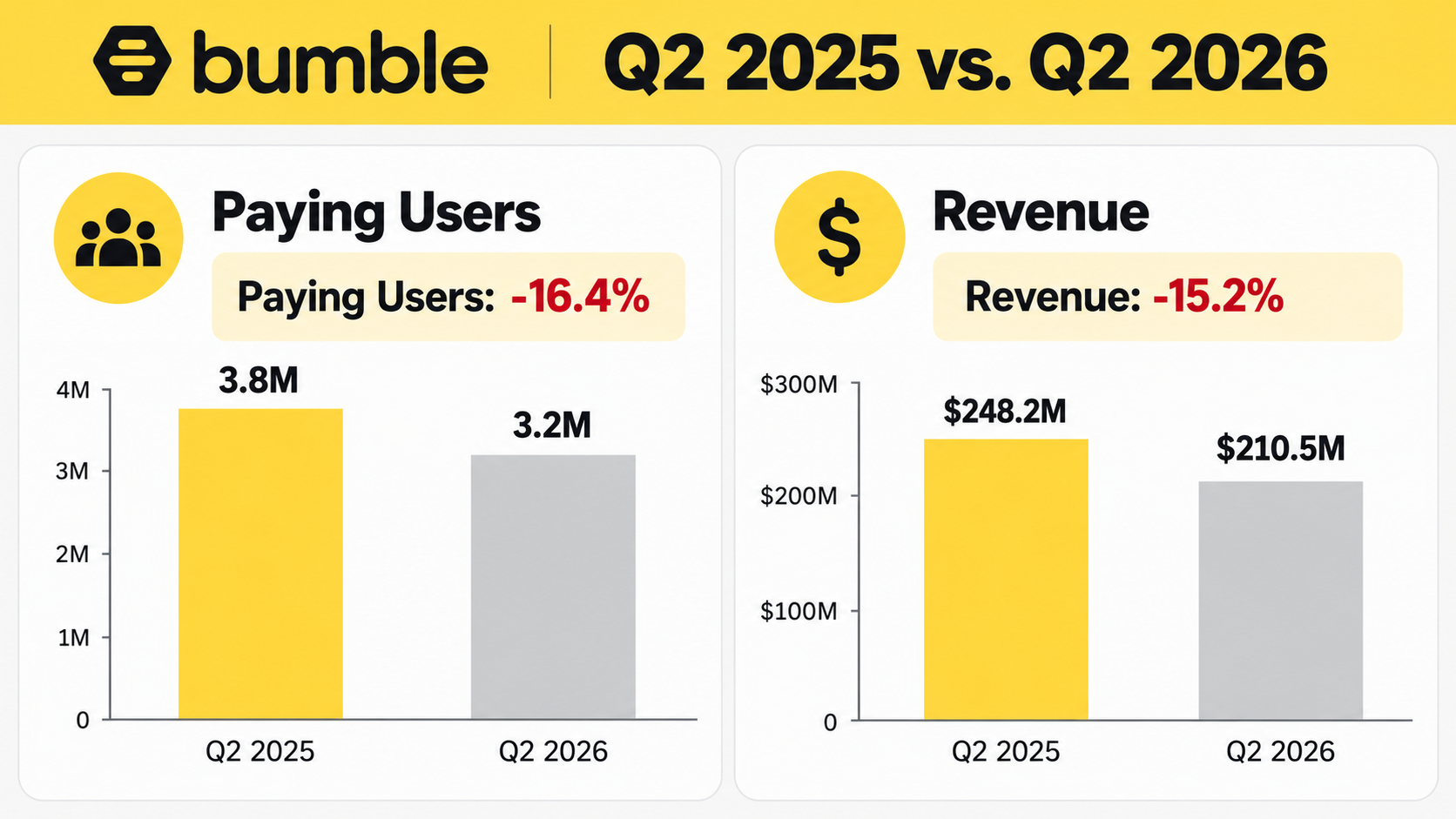
The clearest explanation for Bumble’s financial troubles is that fewer people were paying for its services, and the company’s revenue was shrinking.
Its second-quarter 2026 financial results tell much of the story.
| Metric | Q2 2025 | Q2 2026 | Change |
|---|---|---|---|
| Total paying users | 3.8 million | 3.2 million | -16.4% |
| Total revenue | $248.2 million | $210.5 million | -15.2% |
| Average monthly revenue per paying user | $21.69 | $21.96 | +1.2% |
The user counts in the table are rounded; the percentage changes are those reported by the company. (Bumble Inc.)
Notice the combination.
Bumble was generating slightly more average revenue per paying user, yet its total revenue still fell.
Why?
Because the number of paying users was declining significantly.
Think of a gym that raises its average monthly membership revenue slightly but loses a substantial number of members. Even though each remaining paying customer brings in a little more money, total membership revenue can still decline.
That is similar to the pressure Bumble was experiencing.
There is an important qualification, though. Bumble Inc.’s total paying-user figure includes the company’s reported dating businesses, including Bumble and Badoo. It is not a count of everyone who opens the Bumble app, nor is it a direct measure of all free users.
A 16.4% decline in paying users does not mean 16.4% of all Bumble users deleted the app.
It means fewer people were counted as paying customers under the company’s financial reporting definition.
And because dating apps depend heavily on subscriptions and other paid features, that decline matters enormously to their business models.
Bumble also reported a second-quarter net loss of $127.9 million, including a substantial noncash impairment charge. That accounting loss should not be confused with an equivalent amount of cash leaving the business during the quarter. (Bumble Inc.)
The challenge was not simply generating revenue today. It was demonstrating that Bumble could rebuild a customer base capable of supporting future growth.
Are People Actually Getting Tired of Dating Apps?

There are credible signs of dating-app fatigue, but that is not the same as proving that Americans have abandoned online dating.
Bumble’s falling paying-user count is one piece of evidence. Broader industry pressure is another. (Reuters)
Dating apps made meeting potential partners more convenient. But that convenience created a different experience: people can browse large numbers of profiles without necessarily developing satisfying relationships.
Matching someone is not the same as having a conversation. And a conversation does not guarantee a date.
For some users, that process can become repetitive or emotionally exhausting.
A Pew Research Center survey conducted in July 2022 and published in 2023 helps explain why the experience can be complicated.
Among Americans who had used dating apps or websites within the previous year:
- 88% reported feeling disappointed at least sometimes by people they encountered.
- 79% reported feeling excited at least sometimes.
- 55% reported feeling insecure at least sometimes because of a lack of messages.
- 36% reported feeling overwhelmed at least sometimes by the number of messages.
These findings show that frustration and excitement can coexist. They are historical survey results, not measurements of dating-app usage in October 2026. (Pew Research Center)
Why does this create a business problem?
Dating apps face an unusual challenge.
A shopping service generally benefits when customers return frequently to purchase more products.
A dating service is different.
Someone who finds a lasting relationship may stop needing the service. That can be a successful outcome for the user, even though it removes a potential customer from the app.
Meanwhile, people who stay may be unwilling to pay if they do not believe the platform is helping them make meaningful connections.
That creates three separate measures of success.
| Perspective | What success looks like |
|---|---|
| User | Meeting compatible people and forming meaningful connections |
| Dating app | Maintaining engagement and attracting paying customers |
| Investor | Growing revenue, profits, and long-term business value |
These goals can overlap, but they are not identical.
A platform that encourages more swiping is not necessarily helping users build better relationships.
And a platform that produces better matches still has to figure out how to build a sustainable business.
This tension helps explain why dating-app companies have been experimenting with their core products rather than relying entirely on the traditional swipe-and-match model.
Why Did Bumble Give Up Its Famous Women-First Messaging Rule?
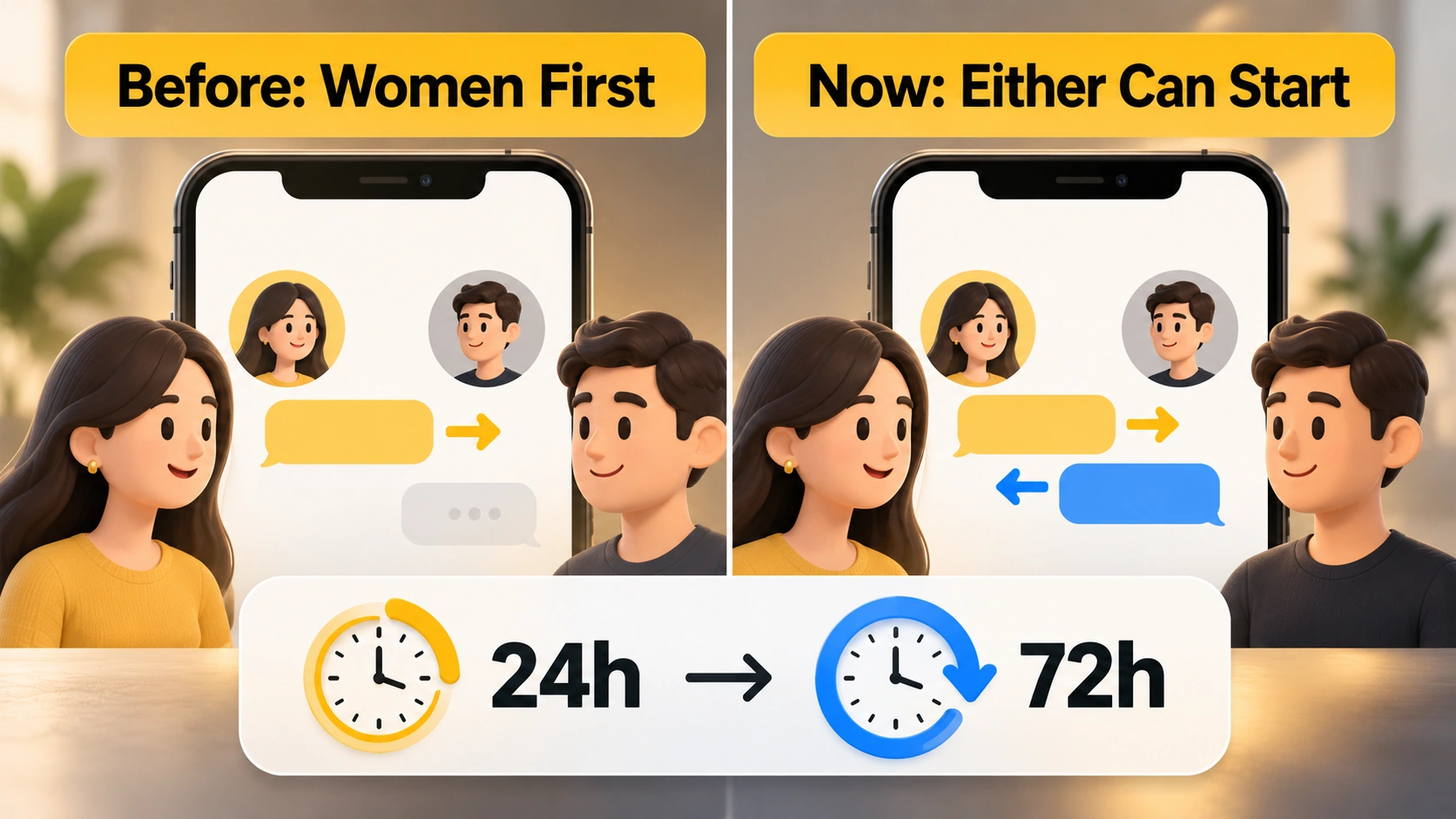
Bumble relaxed its signature women-first rule because it was trying to make conversations easier to start and reduce friction for users.
The change was particularly revealing because the original rule had been central to the company’s identity.
When Bumble launched in 2014, women in heterosexual matches had to make the first move. The concept helped distinguish Bumble from competitors such as Tinder.
Over time, however, the company began changing the experience.
In 2024, Bumble introduced Opening Moves, which allowed women to set questions that matches could answer. That loosened the original conversation structure.
Then, on August 11, 2026, Bumble announced that either person in a match could send the first message.
The company also extended the response window from 24 hours to 72 hours. Bumble said the changes were intended to reduce pressure and give members more flexibility. (Reuters)
What changed for users?
| Feature | Original approach | August 2026 change |
|---|---|---|
| First message in heterosexual matches | Women initiated | Either person could initiate |
| Response window | 24 hours | 72 hours |
| Basic goal | Put women in control of initiating contact | Make conversations more flexible and accessible |
The original women-first requirement applied specifically to heterosexual matching. Other types of matches had different messaging arrangements, so it would be inaccurate to say the former restriction applied to every user in the same way.
The August update did not mean Bumble abandoned every aspect of its women-first positioning or safety commitments.
But removing the mandatory first-message rule was a major product change.
Bumble was essentially acknowledging that a feature that helped make it distinctive might also be creating friction for some people.
For users, that change may seem practical.
For investors and industry observers, it raised another question: If Bumble no longer relies on its most recognizable differentiator, what makes the experience meaningfully different from competing apps?
That question becomes even more important under new ownership.
Can AI and a Better Dating Experience Save Bumble?

AI could help Bumble improve its matching experience, but there is no guarantee that artificial intelligence will solve the company’s underlying business problems.
Before the acquisition announcement, Bumble had already been working on a broad product redesign.
Its plans included changes to matching algorithms, new ways to start conversations, group experiences, and features intended to help users move toward in-person dates. (Bumble Inc.)
In May 2026, Wolfe Herd also discussed moving Bumble away from traditional swiping. (Axios)
This is a significant change in strategy.
Traditional dating apps often emphasize the number of potential matches available to users.
A more AI-assisted experience could instead attempt to help users identify compatible people with less repetitive browsing.
Imagine two approaches.
One app shows someone hundreds of profiles and asks them to keep swiping.
Another attempts to identify a smaller set of compatible people based on preferences, interests, and other relevant information.
The second approach might save time—but only if its recommendations are useful.
AI alone cannot guarantee attraction, trust, compatibility, or a successful relationship.
It also introduces questions about how users’ personal information is handled, what information influences recommendations, and whether people understand how the system works.
For Bumble, the bigger challenge is commercial.
A redesigned app must do more than generate attention when a new feature launches. It needs to attract members, improve their experiences, and persuade enough of them that paid services offer meaningful value.
The next version of Bumble may look different.
Whether people will pay for that difference is much harder to predict.
Who Will Run Bumble After the Acquisition?
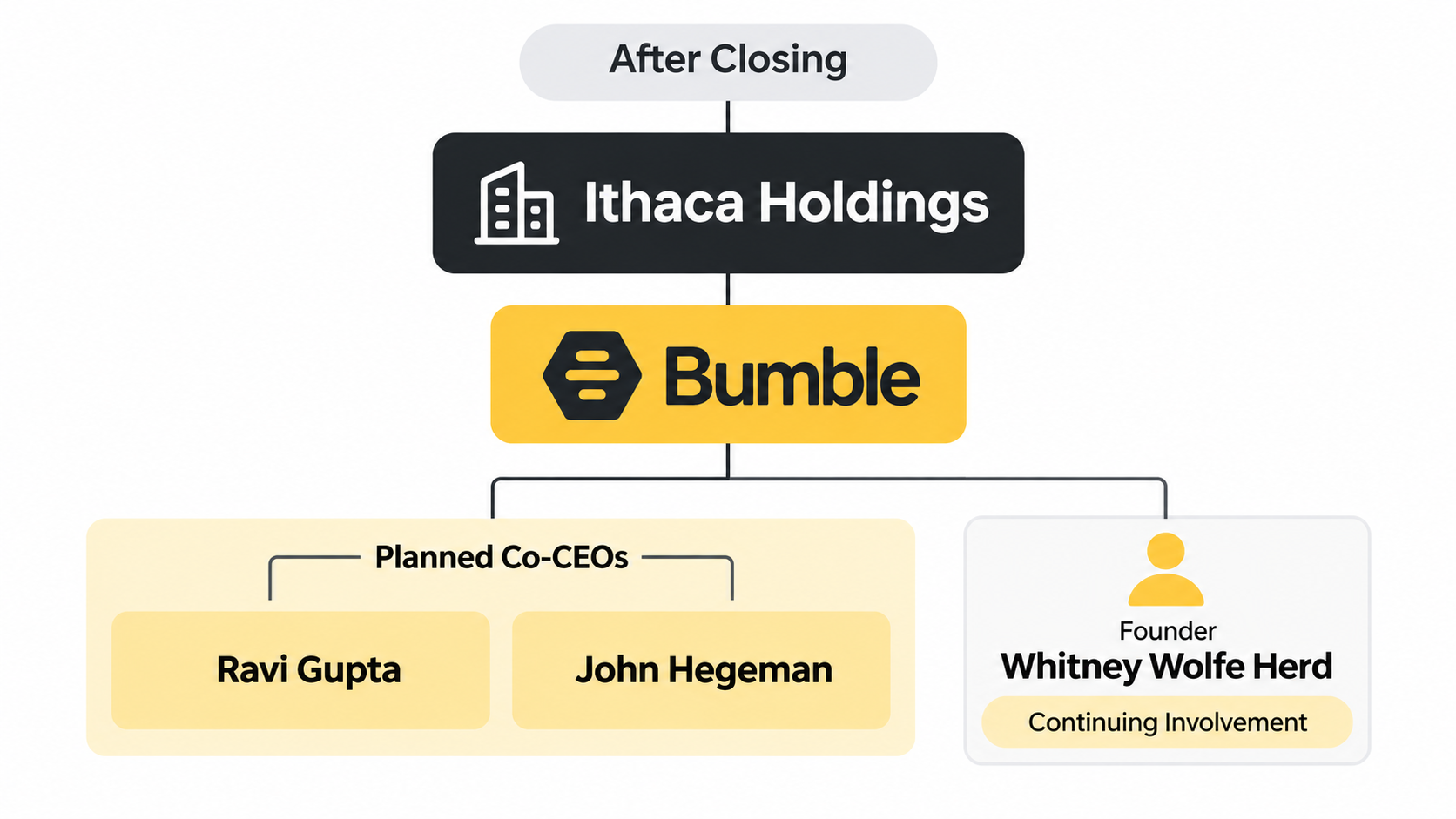
If the acquisition closes, Ithaca Holdings co-founders Ravi Gupta and John Hegeman are expected to become Bumble’s co-CEOs.
Whitney Wolfe Herd, Bumble’s founder and current CEO, has said she will remain actively involved with the company.
The official announcement does not establish every detail of her future day-to-day responsibilities. (Bumble Inc.)
That is an important distinction.
The company is not simply replacing one executive while continuing under exactly the same structure.
It is moving toward a new ownership arrangement that combines Ithaca’s investment and operating approach with the involvement of Bumble’s founder.
Gupta previously worked at Instacart and Sequoia Capital, while Hegeman held a senior revenue role at Meta. Their experience comes from technology investment, operations, and digital business growth. (Business Insider)
Ithaca has described its strategy as using advanced technology to renew established businesses.
For Bumble, that creates an opportunity to pursue changes outside the constant pressure of public stock trading.
But private ownership does not make financial problems disappear.
New owners still need a business that can retain customers, generate sufficient revenue, and justify the investment.
They simply have a different ownership structure and potentially more freedom to pursue a longer-term plan.
What Does Going Private Mean for Bumble Users and Shareholders?
The immediate consequences are very different depending on whether someone uses Bumble or owns its stock.
For ordinary app users, the agreement does not automatically change subscriptions, profiles, matches, or account access.
For public shareholders, the financial consequences are more direct.
Two different perspectives
| Question | Bumble users | Public shareholders |
|---|---|---|
| What changes immediately? | No shutdown or automatic account change announced | Shares remain publicly traded until the deal closes |
| What matters most? | App quality, pricing, safety, and features | The $6.05-per-share cash consideration |
| What happens after closing? | The service could evolve under new ownership | Eligible shares would be converted into the right to receive cash under the deal |
| What remains uncertain? | Future product and pricing decisions | Completion timing and any remaining transaction risk |
The acquisition agreement does not promise that users will receive cheaper subscriptions or better matches.
Those outcomes would depend on decisions made by the company and on whether its product strategy works.
For shareholders, the $6.05 price provides a concrete reference point.
However, an agreed acquisition price is not the same as cash already paid. The transaction must still close, and until then the stock can trade at a price that reflects uncertainty about completion.
There is another reason this deal matters beyond Bumble.
It reflects the challenge facing companies that built businesses around dating-app subscriptions.
Those companies need to make digital dating more satisfying while still generating revenue from the people using their services.
If Bumble’s new owners develop a model that improves both user satisfaction and the business’s finances, competitors may pay attention.
If they cannot, the company may continue struggling despite the ownership change.
What Should We Watch Next?
The first question is whether the acquisition closes on the announced terms.
Bumble has already obtained the required shareholder approval through written consent, according to its October 13 announcement.
The company is also expected to distribute an information statement to shareholders. Regulatory filings and any remaining transaction conditions will help clarify the path to completion. (Bumble Inc.)
There are several developments that could show whether the business is actually improving.
- Paying-user trends: Does Bumble stabilize or reverse the decline?
- Product redesign: Do new matching and conversation features help users form more meaningful connections?
- Subscription value: Can the company persuade customers that paid features are worth buying?
- Leadership: How will the new co-CEOs and Wolfe Herd divide responsibilities?
- Competition: How will Bumble distinguish itself from Tinder, Hinge, and other dating services?
One additional financial milestone is already approaching.
Bumble has said it plans to file its third-quarter 2026 report with the Securities and Exchange Commission by November 9, 2026. Because of the acquisition agreement, it does not plan to issue its usual earnings release or hold a conference call for that quarter. (Bumble Inc.)
Those results may provide another view of the company’s performance before the ownership transition.
The sale is a major development, but the real test will be whether Bumble can make dating apps feel valuable again.
Bottom Line: What This Story Really Means
Bumble’s $1.3 billion acquisition agreement marks a dramatic change for a company that once symbolized the future of online dating.
It built a recognizable brand around giving women more control over conversations. It attracted investors, grew into a major publicly traded dating company, and briefly reached a market valuation of roughly $14 billion.
But a strong brand could not prevent declining revenue, fewer paying customers, and pressure to rethink the experience that made the app successful.
Bumble is going private because its owners have agreed to a new structure for a business that needs a turnaround—not because online dating has disappeared or the app is shutting down.
The deeper story is about the tension between helping people find meaningful relationships and making money from a digital platform.
Users want compatible partners, worthwhile conversations, and real connections.
Dating companies need engagement and paying customers.
Investors need sustainable returns.
Those goals are related, but they are not automatically the same.
Bumble’s new owners are betting that technology, product changes, and a different ownership structure can bring them closer together.
Whether that approach works will tell us something important about the future of dating apps—not just Bumble.
Bumble Going Private: Key Questions Explained
Q. Is Bumble shutting down in 2026?
No. Bumble announced an agreement to be acquired and taken private, not a shutdown of its dating app. Its services are not scheduled to close as a direct result of the announcement.
Q. Who is buying Bumble?
Ithaca Holdings has agreed to acquire Bumble in a transaction valued at $1.3 billion. Its co-founders, Ravi Gupta and John Hegeman, are expected to become Bumble’s co-CEOs after closing.
Q. How much will Bumble shareholders receive?
Under the announced terms, eligible holders of Bumble Class A common stock will receive $6.05 per share in cash if the deal is completed.
Q. Has Bumble’s acquisition already been completed?
No. As of October 14, 2026, Bumble has announced a definitive acquisition agreement and secured the required shareholder approval, but completion of the transaction has not been confirmed.
Q. Why has Bumble lost so much value since its IPO?
The company struggled to maintain the growth investors expected. Declining paying-user numbers, lower revenue, competitive pressure, and changing expectations about dating apps all contributed to its difficulties.
Q. How many paying users did Bumble lose?
In the second quarter of 2026, Bumble Inc.’s reported total paying-user count declined 16.4% from the same quarter in 2025, falling from approximately 3.8 million to 3.2 million. This figure does not represent the company’s entire free and paid user base.
Q. Can men now send the first message on Bumble?
Yes. Bumble changed its messaging policy in August 2026 to allow either person in a match to initiate contact, ending the former women-first requirement in heterosexual matches.
Q. Will Bumble subscriptions become cheaper after the acquisition?
No subscription price reduction was established by the October 13 acquisition announcement. Future pricing and product decisions remain separate questions for the company.
Q. Will Whitney Wolfe Herd leave Bumble?
She has said she will remain actively involved following the acquisition. However, Ithaca co-founders Ravi Gupta and John Hegeman are expected to become co-CEOs once the transaction closes.
Q. Does Bumble’s decline mean dating apps are dying?
Not necessarily. Bumble’s financial results show difficulties in retaining paying customers, and broader research has documented frustration with online dating. Neither finding proves that people have stopped using dating apps altogether.
Did this help make the story clearer? 🙂 WIN keeps unpacking the “why” behind the news—clearly and simply!
Sources
Acquisition Agreement and New Ownership
Bumble Inc. — Official October 13, 2026 Acquisition Announcement
Reuters — Bumble’s $1.3 Billion Take-Private Deal
Business Insider — New Leadership and the Going-Private Transaction
Financial Performance and Valuation History
Bumble Inc. — Second Quarter 2026 Financial Results
SEC — Bumble’s 2021 IPO Prospectus
Bloomberg — Bumble’s 2021 Stock Market Debut
Reuters — Acquisition Talks and Bumble’s Valuation History
Dating-App Changes and User Experiences
Reuters — Bumble’s August 2026 Messaging Rule Changes
Axios — Bumble’s Planned Move Away From Swiping
Pew Research Center — From Looking for Love to Swiping the Field: Online Dating in the U.S.