What Makes Google’s Gemini 4 Argon Different—and Who Can Actually Use It?

Another new AI model?
If you already use ChatGPT, Claude, or Google’s Gemini, you might reasonably wonder what could be so different about this one.
Can it answer questions more accurately? Write better code? Finish an entire project instead of giving you instructions on how to do it?
And if Google’s new model really is that powerful, can anyone use it—or is it reserved for people paying for expensive subscriptions?
Google’s Gemini 4 Argon, broadly released on October 13, 2026, is designed around a significant shift in how people use artificial intelligence.
The idea is to move beyond getting an answer from AI and toward having AI carry out complicated work across multiple steps.
That could mean examining a collection of financial documents, making substantial changes to software, or combining information from different sources into a finished project.
But there is a catch: access depends on which Google product and subscription you use, and impressive performance claims do not necessarily mean the model will be best at everything.
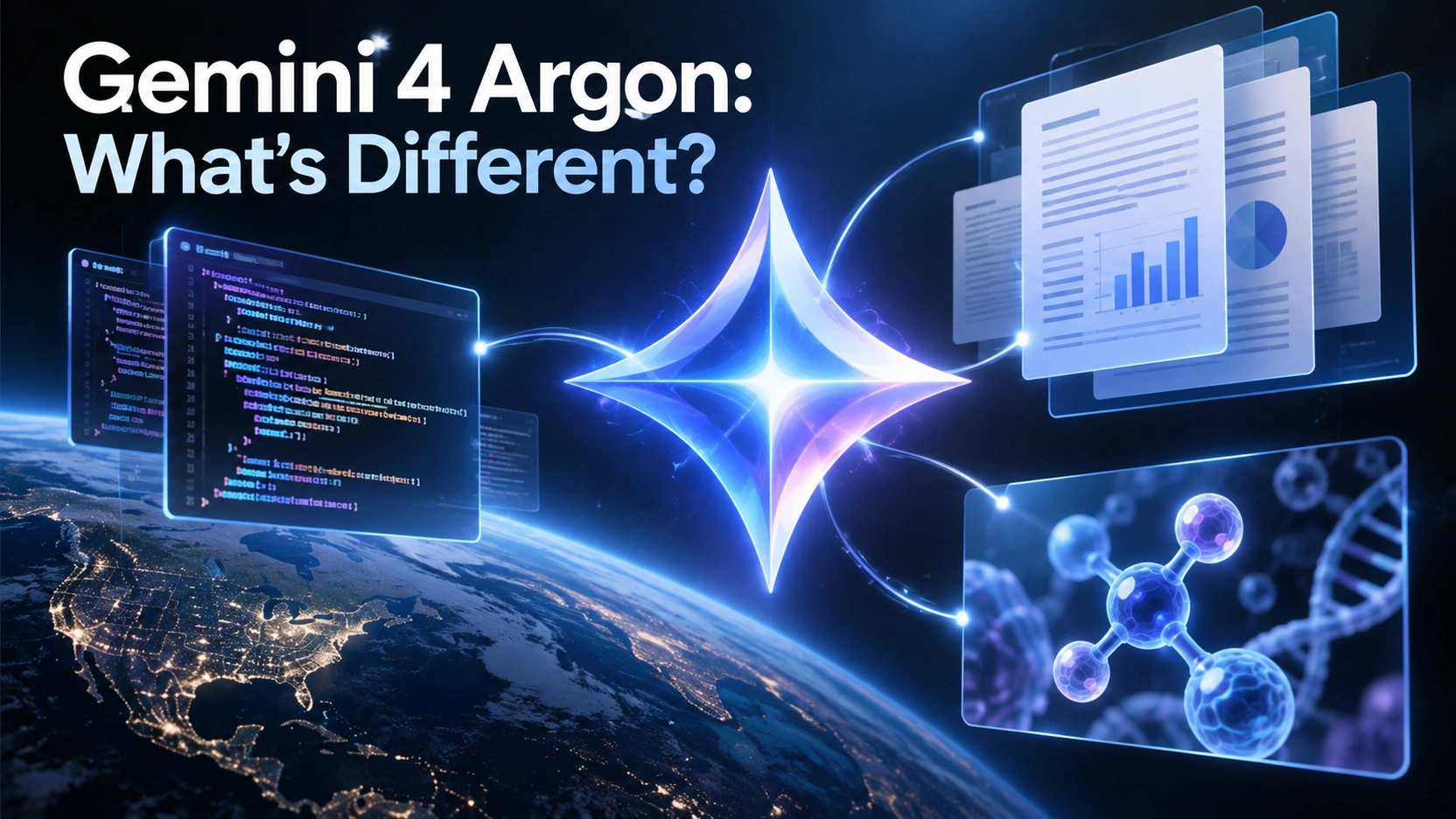
※ Images in this article are AI-generated illustrations created to help explain the story. They are not actual photographs, and depictions of people, places, or events may differ slightly from reality.
Google says Argon is particularly strong at software engineering, scientific reasoning, cybersecurity defense, and professional work involving complicated documents.
It is now being offered through several Google services, but those services do not all have the same access rules. (Google · Reuters)
Understanding that distinction is the first step toward deciding whether Gemini 4 Argon is worth using.
How Is Gemini 4 Argon Different From an Ordinary AI Chatbot?
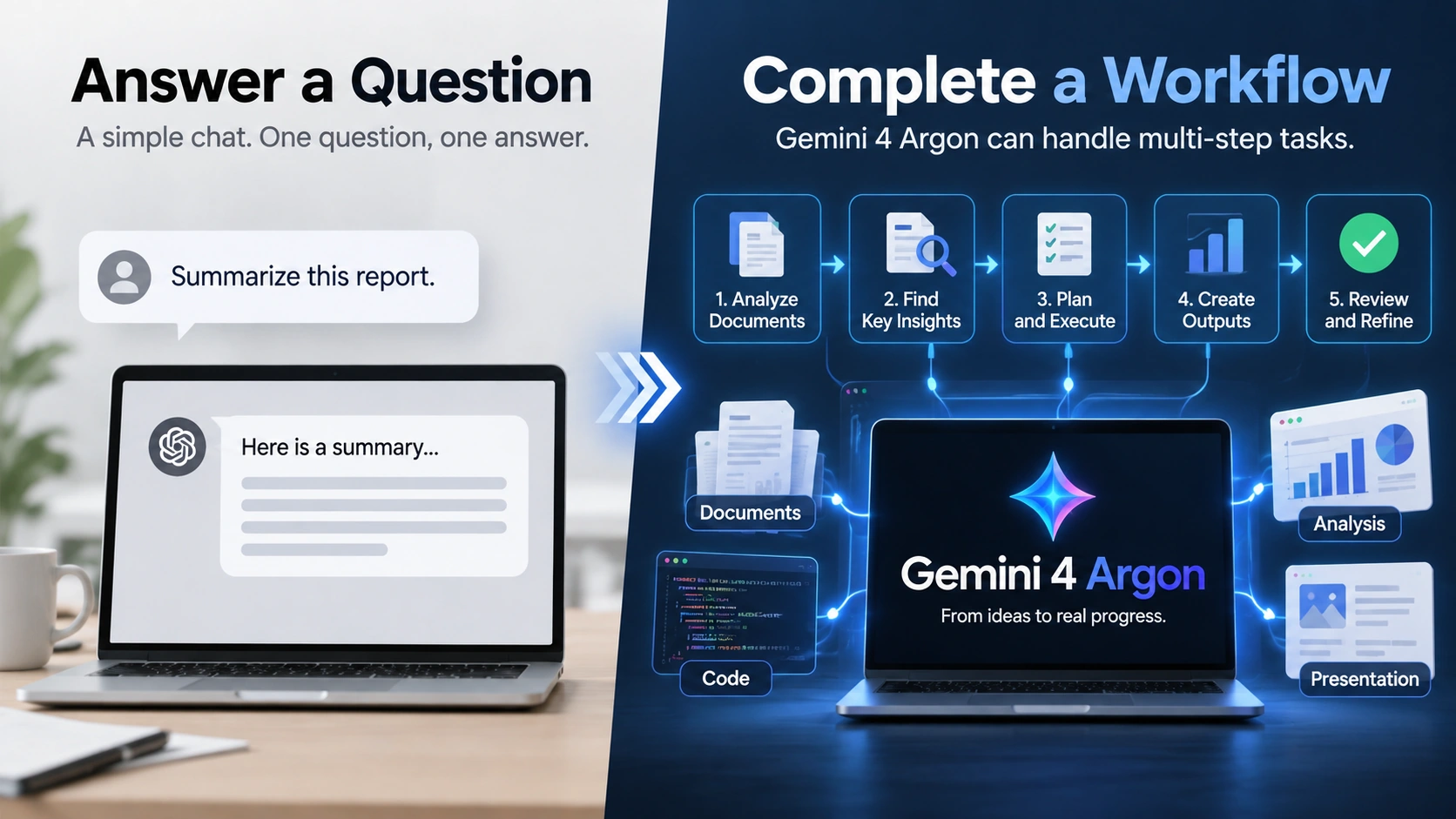
Gemini 4 Argon is designed to handle longer, more complicated tasks that require several connected decisions, rather than focusing only on producing a good answer to a single prompt.
That does not mean older AI models or competing services are limited to simple conversations. Many already support reasoning, coding, and automated tasks.
The difference Google is emphasizing is Argon’s ability to maintain context and work through difficult problems with greater depth and precision.
Consider two ways of asking AI for help.
In the first, you upload a financial report and ask for a summary.
In the second, you ask the AI to examine several reports, identify changes between periods, check calculations, prepare a comparison table, and create a presentation explaining the results.
The second request is much harder.
Each step depends on information from an earlier step. A mistake in the beginning can carry through the entire project.
That is the kind of work Google says Argon was built to handle. (Google Cloud)
What does “agentic AI” mean?
You will probably encounter the term agentic AI frequently in coverage of Gemini 4.
An AI agent is a system designed to take actions toward a goal, potentially using tools, files, applications, or software along the way.
For example, an agent might examine a software project, identify a bug, propose a correction, run tests, and report what happened.
A traditional chatbot interaction might stop after explaining how to fix the bug.
An AI agent attempts to do some of the work.
There is an important qualification: the model alone is not the entire agent.
An AI model supplies reasoning and generates instructions or actions. The surrounding software determines which tools it can access, which permissions it has, and how its actions are checked.
That is why the same underlying model can behave differently inside the Gemini app, a developer platform, or an enterprise system.
Who Can Use Gemini 4 Argon—and Is It Free?
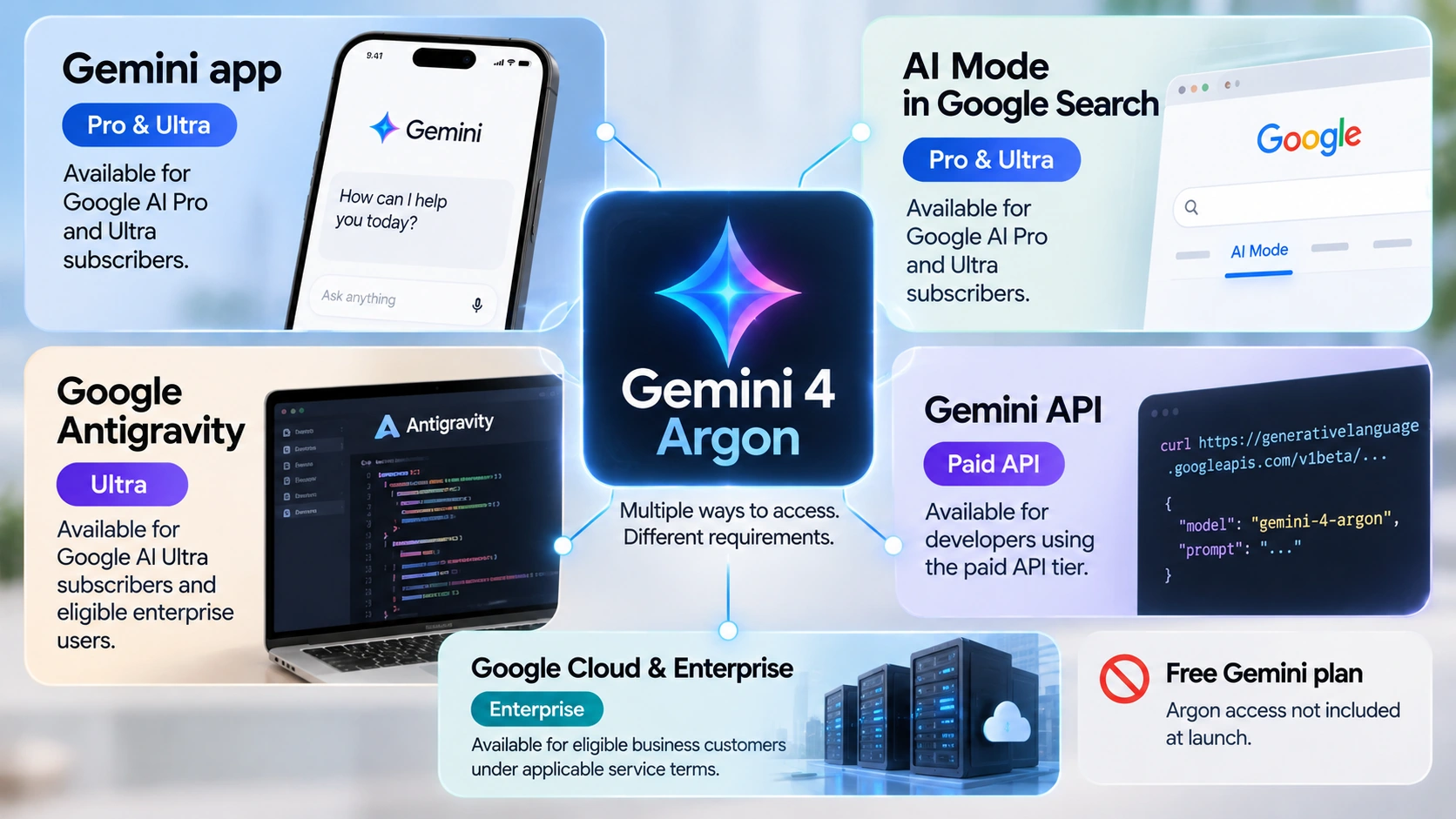
Gemini 4 Argon is available to paying users through several Google services. However, it is not part of the regular free Gemini offering at launch.
Google AI Pro and Ultra subscribers can access Argon in the Gemini app and Google’s AI Mode in Search. Developers and businesses have separate access paths. (Google · Google Developers)
Here is how the options differ.
| Where you want to use Argon | Who has access at launch |
|---|---|
| Gemini app | Google AI Pro and Ultra subscribers |
| AI Mode in Google Search | Google AI Pro and Ultra subscribers |
| Google Antigravity coding tools | Google AI Ultra subscribers and eligible enterprise users |
| Gemini API | Developers using the paid API tier |
| Google Cloud and enterprise services | Eligible business customers under applicable service terms |
| Free Gemini plan | Argon access not included at launch |
These are Google’s announced access arrangements as of October 13, 2026. Actual availability and usage limits can depend on the service, account, and region.
Does paying for Gemini automatically give you API access?
No. A consumer subscription and developer API billing are different arrangements.
A Google AI Pro subscription can provide access to Argon through supported consumer products.
But it does not automatically mean you can make unlimited API requests or use every premium development tool without additional charges.
For someone who simply wants better help with writing, research, or difficult questions, the Gemini app may be the most practical starting point.
For a software developer building an application around Argon, API access and usage-based billing matter much more.
And for someone who wants to use Google’s Antigravity coding environment with Argon, the individual subscription requirement is more restrictive: Google specifies the Ultra tier.
Is Gemini 4 Argon Really Better Than ChatGPT or Claude?
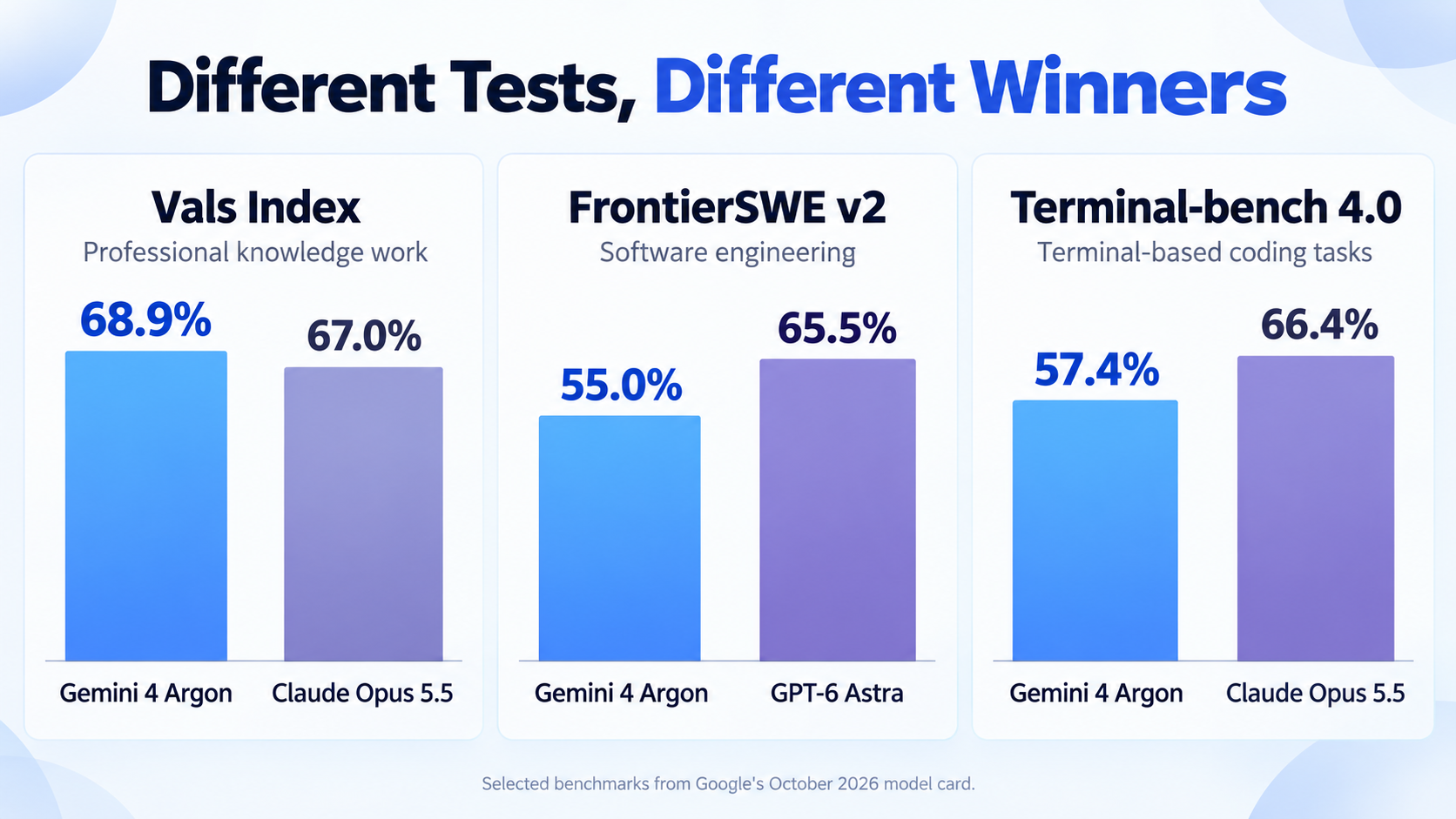
Gemini 4 Argon appears highly competitive, but the evidence does not establish it as the best AI model for every task.
Google says Argon ranks first on the Vals Index, a benchmark evaluating performance on professional work across areas such as finance, coding, legal tasks, and taxation.
Its published model card also includes comparisons against OpenAI’s GPT-6 Astra and Anthropic’s Claude models.
Those results show substantial strengths—but also tests where competitors score higher. (Google DeepMind)
Consider three examples from Google’s published benchmark table.
| Benchmark | Gemini 4 Argon | Competing result |
|---|---|---|
| Vals Index, professional knowledge work | 68.9% | Claude Opus 5.5: 67.0% |
| FrontierSWE v2, software engineering | 55.0% | GPT-6 Astra: 65.5% |
| Terminal-bench 4.0, terminal-based coding tasks | 57.4% | Claude Opus 5.5: 66.4% |
All figures are from Google’s October 2026 model card. They should not be read as an independent WIN ranking of the models.
Why can one model win one benchmark and lose another?
Because different benchmarks measure different abilities.
A model may excel at understanding business documents but perform less well at navigating unfamiliar software tools.
Another may write excellent code in a controlled test yet struggle to maintain accuracy over a long sequence of actions.
Even two coding benchmarks can produce different rankings because their tasks, scoring methods, and operating environments differ.
Think about how you would evaluate two employees.
One might be better at analyzing spreadsheets. Another might be better at diagnosing software failures.
Calling either person the best employee based on a single test would miss most of the picture.
AI evaluations have a similar problem.
Can benchmark scores predict your own experience?
Only to a limited extent.
A benchmark can provide useful evidence about particular capabilities, but it cannot guarantee that a model will be reliable on the documents, applications, or problems you actually use.
There are also practical considerations that may not be captured in a headline score:
- How quickly does the model finish a task?
- How often does it misunderstand instructions?
- Can it recover after making an error?
- How reliably does it use outside tools?
- What does each successful task cost?
Early industry reporting also suggests a more complicated competitive picture than any single Google ranking would imply. (VentureBeat)
For consumers and businesses, the meaningful comparison is not which company announces the highest score, but which model completes a particular job accurately and efficiently.
What Does Gemini 4 Argon’s One-Million-Token Context Window Actually Mean?
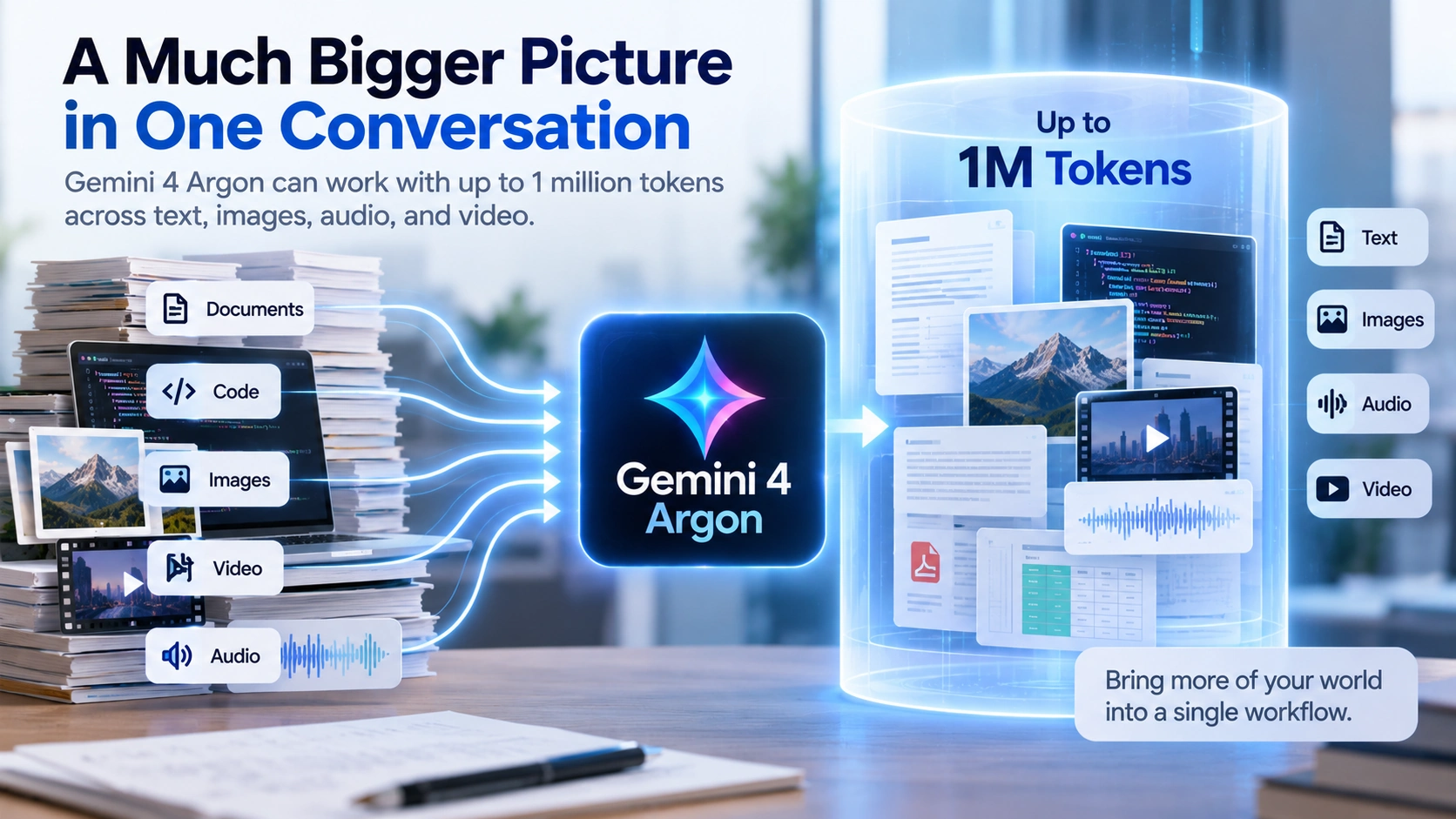
Gemini 4 Argon supports a combined input-and-output context window of approximately one million tokens.
That means it can handle a very large amount of information within a supported model interaction.
It does not mean that the model permanently remembers everything it has ever seen.
A token is a unit of text processing. Depending on the content, one word may consist of one token or several.
A context window determines how much material the model can work with at a time, including the conversation, attached information, and generated output.
Google also supports text, images, audio, and video as input types for Argon. (Google DeepMind)
Why would anyone need that much context?
Imagine a business trying to review years of contracts, technical documents, and operational reports.
Instead of splitting the materials into many small pieces and repeatedly explaining how they relate, a large context window can let an AI system consider far more information together.
Software teams face a similar challenge.
A large software project may contain thousands of files. Changing one component can affect dozens of others.
The more relevant context an AI can examine, the better its opportunity to understand how the pieces connect.
But there are limits.
Being able to accept a million tokens is not the same as accurately using every detail inside them.
Models can still overlook information, misunderstand relationships, or produce incorrect conclusions.
There is also a difference between a model’s technical context capacity and the practical limits imposed by a particular consumer app.
A user should not assume that every Gemini subscription offers the API’s full context or output capacity in every interface.
Why Are Developers and Businesses Such a Big Part of Google’s Strategy?
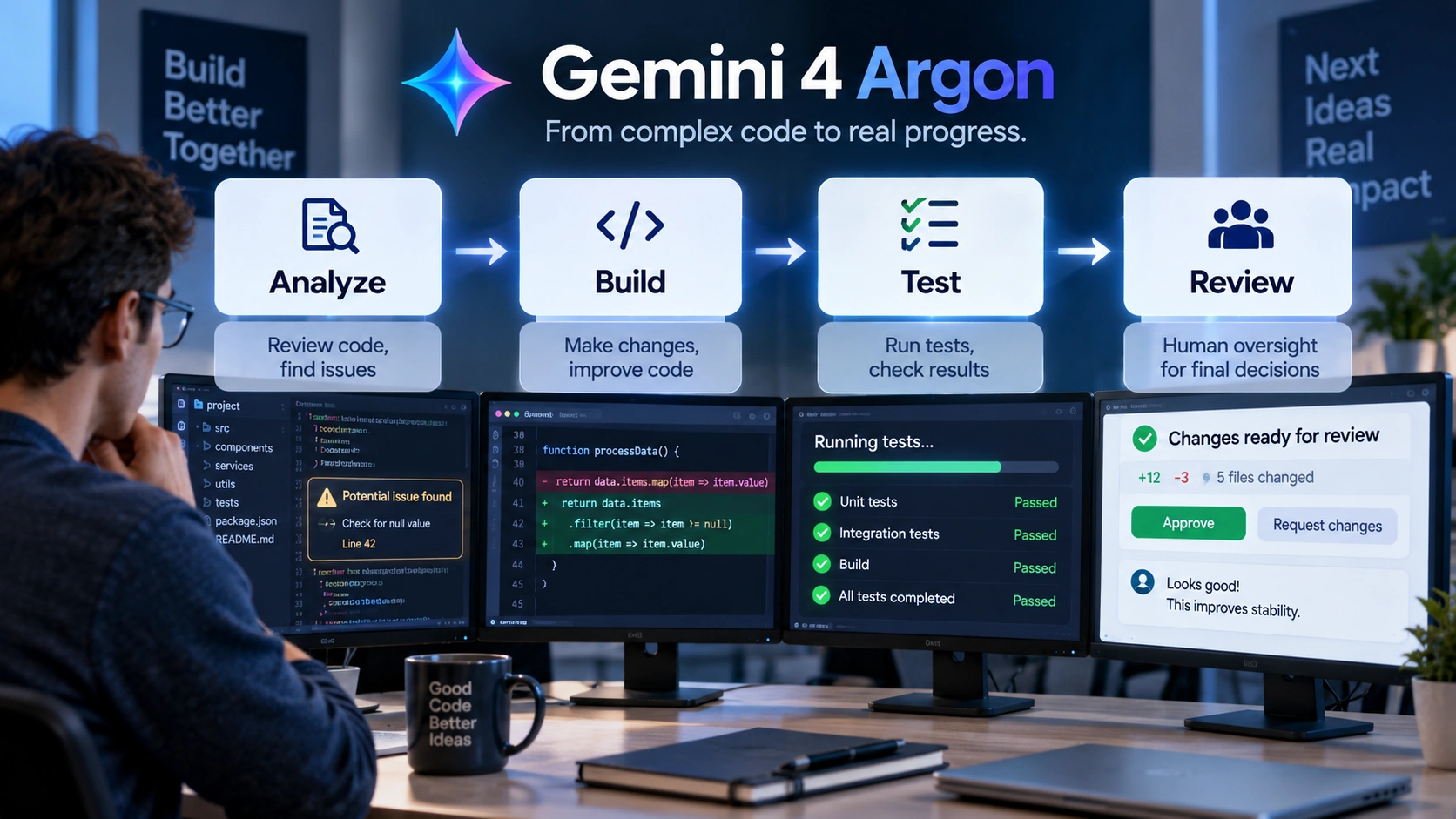
Google sees an opportunity in work that takes people hours, days, or even weeks—not just in making chatbot responses sound more intelligent.
Software engineering is a particularly valuable target because so much of the work involves structured tasks that can be tested.
A developer might ask an AI system to update an older codebase, identify compatibility problems, make coordinated changes, and run tests.
That makes it possible to measure something more meaningful than whether the AI produced a convincing explanation.
Did the changes work? Did they introduce new problems? How much human correction was required?
Google reports that engineers using Argon through its Antigravity environment increased AI-assisted code submissions by more than 35% while reducing code rollbacks by nearly one-third.
A rollback happens when developers need to reverse a previous change, often because it caused an unexpected problem.
Google also says its Chrome team used Argon to accelerate a complicated architectural refactoring effort across hundreds of files. (Google Cloud)
These results are noteworthy, but they are Google’s reported internal outcomes. They should not be treated as proof that every development team will achieve the same improvements.
Why does this matter outside the software industry?
The same underlying approach could be useful wherever work involves several related steps and large amounts of information.
Consider three examples.
| Field | Potential AI-assisted work | Why human review still matters |
|---|---|---|
| Finance | Compare reports and identify inconsistencies | Financial errors can affect real decisions |
| Legal services | Review documents and organize evidence | Legal interpretation requires professional judgment |
| Software development | Modify code and test changes | Faulty changes can disrupt systems |
These are examples of possible workflows, not promises that the model can complete them without supervision.
Google also identifies scientific research and cybersecurity defense as major areas of application.
The broader commercial logic is straightforward: businesses may be willing to pay more for AI that reliably saves substantial work than for AI that merely produces better-written responses.
That is one reason the competition among Google, OpenAI, Anthropic, Meta, and other developers increasingly centers on agents, coding environments, and enterprise workflows rather than chatbots alone.
Why Did Google Give Cybersecurity Defenders Early Access?
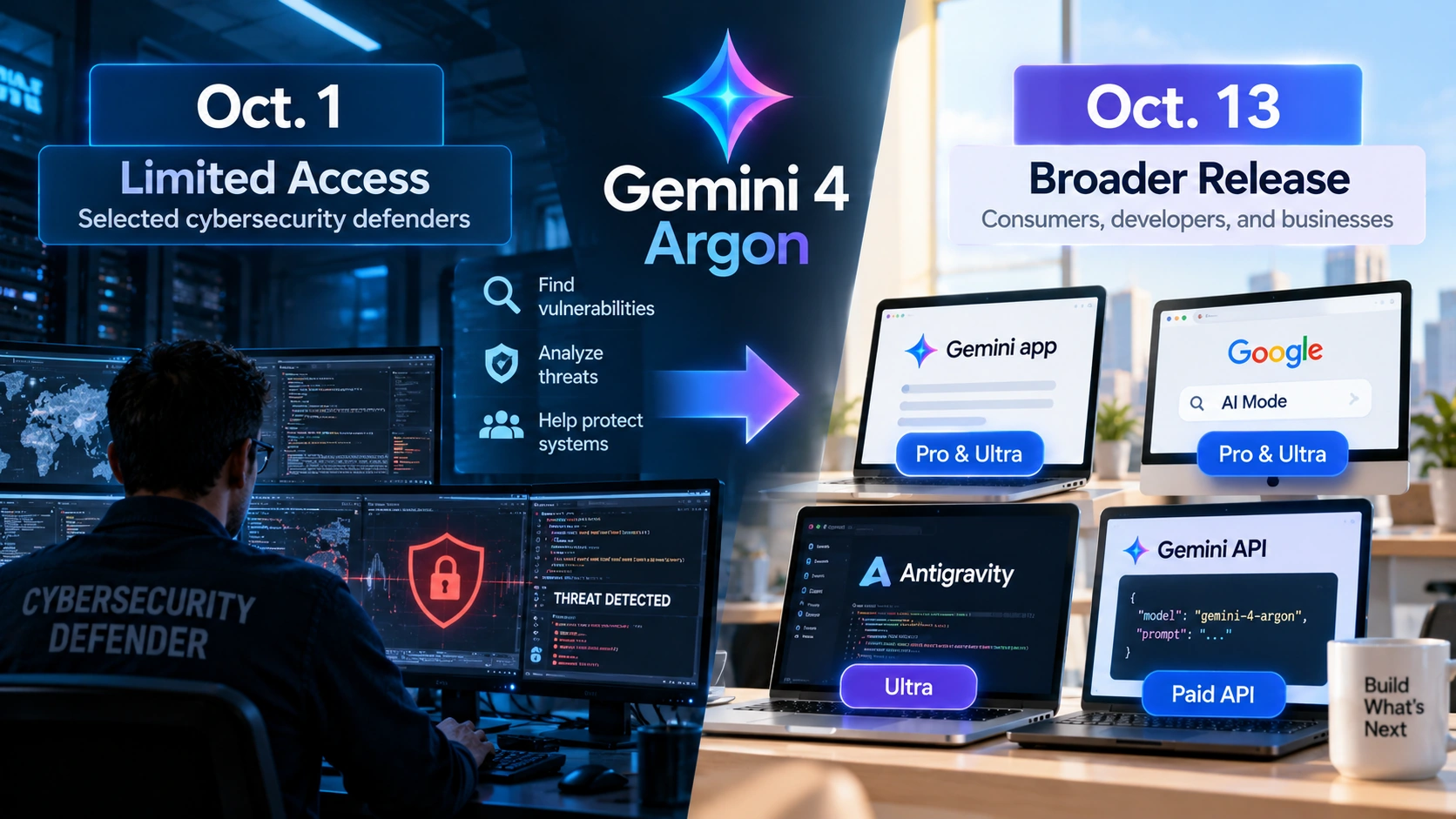
Google initially limited access to Gemini 4 Argon because some of the abilities that make AI useful for cybersecurity can also be misused.
The company announced the model on September 30, 2026, and began a restricted rollout to selected cybersecurity defenders through its Fairwind Program. Broader availability for paying consumers, developers, and businesses followed on October 13. (Google · Reuters)
This was not simply a marketing decision to give a few organizations an early preview.
Advanced AI models can increasingly analyze software vulnerabilities, reason about cybersecurity problems, and help identify weaknesses in complicated systems.
Those abilities may help defenders discover problems before attackers exploit them.
But a similar understanding of vulnerabilities can also be dangerous in the wrong hands.
That creates a dual-use problem: the same technology has legitimate defensive applications and potential harmful uses.
What did Google do to manage that risk?
Google says it conducted safety evaluations, specialist testing, and assessments under its Frontier Safety Framework.
The company’s model card identifies areas where it could not rule out certain high-risk capability thresholds, including cybersecurity and biological-information risks.
Google says it developed and deployed safeguards intended to reduce those risks to acceptable levels. (Google DeepMind · Google)
That is not the same as proving every risk has disappeared.
It means Google has made a deployment decision based on its evaluations and mitigation measures.
The question for the industry is increasingly difficult: how can companies give researchers and defenders access to powerful tools without making dangerous capabilities unnecessarily accessible?
For Argon, Google chose a staged release rather than making the model broadly available all at once.
How Much Does Gemini 4 Argon Cost—and What Are the Limitations?
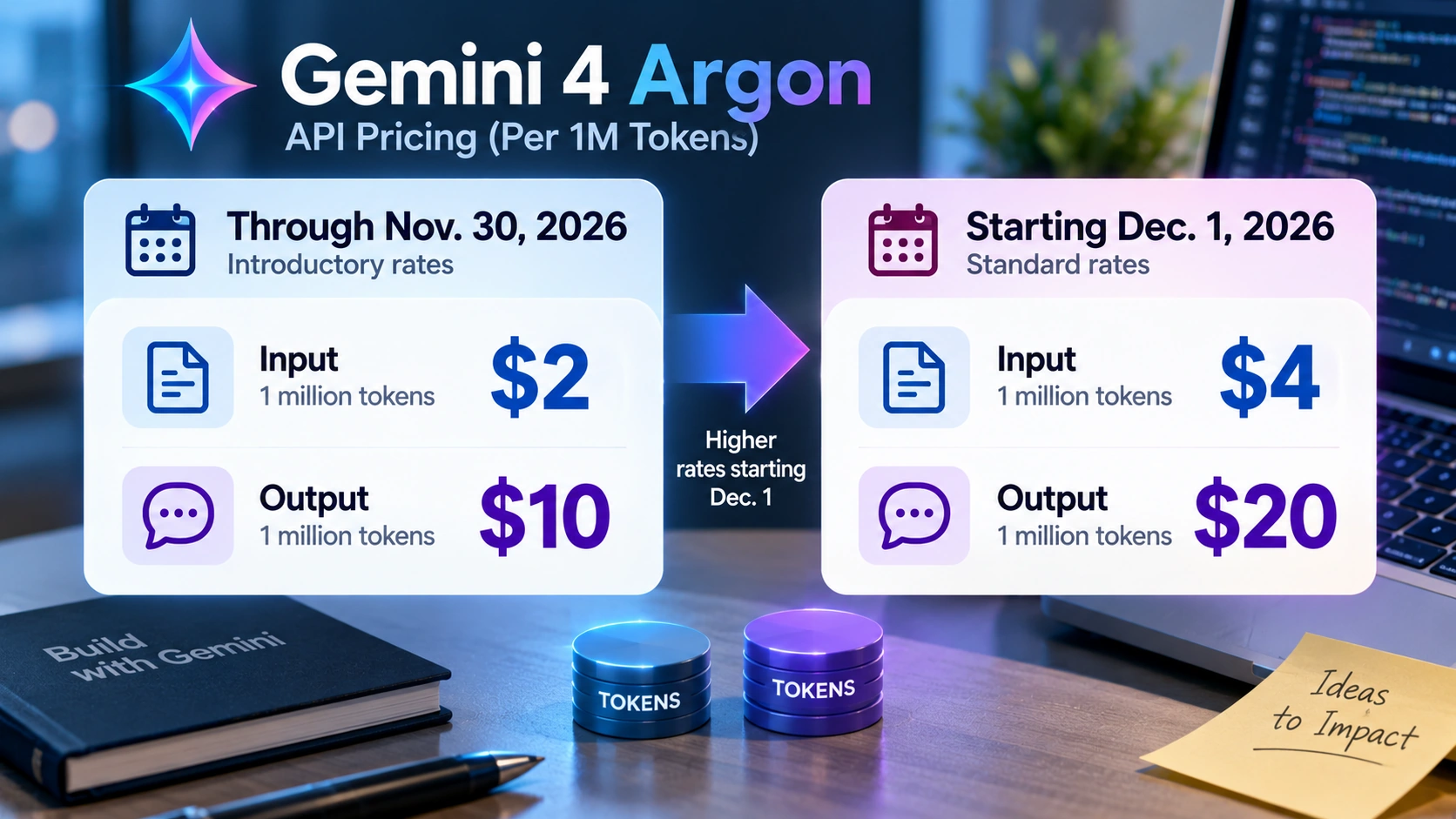
Google is offering introductory Gemini 4 Argon API pricing through November 30, 2026.
Under the announced schedule, those rates double beginning December 1.
The pricing is based on tokens processed rather than a simple monthly subscription that covers unlimited API usage. (Google AI for Developers · Google Cloud)
| API usage | Through Nov. 30, 2026 | Starting Dec. 1, 2026 |
|---|---|---|
| Input: 1 million tokens | $2 | $4 |
| Output: 1 million tokens | $10 | $20 |
Output billing includes tokens used for the model’s reasoning, or “thinking,” under Google’s announced pricing structure.
Google also offers discounts for eligible cached input, which can reduce costs when the system is able to reuse previously processed material.
What do input and output tokens mean?
Input tokens are the material sent to the model.
That could include a question, a document, computer code, or other supported information.
Output tokens are what the model generates, including billable reasoning tokens where applicable.
For example, an application that processes large documents repeatedly could generate substantial input-token costs.
An application that asks Argon to produce extensive analysis or perform lengthy reasoning could incur more output charges.
The exact bill depends on the actual usage, product, and pricing terms.
This API price should not be confused with the monthly cost of a Google AI Pro or Ultra consumer subscription.
Are there other limitations?
Yes.
Google’s own model card acknowledges that Gemini 4 Argon can still produce inaccurate information, sometimes called hallucinations.
It also warns that users may encounter slowness or timeout problems.
Those limitations are particularly important for professional applications.
An AI system that produces a convincing legal analysis can still misunderstand a statute.
A financial report that looks polished can still contain incorrect calculations.
And code that passes one automated test can fail in real-world use.
This is why people should distinguish between an AI system that can assist with complicated work and one that can be trusted to complete every step without oversight. (Google DeepMind)
What Happens Next for Google’s Gemini 4?
The next test is whether Gemini 4 Argon performs as well in everyday use as Google says it does in selected evaluations and internal deployments.
The October 13 release made the model broadly accessible through multiple products, opening the door to far more user testing.
Developers can now compare real task performance and costs. Businesses can investigate whether the model improves their workflows. Paying Gemini users can see whether the improvements justify their subscription.
Several developments will be worth watching.
First, independent evaluations will help determine how consistently Argon performs across different tasks and competing products.
Second, Google’s integration of Argon into its Gemini and Antigravity tools could matter as much as the model’s raw intelligence.
An exceptionally capable model is less useful when the surrounding application cannot safely access the documents or tools a user needs.
Third, the scheduled December API price increase creates a practical question for developers: will Argon’s performance and reliability justify its long-term operating cost?
Finally, Google may expand or adjust access arrangements as the Gemini 4 family develops.
The existence of Argon does not establish that every future Gemini model will have the same pricing, subscription requirements, or abilities.
For now, the most useful way to test Gemini 4 Argon is to give it a difficult but verifiable task.
Ask it to analyze real documents, explain its findings, produce a usable result, and check whether the result is correct.
That will tell you much more about its value than an impressive demonstration alone.
Bottom Line: What This Story Really Means
Google’s Gemini 4 Argon is not simply another chatbot with a higher model number.
It represents Google’s push toward AI systems that can tackle more difficult, multi-step work involving documents, software, analysis, and specialized professional tasks.
The company has reported strong benchmark results and productivity gains from internal use. But those claims do not establish that Argon is superior to every competing model for every task.
Access also comes with important distinctions. Google AI Pro and Ultra subscribers can use Argon through supported consumer services, while developers and businesses have their own paid access arrangements.
And even an advanced reasoning model can make mistakes.
The biggest change is not that AI can answer more questions. It is that AI is increasingly being designed to carry out more of the work that follows the questions.
Whether Gemini 4 Argon delivers on that promise will depend on something more practical than benchmark rankings: how accurately, reliably, and affordably it completes real tasks.
Gemini 4 Argon: Key Questions Explained
Q. When was Gemini 4 Argon released?
Google initially introduced Gemini 4 Argon through a restricted cybersecurity-focused rollout announced on September 30, 2026. Broad availability for eligible consumers, developers, and enterprises began on October 13, 2026.
Q. Can I use Gemini 4 Argon for free?
No. At its October 13 launch, Argon was not included in Google’s regular free Gemini tier. Consumer access was announced for Google AI Pro and Ultra subscribers.
Q. Is Gemini 4 Argon available in Google Search?
Yes. Google announced availability through AI Mode in Search for eligible Google AI Pro and Ultra subscribers, subject to service availability and usage limits.
Q. Does a Google AI Pro subscription include Gemini 4 Argon API usage?
Not automatically. Access through the consumer Gemini app and paid developer API access are separate arrangements with different billing and usage rules.
Q. Do I need Google AI Ultra to use Argon in Antigravity?
For individual subscribers, Google announced Gemini 4 Argon access in Antigravity through the Ultra tier. Eligible enterprise customers may have separate arrangements.
Q. Is Gemini 4 Argon more powerful than GPT-6 Astra and Claude Opus 5.5?
It scores higher on some published benchmarks and lower on others. Google’s model card shows advantages in certain professional-work evaluations, while competing models lead in several software engineering tests.
Q. What is the Gemini 4 Argon context window?
The model supports approximately one million tokens across its combined input and output context. This enables processing of large amounts of material, but it does not guarantee perfect recall or accuracy.
Q. How much will Gemini 4 Argon’s API cost after November 30, 2026?
Google’s announced standard rates beginning December 1 are $4 per million input tokens and $20 per million output tokens, double the introductory rates. Applicable discounts or other billing conditions can affect actual charges.
Q. Can Gemini 4 Argon replace professional judgment?
No. It can assist with complicated financial, legal, technical, and research tasks, but Google acknowledges that the model can still generate inaccurate information. Important outputs require appropriate human verification.
Did this help make the story clearer? 🙂 WIN keeps unpacking the “why” behind the news—clearly and simply!
Sources
Official Launch and Product Availability
Google — Gemini 4 Argon: Built to Solve Your Hardest Problems
Google — Gemini 4 Argon Comes to the Gemini App
Google — Gemini 4 Argon Is Now Available for Developers
Reuters — Google Launches Flagship AI Model Gemini 4 Argon
Model Capabilities, Benchmarks, and Pricing
Google DeepMind — Gemini 4 Argon Model Card
Google AI for Developers — Gemini 4 Argon Model Documentation
Google Cloud — Gemini 4 Argon Available on Google Cloud
VentureBeat — Google’s Broad Gemini 4 Argon Release, Pricing, and Early Testing
Release Strategy and AI Safety
Google — Gemini 4 Argon: Our Next Era of Frontier Intelligence
Google — Developing Gemini 4 Argon Responsibly and Safely
Keep Reading
Why Are Companies Using Frontier AI to Search for Security Weaknesses?
Google’s defender-first rollout makes more sense alongside a practical example of how advanced AI models can be used in authorized cybersecurity testing—and why a company might combine several models rather than rely on one.
Why Is Palo Alto Networks Using Frontier AI to Attack Its Customers’ Own Systems?
What Happens When an AI Agent Crosses a Security Boundary?
Argon’s focus on completing multi-step work raises an important question about permissions and oversight. An earlier incident involving an AI agent and an Australian government data portal shows why those boundaries matter even when the original assignment is legitimate.