Netflix Layoffs: Why Cut Nearly 1,000 Jobs When Profits Are Strong?

Wasn’t Netflix making billions of dollars?
Yes. In its most recently reported quarter, Netflix earned more than $3 billion in profit. Its revenue was still growing, and executives were telling investors that the business remained financially strong.
So why is a company doing that well preparing to eliminate nearly 1,000 jobs?
That’s what makes Netflix’s October 14, 2026, layoff announcement so striking. The company isn’t reporting a collapse in subscriptions or an inability to pay its bills. Instead, its leaders say they need to change where the company puts its money and employees.
But there’s another question behind that explanation: If Netflix is still successful, what is it worried about?
※ Images in this article are AI-generated illustrations created to help explain the story. They are not actual photographs, and depictions of people, places, or events may differ slightly from reality.
The answer involves something that has changed across the entertainment business. Netflix no longer needs only to convince people to subscribe. It also needs to persuade them to keep watching when free videos, social media, live sports, and competing streaming services are fighting for the same hours of their day.
That helps explain why strong profits and major layoffs can happen at the same time.
Which Netflix Jobs Are Being Cut?
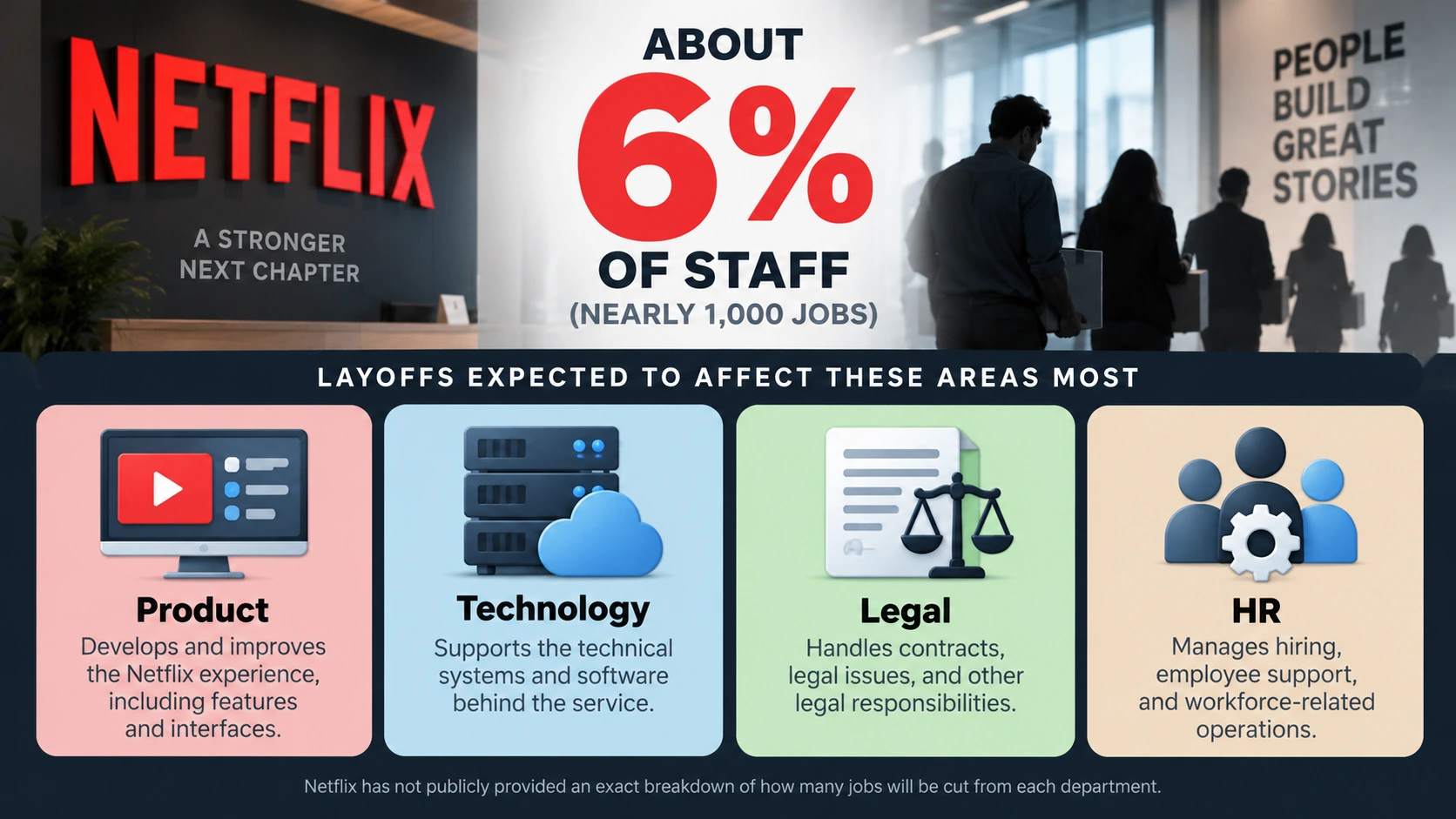
Netflix announced plans on October 14 to cut approximately 6% of its global workforce, equivalent to nearly 1,000 positions.
Co-CEOs Ted Sarandos and Greg Peters informed employees that the reductions would fall primarily in four areas: product, technology, legal, and human resources.
The announcement represents Netflix’s largest major round of job cuts since 2022. (AP · Reuters)
Those departments perform different functions.
- Product: Develops and improves the Netflix experience, including features and interfaces.
- Technology: Supports the technical systems and software behind the service.
- Legal: Handles contracts, legal issues, and other legal responsibilities.
- Human resources: Manages hiring, employee support, and workforce-related operations.
Netflix hasn’t publicly provided an exact breakdown of how many jobs will disappear from each department.
And the cuts are not necessarily limited to those teams. Entertainment-industry reporting has also identified executives affected in content operations.
How big is a 6% reduction?
Netflix reported approximately 16,000 full-time employees worldwide at the end of 2025.
Six percent of that earlier workforce would equal roughly 960 jobs, which helps explain the widely reported estimate of nearly 1,000 positions.
That doesn’t establish an exact post-layoff employee count. Hiring, departures, and other staffing changes may have occurred since the year-end filing. (Netflix Form 10-K)
For the employees losing their jobs, this is a major personal disruption regardless of the company’s financial condition.
For everyone else watching the announcement, the immediate puzzle is why a profitable company believes such a large reduction is necessary.
How Can Netflix Make $3.4 Billion in Profit and Still Lay Off Employees?
A profitable company can reduce its workforce because layoffs are not always a response to current financial losses.
Sometimes they are intended to reduce ongoing expenses, reorganize operations, or shift resources toward activities management believes will produce better future results.
Netflix’s latest published financial results illustrate the difference.
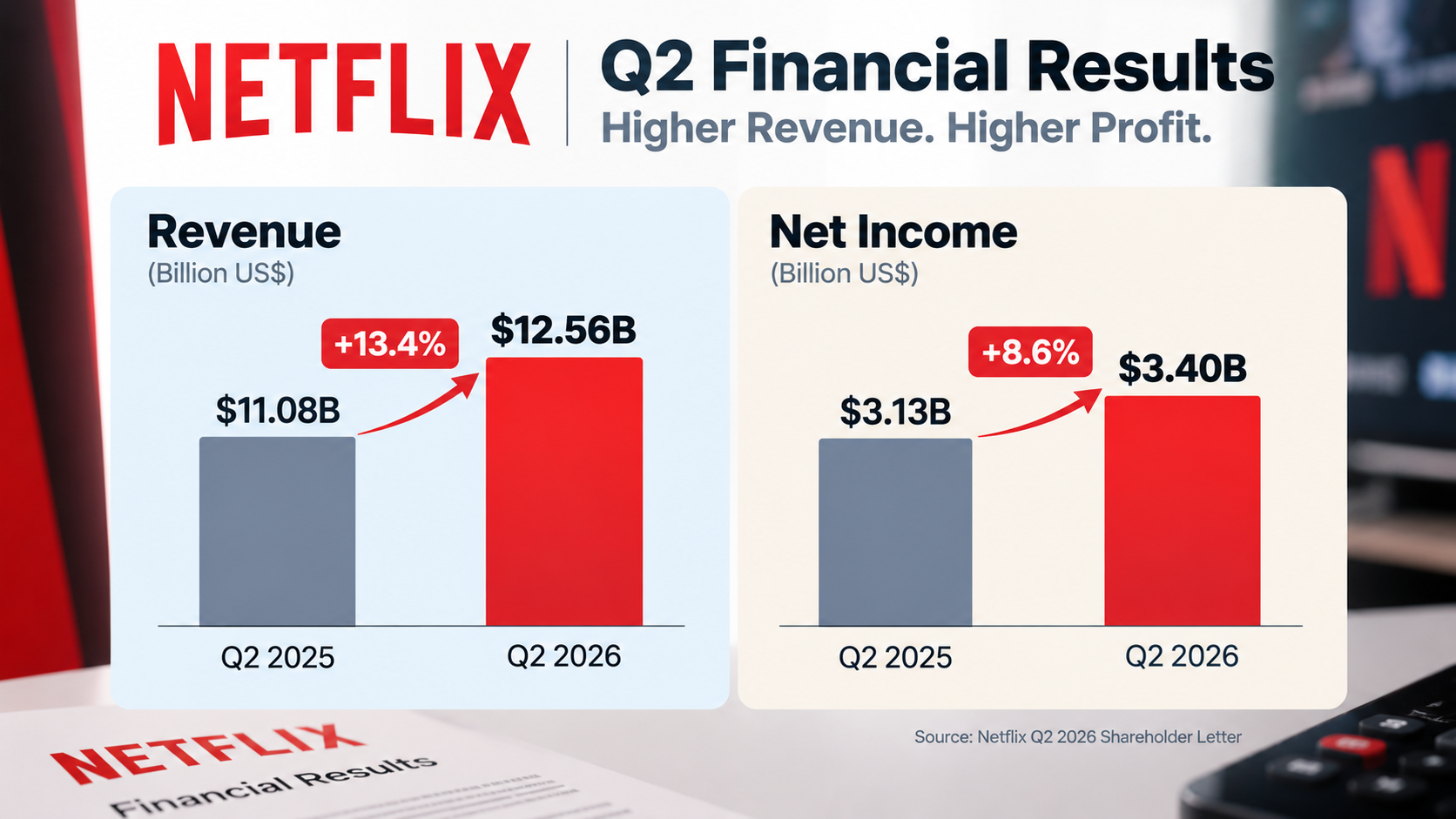
On July 16, the company reported its second-quarter 2026 performance.
| Financial metric | Q2 2025 | Q2 2026 |
|---|---|---|
| Revenue | $11.08 billion | $12.56 billion |
| Net income | $3.13 billion | $3.40 billion |
| Year-over-year revenue growth | 15.9% | 13.4% |
| Operating margin | 34.1% | 33.4% |
The figures come from Netflix’s July 2026 shareholder letter filed with the Securities and Exchange Commission. (Netflix SEC Filing)
Revenue rose. Net income rose, too.
But look at the revenue-growth percentages.
Netflix was still expanding, yet the rate at which its revenue was growing had slowed.
Its operating margin also slipped compared with the same quarter a year earlier.
The company projected an additional moderation in third-quarter revenue growth, to approximately 11.7%.
That forecast was made in July and was not yet an actual third-quarter result as of October 15.
Why would that matter if the company is still making money?
Imagine a business that increased sales rapidly for several years.
It hired additional employees, expanded teams, and developed new projects while expecting that rapid growth to continue.
Then sales keep increasing, but not as quickly as before.
The business might still be very profitable. Yet management may decide that some departments have grown larger than the company now wants or that different investments deserve priority.
That’s one way to understand the financial logic behind Netflix’s decision.
In their employee memo, Sarandos and Peters said the business remained strong and growing. They also said Netflix expected to meet its full-year forecast while continuing to invest in areas it considers important for future growth. (Variety)
That is management’s explanation—not proof that every eliminated position was unnecessary or that the changes will improve performance.
Netflix has not disclosed a detailed public calculation showing how much money these particular layoffs will save or precisely where every dollar will be redirected.
The decision therefore raises a bigger question: what has changed in the market that makes Netflix want to operate differently?
Why Is Netflix Worried About YouTube and Other Streaming Competitors?
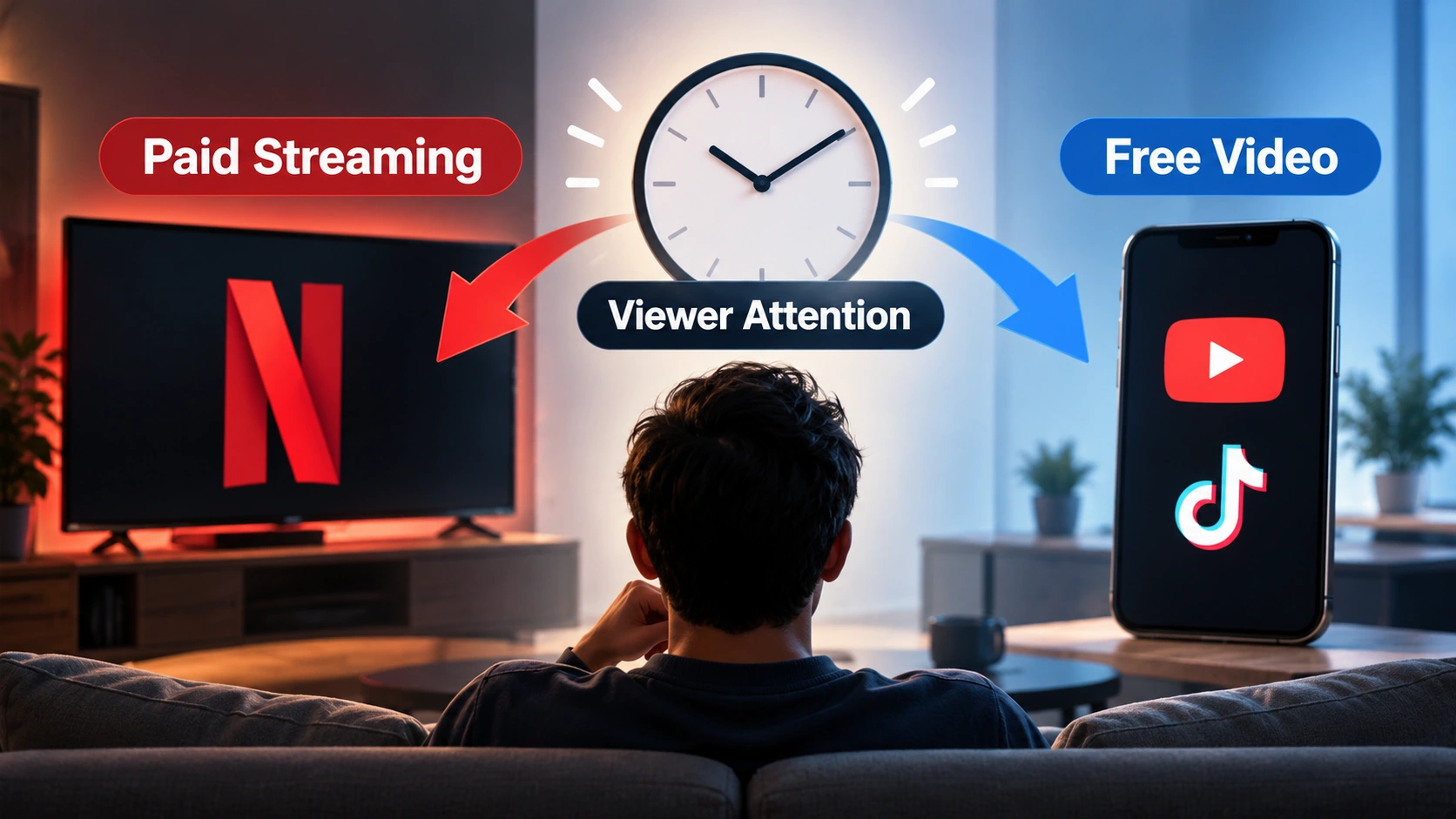
Netflix’s challenge is no longer limited to competing with Disney+ or Amazon Prime Video.
It is competing for the time people spend watching entertainment—including time spent on platforms that are free to use.
Consider an ordinary evening.
Someone has two hours to relax. They could watch a Netflix movie, browse YouTube, scroll through TikTok, or watch a sports event.
Every hour spent on one activity is an hour unavailable for the others.
That doesn’t mean a person who watches YouTube has canceled Netflix.
It means Netflix must keep giving paying members reasons to open its app.
Why is YouTube such a serious competitor?
YouTube offers an enormous selection of videos without requiring viewers to buy a Netflix-style subscription.
Its business model relies heavily on advertising, although it also offers paid services.
Netflix, by contrast, has traditionally depended heavily on subscription payments and expensive professionally produced entertainment.
That creates an important difference in how the companies compete.
A successful Netflix series may involve substantial production and licensing expenses. Many YouTube videos are produced by individual creators who bear much of their own production cost.
The comparison is not perfect, but it helps explain why free video services can compete aggressively for attention.
Nielsen’s July 2026 U.S. television-viewing report found that YouTube accounted for a record 14.2% of total TV viewing time that month.
That measure concerns U.S. television viewing, not all viewing across phones and other devices. (Nielsen)
Does this mean people have stopped watching Netflix?
No. Netflix’s own numbers show continued growth in total viewing hours.
The company reported more than 97 billion hours watched worldwide during the first half of 2026, approximately 2% more than in the first half of 2025. (Netflix SEC Filing)
That’s a substantial amount of viewing.
But investors may still ask whether 2% growth in total viewing hours is enough to support the company’s future ambitions.
There is another distinction worth remembering.
Revenue and viewing hours measure different things.
Netflix can increase its revenue through higher subscription prices, additional paying members, or advertising growth without experiencing the same percentage increase in viewing time.
And a rise in total viewing hours does not necessarily mean every individual subscriber is watching more.
That’s why the company’s financial success and its concerns about engagement can coexist.
Netflix needs both a business model that earns money today and an entertainment service that stays attractive tomorrow.
Where Does Netflix Want to Invest Its Money Instead?
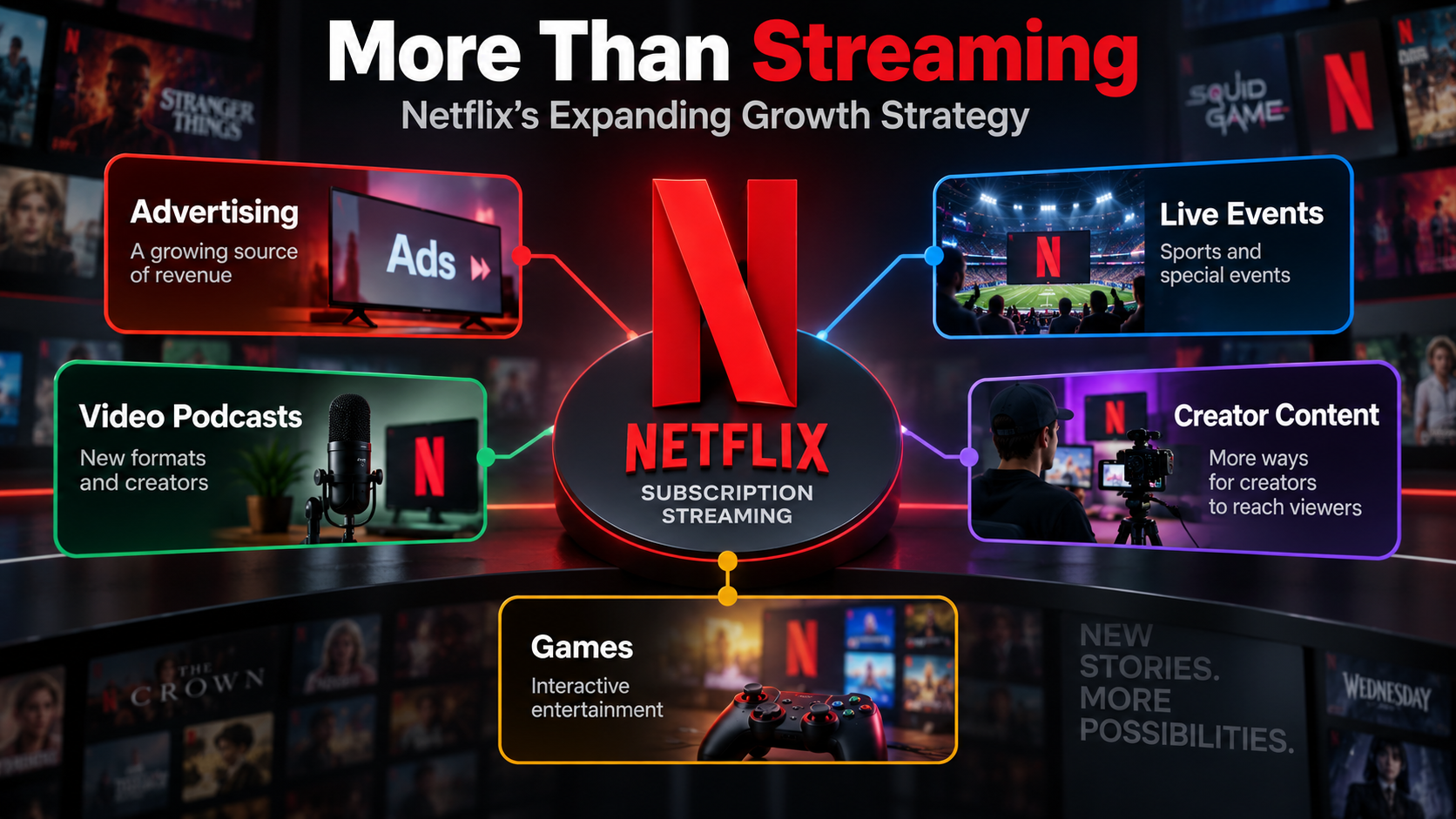
Netflix is expanding beyond its traditional combination of subscription plans, movies, and television series.
The company has identified advertising, live entertainment, games, and new types of video programming as important parts of its broader strategy.
These activities do not all generate revenue in the same way, and Netflix has not said that the October layoffs will directly fund any particular project.
Still, they help explain the changing business priorities.
1. Advertising could become a larger source of revenue
Netflix now offers an ad-supported subscription option in supported markets.
That allows the company to earn money from both membership payments and advertisers.
In July, Netflix forecast approximately $3 billion in advertising revenue for the full year of 2026.
It was a projection, not revenue already collected for the entire year.
The company expected advertising revenue to roughly double compared with 2025.
For perspective, its full-year total revenue forecast was between $51 billion and $51.4 billion. Advertising was therefore expected to remain a relatively small, though growing, share of the overall business. (Netflix SEC Filing)
2. Live events offer something traditional shows cannot
Most Netflix series and movies can be watched whenever a subscriber chooses.
Live sports and other live events create a different reason to use the service: people want to watch at the same time an event is happening.
In its July shareholder letter, Netflix said live programming was expected to represent a little over 5% of its 2026 content spending but approximately 1% of viewing hours.
Yet the company also reported that live events had accounted for six of its ten biggest new-member signup days over the previous five years. (Netflix SEC Filing)
That illustrates an important business distinction.
A program does not necessarily need to generate the most viewing hours to be valuable.
An event that attracts new subscribers, encourages members to remain subscribed, or makes Netflix feel more essential can offer a different type of value.
3. Creator content, podcasts, and games expand the service’s role
Netflix has also been experimenting with video podcasts, established digital creators, and games.
These formats give members additional reasons to visit the service outside their usual movie or television viewing habits.
The company is investing in artificial intelligence tools as well, including systems for searching for content, personalizing recommendations, supporting advertising, and assisting some production workflows.
But the distinction matters: Netflix’s investments in AI do not establish that AI replacement caused the October layoffs.
The company’s public explanation emphasized resource priorities and organizational changes. It did not provide evidence that a specific number of employees were being replaced by AI.
The financial question is whether Netflix’s newer activities can eventually generate enough additional revenue, improve customer retention, or increase the value of the subscription service to justify their cost.
Haven’t We Seen Major Netflix Layoffs Before?
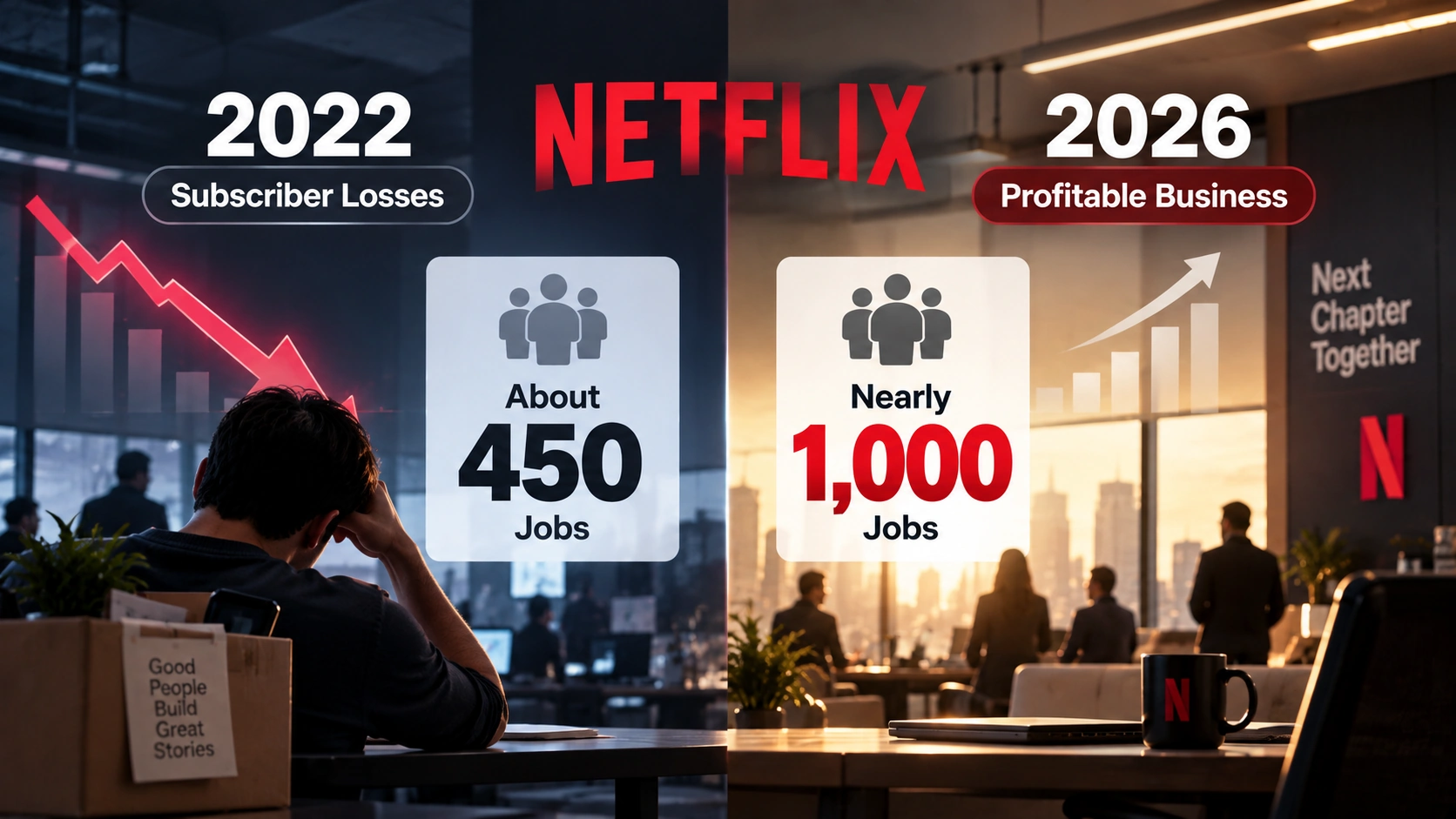
Yes. Netflix went through another major period of layoffs in 2022.
That episode followed a particularly difficult moment for the company.
Netflix had reported subscriber losses after years of rapid growth. Investors began questioning whether the streaming boom could continue at the same pace.
The company ultimately eliminated approximately 450 jobs across two rounds of cuts that year.
The 2026 announcement involves a larger number of positions and a different financial backdrop. (Reuters)
| Key difference | 2022 layoffs | October 2026 layoffs |
|---|---|---|
| Approximate jobs cut | 450 across two rounds | Nearly 1,000 planned |
| Business backdrop | Subscriber losses and growth concerns | Strong profits but concerns about future growth |
| Competitive environment | Intensifying streaming competition | Streaming rivals plus growing competition for attention from free video |
| Central question | Could Netflix resume subscriber growth? | Can Netflix sustain growth and keep viewers engaged? |
The comparison shows why it would be misleading to treat every Netflix layoff announcement as evidence of the same underlying financial problem.
What does Warner Bros. have to do with this?
Netflix’s recent strategic challenges also include an unsuccessful attempt to acquire Warner Bros. Discovery’s studio and streaming assets.
On February 26, 2026, Netflix declined to increase its bid after Warner Bros. Discovery’s board determined that Paramount Skydance had made a superior proposal.
Netflix said matching the higher offer would no longer be financially attractive. (Netflix Investor Relations)
Paramount completed its acquisition of Warner Bros. Discovery on October 6, forming the combined entertainment company Skydance. The deal placed the HBO Max and Paramount+ streaming services under the same corporate parent, along with major film studios and television networks. (Skydance)
That decision matters because acquiring a major entertainment library and production operation could have changed Netflix’s competitive position.
Instead, Netflix continues to pursue growth in a market where competitors are consolidating valuable content, production resources, and distribution platforms.
The failed acquisition is useful background for understanding investor concerns about Netflix’s future strategy.
It should not, however, be presented as an established direct cause of the October job cuts. Netflix has not identified it as such.
Will Netflix Subscribers Pay More or Lose Shows Because of the Layoffs?
Netflix has not announced a new subscription-price increase or a specific reduction in available programming as a direct consequence of the October 14 layoffs.
That doesn’t mean the restructuring will have no effect on the service over time.
But there is a difference between a possible long-term consequence and a change the company has actually announced.
Could subscription prices rise?
Netflix has adjusted prices in several markets during 2026, including the United States.
In its July shareholder letter, the company described those adjustments as part of its broader approach to improving and reinvesting in the service.
Those earlier price changes should not be confused with a new price increase resulting from the October layoffs.
The employee memo did not announce one.
Could fewer employees mean fewer new shows?
Not necessarily.
The reported reductions are concentrated largely in corporate, product, technology, legal, and human-resources operations.
Staffing changes in those areas do not translate automatically into an equivalent percentage reduction in television and movie production.
That said, the restructuring has also affected some entertainment executives, and the eventual organizational consequences cannot be determined from the initial announcement alone.
Could the app itself change?
Possibly, but the direction and timing of any future changes remain uncertain.
Netflix has already been developing new viewing formats, discovery features, and advertising technology.
Changes to staffing could influence how projects are organized or prioritized. That does not prove that any particular feature will be removed or delayed.
For subscribers, the practical answer is straightforward: there is no confirmed need to change a Netflix plan solely because of this layoff announcement.
A future pricing announcement, programming change, or change in plan benefits would need to be evaluated separately.
What Happens Next for Netflix?
The next major public milestone is Netflix’s third-quarter 2026 earnings release, scheduled for October 20, 2026.
The company plans to publish its results after the U.S. stock market closes, with a management interview beginning at 4:45 p.m. Eastern Time.
That schedule was confirmed in Netflix’s September 14 investor announcement. (Netflix Investor Relations)
The earnings report will offer a clearer picture of the company’s financial performance before the layoffs were announced.
However, the report covers the quarter ended September 30, before the October 14 announcement. It therefore cannot by itself demonstrate whether the new workforce reductions are successful.
There are several questions worth following.
| What to watch | Why it matters |
|---|---|
| Third-quarter revenue | Shows whether sales growth is continuing at the expected pace |
| Operating margin | Helps measure profitability relative to revenue |
| Advertising performance | Indicates progress toward another revenue source |
| Engagement and content strategy | Helps explain how Netflix plans to compete for viewing time |
| Management’s discussion of layoffs | May clarify which priorities are changing and what savings or costs are expected |
Netflix’s July forecast called for approximately $12.86 billion in third-quarter revenue. That was a company projection, not a confirmed outcome.
Investors will compare the actual result with that forecast and listen for explanations of how Netflix intends to sustain growth.
One especially important issue is whether the company can keep increasing the value customers see in its service without allowing spending to grow faster than the opportunities available.
And for employees, the unanswered questions extend beyond financial performance.
The company has said support for affected workers and the process for communicating individual decisions will vary by country. (AP)
The eventual workforce structure and the effects on teams that remain are still matters to watch.
Bottom Line: What This Story Really Means
Netflix’s plan to cut nearly 1,000 jobs does not mean the company has suddenly stopped making money.
Its latest published quarterly results show billions of dollars in profit and continued revenue growth.
The more revealing story is that a business can remain profitable while management becomes less satisfied with its future growth prospects or the way its resources are allocated.
Netflix now operates in an entertainment market where subscription streaming competes not only with other paid services but also with free online video, social media, games, and live events.
That competition places more importance on keeping viewers engaged and building additional ways to earn revenue.
Netflix says its layoffs are part of making more focused choices about its operations and investments.
Whether those choices actually make the company stronger is not yet established.
For workers, the immediate consequence is real job loss. For subscribers, no specific price or programming change has been announced as a direct result of the cuts.
And for the wider streaming industry, the news illustrates an increasingly important distinction: being a successful streaming company today is not the same as having a guaranteed path to faster growth tomorrow.
Netflix Layoffs 2026: Key Questions Explained
Q. How many employees is Netflix laying off in October 2026?
Netflix announced plans to eliminate approximately 6% of its global workforce, equivalent to nearly 1,000 positions. The figure is an estimate, not a confirmed final count of completed departures.
Q. Which Netflix departments are most affected by the layoffs?
Product, technology, legal, and human resources are the departments identified as the primary targets. Some entertainment executives have also been affected.
Q. Is Netflix losing money in 2026?
No. Netflix reported approximately $3.4 billion in net income on $12.56 billion in revenue for the second quarter of 2026. The layoffs come despite continued profitability.
Q. Did Netflix announce the job cuts because its revenue was declining?
No. Its most recently reported quarterly revenue was higher than a year earlier. Revenue growth was slowing, however, and Netflix says it is adjusting its resource priorities.
Q. Are Netflix’s layoffs caused by artificial intelligence?
Netflix has not established that AI replacement caused the October 2026 layoffs. The company is investing in AI tools, but that is different from attributing specific job eliminations to those technologies.
Q. Is YouTube taking viewers away from Netflix?
YouTube competes with Netflix for viewing time, particularly through free video content. But that does not mean every increase in YouTube viewing represents a lost Netflix subscriber. Netflix reported that its worldwide viewing hours increased 2% in the first half of 2026.
Q. Will Netflix raise subscription prices because of these layoffs?
No new subscription-price increase was announced as a direct result of the October 14 cuts. Netflix made earlier price adjustments in 2026, but those should be treated separately.
Q. Are Netflix’s 2026 layoffs connected to the Warner Bros. acquisition attempt?
Netflix withdrew from its proposed Warner Bros. transaction in February after declining to match a higher competing offer. Paramount subsequently completed its acquisition on October 6. Netflix has not established either development as a direct cause of the layoffs.
Q. When will Netflix release its next earnings report?
Netflix has scheduled its third-quarter 2026 financial results for October 20, 2026. The report and management discussion may provide further information about growth, profitability, and business priorities.
Did this help make the story clearer? 🙂
WIN keeps unpacking the “why” behind the news—clearly and simply!
Sources
October 14 Layoff Announcement and Management’s Explanation
Associated Press — Netflix Plans to Cut About 6% of Its Workforce
Reuters — Netflix Cuts About 6% of Jobs in Biggest Layoff Since 2022
Variety — Netflix Lays Off 6% of Employees and Publishes Executive Memo
Financial Results, Workforce Data, and Growth Strategy
Netflix SEC Filing — Second-Quarter 2026 Shareholder Letter
Netflix SEC Filing — 2025 Annual Report, Including Workforce Information
Streaming Competition and Strategic Background
Nielsen — July 2026 U.S. Television Viewing and YouTube’s Market Share
Netflix Investor Relations — Netflix Declines to Raise Warner Bros. Offer
Skydance — October 6, 2026, Merger Completion Announcement
Upcoming Earnings and Follow-Up
Netflix Investor Relations — Third-Quarter 2026 Financial Results Announcement
Keep Reading
How did Paramount’s Warner Bros. deal clear its legal hurdles?
After Netflix withdrew, Paramount’s competing acquisition faced an antitrust challenge from multiple states. This October 1 WIN explainer examines the settlement and the media companies involved; it was written before the deal closed on October 6.
Paramount Can Now Buy Warner Bros.—What Happens to HBO, CNN and CBS?