Hilary Swank Is Expecting Baby No. 3 at 52—What Makes This Pregnancy So Unusual?

Another baby? At 52?
For anyone who remembers Hilary Swank announcing that she was expecting twins just a few years ago, the latest news might seem almost impossible to believe.
The two-time Oscar-winning actress is preparing to welcome another child with her husband, Philip Schneider. And unlike her first pregnancy announcement, which revealed that she was expecting two babies, this one arrived with a playful family video and a surprising message.
But the most interesting part of this story isn’t simply that a Hollywood star is having another baby.
It’s her age—and what we actually know about her journey to motherhood.
Pregnancy in the early 50s is uncommon. Medical advances have made more reproductive options available, but that doesn’t mean pregnancy at 52 is medically straightforward or that everyone reaches parenthood through the same process.
There is also a detail from Swank’s past that makes this story especially interesting: she previously revealed that she froze her eggs at age 37.
Does that explain her latest pregnancy?
Not necessarily. And understanding why is where the story becomes much more revealing.

※ Images in this article are AI-generated illustrations created to help explain the story. They are not actual photographs, and depictions of people, places, or events may differ slightly from reality.
The announcement itself is confirmed. But Swank has not publicly explained the specific medical circumstances behind this pregnancy.
That distinction matters because a celebrity’s personal experience and the medical possibilities available to other women are two very different things.
What Did Hilary Swank Actually Reveal in Her Pregnancy Announcement?

On October 14, 2026, Swank announced that she was expecting her third child through an Instagram video featuring her husband and their three-year-old twins, Aya and Ohm.
Instead of a traditional pregnancy photograph, the family danced in the dark with glowing sticks attached to their clothing, creating illuminated stick-figure outlines.
As Swank turned, another tiny glowing figure appeared over her growing belly.
Her caption treated the pregnancy like an upcoming entertainment release:
“A lot of people have been asking what project I’m doing next, this one releases in December.”
The playful wording appeared to point to a December arrival, although it did not specify an exact due date. (ABC News · People)
For longtime fans, the announcement also brought back memories of her first pregnancy.
Swank and Schneider married in 2018. In October 2022, she revealed on Good Morning America that she was expecting twins.
She gave birth to a daughter and son in April 2023, when she was 48.
Now, three and a half years later, the family is preparing to expand again.
The new announcement confirms a pregnancy. It does not establish how that pregnancy began.
And at 52, that is an important difference.
Why Is Pregnancy at Age 52 So Unusual?
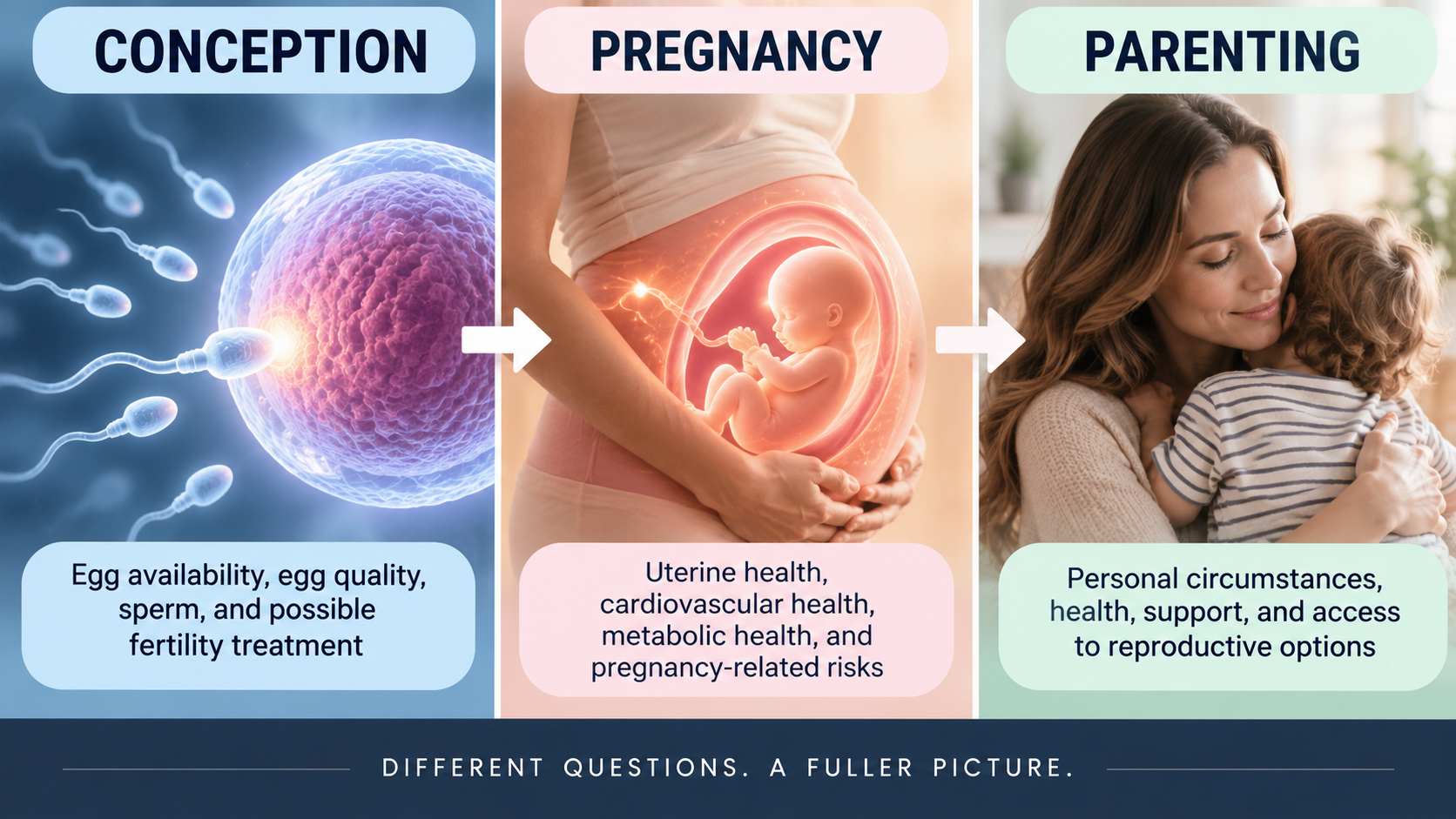
Pregnancy at 52 is unusual primarily because female fertility declines with age, especially after 40. Yet the biological ability to conceive and the physical ability to carry a pregnancy are not exactly the same.
That distinction is essential when discussing pregnancies in the 50s.
A woman’s eggs change in both number and quality as she ages. By the late 40s and early 50s, spontaneous conception becomes uncommon, and many women are approaching or have reached menopause.
But reproductive medicine can create additional possibilities.
For example, previously frozen eggs or embryos, or donated eggs, may make pregnancy possible later in life. The American Society for Reproductive Medicine (ASRM) recognizes egg and embryo donation as established options for treating age-related infertility. (ASRM)
It helps to separate three questions:
| Question | What matters |
|---|---|
| Can conception occur? | Egg availability, egg quality, sperm, and possible fertility treatment |
| Can a pregnancy be carried? | Uterine health, cardiovascular health, metabolic health, and pregnancy-related risks |
| Can someone become a parent later in life? | Personal circumstances, health, support, and access to reproductive options |
The first two questions are related, but they are not interchangeable.
A person may have difficulty conceiving with their own eggs at an older age while still being medically able to carry an embryo created through assisted reproduction.
That possibility does not eliminate the increased risks associated with carrying a pregnancy later in life.
And there is no universal age at which every woman suddenly becomes unable to conceive or carry a pregnancy.
This is why a pregnancy at 52 can be medically possible while still being relatively uncommon.
What Has Hilary Swank Said About Freezing Her Eggs?
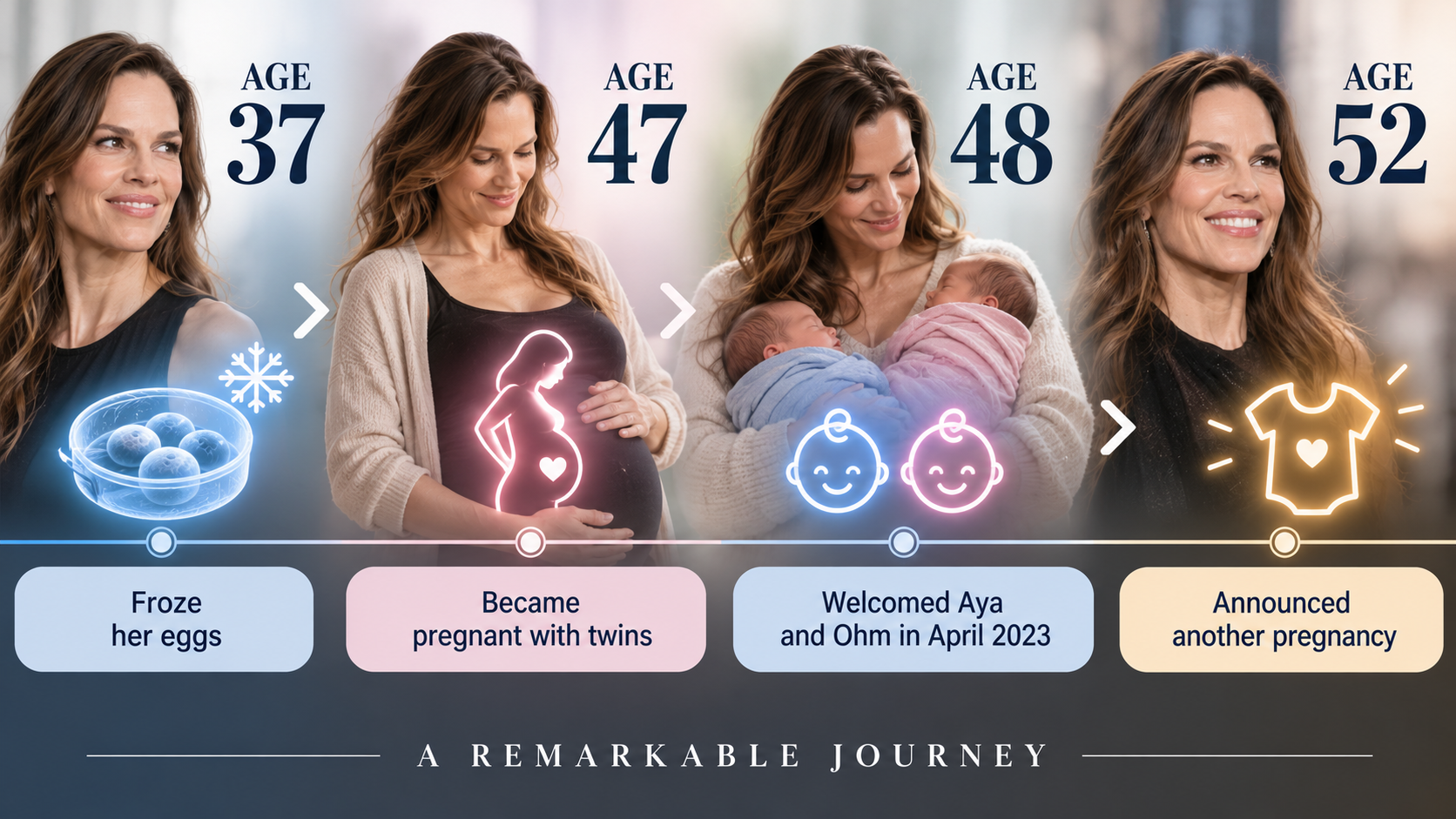
One of the most revealing pieces of Swank’s story actually came before her latest announcement.
In an April 2025 interview with Women’s Health, the actress said she had frozen her eggs when she was 37.
She became pregnant with her twins at 47 and gave birth at 48.
Swank described egg freezing as an important decision that gave her more flexibility while considering motherhood. But she also acknowledged that storing eggs does not guarantee a future pregnancy. (Women’s Health)
Her publicly known milestones can be organized this way:
| Age | Milestone | What it establishes |
|---|---|---|
| 37 | Froze her eggs | She took steps to preserve future reproductive options |
| 47 | Became pregnant with twins | Her first publicly announced pregnancy |
| 48 | Welcomed Aya and Ohm in April 2023 | She became a mother of two |
| 52 | Announced another pregnancy on October 14, 2026 | She is expecting her third child |
The crucial point is that the timeline does not reveal whether Swank used frozen eggs for either pregnancy.
Egg freezing preserves eggs collected at an earlier age. That can matter because reproductive outcomes are strongly influenced by egg age and quality, rather than simply the age of the person carrying the pregnancy.
But not every frozen egg survives thawing, fertilizes successfully, develops into a transferable embryo, or leads to a live birth.
Freezing eggs may preserve an opportunity. It does not preserve a guaranteed outcome. (ReproductiveFacts.org)
Swank’s comments also reveal something about her life choices.
She has said she would have welcomed children earlier under different circumstances and did not deliberately set out to wait until her late 40s.
In the 2025 interview, she described feeling more patient and emotionally prepared as a parent than she believed she would have been earlier in adulthood.
Her established career, she explained, also gave her more flexibility to spend time with her children.
That personal history helps explain why she has spoken positively about later motherhood.
It does not tell us which medical methods were involved.
Did Swank Use IVF, Frozen Eggs, or Donor Eggs for This Pregnancy?
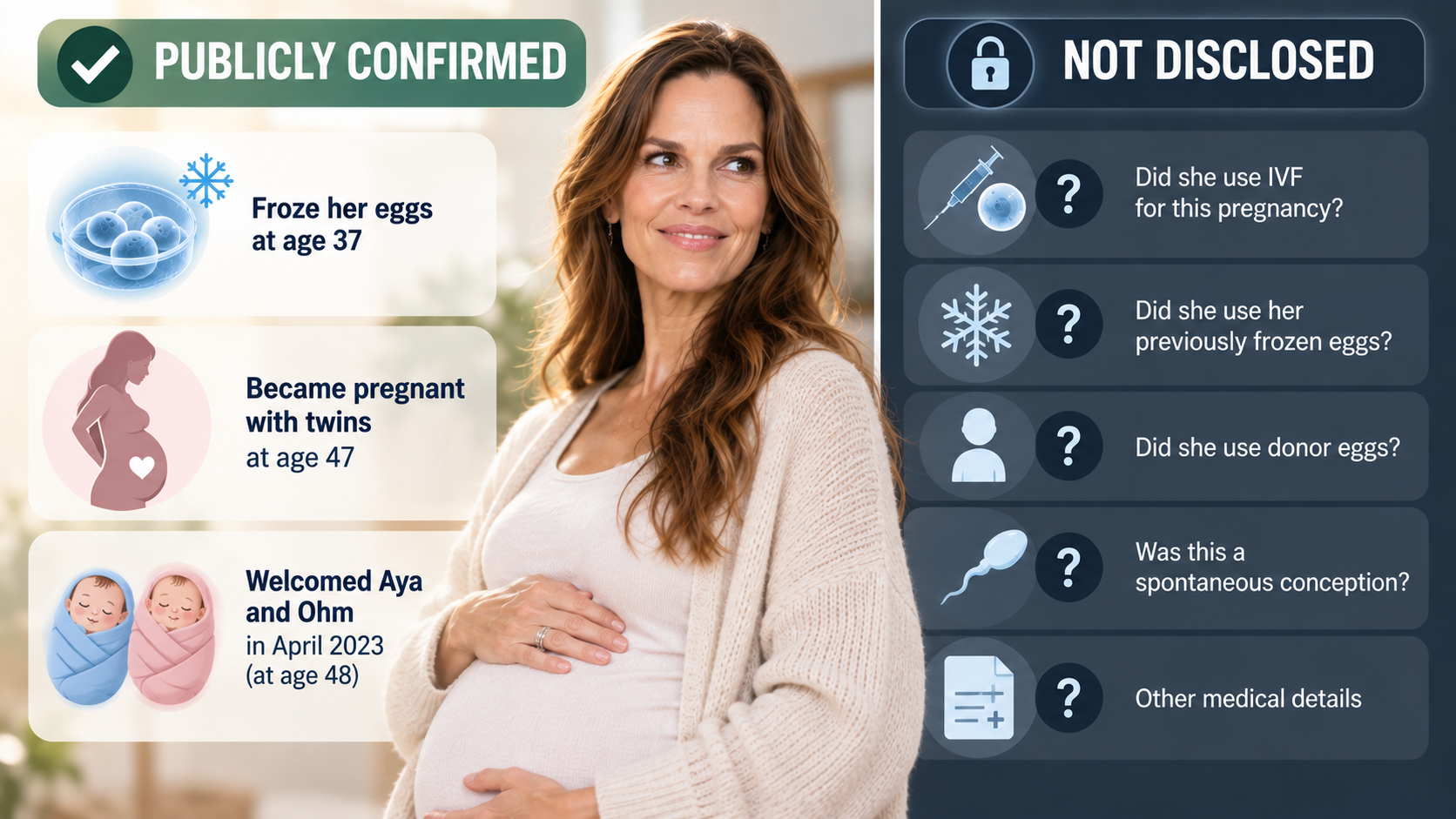
Swank has not publicly confirmed whether her latest pregnancy involved in vitro fertilization (IVF), previously frozen eggs, donor eggs, or spontaneous conception.
Her statement that she froze eggs at 37 does not answer that question.
This distinction can get lost when people discuss pregnancies at unusually advanced maternal ages.
Several reproductive pathways are medically different:
| Reproductive pathway | How it works |
|---|---|
| Spontaneous conception | Pregnancy begins without assisted fertilization |
| IVF using previously frozen eggs | Stored eggs are thawed, fertilized, and resulting embryos may be transferred |
| IVF using donor eggs | Eggs from a donor are fertilized, and an embryo may be transferred to the intended recipient |
| Frozen embryo transfer | An embryo created and frozen earlier is thawed for transfer |
These are general reproductive options, not a list of treatments known to have been used by Swank.
In IVF, fertilization takes place outside the body before an embryo is transferred into a uterus.
The source and age of the egg are important factors in the chance of success. An egg retrieved years earlier is biologically different from an egg retrieved from the same person much later in life.
Donor-egg IVF can also make pregnancy possible for some women who can no longer conceive with their own eggs.
However, pregnancy after 50 still requires appropriate medical evaluation because the risks of carrying a pregnancy are not eliminated by using younger eggs or embryos. (ASRM)
This leaves two important conclusions.
First, reproductive technology has expanded the circumstances in which later pregnancy may be possible.
Second, a person’s age and public pregnancy announcement are not enough to identify their reproductive history.
In Swank’s case, the medical details remain private.
It would be misleading to turn a general scientific explanation into a claim about how she conceived.
What Are the Medical Risks of Pregnancy After 50?
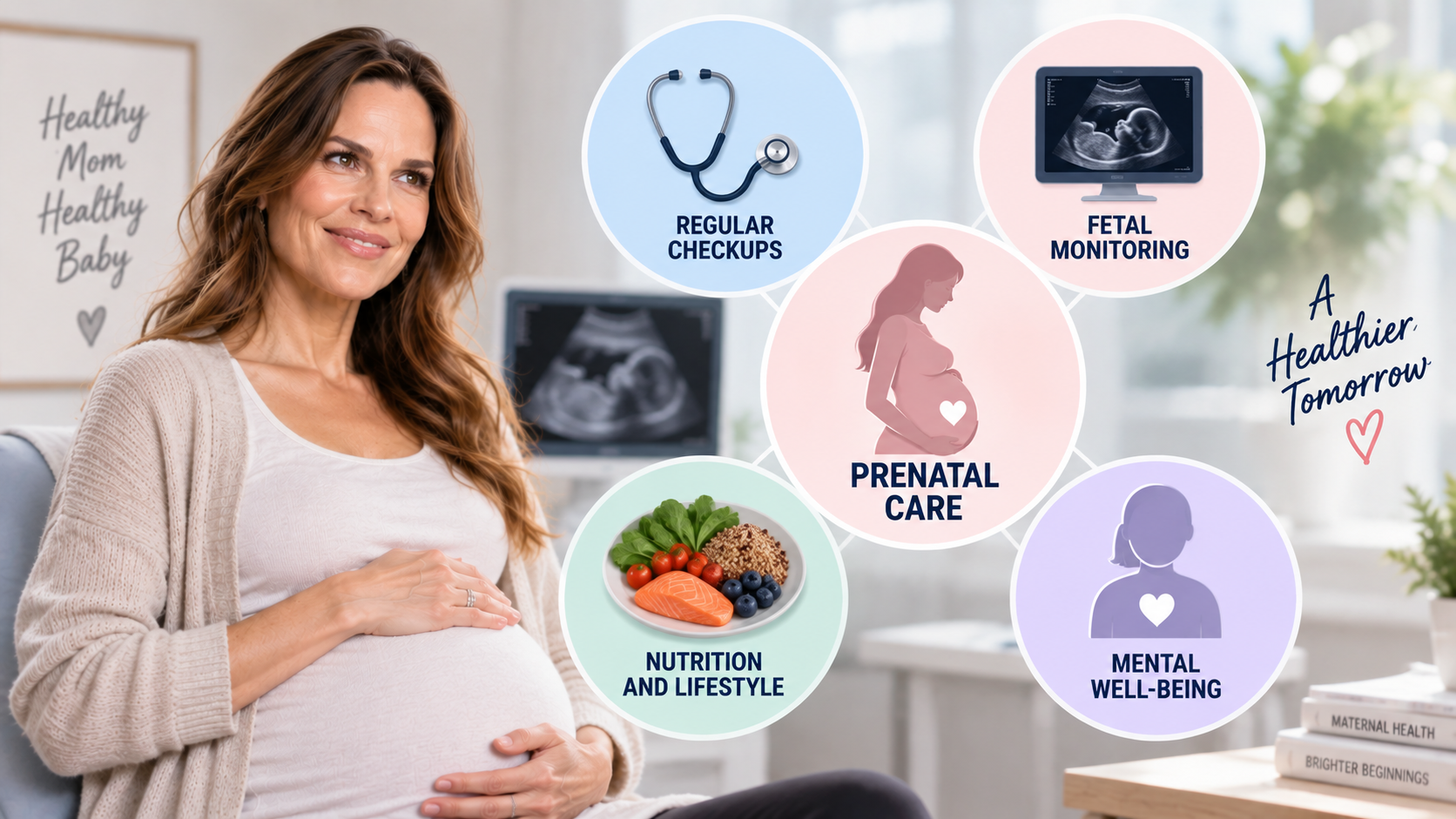
Pregnancy after 50 is associated with higher average risks of certain complications than pregnancy at younger ages. But an increased statistical risk does not mean a particular pregnant person will experience those complications.
The American College of Obstetricians and Gynecologists (ACOG) uses age 35 or older as the traditional threshold for advanced maternal age.
That does not mean pregnancy suddenly becomes dangerous on a woman’s 35th birthday.
Instead, the risks generally increase along a continuum, with some becoming more pronounced after 40.
ACOG and the Society for Maternal-Fetal Medicine identify several important considerations for pregnancies at older maternal ages. (ACOG)
| Medical concern | Why doctors pay attention |
|---|---|
| Gestational diabetes | Pregnancy-related changes can affect blood sugar regulation |
| Preeclampsia | High blood pressure and related organ complications can develop during pregnancy |
| Preterm birth | The chance of delivery before 37 weeks is higher in some older-age groups |
| Fetal growth problems | Ultrasound monitoring may help identify babies growing unusually slowly or rapidly |
| Stillbirth risk | Increasing maternal age is associated with higher risk, especially later in pregnancy |
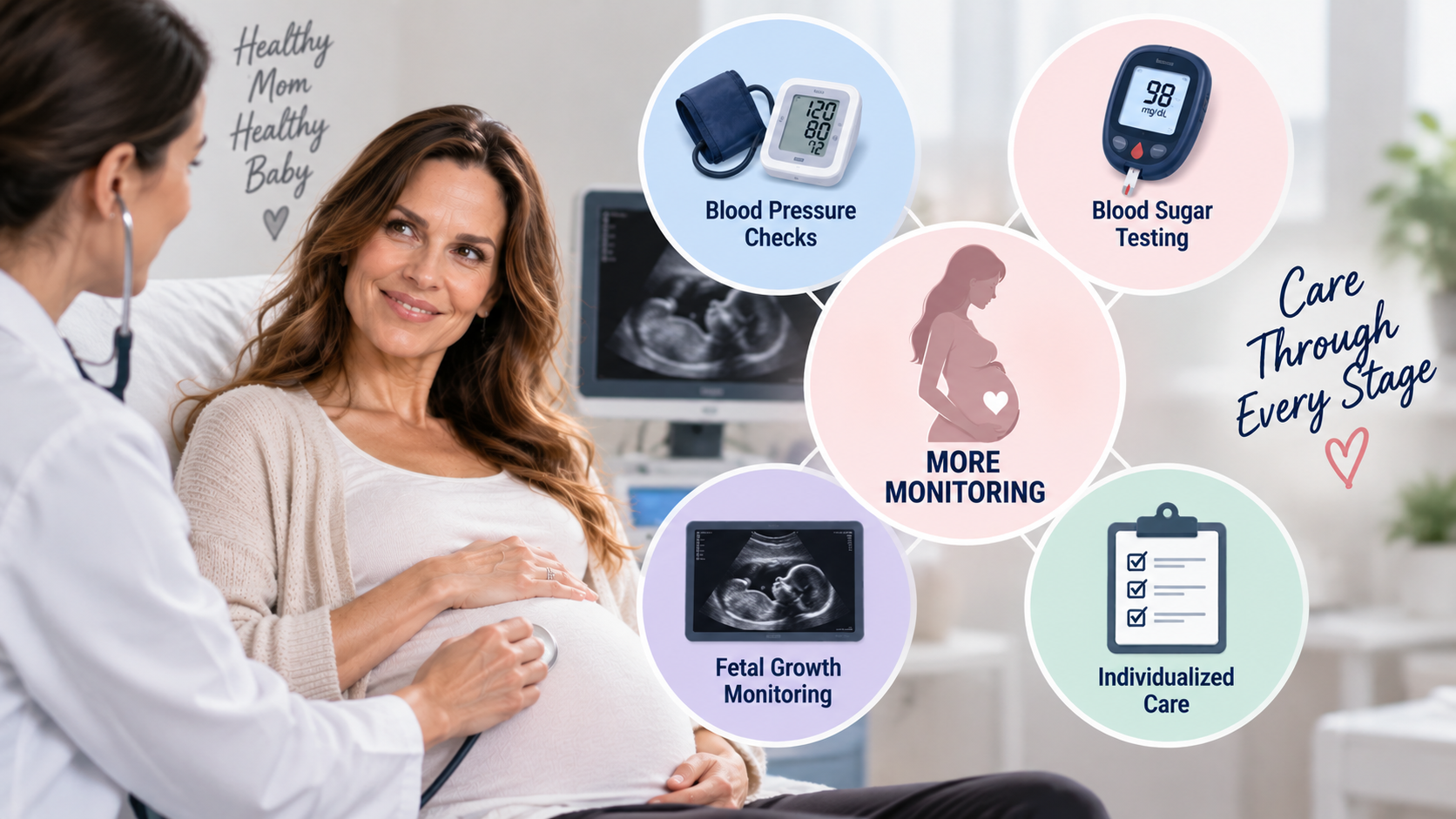
These concerns are why pregnancy care may involve additional evaluation and monitoring.
For pregnancies with an anticipated delivery at age 40 or older, ACOG suggests additional fetal growth assessment and antenatal surveillance, depending on the circumstances.
It also recommends discussing delivery timing carefully, including delivery during the 39th week for well-dated pregnancies in this age group.
Those are general clinical recommendations—not a description of Swank’s personal treatment plan.
Does advanced maternal age automatically mean a C-section?
No.
ACOG states that maternal age alone is not an indication for cesarean delivery.
A vaginal birth may be appropriate when there are no other medical reasons to recommend a different delivery approach.
The decision depends on the individual pregnancy, maternal health, fetal condition, and clinical circumstances. (ACOG)
For Swank, there has been no public disclosure establishing that she has experienced any particular complication during this pregnancy.
Applying general medical risk statistics to an individual without that information would be inappropriate.
How Rare Are Births at Older Maternal Ages in the United States?
Births in the United States are increasingly concentrated at older ages than in previous generations. But births in the early 50s remain uncommon.
The Centers for Disease Control and Prevention’s provisional data for 2025 provide useful context.
| Mother’s age | U.S. births in 2025 |
|---|---|
| 35–39 | 640,234 |
| 40–44 | 142,927 |
| 45–54 | 11,319 |
These figures come from the National Center for Health Statistics. They represent recorded births, not the probability that any particular woman will become pregnant. (CDC/NCHS · National Library of Medicine)
There is an especially important limitation to the oldest category.
The 11,319 births among mothers ages 45–54 do not mean 11,319 babies were born to women over 50.
The CDC groups ages 45 through 54 together in this table and notes that most births in the category occur among women ages 45–49.
It does not provide a separate count for 52-year-old mothers in that table.
Still, the scale is revealing.
The number of births declines sharply between the 35–39, 40–44, and 45–54 groups.
That helps explain why a widely recognized actress announcing a pregnancy at 52 attracts attention.
Swank’s experience is not impossible according to reproductive medicine. But it is well outside the age range in which most U.S. births occur.
Does this mean more women should expect to become mothers in their 50s?
No.
The wider trend toward having children later does not mean fertility at 50 resembles fertility at 35.
Later childbearing reflects a combination of personal choice, changing family patterns, medical developments, and individual circumstances.
For some people, reproductive treatment can expand their options. Others face biological, medical, financial, or practical barriers.
Celebrity experiences can make unusual circumstances more visible, but they should not be treated as a reliable forecast of what is possible for everyone.
Why Does Swank’s Personal Story Matter Beyond the Medical Questions?
There is another reason this announcement has resonated beyond the usual celebrity pregnancy coverage.
For much of her public life, Swank was known first for her acting career.
She won Academy Awards for Boys Don’t Cry and Million Dollar Baby, establishing herself as one of Hollywood’s best-known performers long before becoming a parent. (Women’s Health)
Her first children arrived after decades of professional success.
In interviews since their birth, she has described motherhood as a deeply meaningful change rather than something she regrets experiencing later.
She has also spoken about the practical value of having a supportive husband and the ability to spend significant time with her children.
In a 2025 conversation with Women’s Health, Swank explained that she felt more patient, understanding, and curious about her children’s development than she believed she would have been years earlier.
That is an observation about her own experience, not a scientific claim that older parents are necessarily better parents.
The distinction is important.
Medical studies can assess fertility and pregnancy outcomes. They cannot determine whether a specific person has reached the right moment in life to become a parent.
Financial stability, emotional readiness, relationships, health, and support networks differ enormously.
Swank’s story brings these questions together because it combines a very public career with an unusually late transition into motherhood.
Now, with another child expected, the story continues.
When Is Hilary Swank’s Third Baby Expected—and What Happens Next?
Swank’s October 14 announcement suggested a December 2026 arrival.
The timing came from her humorous reference to a new project being released in December, rather than a detailed public medical announcement. (ABC News)
As of October 15, 2026, several details had not been publicly established in the reporting reviewed for this article.
These include the baby’s exact due date, sex, and name, as well as the specific reproductive circumstances behind the pregnancy.
There is no need to invent answers to those questions.
The most meaningful developments to watch are any additional information Swank chooses to share and, eventually, the arrival of the baby.
In the meantime, her announcement is a useful reminder that pregnancy, fertility, and parenthood are related but separate experiences.
Reproductive medicine can help explain what is possible.
Only Swank and her medical team know the details of her own pregnancy.
Bottom Line: What This Story Really Means
Hilary Swank’s announcement that she is expecting her third child at 52 is remarkable because pregnancy at that age is uncommon, even as reproductive medicine has expanded options for having children later in life.
Her experience also has an unusual history.
She previously revealed that she froze her eggs at 37, became pregnant with twins at 47, gave birth at 48, and is now expecting another baby at 52.
But there is no confirmed public explanation of how her latest pregnancy was conceived.
That is why her story should not be used as proof that pregnancy after 50 is either easy or impossible.
The medical evidence points to a more nuanced reality: fertility generally declines with age, assisted reproductive methods can offer additional possibilities, and carrying a pregnancy later in life involves increased medical risks that require individualized care.
Swank’s personal story adds another dimension.
She has described finding fulfillment in parenthood after establishing her career and reaching a stage of life in which she feels ready to give her children substantial attention.
Her announcement is therefore more than an unexpected celebrity headline.
It brings together two subjects that are often confused: what reproductive medicine makes possible and what becoming a parent means to the individual.
Hilary Swank Pregnancy at 52: Key Questions Explained
Q. Is Hilary Swank pregnant again in 2026?
Yes. Hilary Swank announced on October 14, 2026, that she is expecting her third child with her husband, Philip Schneider.
Q. How old is Hilary Swank while expecting her third child?
Swank is 52 years old as of October 2026. She was 48 when she gave birth to twins in April 2023.
Q. Who is Hilary Swank’s husband?
Her husband is Philip Schneider. They married in 2018 and are the parents of twins Aya and Ohm, born in April 2023.
Q. Did Hilary Swank use IVF to become pregnant at 52?
Her specific conception method has not been publicly confirmed. Although she previously discussed freezing her eggs, that does not establish whether IVF or another fertility treatment was involved in her current pregnancy.
Q. Did Hilary Swank freeze her eggs before becoming a mother?
Yes. In a 2025 Women’s Health interview, she discussed freezing her eggs at 37 to preserve future reproductive options.
Q. Is it possible to get pregnant naturally at 52?
Spontaneous conception at 52 is possible but rare before menopause; natural conception is not possible after menopause. Assisted reproduction can offer options for some patients, but Swank has not disclosed how her pregnancy began.
Q. When is Hilary Swank’s third baby due?
Her October 14 announcement indicated December 2026 through a playful reference to an upcoming project. No exact delivery date was established in the reporting reviewed.
Q. Is pregnancy after age 50 considered high risk?
Pregnancy after 50 is associated with increased average risks of complications, including gestational diabetes, hypertensive disorders, preterm birth, and stillbirth. An individual’s risk depends on their health and pregnancy circumstances.
Q. Does being over 50 automatically require a C-section?
No. Maternal age alone is not a reason to require cesarean delivery. The appropriate delivery method depends on individual clinical circumstances.
Did this help make the story clearer? 🙂
WIN keeps unpacking the “why” behind the news—clearly and simply!
Sources
October 2026 Announcement and Family Background
ABC News / Good Morning America — Hilary Swank, 52, Expecting Her 3rd Child
People — Hilary Swank, 52, Is Pregnant! Actress Expecting Third Baby
Swank’s Fertility Planning and Reproductive Medicine
Women’s Health — Hilary Swank Is Exactly Where She Wants to Be
ASRM ReproductiveFacts — Age and Fertility
Pregnancy Risks and U.S. Birth Statistics
ACOG — Pregnancy at Age 35 Years or Older: Obstetric Care Consensus
ACOG — Having a Baby After Age 35: How Aging Affects Fertility and Pregnancy
CDC / National Center for Health Statistics — Births: Provisional Data for 2025
National Library of Medicine — U.S. Birth Counts and Birth Rates by Maternal Age, 2025