How Does Israel Find and Kill Its Enemies So Precisely? Inside Mossad’s Intelligence Network

How do you find one person who is hiding inside a heavily guarded compound, surrounded by security forces, and protected by an entire country’s military?
And how do you strike that person without first fighting your way through the country’s defenses?
Those questions have become increasingly important as Israel has carried out high-profile military operations across the Middle East.
In September 2024, an Israeli airstrike killed Hezbollah leader Hassan Nasrallah in an underground headquarters in Beirut. In June 2025, Israeli attacks killed senior Iranian commanders and nuclear scientists while striking military and nuclear facilities deep inside Iran.
Then, on February 28, 2026, the United States and Israel launched a joint military offensive that killed Iran’s supreme leader, Ayatollah Ali Khamenei. Reporting indicated that intelligence about a meeting involving senior Iranian officials shaped the timing of the operation. (Reuters)
These operations appeared to demonstrate an extraordinary ability to locate people who had spent years trying to avoid exactly that fate.
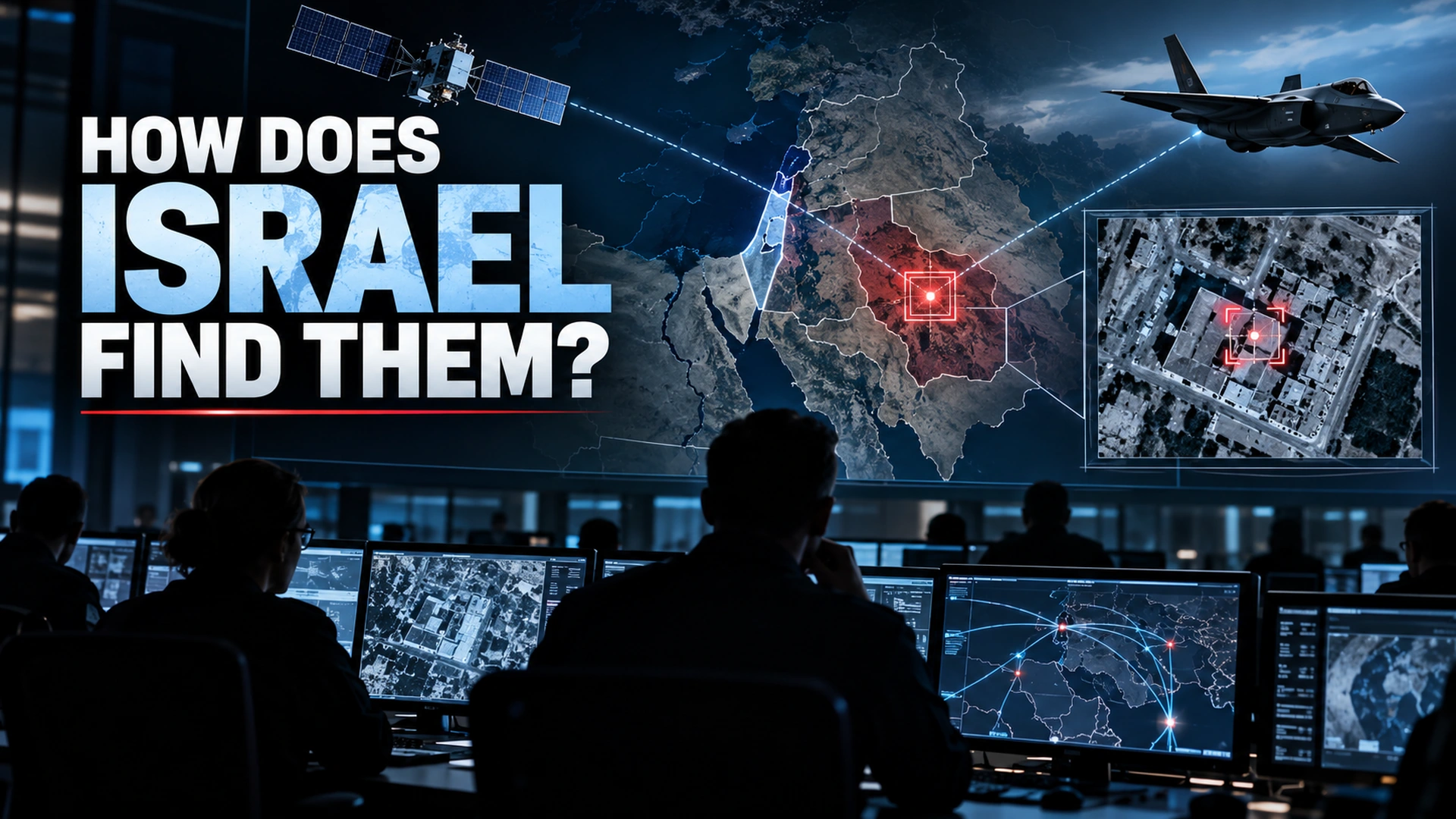
※ Images in this article are AI-generated illustrations created to help explain the story. They are not actual photographs, and depictions of people, places, or events may differ slightly from reality.
The secret is not one extraordinary missile or a single all-powerful spy agency.
Israel’s ability to carry out targeted strikes comes from combining human intelligence, electronic surveillance, data analysis, aircraft, and precision-guided weapons into a coordinated system.
Understanding how that system works also reveals something less obvious: being able to hit a target accurately does not necessarily mean the intelligence was correct, the attack was lawful, or the surrounding civilians were safe.
From Hezbollah’s Bunkers to Iran’s Leadership: What Changed?
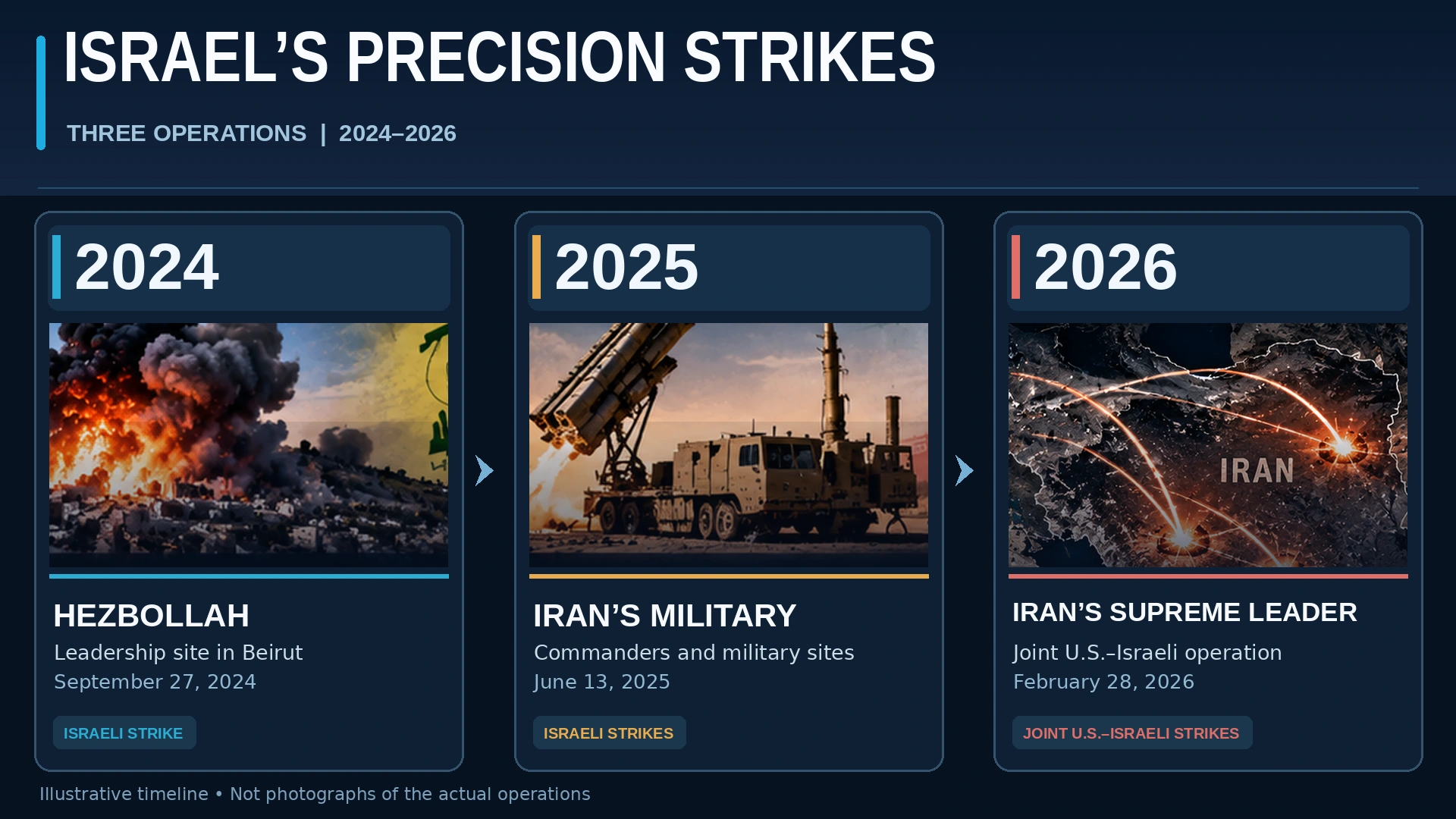
Israel’s recent operations show how warfare can focus not only on destroying weapons, but also on disrupting the people and institutions directing them.
Consider three important examples.
| Date | Operation or Event | Why It Mattered |
|---|---|---|
| September 27, 2024 | Israeli airstrike killed Hezbollah leader Hassan Nasrallah in Beirut | Demonstrated Israel’s ability to locate and strike a secretive leadership site |
| June 13, 2025 | Israel launched major attacks on Iranian military and nuclear targets | Combined intelligence preparation, air-defense attacks, and strikes against senior commanders |
| February 28, 2026 | Joint U.S.-Israeli strikes killed Iran’s supreme leader, Ali Khamenei | Showed that a heavily guarded national leadership compound could be targeted |
The Nasrallah operation offers a revealing example. According to the Israel Defense Forces (IDF), years of intelligence collection helped identify the location of Hezbollah’s secret underground headquarters in Beirut. Israel says its air force carried out a coordinated bombing operation that killed Nasrallah and other commanders. The IDF is a party to the conflict, so its account of classified operational details should be understood as its own description. (IDF)
The June 2025 campaign in Iran demonstrated something different. Associated Press reporting described preparations involving Israeli operatives, drones and other weapons positioned inside Iran, along with intelligence gathering about military infrastructure. Not every operational detail has been independently verified. (AP)
The February 2026 operation involved direct American military participation and killed Iran’s highest political and religious authority, not merely military commanders.
These were not completely new methods invented overnight. They were increasingly visible demonstrations of intelligence-led warfare developed over decades.
Who Actually Finds the Targets: Mossad, Shin Bet, or Unit 8200?
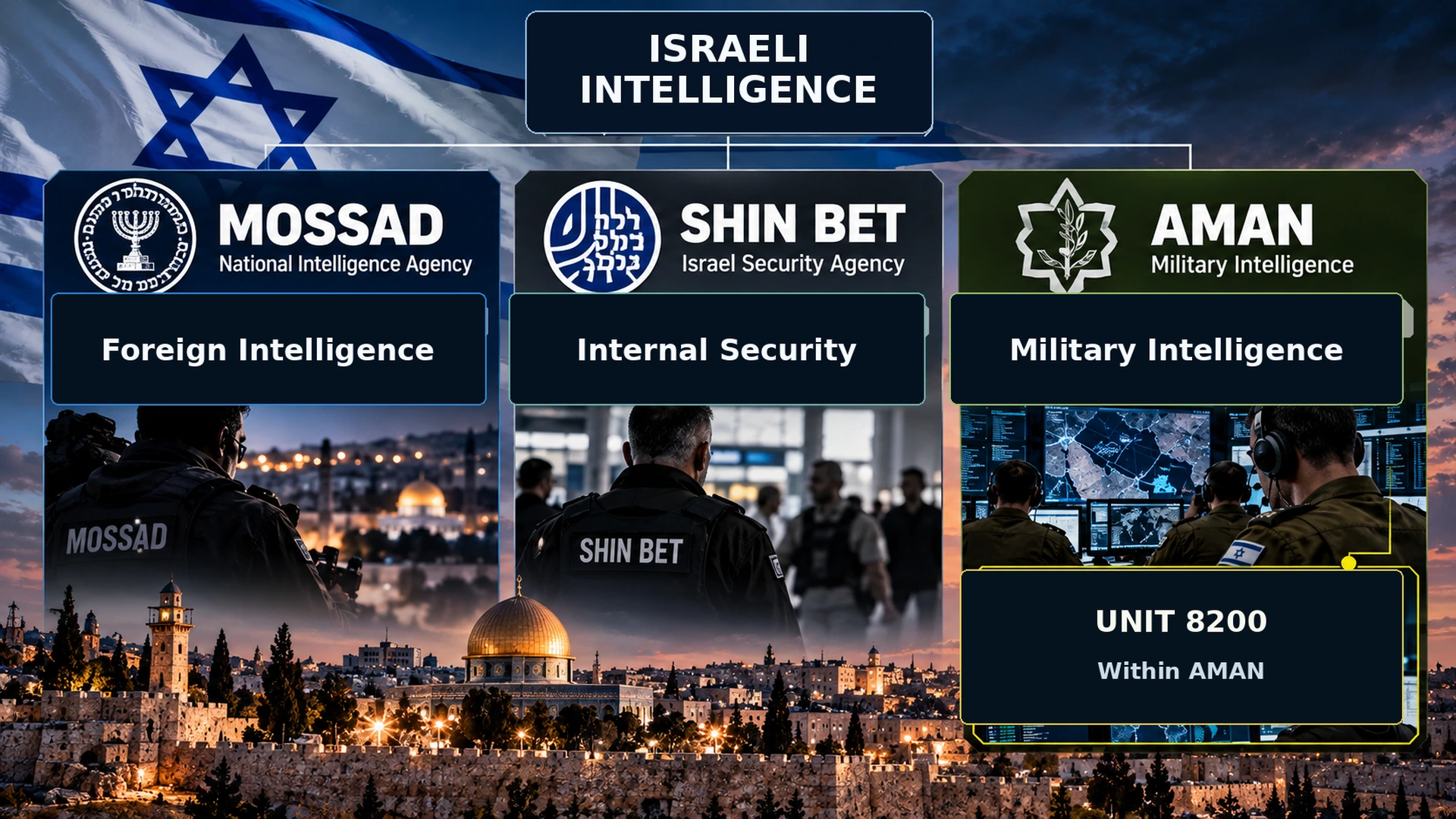
Israel does not depend on a single intelligence service. Its security system divides responsibilities among organizations specializing in different threats.
The three names worth knowing are Mossad, Shin Bet, and Aman.
| Organization | Primary Responsibility | Typical Role |
|---|---|---|
| Mossad | Foreign intelligence and covert operations | Recruiting foreign sources and collecting intelligence overseas |
| Shin Bet (Shabak) | Internal security and counterintelligence | Investigating domestic security threats and militant networks |
| Aman | Military intelligence | Assessing military threats and supporting military operations |
| Unit 8200 | A major unit within Aman | Collecting and processing signals and digital intelligence |
Mossad is probably the best-known organization internationally. It is responsible for foreign intelligence and covert operations supporting Israeli national-security objectives. Its work can involve overseas human sources and clandestine networks. (Mossad)
Shin Bet has a different primary mission. It concentrates on internal security, counterterrorism, and counterintelligence, including threats involving Gaza and the West Bank.
Aman is the Israeli military’s intelligence directorate. It provides intelligence assessments that support military planning, targeting, and operational decisions.
Why is Unit 8200 so important?
Unit 8200 is important because modern military intelligence increasingly involves collecting and analyzing enormous amounts of electronic information. The IDF describes it as a major intelligence collection organization developing tools and processing information for military units. (IDF)
A human source might report that a commander plans to attend a meeting. An electronic intelligence unit might identify communications activity associated with the same network. Military analysts could then compare both reports with other evidence.
Each piece may be incomplete. Together, they can become more useful. These organizations do not form one simple chain of command, however, and not every Israeli operation involves all of them.
How Can Intelligence Agencies Locate Someone Who Is Trying to Hide?
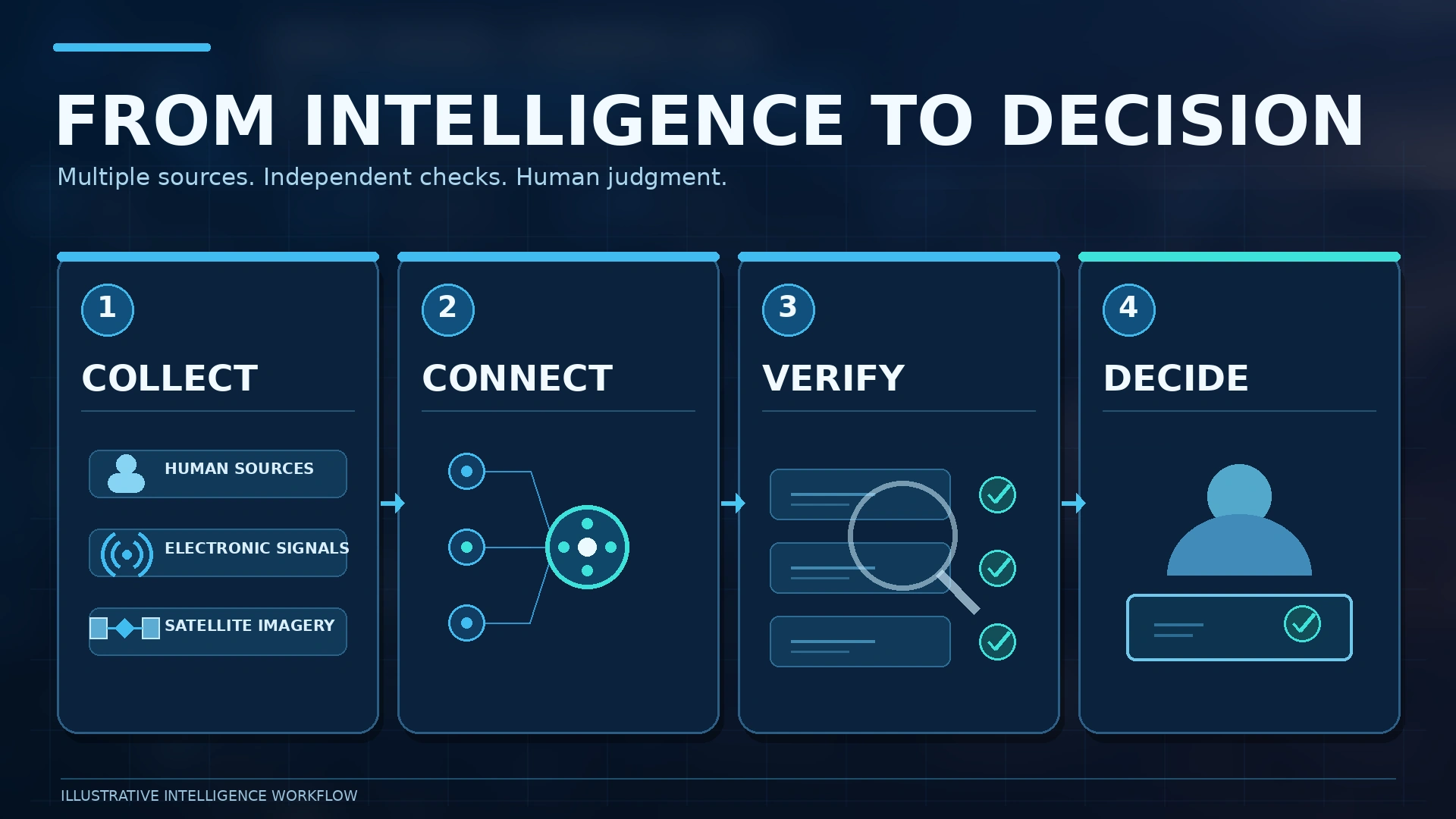
The hardest part of many targeted operations is not delivering the weapon. It is establishing where the intended target is, whether the intelligence is reliable, and whether an attack can be authorized.
Intelligence agencies use several broad sources of information.
Human intelligence: Information from people
Human intelligence, or HUMINT, can come from informants, recruited sources, interviews, defectors, and other human contacts. An insider may reveal internal decisions or the meaning of an otherwise ordinary meeting. But human intelligence can be mistaken, incomplete, or deliberately misleading.
Signals intelligence: Information from communications
Signals intelligence, or SIGINT, involves gathering information from electronic signals and communications. Depending on the method, analysts may examine communications patterns or intercepted information. The existence and timing of a communication can sometimes be useful even when its contents are unknown.
Imagery intelligence: Information from above
Satellites, reconnaissance aircraft, and drones can reveal terrain, facilities, vehicles, and changes at important locations. Images may support or contradict other information, but an image alone generally cannot show everything happening inside a building.
Intelligence fusion: Connecting the evidence
The most important step is often bringing multiple sources together. Imagine investigators trying to confirm whether an important meeting has taken place. One source provides a report. Another provides electronic information. A third offers imagery suggesting unusual activity.
If those reports are independent and consistent, confidence may increase. But analysts must test alternative explanations. Several reports can appear independent even when they come from the same unreliable origin.
That is why locating a suspected target is not the same as proving the person is present.
In the February 2026 strikes, Reuters reported that U.S. and Israeli forces timed attacks around intelligence about a meeting involving Khamenei and senior officials. The classified collection and verification process has not been made public. (Reuters)
That does not establish that an agency can track every individual continuously or without error.
How Did Israel Get Through Iran’s Air Defenses?
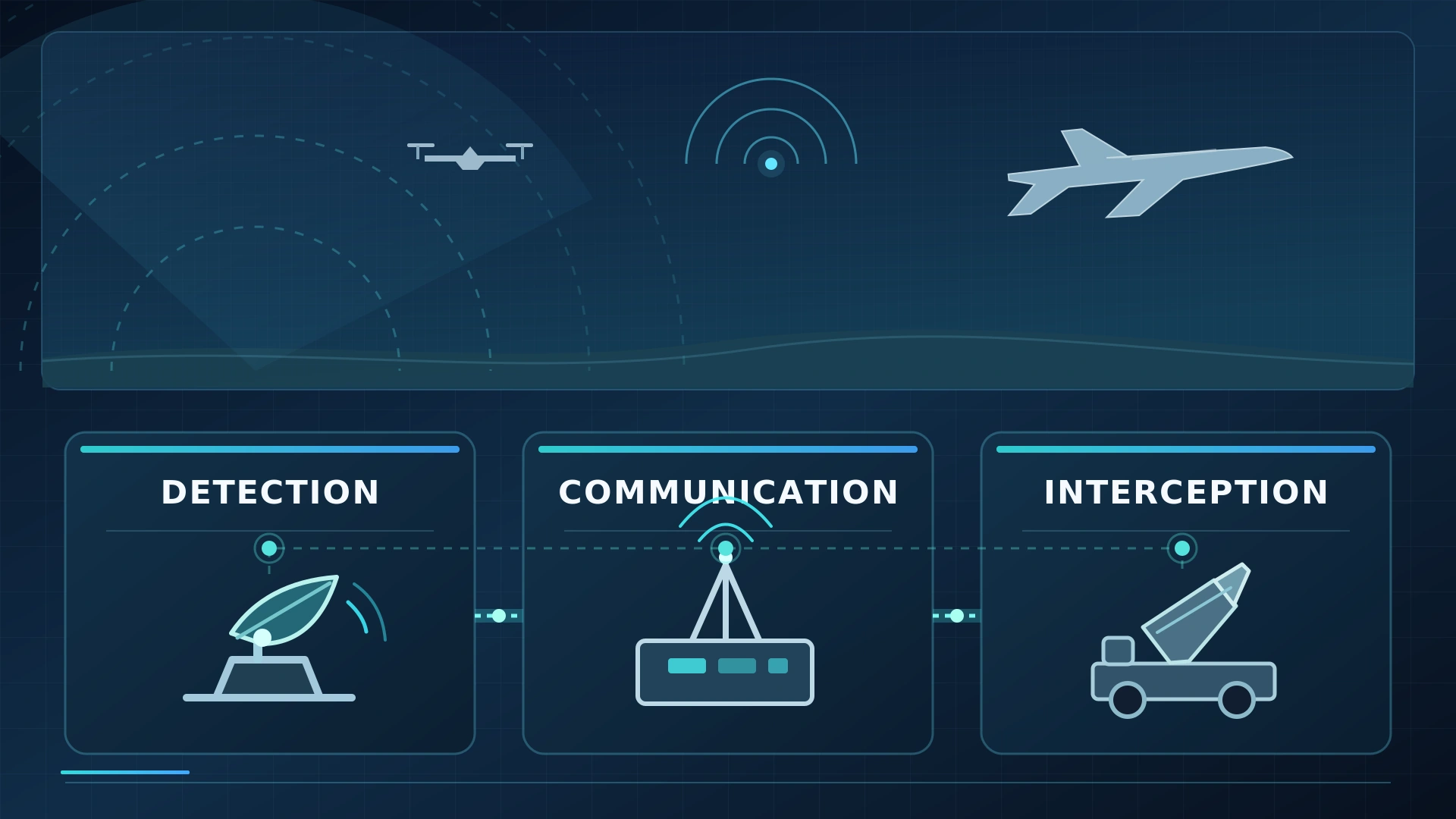
Getting an aircraft or missile to a target requires dealing with enemy defenses. Israel’s advantage has often come from combining intelligence preparation, electronic warfare, drones, and aircraft rather than relying on stealth technology alone.
A modern air-defense network may include radar, surveillance systems, communications links, command centers, and interceptor weapons. These systems must cooperate to detect threats, identify them, communicate, and respond.
Electronic warfare can interfere with detection
Electronic warfare uses electromagnetic capabilities to disrupt, deceive, or protect electronic systems. Jamming can degrade some radar and communication functions, depending on the environment and countermeasures. But electronic warfare is not a universal off switch: defenses can use alternative sensors and anti-jamming techniques.
Drones can threaten exposed military systems
Unmanned aircraft and loitering munitions can be used for surveillance or strikes. Their performance and ability to reach a target vary widely.
In June 2025, AP reported that drones and weapons positioned inside Iran helped attack defensive equipment during the opening phase of the Israeli campaign. The broader lesson is that a defender can face threats from locations it did not expect. (AP)
Stealth and stand-off weapons reduce exposure
Aircraft such as the U.S.-designed F-35 reduce detectability under some conditions. Stealth does not mean invisibility, and radar detection is not a simple yes-or-no proposition.
A stand-off missile can be launched from outside part of an enemy’s air-defense coverage, so the aircraft need not fly directly over the target. The goal is to reduce the defender’s ability to respond effectively—not to assume the entire defense network has disappeared.
Are Israel’s Missiles Really More Accurate Than Ordinary Weapons?
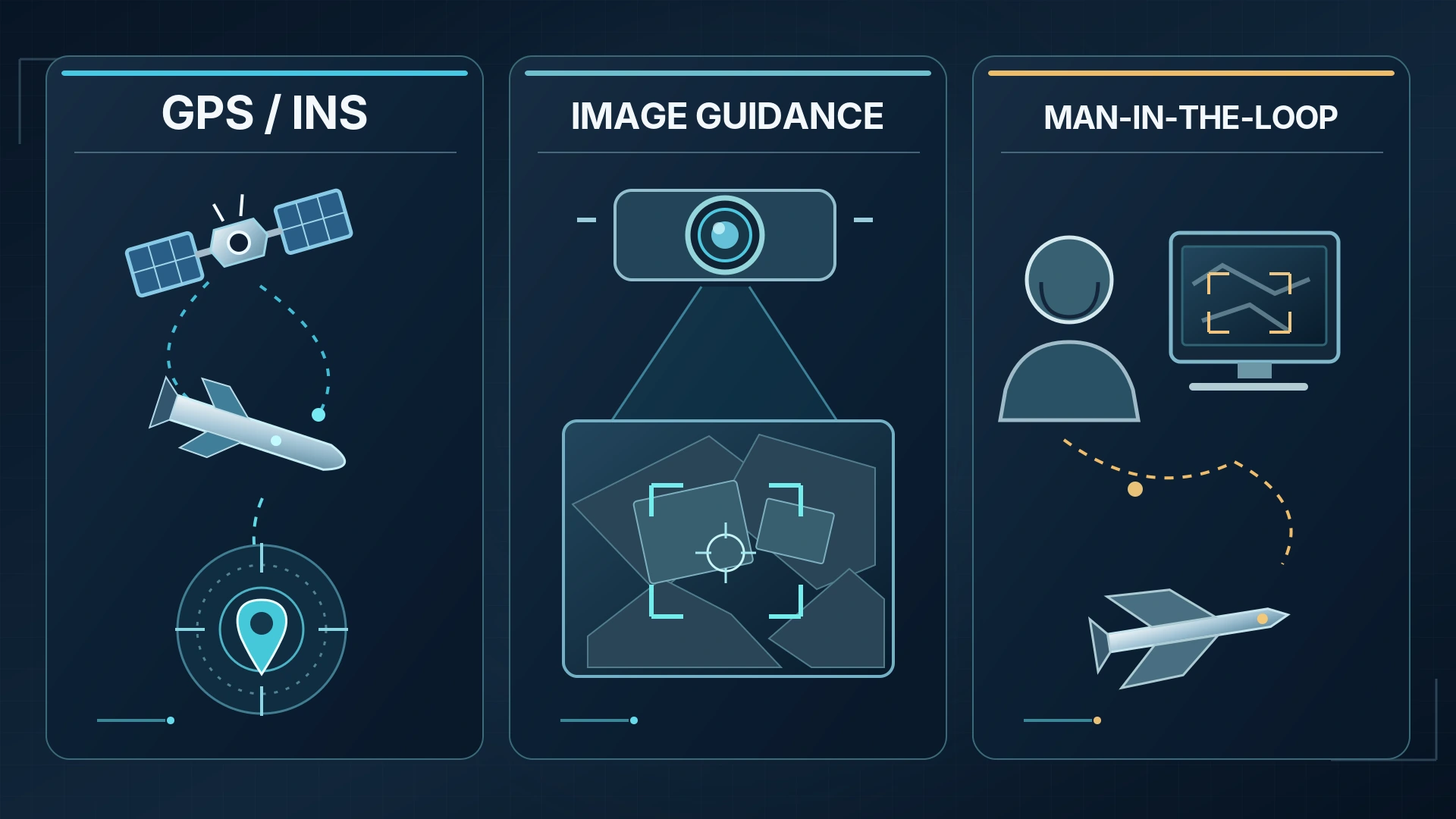
Israel produces several families of guided weapons, but their capabilities are not interchangeable. Important differences involve navigation, target recognition, speed, launch distance, and the ability to change decisions during flight.
| Weapon System | Publicly Described Feature | What It Means |
|---|---|---|
| SPICE | Electro-optical scene-matching guidance | Uses visual information to help identify target features |
| ROCKS | Stand-off air-to-surface weapon with multiple guidance methods | Designed to engage targets from a distance |
| Rampage | Supersonic, GPS/INS-guided air-to-ground missile | Combines stand-off launch with high-speed flight |
| Delilah | Loitering missile with camera and operator involvement | Allows visual review of its final aim point |
These are examples from manufacturers’ public descriptions. The existence of a weapon does not establish that it was used in any particular strike.
Why does image-based guidance matter?
Many guided weapons rely partly on GPS and inertial navigation. GPS provides location information; an inertial system estimates movement using onboard sensors. Satellite navigation can be disrupted, so some weapons incorporate electro-optical sensors and image-matching methods.
Rafael describes ROCKS as using imagery alongside other guidance technologies. That does not mean a missile exercises human judgment; it means the weapon has additional ways to navigate or recognize relevant features. (Rafael)
Why does missile speed matter?
A fast missile can reduce the time available for defenders to respond. Israel Aerospace Industries describes Rampage as a supersonic precision-strike weapon. Speed alone, however, never guarantees that a missile cannot be intercepted. (IAI)
Can a missile really be controlled through a camera?
Some missile systems support operator involvement using imagery. Such an arrangement can provide flexibility not found in every fire-and-forget weapon, but still depends on communications, sensors, and correct decisions.
No guidance system can compensate for every intelligence error. A weapon may arrive precisely where intended and still hit the wrong person or an unlawfully selected target.
How Is Artificial Intelligence Changing Israeli Targeting?
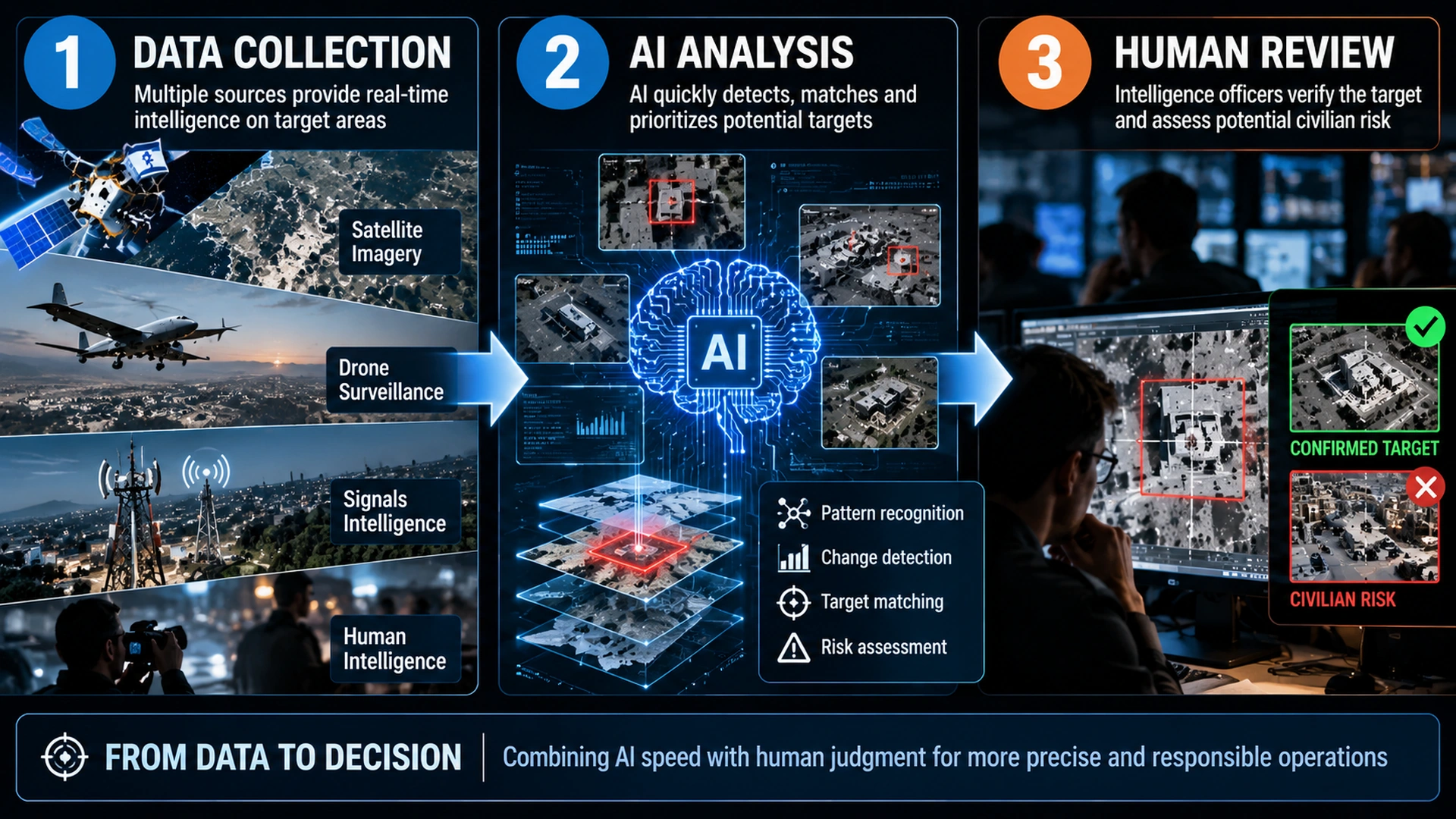
Artificial intelligence can process more information faster. But faster analysis can also magnify mistakes when the underlying data is wrong or oversight is inadequate.
Military organizations collect far more information than human analysts can review individually: communications, images, videos, reports, and records gathered over years. AI tools can help organize, search, translate, and identify patterns in those materials.
The Associated Press investigated the Israeli military’s growing use of AI and commercial cloud computing during the wars in Gaza and Lebanon. Its reporting described tools that helped process surveillance information and generate possible targets more rapidly, alongside concerns about errors and oversight. (AP)
What is the controversy over AI-generated target lists?
Investigative reporting has described Israeli systems used to generate possible targets in Gaza, including a system widely referred to as Lavender. Human-rights advocates have raised concerns about automation bias: the tendency to trust computer-generated recommendations too readily.
Consider a hypothetical example. An automated system associates a phone number with a suspected militant. Someone else is actually using that phone. If reviewers mistake the association for certainty, later analysis may reinforce an incorrect conclusion.
Israel’s military maintains that its systems assist rather than replace human decision-making and that personnel review targets under applicable rules. Critics question whether oversight has consistently been sufficient. (AP)
AI can accelerate the identification of possible targets. It cannot independently establish the legality of an attack or guarantee that an identification is correct.
Is This Technology New? The Stuxnet Attack and the Remote-Controlled Gun
Not entirely. Israel’s reputation for sophisticated intelligence operations developed long before the recent wars with Iran and Hezbollah. Two earlier cases offer background.
Stuxnet: When computer code damaged physical machinery
Stuxnet was sophisticated malware discovered publicly in 2010. It targeted industrial control equipment associated with uranium enrichment at Iran’s Natanz facility. Instead of merely stealing information, it manipulated machinery in ways that could damage centrifuges.
The Washington Post reported, citing U.S. officials, that Stuxnet was linked to a classified U.S.-Israeli effort to disrupt Iran’s nuclear program. It should not be described as an exclusively Israeli operation. (The Washington Post)
The killing of Iranian scientist Mohsen Fakhrizadeh
In November 2020, Iranian nuclear scientist Mohsen Fakhrizadeh was killed near Tehran. Iranian officials later claimed that a remotely operated, satellite-linked machine gun had been used. They blamed Israel, which did not publicly establish the full operational details in the Iranian account.
Reuters reported those allegations, but the precise technical explanation was not independently established by the official claims alone. (Reuters)
The broader significance was the intelligence challenge: finding a protected individual and identifying an opportunity to attack. That same challenge appears in recent operations, even when the weapons differ.
If Israel’s Intelligence Is So Advanced, How Did Hamas Surprise It in 2023?
Advanced intelligence systems do not guarantee accurate predictions. Israel’s failure to anticipate the October 7, 2023, Hamas-led attack is a major demonstration of that limitation.
Hamas-led attackers killed approximately 1,200 people in Israel and took more than 250 hostages. Israel possessed considerable surveillance capability around Gaza, yet its military and intelligence organizations failed to anticipate and prepare adequately for the assault.
A 2025 Israeli military investigation concluded that leaders had underestimated Hamas’s intentions and capabilities and had wrongly assumed it was more interested in governing Gaza than launching a major attack. (AP)
Intelligence is not just collecting information; it is correctly interpreting what is available.
The warning from 1973
On October 6, 1973, Egyptian and Syrian forces launched a coordinated attack beginning the Yom Kippur War. Israeli and American intelligence organizations failed to anticipate the attack adequately, even though relevant warning information was available. A CIA historical study examines those failures. (CIA)
The episodes occurred in different circumstances but reveal the same basic risk: analysts can have meaningful information and still draw the wrong conclusion.
Finding a known target and anticipating an adversary’s strategic decision are different intelligence tasks.
Does a Precision Strike Mean Civilians Are Safe?
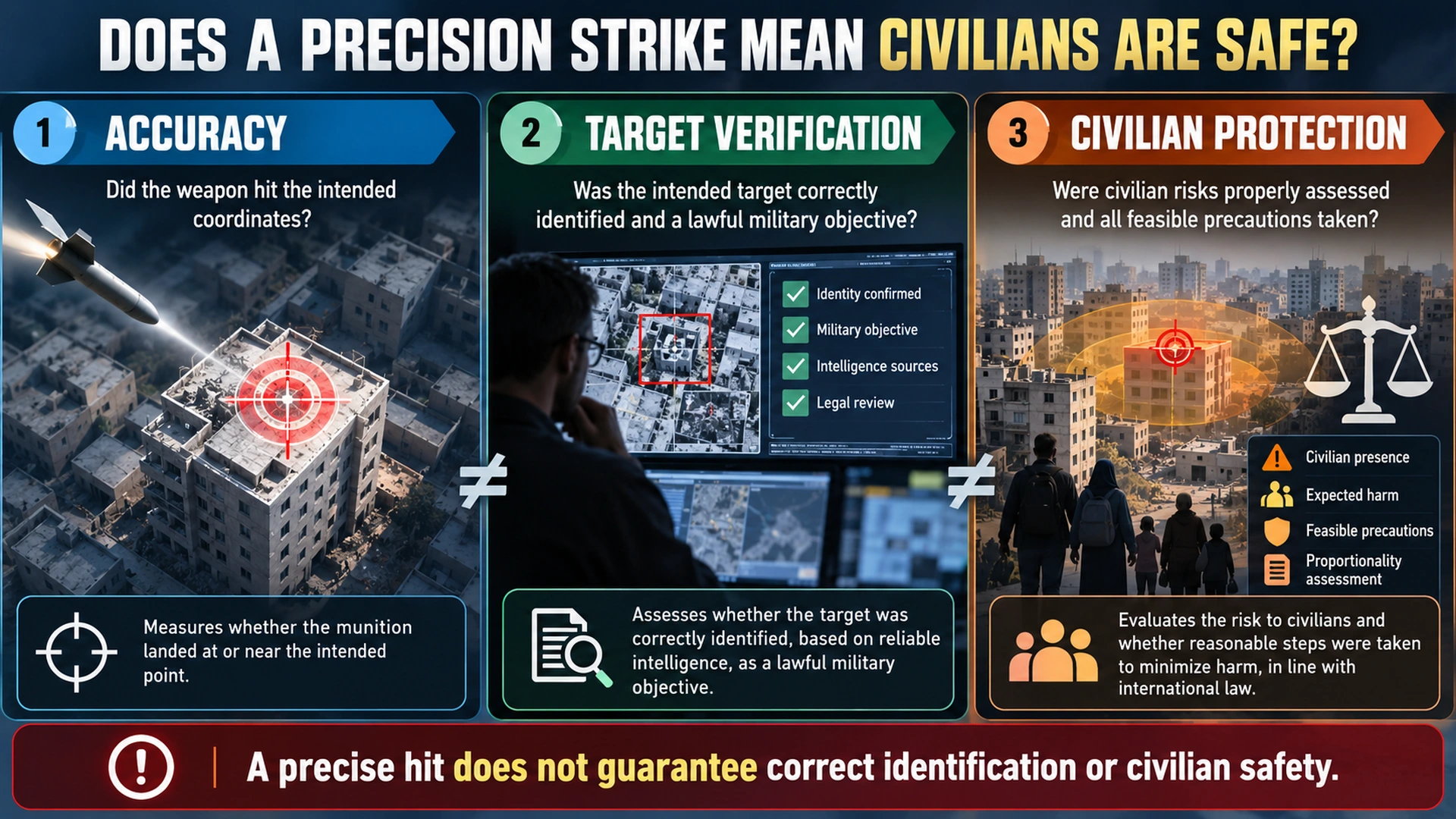
No. A weapon can strike the intended coordinates accurately and still kill civilians.
Three questions are often confused:
- Accuracy: Did the weapon hit where it was aimed?
- Target identification: Was the intended target present, and was it a lawful military objective?
- Civilian protection: Were risks to civilians properly assessed, and were feasible precautions taken?
An affirmative answer to the first does not answer the other two. A strike may hit a building believed to contain a commander while the underlying intelligence is mistaken. Even if a commander is present and lawfully targetable, civilians may also be nearby.
What does international law actually require?
International humanitarian law imposes duties on all parties to armed conflict. The International Committee of the Red Cross explains the principles of distinction, proportionality, and precautions. (ICRC)
| Principle | Basic Meaning |
|---|---|
| Distinction | Attacks must be directed at lawful military objectives, not civilians as such |
| Proportionality | Expected incidental civilian harm must not be excessive relative to the concrete and direct military advantage anticipated |
| Precautions | Forces must take all feasible steps to verify targets and avoid or minimize civilian harm |
Proportionality does not make any level of civilian harm permissible just because an important commander is targeted. Nor does every attack causing civilian casualties automatically violate international law. The circumstances, military objective, expected harm, and feasible precautions matter.
What about attacking another country’s territory?
That raises a separate legal question. The United Nations Charter generally prohibits using force against another state, with limited exceptions including lawful self-defense and Security Council authorization.
The legality of crossing a border to use force is distinct from whether individual attacks comply with humanitarian law. Following the February 2026 U.S.-Israeli strikes and regional retaliation, UN Secretary-General António Guterres warned against the escalating conflict and emphasized the importance of international law. (United Nations)
Israel and the United States cited serious security threats involving Iran’s nuclear program, missiles, and regional activities. Iran rejected the legality of the attacks and maintained that its nuclear program was intended for peaceful purposes. Precision alone does not resolve those disputes.
Can Killing Senior Leaders Actually End a War?
Killing a commander may disrupt an organization, but it does not automatically eliminate the organization or end an armed conflict.
A leadership strike can interrupt decision-making, communications, and succession planning. Surviving officials may change their behavior or lose important expertise. But organizations may also replace leaders, distribute authority, or reorganize.
Before the February 2026 strikes, U.S. intelligence assessments considered whether Khamenei’s death might open opportunities for political change or strengthen hardline elements of Iran’s security establishment. Reuters reported that no succession outcome was certain. (Reuters)
Subsequent events underscored the limits of leadership strikes. An October 15, 2026, Reuters investigation documented coordinated Iranian and allied attacks on energy, transportation, and other infrastructure around the Gulf, despite sustained military pressure. (Reuters)
The ability to deliver a devastating first strike is not the same as the ability to determine the final political outcome.
Why Does Israel’s Precision-Strike Strategy Matter to Americans?
The United States is connected to this story through direct military operations, weapons technology, intelligence cooperation, regional security commitments, and economic exposure.
Israel combines domestically developed equipment with U.S.-supplied systems. American technology companies have also supplied computing and AI services used by the Israeli military. Most significantly, the February 2026 attack on Iran was a joint U.S.-Israeli military operation, not an Israeli strike with the United States merely watching from the sidelines. (Reuters)
Regional retaliation can affect Americans
Iranian attacks and the wider conflict have threatened U.S. facilities, regional partners, shipping, and energy infrastructure. The Strait of Hormuz is important because of its role in global oil and gas shipments.
Disruptions can affect energy costs and international trade far beyond the Middle East. Reuters reported in October 2026 that Iran was shifting tactics and increasing pressure on shipping in the strait. (Reuters)
The technology raises questions about American oversight
AI-assisted targeting, commercial cloud services, and precision-guided weapons raise questions about how U.S.-developed technology is used overseas and who is accountable when something goes wrong.
What should readers watch next?
As of October 17, 2026, important questions include whether regional escalation can be contained, whether diplomacy can reduce the U.S.-Iran confrontation, and whether attacks on civilians and critical infrastructure can be reduced.
Technology may improve a country’s ability to hit a chosen target. It cannot guarantee that the target was correctly chosen, that retaliation will be limited, or that the broader war can be controlled.
Bottom Line: What This Story Really Means
Israel’s reputation for precision strikes rests on more than advanced missiles. Its security institutions bring together human sources, electronic surveillance, imagery, data processing, military planning, and weapons capable of attacking distant targets.
Mossad plays an important role in foreign intelligence and covert operations. Aman, including Unit 8200, supports military intelligence collection and analysis. Shin Bet focuses on internal security and related threats.
Operations against Hezbollah in 2024, Iranian military targets in 2025, and the joint U.S.-Israeli attack that killed Iran’s supreme leader in 2026 illustrate different applications of intelligence-led military force.
Yet October 7, 2023, demonstrated that extensive information collection does not guarantee correct strategic judgment. Civilian casualties show that weapon accuracy is not synonymous with protection. Iran’s continued ability to retaliate demonstrates that military strikes cannot automatically settle a political conflict.
Modern military technology can make it easier to find and strike an enemy. Whether that strike is justified—and what follows—is a much more complicated question.
Israel Precision Strikes: Key Questions Explained
Q. What makes Israeli precision strikes so effective?
They combine intelligence collection, surveillance, analysis, military planning, and guided weapons. Coordination matters at least as much as any single weapon.
Q. Is Mossad part of the Israeli military?
No. Mossad is Israel’s foreign intelligence agency. Aman is the military intelligence directorate, and Unit 8200 operates within Aman.
Q. What does Israel’s Unit 8200 do?
It collects and analyzes signals and digital intelligence for military and national-security purposes.
Q. Did Israel kill Iran’s Supreme Leader Ali Khamenei in 2026?
Yes, in a joint operation with the United States. Khamenei was killed during strikes on February 28, 2026, according to Iranian state media and international reporting.
Q. Did Israel secretly place drones inside Iran?
Reporting on the June 2025 attacks described preparations involving drones and other weapons inside Iran. Not every operational detail has been independently verified.
Q. Can Israeli missiles still work when GPS is jammed?
Some use additional navigation and target-recognition methods that reduce reliance on GPS. Their effectiveness depends on the specific weapon and conditions.
Q. Does AI independently decide whom Israel kills?
Public reporting describes AI-assisted target analysis. Israel’s military says humans review and authorize attacks; critics question whether oversight has always been sufficient.
Q. Does a precise attack automatically comply with international law?
No. Lawful targeting, proportionality, and precautions still matter. The legality of using force across a national border is a separate issue.
Q. Why haven’t targeted killings ended the fighting?
Governments and armed groups can replace leaders and continue military operations. Leadership losses do not automatically resolve a conflict’s political causes.
Q. How does the Israel-Iran conflict affect the United States?
The United States has participated directly in strikes and maintains security commitments in the region. Escalation also threatens personnel, shipping, and energy markets.
Did this help make the story clearer? 🙂 WIN keeps unpacking the “why” behind the news—clearly and simply!
Sources
Military Operations and Intelligence-Led Strikes
Reuters — Iranian Leader Khamenei Killed in U.S.-Israeli Airstrikes, February 28, 2026
Associated Press — How Israel Used Spies, Smuggled Drones, and AI Against Iran, June 17, 2025
Israel Defense Forces — How Intelligence Led to Nasrallah’s Elimination, September 27, 2025
Intelligence Organizations and Military Technology
Israel Defense Forces — Military Intelligence Directorate and Unit 8200
Associated Press — AI and the Israeli Military
Israel Aerospace Industries — Rampage Precision-Strike Weapon
Rafael — ROCKS Air-to-Surface Missile
Intelligence Failures, Civilian Protection, and International Law
Associated Press — Israeli Military Investigation of October 7 Intelligence Failures
CIA — Intelligence in the 1973 Arab-Israeli War
United Nations — Secretary-General’s Remarks on the February 2026 Middle East Escalation
Recent Regional Developments and U.S. Implications
Reuters — Iran’s Precision Strikes Against Gulf Infrastructure, October 15, 2026
Reuters — Iran’s Changing Shipping-Attack Strategy, October 14, 2026