Virginia Legalized Marijuana—So Why Is Senator Louise Lucas Facing Federal Charges?

Wait—didn’t Virginia legalize marijuana years ago?
Then why is one of the state’s most influential lawmakers facing federal drug trafficking and racketeering charges involving a cannabis business?
That’s the question behind the indictment of Virginia state Senator L. Louise Lucas, an 82-year-old Democrat who has spent decades in the legislature and supported marijuana legalization.
The answer begins with a distinction that is easy to miss: Virginia legalized certain forms of marijuana possession and personal use, but that did not immediately make recreational marijuana stores legal.
And prosecutors say the case goes much further than unauthorized sales. They accuse Lucas of helping direct a marijuana distribution operation, laundering proceeds, and using her political influence in ways that could benefit her business interests.
Lucas disputes the allegations and says federal authorities are attempting to intimidate her. Nothing in the indictment establishes that she committed a crime. (U.S. Department of Justice · AP)
※ Images in this article are AI-generated illustrations created to help explain the story. They are not actual photographs, and depictions of people, places, or events may differ slightly from reality.
The case brings together three issues that are often treated separately: what marijuana legalization actually permits, how a future cannabis business license can become financially valuable, and where public service crosses into an alleged conflict of interest.
Understanding those differences is essential to understanding why this particular indictment has attracted so much attention.
What Was Louise Lucas Actually Charged With?
Federal prosecutors accuse Lucas of participating in an alleged criminal enterprise involving marijuana distribution, money laundering, and the misuse of public office.
On October 22, 2026, the Justice Department announced the unsealing of an eight-count federal indictment naming seven defendants. Lucas herself faces five counts, including racketeering conspiracy, conspiracy to distribute marijuana, conspiracy to launder money, conspiracy to commit honest services fraud, and maintaining a drug-involved premises.
The indictment includes her two daughters, a grandson, and other associates. Not every defendant faces every charge, and the separate firearms-related allegations in the wider indictment should not be confused with the five counts against Lucas. (U.S. Department of Justice · Reuters)
The most important distinction is between a business operating outside marijuana regulations and an alleged organized scheme involving criminal proceeds and political influence.
Prosecutors are alleging the second, more serious scenario. Whether they can prove it is a question for the federal court.
What Does Racketeering Mean in This Case?
Racketeering is generally associated with organized criminal activity. Under the federal Racketeer Influenced and Corrupt Organizations Act, commonly called RICO, prosecutors can pursue cases involving an alleged enterprise and a pattern of qualifying criminal conduct.
A racketeering conspiracy charge focuses on an alleged agreement to participate in such unlawful activity. It does not mean that everyone associated with a business is automatically responsible for every alleged offense.
In the Lucas case, prosecutors characterize the family and business relationships as part of an alleged criminal enterprise. The government still has to prove the elements of its charges.
That is a much broader allegation than simply owning a store that sells cannabis-related products.
If Marijuana Is Legal in Virginia, Why Can Selling It Still Be a Crime?
Virginia’s marijuana legalization did not establish an unrestricted right to sell recreational cannabis.
Adults have been permitted to possess marijuana for personal use under specified conditions since 2021. But the state did not simultaneously open a general legal market for recreational cannabis stores.
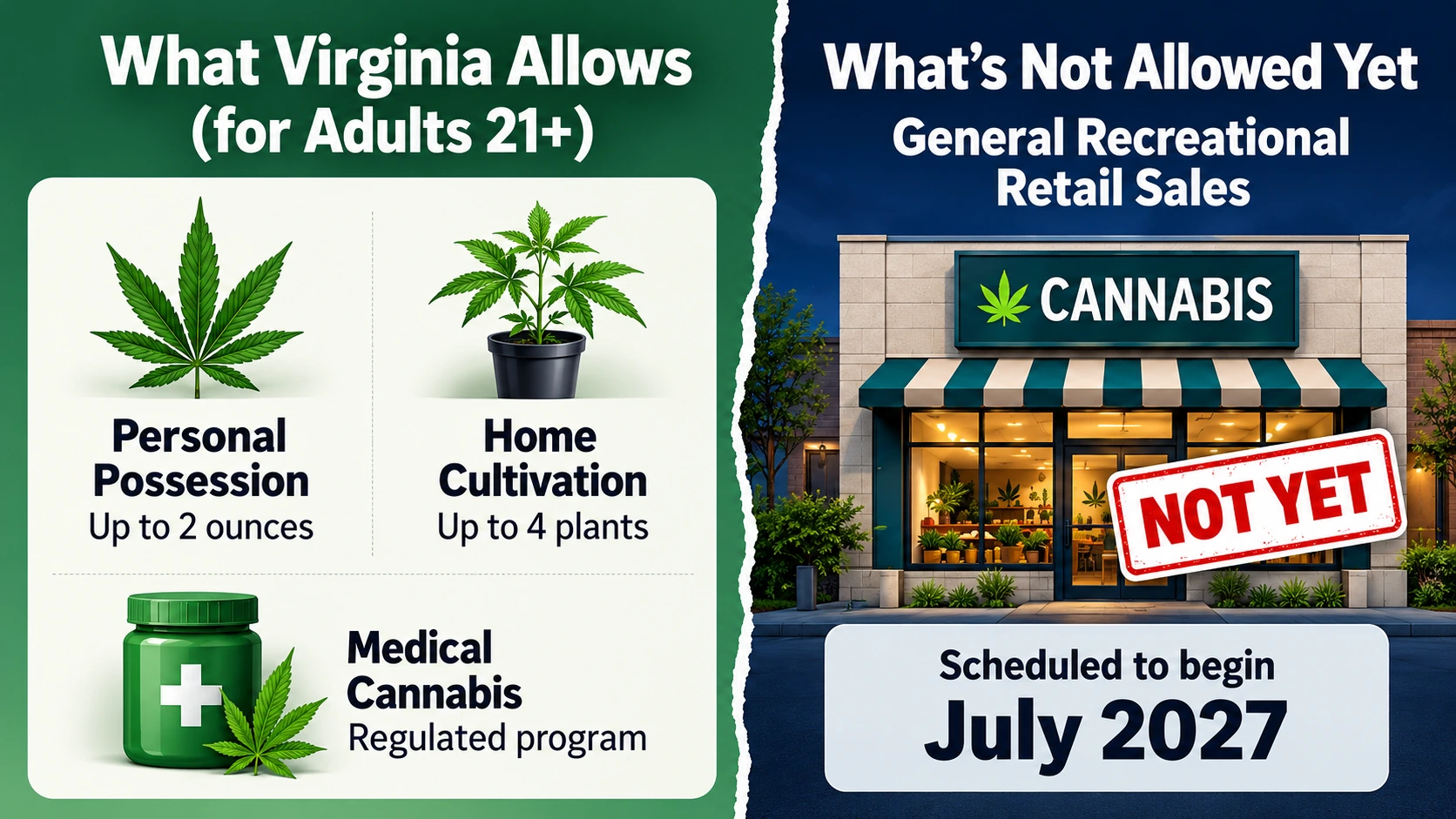
As of October 2026, nonmedical retail marijuana sales remain illegal. The state’s regulated recreational retail market is scheduled to allow sales beginning July 1, 2027. (Virginia Cannabis Control Authority · Virginia Retail Marijuana Market Timeline)
What Virginia’s Marijuana Laws Actually Allow
The distinction becomes clearer when the rules are placed side by side.
| Activity | Virginia law as of October 2026 |
|---|---|
| Possessing up to 2 ounces in public | Generally legal for adults 21 and older |
| Growing marijuana at home | Up to 4 plants per household under specified rules |
| Giving marijuana to another adult | Limited transfers without payment are permitted |
| Selling medical cannabis | Permitted through authorized medical cannabis businesses |
| Operating a recreational marijuana store | Not yet legal without the applicable future authorization |
These distinctions are explained by the Virginia Cannabis Control Authority.
Think of the difference between being allowed to make something for your own use and being authorized to operate a commercial business selling it.
Permission to possess a product is not the same thing as permission to run a retail operation.
Virginia’s government has spent years trying to establish the licensing, testing, enforcement, and consumer protection systems needed for legal recreational sales.
Until that market opens, an ordinary store cannot assume that legalization of personal possession gives it permission to sell recreational marijuana.
There is also a federal dimension. Marijuana remains subject to the federal Controlled Substances Act. In 2026, federal authorities moved certain FDA-approved and state-licensed medical marijuana products into Schedule III, but that limited change did not broadly legalize recreational marijuana distribution. (U.S. Drug Enforcement Administration)
The federal charges against Lucas therefore cannot be understood simply by asking whether Virginia residents may legally possess cannabis.
What Do Prosecutors Say Happened Inside the Cannabis Business?
Prosecutors allege that Lucas and several relatives and associates participated in an operation that acquired, distributed, and profited from marijuana outside the state’s lawful retail framework.
According to the Justice Department, the alleged enterprise involved at least 100 kilograms of marijuana, or roughly 220 pounds.
The government also alleges that the participants laundered proceeds from marijuana sales. That means prosecutors claim money generated through unlawful activity was moved or handled in ways designed to conceal or facilitate its use.
Those are allegations, not established findings. (U.S. Department of Justice)
Who Is Connected to the Business?
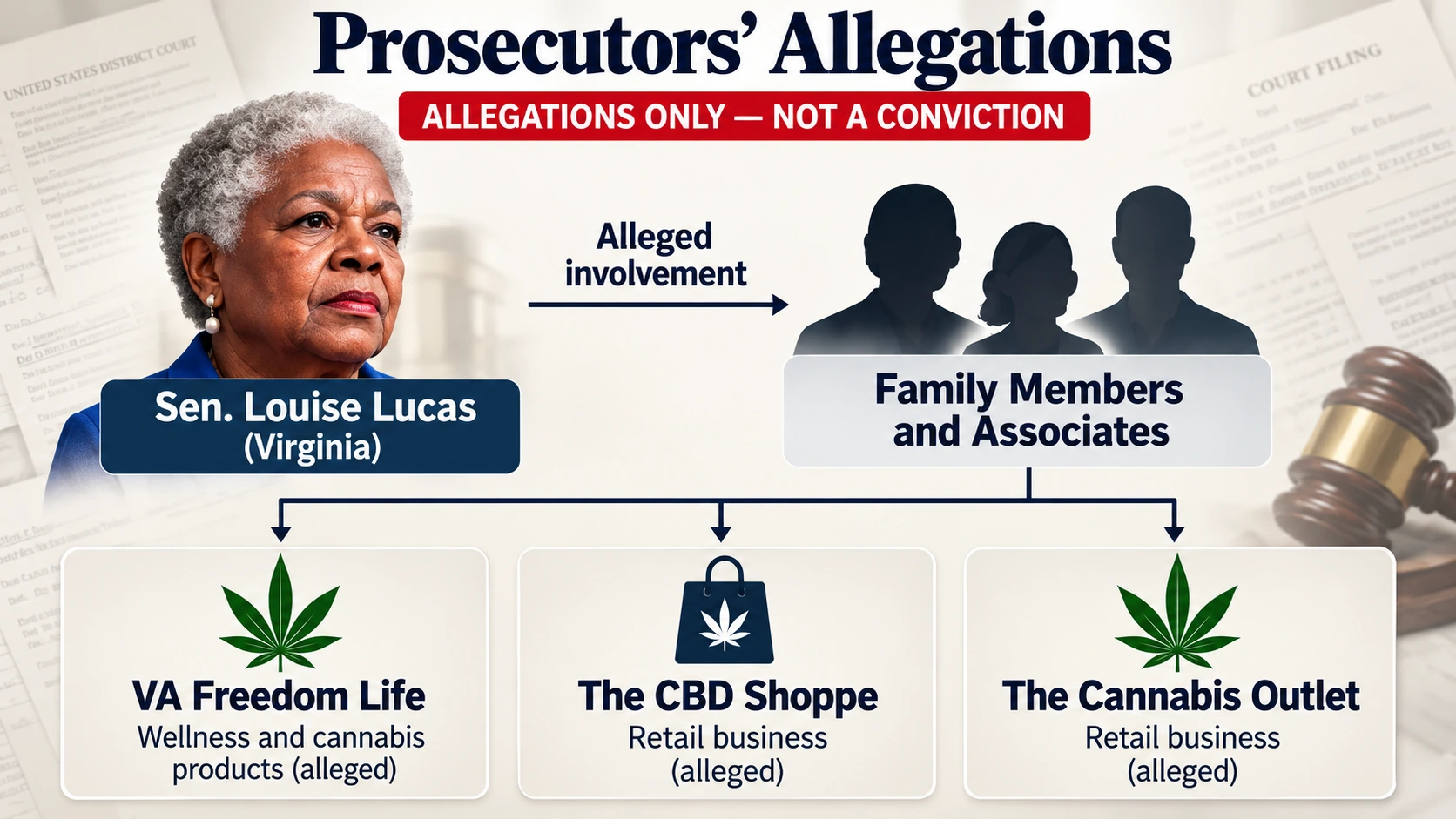
The Justice Department describes VA Freedom Life as a business associated with Lucas and Carlton Upton Jr. It identifies The CBD Shoppe and The Cannabis Outlet as businesses operating under that umbrella.
According to prosecutors, Lucas and her daughter Lisa Lucas-Burke opened The Cannabis Outlet in Portsmouth in 2021. They also allege that another daughter, Theresa Lucas-Lamb, and Lucas-Lamb’s son Ryan Eichelberger played roles in obtaining and distributing marijuana and managing the operation.
The government says Upton worked with Lucas on plans to obtain a recreational marijuana business license. (U.S. Department of Justice)
The distinction between confirmed relationships and alleged misconduct matters here. Owning a cannabis-related business or working with family members is not, by itself, proof of a criminal conspiracy.
Prosecutors must show what each defendant allegedly agreed to do and how that conduct satisfies the relevant criminal statutes.
What Happened During the FBI Searches?
On May 6, 2026, FBI agents executed federal search warrants at The Cannabis Outlet and The CBD Shoppe.
According to the Justice Department, agents recovered marijuana and firearms from the locations.
The searches became public months before the indictment was unsealed. But finding marijuana or firearms at a location does not, by itself, establish that Lucas personally committed every offense described in the indictment. (U.S. Department of Justice · AP)
Why Does Louise Lucas’s Political Position Matter?
The government’s public-corruption allegations make this more than a marijuana licensing case.
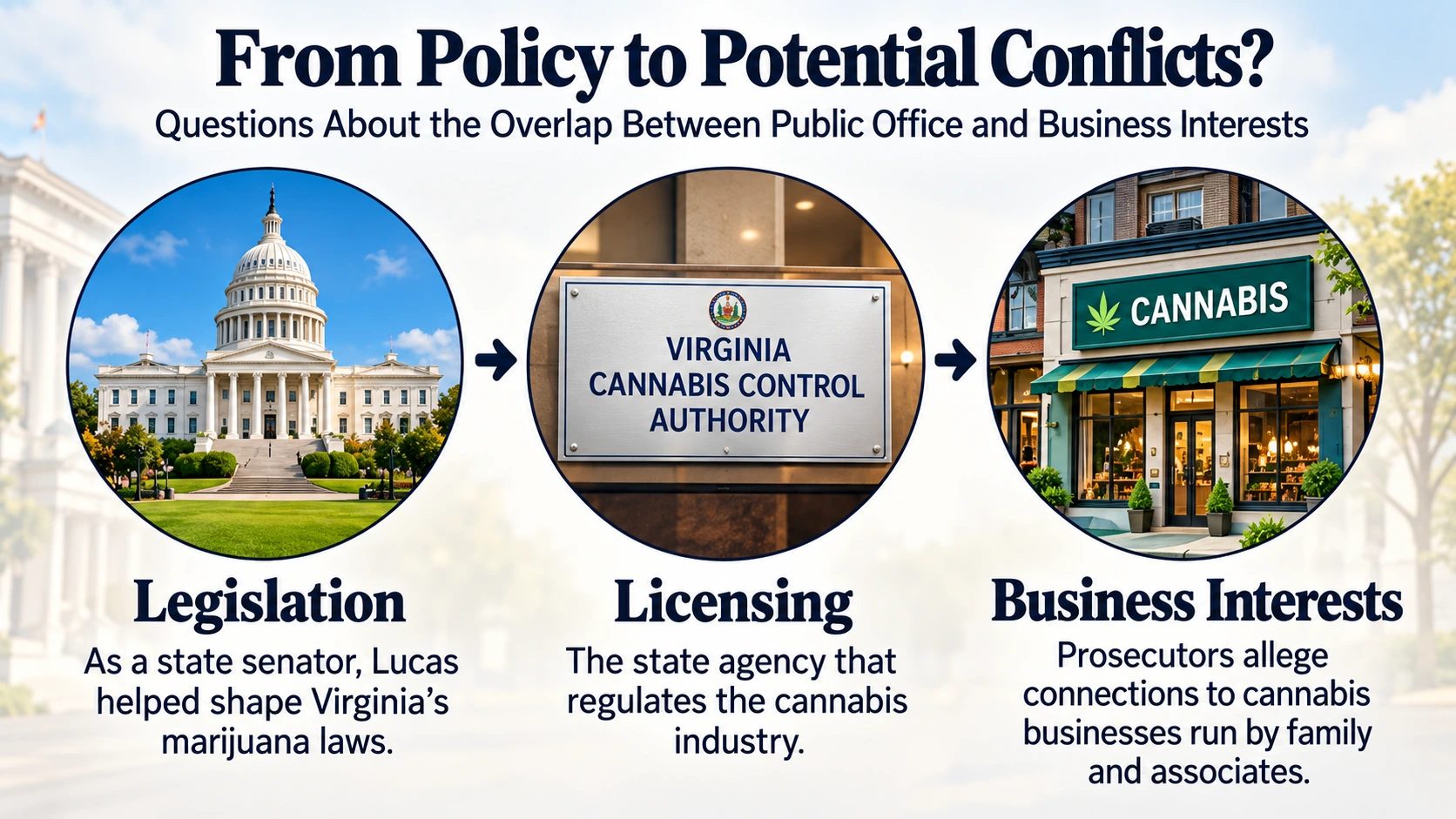
Lucas has served in the Virginia Senate since 1992. She holds the largely procedural title of president pro tempore, but her chairmanship of the Senate Finance and Appropriations Committee gives her substantial influence over state budgeting and legislation with financial implications.
That matters because the people who help shape a regulated industry may also have access to information and decisions that carry enormous business value.
Prosecutors allege that Lucas used her elected position to help protect the enterprise and influence decisions that could benefit its business interests. Lucas contests the case. (Reuters · U.S. Department of Justice)
What Is the Alleged Licensing Scheme?
One of the more consequential allegations involves a payment connected to an anticipated recreational marijuana license.
According to the Justice Department, Lucas allegedly paid $750,000 in August 2022 to acquire complete ownership of a company associated with another person’s expected future marijuana license.
Prosecutors also allege that she failed to disclose that interest on required financial reporting forms and engaged in discussions or actions involving an alleged bribery arrangement related to licensing decisions.
The government has not established those allegations as proven facts. Nor should the allegation be read as confirmation that the anticipated recreational license had actually been issued. (U.S. Department of Justice)
Why Could a License Be So Valuable?
In a newly regulated market, a license can determine whether a business is legally allowed to participate.
A company permitted to enter a new industry while other companies are still waiting for authorization may have a significant commercial advantage.
That creates a straightforward potential conflict: a lawmaker may legitimately work on rules governing the industry, but using official influence in exchange for improper personal financial benefits can create criminal liability.
The key legal question is not whether Lucas supported marijuana legalization while having cannabis business interests.
It is whether prosecutors can prove that she participated in an unlawful arrangement involving those interests and her official duties.
How Did Virginia End Up With Legal Marijuana but No Recreational Stores?
Virginia began legalizing adult personal possession before it created a functioning commercial retail system.
That gap persisted through several legislative sessions. Attempts to establish a recreational retail market encountered political disagreements and vetoes before a compromise was reached in 2026.
Governor Abigail Spanberger’s administration announced a negotiated approach in June 2026, with recreational sales scheduled to begin July 1, 2027. (Office of Governor Abigail Spanberger)
The Two Timelines Behind the Story
| Date | What happened |
|---|---|
| 2019 | Lucas and Upton’s business association began, according to prosecutors |
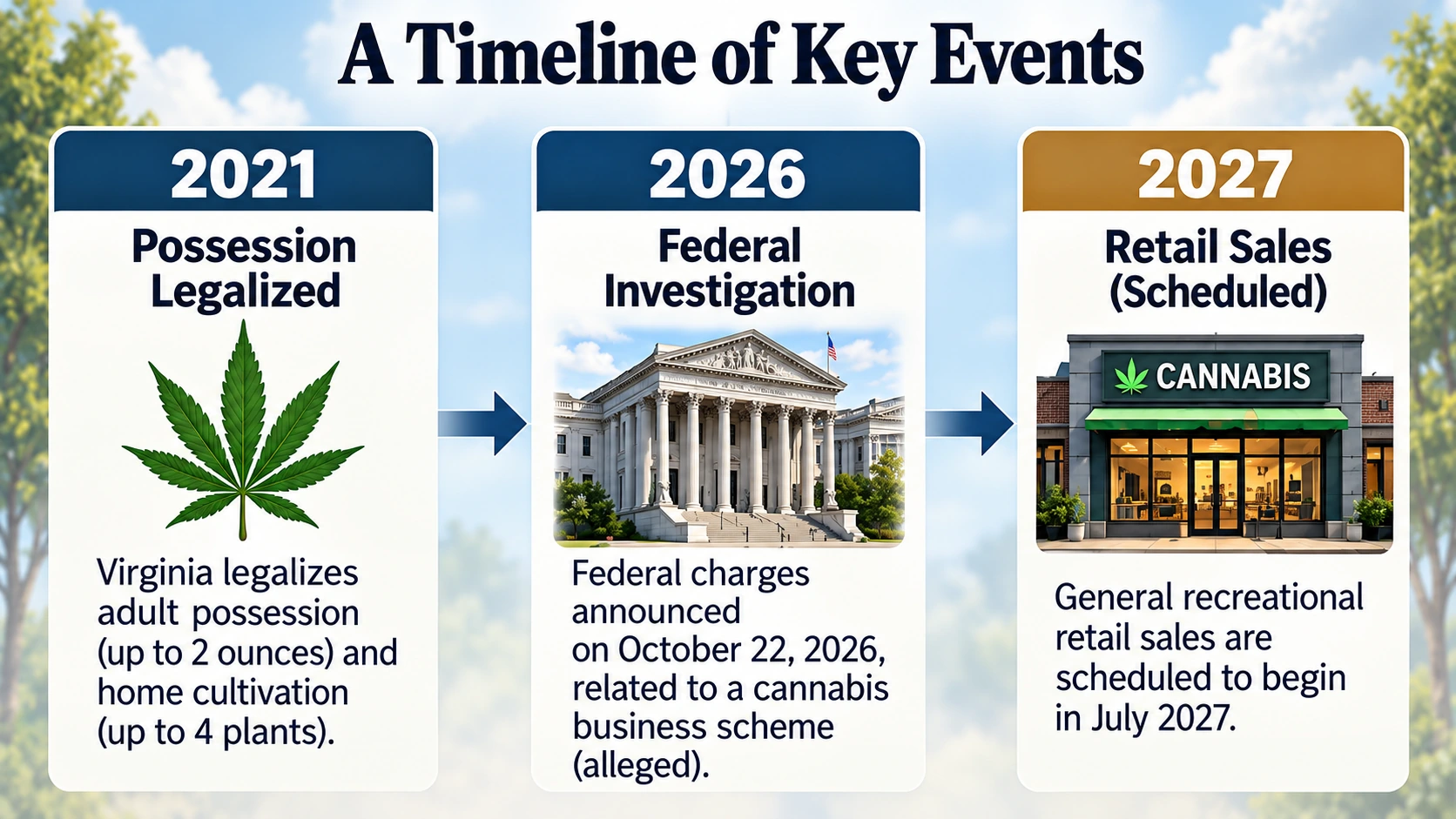
| July 2021 | Virginia began permitting limited adult marijuana possession |
| 2024–2025 | Legislative efforts to establish recreational retail sales encountered gubernatorial vetoes |
| May 6, 2026 | FBI agents searched cannabis-related business locations |
| June 16, 2026 | Virginia officials announced a compromise framework for regulated recreational sales |
| October 22, 2026 | Federal prosecutors publicly announced the indictment of Lucas and six others |
| July 1, 2027 | Regulated recreational retail sales are scheduled to begin |
The timeline combines federal prosecution information with Virginia’s official cannabis market announcements. (U.S. Department of Justice · Virginia Cannabis Control Authority)
The timing explains the apparent contradiction.
Virginia residents gained certain personal marijuana rights years before the state created the legal framework for recreational stores.
Businesses hoping to enter that future market therefore had an incentive to prepare early. But commercial opportunity did not remove the restrictions that remained in place.
That distinction helps explain why prosecutors are scrutinizing conduct allegedly occurring well before recreational retail licenses could become operational.
Is the Louise Lucas Prosecution Politically Motivated?
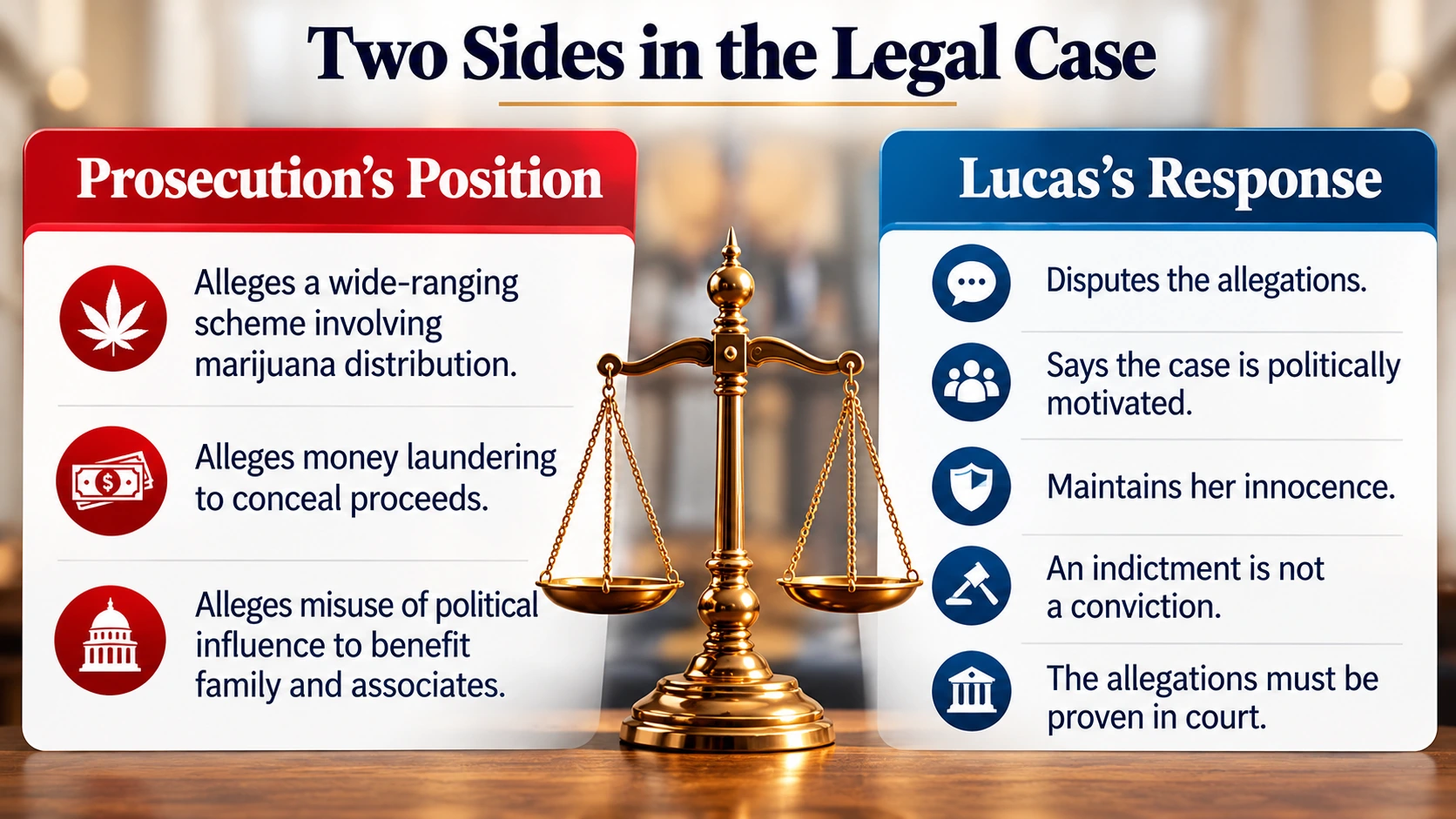
Lucas argues that federal law enforcement is being used to target or intimidate her. The Justice Department disputes that characterization.
Lucas has been an outspoken critic of President Donald Trump and his administration. The case has therefore attracted attention not only for the alleged crimes but also for the timing and political circumstances of the prosecution.
The indictment was made public less than two weeks before the November 2026 midterm elections, although Lucas herself is not on the ballot. (Reuters)
What Has Lucas Said?
In a statement after the indictment became public, Lucas rejected the idea that federal pressure would silence her.
She invoked her experiences growing up under Jim Crow segregation and suggested that the prosecution was part of an effort to intimidate political opponents.
Her public statement included the words: “I will not be intimidated. I will not be bullied.” (Courthouse News Service · Axios)
Her response frames the case as a dispute about the use of government power. It does not, by itself, resolve the specific criminal allegations.
What Does the Justice Department Say?
Attorney General Todd Blanche has rejected suggestions that the prosecution is politically motivated.
He said the investigation began before Trump returned to office in January 2025 and defended the decision to proceed with the charges.
That is the Justice Department’s account of the investigation’s history and timing, rather than an independent judicial finding about the government’s motives. (AP · Reuters)
Virginia Governor Abigail Spanberger has also emphasized the presumption of innocence while questioning the timing of the indictment so close to an election. (FOX 5 DC)
Three separate questions should therefore be kept apart:
| Question | What is established? |
|---|---|
| Was Lucas indicted? | Yes. A federal indictment was publicly announced on October 22. |
| Have the criminal accusations been proven? | No. An indictment is not a conviction. |
| Was the prosecution politically motivated? | The parties disagree; the competing claims do not establish a definitive answer. |
It is possible to examine the seriousness of the charges and the concerns surrounding prosecution timing without presuming guilt or accepting an unproven claim of political retaliation.
What Could This Case Mean for Virginia’s Cannabis Industry?
The case places new attention on how Virginia awards and oversees cannabis business licenses.
The Commonwealth’s regulated retail system is scheduled to begin operating in July 2027. Before that happens, the Virginia Cannabis Control Authority must complete key regulatory and licensing steps.
According to the authority’s published timeline, final regulations and the initial application process are among the milestones preceding the retail launch. (Virginia Cannabis Control Authority)
That makes transparency particularly important.
Cannabis businesses need to know that licenses are awarded according to published qualifications and procedures, rather than personal relationships or political access.
The indictment raises questions about those safeguards, but it does not establish that Virginia’s licensing program as a whole is corrupt or that the planned launch has been canceled.
Could Ordinary Cannabis Consumers Be Affected?
The indictment does not itself repeal Virginia’s existing marijuana possession rules or change the scheduled retail opening date.
Residents should still distinguish personal possession, limited home cultivation, medical cannabis sales, and recreational commercial sales.
For consumers, the immediate practical lesson is that a storefront advertising cannabis products is not necessarily authorized to sell recreational marijuana.
For prospective business owners, the lesson is that compliance depends on the specific products, licenses, and activities involved—not merely on a state’s general legalization policy.
What Happens Next in the Federal Case?
The next stage is the federal criminal court process, where prosecutors must support their allegations with admissible evidence and the defendants can challenge the case.
Lucas surrendered to federal authorities on October 22 and made an initial appearance in federal court in Norfolk that afternoon. She was released on her own recognizance, and her arraignment was scheduled for November 16. (AP · The Washington Post)
The case is proceeding in the U.S. District Court for the Eastern District of Virginia. The Justice Department identifies it as Case No. 4:26-cr-75. (U.S. Department of Justice)
Several developments will be particularly important.
First, court filings and hearings may provide a clearer picture of the evidence supporting the alleged marijuana distribution and financial transactions.
Second, the public-corruption counts will put attention on the difference between lawful legislative advocacy, disclosed private business interests, and any alleged exchange of official influence for improper financial benefit.
Third, the defendants’ responses, motions, and eventual trial proceedings—if the case reaches trial—will help determine which claims can actually be established.
There is no conviction merely because a grand jury returned an indictment. The prosecution bears the burden of proving guilt beyond a reasonable doubt.
The case may also generate political debate over Lucas’s leadership positions, but any institutional decision about those roles is separate from a criminal verdict.
Bottom Line: What This Story Really Means
Louise Lucas was not indicted simply because she owned an interest in a cannabis-related business in a state that legalized marijuana possession.
Federal prosecutors allege a much broader scheme involving unauthorized marijuana distribution, financial misconduct, and the misuse of political influence.
The unusual legal backdrop makes the story particularly confusing: Virginia legalized limited adult possession years ago, but its regulated recreational retail market is not scheduled to begin until July 2027.
The charges remain allegations, and Lucas is entitled to contest them in court.
Beyond her individual case, the controversy highlights why marijuana legalization, commercial licensing, federal enforcement, and public ethics are separate legal questions.
Understanding those distinctions makes the apparent contradiction in the headline much easier to understand.
Louise Lucas Indictment: Key Questions Explained
Q. Who is Louise Lucas?
L. Louise Lucas is a longtime Democratic Virginia state senator who serves as Senate president pro tempore and chairs the Senate Finance and Appropriations Committee.
Q. When was Louise Lucas indicted?
The federal indictment was publicly announced and unsealed on October 22, 2026. The Justice Department says the case involves Lucas and six other defendants.
Q. What federal charges does Louise Lucas face?
Lucas faces five counts involving alleged racketeering conspiracy, marijuana distribution conspiracy, money laundering conspiracy, honest services fraud conspiracy, and maintaining a drug-involved premises.
Q. Is recreational marijuana legal in Virginia?
Certain adult possession, cultivation, and sharing activities are legal under state law. General recreational retail sales are not yet authorized and are scheduled to begin under a regulated licensing system on July 1, 2027.
Q. Can marijuana businesses operate legally in Virginia?
Yes, some cannabis-related businesses can operate legally, including authorized medical cannabis facilities and compliant hemp businesses. That does not mean an ordinary store may currently sell recreational marijuana.
Q. Why does federal law matter if a state legalizes cannabis?
State legalization does not automatically eliminate federal restrictions. Federal law continues to regulate marijuana distribution, and the 2026 medical marijuana rescheduling changes did not create unrestricted recreational sales rights.
Q. Why were Lucas’s family members included in the case?
Federal prosecutors allege that certain relatives and business associates participated in the enterprise. Their precise legal responsibility depends on the allegations and evidence concerning each defendant.
Q. What does the marijuana licensing allegation involve?
Prosecutors allege that Lucas had financial interests connected to a potential future cannabis license and sought improper advantages through her public position. Those allegations have not been proven in court.
Q. Has Louise Lucas been found guilty?
No. The indictment is an accusation, not a conviction. Lucas disputes the prosecution, and guilt would have to be established through the criminal justice process.
Q. Does the indictment delay Virginia’s legal marijuana retail market?
The indictment itself does not change the scheduled July 1, 2027, retail launch. The state regulatory and licensing process remains a separate matter.
Did this help make the story clearer? 🙂
WIN keeps unpacking the “why” behind the news—clearly and simply!
Sources
Federal Indictment and Criminal Allegations
U.S. Attorney’s Office, Eastern District of Virginia — Indictment Announcement and Case Details
Virginia Cannabis Laws and Retail Licensing
Virginia Cannabis Control Authority — Cannabis Laws and Regulations
Virginia Cannabis Control Authority — Retail Marijuana Market and Licensing Timeline
Governor of Virginia — June 16, 2026, Retail Cannabis Market Agreement
U.S. Drug Enforcement Administration — Marijuana Rescheduling Regulatory Actions
Political Responses and Independent Reporting
Associated Press — Powerful Virginia Senator Accused of Leading Marijuana Conspiracy
Reuters — Top Virginia Lawmaker Charged With Running Illegal Cannabis Operation
Courthouse News Service — Federal Cannabis Enterprise Charges and Lucas’s Response
FOX 5 DC — Spanberger Statement on the Indictment
The Washington Post — Louise Lucas Federal Indictment and Initial Hearing