Why Did Elon Musk Restrict Ukraine’s Starlink—and Who Really Controls It?

A country is fighting a war. Its soldiers rely on satellite internet to communicate, move supplies, and operate drones. Then, without warning, a restriction makes some of that equipment stop working properly.
Who has the authority to do that?
Ukraine faced exactly this problem in October 2026 when restrictions on SpaceX’s Starlink and Starshield satellite services interfered with military operations against Russia.
On October 24, Ukrainian officials announced that normal operating capabilities had been restored. Hours later, Elon Musk accused Ukraine’s military of violating Starlink’s rules and said SpaceX had closed a loophole that allowed offensive drone strikes.
That sounds like a straightforward explanation. But there is a complication.
Starlink and Starshield are not the same service. Musk says the U.S. government controls Starshield, while separate reporting has pointed to decisions involving both the White House and Musk himself.
The central question is no longer just why Ukrainian drones lost connectivity.
It’s who can change a communications system that an entire military depends on—and who is accountable when that happens.
※ Images in this article are AI-generated illustrations created to help explain the story. They are not actual photographs, and depictions of people, places, or events may differ slightly from reality.
What Actually Happened to Starlink in Ukraine?
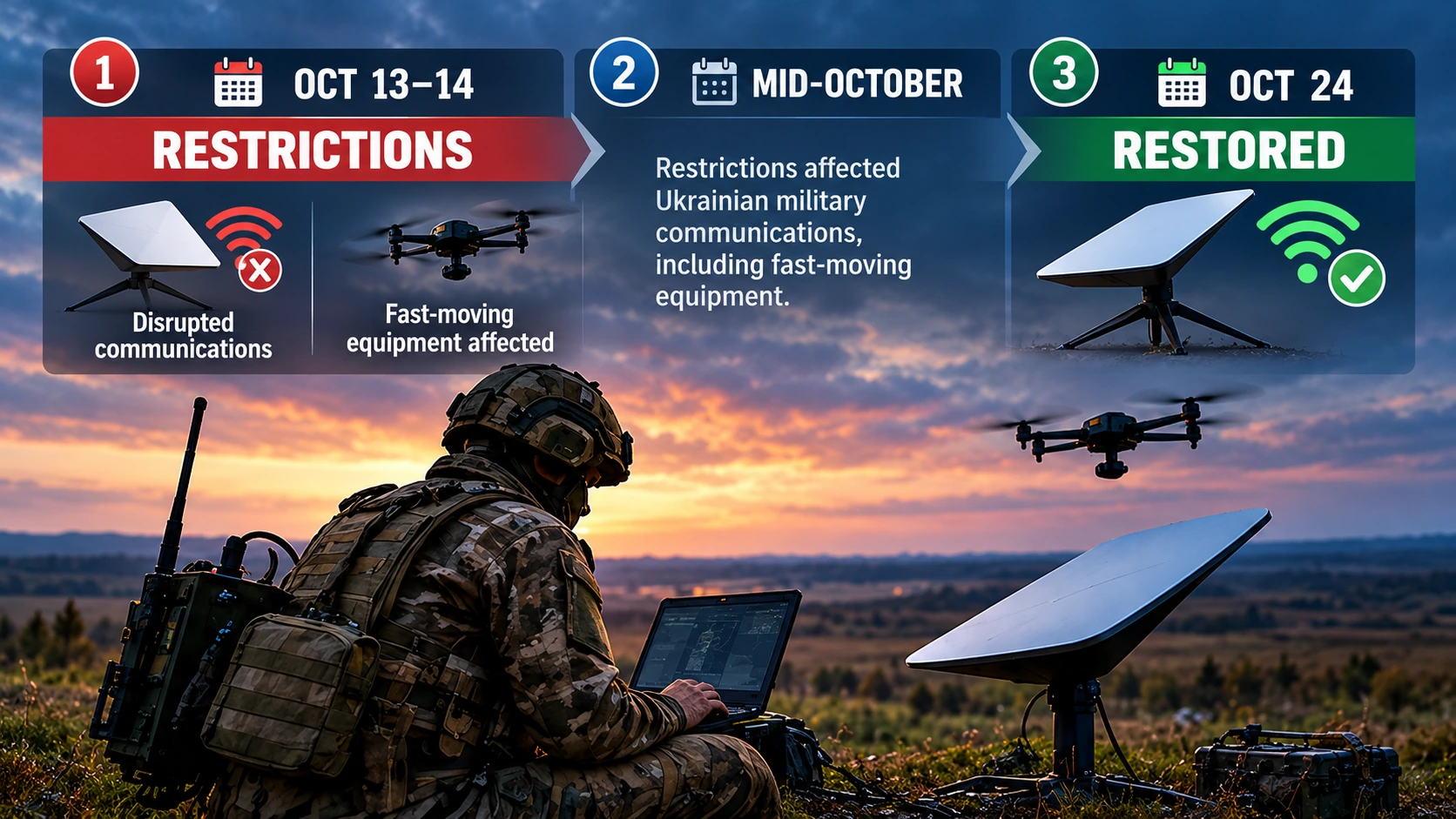
Ukraine’s satellite communications difficulties began in mid-October, when newly imposed restrictions affected equipment moving at high speeds. On October 24, Ukraine announced that the affected systems were operating at their earlier speeds again.
The problem was not necessarily that every Starlink terminal across Ukraine stopped providing internet.
Instead, Ukrainian officials described a limitation that particularly affected devices installed on fast-moving military platforms.
The reported restrictions interfered with drone missions, air-defense operations, and frontline logistics.
On October 24, Ukraine’s Ministry of Defense announced that monitoring systems were recording stable Starlink and Starshield connections on equipment moving faster than 400 kilometers per hour.
President Volodymyr Zelenskyy confirmed that the systems had returned to their pre-restriction operating levels and thanked American officials and other partners who helped address the disruption. (Ukrainian Ministry of Defense · President of Ukraine)
The sequence helps explain how the controversy developed:
| Date | What happened |
|---|---|
| October 13–14 | Ukrainian forces encountered new restrictions affecting Starshield and fast-moving equipment. |
| October 15 | Reuters reported that officials had traced an order to restrict Starshield to the White House. |
| October 20–23 | Conflicting accounts emerged over who authorized the restrictions and whether they had been lifted. |
| October 24 | Ukraine announced restored operating speeds. Musk subsequently defended restrictions on commercial Starlink use. |
The recovery was significant, but it did not settle the question of responsibility.
In fact, Musk’s comments raised another question: what exactly had SpaceX restricted?
Why Did a 100 MPH Speed Limit Cause Such a Military Problem?
Because the limit concerned how fast a device could travel while maintaining satellite connectivity, not how quickly someone could download data.
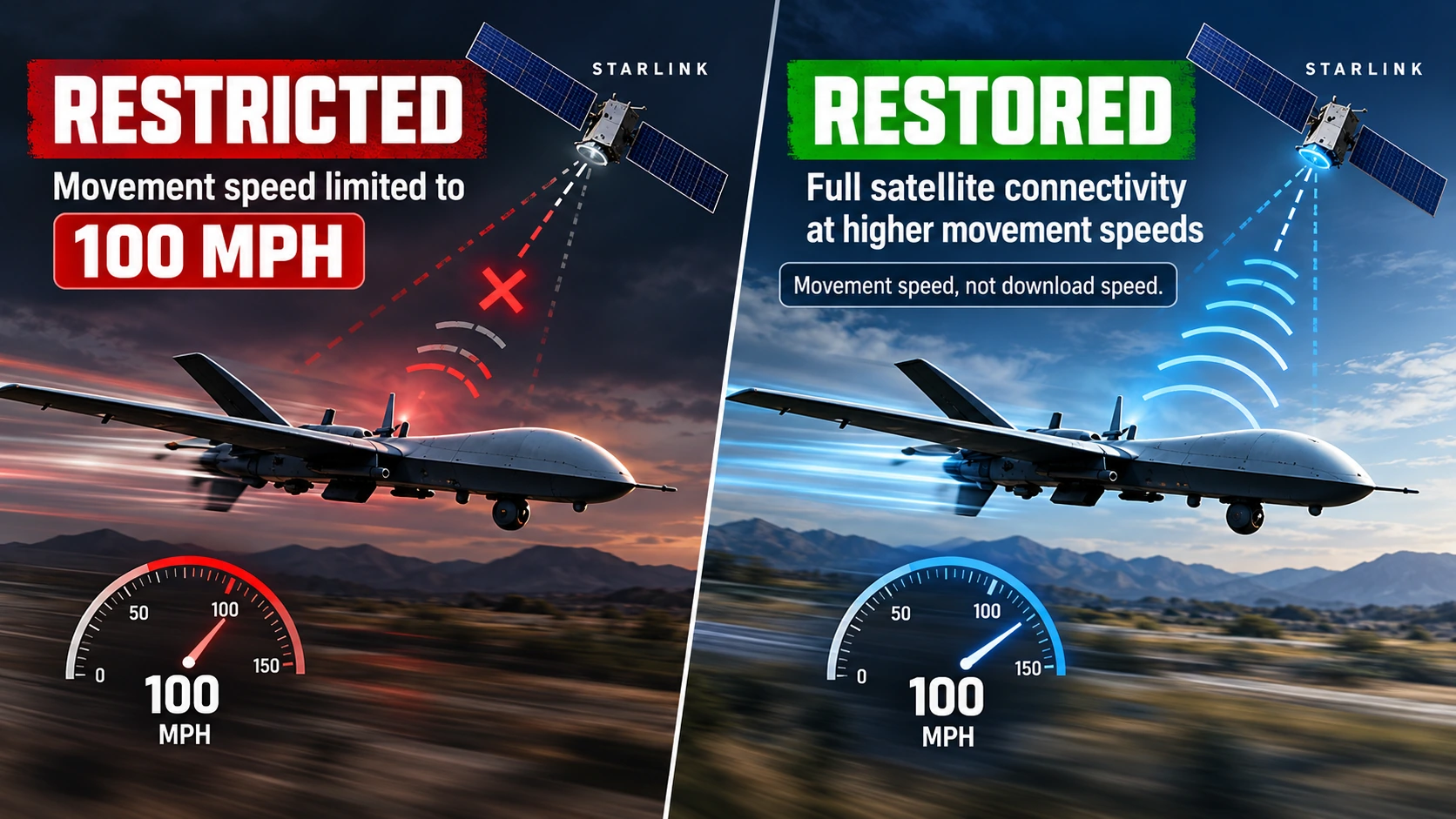
When people hear that Starlink’s speed was reduced, they might assume that internet service simply became slower.
That was not the central issue here.
A satellite terminal can provide a fast internet connection while remaining subject to restrictions on how quickly the vehicle carrying it may travel.
Ukrainian officials said the October restrictions caused connections to become unreliable when equipment moved at around 100 mph, or 160 kilometers per hour.
For a stationary command post, this might have had little immediate effect. For a fast-moving drone, the consequences could be far more serious.
Consider a Ukrainian interceptor drone chasing an incoming Russian attack drone.
The Ukrainian drone may need a reliable communications link for navigation, operator commands, or other mission functions. If its satellite connection stops working above a particular movement speed, the drone may lose an important operational capability precisely when speed is essential.
That does not mean every drone automatically crashes or that every Ukrainian drone relies on Starlink. Different systems use different communications and control methods.
But Ukrainian officials reported that the restrictions prevented some operations from proceeding and interfered with efforts to intercept Russian drones. (Reuters · AP)
The October 24 announcement therefore concerned a military capability that had been restored, not merely improved consumer internet performance.
That distinction matters because a technical setting that sounds minor can substantially change what equipment can accomplish in the field.
Why Did Elon Musk Say Ukraine Violated Starlink’s Rules?
Musk argued that Ukraine had used commercial Starlink service for offensive drone strikes, something he said the company never permitted.
In an October 24 post on X, Musk accused the Ukrainian military of using commercial Starlink connections to conduct offensive strikes.
He wrote that Ukraine had violated the service’s terms and that the loophole had been closed the previous week.
He also emphasized that Starshield was a separate system whose decisions, in his account, were controlled by the U.S. government. (Reuters · AP)
What Is the Difference Between Starlink and Starshield?
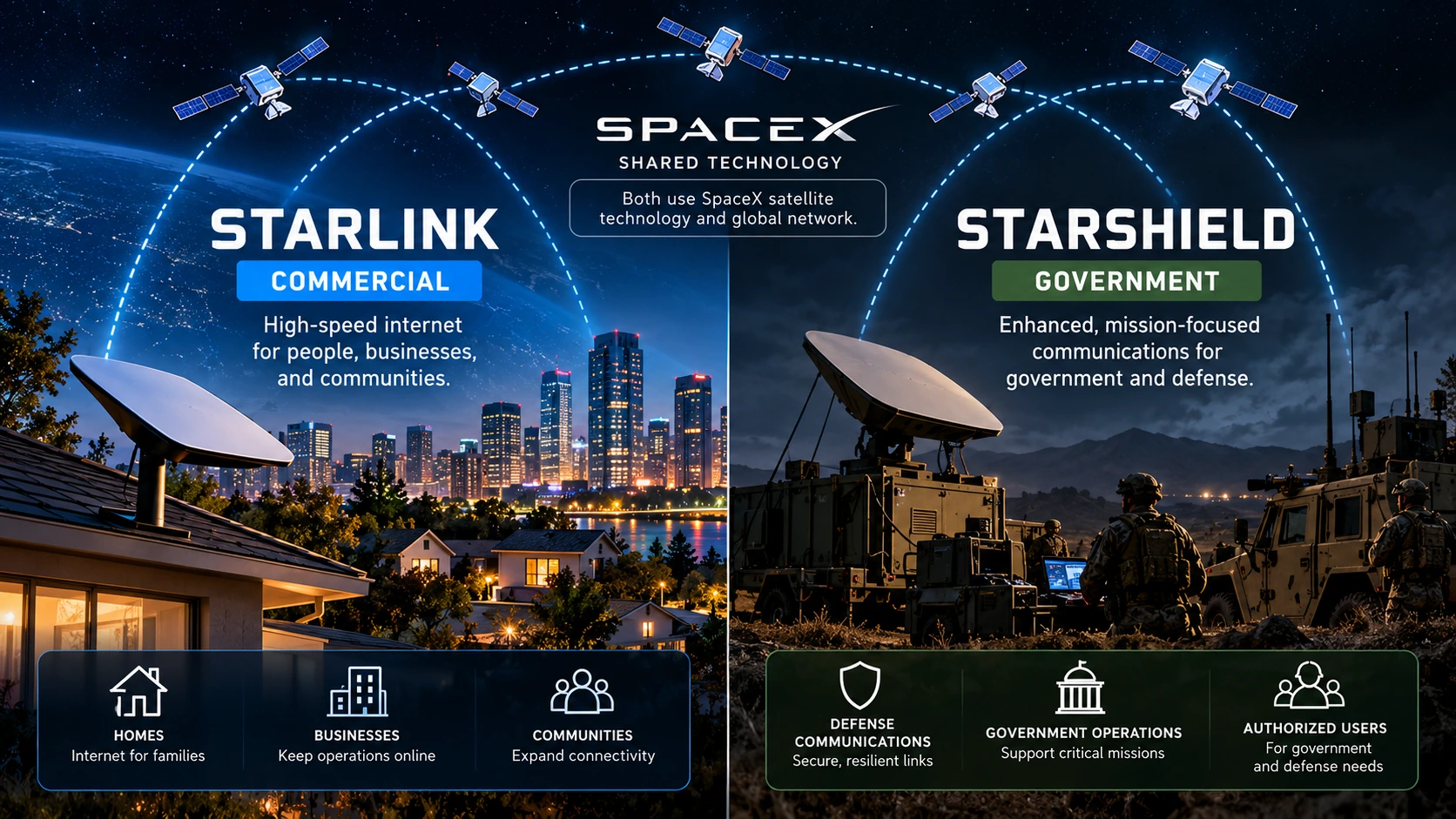
SpaceX operates both products, but they are designed for different purposes.
| Feature | Starlink | Starshield |
|---|---|---|
| Primary purpose | Commercial satellite internet | Government and national-security services |
| Typical users | Consumers, businesses, civilian organizations | Defense and government customers |
| Military applications | Restricted under commercial terms | Designed to support government defense requirements |
| Technology | SpaceX satellite internet network | Builds on SpaceX technology with additional security capabilities |
| Control controversy | SpaceX’s commercial service policies | Disputed authority under government arrangements |
SpaceX describes Starshield as a government-focused system that supports secure communications, Earth observation, and other national-security missions.
Unlike ordinary commercial Starlink offerings, Starshield is specifically designed for government use. (SpaceX · Starlink Government Services)
Does Starlink Actually Prohibit Military Use?
Starlink’s published terms state that its commercial equipment and services are not designed or intended for integration with offensive or defensive weapons.
The terms also address export-control requirements that may apply when products are modified for military purposes. (Starlink Terms of Service)
That provides a documented basis for SpaceX’s distinction between commercial communications and military weapons applications.
But the existence of those terms does not independently establish that Ukraine committed the particular violation Musk alleged.
Ukrainian presidential adviser Serhii Beskrestnov disputed the accusation. He said commercial Starlink was already subject to restrictions that made its use for medium- and long-range drone strikes physically impractical.
His explanation also highlighted the distinction between Ukraine’s commercial Starlink equipment and its military Starshield capabilities. (Reuters)
There are therefore two separate questions.
One is whether SpaceX has policies restricting the use of commercial Starlink in weapons systems. Its published terms show that it does.
The other is whether those policies explain the specific October restrictions that affected Ukraine’s military communications.
That remains disputed.
Who Really Controls Starshield: Musk, SpaceX, or the U.S. Government?
The publicly available evidence does not establish one clear decision-maker for every October restriction.
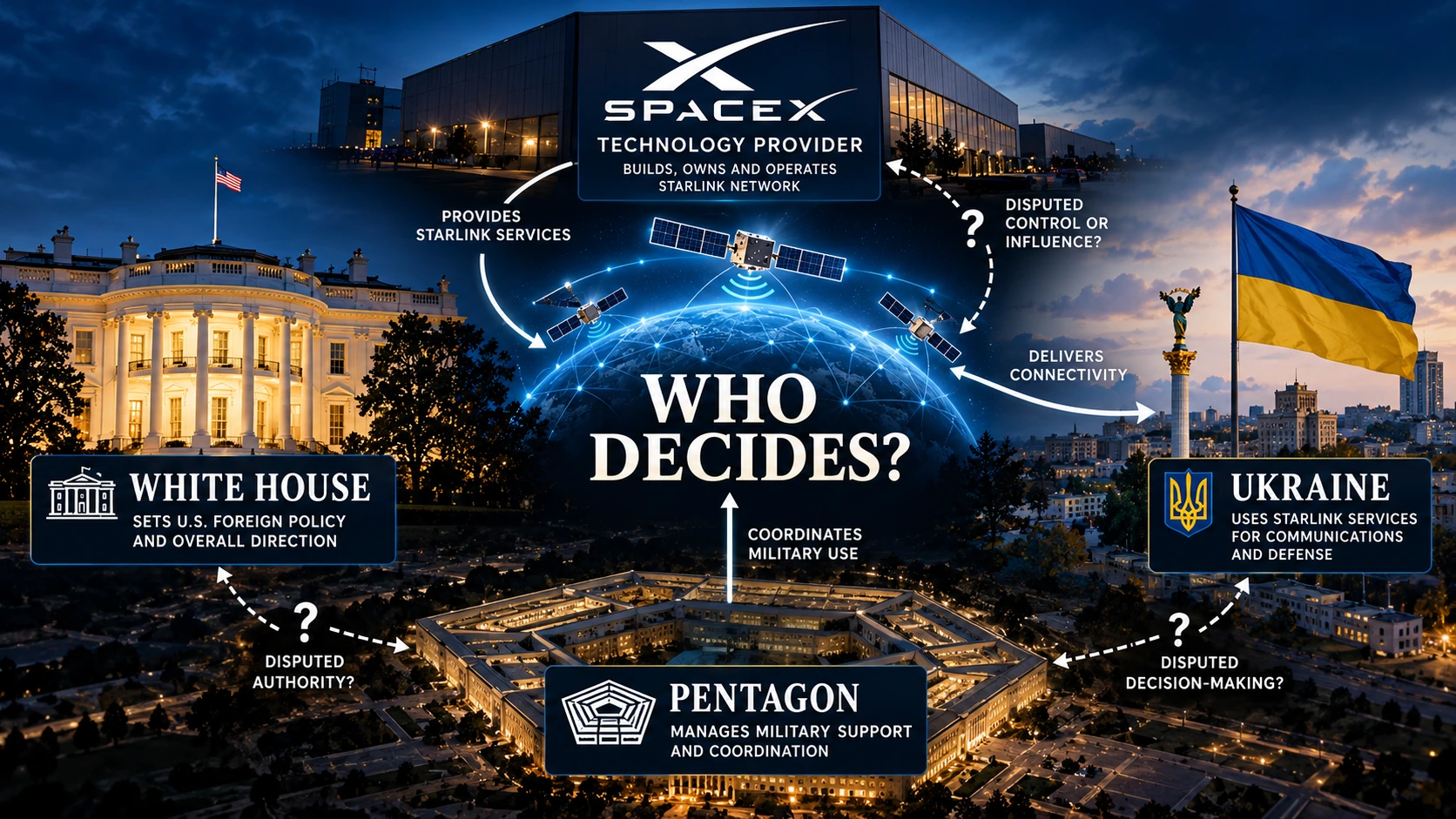
Musk has repeatedly said that Starshield is controlled by the U.S. government and that military decisions concerning the system are not his to make.
But reporting about the October disruption has presented a more complicated picture.
On October 15, Reuters reported that two U.S. officials and a Western official said the instruction to restrict Starshield originated inside the White House.
Those sources did not identify who made the decision. A senior U.S. official denied that President Trump personally ordered the restriction. (Reuters)
Separate reporting by The Wall Street Journal attributed the slowdown to Musk. Reuters reported that allegation but said it could not independently verify the Journal’s account at the time. (Reuters)
The Trump administration also offered differing public explanations.
Secretary of State Marco Rubio said decisions concerning Ukraine’s access to Starlink were up to SpaceX and Musk. Musk, meanwhile, pointed to U.S. government control of Starshield.
Trump denied personally ordering the restrictions and later said he would address the problem if Ukraine’s access had not been restored. (AP · Washington Post)
The Difference Between Technical Control and Legal Authority
This is where the controversy becomes especially important.
Several different forms of control may exist over the same communications service.
- Technical control: Who can implement a restriction through the network’s operating systems?
- Contractual authority: Who is permitted to order a change under an agreement?
- Government authority: Which officials can lawfully direct a change in military capabilities?
- Operational dependence: Who actually suffers the consequences when service changes?
Those are not necessarily the same person or organization.
A company may operate the technical infrastructure while a government has contractual rights to direct its use. That does not automatically tell us which party initiated a particular restriction.
In Ukraine’s case, the public record has not fully resolved that chain of authority.
Congress Wants Answers
On October 22, Sen. Richard Blumenthal, the ranking Democrat on the Senate Permanent Subcommittee on Investigations, announced an inquiry into Starlink and Starshield.
He requested information from SpaceX and the Pentagon about who ordered the restrictions, how they were implemented, and whether SpaceX could independently alter military communications.
His inquiry also seeks details about the government’s dependence on SpaceX technology and the safeguards governing future service changes.
The requests included a November 5 deadline for written responses and a November 12 deadline for a briefing from knowledgeable SpaceX officials. Those are requested deadlines, not evidence that the questions have already been answered. (U.S. Senate — Blumenthal Inquiry)
The inquiry does not establish that Musk or any government official acted unlawfully.
It does, however, show that the dispute has become a question of U.S. defense oversight.
Why Has Ukraine Become So Dependent on SpaceX?
Because satellite communications have become essential to Ukraine’s military operations, particularly when conventional communications infrastructure is damaged or vulnerable to disruption.
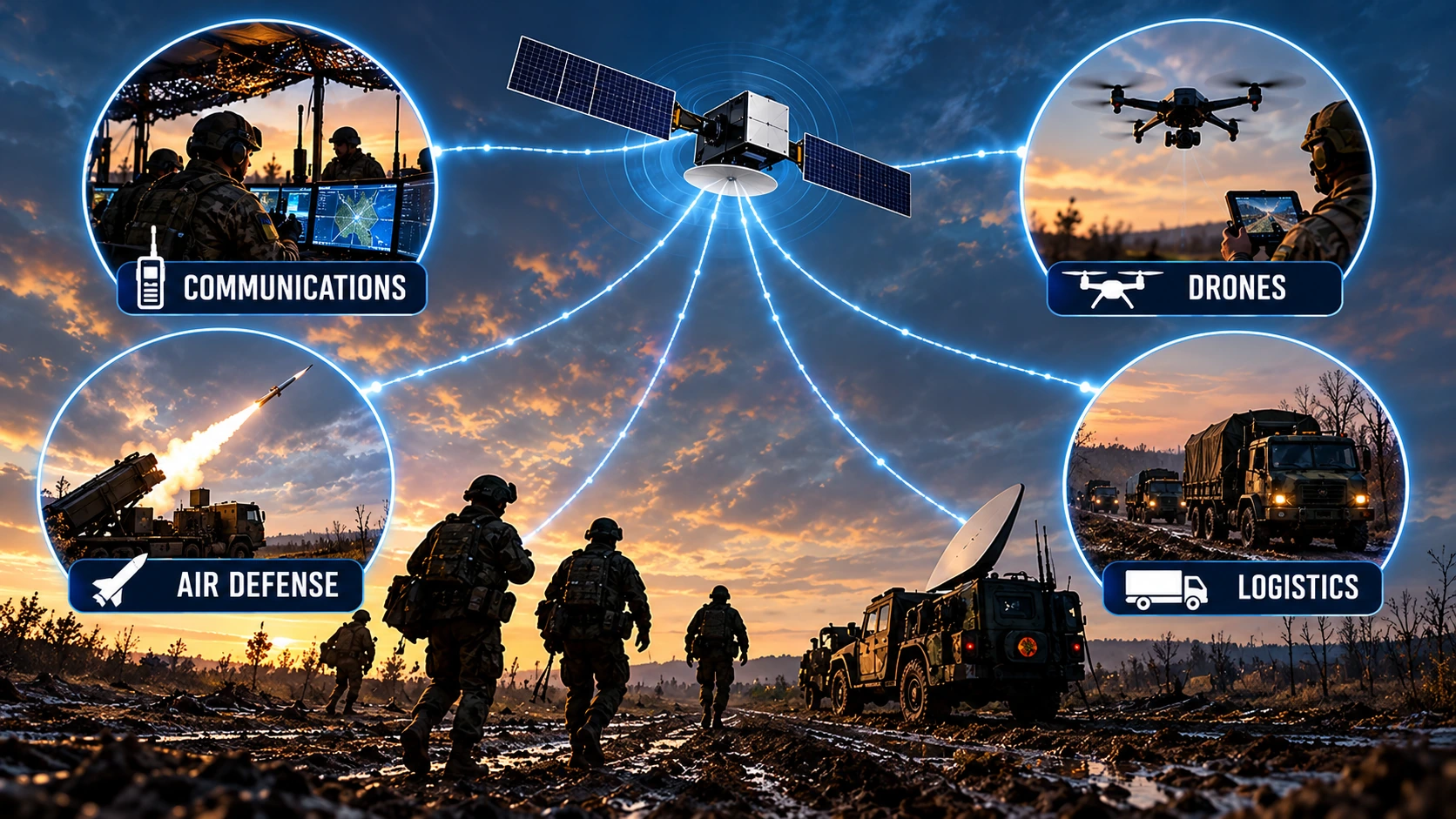
Russia’s full-scale invasion began in February 2022.
As the war developed, Starlink became a major communications resource for Ukrainian forces, civilian institutions, and emergency services.
Satellite internet is especially useful during a conflict because it can provide connectivity where conventional terrestrial networks are damaged, disrupted, or unavailable.
But communication in modern warfare is not limited to soldiers talking over radios.
Military units need to exchange information about drone activity, coordinate movements, share intelligence, and respond to rapidly changing conditions.
When that information depends on a communications service, losing access can interrupt several activities at once.
This helps explain why the October restrictions became such a serious issue for Ukraine.
Why Defensive Drones Matter
Ukraine uses drones for multiple missions, including reconnaissance, attacks on military targets, and interceptions of incoming Russian drones.
Some interceptor drones are intended to destroy hostile drones before they reach Ukrainian cities or infrastructure.
A speed restriction that affects the communication systems of those interceptors can create a direct defensive problem.
Other restrictions can interfere with strike missions and military logistics.
The exact consequences depend on the aircraft, communications equipment, mission, and alternative systems available. The October reports do not establish that every Ukrainian drone experienced the same disruption. (AP · Reuters)
The Larger Risk: A Single Point of Dependence
Imagine a business whose payment processing, customer records, and internal communications all depend on one technology provider.
If that provider suddenly changes an essential service, several parts of the business could be affected simultaneously.
The military stakes are much higher, but the underlying vulnerability is similar.
A communications service can become so central to operations that a relatively narrow restriction creates widespread difficulties.
This does not mean SpaceX’s technology is uniquely unreliable. Ukraine’s extensive use of its services reflects the capabilities and practical advantages those services have provided.
The concern is that dependence on one provider gives any decision about that provider’s service unusually significant consequences.
For the United States, this is also a defense procurement issue. The Pentagon relies on commercial companies for various advanced technologies, and the Ukraine experience raises questions about how those relationships should be governed.
Has Musk Been Involved in Similar Starlink Controversies Before?
Yes. The tension between helping Ukraine defend itself and restricting commercial satellite internet for offensive military operations dates back years.
In February 2023, SpaceX President Gwynne Shotwell said the company had taken steps to prevent Ukraine from using Starlink to control drones for offensive purposes.
Her position was that providing communications support did not necessarily mean authorizing every potential battlefield application.
That distinction was already part of SpaceX’s public approach long before the October 2026 restrictions. (Reuters)
Another controversy concerned a Ukrainian request to activate Starlink coverage near Russia’s naval forces in Crimea during 2022.
Some early reports suggested Musk had disabled service during the attempted attack.
That version was subsequently corrected.
The clarified account was that Starlink coverage had not been enabled in the relevant area and that Musk declined Ukraine’s request to activate it.
This is an important factual distinction: refusing to extend a service is not necessarily the same as shutting off service that was already operating. (Washington Post · Reuters)
Then, in July 2025, Reuters published an investigation reporting that Musk had ordered restrictions on Starlink coverage during a Ukrainian counteroffensive in 2022.
SpaceX disputed that reporting as inaccurate.
The disagreement over that earlier incident illustrates why claims about specific service restrictions require careful examination of the evidence and the distinction between the company’s stated policies and individual operational decisions. (Reuters)
The October 2026 episode has now renewed those questions on a much more immediate timetable.
What Happens After Ukraine’s Starlink Service Is Restored?
Restoration resolves the immediate operational problem reported by Ukraine, but it does not automatically resolve the dispute over authority or prevent similar disruptions.
Three issues deserve particular attention.
Will the Actual Decision-Making Process Become Public?
The Senate inquiry could clarify whether the October restrictions were directed by SpaceX, the Pentagon, the White House, or some combination of parties with different responsibilities.
It could also establish whether advance notice was required and whether existing agreements contain adequate safeguards.
Until documentation and a clearer official account emerge, assigning definitive responsibility for every restriction would go beyond the established public record.
Could Ukraine Reduce Its Dependence on One Satellite Provider?
Ukraine has been exploring alternative communications options, including other satellite networks.
But replacing an established military communications service requires more than finding another company that offers internet connectivity.
Equipment must work with existing systems, deliver adequate coverage and reliability, and support the operational requirements of the military.
A backup system that handles routine communications may not necessarily meet the requirements of fast-moving drones.
That makes diversification a practical challenge rather than an immediate switch.
Could This Change How the United States Buys Military Technology?
Potentially, though no new policy outcome should be assumed.
The controversy highlights questions government agencies may need to address when contracting for mission-critical commercial technology.
Those questions include whether contracts clearly allocate operational authority, whether customers receive advance notice of major changes, and what alternatives exist when a provider becomes unavailable.
The Senate investigation is a concrete opportunity for those issues to receive further scrutiny.
For now, Ukraine says the satellite connections it depends on have been restored. The broader debate about control remains unresolved.
Bottom Line: What This Story Really Means
On October 24, 2026, Ukraine announced that Starlink and Starshield had returned to the operating speeds needed for its military missions.
Elon Musk subsequently defended restrictions on commercial Starlink service, accusing Ukraine of violating the company’s rules against using the system in offensive weapons operations. Ukrainian officials disputed his accusation.
At the same time, conflicting reporting and official statements left a major question unanswered: who was responsible for the particular Starshield restrictions that disrupted Ukraine’s military?
The distinction between commercial Starlink and government-focused Starshield is central to understanding the dispute.
But there is an even broader lesson.
A private company’s technology can become vital national-security infrastructure long before the public has a clear understanding of who controls critical decisions about it.
Ukraine’s immediate communications problem appears to have been resolved, according to its defense officials.
Whether the United States can establish clearer accountability for future disruptions remains an open question.
Elon Musk Starlink Ukraine: Key Questions Explained
Q. Did Elon Musk admit that SpaceX restricted Starlink in Ukraine?
Musk said SpaceX had closed a loophole involving commercial Starlink use for offensive drone strikes. That does not, by itself, establish that he personally ordered every restriction affecting Ukraine’s separate Starshield military service.
Q. Was all Starlink internet service shut down across Ukraine?
No such nationwide shutdown was established by the October reports. The central military problem involved restrictions that interfered with communications on fast-moving equipment, particularly drones and other mobile platforms.
Q. What did the reported 100 mph Starlink limit mean?
It referred to the movement speed of equipment using the satellite connection, not to internet download speed. Ukrainian officials said some connections became unreliable when devices traveled above that threshold.
Q. What is the difference between Starlink and Starshield?
Starlink is SpaceX’s commercial satellite internet service. Starshield builds on SpaceX technology but is designed for government and national-security requirements, including specialized military communications.
Q. Can the U.S. government control Starshield?
Musk says the U.S. government controls decisions concerning Starshield. However, the exact technical and contractual responsibilities related to Ukraine’s October restrictions remain disputed and are among the questions raised by a U.S. Senate inquiry.
Q. Did President Trump order Ukraine’s Starshield restrictions?
Trump denied personally ordering them. Reuters reported that sources traced an instruction to restrict Starshield to the White House, while other reporting attributed the decision to Musk. The public evidence has not conclusively resolved the disagreement.
Q. When was Starlink service restored for Ukraine?
Ukraine announced on October 24, 2026, that Starlink and Starshield had returned to pre-restriction operating levels. Its Defense Ministry reported stable connections on equipment moving faster than 400 kilometers per hour.
Q. Why were Starlink restrictions a problem for Ukrainian air defense?
Some Ukrainian interceptor drones rely on satellite communications during operations against incoming Russian drones. Restrictions affecting fast-moving equipment reportedly disrupted some of those defensive missions.
Q. Is Ukraine completely dependent on Starlink?
No. Ukraine uses other communications technologies, but Starlink and Starshield have become important components of its military communications infrastructure. Replacing their capabilities across multiple missions would be difficult.
Q. What is Congress investigating?
Sen. Richard Blumenthal’s inquiry seeks answers about who authorized the restrictions, how SpaceX and U.S. officials were involved, what contractual safeguards apply, and whether the Pentagon has adequate alternatives to SpaceX’s services.
Did this help make the story clearer? 🙂
WIN keeps unpacking the “why” behind the news—clearly and simply!
Sources
October 24 Restoration and Musk’s Statements
Ukraine’s Ministry of Defense — Official Starlink and Starshield Restoration Announcement
President Volodymyr Zelenskyy — October 24 Address Confirming Restoration
Reuters — Ukraine Says Starlink and Starshield Are Back to Normal; Musk Accuses Kyiv of Violations
Associated Press — Musk Says He Was Behind Starlink Speed Restriction After Service Is Restored
Responsibility, Government Oversight, and Investigation
Reuters — Order to Limit Starshield Came From Inside the White House, Sources Say
Sen. Richard Blumenthal — Congressional Inquiry Into Starlink and Starshield, October 22, 2026
Reuters — Report on Musk’s Alleged Role in Ordering the Starlink Slowdown
SpaceX Technology and Service Rules
SpaceX — Official Starshield Technology and Government Services Overview
Starlink — Official Terms of Service
Starlink — Government Purchasing Guidance and Differences Between Starlink and Starshield
Earlier Starlink Restrictions and Historical Background
Reuters — SpaceX Curbed Ukraine’s Use of Starlink for Drones in 2023
Washington Post — Corrected Account of Musk’s Refusal to Enable Starlink Near Crimea
Keep Reading
Why Did Ukraine’s Intelligence-Sharing Dispute With Washington Matter?
Satellite links, missile-warning intelligence, and interceptor weapons are separate forms of military support. The earlier dispute over intelligence sharing explains why restoring one capability cannot automatically fix problems with the others.
Why Did U.S. Intelligence Sharing With Ukraine Falter—and Is It Back?