Why Are Hundreds of Thousands Marching in France—and Why Are Museums Closing?

Imagine traveling all the way to Paris, finally reaching the Louvre, and finding its gates locked.
No Mona Lisa. No famous galleries. No chance to use the museum tickets you planned your day around.
That’s what visitors encountered on Saturday, October 24, 2026, when the Louvre and several other major Paris museums closed as France prepared for another enormous day of protests.
But why would demonstrations about schools and the cost of living force some of the world’s most famous museums to shut their doors?
The answer begins in an unlikely place: a high school outside Paris where teachers and students were frustrated by missing staff and inadequate resources.
Within weeks, those complaints had grown into a national movement involving students, workers, labor unions, and veterans of France’s Yellow Vest protests.
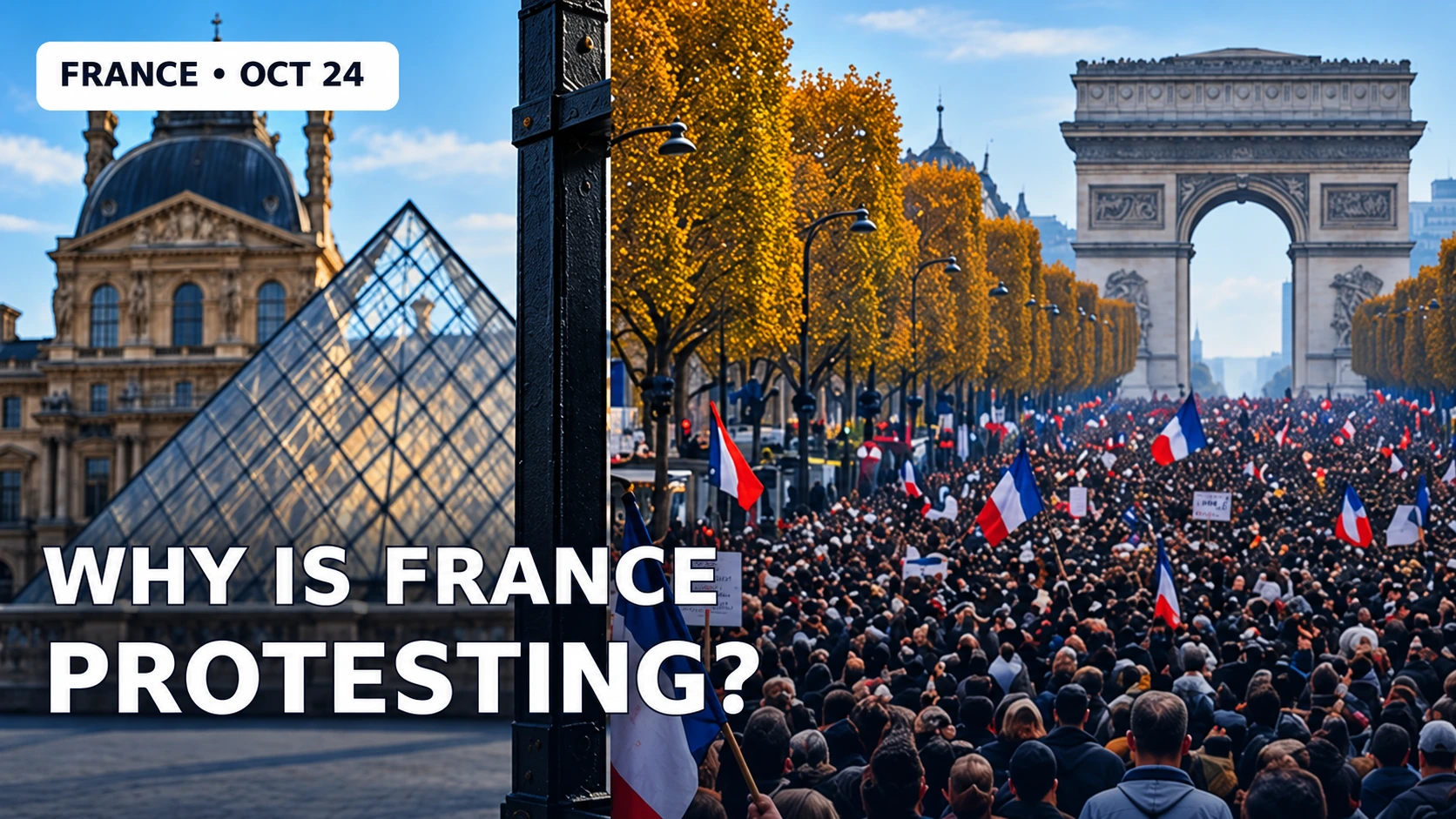
※ Images in this article are AI-generated illustrations created to help explain the story. They are not actual photographs, and depictions of people, places, or events may differ slightly from reality.
On October 24, the French Interior Ministry estimated that 410,000 people demonstrated nationwide. As evening approached, some largely peaceful marches gave way to clashes involving police and groups of masked protesters.
The museum closures, meanwhile, were mainly precautionary. Authorities were trying to prevent the destruction and looting that had accompanied demonstrations the previous weekend—not responding to a reported attack inside the Louvre. (AP · Reuters)
Understanding what happened requires separating three issues that have become intertwined: the reasons people are protesting, the government’s response, and the violence surrounding parts of the movement.
What Actually Happened Across France on October 24?
France experienced another major nationwide protest on October 24, one week after demonstrations on October 17 had descended into serious unrest in several cities.
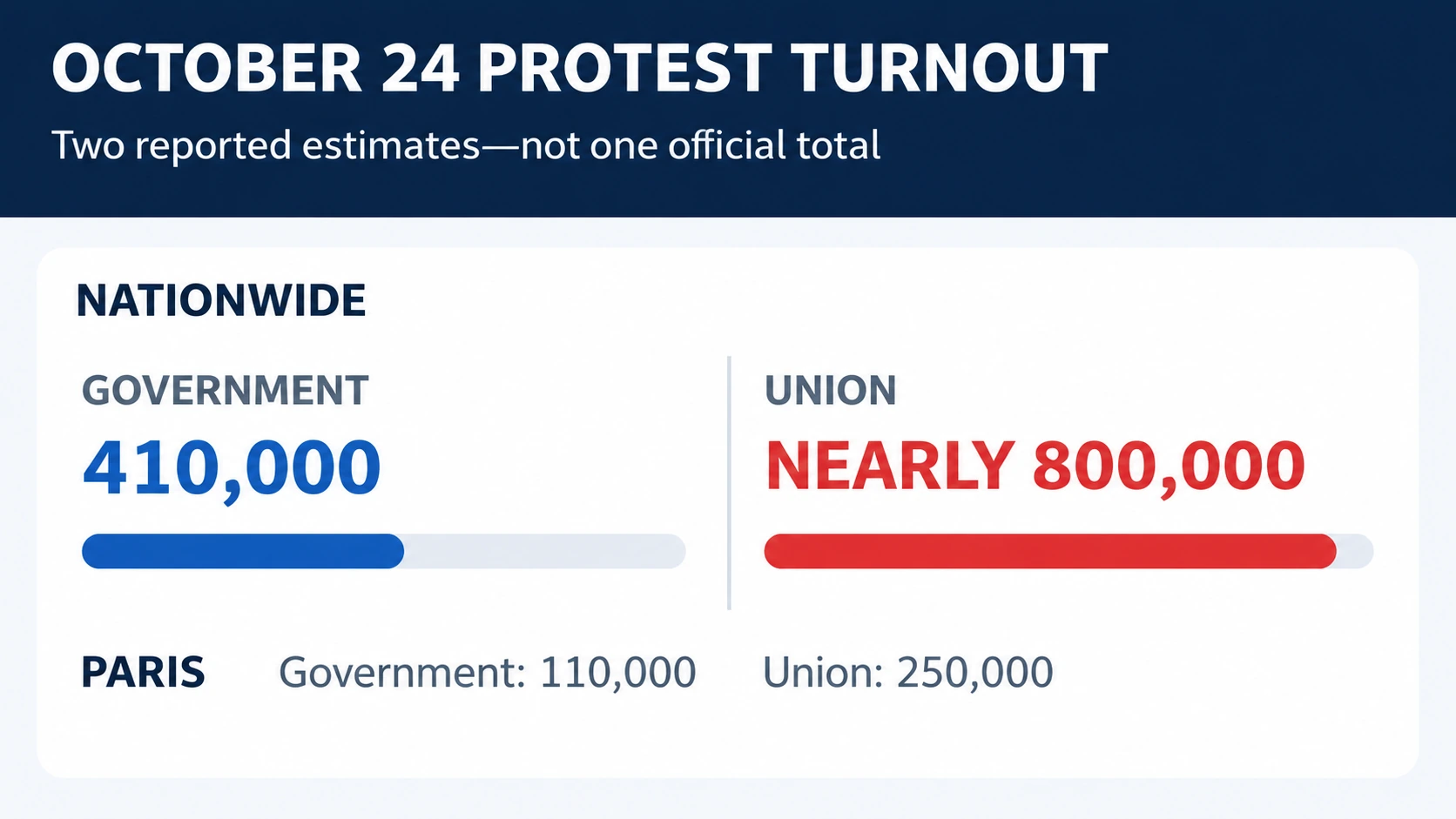
According to the Interior Ministry, approximately 410,000 people participated across the country, including 110,000 in Paris.
The CGT, one of France’s largest labor unions, gave much higher estimates: nearly 800,000 nationwide and approximately 250,000 in Paris. (AP)
The figures are not interchangeable. They represent estimates from different organizations rather than a single agreed count.
| Measure | Government estimate | Union estimate |
|---|---|---|
| October 24, nationwide | 410,000 | Nearly 800,000 |
| October 24, Paris | 110,000 | 250,000 |
| October 17, nationwide | 550,000 | About 800,000 |
The government’s October 24 count was lower than its estimate for the previous Saturday. That does not necessarily mean the underlying dispute is fading. Hundreds of thousands of people were still participating, and further labor action was already being organized. (Reuters · CGT)
Much of the October 24 marching was peaceful. The most serious disturbances occurred near the end of demonstrations in Paris and Marseille, where groups threw projectiles and police used crowd-control weapons.
Nearly 1,000 arrests were reported nationwide, according to Interior Minister Laurent Nuñez. An arrest does not establish that someone committed a crime, and the national figure should not be mistaken for the number of violent offenders. (AP)
But the size of the demonstrations raises another question: How did a movement that started with problems in schools become a confrontation over France’s wider economic and political direction?
How Did Missing Teachers Become a National Protest Movement?
The current protests grew out of education complaints, not a single new tax or presidential decree.
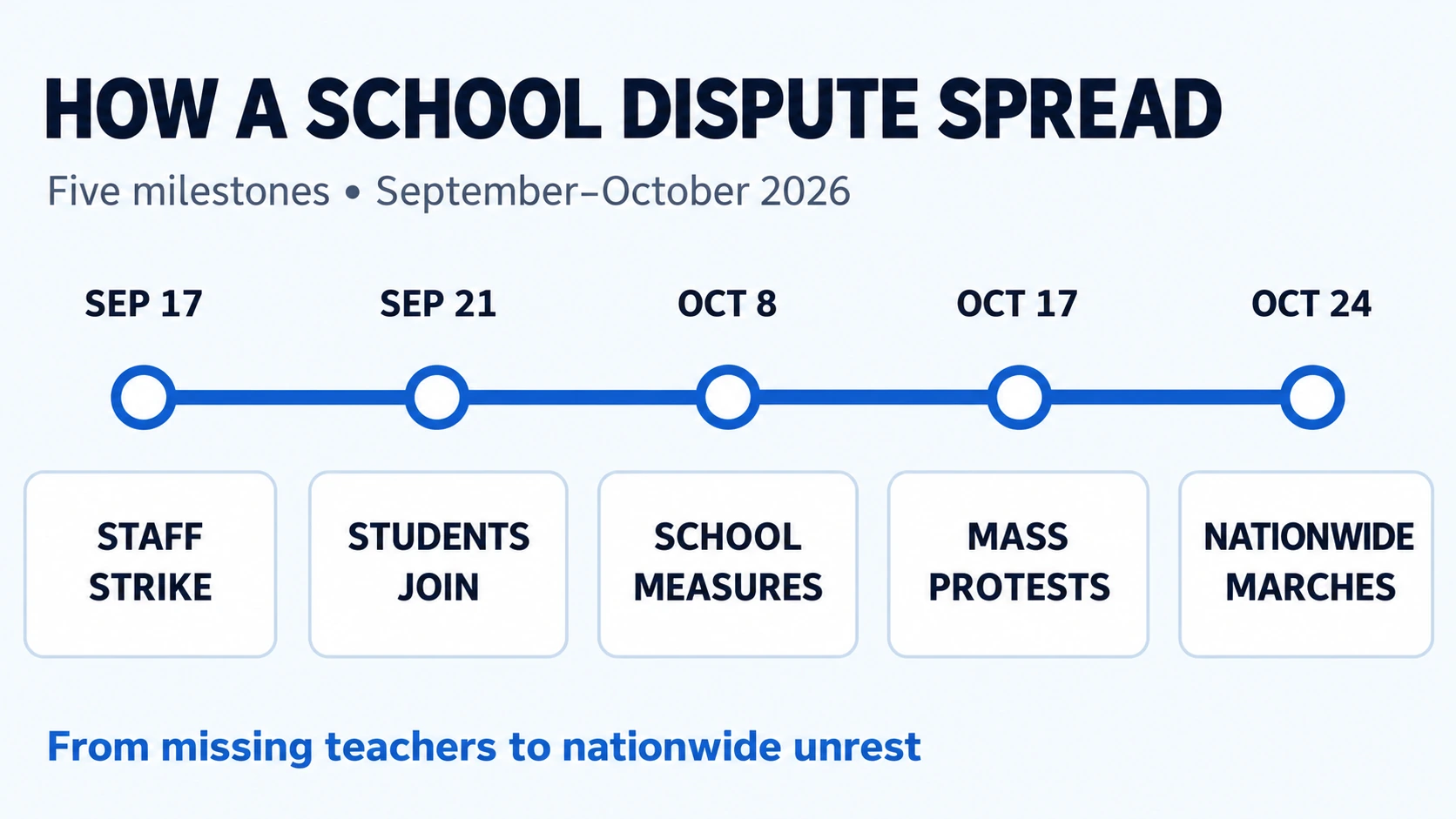
In September, staff at Saint-Exupéry High School in Créteil, a suburb southeast of Paris, went on strike over staffing shortages and inadequate resources. Students soon joined them.
Similar complaints spread through the Paris suburbs and then to schools elsewhere in France. Students used social media to organize blockades and demonstrations, turning a local problem into a much wider movement. (CNA)
Their demands centered on problems that are easy to understand even without knowing anything about the French education system.
Some students said classes were overcrowded. Others complained about teachers being absent without replacements, aging buildings, and unequal educational opportunities.
The concern was not merely that school was inconvenient. Students questioned whether the public education system was giving them a fair chance at the future.
That distinction matters in France, where access to public education has long been closely connected to the country’s promise of equal opportunity.
The complaints also included Parcoursup, France’s national higher-education application platform.
For American readers, Parcoursup can be understood as a centralized system through which students apply for places in higher education. Critics argue that aspects of the admissions process can reinforce existing inequalities, particularly for students from disadvantaged backgrounds. (Le Monde)
Here is how the movement developed:
| Date | What changed |
|---|---|
| September 17 | Staff strike over shortages at a high school in Créteil |
| September 21 onward | Student protests spread across schools and cities |
| October 8 | Government announces additional teaching and consultation measures |
| October 17 | Large demonstrations bring broader economic grievances into the streets |
| October 24 | Another nationwide protest draws hundreds of thousands |
A dispute over school staffing had become part of a broader argument about whether French public institutions were meeting people’s needs.
And that made it easier for groups with different grievances to find common ground.
Why Did Workers, Unions, and Yellow Vest Protesters Join the Students?
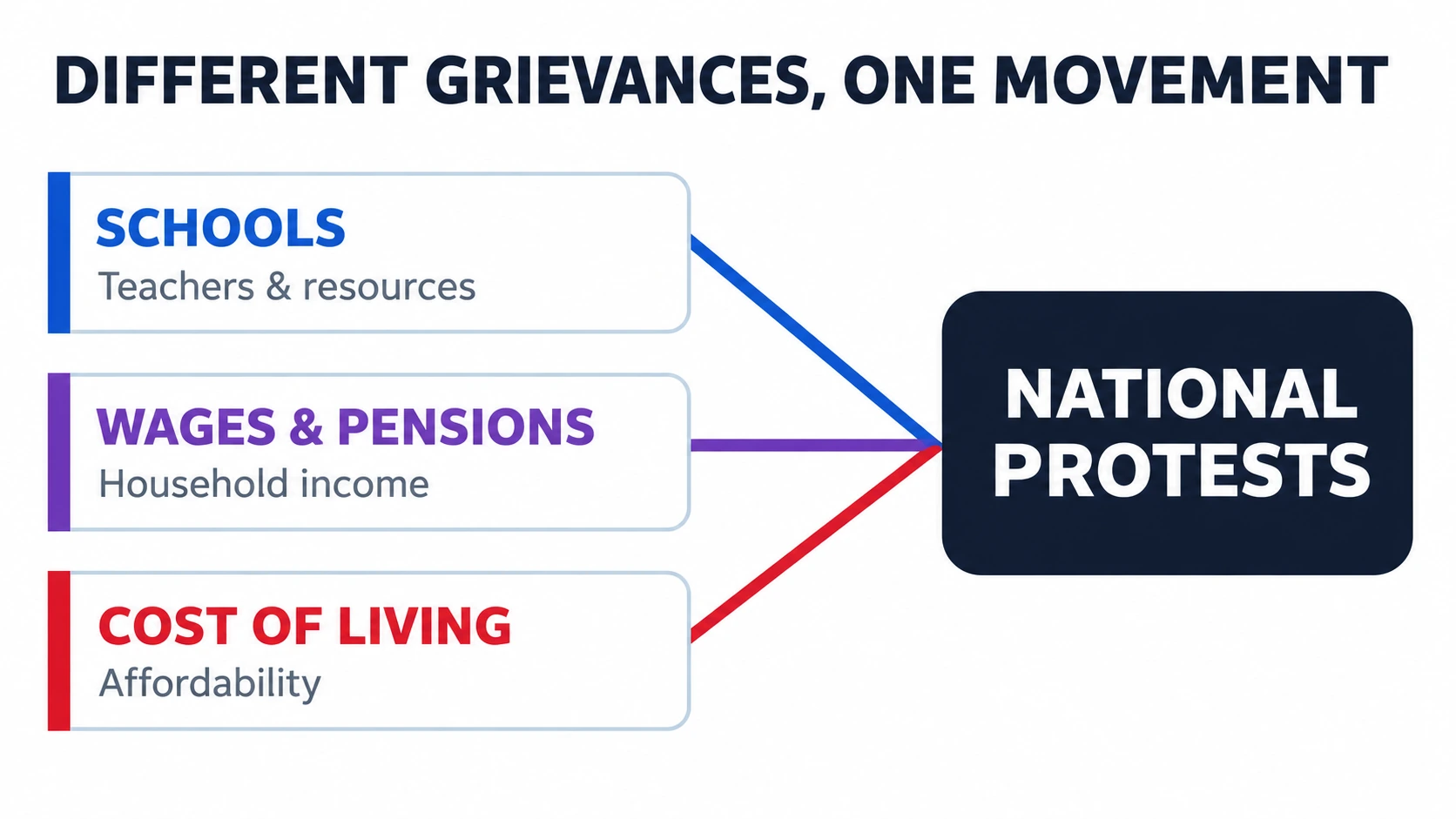
The different groups joined because they saw related problems behind their individual grievances: rising expenses, strained public services, and a belief that government responses were falling short.
Students wanted better schools. Workers and unions raised concerns about wages, pensions, public spending, and affordability. Some veterans of the Yellow Vest movement returned with familiar complaints about purchasing power.
Those demands are related, but they are not identical.
| Group | Main concerns |
|---|---|
| High school and university students | Teachers, facilities, educational opportunity |
| Workers and labor unions | Pay, pensions, living costs, public services |
| Yellow Vest participants | Fuel prices, household costs, economic fairness |
| Other demonstrators | Government accountability, protest rights, inequality |
The CGT has explicitly linked the student movement with demands for higher wages and pensions, stronger public services, and relief from rising living costs. (CGT)
For an American comparison, imagine teachers protesting staff shortages while families worry about their utility bills and workers argue that their pay is not keeping up with expenses.
The issues begin separately. But people may come to see them as different symptoms of the same problem: They feel they are paying more while receiving less.
That helps explain why a school dispute could attract people who have no children in school.
What Do the Yellow Vests Have to Do With This?
France’s Yellow Vest movement first emerged in 2018, when anger over fuel taxes became a much larger protest against living costs and economic inequality.
The name came from the reflective safety vests French drivers were required to carry in their vehicles.
The movement eventually expanded far beyond fuel taxes, becoming a symbol of frustration with political elites and financial pressure on ordinary households.
The reappearance of those yellow vests in 2026 does not mean the original movement has returned unchanged. This time, students and education demands have played a much more prominent role alongside economic grievances.
That broadening of the movement is one reason the October demonstrations have become so difficult to address with a single policy announcement.
Why Were the Louvre and Other Paris Museums Closed?

The museums closed because authorities feared violence could spill into busy tourist and commercial areas after the destruction associated with the October 17 protests.
The closures were preventive security decisions, not evidence that protesters had attacked the Louvre.
During the earlier demonstrations, rioting, looting, fires, and attacks on public buildings had caused significant damage in multiple cities.
That experience shaped the government’s preparations for October 24.
Paris authorities sought to protect landmarks, businesses, visitors, and employees while limiting opportunities for further disorder. (Reuters)
Among the major cultural venues closed on October 24 were the Louvre, Musée d’Orsay, and several other Paris museums.
Reuters reported disappointed visitors arriving at locked museum gates, including tourists who had planned their trips around seeing famous works of art. (Reuters)
The distinction between a museum closure and a citywide shutdown is important.
Paris was not uniformly closed. Some attractions and businesses continued operating, while others took precautions or changed access arrangements.
Why Did the Authorities Restrict Protest Routes?
Police also sought to keep large demonstrations away from some central neighborhoods that had suffered damage the previous weekend.
In Paris, the main October 24 march was restricted to the southeastern edge of the city rather than moving through the most prominent central tourist districts.
Officials presented these restrictions as necessary to maintain public order and prevent renewed violence.
Critics argued that limits on demonstrations, combined with aggressive policing, risked undermining the right to protest. (Reuters · The Guardian)
For tourists, the practical lesson is straightforward: a museum closure or restricted march route does not mean every Paris attraction is inaccessible.
Visitors should check individual venue announcements, transportation updates, and any temporary local restrictions rather than assuming normal citywide conditions or a blanket shutdown.
Why Did Clashes Erupt if Most Demonstrators Were Peaceful?
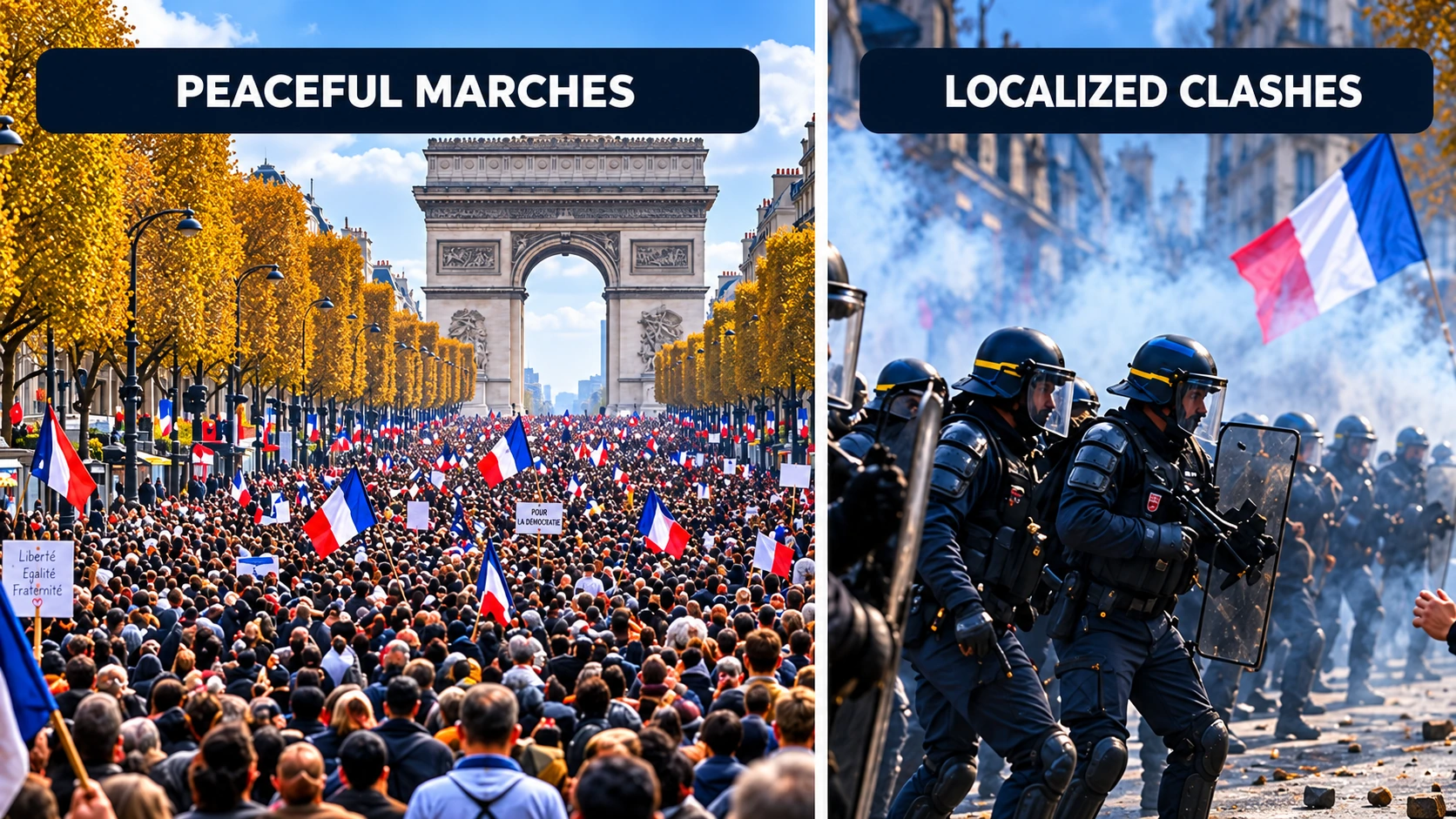
Because a large peaceful protest and a violent confrontation can take place during the same demonstration.
On October 24, the main Paris march began peacefully. But near its endpoint, some masked individuals threw objects and fireworks toward police.
Officers responded with tear gas and water cannons. Clashes were also reported in Marseille and other cities. (AP · Reuters)
It would be misleading to portray all of the day’s demonstrators as rioters.
It would also be misleading to ignore the documented violence simply because many participants marched peacefully.
Both realities matter.
Why Were So Many Police Deployed?
French authorities mobilized approximately 70,000 police officers and gendarmes nationwide for the October 24 demonstrations.
That was about 10,000 more officers than the previous weekend, reflecting the government’s concern that violence and looting could occur again.
Security measures included water cannons, armored vehicles, helicopters, and additional protection around prominent Paris landmarks. (Reuters)
Interior Minister Laurent Nuñez and other officials argued for a strong security response to protect people and property.
But police tactics have become a controversy of their own.
Human Rights Watch raised concerns about the use of force against students during the earlier demonstrations, including the use of tear gas, stun grenades, and other crowd-control weapons.
The organization called for the protection of children’s rights to participate in peaceful protests. (Human Rights Watch)
There are therefore two different accountability questions.
First, who committed vandalism, looting, or violence against police and civilians?
Second, were police measures lawful and proportionate, particularly where children or peaceful demonstrators were affected?
Neither question can be answered simply by counting arrests or watching a short video of a confrontation.
An arrest is not a conviction. Likewise, an allegation of excessive force requires examination of the circumstances and available evidence.
Has Macron’s Government Offered Any Solutions?
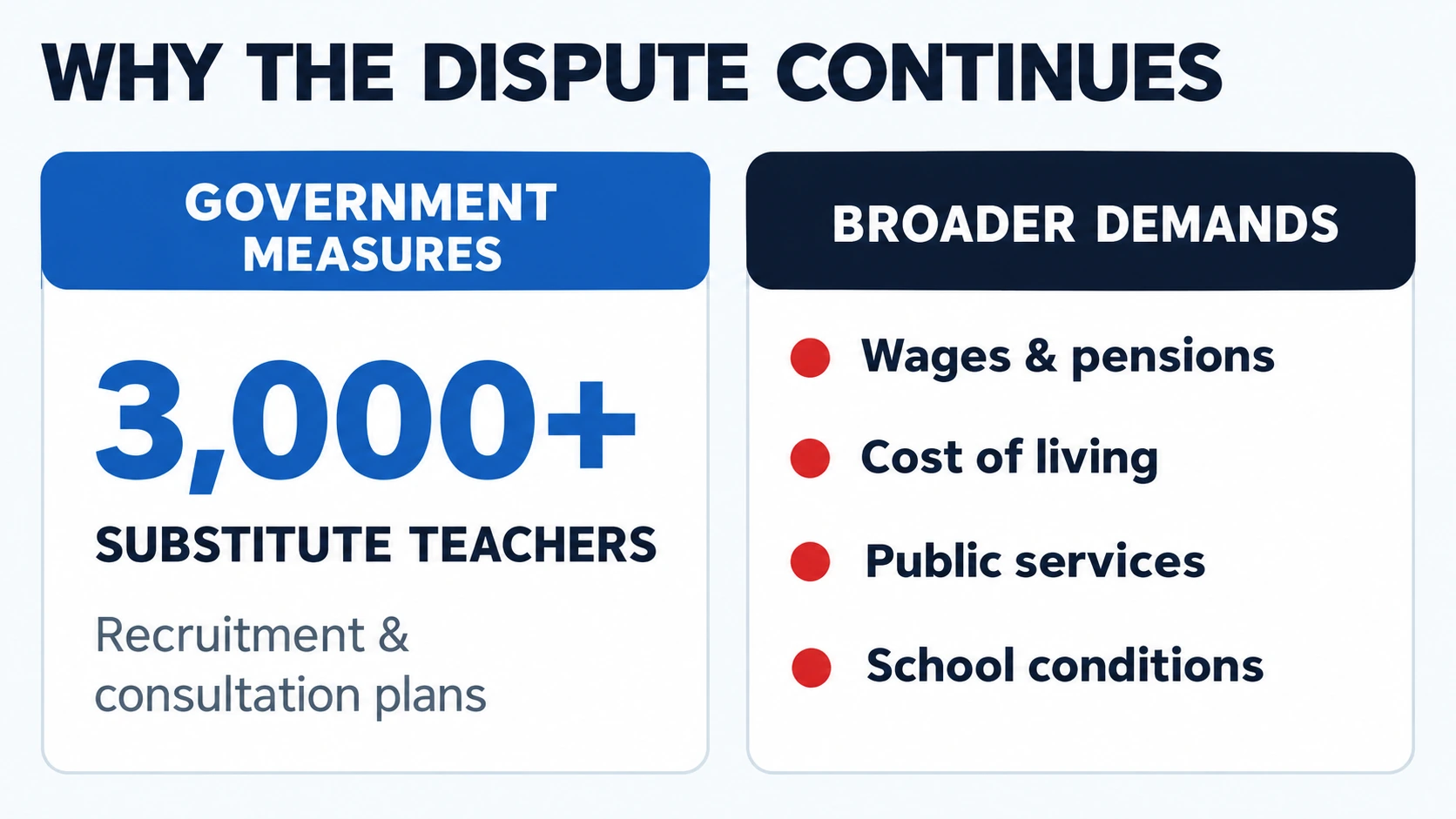
Yes. France’s government has announced measures addressing some of the students’ complaints.
On October 8, Education Minister Édouard Geffray announced steps that included mobilizing more than 3,000 substitute teachers for schools with urgent staffing needs, authorizing additional recruitment, and providing more resources for short-term teacher replacements.
The Education Ministry also announced changes intended to strengthen student representation and give high school students a greater voice in decisions affecting their education. (French Ministry of National Education)
Those commitments are significant, but announcing a measure is different from demonstrating that the problem has been solved.
A school that has missed weeks of instruction still needs teachers who actually arrive and stay. Students concerned about university admissions or deteriorating facilities may also find that staffing measures address only part of their complaint.
The broader protest coalition has demands extending well beyond education.
| Issue | Government action or position | Continuing concern |
|---|---|---|
| Teacher shortages | Additional substitute staffing announced | Whether schools actually receive enough teachers |
| Student participation | Consultation and representation changes announced | Whether student input produces meaningful decisions |
| School facilities | Government workstreams announced | Whether repairs and improvements are funded and delivered |
| Wages and pensions | Subject of wider labor and budget disputes | Unions seek higher incomes and stronger protections |
| Cost of living | Central issue in broader government-union tensions | Protesters seek more substantial relief |
The French government faces competing pressures: meeting demands for better services and higher spending while managing public finances and maintaining order.
Labor unions argue that the government’s response has not adequately addressed people’s economic difficulties. Government officials have emphasized security, dialogue, and the education measures already announced. (CGT · French Government)
This helps explain why the demonstrations have continued even after education measures were announced.
A response to missing teachers cannot, by itself, settle disputes over purchasing power, pensions, policing, and broader public spending.
What Happens Next for France—and Why Should Americans Care?
The next important test is whether the movement moves beyond repeated weekend demonstrations into a broader labor confrontation.
The CGT and other unions have called for nationwide strikes and demonstrations on November 5, 2026, over wages, purchasing power, public services, and the government’s budget priorities.
That is an announced mobilization, not a guarantee that every sector will participate or that the country will come to a standstill. (CGT)
Three developments will be especially important.
First, education: Will the announced substitute teachers, recruitment measures, and consultations lead to visible improvements in affected schools?
Second, public order: Can authorities protect people and businesses while allowing peaceful demonstrations and investigating allegations of misconduct?
Third, the wider economy: Will negotiations produce changes that satisfy unions and other protesters, or will disputes over wages, pensions, and government spending continue?
France is also approaching its 2027 presidential election, when voters are scheduled to choose a successor to Emmanuel Macron.
The protests may influence public debate over government services, economic fairness, and how authorities respond to unrest. That does not establish which political party or candidate will benefit.
Does This Affect Americans Directly?
For most Americans, France’s demonstrations do not automatically change prices, taxes, or everyday spending in the United States.
The immediate implications are clearer for Americans visiting France or operating businesses affected by local disruptions.
Museum closures, transportation changes, strikes, and temporary security restrictions can affect travel plans and commercial activity.
The broader significance is diplomatic and economic. France is a major European economy and a longtime U.S. ally, so prolonged political disruption could complicate debates over government budgets and shared international priorities.
But a possible consequence is not the same as an established outcome.
The next union actions, government negotiations, and actual changes to schools and public services will provide better evidence of where the movement is heading.
Bottom Line: What This Story Really Means
France’s October 24 demonstrations drew hundreds of thousands of people because a dispute that began with education has become part of a much wider argument about affordability, public services, and economic fairness.
The Louvre and other museums closed largely as a precaution after the previous weekend’s serious unrest. Their closures were a consequence of the security concerns surrounding the protests, not evidence that demonstrators had attacked the museums.
The government estimated 410,000 participants nationwide, while unions reported a substantially higher turnout. Most demonstrators marched peacefully, although clashes between some groups and police created another difficult public-order challenge.
The most important distinction is between the grievances driving the movement and the violence surrounding parts of it.
France’s government has made education commitments, but those measures do not resolve every demand brought into the streets by workers, students, and other protesters.
The November 5 labor mobilization and the implementation of the government’s earlier promises will help show whether the conflict is moving toward negotiation or further disruption.
France Protests 2026: Key Questions Explained
Q. How many people protested in France on October 24, 2026?
The French Interior Ministry estimated 410,000 protesters nationwide, including 110,000 in Paris. The CGT labor union estimated nearly 800,000 nationwide and approximately 250,000 in Paris.
Q. Did protesters attack the Louvre Museum?
The Louvre closed as a precaution ahead of the October 24 demonstrations. The closure was not reported as the result of an attack on the museum or its artworks that day.
Q. Which major Paris museums closed during the protests?
The Louvre, Musée d’Orsay, and several other major cultural institutions closed on October 24 as authorities prepared for potential unrest. The closures did not mean every attraction in Paris had shut down.
Q. What started the latest French protest movement?
The movement began with school staffing and resource complaints in September 2026. It expanded as other students, workers, unions, and Yellow Vest participants joined demonstrations over public services and living costs.
Q. Are the 2026 demonstrations the same as the original Yellow Vest protests?
No. Some Yellow Vest activists and economic grievances have returned, but the current movement also includes a major student-led component and wider labor participation.
Q. Why did France deploy 70,000 police officers?
Authorities mobilized approximately 70,000 officers nationwide to prevent renewed looting and violence after serious unrest during the October 17 demonstrations.
Q. Has the French government responded to the student protests?
Yes. Education measures announced in October included mobilizing more than 3,000 substitute teachers, authorizing additional recruitment, and expanding student consultation. Whether those measures sufficiently address the complaints remains contested.
Q. Were all 410,000 protesters involved in violence?
No. Most demonstrations were largely peaceful. Clashes occurred in particular locations, including Paris and Marseille, and should not be attributed to everyone who participated.
Q. When is the next major French strike planned?
Labor unions have called for a nationwide day of strikes and demonstrations on November 5, 2026. The actual extent of participation and disruption will depend on developments closer to that date.
Q. Could the protests affect France’s 2027 presidential election?
They could influence public debate about living costs, education, government accountability, and policing. Their eventual electoral consequences remain uncertain.
Did this help make the story clearer? 🙂
WIN keeps unpacking the “why” behind the news—clearly and simply!
Sources
October 24 Protests, Attendance, and Clashes
Reuters — Violence Flares in Paris After Largely Peaceful Protests Across France
Reuters — France Mounts Huge Security Operation as Protesters Prepare to March
Museum Closures and Security Precautions
Reuters — Mona Lisa Off Limits as Paris Shuts Museums Over Protest Fears
The Guardian — Hundreds of Thousands March Across France in Protests Over Schools and Policing
Student Protests and Government Education Measures
CNA — What Are the Grievances Driving France’s Expanding School Protests?
Le Monde — Why French High Schoolers Are Protesting
French Ministry of National Education — Building Solutions With High School Students
French Government — Five Areas of Action to Improve High School Education
Protest Rights and Upcoming Labor Action
Human Rights Watch — French High School Student Protests Met With Excessive Force
CGT — Call to Expand Strikes on November 5
Keep Reading
Why Did France’s Yellow Vests Return After Years Out of the Headlines?
The October 24 demonstrations followed another major protest just one week earlier. Understanding how students, unions, and veterans of the Yellow Vest movement came together helps explain why France’s current unrest has become so widespread.
Why Are France’s Yellow Vests Back? How Student Protests Became a National Crisis