Why Did a Court Reject the DOJ’s Bid to Separate 20,000 California Voters’ Ballots?

Did California really have 20,000 illegal voters? And if federal officials believed it did, why wouldn’t a court let them separate those voters’ ballots?
Those are reasonable questions after a federal appeals court rejected an emergency request from the Justice Department on October 30, 2026, just days before the November 3 midterm elections.
But the ruling contains an important distinction. The judges did not decide that 20,000 people were eligible to vote—or that every person on the government’s list was a noncitizen.
They decided that the Justice Department had not met the demanding legal requirements for forcing California to change how it handles certain mail ballots during an election already underway.
And an October 31 analysis of the federal government’s list raised another question: How many of the names should have been flagged in the first place?
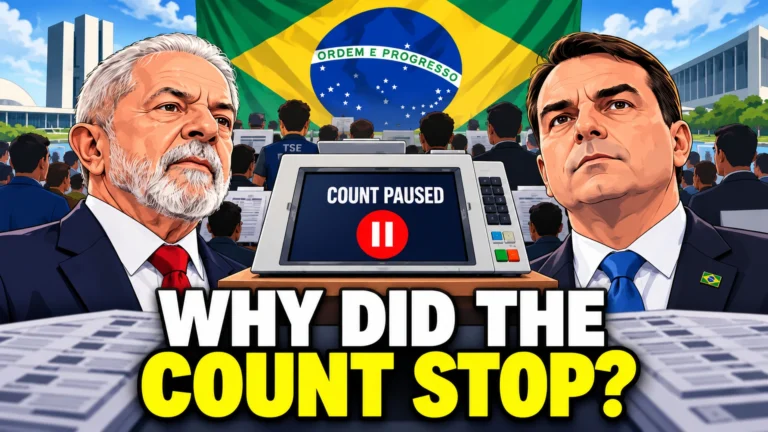
※ Images in this article are AI-generated illustrations created to help explain the story. They are not actual photographs, and depictions of people, places, or events may differ slightly from reality.
What Did the October 30 Appeals Court Actually Decide?
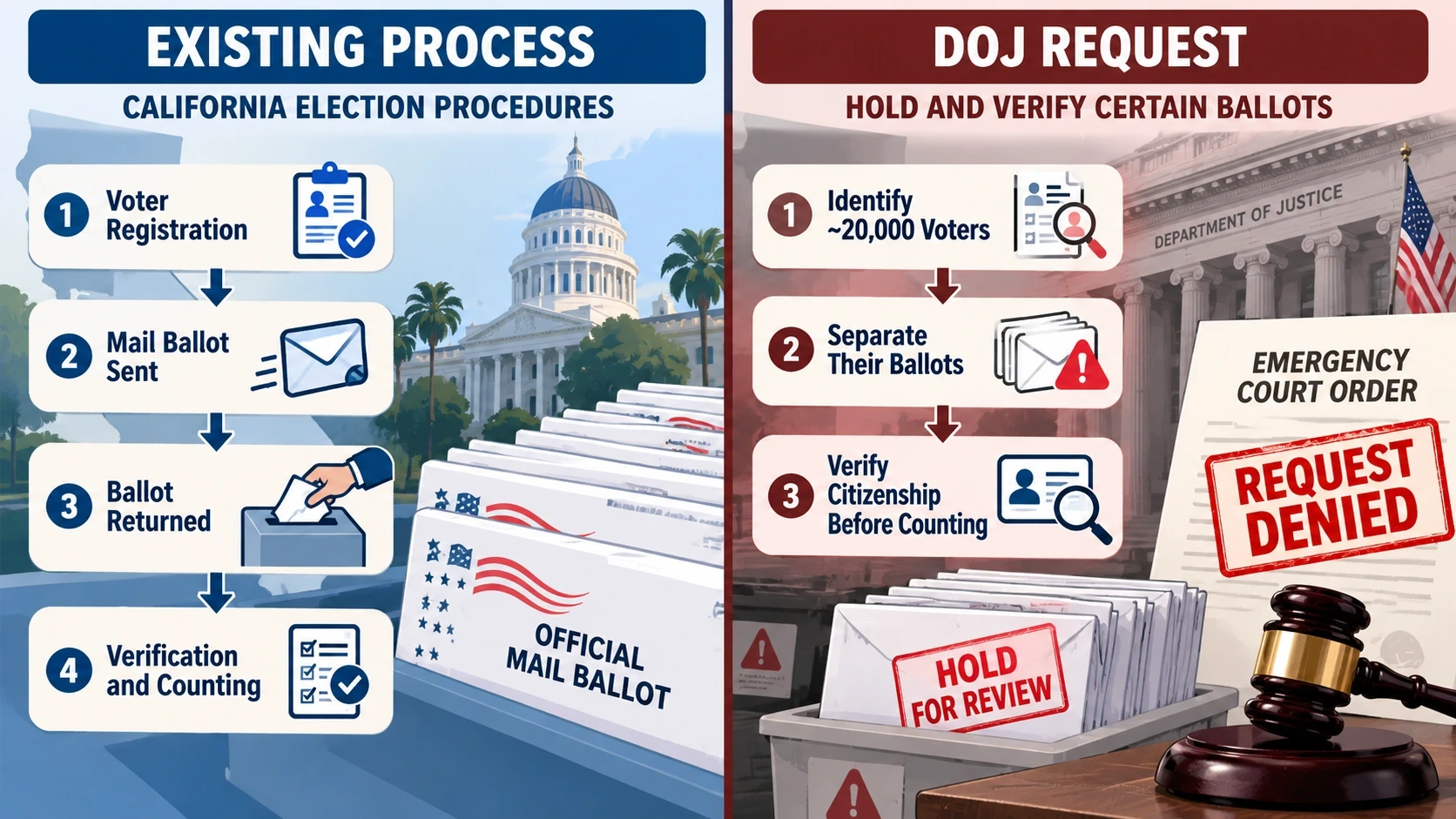
The U.S. Court of Appeals for the Ninth Circuit ruled 2–1 against the Justice Department’s emergency request. The federal government wanted California to hold ballots associated with approximately 20,000 people it suspected might not be citizens, then verify their eligibility before counting those ballots.
Judges Mark Bennett and Gabriel Sanchez concluded that the government had not made the required showing for such an extraordinary order. Judge Patrick Bumatay dissented. (Ninth Circuit · AP)
This was a decision about an emergency injunction—a court order that would have required election officials to take immediate action before the underlying lawsuit was fully resolved.
It did not establish that everyone on the disputed list was eligible. Nor did it mean California was free to count ballots known to be unlawful.
Instead, the court refused to impose the particular emergency procedure the Justice Department requested.
That distinction matters because an emergency ruling can determine what happens during an election without resolving every legal or factual issue in the case.
The decision also came after a federal district judge, David O. Carter, rejected the Justice Department’s request for a temporary restraining order on October 28.
The government appealed, seeking intervention before Election Day. The appellate court declined to grant that intervention. (California Department of Justice)
How Did a List of 20,000 People Trigger a Court Fight?
The dispute began with federal investigators comparing California voter-registration records with immigration-related information.
The Justice Department said agencies including U.S. Citizenship and Immigration Services and Homeland Security Investigations identified more than 20,000 people believed to be likely noncitizens registered to vote.
Federal prosecutors argued that allowing ballots from those individuals to enter the count could violate federal election law and weaken the voting power of eligible citizens.
On October 15, the Justice Department sued California and sought court intervention. (U.S. Department of Justice)
But there is a difference between identifying a potentially ineligible voter and establishing that an illegal ballot has been cast.
| Stage | What It Actually Means |
|---|---|
| Name appears on a federal list | Investigators suspect the person may be ineligible |
| Ballot is mailed | A registered voter received a ballot |
| Ballot is returned | A ballot was submitted for processing |
| Illegal voting is established | Evidence and applicable legal standards support that finding |
The list was not proof that 20,000 noncitizens had voted.
A name on a database list is an investigative lead. It does not automatically establish a person’s current citizenship, whether the person returned a ballot, or whether that ballot was counted.
The Justice Department has also pursued specific criminal cases. On October 19, it announced charges against 28 lawful permanent residents over alleged election-related offenses.
Those charges are separate from proving every allegation involving the much larger list. Criminal defendants remain presumed innocent unless convicted. (U.S. Department of Justice)
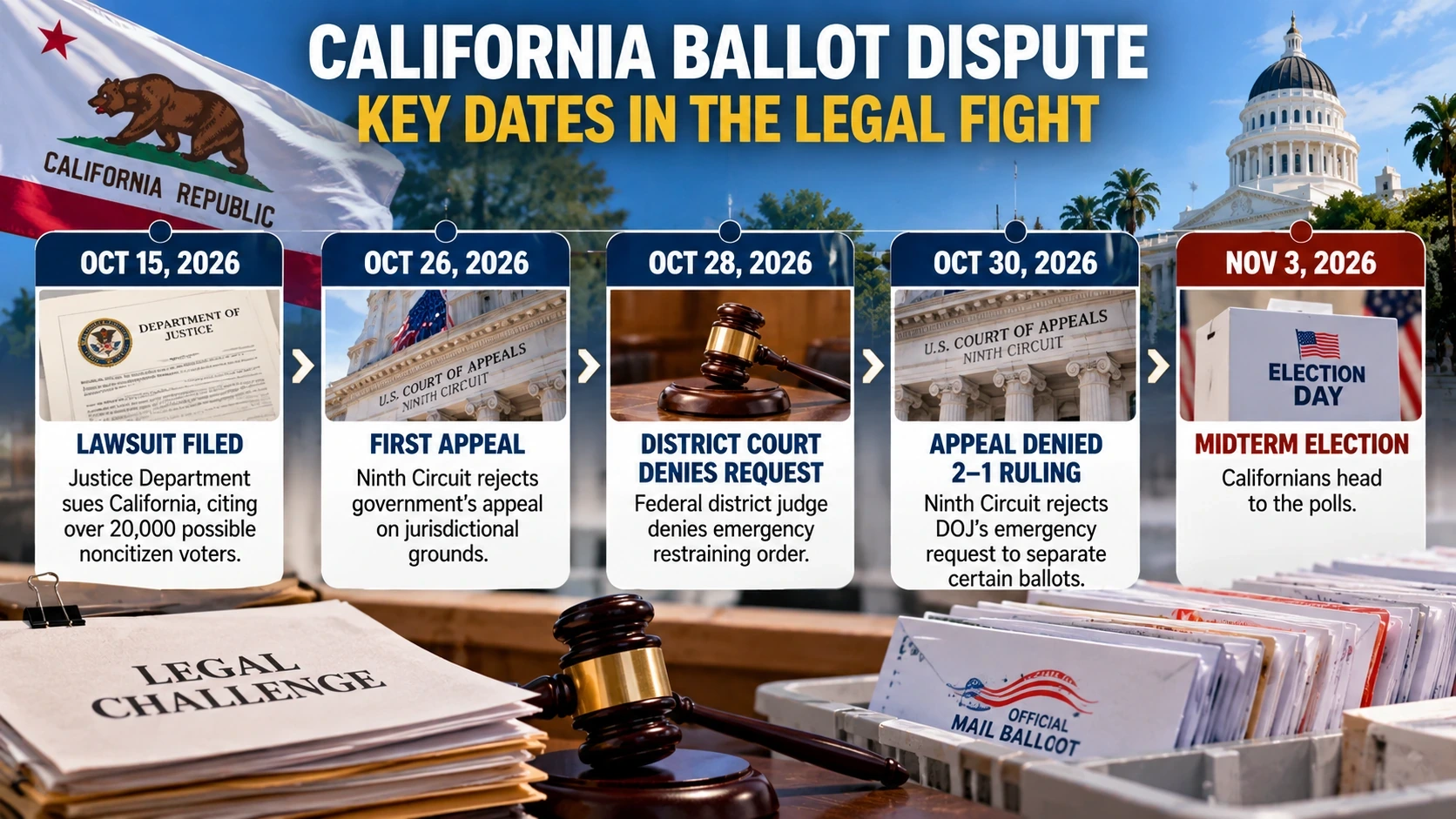
The Courtroom Timeline
| Date | What Happened |
|---|---|
| October 15 | Justice Department filed its California lawsuit |
| October 26 | Ninth Circuit rejected an earlier appeal on jurisdictional grounds |
| October 28 | District court denied the emergency restraining-order request |
| October 29 | Justice Department filed another emergency appellate request |
| October 30 | Ninth Circuit denied emergency relief in a 2–1 ruling |
| November 3 | Scheduled midterm Election Day |
The October 26 appellate decision turned on jurisdiction: The lower court had not yet issued the relevant ruling.
By October 30, the district court had acted, allowing the appellate judges to consider the government’s new emergency motion on its legal merits. (Ninth Circuit)
That explains why the Justice Department returned to the same appeals court within days.
Is the Federal Government’s Voter List Accurate?
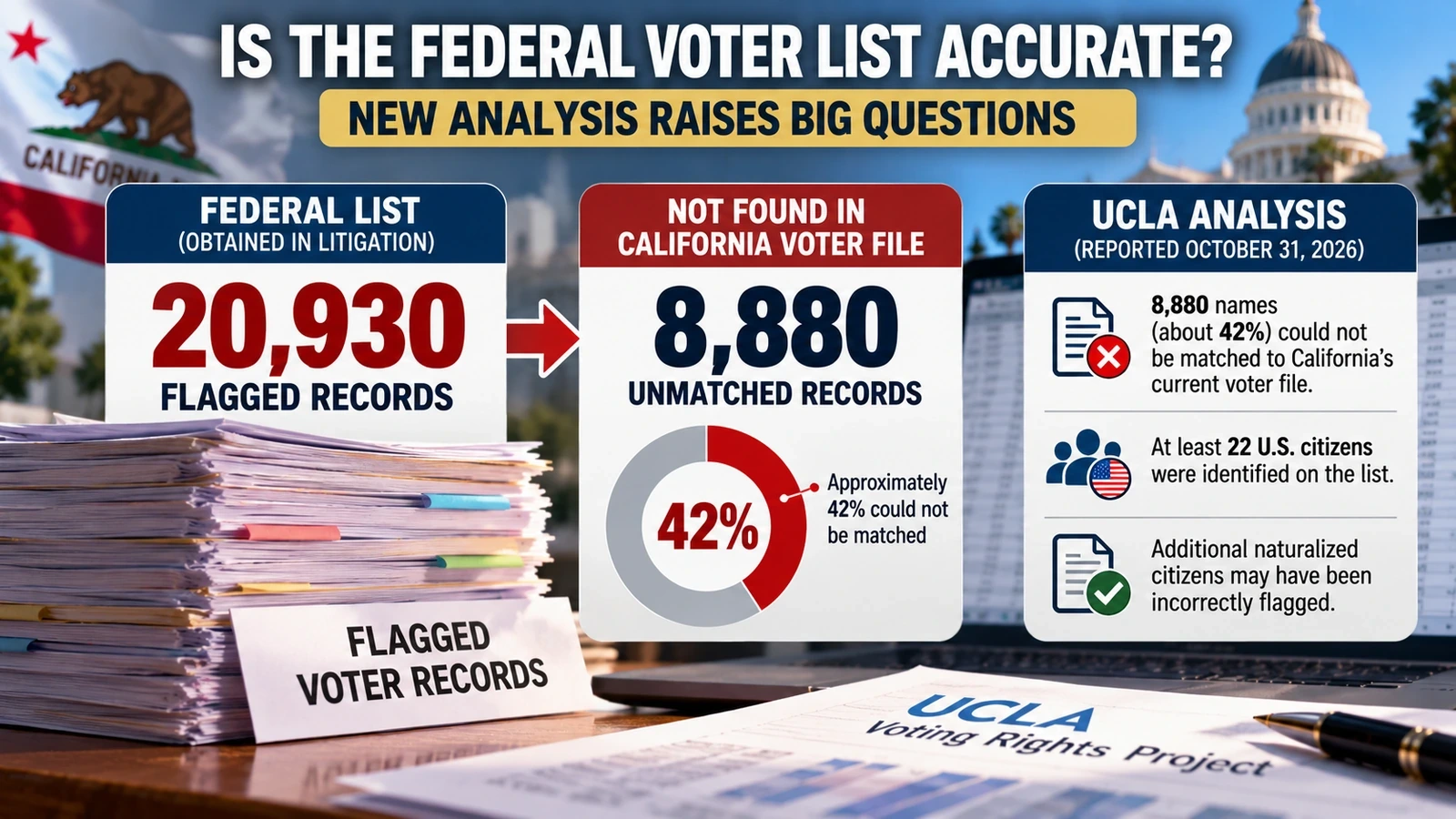
The reliability of the federal government’s list has become one of the central problems in the case.
California officials argued that the government had not adequately demonstrated how accurately its data distinguished noncitizens from eligible voters.
The October 30 appeals court decision cited concerns about missing error rates and a lack of validation against reliable benchmarks. (Ninth Circuit)
Then, on October 31, a new analysis added more specific numbers.
Researchers affiliated with UCLA’s Voting Rights Project examined a list containing 20,930 names. According to their analysis, submitted in litigation by voting-rights advocates, 8,880 names—approximately 42%—could not be matched to California’s current voter file.
The researchers also identified at least 22 U.S. citizens on the list and reported indications that additional naturalized citizens may have been incorrectly flagged. (AP)
These findings require some care.
The analysis was conducted by researchers involved in litigation challenging the government’s approach. It was not a final judicial determination that 42% of the list was fraudulent or that every unmatched record belonged to an eligible voter.
The Justice Department disputes the outside analysis.
Still, an unmatched record raises an obvious practical question: If election officials cannot reliably connect a flagged name to a current registered voter, how could they confidently identify the correct ballot to hold?
The issue becomes more complicated when citizenship status has changed over time.
A person who was previously a lawful permanent resident may later become a naturalized American citizen. An older immigration record may not reflect that change.
A database system must correctly identify the individual and account for their present legal status. Otherwise, an eligibility investigation can produce false matches.
A questionable database match does not establish unlawful voting. But a questionable match also does not eliminate the government’s authority to investigate genuinely supported allegations.
The central question is how reliably officials can distinguish those situations before restricting a ballot.
Why Did the Judges Say the Emergency Request Went Too Far?
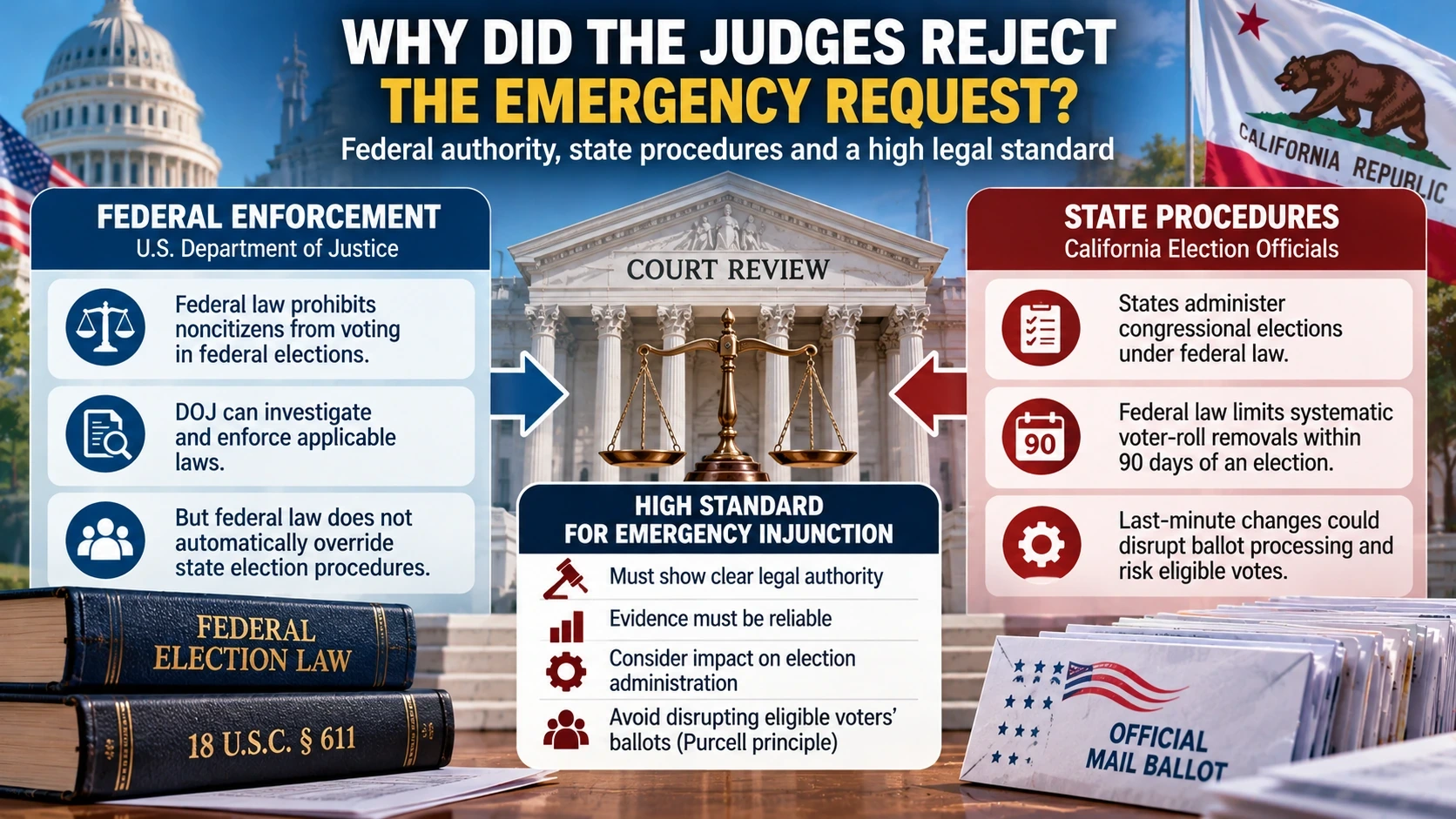
The majority identified several reasons the requested intervention could not be justified on the record before it.
Federal Criminal Law Does Not Automatically Rewrite State Election Procedures
Federal law generally prohibits noncitizens from voting in federal elections, subject to narrow statutory exceptions.
But the two judges concluded that the relevant federal criminal statute, 18 U.S.C. § 611, did not clearly authorize the Justice Department to override California’s established ballot-processing procedures in the way it requested.
States have primary responsibility for administering congressional elections, subject to federal laws enacted by Congress.
The federal government can enforce applicable law, but that does not mean every federal enforcement demand automatically becomes a binding instruction for state election officials.
The court emphasized that Congress had not clearly required the particular mass ballot-separation procedure requested here. (Ninth Circuit)
The 90-Day Rule Added Another Legal Problem
The National Voter Registration Act generally requires states to finish systematic programs removing ineligible names from voter rolls at least 90 days before a federal election.
Individualized reviews can still occur under applicable law.
The judges expressed concern that the proposed treatment of a large batch of voters could effectively become a systematic challenge or removal process during the protected period.
The government argued that it wanted ballots temporarily separated, not voters improperly removed.
The majority nevertheless found that the government had not clearly established that its requested procedure was compatible with the relevant statutory framework. (Ninth Circuit)
The Proposed Remedy Could Disrupt an Election Already Underway
The judges also considered the practical consequences.
California election officials warned that identifying and separating thousands of specific ballots could require changes to computerized systems, established procedures, and staff training.
The majority concluded that the requested order risked disrupting ballot tabulation and preventing eligible voters from having their votes counted.
Courts also consider a principle associated with the Supreme Court’s Purcell decision: Last-minute judicial changes to election procedures can create confusion and administrative problems.
Because voting was already underway, that concern carried particular weight.
The court was not saying that preventing illegal voting lacks importance. Rather, it concluded that the Justice Department had not demonstrated why this particular late-stage remedy was legally justified. (Ninth Circuit)
Why Did One Appeals Court Judge Disagree?
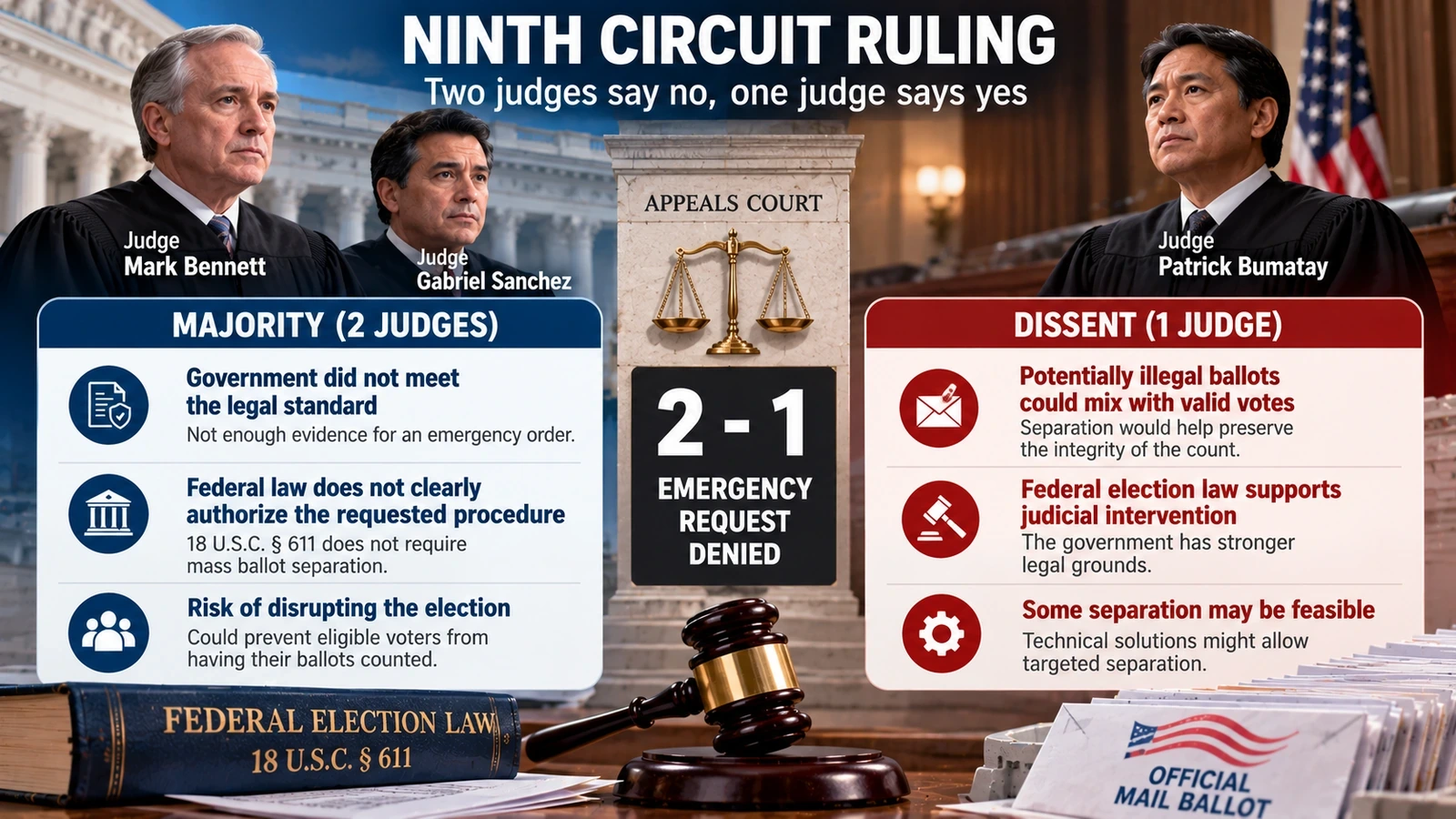
Judge Patrick Bumatay believed the court should have granted the government’s request, at least to the extent that separating the disputed ballots was feasible.
His dissent focused on the possibility that votes cast by ineligible individuals could be mixed with valid ballots before their eligibility was determined.
In his view, temporarily separating ballots would preserve the ability to investigate without automatically canceling those votes.
He also cited evidence suggesting that ballot-separation procedures might be technically achievable. The majority placed greater weight on the risks identified by Los Angeles County officials and the demanding standard for emergency relief. (Ninth Circuit)
The competing legal views can be understood this way:
| Question | Majority: Bennett and Sanchez | Dissent: Bumatay |
|---|---|---|
| Main concern | Unsupported emergency changes could harm eligible voters and election administration | Potentially illegal ballots could undermine valid votes |
| Federal authority | DOJ had not shown the requested procedure was clearly authorized | Federal election law supported judicial intervention |
| Practical impact | Separation could seriously disrupt existing systems | Some separation might be feasible |
| Proposed result | Deny emergency injunction | Grant targeted relief where workable |
The disagreement was not principally about whether noncitizens should be allowed to vote in federal elections.
It concerned what the federal government must prove before a court can require new election procedures, especially when ballots are already being processed.
What Else Changed in Court on October 30?
The Ninth Circuit’s ruling was not the only development affecting the Justice Department’s election-related actions.
In a separate federal case, U.S. District Judge Trina Thompson issued a temporary restraining order restricting Justice Department and Homeland Security efforts to pressure or threaten election officials over their ballot-processing duties.
That order arose from litigation brought by unions and civil-rights organizations, which alleged that federal threats were intimidating election workers.
The order addressed demands to alter voting procedures and threats of criminal prosecution tied to officials’ lawful election-administration work. It was a separate case, not part of the Ninth Circuit’s 2–1 decision. (CBS News · Reuters)
Another federal court ordered the government to provide the disputed voter list to lawyers representing immigrant-rights and voting-rights groups.
That disclosure allowed outside researchers to examine the underlying data, contributing to the October 31 findings concerning unmatched records and potentially eligible citizens.
The government appealed the disclosure order. (UCLA Voting Rights Project · AP)
Together, the proceedings show how the controversy has expanded beyond a single question about citizenship eligibility.
It now involves the reliability of government databases, the legal authority of federal investigators, the independence of election administrators, and the safeguards required before lawful ballots can be restricted.
What Happens Before and After the November 3 Election?
The October 30 appellate decision leaves the Justice Department without the emergency ballot-separation order it requested. It does not end every investigation, resolve the citizenship status of every flagged individual, or constitute a final judgment on all claims in the lawsuit.
California election officials remain subject to applicable federal and state election laws and existing legal procedures.
The district court has also appointed a special master to examine the government’s data and indicated that further proceedings could occur after Election Day. (Ninth Circuit)
Several questions remain important.
First, can the federal government substantiate its allegations concerning specific individuals with reliable records?
Second, what will further examination reveal about the accuracy of the list that prompted the emergency request?
Third, will subsequent proceedings clarify the circumstances under which federal courts may intervene in state ballot-processing systems during an ongoing election?
Those questions matter beyond California.
Federal election laws apply nationwide, but states administer elections through different systems. Disputes over federal enforcement and state procedures may arise elsewhere, even though any judicial decision must be understood within its particular facts and legal scope.
The key distinction is between investigating suspected illegal voting and requiring election officials to change an ongoing election process before the evidence and legal authority have been sufficiently established.
Those are related responsibilities, but they are not the same thing.
Bottom Line: What This Story Really Means
The October 30 decision did not establish that California had 20,000 illegal voters. It also did not rule that every individual on the federal government’s list was eligible.
It rejected the Justice Department’s emergency effort to force California to separate ballots associated with those individuals.
The majority concluded that the government had not met the demanding requirements for such intervention, particularly given questions about the list’s reliability, California’s established election procedures, and the risk of interfering with eligible votes.
The dissenting judge believed that the government had a stronger legal case for temporarily protecting the count from potentially unlawful ballots.
The October 31 analysis reporting that 42% of the flagged names could not be matched to the current voter file introduced another significant challenge to the government’s evidence. That analysis remains contested and is not a final court finding.
The dispute turns on the difference between suspicion, verified eligibility, and legal authority.
Federal officials have a responsibility to enforce election laws. Election officials also have a responsibility to protect the lawful votes of eligible citizens.
A court asked to intervene must consider both—and determine whether the requested action is supported by the evidence and the law.
California Ballots: Key Questions Explained
Q. Did the court rule that 20,000 suspected noncitizens could legally vote?
No. The October 30 appeals court decision addressed the Justice Department’s emergency injunction request, not the final citizenship eligibility of every person identified in the federal list.
Q. Were 20,000 illegal votes discovered in California?
No such finding was established by the ruling. Federal officials identified approximately 20,000 records they suspected might involve noncitizens; those records are not equivalent to 20,000 proven illegal ballots.
Q. Which court rejected the Justice Department’s appeal?
The U.S. Court of Appeals for the Ninth Circuit denied emergency relief on October 30, 2026, in a 2–1 decision.
Q. Why did the judges reject the emergency request?
The majority found that the Justice Department had not met the demanding legal requirements for an injunction requiring California to change election procedures. The judges also cited risks to eligible voters and ballot processing.
Q. What does the 42% finding about California’s voter list mean?
An October 31 analysis by UCLA-affiliated researchers reported that 8,880 of 20,930 names could not be matched to the current California voter file. It was an outside analysis presented in litigation, not a final judicial determination about the citizenship of every person listed.
Q. Can the federal government still investigate alleged illegal voting?
Yes. The denial of this particular emergency injunction does not automatically terminate lawful investigations or the underlying lawsuit. Other court orders may restrict specific investigative demands or threats.
Q. Why does the 90-day voter-roll rule matter?
Federal law restricts systematic voter-removal programs close to federal elections while allowing certain individualized action. The appeals court questioned whether the Justice Department’s requested mass review was compatible with those protections.
Q. Did every judge agree that separating the ballots would be improper?
No. Judge Patrick Bumatay dissented, arguing that targeted separation could help prevent potentially unlawful votes from being mixed with eligible votes while citizenship questions were resolved.
Q. Is the October 30 ruling a final decision on the entire lawsuit?
No. It denied an emergency injunction pending appeal. Further litigation and examination of the government’s evidence may continue.
Did this help make the story clearer? 🙂 WIN keeps unpacking the “why” behind the news—clearly and simply!
Sources
Federal Appeals Court Ruling and Legal Reasoning
Ninth Circuit — United States v. California, No. 26-7231, October 30, 2026
California Department of Justice — October 28 District Court Decision
Associated Press — October 30 Appeals Court Decision
Federal Voter Allegations and Criminal Cases
U.S. Department of Justice — October 15 California Voter-List Lawsuit
U.S. Department of Justice — October 19 Election-Related Criminal Charges
Voter-List Accuracy and Related Court Proceedings
Associated Press — October 31 Analysis of the Federal Voter List
UCLA Voting Rights Project — October 30 Court Order on List Disclosure
CBS News — Separate Federal Court Order Concerning Election Workers
Keep Reading
How Did the Justice Department’s Ballot Dispute Begin?
The October 30 ruling explains why the emergency court request failed. The earlier confrontation shows how federal investigators, disputed voter records, and demands sent to California election officials brought the case to this point.
Can the Justice Department Force California Counties to Set Aside Mail Ballots?