Why Are 18 Suspects in Haiti’s President’s Assassination Being Tried in Florida?

Haiti’s president was killed inside his own home near Port-au-Prince.
So why were 18 suspects flown out of Haiti on September 20, 2026, to face a federal case in Florida?
At first glance, it can sound as though the United States simply took over a Haitian murder prosecution.
That is not what gives the U.S. courts authority here.
The central legal connection is much closer to home: federal prosecutors say critical parts of the conspiracy were organized, financed, supported, and prepared through South Florida. U.S. law specifically allows federal prosecution when people within U.S. jurisdiction conspire to kill or kidnap someone abroad and at least one conspirator acts within U.S. jurisdiction to advance that plan. (justice.gov)
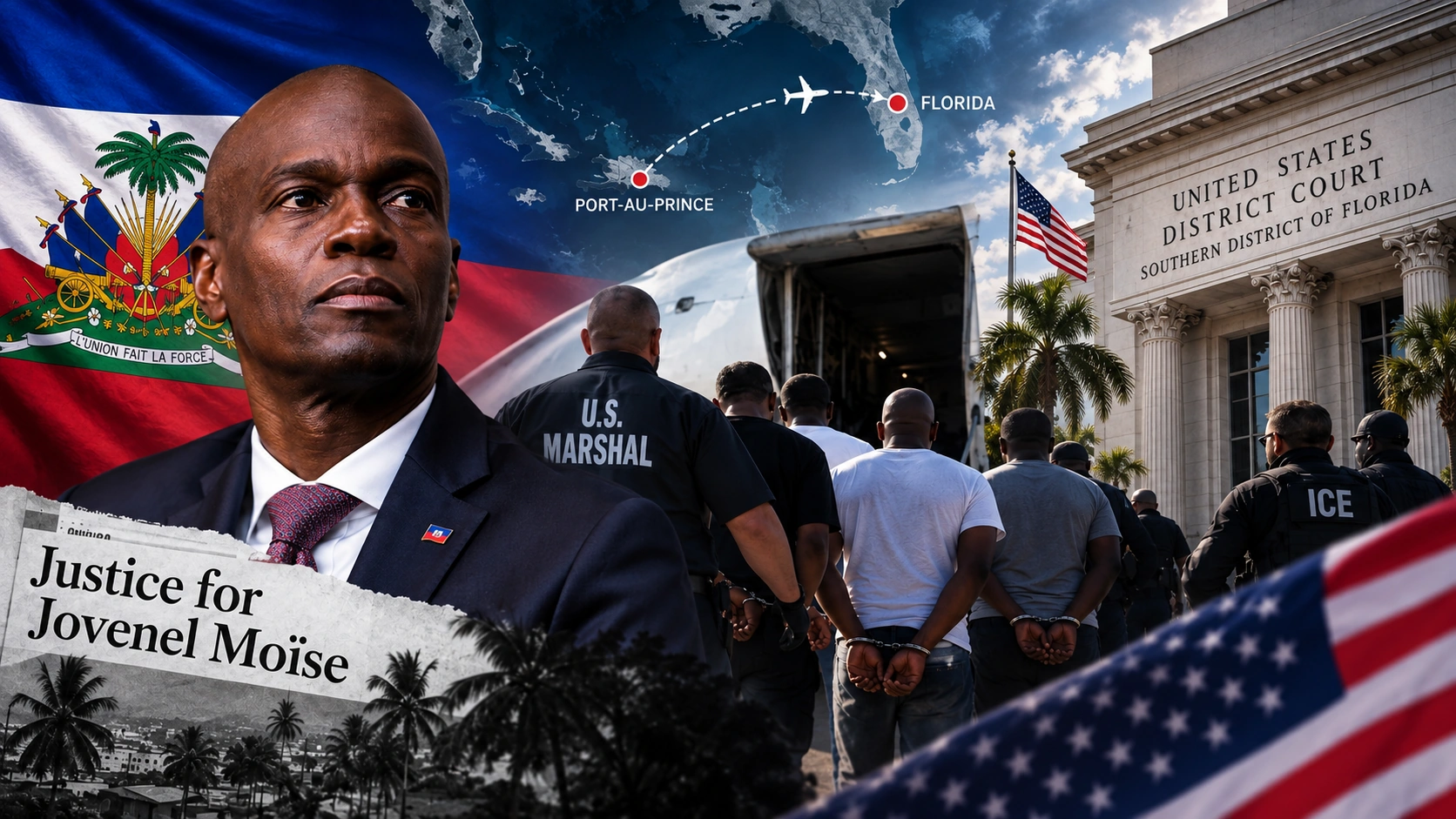
On Sunday, September 20, a U.S. military aircraft carried 18 defendants from Haiti to the United States. AP reported that the group included 17 Colombian former soldiers and Joseph Félix Badio, a former Haitian Justice Ministry employee. Haitian authorities said they surrendered the detainees so they could be tried in the United States after the Haitian case had failed to reach trial in five years. (apnews.com)
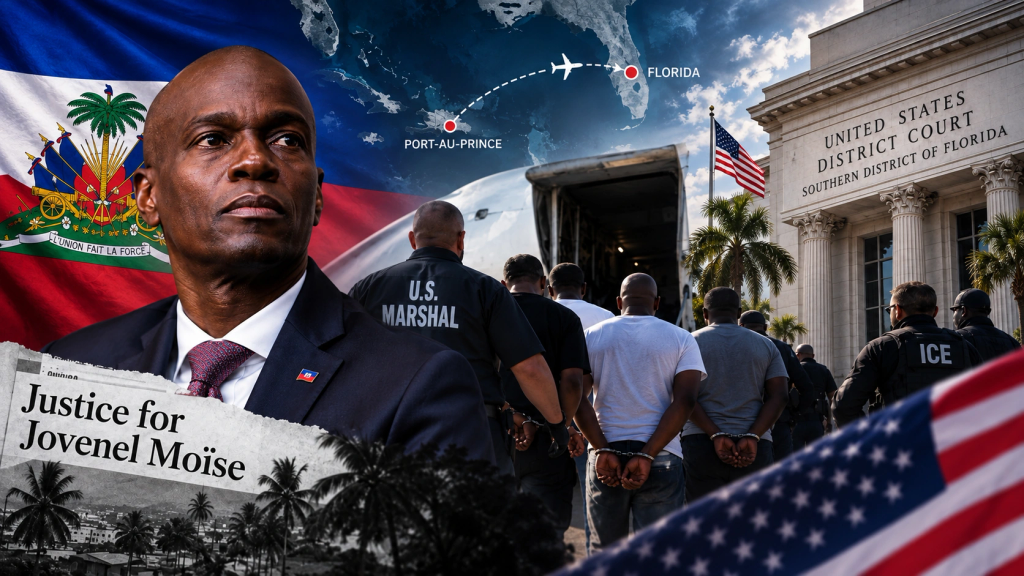
※ Images in this article are AI-generated illustrations created to help explain the story. They are not actual photographs, and depictions of people, places, or events may differ slightly from reality.
The surprising part of this story is not simply that defendants crossed an international border.
It is that a killing carried out in Haiti had already become, in important ways, a South Florida federal case before the gunmen ever entered President Jovenel Moïse’s home.
Why Can a U.S. Court Prosecute a Killing That Happened in Haiti?
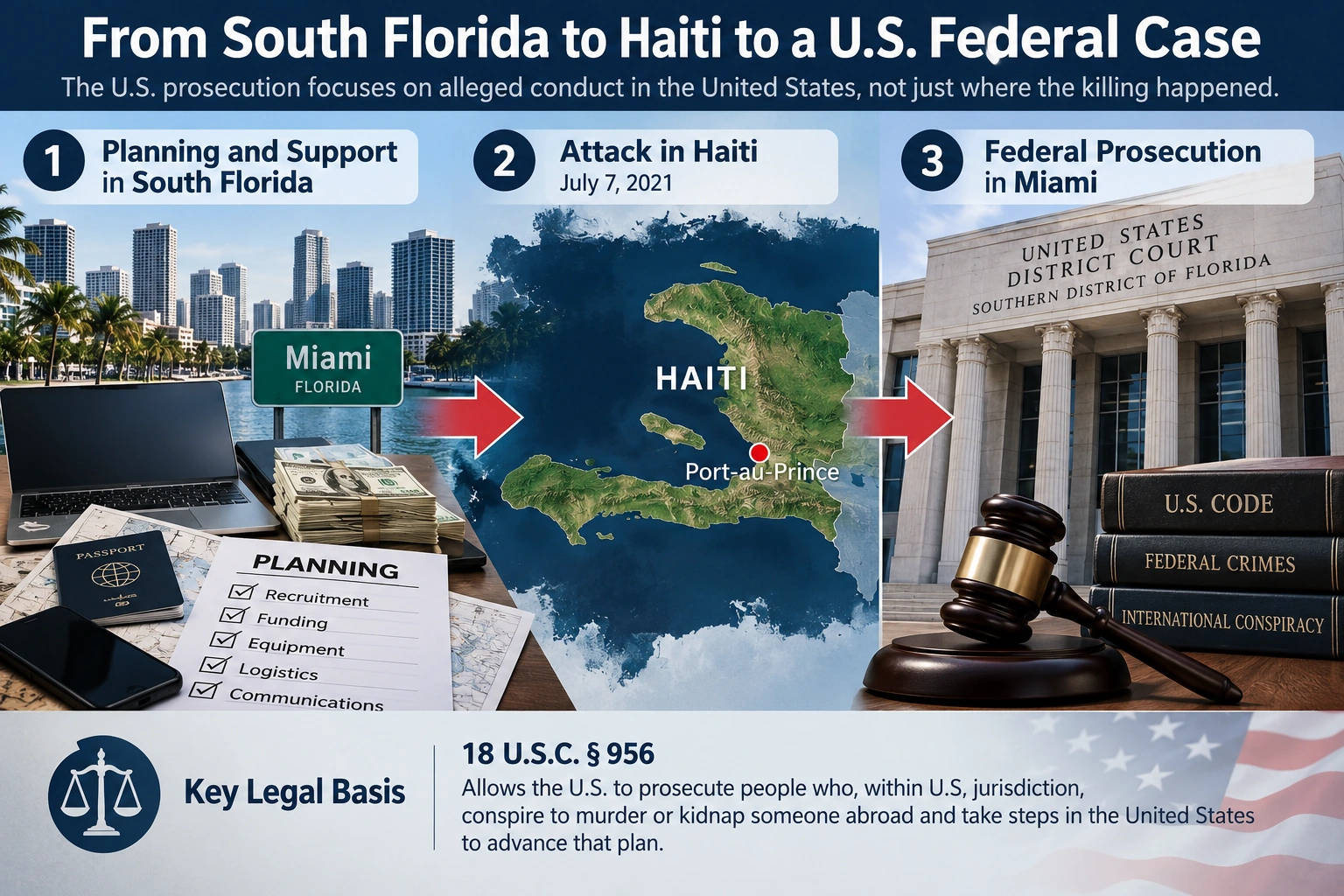
Because federal prosecutors are not relying on the simple fact that Florida is geographically close to Haiti.
They are relying on alleged conduct that took place inside the United States.
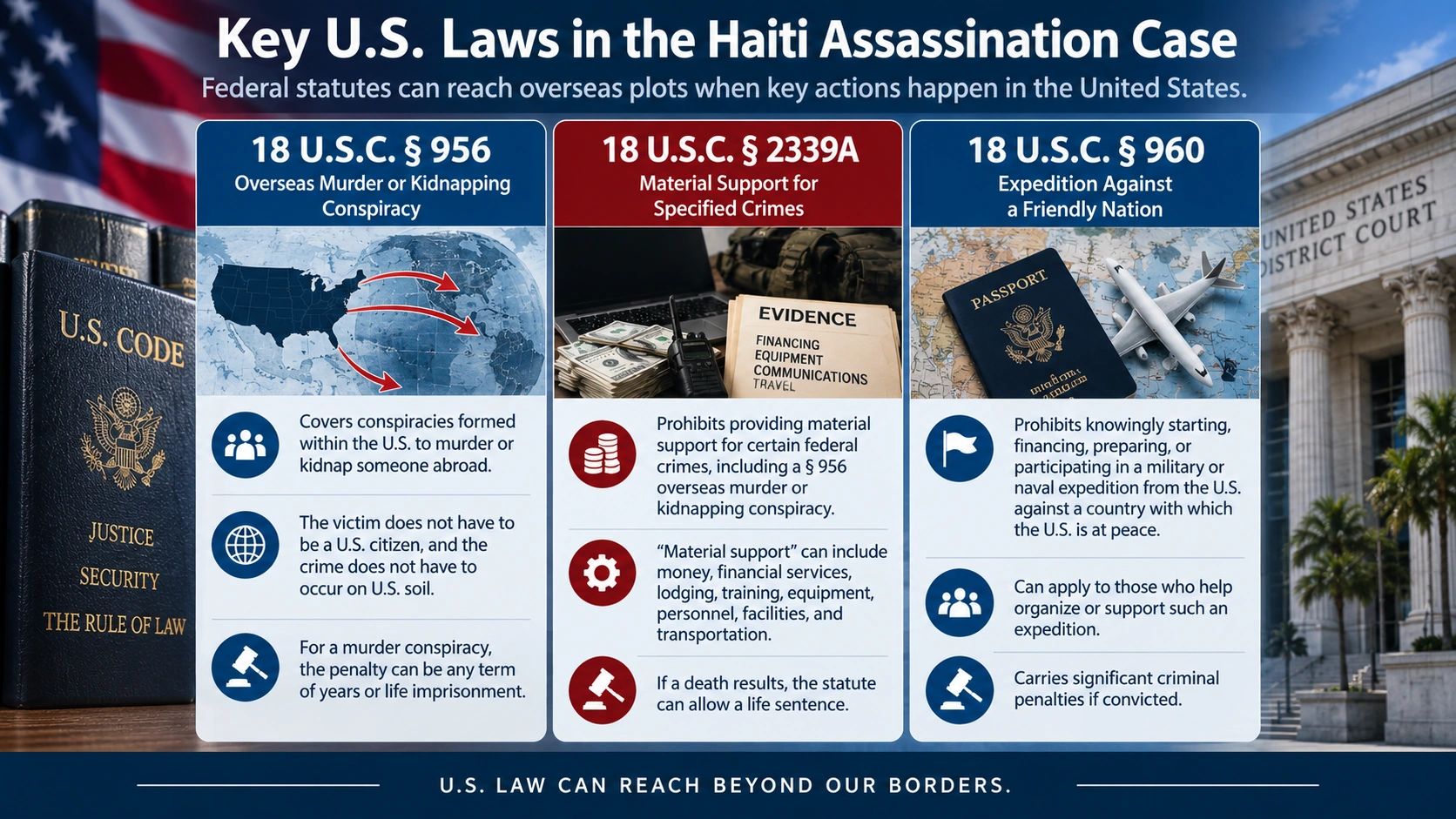
One of the principal statutes in the case, 18 U.S.C. § 956, applies when people within U.S. jurisdiction conspire to murder or kidnap someone outside the United States and at least one conspirator takes an action inside U.S. jurisdiction to advance the conspiracy. The intended victim does not have to be American, and the planned killing does not have to occur on U.S. soil. (uscode.house.gov)
That distinction explains the case better than a map does.
The question is not:
“Where was President Moïse killed?”
Everyone agrees the assassination occurred in Haiti.
The federal question is:
“What parts of the alleged conspiracy happened in the United States?”
According to evidence presented in an earlier Miami trial, prosecutors said organizers used South Florida as a base while recruiting people in the United States, Colombia, and Haiti. The operation eventually involved 22 former Colombian Army soldiers and Haitian allies, according to the Justice Department. (justice.gov)
That is the jurisdictional bridge between Port-au-Prince and Miami.
What Was Allegedly Happening in South Florida?
The U.S. prosecution describes something much broader than 18 people suddenly being brought to Miami in 2026.
Federal prosecutors said the conspiracy developed during 2021 around plans to remove Moïse and install a preferred successor who could award valuable government contracts.
The plans changed over time. Evidence presented at the 2026 Miami trial showed that conspirators discussed kidnapping Moïse, forcing him to resign, and ultimately sending armed men to his residence. Prosecutors said money, personnel, equipment, communications, and business relationships connected South Florida to the operation. (justice.gov)
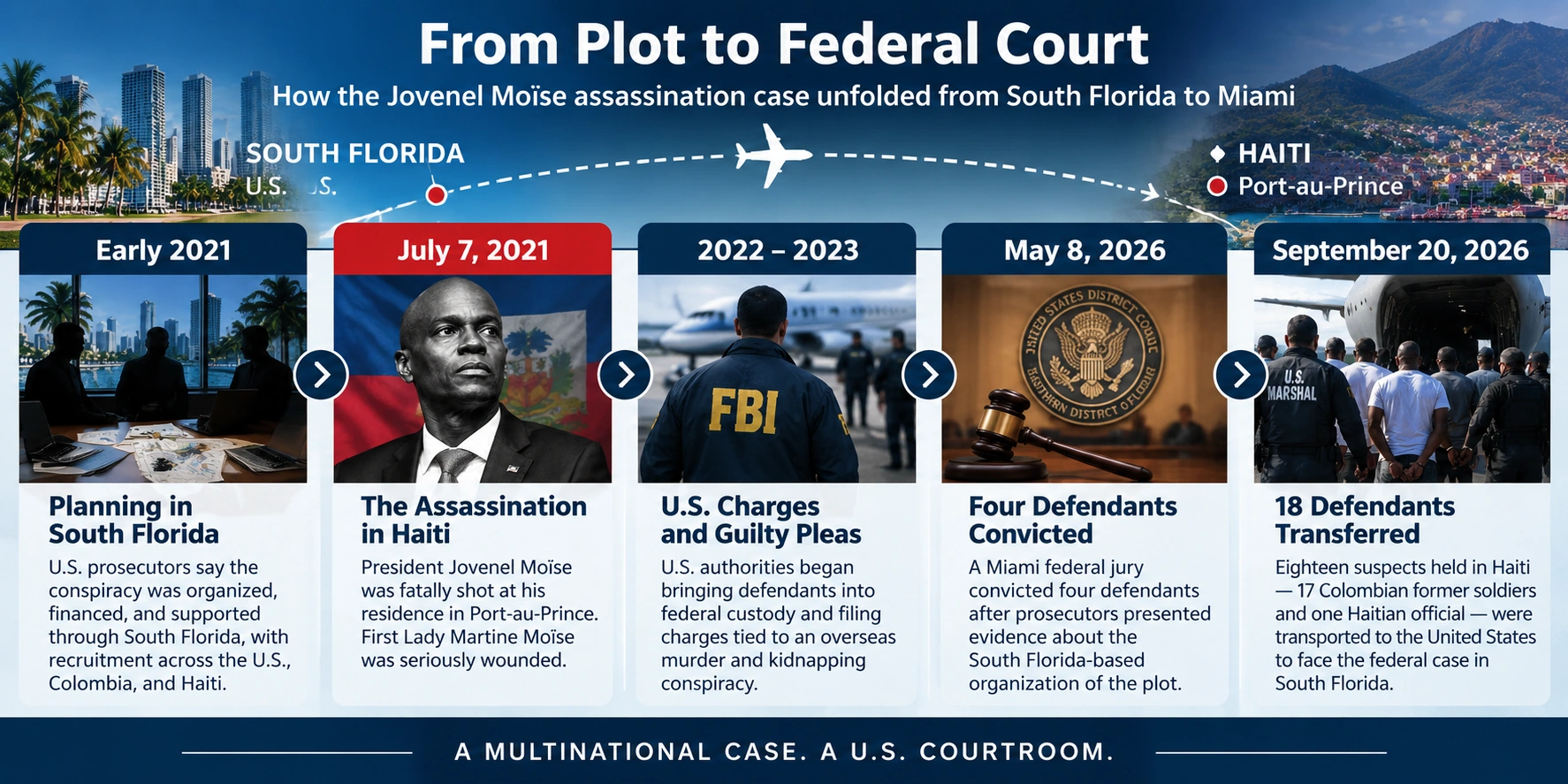
The assassination occurred on July 7, 2021. Moïse was fatally shot at his residence, and First Lady Martine Moïse was seriously wounded. (justice.gov)
The American prosecution then developed in stages.
| Date | What changed |
|---|---|
| July 7, 2021 | Jovenel Moïse was assassinated at his home in Haiti. (justice.gov) |
| 2022–2023 | U.S. authorities began bringing defendants into federal custody and filing charges tied to the overseas conspiracy. (justice.gov) |
| May 8, 2026 | A Miami federal jury convicted four defendants after prosecutors presented evidence about the South Florida-based organization of the plot. (justice.gov) |
| August 27, 2026 | A new superseding federal indictment expanded the case and listed additional defendants and charges. (justice.gov) |
| September 20, 2026 | Eighteen defendants held in Haiti were transported to the United States to face the federal case in South Florida. (apnews.com) |
So the September transfer did not create the American case.
It dramatically expanded a prosecution that had already produced guilty pleas and jury convictions.
Who Are the 18 People Sent From Haiti?
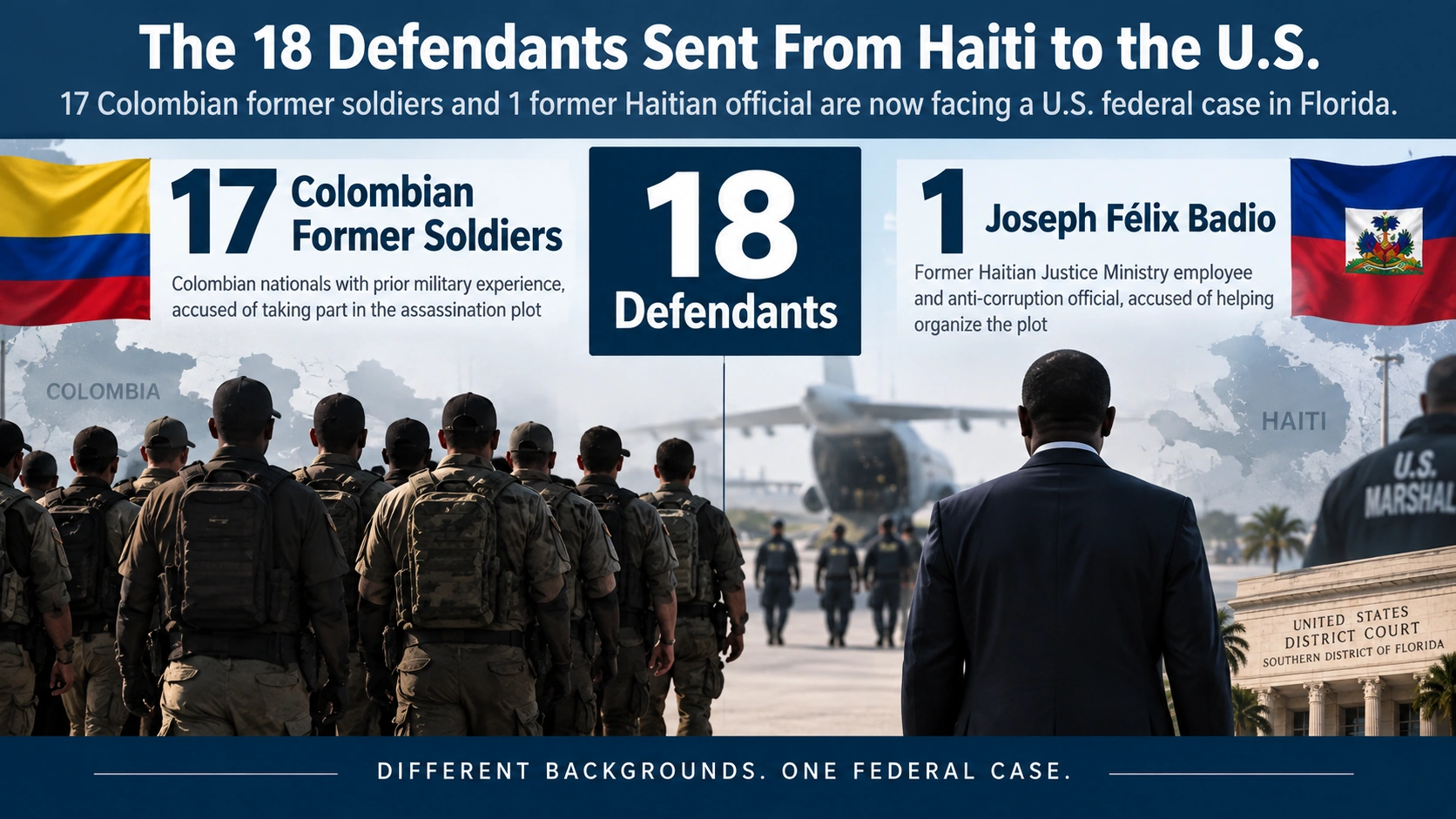
AP reported that the transferred group consisted of 17 Colombian former soldiers and Joseph Félix Badio, who previously worked for Haiti’s Justice Ministry and an anti-corruption unit. (apnews.com)
Badio has long been treated as a central suspect in the Haitian investigation, but that is not the same thing as a conviction. Claims about his precise role have come from investigators, prosecutors, other defendants, and defense attorneys, and those claims must now be tested through the federal process.
The same caution applies to the Colombian defendants.
Some suspects have said the original operation was presented to them differently from the assassination that ultimately occurred. AP has reported that Colombian detainees also alleged mistreatment while in Haitian custody and said they were forced to sign documents they did not understand. (apnews.com)
Their transfer to Florida therefore answers the question of where they will face the U.S. charges.
It does not answer the question of individual guilt.
The prosecutor has said that 30 people have been indicted in connection with the broader U.S. case, meaning the 18 newly transferred defendants are only one part of a much larger prosecution. (apnews.com)
Why Did Haiti Agree to Send Them to the United States Now?
Because Haiti’s own case has repeatedly stalled.
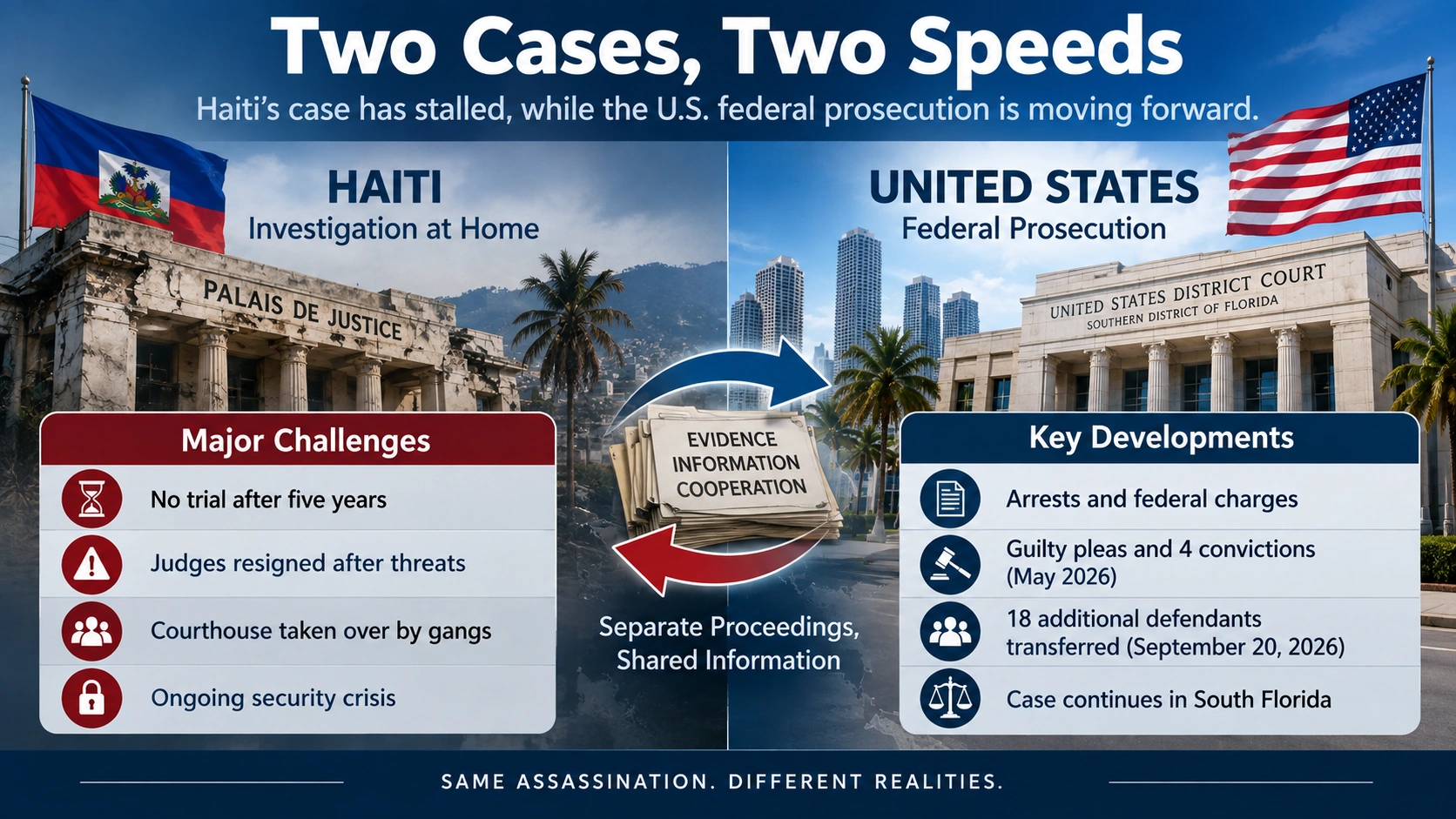
Haiti’s Justice Ministry said its proceedings had faced major difficulties and had not produced a trial after five years, while the American proceeding had already produced arrests, prosecutions, and convictions. The government said stronger cooperation with U.S. authorities could help move the case forward. (reuters.com)
Those “difficulties” are not just ordinary court delays.
AP has reported that judges handling the case resigned after threats, while gangs seized control of the downtown Port-au-Prince courthouse where suspects had been questioned. Haiti’s worsening security crisis has made even basic judicial work extraordinarily difficult. (apnews.com)
That creates an unusual contrast:
| Haiti | United States |
|---|---|
| The assassination occurred there, and Haiti opened its own criminal investigation. | Federal prosecutors pursued conduct they say was planned or supported through the United States. |
| Haiti’s government says the case has not reached trial after five years. (reuters.com) | The U.S. case has already produced guilty pleas and four jury convictions in May 2026. (justice.gov) |
| Judges, court facilities, and the wider justice system have been disrupted by insecurity and gang violence. (apnews.com) | The federal prosecution is proceeding in the Southern District of Florida. (justice.gov) |
The transfer therefore reflects two things at once: the strength of the U.S. legal connection to the alleged conspiracy and the severe constraints facing Haiti’s justice system in bringing one of its most important criminal cases to trial.
What Federal Crimes Can Cover a Plot to Kill Someone Overseas?
This is where the case can sound more complicated than it really is.
Three federal concepts explain much of the U.S. theory.
1. Conspiracy to kill or kidnap someone abroad
Under 18 U.S.C. § 956, people within U.S. jurisdiction can be prosecuted if they agree to murder or kidnap someone abroad and a conspirator commits an act in the United States to advance that agreement. A murder conspiracy under the statute can carry life imprisonment. (uscode.house.gov)
That is the clearest answer to “How can America prosecute a killing in Haiti?”
2. Providing material support for that conspiracy
The case also invokes 18 U.S.C. § 2339A.
The phrase “material support” is broader than handing someone a weapon. Federal law defines it to include things such as money, financial services, lodging, training, communications equipment, weapons, personnel, facilities, and transportation when they are knowingly provided for specified crimes. If a death results, the statute can allow a life sentence. (uscode.house.gov)
There is an important misconception here.
The fact that § 2339A appears in the federal terrorism chapter does not, by itself, mean prosecutors must prove that every defendant belonged to a formally designated terrorist organization. Section 2339A focuses on support knowingly provided for specified federal crimes, including a § 956 overseas murder or kidnapping conspiracy. (uscode.house.gov)
3. Launching an expedition against a friendly country
Another unusually worded charge is 18 U.S.C. § 960, “Expedition against friendly nation.”
The statute applies when someone in the United States knowingly starts, finances, prepares, or participates in a military or naval expedition to be carried out from the United States against a country with which the United States is at peace. (uscode.house.gov)
The Justice Department used that statute in the earlier Moïse case, and the August 2026 superseding indictment contains a broader set of federal charges for different defendants. Not everyone in the case necessarily faces the same counts. (justice.gov)
Does the U.S. Trial Mean Haiti Has Lost Its Own Case?
No.
The American prosecution does not erase the fact that Moïse was killed in Haiti or eliminate Haiti’s own interest in investigating the assassination.
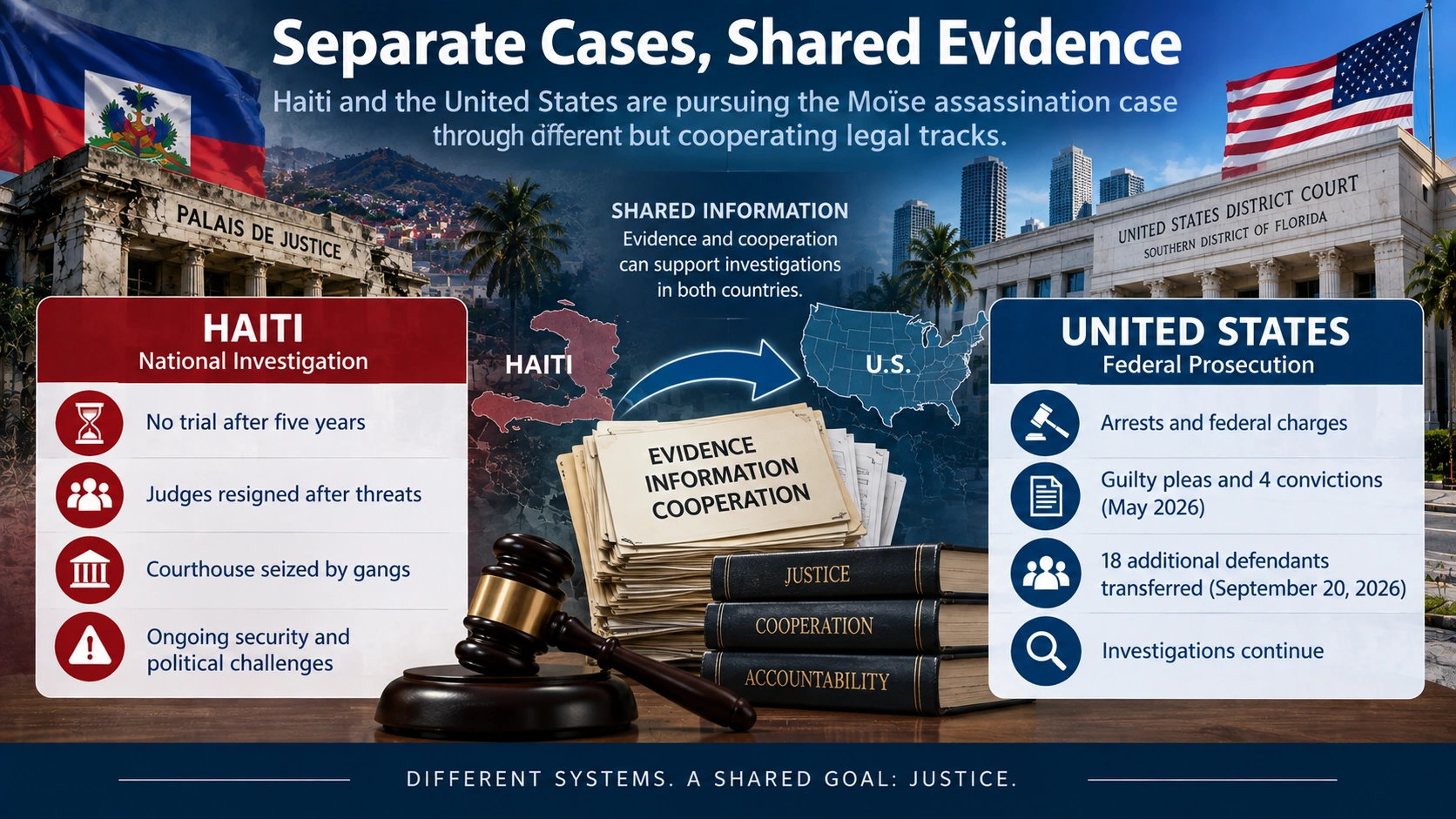
Haiti’s Justice Ministry said the two countries have been pursuing separate proceedings and that information or evidence obtained through U.S.-Haitian cooperation could also contribute to investigations in Haiti. (apnews.com)
A simple way to picture it is as two legal tracks built around the same assassination.
Haiti can investigate crimes committed in Haiti.
The United States can prosecute federal crimes tied to conduct that occurred within U.S. jurisdiction.
Those tracks can overlap without being identical.
That is why someone can face a federal conspiracy charge in Miami even though the person allegedly killed was Haiti’s president and the fatal attack occurred hundreds of miles away.
What Happens Next in Florida?
The most important point is that transfer to U.S. custody is not a conviction.
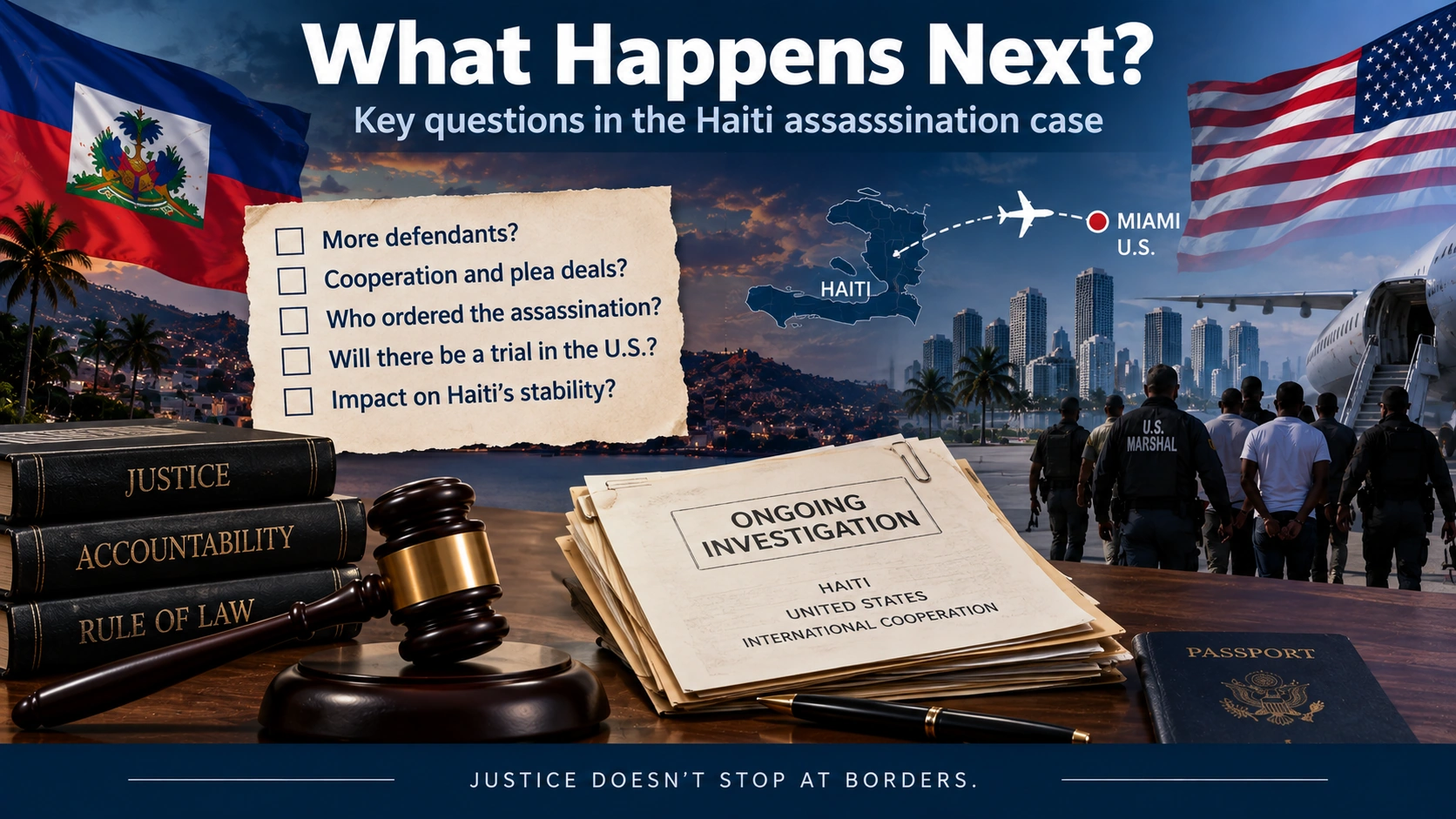
The 18 defendants have now been moved into the U.S. federal system, where the charges against each defendant will have to be addressed through federal court proceedings. The publicly available Justice Department announcement confirms the transfer and federal charges but does not provide one consolidated trial date for the newly transferred group. (justice.gov)
Some defendants in the wider case have already pleaded guilty. Four others were convicted by a Miami jury in May 2026. Those outcomes apply to those particular defendants; they do not establish the guilt of the newly transferred defendants. (justice.gov)
The August superseding indictment also shows why this could become a large and complicated federal proceeding: the case involves numerous defendants, multiple statutes, evidence spanning several countries, and alleged conduct stretching over years. (justice.gov)
And prosecutors are signaling that even this may not be the end.
U.S. Attorney Jason A. Reding Quiñones said investigators intend to continue pursuing people they believe financed, facilitated, supported, or participated in the plot. (justice.gov)
Why It Matters in One Sentence
The 18 suspects are being prosecuted in Florida not because the United States has claimed jurisdiction over every crime committed in Haiti, but because prosecutors allege that crucial parts of the conspiracy to remove and kill Jovenel Moïse were organized or supported from inside the United States under federal laws that specifically reach violent plots carried out abroad. (uscode.house.gov)
Jovenel Moïse Assassination: Key Questions Explained
Q. Why are suspects in a Haitian president’s assassination being tried in Florida?
Because U.S. prosecutors allege that significant parts of the conspiracy were planned, financed, organized, or supported through South Florida. Federal law can cover a conspiracy formed within U.S. jurisdiction to kill or kidnap someone overseas. (uscode.house.gov)
Q. Were all 18 suspects arrested in the United States?
No. The 18 had been held in Haiti and were transported to the United States on September 20, 2026. AP reported that the group included 17 Colombian former soldiers and Joseph Félix Badio. (apnews.com)
Q. Does Florida have jurisdiction simply because it is close to Haiti?
No. Geographic proximity is not the core legal basis. The federal case rests on alleged conduct connected to the United States and federal statutes covering overseas murder conspiracies and related support. (uscode.house.gov)
Q. What is 18 U.S.C. § 956?
It is a federal law covering certain conspiracies formed within U.S. jurisdiction to murder, kidnap, maim, or injure people abroad. For a murder or kidnapping conspiracy, the statute can provide for imprisonment for any term of years or life. (uscode.house.gov)
Q. Does a material-support charge mean every defendant is accused of joining a terrorist organization?
No. Section 2339A can apply when someone knowingly provides defined forms of support for specified federal crimes, including a § 956 overseas murder or kidnapping conspiracy. Membership in a designated terrorist organization is not what § 2339A itself requires in this case. (uscode.house.gov)
Q. Why did Haiti send the defendants to the United States?
Haiti’s government said its own case had failed to reach trial after five years and continued to face major difficulties, while the U.S. proceeding had already produced prosecutions and convictions. (apnews.com)
Q. Has anyone already been convicted in the U.S. case?
Yes. A Miami federal jury convicted four defendants on May 8, 2026, and other defendants in the broader case had previously entered guilty pleas. (justice.gov)
Q. Does the transfer of the 18 defendants prove they took part in the assassination?
No. Transfer to U.S. custody and an indictment are not findings of guilt. The charges against each transferred defendant must still be resolved through the federal judicial process.
Q. Is Haiti’s own investigation now over?
No. Haiti has described its proceedings and the U.S. proceedings as separate tracks and said evidence obtained through cooperation could also support the Haitian investigation. (apnews.com)
Did this help make the story clearer? 🙂
WIN keeps unpacking the “why” behind the news—clearly and simply!
Sources
September 2026 Transfer and Federal Case
U.S. Attorney’s Office — 18 Defendants Transported From Haiti to South Florida
Associated Press — 18 Suspects Extradited From Haiti to the United States
Reuters — Suspects in 2021 Killing of Haitian President Flown to U.S. to Face Trial
Earlier Miami Trial and Alleged South Florida Plot
U.S. Department of Justice — Four Defendants Convicted in Plot to Kill Jovenel Moïse
U.S. Department of Justice — 2026 Superseding Indictment
Federal Laws Behind U.S. Jurisdiction
U.S. Code — 18 U.S.C. § 956, Conspiracy to Kill or Kidnap Abroad
U.S. Code — 18 U.S.C. § 2339A, Material Support
U.S. Code — 18 U.S.C. § 960, Expedition Against Friendly Nation