
Why Is Dangote’s Refinery IPO Triggering a Retail-Investing Rush in Nigeria?
Can ordinary people really buy into Africa’s biggest refinery for about $4?
Yes—but that number is easy to misunderstand.
Dangote Petroleum Refinery’s IPO is priced at ₦525 per share, not $4 per share. Investors must buy at least 10 shares, making the minimum subscription ₦5,250—roughly $4 at recent exchange rates. The offer opened on September 14 and is scheduled to close on October 13. (Reuters · Nigeria SEC)
That sounds like a remarkably low barrier to owning part of a giant oil refinery.
But it leads to a more interesting question.
Why are so many Nigerians suddenly trying to buy shares in a refinery?
On September 29, Aliko Dangote said demand for the offering was “enormous.” Retail-investing platform Bamboo told Reuters that new accounts had jumped 350% in the week before the IPO opened, and demand after launch was strong enough to disrupt some financial platforms. (Reuters)
※ Images in this article are AI-generated illustrations created to help explain the story. They are not actual photographs, and depictions of people, places, or events may differ slightly from reality.
The excitement is real.
But the story is bigger than a cheap minimum investment or a hot stock market.
It starts with one of the strangest facts about Nigeria’s oil industry: one of Africa’s largest oil producers spent years importing huge quantities of gasoline and other refined fuels.
Why Is This IPO Such a Big Deal?
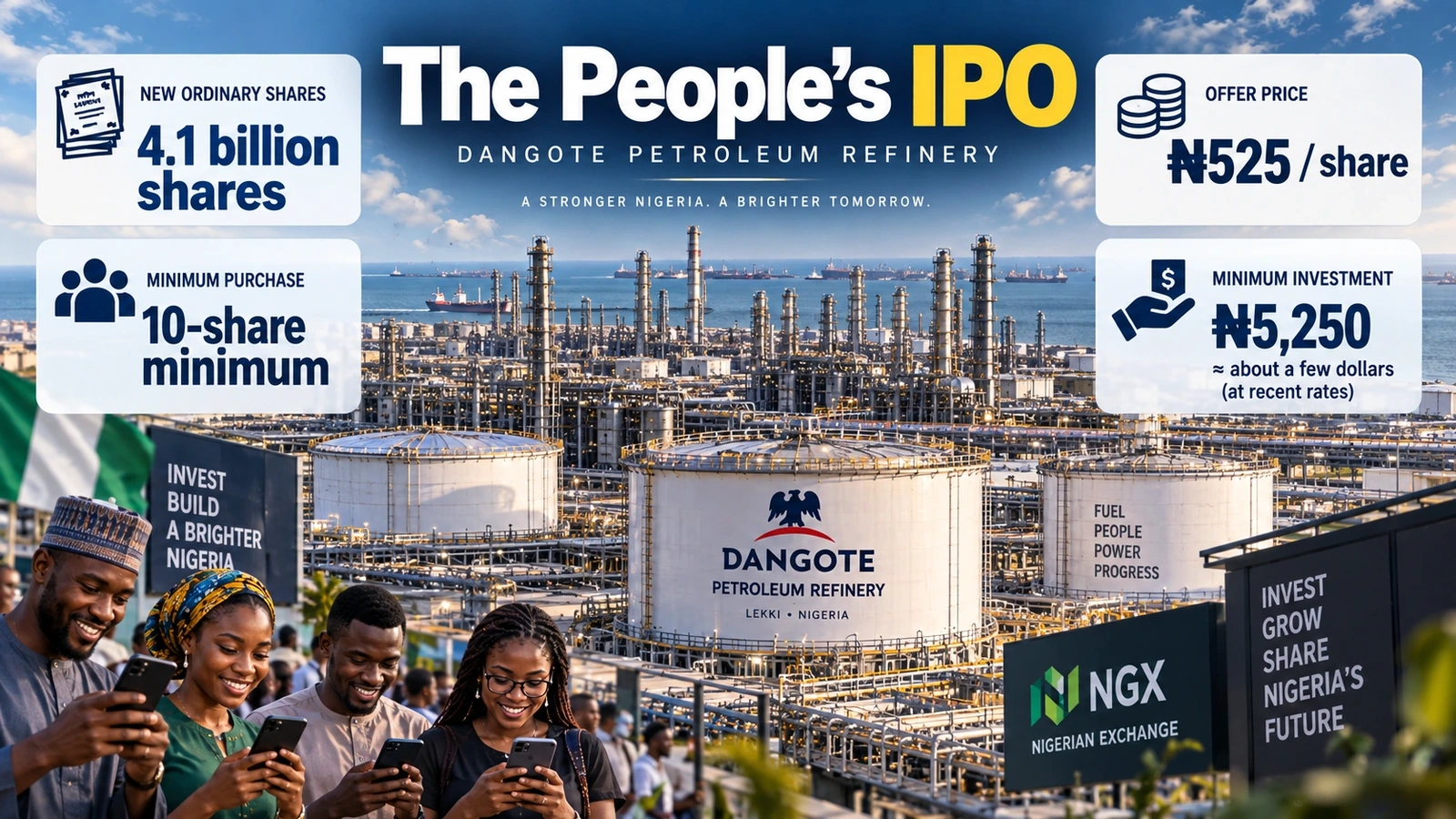
Dangote is offering 4.1 billion new ordinary shares at ₦525 each. A fully subscribed offering would raise about ₦2.15 trillion, or roughly $1.6 billion, making it the largest share sale in African history. (Reuters)
Here is the basic structure:
| IPO detail | What it means |
|---|---|
| Offer price | ₦525 per share |
| Minimum purchase | 10 shares |
| Minimum investment | ₦5,250, roughly $4 |
| New shares offered | 4.1 billion |
| Potential base proceeds | About ₦2.15 trillion / $1.6 billion |
| Offer period | September 14–October 13, 2026 |
| Dangote’s stated ambition | As many as 10 million shareholders |
The 10 million figure is a target, not the current number of investors.
Dangote has described the offering as an effort to spread ownership across Nigeria and Africa. He has said he wants ownership spread so widely that a future annual meeting might need a stadium. (Punch)
The appeal is easy to understand.
Instead of asking ordinary investors for thousands of dollars, the offering lets someone enter with the equivalent of only a few dollars.
But accessibility and valuation are two completely different questions.
How Did an Oil-Rich Country End Up Importing So Much Fuel?
Producing crude oil does not automatically mean a country can turn that crude into gasoline, diesel or jet fuel.
Those are separate businesses.
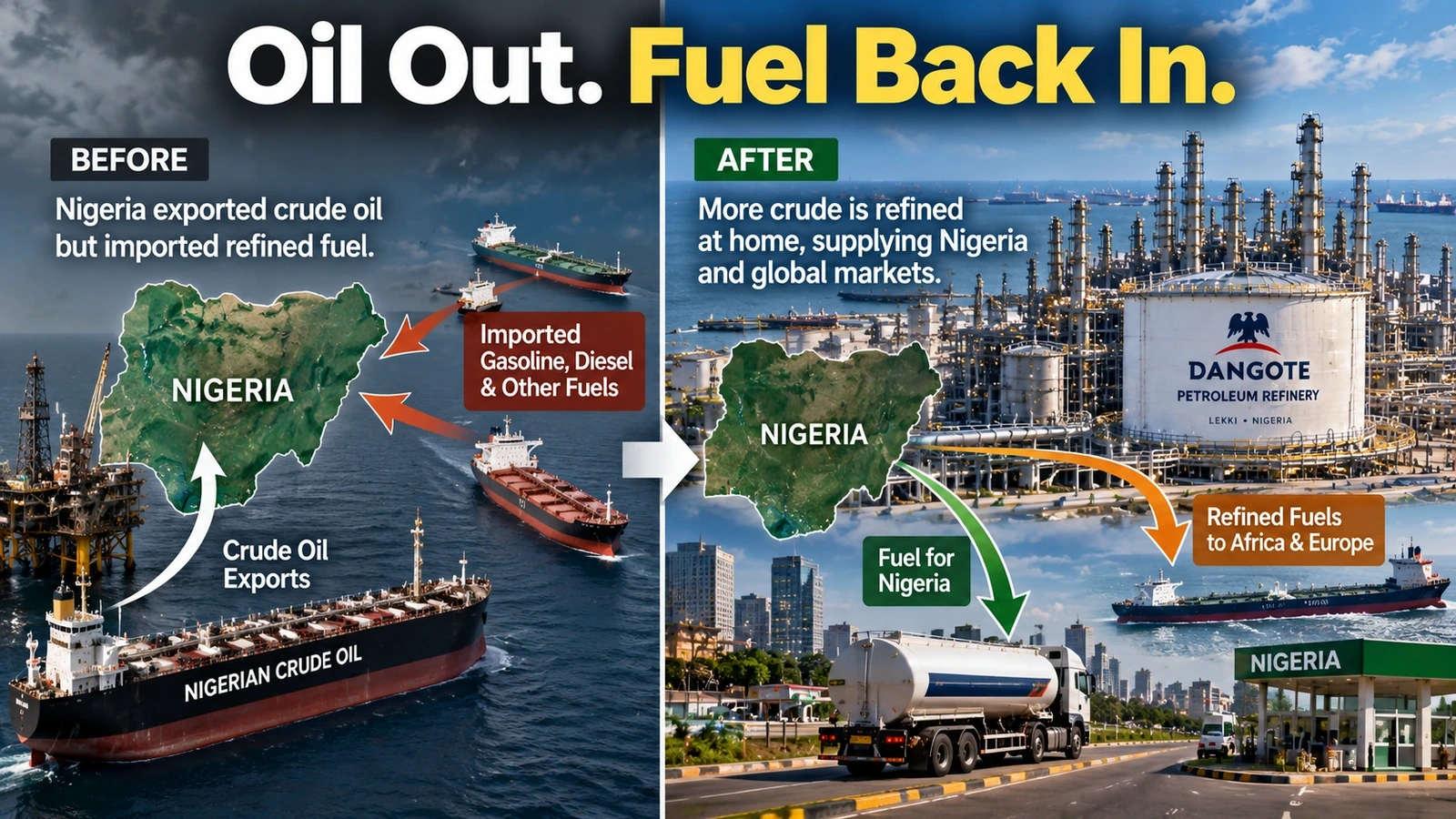
For years, Nigeria exported crude oil while its domestic refining system failed to produce enough finished fuel. The country then had to use foreign currency to buy refined petroleum products from overseas.
The U.S. Energy Information Administration says Nigeria imported nearly 400,000 barrels per day of petroleum products in 2023. By the second quarter of 2026, after Dangote’s refinery ramped up production, seaborne imports had fallen below 130,000 barrels per day. (U.S. EIA)
That is the structural change behind much of the enthusiasm.
A simple way to picture it:
Old model: sell crude oil abroad → buy gasoline and diesel back.
New model: refine more crude at home → replace imports → export some finished fuel.
That does not mean Nigeria has become completely independent from global energy markets.
But it changes where a much larger share of the value is created.
What Changed Once the Dangote Refinery Reached Scale?
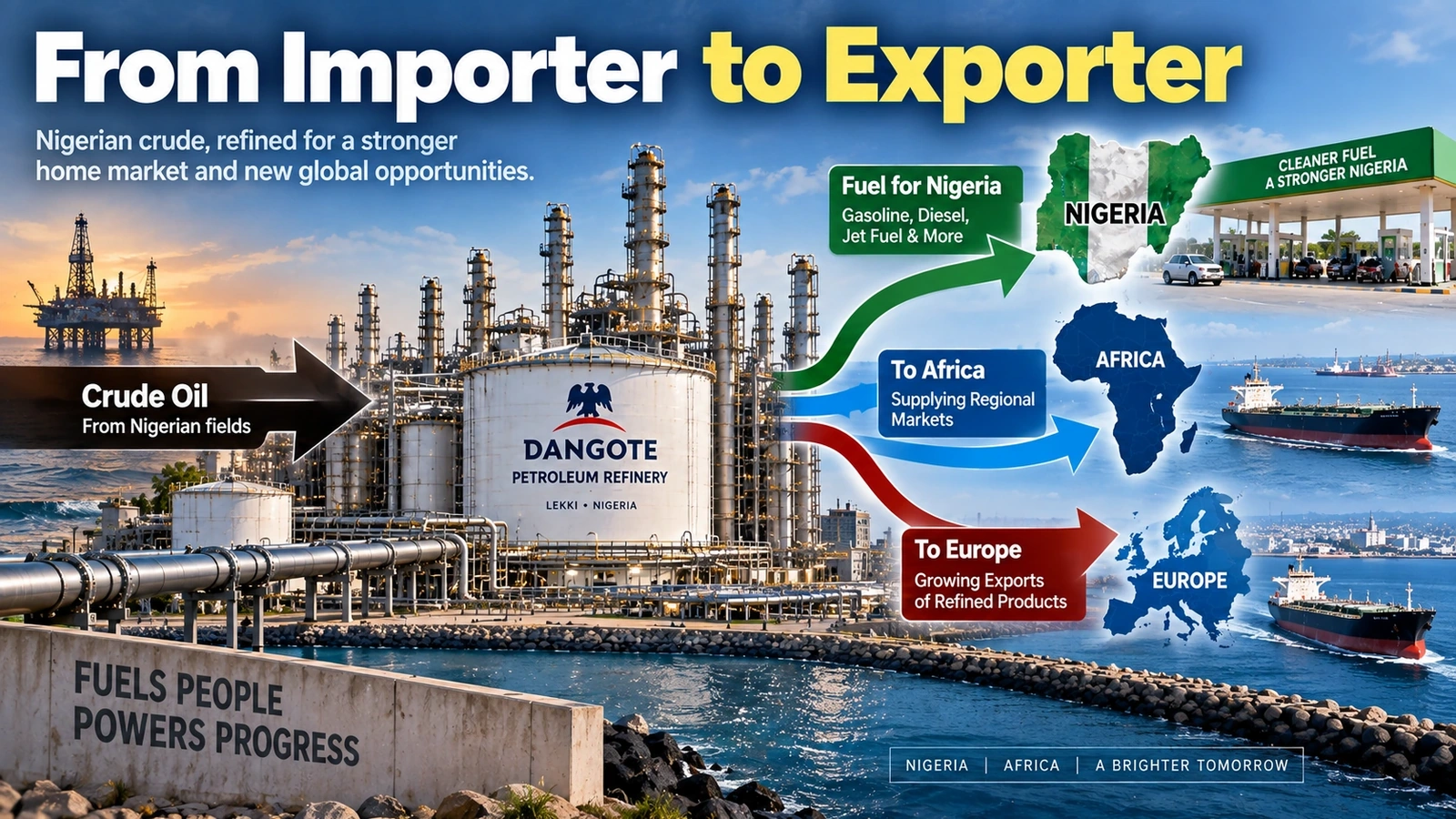
The refinery began operating in 2024 and has since expanded its crude-distillation capacity to around 700,000 barrels per day.
That is enormous.
The EIA says Nigeria’s seaborne petroleum-product exports reached about 350,000 barrels per day in the second quarter of 2026, up from an annual average of just 46,000 barrels per day in 2023. Exports to Europe averaged about 130,000 barrels per day during the quarter. (U.S. EIA)
Jet fuel became particularly important.
After Middle East disruptions reduced Europe’s usual supply of diesel and jet fuel, Dangote became a major alternative source. Reuters reported that Europe imported roughly 80,000 barrels per day of jet fuel from Dangote in the second quarter, equal to about 13% of the supply shortfall created by the disruption. (Reuters)
That is a remarkable reversal.
Nigeria once depended heavily on imported refined fuel.
Now one Nigerian refinery has become important enough to help ease a European fuel shortage.
Why Did Dangote’s Profits Suddenly Jump?
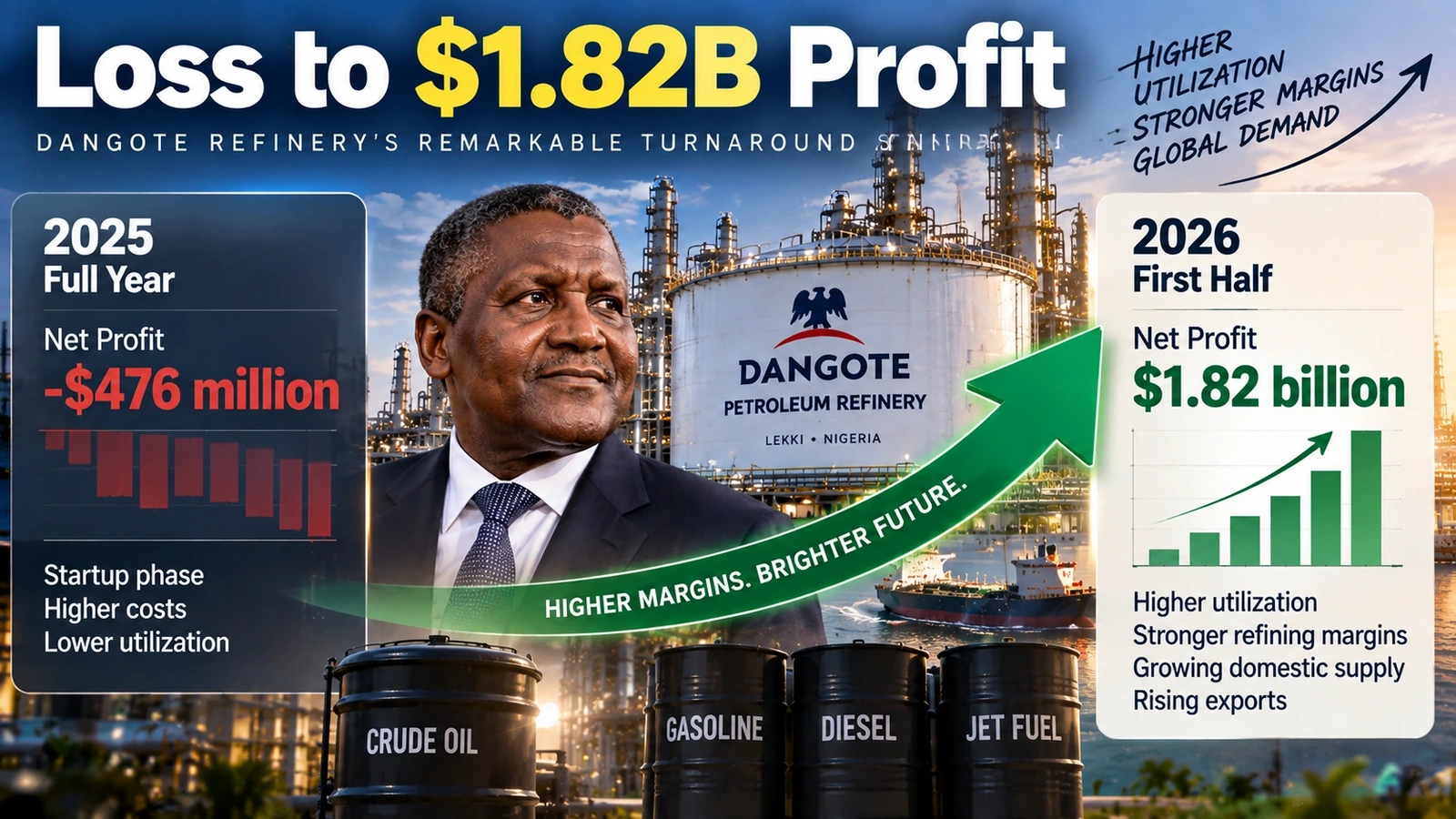
The financial turnaround is one of the strongest reasons investors are paying attention.
The refinery reported more than $13 billion in revenue and $1.82 billion in net profit in the first half of 2026. In all of 2025, it had recorded a $476 million loss. (Reuters)
That comparison needs one important caveat: one figure covers six months and the other covers a full year.
Still, the direction of change is unmistakable.
Three things happened at roughly the same time:
- The refinery moved closer to full-scale operation.
- Nigeria needed fewer imported fuels while Dangote exported more.
- Middle East disruptions sharply increased refining margins and demand for alternative suppliers.
That third factor matters.
A refinery earns money from the difference between the cost of crude oil and the value of the gasoline, diesel, jet fuel and other products it produces. When finished fuel becomes scarce, that gap—often called a refining margin—can rise.
That helped make 2026 unusually profitable.
It also creates one of the biggest risks for new shareholders: crisis-level refining margins do not necessarily last forever.
Is Nigeria’s Stock-Market Boom Basically a Dangote Story?
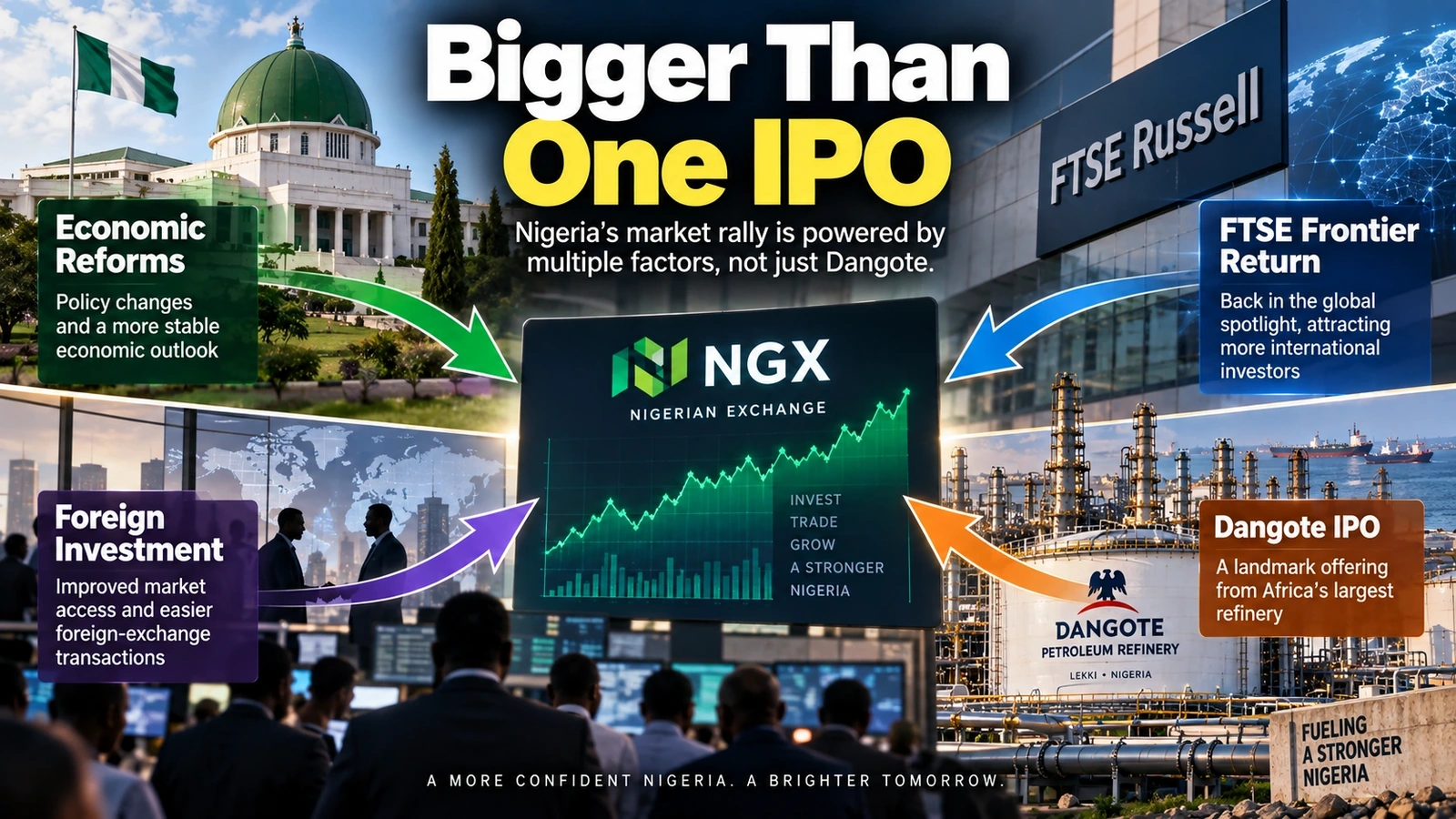
No.
The Dangote IPO arrived during an extraordinary Nigerian stock-market rally, but the refinery did not single-handedly create that rally.
The NGX All-Share Index closed at 251,913.20 on September 29, up 61.88% for the year. (Network Capital)
A major factor is Nigeria’s improving access to global capital.
FTSE Russell announced in April that Nigeria would be reclassified from Unclassified to Frontier Market status, effective September 21, 2026. Nigeria had been removed from Frontier status in 2023 after foreign-exchange market problems made it difficult for international investors to repatriate capital. (FTSE Russell)
So several stories are happening at once:
| Factor | Why investors care |
|---|---|
| Dangote IPO | Gives retail investors access to a nationally prominent industrial asset |
| FTSE Frontier status | Makes Nigerian stocks more visible to global funds |
| FX-market improvements | Makes it easier for foreign investors to enter and exit |
| Strong domestic equity performance | Draws more public attention to stocks |
| Refinery profitability | Gives the IPO an unusually powerful earnings story |
Dangote is therefore both a participant in the boom and a symbol of it.
That is different from saying one company caused the entire market to rise.
If the Refinery Is So Successful, Why Is Fuel Still Expensive in Nigeria?
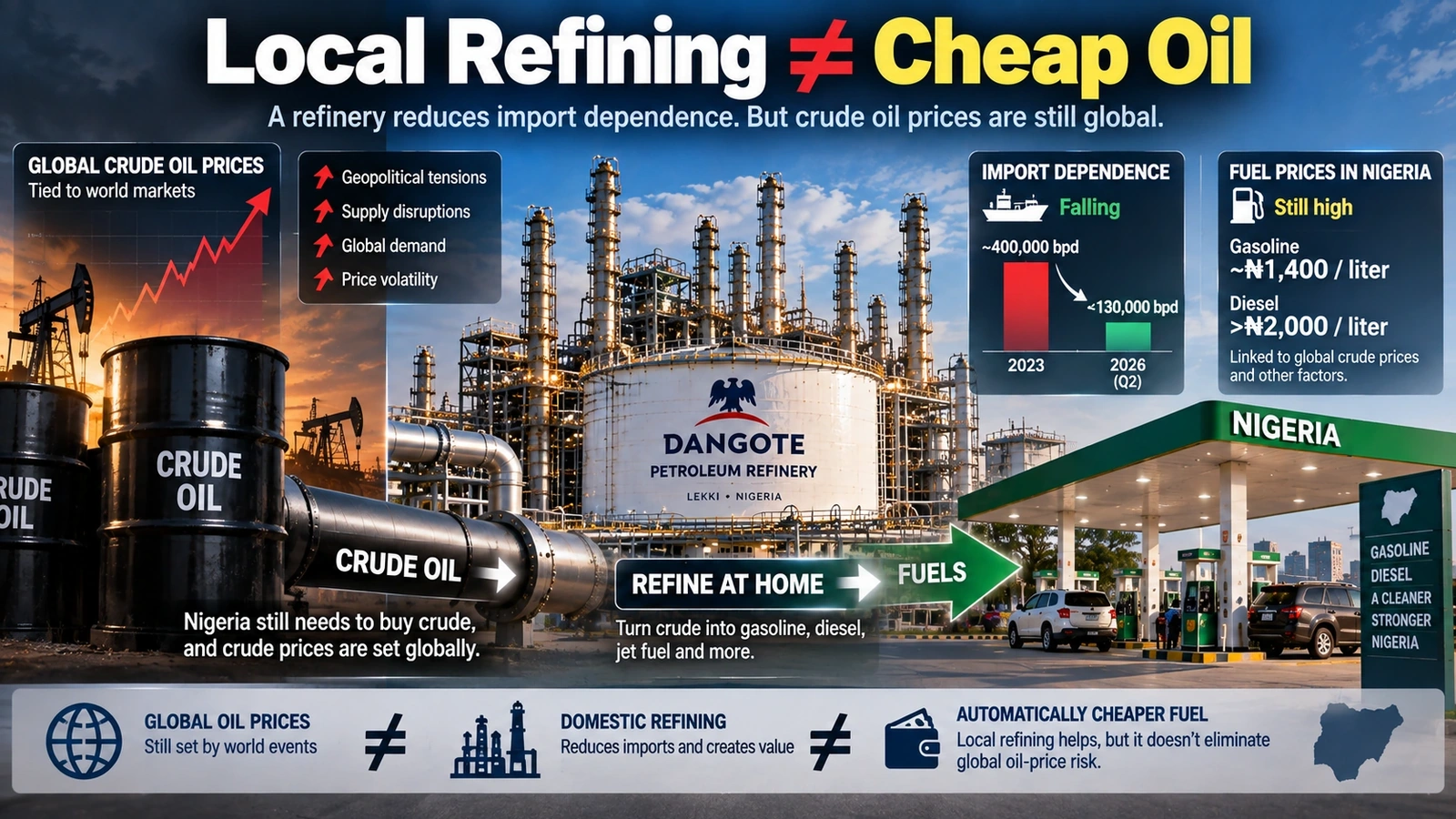
This is one of the most important parts of the story.
A domestic refinery can reduce the cost and foreign-exchange burden of importing finished fuel.
It cannot make the crude oil itself free.
Nigeria has recently experienced record-high fuel prices even while the Dangote refinery has been running at high capacity. Reuters reported gasoline prices of around ₦1,400 per liter in Lagos and Abuja in September, while diesel had risen above ₦2,000 per liter, largely as global crude prices surged amid Middle East disruptions. (Reuters)
This distinction is crucial:
A refinery solves a refining problem. It does not eliminate global oil-price risk.
Nigeria can import less gasoline and still experience expensive gasoline if the crude going into the refinery becomes much more expensive.
That is why the same global energy crisis can simultaneously make life harder for Nigerian drivers and improve the profits of a Nigerian refinery.
Does Dangote Strengthen Nigeria’s Currency and Foreign Reserves?
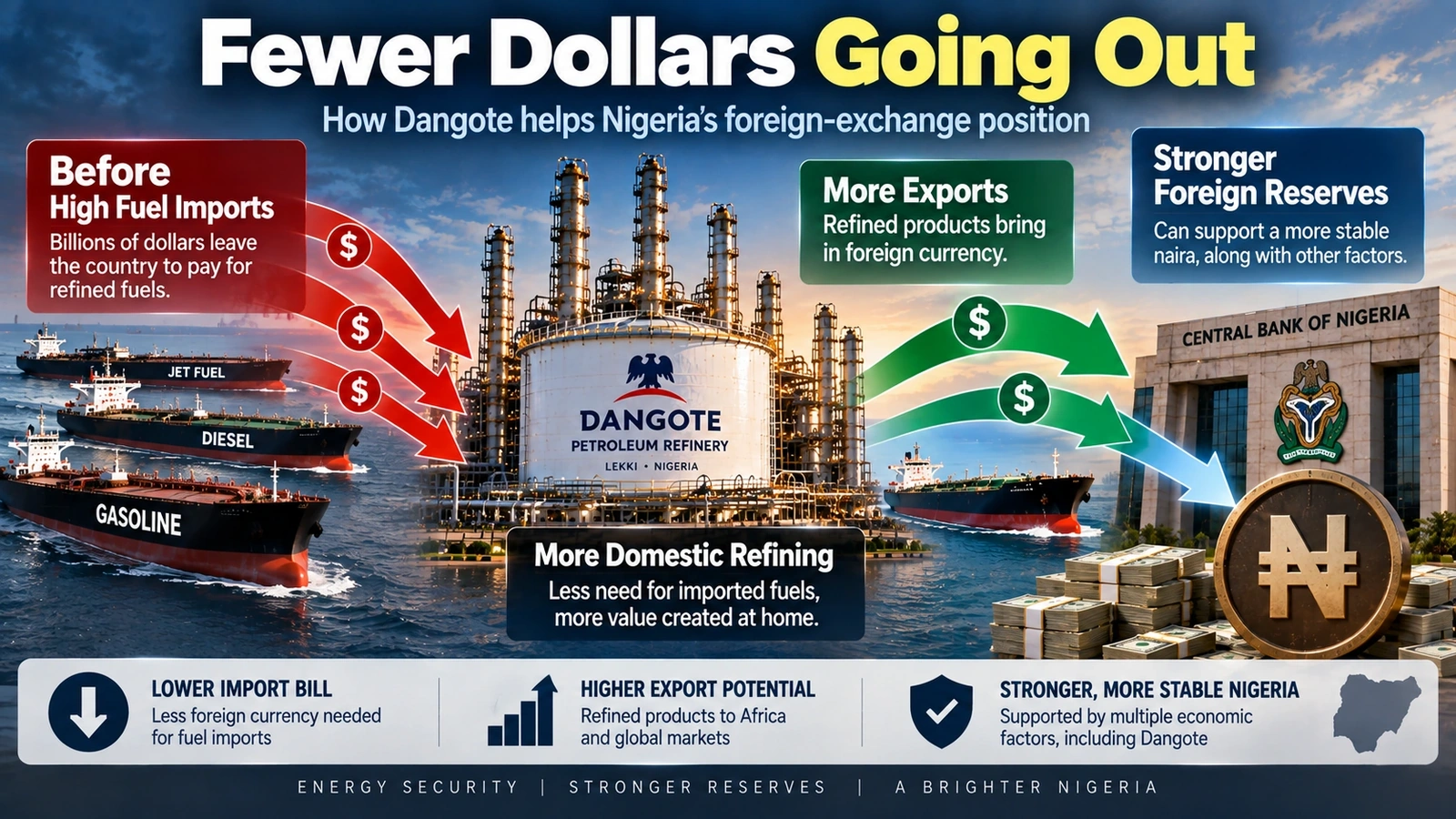
It can help, but it would be an exaggeration to say the refinery alone stabilized the naira or rebuilt Nigeria’s reserves.
Think about the foreign-exchange mechanics.
When Nigeria imports fuel, someone eventually needs foreign currency—often dollars—to pay the overseas supplier.
If the same fuel is produced domestically, some of that demand for foreign currency disappears.
If Nigeria then exports refined products, the country can also earn foreign currency.
The Central Bank of Nigeria’s 2026 macroeconomic outlook said the refinery’s expansion could further support growth in external reserves, while also identifying oil earnings, sovereign borrowing and remittances as major drivers. (Central Bank of Nigeria)
So the more accurate chain is:
More domestic refining → fewer fuel imports → less foreign-currency demand for those imports → more export potential → possible support for the external balance.
That is meaningful.
It is not the same thing as saying one refinery determines the exchange rate.
Is ₦525 Per Share Actually Cheap?
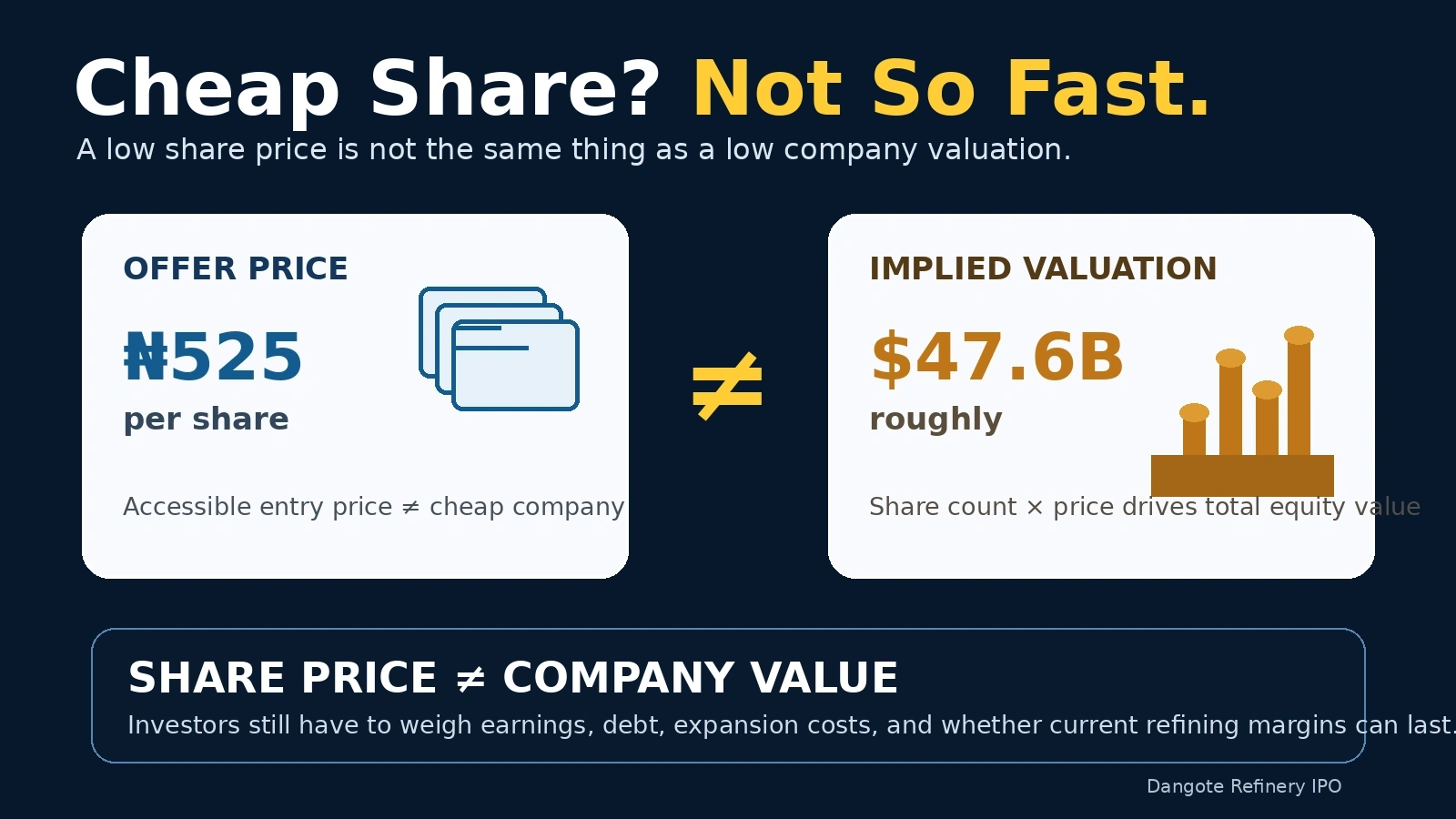
A low share price does not tell you whether a company is cheap.
This is a common investing mistake.
Imagine two companies:
- Company A has 1 million shares priced at $100.
- Company B has 1 billion shares priced at $1.
Company B has the lower share price—but its total equity value is much larger.
The same principle applies here.
Reuters reported that the ₦525 offer price implied a refinery valuation of about ₦63 trillion, or roughly $47.6 billion. For comparison, Reuters noted that Turkish refiner Tupras, with broadly similar total refining capacity spread across several sites, was worth about $12 billion, while U.S.-listed HF Sinclair, with roughly 678,000 barrels per day of capacity, was valued at about $16 billion at the time. (Reuters)
Those companies are not perfect apples-to-apples comparisons.
Dangote has different growth prospects, assets, markets, costs and expansion plans.
But the comparison explains why investors should separate two ideas:
The IPO is accessible.
That does not automatically mean the valuation is low.
What Are Investors Really Betting On?
The investment case is ultimately about whether today’s exceptional performance can become durable.
Dangote plans to expand the refinery toward 1.4 million barrels per day by 2029, with an expansion program estimated at about $14.3 billion. (Reuters)
That creates opportunity—and risk.
Investors are effectively watching several questions at the same time:
- Can the refinery continue operating near high utilization?
- Will refining margins remain profitable after Middle East supply disruptions ease?
- Can management complete the second phase without major delays or cost overruns?
- Can Nigeria supply enough crude reliably?
- Will exports to Europe and other African markets remain competitive?
- Will the valuation still look reasonable if industry profits normalize?
And one more question may matter even more.
Can Dangote turn the enormous public excitement around this IPO into a genuinely broader culture of long-term share ownership?
That may be why the 10 million shareholder target is so striking.
This is not just an attempt to finance a refinery.
It is also an experiment in whether a huge industrial project can turn millions of ordinary Africans into equity investors.
Bottom Line: What This Story Really Means
The Dangote IPO is attracting extraordinary attention because several big stories have collided at once.
Nigeria’s largest new refinery sharply reduced the country’s dependence on imported fuel. Global supply disruptions then made refined products unusually valuable. Dangote’s profits surged. Nigerian stocks were already rising strongly. International investors regained easier access to the market. And now ordinary investors can participate in the refinery IPO with a minimum subscription worth only about $4.
But the most important distinction is this:
The $4 figure describes the minimum entry cost, not whether the investment itself is cheap.
The refinery has become strategically important to Nigeria and increasingly important to global fuel markets.
Whether its shares ultimately justify a valuation approaching $50 billion will depend on something much harder than attracting millions of investors: sustaining profits after the current extraordinary energy-market conditions change.
Dangote IPO: Key Questions Explained
Q. Can someone really invest in the Dangote Refinery IPO with about $4?
Yes. The minimum subscription is 10 shares at ₦525 each, or ₦5,250 in total, which has recently been roughly equivalent to $4. The individual share itself is not priced at $4.
Q. How much money is Dangote trying to raise?
The base offering of 4.1 billion shares could raise approximately ₦2.15 trillion, or around $1.6 billion, if fully subscribed.
Q. Does Dangote already have 10 million shareholders?
No. Ten million shareholders is Aliko Dangote’s stated target for broad participation in the IPO, not a confirmed current shareholder count.
Q. Why are so many retail investors interested?
The refinery has rapidly moved from startup losses to large profits, reduced Nigeria’s reliance on imported fuel and become a significant exporter. A very low minimum subscription also makes the offer accessible to a wide range of investors.
Q. Did the Dangote IPO cause Nigeria’s stock market to rise more than 60%?
No. Nigerian equities were already benefiting from broader economic and market developments, including improved foreign-exchange access and Nigeria’s return to FTSE Russell Frontier Market status. Dangote has added to investor attention but is not the sole explanation for the rally.
Q. Has the refinery stopped Nigeria from importing fuel?
No. Imports have fallen dramatically, but Nigeria still imports some petroleum products. The refinery has substantially reduced import dependence rather than eliminating it entirely.
Q. Why can fuel still be expensive if Nigeria now has a huge refinery?
Because crude oil remains tied to global prices. Domestic refining reduces import dependence and some transportation or foreign-exchange costs, but it does not protect consumers from a major rise in the underlying price of crude.
Q. Why has Dangote become important to Europe?
Middle East disruptions reduced European supplies of diesel and jet fuel, while Dangote increased exports. That turned the Nigerian refinery into an important alternative supplier during a tight global fuel market.
Q. Is ₦525 a cheap price for the stock?
The nominal share price alone cannot answer that. Investors also have to consider the total number of shares, the implied company valuation, earnings, debt, expansion spending and future profitability.
Q. What should investors watch next?
The October 13 close of the IPO, the expected late-November trading start, refinery utilization, global refining margins, crude supply, export volumes and progress toward the planned 1.4-million-barrel-per-day expansion are among the most important indicators.
Did this help make the story clearer? 🙂
WIN keeps unpacking the “why” behind the news—clearly and simply!
Sources
IPO Terms, Valuation and Retail Demand
Reuters — Facts About Nigeria’s Dangote Oil Refinery Initial Public Offering
Nigeria SEC — Dangote Petroleum Refinery and Petrochemicals Initial Public Offering
Reuters — Dangote Says Refinery IPO Demand Is “Enormous”
Punch — Dangote Targets 10 Million Shareholders in Refinery IPO
Refinery Output, Profits and Fuel Trade
U.S. EIA — Dangote Refinery Drives Increase in Petroleum Shipments From Nigeria
Reuters — Dangote Profits From Europe Fuel Crunch as IPO Tests Investor Appetite
Reuters — Rising Fuel Prices Revive Cost-of-Living Pressure in Nigeria
Nigeria’s Capital-Market Context
FTSE Russell — Nigeria Reclassification to Frontier Market Status
Network Capital — Nigerian Exchange Daily Market Wrap, September 29, 2026
Foreign Exchange and Expansion Outlook
Central Bank of Nigeria — Macroeconomic Outlook for Nigeria
Reuters — Dangote Refinery Plans $14.3 Billion Expansion as It Signs IPO Documents
Keep Reading
Why Did Middle East Oil Routes Become So Fragile?
Dangote’s export boom was helped by disruptions to Middle East fuel supply. This earlier WIN explainer shows why even Saudi Arabia’s main bypass around the Strait of Hormuz can leave oil flows exposed to other chokepoints—and why buyers in Europe had to look harder for alternative supply.
Saudi Arabia Built a Pipeline to Bypass Hormuz—So Why Is Its Oil Route Still at Risk?