How Did a Missed $46,020 Capital Call Allegedly Cost a Fund Its Nearly $3 Million SpaceX Investment?

Wait—how can missing a $46,020 payment lead to the loss of a SpaceX investment worth nearly $3 million?
And if investors put money into a fund that was supposed to give them access to SpaceX before its IPO, didn’t they effectively own SpaceX shares?
Not necessarily.
That distinction is the part of this story that makes the Securities and Exchange Commission’s September 30 case against Meyer Global Management LLC and its CEO, Owen E.H. Meyer, much easier to understand. The SEC alleges that one Meyer Global-managed fund did not hold SpaceX shares directly. Instead, it invested through another fund—and that layered structure came with obligations of its own. (SEC)
The SEC says one of those obligations was a $46,020 capital call. According to the complaint, the payment was not made, three default notices followed, a lawsuit went unanswered, and the fund ultimately forfeited its SpaceX interests. The agency describes the lost investment as nearly $3 million. (SEC)
That does not mean a $46,020 bill mechanically “turned into” a $3 million loss. It means the fund agreement allegedly allowed a much larger investment interest to be forfeited after the smaller contractual obligation went unpaid.
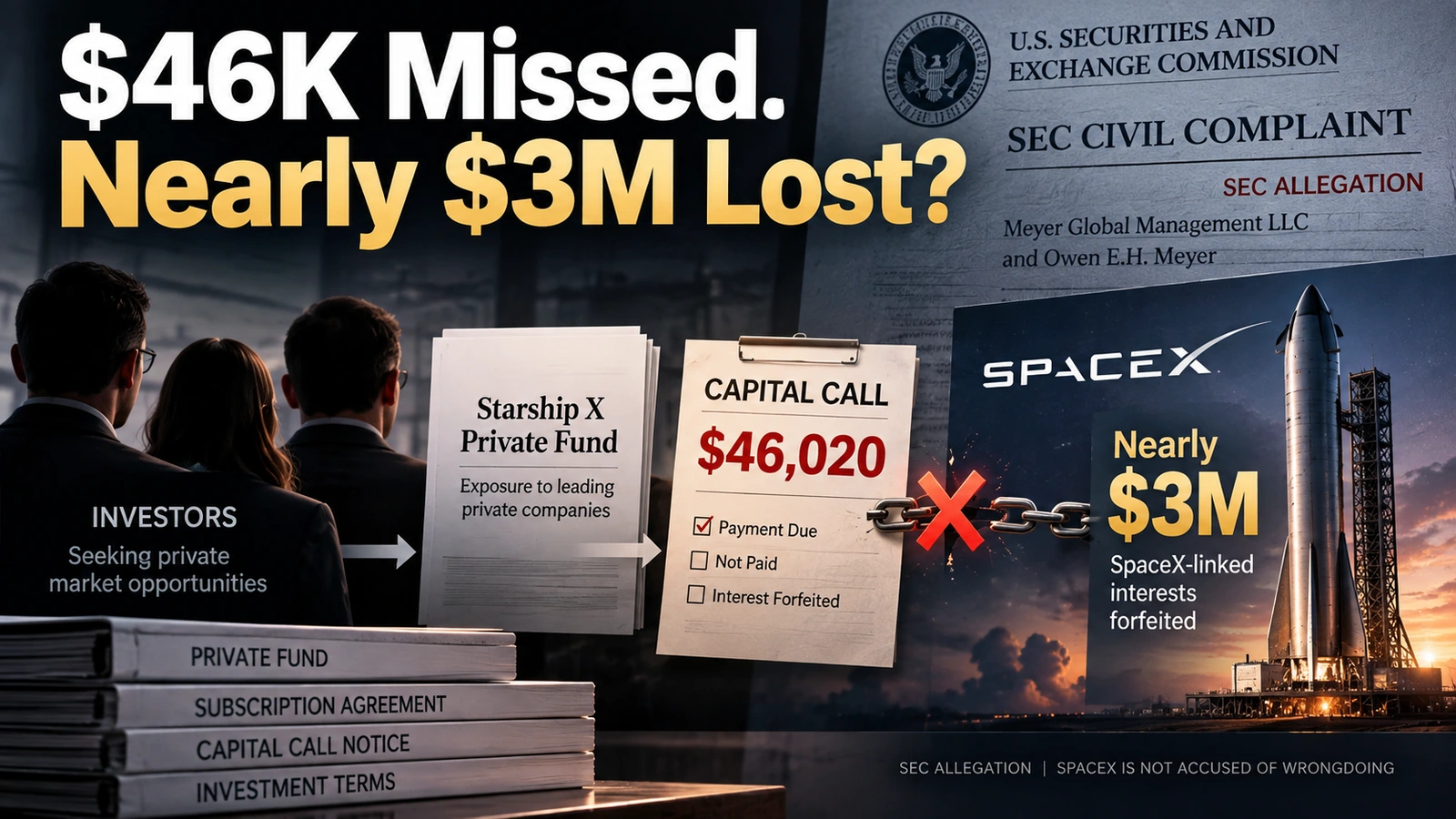
※ Images in this article are AI-generated illustrations created to help explain the story. They are not actual photographs, and depictions of people, places, or events may differ slightly from reality.
There is another important wrinkle: SpaceX was still private when these investments were made. It priced its IPO on June 11, 2026, began public trading on June 12, and closed the offering on June 15. So this is now a story about what happened inside a pre-IPO investment structure before SpaceX became publicly traded—not a guide to buying SpaceX today. (SpaceX · SpaceX)
What Exactly Did the SEC Charge Meyer Global With?
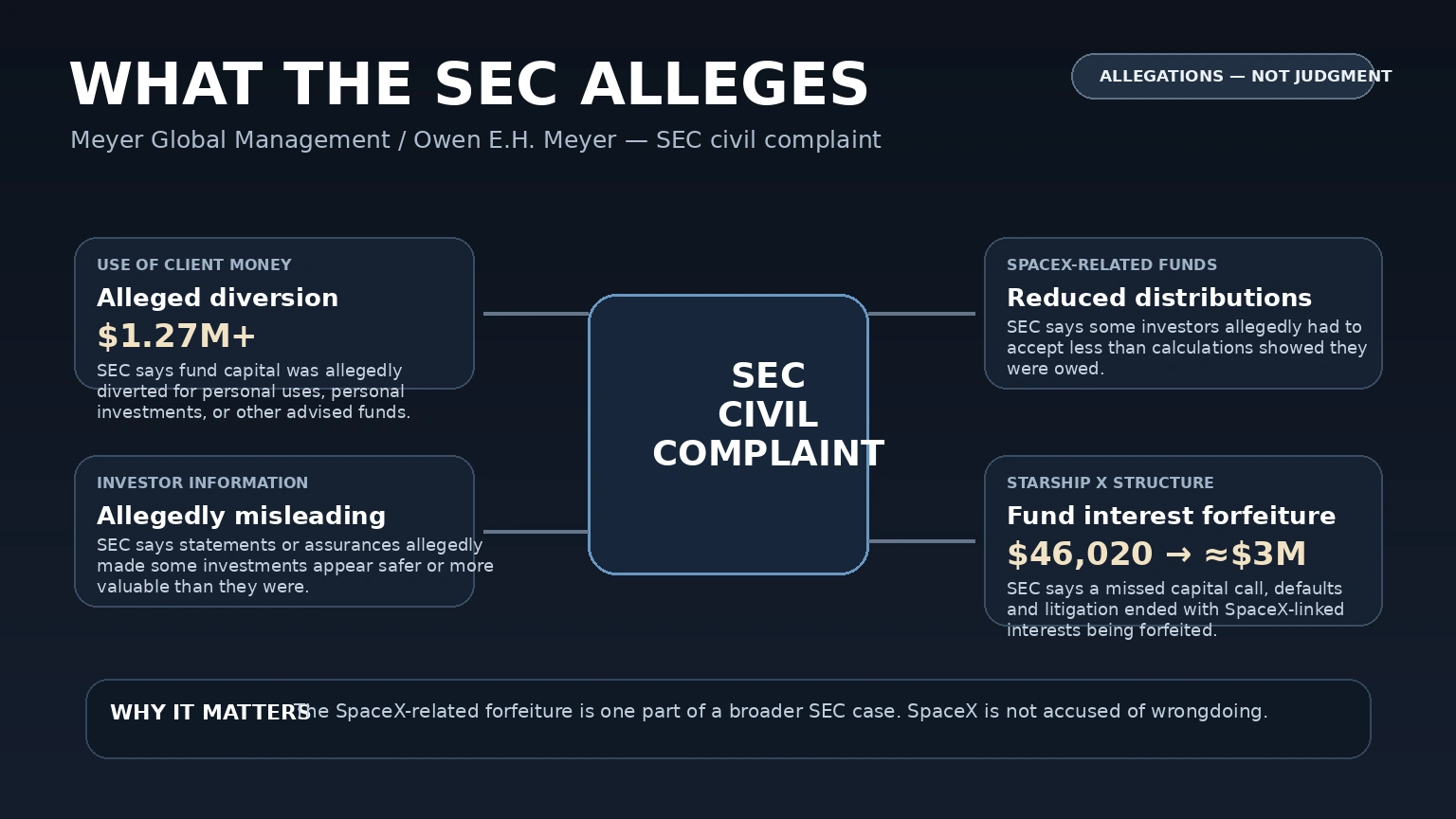
The SEC filed a civil enforcement complaint, not a criminal conviction and not a final court judgment.
The agency alleges that Meyer Global Management and Meyer carried out at least five fraudulent schemes from December 2021 onward. It says that from 2019 through 2024, the firm raised at least $18.5 million from nearly 100 investors through private funds tied to pre-IPO companies including SpaceX and OpenAI. (SEC complaint)
The complaint alleges four broad types of misconduct:
| SEC allegation | What the agency says happened |
|---|---|
| Misuse of client money | At least $1.27 million in fund capital was allegedly diverted for Meyer’s lifestyle, personal investments, or other Meyer Global-advised funds. |
| Misleading investors | The SEC says investors were given statements or assurances that made some investments appear safer or more valuable than they were. |
| Withholding or reducing distributions | In one group of SpaceX-related funds, the complaint alleges investors were required to accept less than the amount Meyer’s own calculations showed they were owed in order to receive distributions. |
| SpaceX fund forfeiture | The SEC says another fund lost its entire SpaceX-related interest after a required $46,020 capital call was not paid and later default proceedings were not addressed. |
The SEC is seeking permanent injunctions, disgorgement of allegedly ill-gotten gains with prejudgment interest, civil penalties, and a conduct-based injunction against Meyer. (SEC)
So the nearly $3 million SpaceX loss is only one part of a broader case.
Did the Investors Actually Own SpaceX Shares?
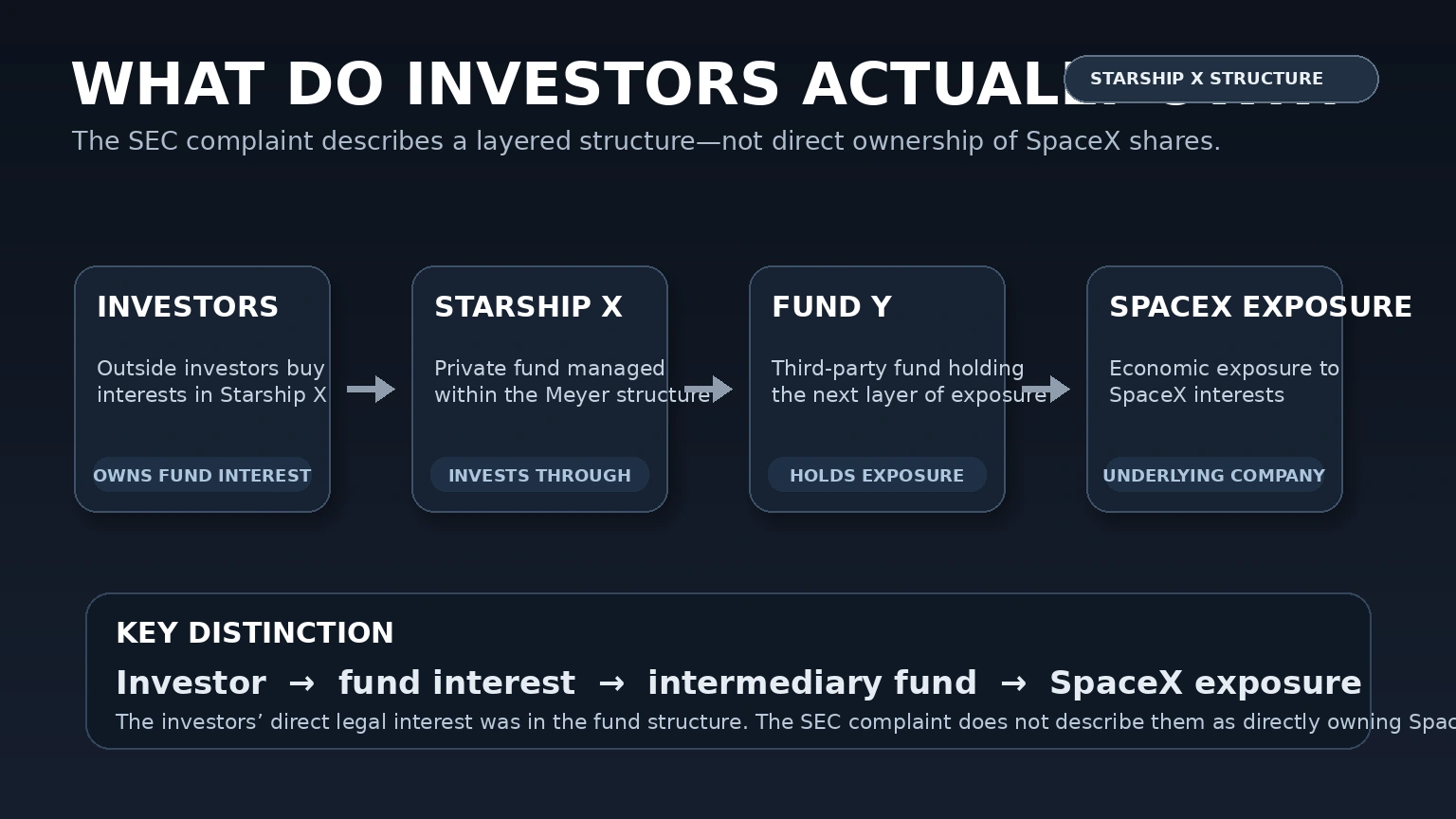
No. At least in the Starship X structure described by the SEC, the outside investors did not simply hand over money and receive SpaceX shares in their own names.
The complaint says Meyer Global raised about $3.125 million from three outside investors for a fund called Oikoi Network Partners, LP – Starship X. Its purpose was to obtain pre-IPO exposure to SpaceX. Starship X then invested in a separate third-party fund, which the SEC identifies as “Fund Y,” to gain that exposure. (SEC complaint)
The structure looked roughly like this:
Investor → Starship X → third-party fund → SpaceX interest
That is a very different legal and operational structure from:
Investor → direct ownership of SpaceX shares
Why does the difference matter?
Because every layer can come with its own contracts, fees, reporting, transfer restrictions, deadlines, and default provisions. If an investor owns public stock in a brokerage account, the main risk is usually what happens to the stock and the broker. In a layered private-fund structure, an additional risk is what happens inside the chain between the investor and the underlying company.
The SEC’s own investor guidance warns that pre-IPO investments can be highly risky, illiquid, and difficult to verify. Private offerings also often provide less required disclosure than registered public offerings. (Investor.gov · Investor.gov)
That does not make every pre-IPO fund suspicious. It does mean that “I have exposure to Company X” is not always the same thing as “I directly own shares of Company X.”
What Is a Capital Call—and Why Could $46,020 Matter So Much?
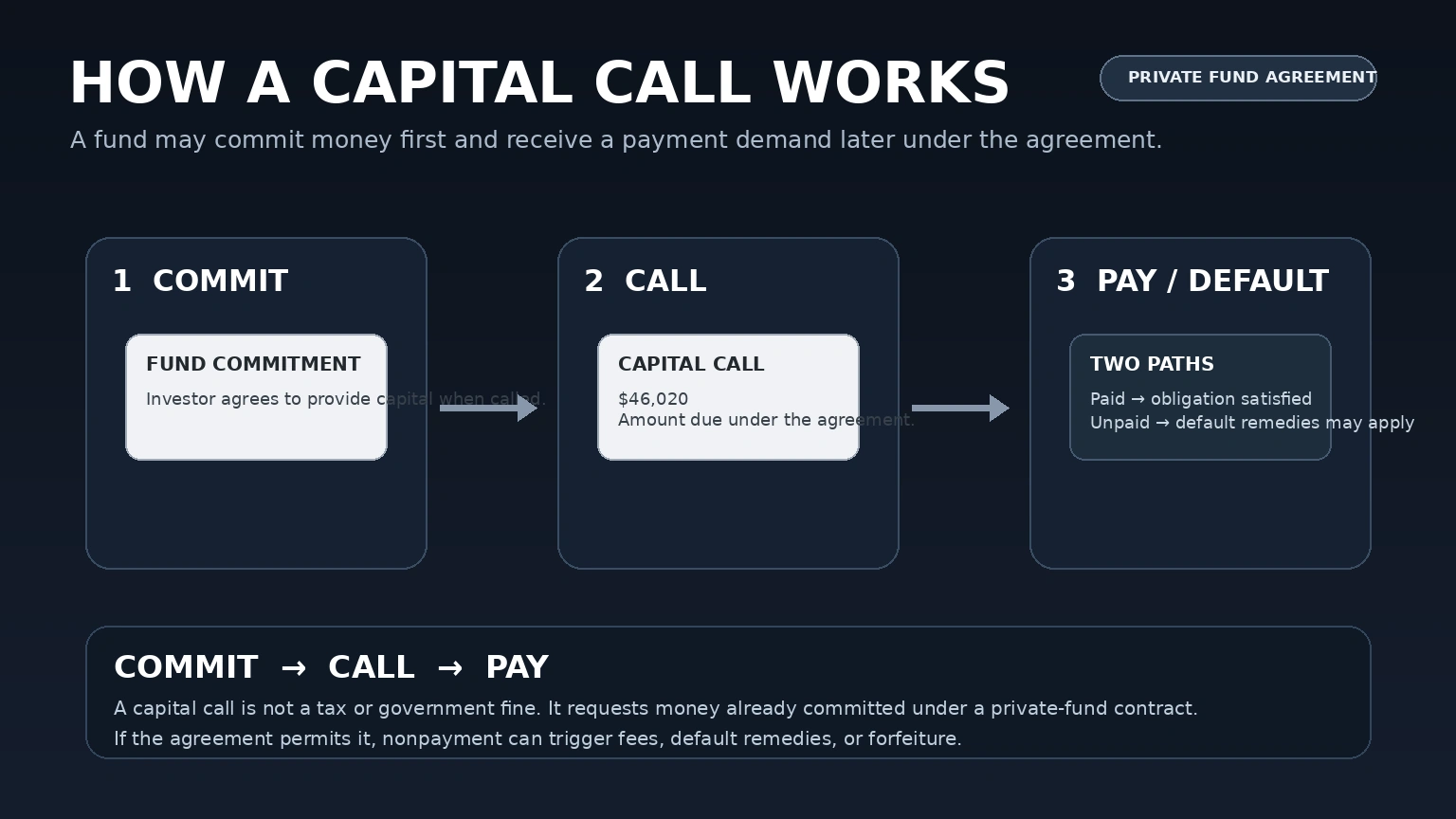
A capital call is essentially a demand for money that an investor or fund has already agreed to contribute under a private-fund contract.
Think of it this way: instead of paying the entire amount on day one, you commit to provide money when the fund asks for it. When the call arrives, the obligation becomes due.
In this case, Starship X was itself an investor in Fund Y. The SEC complaint says the agreement required Starship X to pay fees, expenses, and periodic capital calls. Meyer Global had paid earlier calls in 2022 and 2023. (SEC complaint)
Then came the call that became central to the SEC’s case.
On January 3, 2024, Fund Y issued a $46,020 capital call. According to the complaint, Starship X did not pay it.
The important part is not that $46,020 was somehow equal to the value of the SpaceX stake. It was not.
The important part is that the underlying agreement allegedly allowed nonpayment to trigger serious default consequences—including forfeiture of the investment.
That is why a relatively small unpaid obligation could put a much larger asset at risk.
How Did the SpaceX Investment Allegedly Get Forfeited?
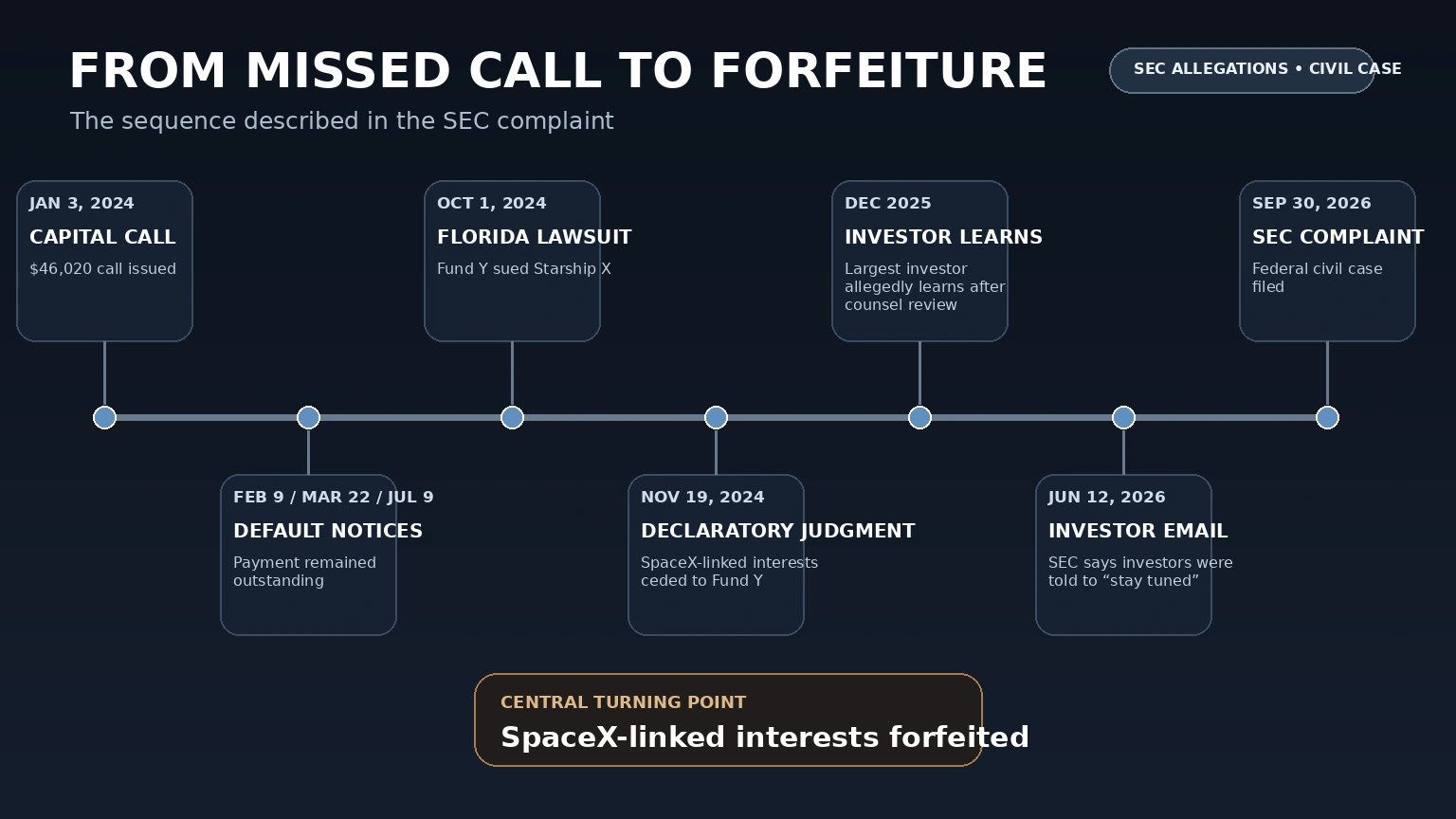
The SEC’s version of events is unusually easy to follow once the dates are placed in order.
| Date | What the SEC complaint says happened |
|---|---|
| February 3, 2022 | Starship X entered agreements with Fund Y to obtain exposure to SpaceX shares. |
| 2022 and 2023 | Earlier capital calls were paid. |
| January 3, 2024 | Fund Y issued a $46,020 capital call. |
| February 9, March 22, and July 9, 2024 | Fund Y sent default notices after the payment remained outstanding. |
| October 1, 2024 | Fund Y sued Starship X in Florida state court. |
| November 19, 2024 | A Florida court issued a declaratory judgment that ceded Starship X’s SpaceX interests to Fund Y. |
| December 2025 | The SEC says Starship X’s largest investor learned of the litigation and forfeiture only after hiring counsel to investigate. |
| June 12, 2026 | On the day SpaceX began public trading, the SEC says Meyer Global told investors to “stay tuned for further updates” about share distributions. |
| September 30, 2026 | The SEC filed its civil complaint against Meyer Global and Meyer. |
The complaint says Meyer Global did not respond to the repeated default notices, did not answer the Florida lawsuit, and did not take steps to cure or finance the outstanding capital call. The November 2024 judgment transferred Starship X’s SpaceX interests to Fund Y, leaving Starship X with zero or nearly zero assets. (SEC complaint)
The agency also alleges investors were not told about the default and litigation while those events were unfolding.
That is why this case is not simply about a missed payment.
The SEC is arguing that the missed payment, the lack of response to the resulting litigation, and the investor communications were all part of a fiduciary and disclosure failure.
Was This Loss Caused by SpaceX Performing Badly?
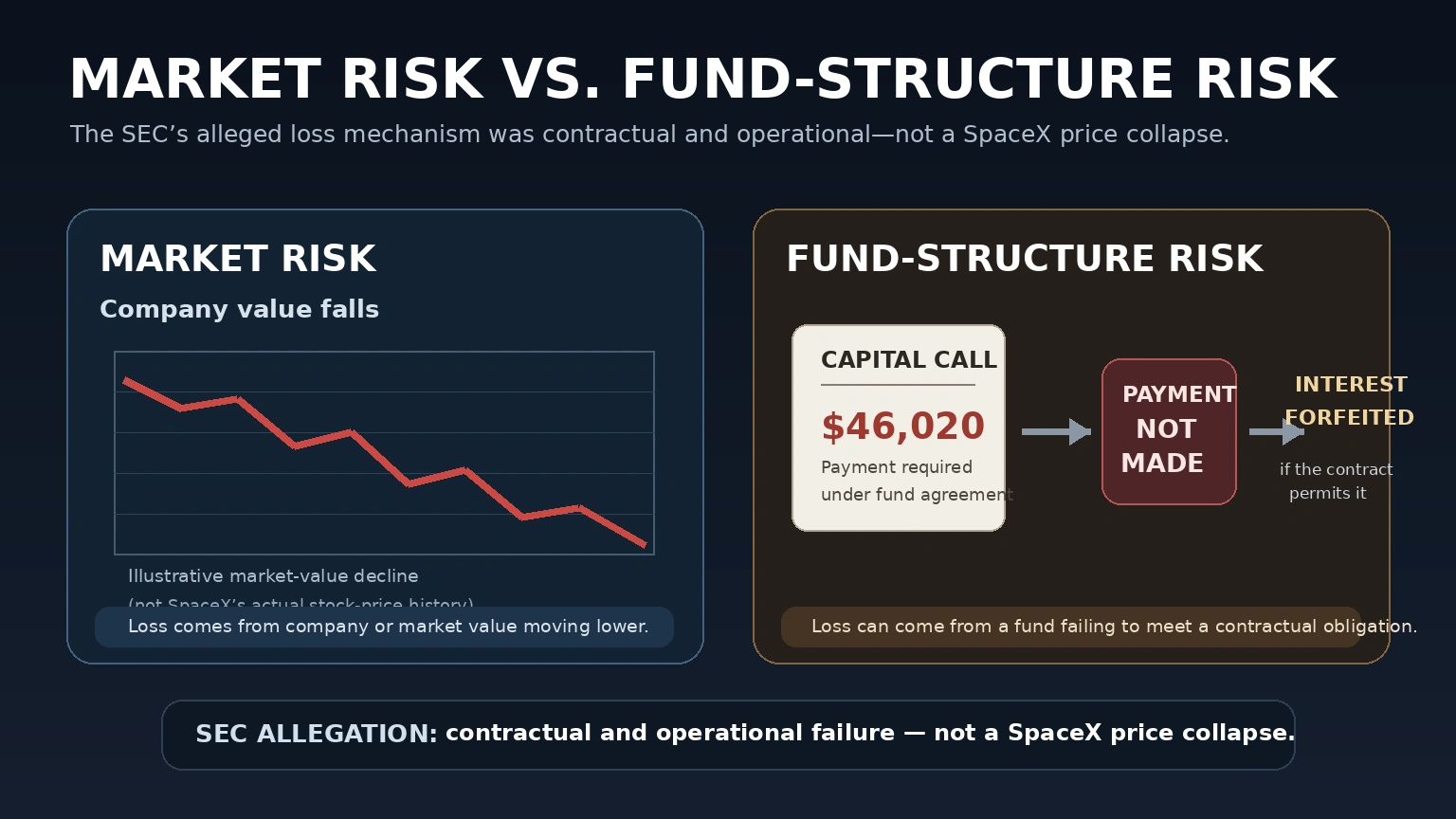
No. The SEC’s complaint describes a fund-structure failure, not a loss caused by SpaceX’s business collapsing or its share price falling.
In fact, SpaceX priced its IPO at $135 per share on June 11, 2026, began public trading under the ticker SPCX on June 12, and closed the offering on June 15 after the underwriters exercised their overallotment option. (SpaceX · SpaceX)
The Starship X problem occurred earlier.
A simple comparison makes the distinction clear:
| Type of risk | Example |
|---|---|
| Company risk | SpaceX performs poorly and the value of its shares falls. |
| Market risk | Investors sell the stock and the public market price drops. |
| Liquidity risk | A private investment cannot easily be sold when an investor wants out. |
| Fund-structure risk | The vehicle holding the investment fails to meet a contractual obligation and loses the underlying interest. |
| Adviser risk | The person or firm managing the vehicle mishandles assets, records, disclosures, or investor money. |
The SEC case is primarily about the last two categories.
SpaceX is not a defendant in the case, and the SEC’s complaint does not accuse SpaceX of wrongdoing in connection with Meyer Global’s alleged conduct.
That is an important distinction because famous private-company names can dominate the headline while the real risk sits one or two layers away from the company itself.
Why Are Pre-IPO Investments Harder to Evaluate Than Public Stocks?
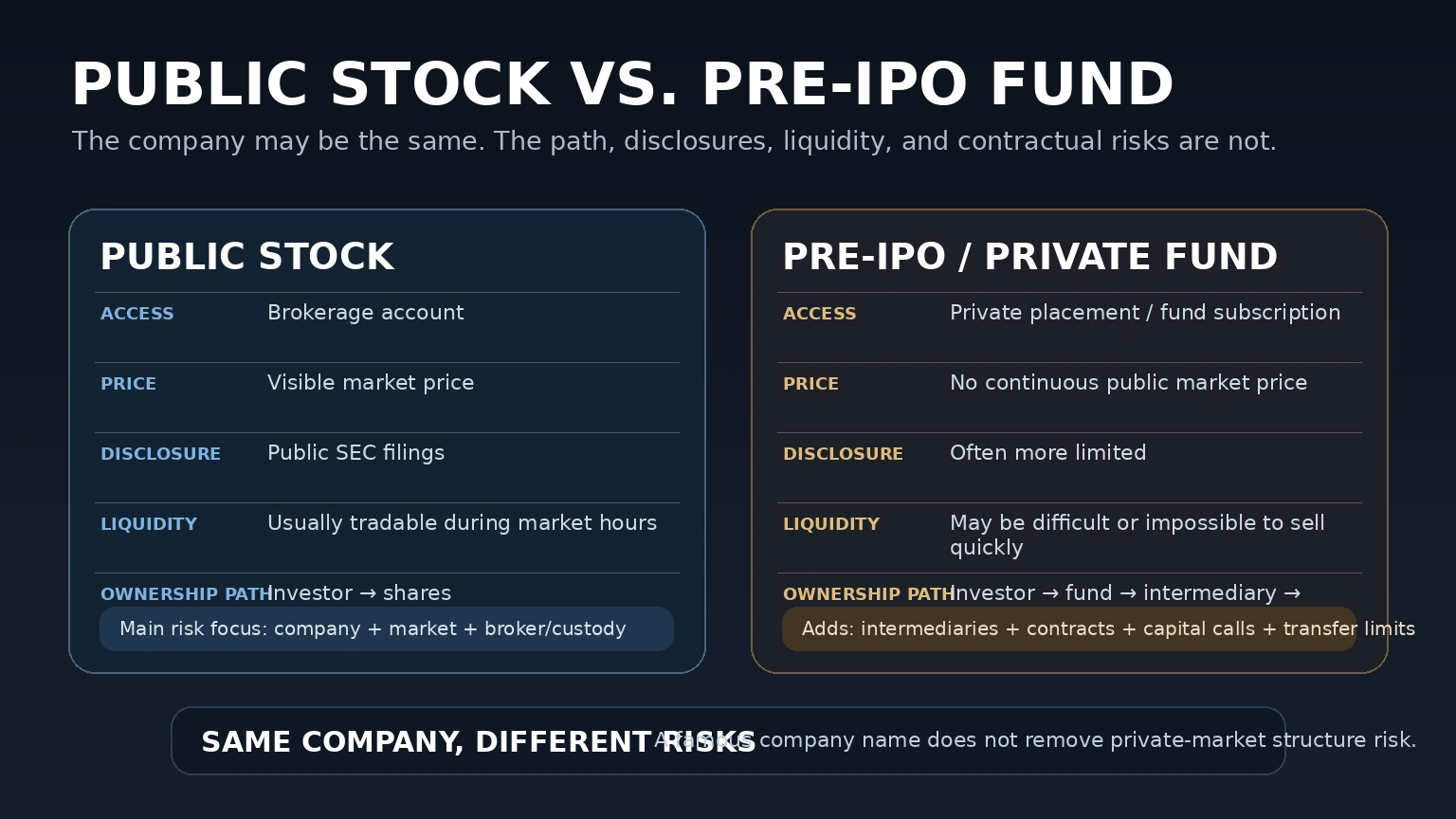
Because the underlying company may be only one part of what an investor is actually buying.
With a public stock, an investor can usually see a market price, trade through a brokerage account, review public SEC filings, and sell during market hours if there is enough liquidity.
A private placement or private fund can work very differently. The securities may be illiquid. Required disclosures may be more limited. The investment may depend on multiple contracts and intermediaries. And many private offerings are available only to accredited investors or other investors who meet specific eligibility standards. (Investor.gov · Investor.gov)
That creates a basic due-diligence problem.
A potential investor should not stop at:
“Is SpaceX a good company?”
The next questions are just as important:
What exactly am I buying? Who legally owns the underlying shares? How many fund layers are between me and the company? What fees can be charged? What happens if the fund misses a capital call? Who sends the account statements? What documents prove the shares or fund interests actually exist?
Investor.gov has repeatedly warned that fraudsters can exploit the appeal of high-profile pre-IPO companies by offering supposed access to shares that may be difficult for ordinary investors to obtain directly. The agency specifically tells investors to verify the seller, the offering, the ownership structure, and whether the investment professional is properly registered or licensed. (Investor.gov)
The famous company name is the hook.
The legal structure is the investment.
What Happens Next in the SEC Case?
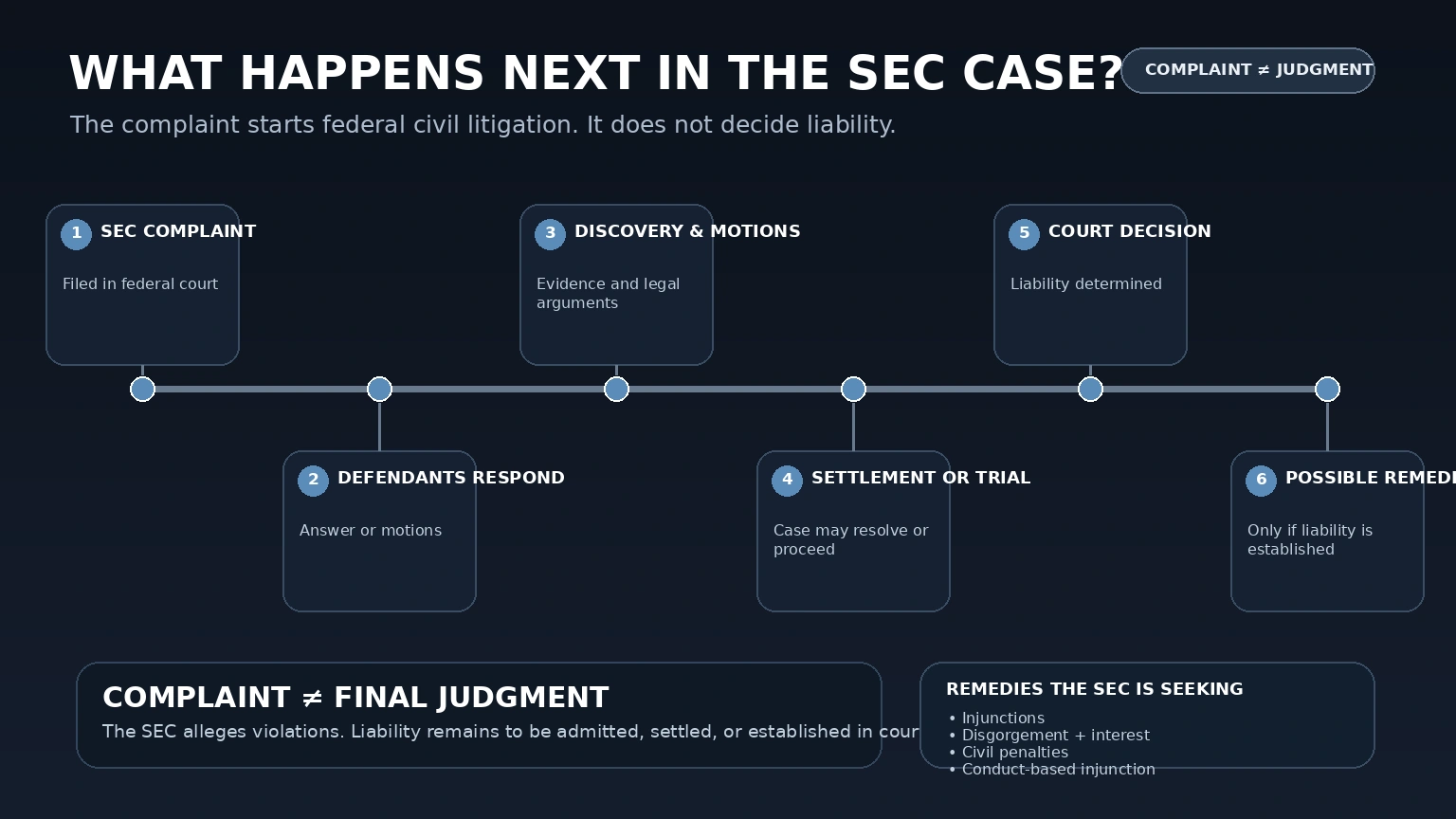
The case is at the beginning of federal civil litigation.
The SEC filed its complaint in the U.S. District Court for the Southern District of New York on September 30, 2026. It alleges violations of antifraud provisions of the Investment Advisers Act of 1940 and asks the court for injunctions, disgorgement, prejudgment interest, and civil penalties. (SEC)
Those are requested remedies, not penalties that have already been imposed.
As of the SEC’s announcement, the allegations had not been resolved by a final judgment. Reuters also reported that a lawyer for Meyer Global did not immediately respond to its request for comment. (Reuters)
The next important things to watch are straightforward:
- How Meyer Global and Meyer formally respond to the complaint.
- Whether any allegations are contested, admitted, or settled.
- Whether the court enters injunctions or monetary remedies.
- Whether investors pursue separate claims or recovery efforts.
- Whether the SEC or other regulators bring additional actions tied to the same conduct.
Until then, the correct wording is that the SEC alleges these events and violations.
Bottom Line: What This Story Really Means
The most important part of the Meyer Global case is not simply that investors wanted access to SpaceX before its IPO.
It is that a pre-IPO investment can expose investors to risks that have little to do with whether the underlying company succeeds.
According to the SEC, Starship X raised about $3.125 million from three outside investors to obtain SpaceX exposure through another private fund. A $46,020 capital call allegedly went unpaid, repeated defaults were not cured, a lawsuit went unanswered, and a Florida court transferred the fund’s SpaceX interests away. The SEC later summarized the forfeited investment as nearly $3 million. (SEC complaint)
That is why “pre-IPO access” needs to be understood as a structure, not just a company name.
An investor may be betting on SpaceX, OpenAI, or another famous private company—but the money can still depend on advisers, contracts, intermediate funds, reporting systems, deadlines, and legal obligations that sit between the investor and the underlying shares.
The SEC’s allegations have not yet been proven in court. But the structure described in the complaint offers a clear lesson: before asking whether a private company could become more valuable, ask exactly what you own and what has to go right for you to keep owning it.
SpaceX Pre-IPO: Key Questions Explained
Q. Did Meyer Global investors directly own SpaceX shares?
Not necessarily. The SEC says investors in Starship X owned interests in that private fund, while Starship X invested in a separate third-party fund to gain exposure to SpaceX.
Q. How much money did Starship X raise for SpaceX exposure?
The SEC complaint says Starship X raised approximately $3.125 million from three outside investors in early 2022.
Q. What was the $46,020 capital call?
It was a payment demand from the third-party fund in which Starship X had invested. The SEC says the payment was required under the fund agreements and went unpaid.
Q. Did missing the $46,020 payment automatically erase $3 million?
No. The SEC alleges that the missed payment triggered default procedures under the fund agreements, which eventually led to litigation and forfeiture of Starship X’s SpaceX interests.
Q. Was SpaceX responsible for the loss?
The SEC complaint does not accuse SpaceX of wrongdoing. The alleged loss resulted from the private-fund structure and the handling of obligations between Starship X and the third-party fund.
Q. Is SpaceX still a private company?
No. SpaceX priced its IPO on June 11, 2026, and its shares began trading publicly on Nasdaq on June 12 under the ticker SPCX.
Q. Are the SEC’s accusations against Meyer Global proven?
No. The SEC has filed a civil complaint containing allegations. The case has not yet produced a final judgment establishing liability on those claims.
Q. Why are pre-IPO funds riskier to understand than ordinary public stocks?
Because investors may face additional layers of risk involving private contracts, limited disclosure, illiquidity, intermediaries, fees, and fund-level obligations that do not exist in the same way when buying ordinary exchange-traded shares.
Did this help make the story clearer? 🙂
WIN keeps unpacking the “why” behind the news—clearly and simply!
Sources
SEC Complaint and Enforcement Action
SEC Press Release — Meyer Global Management and Owen E.H. Meyer
SEC Litigation Release No. 26659
SEC Civil Complaint — SEC v. Meyer Global Management LLC and Owen E.H. Meyer
Independent Reporting
Reuters — SEC charges private fund adviser for allegedly defrauding retail investors
Pre-IPO and Private-Market Investor Guidance
Investor.gov — Pre-IPO Investment Scams
Investor.gov — Accredited Investors
Investor.gov — Private Placements Under Regulation D