
Tesla Beat Delivery Forecasts—So Why Were Its Q3 Deliveries Still Down From Last Year?

Tesla delivered more vehicles than analysts expected.
So why did another headline say Tesla’s deliveries were down?
Both can be true because they compare the same quarter with two different benchmarks.
Tesla said it delivered 486,532 vehicles in the third quarter of 2026. That was comfortably above major analyst consensus estimates but below the 497,099 vehicles Tesla delivered during the same quarter in 2025. (Tesla · Tesla Q3 2025)
That makes this quarter a useful example of why a company can “beat expectations” without actually delivering more vehicles than it did a year earlier.
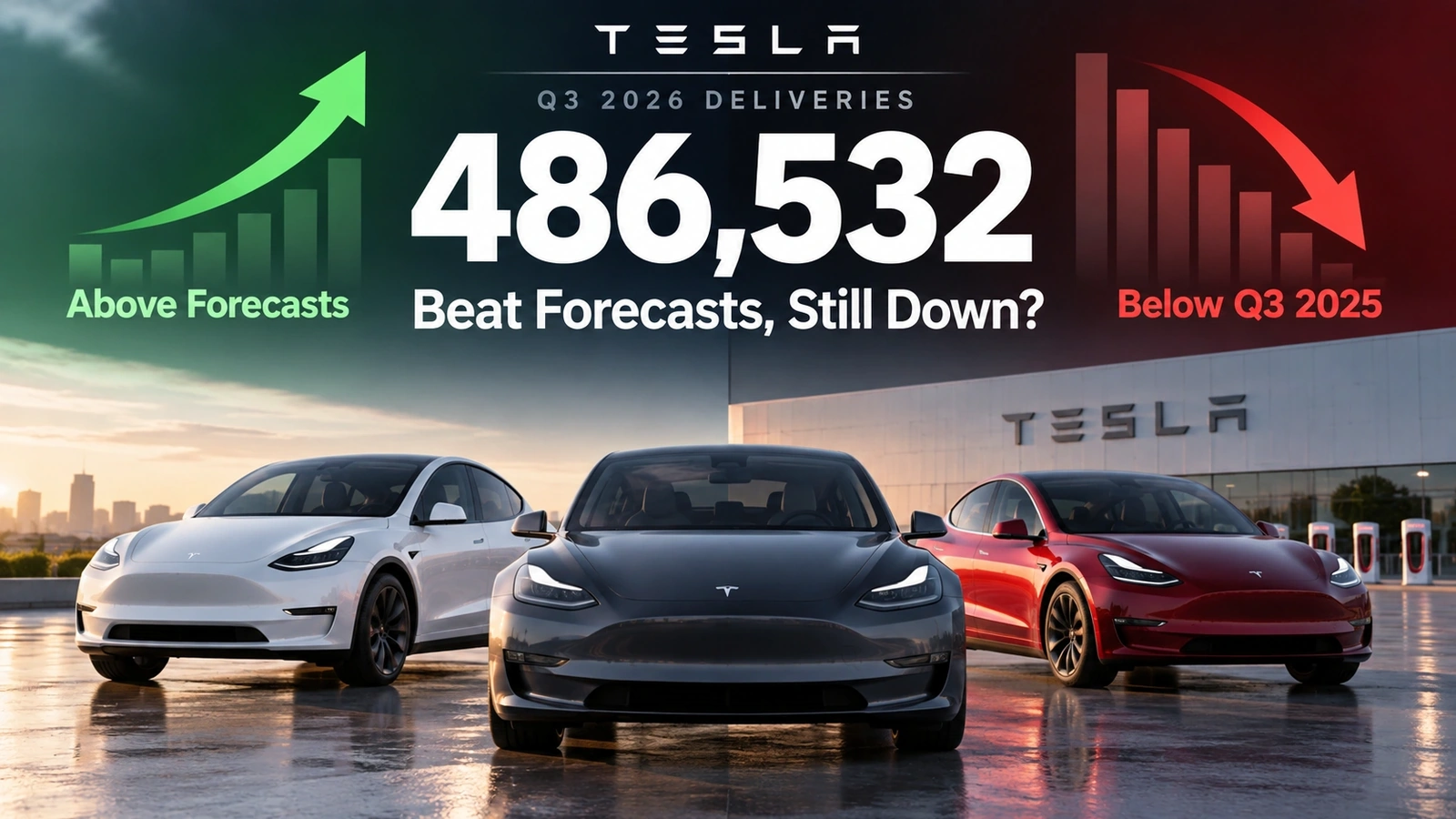
※ Images in this article are AI-generated illustrations created to help explain the story. They are not actual photographs, and depictions of people, places, or events may differ slightly from reality.
The bigger question is whether Tesla’s core vehicle business is strengthening again—or whether the strong-looking headline mainly reflects expectations that had already been lowered.
What Did Tesla Actually Report?
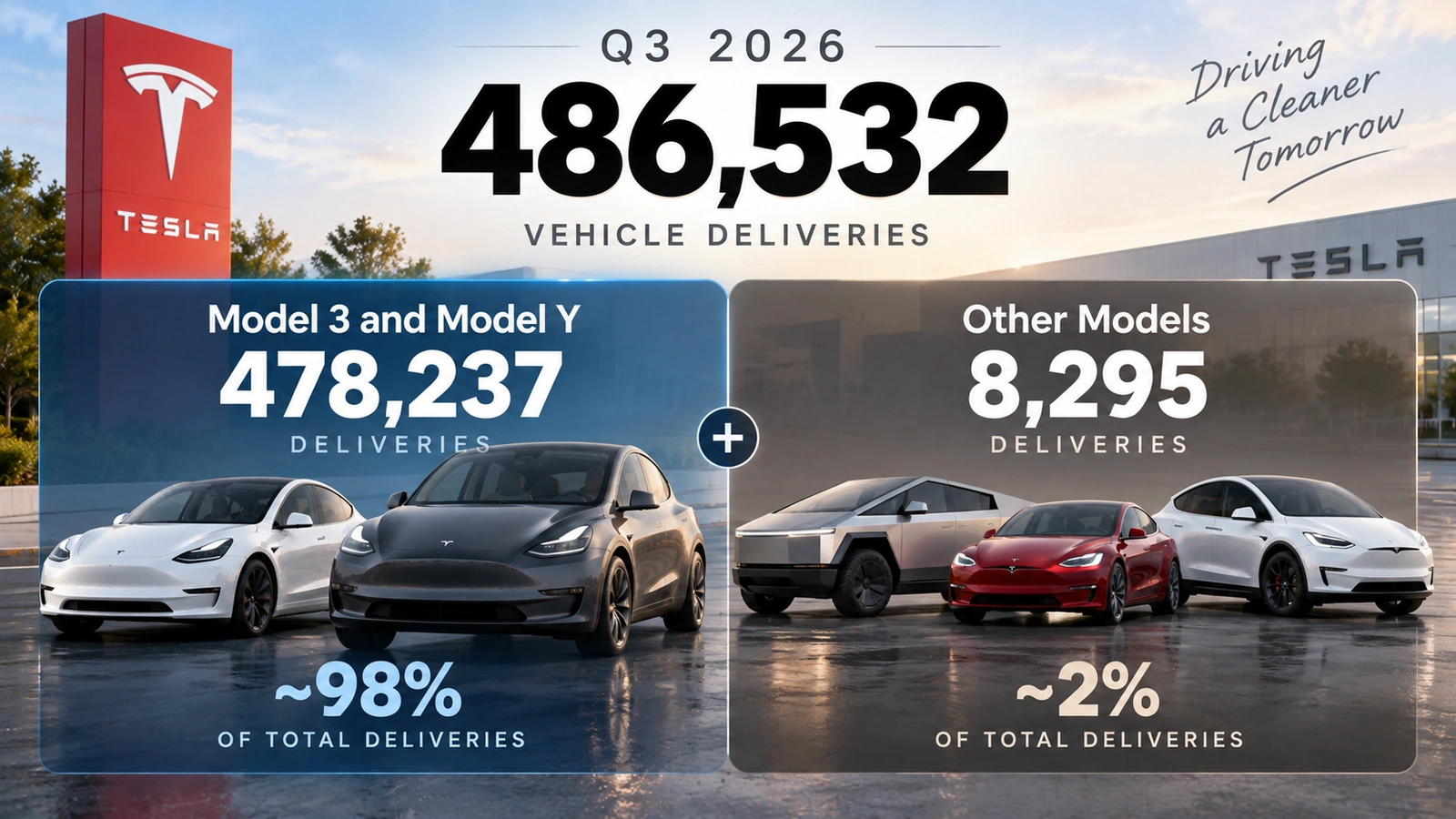
Tesla delivered 486,532 vehicles during the third quarter of 2026. It produced 464,391 vehicles during the same period. (Tesla)
The breakdown was heavily concentrated in Tesla’s two mass-market vehicles.
| Q3 2026 | Production | Deliveries |
|---|---|---|
| Model 3 and Model Y | 457,387 | 478,237 |
| Other models | 7,004 | 8,295 |
| Total | 464,391 | 486,532 |
Model 3 and Model Y accounted for about 98% of all Tesla deliveries during the quarter.
There is another distinction worth making.
These figures are Tesla’s companywide vehicle totals, not U.S.-only sales. The quarterly delivery release does not provide a country-by-country breakdown.
And “deliveries” should not be confused with quarterly revenue or profit. Tesla itself warns that vehicle deliveries are only one measure of financial performance. Prices, costs, foreign-exchange movements and other factors determine what the full financial results eventually look like. (Tesla)
That matters because Tesla will not report its complete third-quarter financial results until October 21.
How Can Tesla Beat Forecasts and Still Be Down From Last Year?
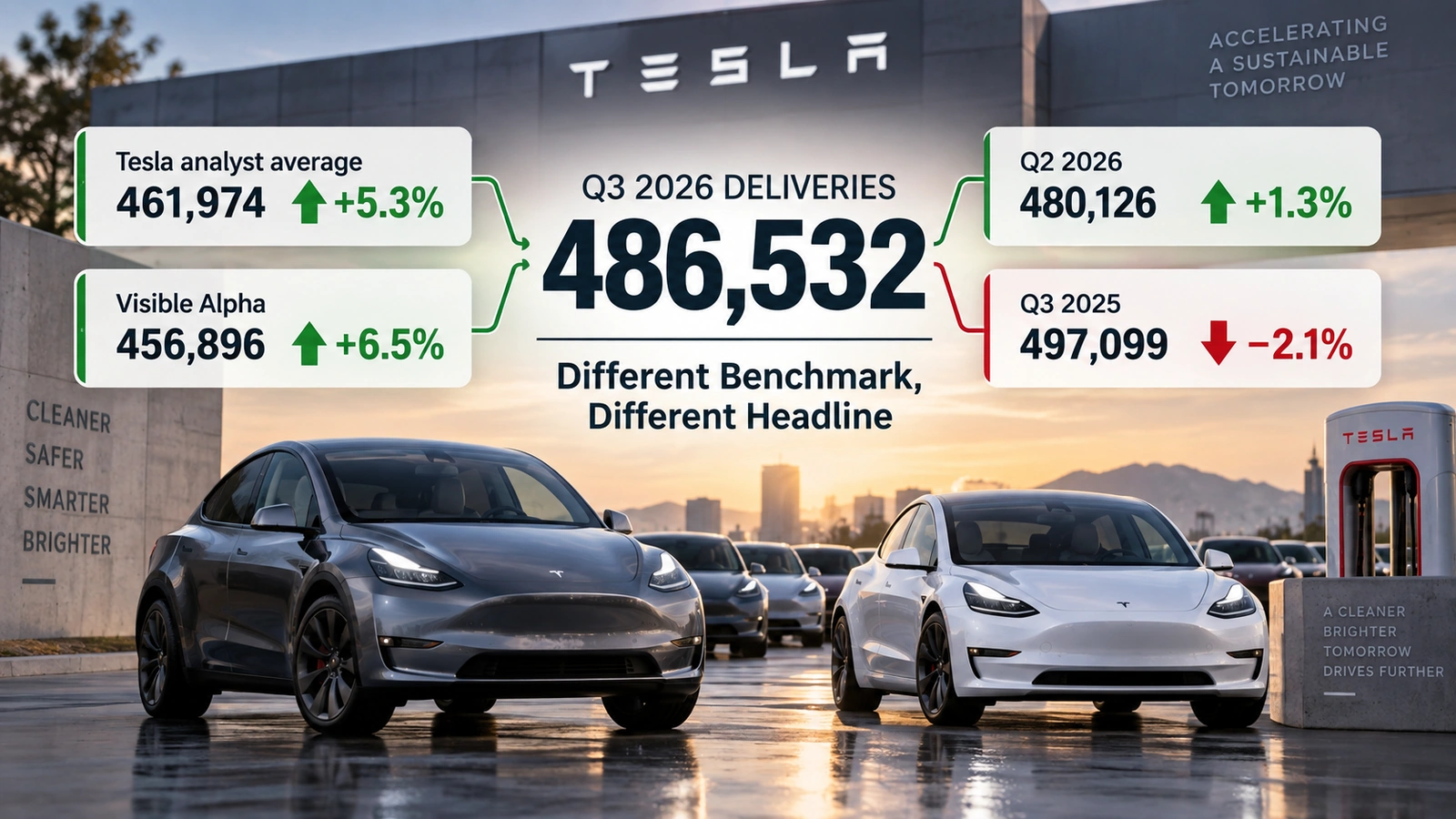
Because “better than expected” and “better than last year” are different questions.
Here is the easiest way to see it:
| Comparison | Benchmark | Q3 2026 difference |
|---|---|---|
| Tesla company-compiled analyst average | 461,974 | +24,558 (+5.3%) |
| Visible Alpha estimate reported by Reuters | 456,896 | +29,636 (+6.5%) |
| Q2 2026 deliveries | 480,126 | +6,406 (+1.3%) |
| Q3 2025 deliveries | 497,099 | −10,567 (−2.1%) |
Tesla published a company-compiled average estimate of 461,974 deliveries from 24 sell-side analysts shortly before the report. Reuters cited a different analyst survey from Visible Alpha, which produced a 456,896 estimate. (Tesla · Reuters)
So there was no single universal “Wall Street forecast.”
But the conclusion was the same under either survey: Tesla delivered substantially more vehicles than analysts had expected.
The year-over-year calculation asks something else entirely.
Did Tesla deliver more vehicles than it did between July and September 2025?
No.
That is where the 2.1% decline comes from.
Why Was Q3 2025 Such a Tough Benchmark?

Because Q3 2025 was not an ordinary comparison period.
Tesla delivered 497,099 vehicles in Q3 2025, its record quarterly total at the time. (Tesla)
One important reason the comparison became unusually difficult was the U.S. clean-vehicle tax-credit deadline.
Eligible buyers could previously qualify for a federal New Clean Vehicle Credit of up to $7,500, subject to vehicle, income and other eligibility rules. The IRS says those clean-vehicle credits are no longer available for vehicles acquired after September 30, 2025. (IRS)
That created a straightforward incentive for some Americans who were already considering an EV purchase: buy before the deadline rather than afterward.
Reuters reported that the expiration of U.S. incentives helped make the 2025 comparison unusually strong and has weighed on U.S. EV demand since then. (Reuters)
So the 2.1% year-over-year decline needs context.
It means Tesla did not quite match an exceptionally strong quarter that included a deadline-driven U.S. buying rush.
It does not mean deliveries fell 2.1% from the immediately preceding quarter.
They actually rose.
Is Tesla Improving From Earlier in 2026?
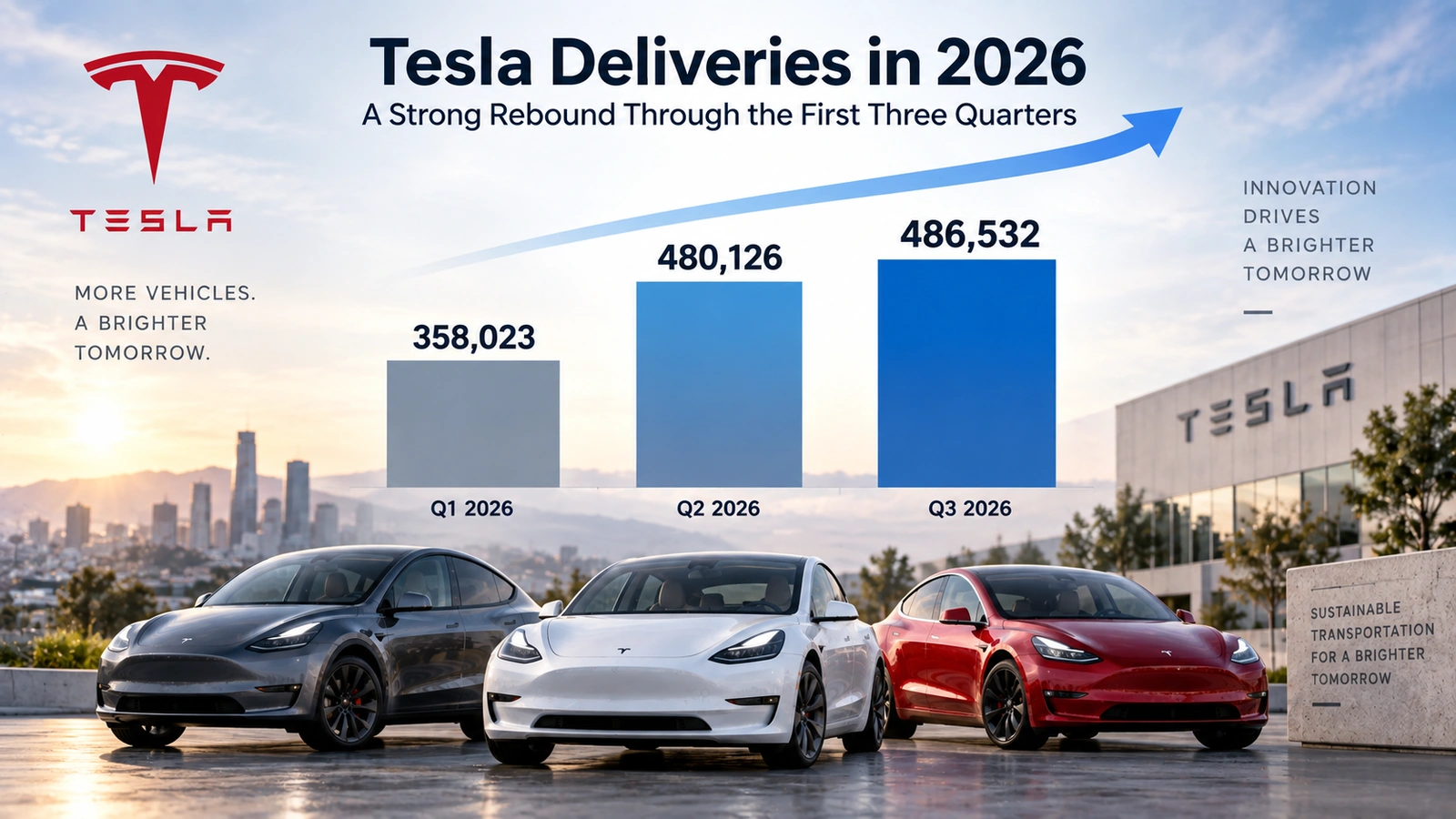
Yes. Compared with the beginning of 2026, Tesla’s delivery numbers have improved sharply.
Tesla reported 358,023 deliveries in Q1, 480,126 in Q2 and 486,532 in Q3. (Tesla Q1 · Tesla Q2 · Tesla Q3)
| 2026 quarter | Tesla deliveries |
|---|---|
| Q1 | 358,023 |
| Q2 | 480,126 |
| Q3 | 486,532 |
That is why the current report can reasonably be described as evidence of a recovery in Tesla’s vehicle business even though the year-over-year comparison remains negative.
The two statements measure different things.
Compared with early 2026, Tesla is delivering far more vehicles.
Compared with the extraordinary tax-credit-driven quarter a year earlier, it is still slightly behind.
This is one reason year-over-year numbers and sequential quarterly numbers are normally read together rather than in isolation.
Why Did Europe Matter So Much This Quarter?

Because Tesla’s companywide number can improve even when one major market is struggling.
Reuters reported that recovering European sales helped compensate for weaker demand in the United States and China during the quarter. (Reuters)
Signs of that European recovery were already visible before Tesla released its companywide total.
In September, Tesla registrations rose year over year in several European markets, including France, Sweden, Spain and Portugal. Across the EU, U.K. and EFTA markets, Tesla registrations through August were also well ahead of the previous year, according to Reuters. (Reuters)
This helps explain something that can otherwise look strange.
A U.S. reader may see weaker domestic EV demand after the federal tax incentive disappeared and assume Tesla’s worldwide business must also be falling sharply.
But Tesla sells cars across many markets.
A gain in one region can offset weakness somewhere else.
That is why a companywide delivery total does not tell you whether Tesla is growing in every major market at the same time.
Does a Delivery Beat Mean Tesla Had a Great Quarter?
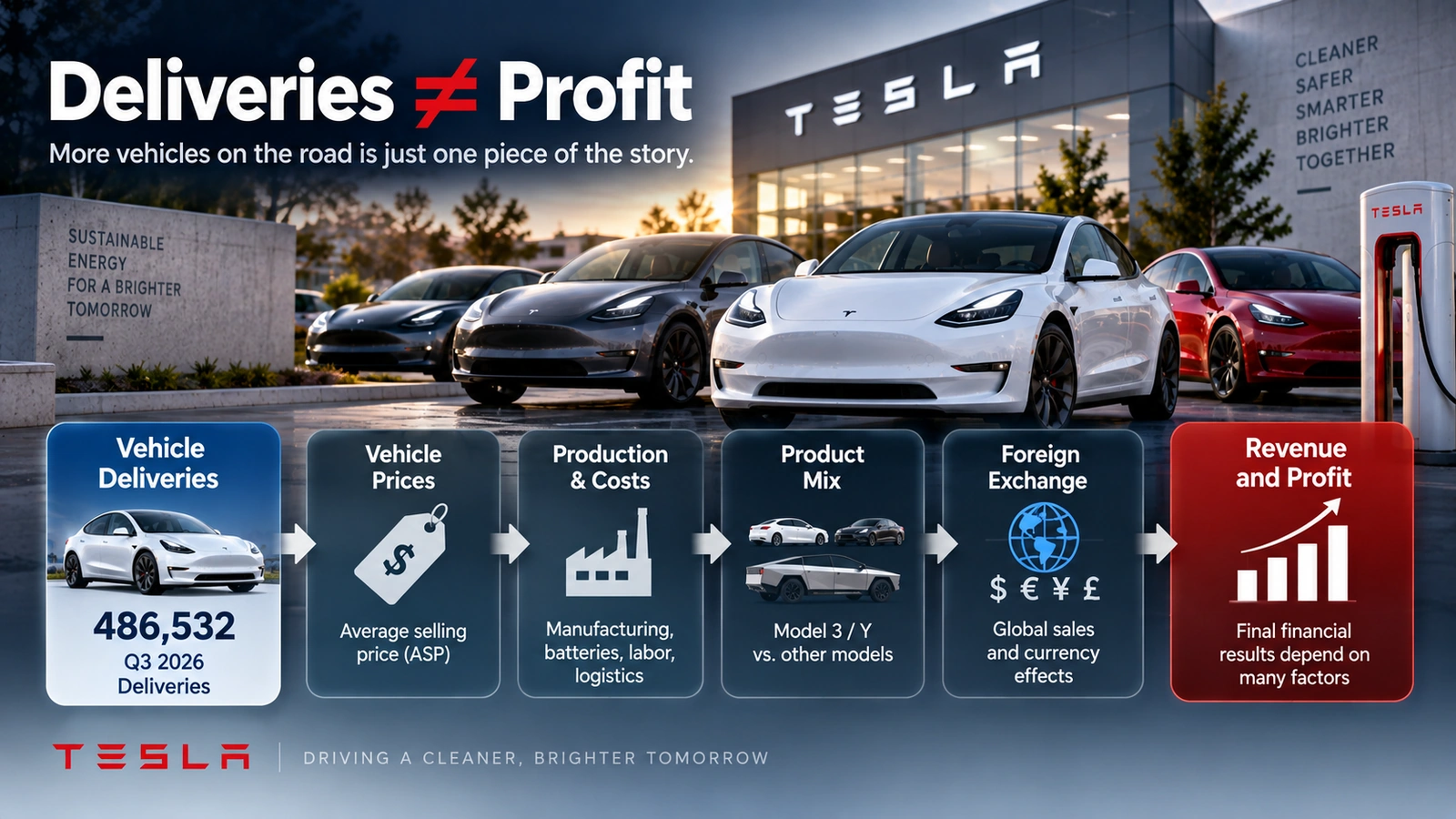
No. A delivery beat tells us demand was stronger than analysts expected. It does not tell us what Tesla earned on those vehicles.
Imagine two car companies each deliver 100,000 vehicles.
One sells higher-priced models with wide margins. The other uses discounts and financing incentives to move inventory.
The vehicle count is identical.
The economics are not.
Tesla explicitly says investors should not rely on deliveries alone as an indicator of quarterly financial results because revenue, average selling prices, costs, foreign exchange and other factors also matter. (Tesla)
There is another interesting number in this quarter.
Tesla produced 464,391 vehicles but delivered 486,532—meaning deliveries exceeded production by 22,141 vehicles.
That can happen because vehicles delivered during a quarter do not all have to be manufactured during that same quarter. Existing inventory can also be sold.
So the delivery report gives investors an important first piece of the quarter.
It is not the complete financial picture.
What Should Investors and EV Buyers Watch Next?
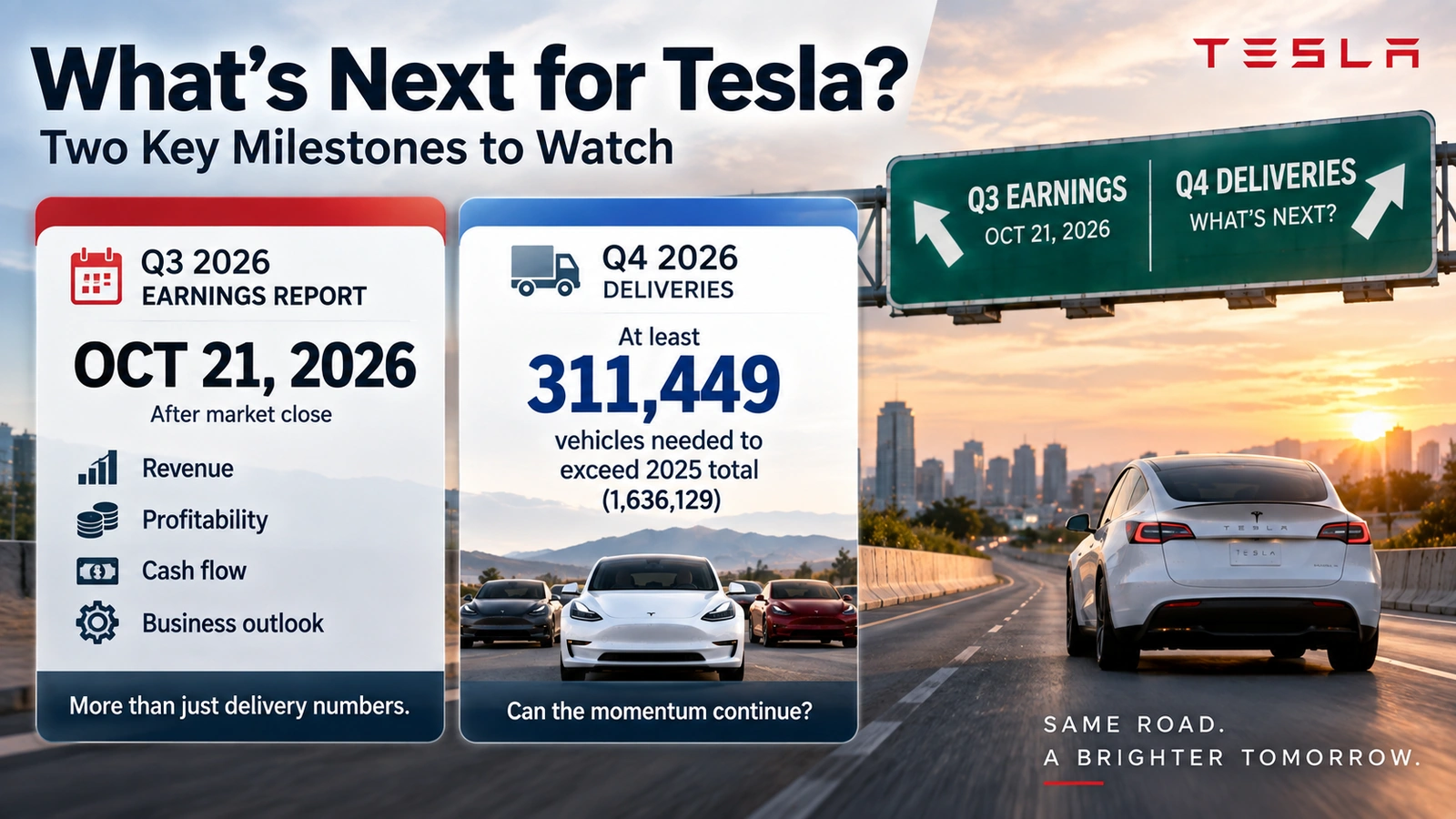
The next major checkpoint is October 21, 2026, when Tesla plans to release its full third-quarter financial results. That is when investors will see revenue, profitability, cash flow and other numbers that the delivery report cannot answer. (Tesla)
Then comes Q4.
Using Tesla’s official quarterly figures, the company has delivered 1,324,681 vehicles through the first nine months of 2026.
Tesla delivered 1,636,129 vehicles in all of 2025. (Tesla)
That means Tesla would need at least 311,449 deliveries in Q4 2026 to finish the year above its 2025 total.
That number is simple arithmetic, not a forecast.
The larger issue is whether the Q3 strength proves durable after the unusual comparisons and regional shifts are stripped away.
For EV buyers, the U.S. market is also operating under a different incentive environment than it was a year ago. The federal clean-vehicle credits that helped shape buying decisions in 2025 are no longer available for vehicles acquired after September 30, 2025. (IRS)
So Q4 will provide another test of how much demand Tesla can generate without that federal incentive.
Bottom Line: What This Story Really Means
Tesla’s Q3 2026 delivery report is neither as simple as “Tesla deliveries are booming” nor as simple as “Tesla deliveries are falling.”
The company delivered 486,532 vehicles, substantially more than analysts had expected and slightly more than it delivered in Q2.
But it still fell 2.1% short of Q3 2025, when U.S. buyers were racing toward the expiration of federal EV tax incentives and Tesla recorded an unusually strong quarter.
The most useful way to read the numbers is this:
Tesla performed better than the market expected, improved from earlier in 2026, but did not surpass last year’s record third quarter.
And deliveries alone will not settle the bigger question about Tesla’s business.
The next answers come from the October 21 earnings report—and then from whether the company can maintain its delivery momentum through the end of the year.
Tesla Deliveries: Key Questions Explained
Q. How many vehicles did Tesla deliver in Q3 2026?
Tesla delivered 486,532 vehicles during the third quarter of 2026, including 478,237 Model 3 and Model Y vehicles.
Q. Did Tesla beat Wall Street delivery expectations?
Yes. Tesla’s company-compiled analyst average was 461,974 deliveries, while Reuters cited a Visible Alpha estimate of 456,896. The actual 486,532 total exceeded both.
Q. Why were Tesla deliveries still down from last year?
Tesla delivered 497,099 vehicles in Q3 2025, compared with 486,532 in Q3 2026. That produces a year-over-year decline of about 2.1%.
Q. Why was Tesla’s Q3 2025 comparison unusually difficult?
Q3 2025 included a rush by some U.S. EV buyers before federal clean-vehicle tax credits ended for vehicles acquired after September 30, 2025. Tesla recorded 497,099 deliveries that quarter.
Q. Did Tesla deliveries improve from Q2 2026?
Yes. Deliveries increased from 480,126 in Q2 to 486,532 in Q3, an increase of about 1.3%.
Q. Does Tesla’s delivery report show how much profit the company made?
No. Deliveries measure vehicles transferred to customers, but Tesla’s profits also depend on vehicle prices, costs, product mix, foreign exchange and other factors.
Q. When will Tesla report its full Q3 2026 earnings?
Tesla is scheduled to release its third-quarter financial results after the market closes on October 21, 2026.
Q. How many vehicles would Tesla need to deliver in Q4 to exceed its 2025 annual total?
Based on Tesla’s published figures, it would need at least 311,449 Q4 deliveries to finish 2026 above the 1,636,129 vehicles delivered in 2025. That is an arithmetic threshold, not a prediction.
Did this help make the story clearer? 🙂 WIN keeps unpacking the “why” behind the news—clearly and simply!
Sources
Q3 Delivery Numbers and Analyst Expectations
Tesla — Third Quarter 2026 Production, Deliveries & Deployments
Tesla — Q3 2026 Delivery Consensus
Reuters — Tesla’s Car Business Back on Growth Path as Deliveries Beat Forecasts
2025 Tax-Credit Deadline and Year-Over-Year Context
Tesla — Third Quarter 2025 Production, Deliveries & Deployments
IRS — Clean Vehicle Tax Credits
IRS — Credits for New Clean Vehicles Purchased in 2023 or After
2026 Delivery Trend and Regional Demand
Tesla — First Quarter 2026 Production, Deliveries & Deployments
Tesla — Second Quarter 2026 Production, Deliveries & Deployments
Tesla — Fourth Quarter 2025 Production, Deliveries & Deployments
Reuters — Tesla September Registrations Rise Across Europe, Extending Recovery