Why Did All 12 U.S. B-1 Bombers Leave RAF Fairford—and Does It Weaken Strikes on Iran?

All 12 bombers leaving a base used for strikes on Iran sounds dramatic.
Did the United States just retreat from one of its most useful military positions in Europe?
And if the bombers were moved because of a suspected security threat, does that mean a handful of people near an airfield managed to disrupt U.S. military operations?
The first answer is important: the withdrawal does not mean the United States lost its ability to conduct long-range strikes. The aircraft that remained at RAF Fairford were B-1B Lancers, bombers specifically designed for long-distance missions, and the Pentagon says U.S. bombers can still launch from bases in the continental United States. (U.S. Air Force · CBS News)
But that does not make the move meaningless.
RAF Fairford is the U.S. Air Force’s preferred European forward operating location for bombers. Moving the entire deployed bomber force out of it removes a convenient forward staging point at a time when the U.S.-Iran conflict is still active. (U.S. Air Force)
And there is a second complication: the public evidence about why the bombers left is not as simple as some headlines make it sound.
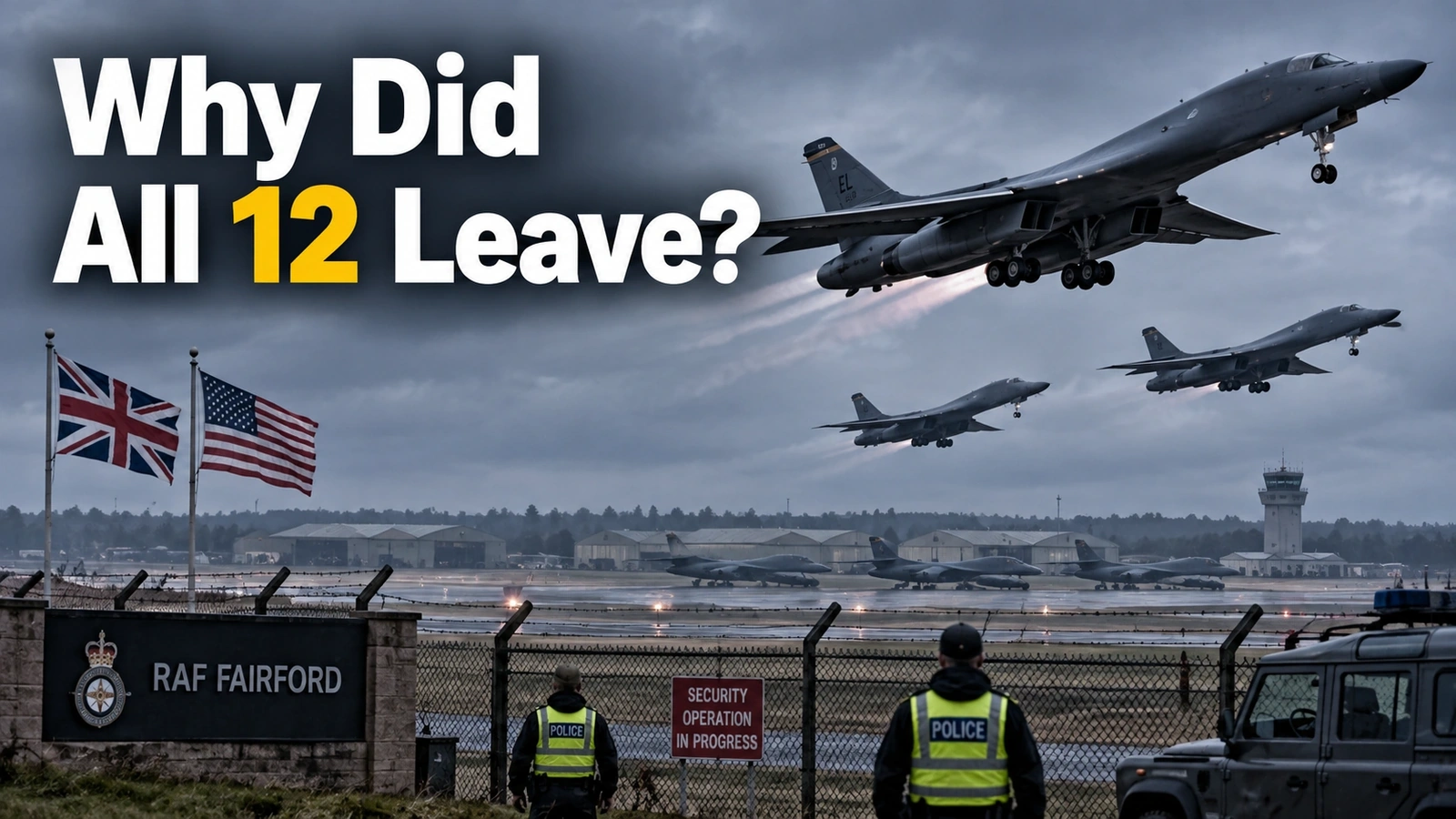
※ Images in this article are AI-generated illustrations created to help explain the story. They are not actual photographs, and depictions of people, places, or events may differ slightly from reality.
The Pentagon confirmed that every U.S. bomber deployed at Fairford had returned to its home station. President Donald Trump later connected the move to threats against the base.
British police are still investigating what happened near Fairford, including possible foreign-state involvement. That is very different from having publicly proved that Iran ordered an attack.
So the real story has three layers: what physically left the base, what is actually known about the security threat, and how much military capability the United States really lost by moving the aircraft home.
What Actually Left RAF Fairford on October 4?
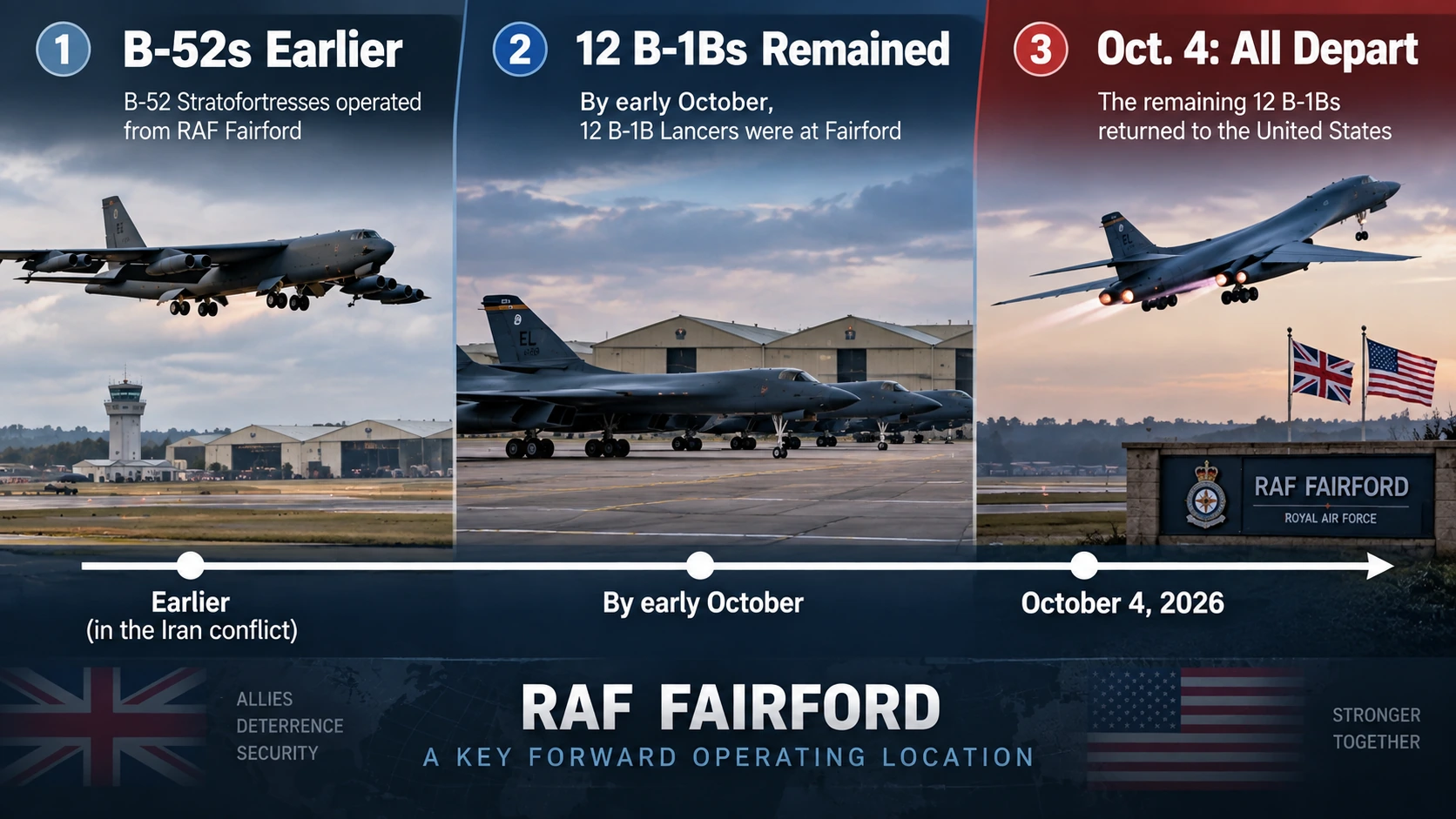
The clearest way to understand the withdrawal is to separate bombers that had used Fairford during the war from the bombers that were still there on October 4.
The base had hosted both B-52 Stratofortresses and B-1B Lancers during U.S. operations connected to Iran. By October 4, 12 B-1Bs remained at Fairford, and those aircraft departed for their U.S. home stations. Air & Space Forces Magazine reported that all 12 deployed B-1Bs left over the course of the day. (Air & Space Forces Magazine · Reuters)
| Stage | What was happening | Why it matters |
|---|---|---|
| Earlier in the Iran conflict | B-52s and B-1Bs operated from RAF Fairford | Fairford became an active forward bomber hub |
| By early October | 12 B-1Bs remained | The deployed force had already narrowed |
| October 4 | The remaining B-1Bs returned to the United States | Fairford was left without a deployed U.S. bomber force |
That distinction matters because the phrase “all U.S. bombers left Britain” can sound as though an entire permanent bomber fleet disappeared.
Fairford does not have permanently assigned U.S. Air Force bombers. It is a forward operating location designed to receive, support, and sustain deployed aircraft when needed. (U.S. Air Force)
So the United States removed the deployed bombers.
It did not close RAF Fairford.
Was the Withdrawal Really Caused by an Iranian Terror Plot?
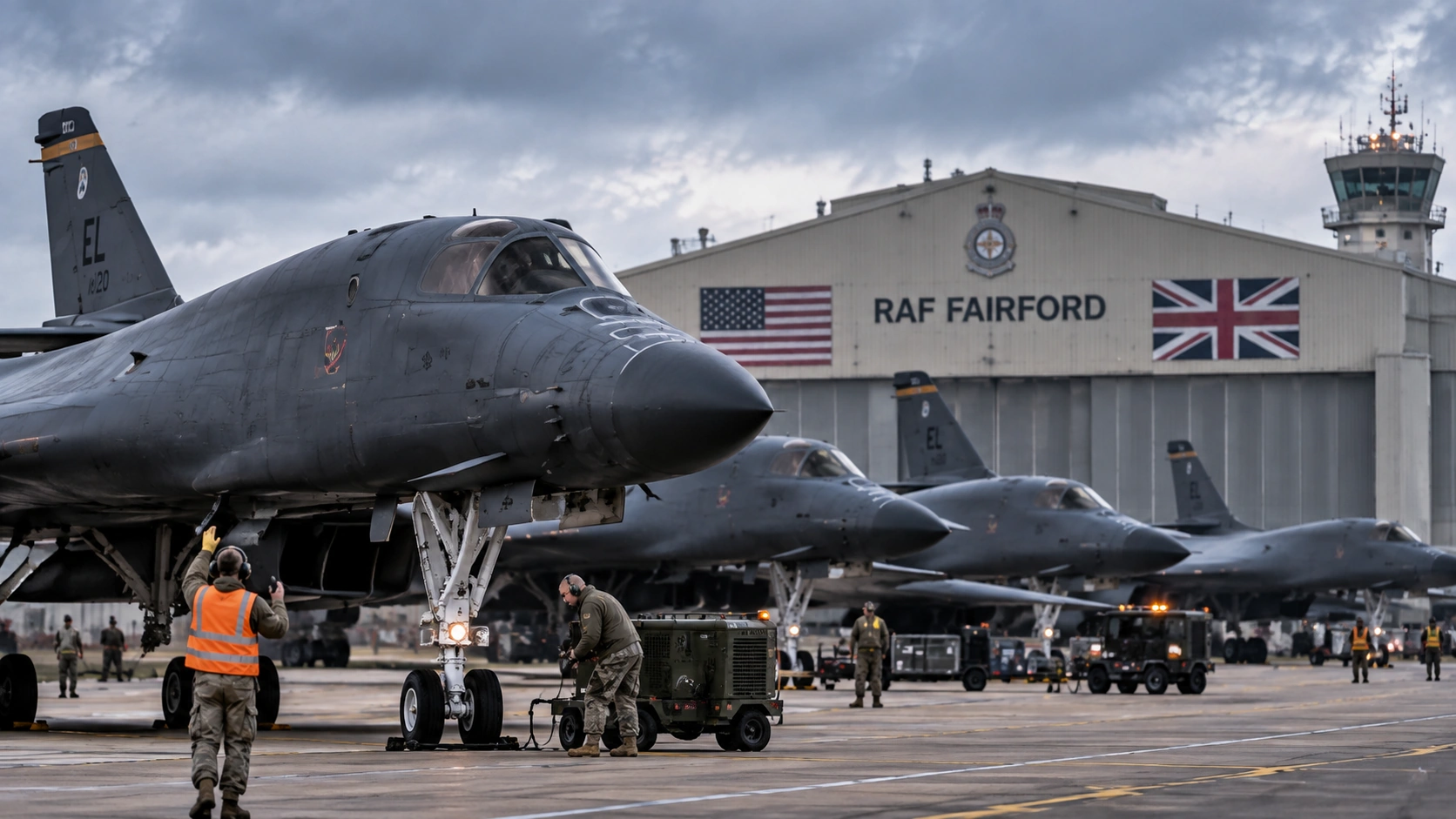
Not publicly proven.
This is the part of the story where several different statements have been compressed into one dramatic narrative.
On September 27, British police responded after three suspicious vehicles were reported traveling toward RAF Fairford. Five British men were arrested on suspicion of offenses under the Explosives Act and preparation of a terrorist act. Police later said no improvised explosive devices were found, although a quantity of gasoline was recovered. The five men were released on bail and remained under investigation. (Counter Terrorism Policing)
A sixth person, a dual U.K.-Iranian national, was arrested in London on October 1 on suspicion of preparation of terrorist acts. He was also released on bail on October 3, and police said the investigation was continuing. (Counter Terrorism Policing)
British investigators have explicitly said they are examining possible foreign-state involvement. (Counter Terrorism Policing)
British Prime Minister Andy Burnham has gone further, saying there are “strong indications” that Iran played a part. Trump has also linked the threat to Iran, while Tehran has denied involvement. (Reuters · AP)
But investigators have not publicly established the full chain.
| Publicly established | Still being investigated |
|---|---|
| Suspicious vehicles were reported near RAF Fairford | The suspects’ full intent |
| Five men were initially arrested | Whether a broader attack was planned |
| Gasoline was recovered | Whether anyone directed the activity |
| No improvised explosive devices were found | Whether a foreign government was involved |
| A sixth dual U.K.-Iranian suspect was later arrested | What role, if any, Iran played |
| All six were released on bail while investigations continued | Whether criminal charges will ultimately follow |
There is also an important difference between the Pentagon’s statement and Trump’s later explanation.
The Pentagon publicly confirmed that all deployed bombers had returned home. Trump subsequently said the aircraft had been moved because of threats. (Reuters)
That makes the cautious version of the story more accurate:
The B-1s left after a serious security incident and amid concerns about possible Iran-linked threats, but public authorities have not established that Iran directed the September 27 incident.
Why Is RAF Fairford So Important to the United States?
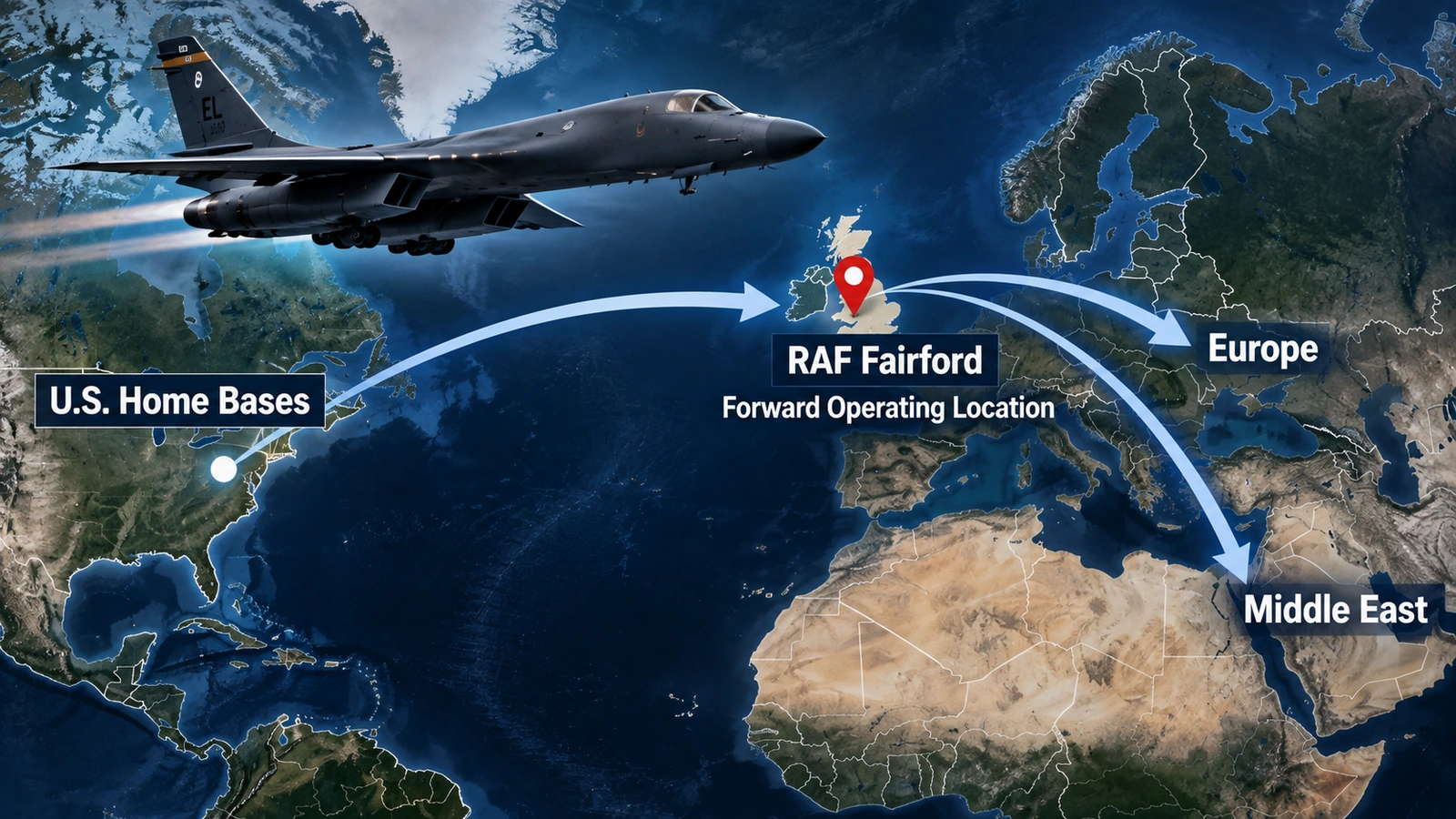
Because geography matters even for aircraft designed to fly across continents.
RAF Fairford is in Gloucestershire, England, roughly 100 miles west of London. The U.S. Air Force describes it as the preferred European bomber forward operating location for Air Force Global Strike Command. It is home to the 501st Combat Support Wing headquarters and the 420th Air Base Squadron, which supports deployed forces operating from Fairford. (U.S. Air Force)
Think of the difference this way.
A bomber’s American home base is where the aircraft and its unit normally live.
A forward operating location is a closer platform from which aircraft can operate when a crisis or deployment requires it.
For long-range bombers, “closer” does not mean they are incapable of flying from the United States. It means planners can reduce the distance between aircraft, maintenance crews, munitions, refueling support, and the theater where operations are occurring.
Fairford has been used for U.S. bomber deployments for years. Air Force descriptions of Bomber Task Force deployments emphasize that operating from the base helps American crews work with European allies and gives the U.S. a ready European location for bomber operations. (U.S. Air Forces in Europe)
That is what made the recent security incident strategically sensitive.
This was not simply suspicious activity beside a small rural airfield.
It happened beside a location that had become part of the operating chain for U.S. strikes connected to Iran.
Does Pulling the B-1s Out Make It Harder for the U.S. to Strike Iran?
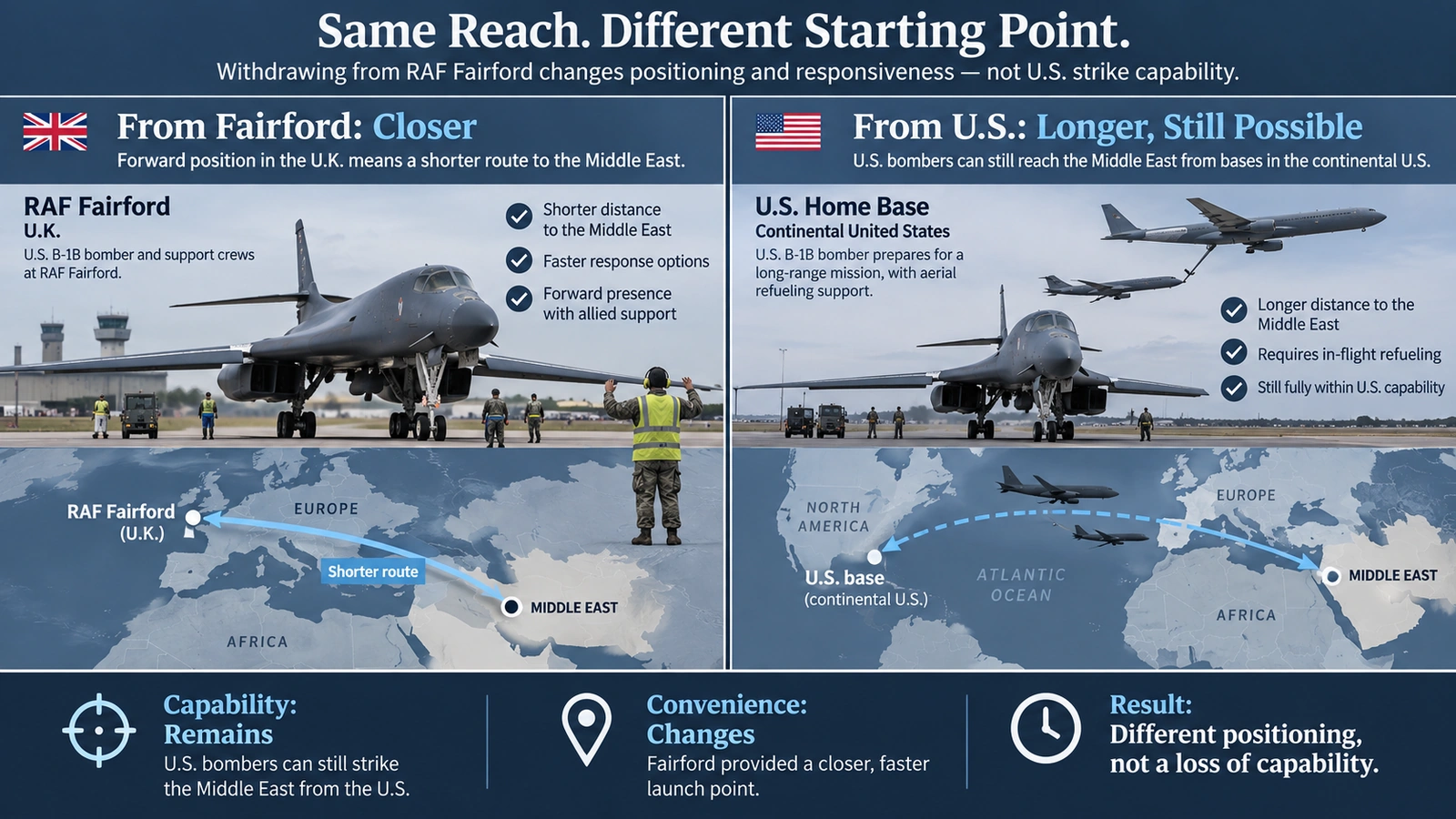
It makes one option less convenient, but it does not remove the U.S. long-range strike capability.
The B-1B is specifically designed for long-range missions. Air Force Global Strike Command describes it as a long-range heavy bomber carrying the largest conventional payload in the Air Force inventory. (Air Force Global Strike Command)
The Pentagon made essentially the same point after the Fairford withdrawal. It said crews operating B-1s, B-2s, and B-52s remain able to conduct global strikes, including missions that launch and recover in the continental United States. (CBS News)
That is not just theoretical.
Long-distance bomber operations can rely on aerial refueling, which allows aircraft to remain airborne far beyond the range possible on their internal fuel alone. The B-52, for example, has an unrefueled combat range of more than 8,800 miles, and the Air Force says aerial refueling can extend its range until crew endurance becomes the practical limitation. (Air Force Global Strike Command)
So there are two different questions:
| Question | Answer |
|---|---|
| Can U.S. bombers still reach distant targets after leaving Fairford? | Yes |
| Is operating from Fairford strategically identical to operating from the United States? | No |
A forward base can shorten transit distances and put crews, maintenance, and aircraft closer to the region.
Moving the bombers back home therefore changes positioning and responsiveness, not the basic existence of the capability.
It is similar to moving a fire engine from a station five minutes away to one 30 minutes away.
The fire engine still exists. It can still respond. But its starting position is no longer the same.
So Why Move Expensive Bombers Instead of Just Guarding the Base More Heavily?
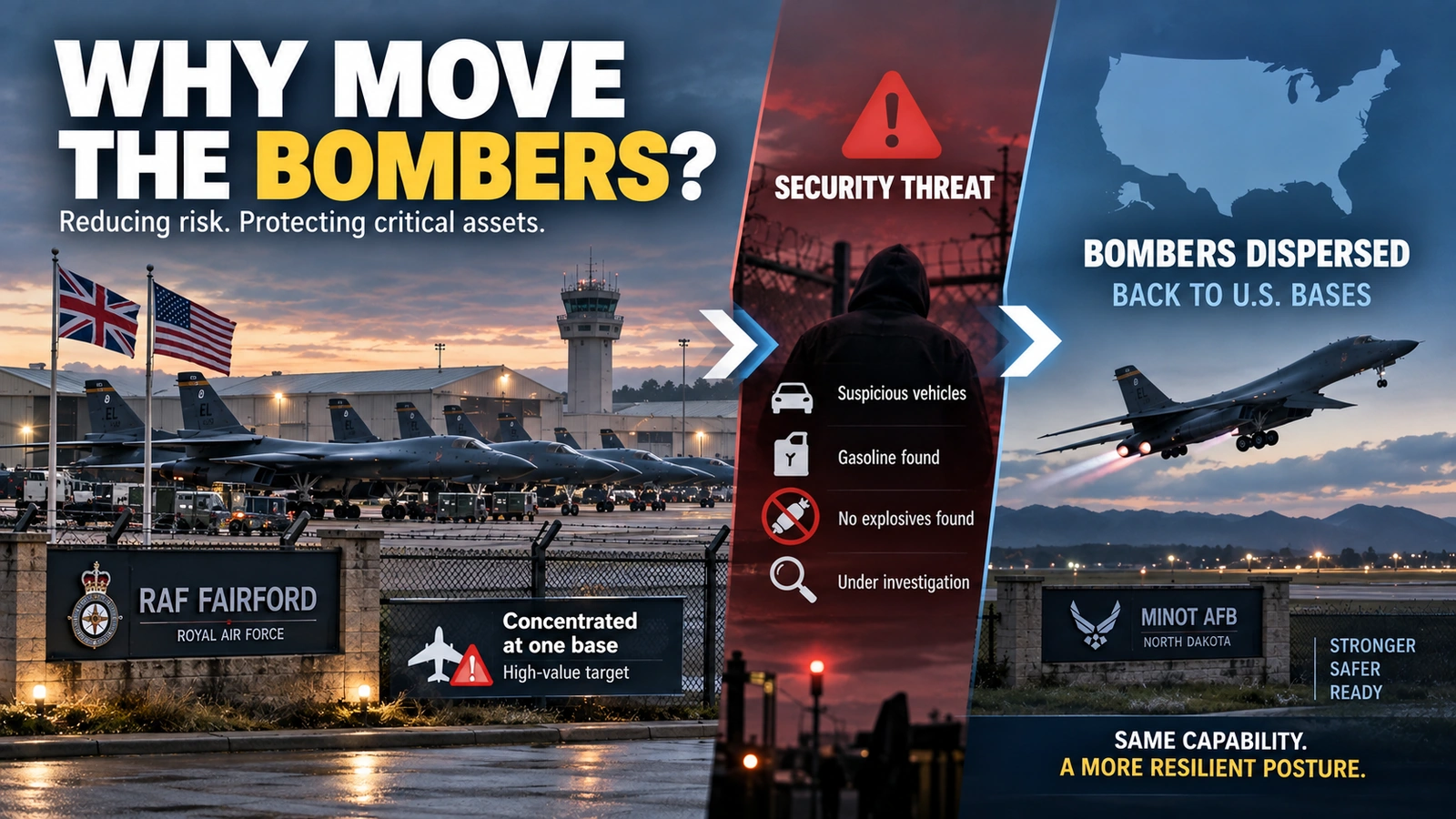
Because a bomber sitting on the ground is a very valuable target.
Military planners constantly balance two competing advantages.
Keeping aircraft forward makes them easier to employ quickly.
Dispersing them makes it harder for an adversary to threaten a large portion of the force in one place.
That trade-off becomes more important when a base itself becomes the subject of a security investigation.
The September 27 incident did not produce a confirmed attack on the bombers. No improvised explosive devices were found in the vehicles police examined. But authorities considered the situation serious enough for a counterterrorism investigation, and possible foreign-state involvement remains one of the lines of inquiry. (Counter Terrorism Policing)
Trump said the bombers were moved because of threats. That is consistent with a precautionary decision to reduce the risk of keeping a dozen high-value aircraft concentrated at one forward location. (Reuters)
That does not necessarily mean the Pentagon expects Fairford to remain unsafe indefinitely.
Aircraft deployments are movable by design.
A forward location can be used heavily during one stage of a crisis, emptied during another, and potentially receive aircraft again later if commanders decide the operational benefits outweigh the security risks.
And that leads to an important distinction: moving the aircraft is not the same as abandoning the base.
RAF Fairford’s U.S. support units and infrastructure remain in place. (U.S. Air Force)
Is This a Military Victory for Iran?
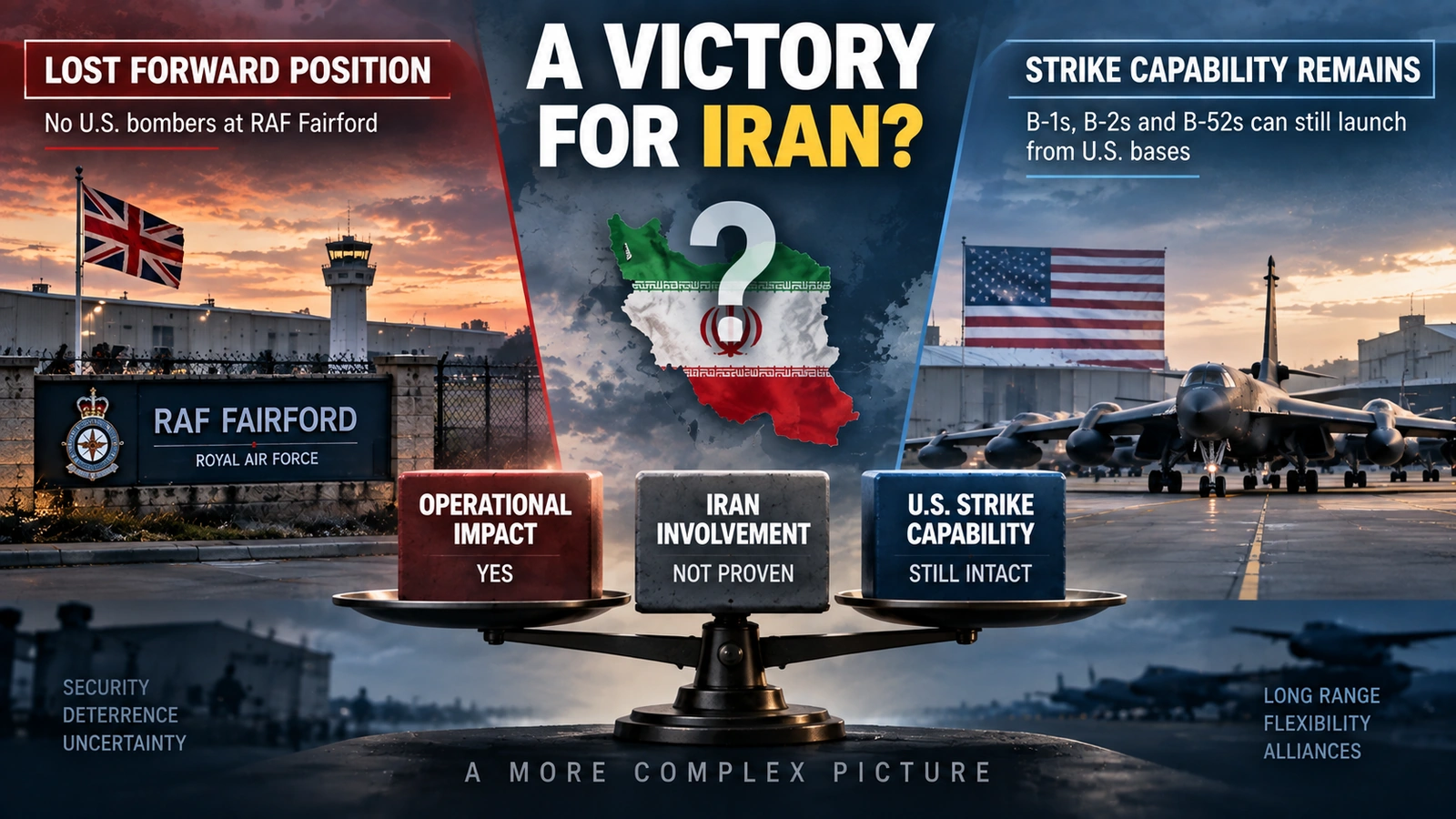
That conclusion goes beyond what is publicly established.
From a strategic perspective, an adversary would benefit if security concerns forced U.S. military assets to operate from farther away. A forward base is useful precisely because it gives commanders options.
But two things must be separated.
First, the operational effect: the United States no longer has a deployed bomber force sitting at RAF Fairford.
Second, responsibility for producing that effect: investigators have not publicly proved that Iran directed the activity that triggered the security investigation.
Calling the withdrawal an Iranian military success assumes the second point before it has been established.
It also risks exaggerating the first.
The United States retains B-1, B-2, and B-52 forces elsewhere, including in the United States, and it continues to maintain other military assets connected to the broader Middle East conflict. AP reported that additional U.S. naval forces were also moving toward the region while the Fairford bombers returned home. (AP)
A more accurate description is that the Fairford episode illustrates something militaries increasingly worry about:
A sophisticated aircraft does not need to be destroyed for a threat to affect how it is deployed.
If commanders conclude that the risk to aircraft on the ground has become too high, they may move them.
That alone can change logistics, operating distances, and planning.
What Should You Watch Next?
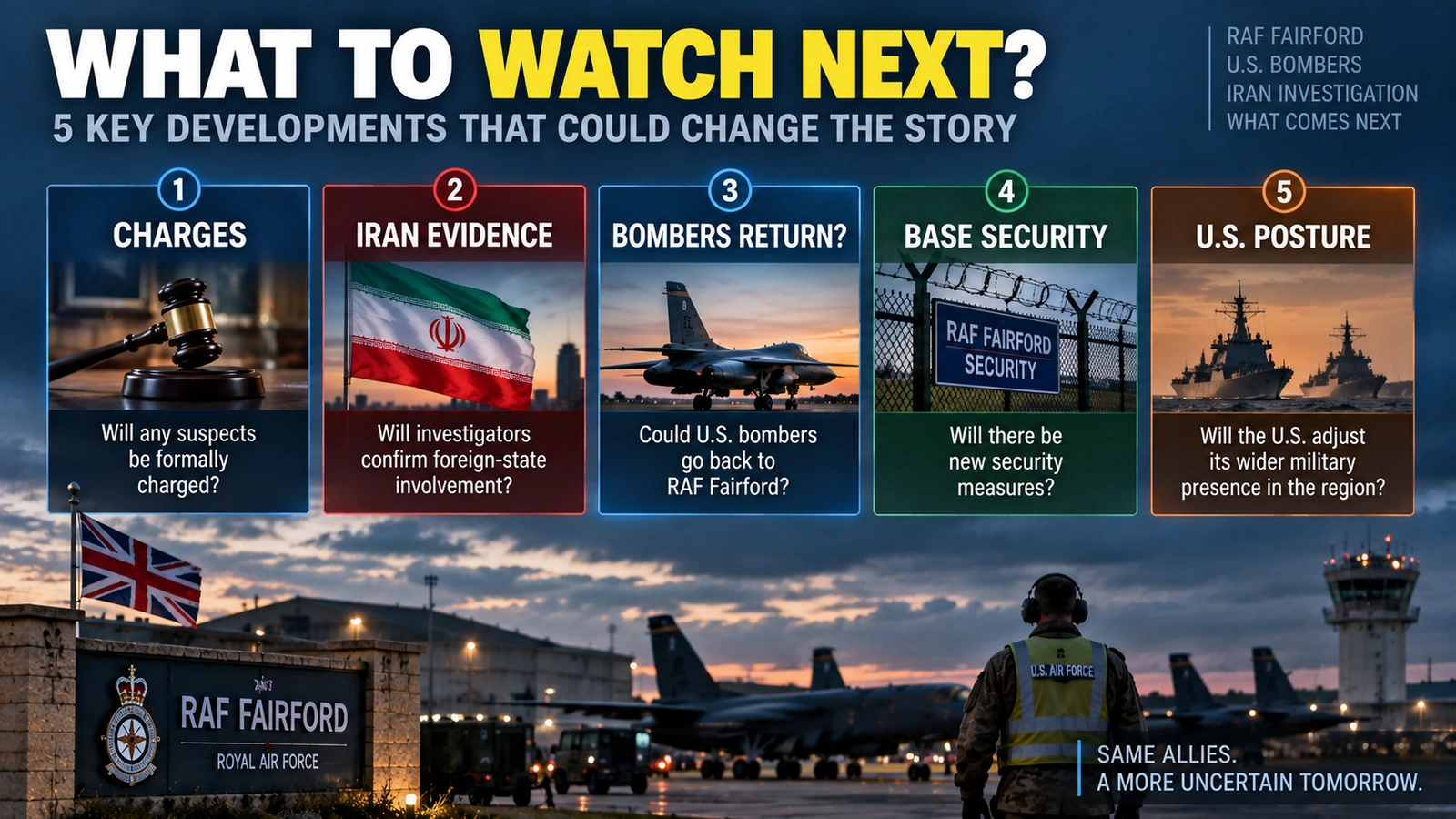
Five developments would materially change what this story means.
1. Whether anyone is charged.
All six people publicly linked to the Fairford investigation have been released on bail while inquiries continue. A charging decision would show whether investigators and prosecutors believe the evidence supports a formal criminal case. (Counter Terrorism Policing)
2. Whether investigators publicly establish foreign-state involvement.
This would move the Iran question from political statements and investigative possibilities toward evidence that can be assessed more directly.
3. Whether U.S. bombers return to Fairford.
Fairford remains a bomber forward operating location. A future deployment would show that the October withdrawal was not a permanent abandonment of the base.
4. Whether security changes at U.S.-used British bases.
A broader change in protection measures would suggest that Washington and London see the problem as larger than one unusual incident.
5. Whether the U.S. changes the wider bomber or naval posture around Iran.
The significance of Fairford depends partly on what replaces the capability that was positioned there. A single base tells only part of the military picture.
The next important headline, in other words, may not be another bomber departure.
It may be a police charge, evidence about foreign involvement, a new U.S. deployment—or bombers quietly returning to Fairford.
Bottom Line: What This Story Really Means
The United States removed the remaining 12 B-1B bombers from RAF Fairford on October 4, leaving the important British forward operating location without a deployed U.S. bomber force.
That is strategically significant because Fairford had given U.S. bombers a useful European staging point during operations connected to Iran.
But the withdrawal does not mean the United States can no longer conduct long-range strikes. B-1s and other American bombers are specifically designed to operate across enormous distances, and the Pentagon says missions can still launch from the continental United States.
The Iran connection also needs careful wording.
British investigators are examining possible foreign-state involvement, British and U.S. political leaders have pointed toward Iran, and Iran has denied responsibility. But public authorities have not established that Tehran directed the September 27 incident.
So the most useful way to read the news is not “America lost its bombers” or “Iran forced the U.S. out of Britain.”
It is this:
A security threat around a strategically important forward base was serious enough for the United States to move its deployed bomber force home—even though the underlying investigation is still unresolved and the broader U.S. strike capability remains intact.
RAF Fairford Bombers: Key Questions Explained
Q. How many U.S. bombers left RAF Fairford on October 4?
Twelve B-1B Lancer bombers remained at RAF Fairford before the October 4 withdrawal. Air & Space Forces Magazine reported that all 12 returned to the United States that day.
Q. Did every type of U.S. bomber leave RAF Fairford on October 4?
The aircraft departing in the final October 4 movement were the remaining B-1Bs. B-52s had also operated from Fairford during the Iran conflict, but they had already left months earlier.
Q. Did the Pentagon say Iran was the reason for the withdrawal?
The Pentagon confirmed the redeployment but did not initially give a specific public reason. Trump later said the bombers had been moved because of threats.
Q. Has Iran been proven to be behind the suspected RAF Fairford plot?
No. British authorities are investigating possible foreign-state involvement, and political leaders have pointed toward Iran, but the public investigation has not established that Iran directed the incident. Tehran denies involvement.
Q. Were explosives found in the vehicles near RAF Fairford?
No improvised explosive devices were found, according to British Counter Terrorism Policing. Investigators did recover a quantity of gasoline.
Q. Have any of the RAF Fairford suspects been convicted or charged?
No charge has been publicly announced in the police updates cited here. All six people publicly linked to the investigation were released on bail while inquiries continued. Arrest on suspicion is not the same as being charged or convicted.
Q. Can U.S. bombers still strike distant targets without RAF Fairford?
Yes. U.S. strategic bombers are designed for long-range operations, and aerial refueling can further extend their reach. The Pentagon says missions can launch and recover from the continental United States.
Q. Is RAF Fairford shutting down as a U.S. bomber base?
No. The deployed bombers left, but RAF Fairford remains a U.S. Air Force forward operating location with supporting personnel and infrastructure.
Q. Could U.S. bombers return to RAF Fairford?
Yes. Fairford is designed to receive deployed bomber forces. Whether and when aircraft return will depend on future operational and security decisions.
Q. What is the most important thing to watch now?
Watch the British investigation for charging decisions or evidence of foreign-state involvement, and watch whether the U.S. sends bombers back to Fairford or shifts more military capability elsewhere.
Did this help make the story clearer? 🙂 WIN keeps unpacking the “why” behind the news—clearly and simply!
Sources
Bomber Withdrawal and U.S. Military Posture
Associated Press — U.S. Air Force Removes Bombers From RAF Fairford
Reuters — Trump Says U.S. Bombers Moved From U.K. Due to Threats
CBS News — U.S. Military Removes Bombers From U.K. Air Base
Air & Space Forces Magazine — All B-1 Bombers Leave RAF Fairford
RAF Fairford and Long-Range Bomber Capabilities
U.S. Air Force — RAF Fairford and RAF Welford
U.S. Air Force — 420th Air Base Squadron
Air Force Global Strike Command — B-1B Lancer
Air Force Global Strike Command — B-52 Stratofortress
RAF Fairford Security Investigation
Counter Terrorism Policing — RAF Fairford Investigation Update, September 28
Counter Terrorism Policing — No IEDs Found and Petrol Recovered
Counter Terrorism Policing — Further Arrest and Foreign-State Inquiry
Counter Terrorism Policing — Dual U.K.-Iranian National Released on Bail
Keep Reading
What happened near RAF Fairford before the bombers left?
The October 4 withdrawal makes more sense once the original September 27 incident is separated from the later political claims about Iran and the decision to move the aircraft.
Why Were Five Men Arrested Near RAF Fairford—and What Is Actually Confirmed?