Did Tesla Really Build a Flying Car? What the New Roadster Actually Does

A car drives straight up a towering ramp, turns upside down, launches into the air, rotates, and lands safely on its wheels.
If that sounds like something created with artificial intelligence, you’re not alone.
But this time, the extraordinary footage came from a real vehicle demonstration.
On October 15, 2026, Tesla unveiled its redesigned next-generation Roadster at a SpaceX testing facility in McGregor, Texas. The electric sports car performed aerial maneuvers using technology developed with Elon Musk’s rocket company. (Reuters · AP)
So has Tesla finally invented the flying car people have imagined for decades?
Not quite. The Roadster demonstrated controlled, short-duration aerial maneuvers—not the sustained flight of a conventional aircraft.
Understanding the difference requires looking at two technologies working together: a powerful fan-based suction system and compressed-gas thrusters.
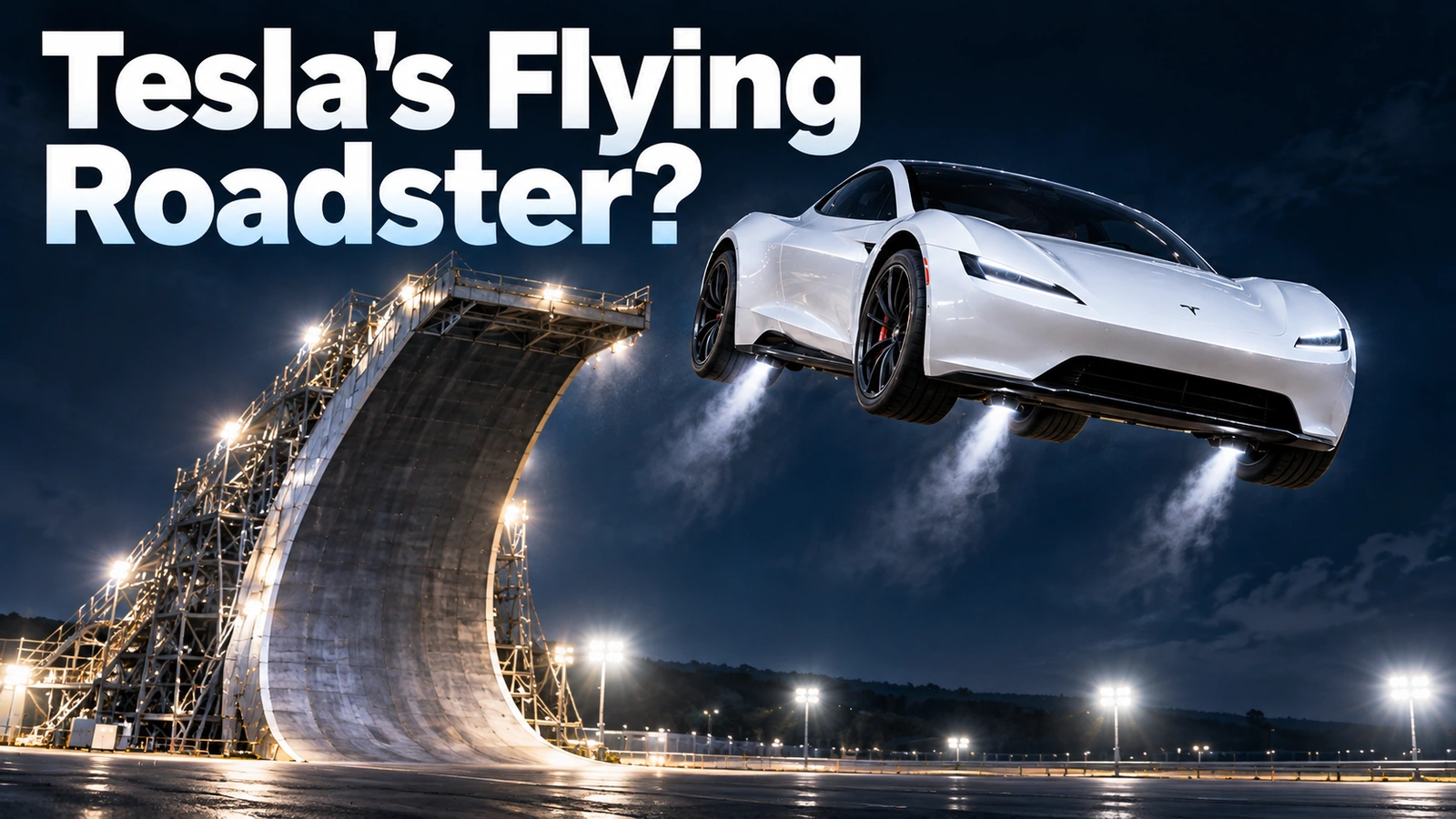
※ Images in this article are AI-generated illustrations created to help explain the story. They are not actual photographs, and depictions of people, places, or events may differ slightly from reality.
The distinction matters because Tesla’s presentation was more than a publicity stunt, yet it also left major questions unanswered. How could a car stick to an upside-down roadway? What makes it move through the air? And when, if ever, could an ordinary customer experience something like this?
What Exactly Happened During Tesla’s Roadster Demonstration?
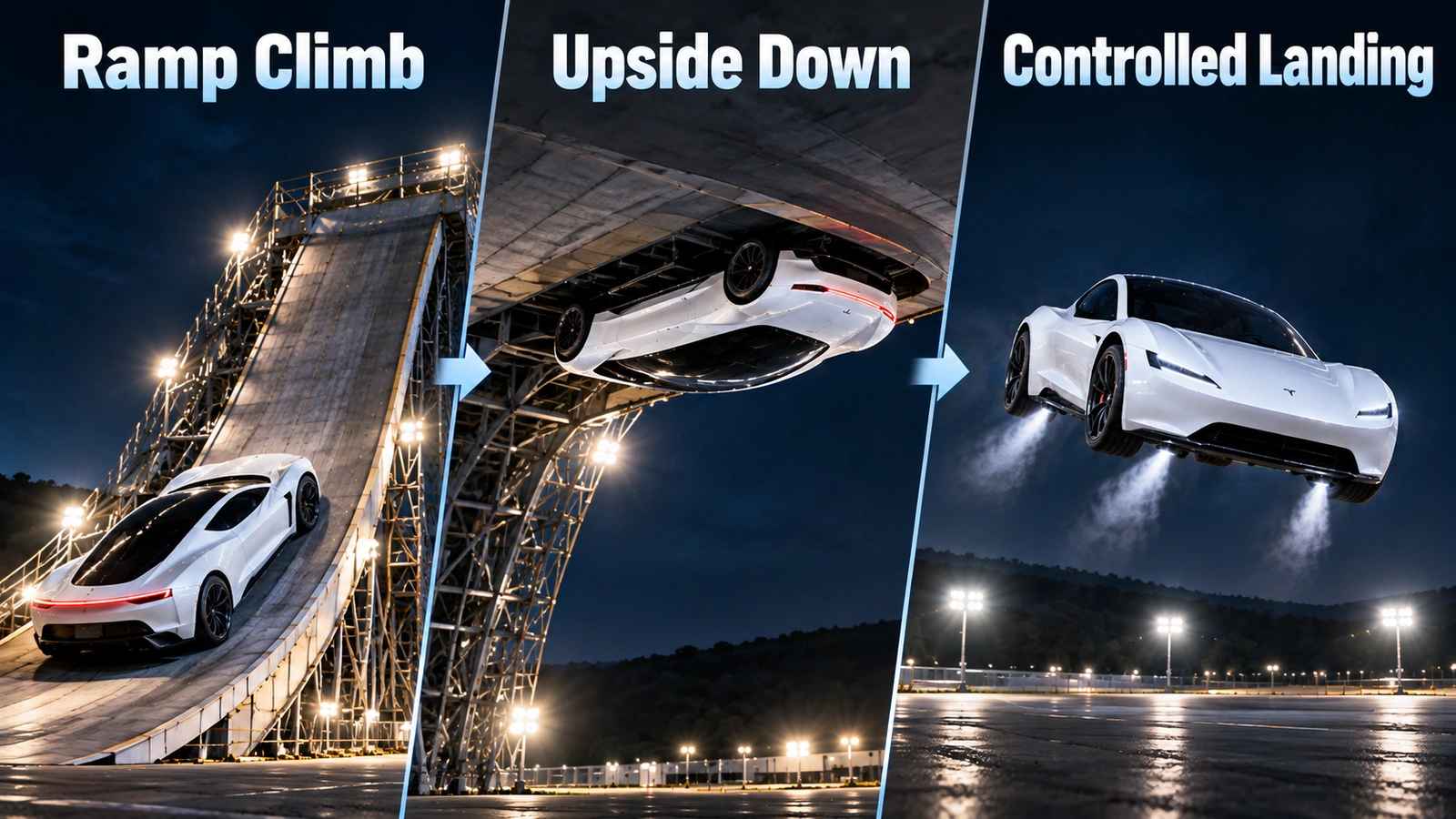
Tesla’s demonstration had two especially memorable moments.
In the first, a white Roadster approached a giant curved ramp. Instead of falling away as the surface became nearly vertical, the vehicle continued climbing. It reached the inverted section near the top, then left the ramp and rotated upright in midair before descending onto the pavement.
The second demonstration was arguably even more surprising. The Roadster used its thrusters to leap over a lineup of five Tesla vehicles, including a Cybertruck, Cybercab, Semi, Model Y, and Model 3, while rotating in the air. (TechCrunch · Tesla demonstration)
This was not simply a computer animation presented as a future concept. The maneuvers were shown during Tesla’s live event.
Yet it was still a carefully controlled demonstration involving prototype technology and a prepared test environment.
A successful demonstration proves that a particular maneuver was achieved under those conditions. It does not automatically prove that the same maneuver would be safe, practical, or legal on a public road.
That raises the first engineering question: how did the car manage to drive upside down in the first place?
How Can a Tesla Roadster Drive Upside Down Without Falling?
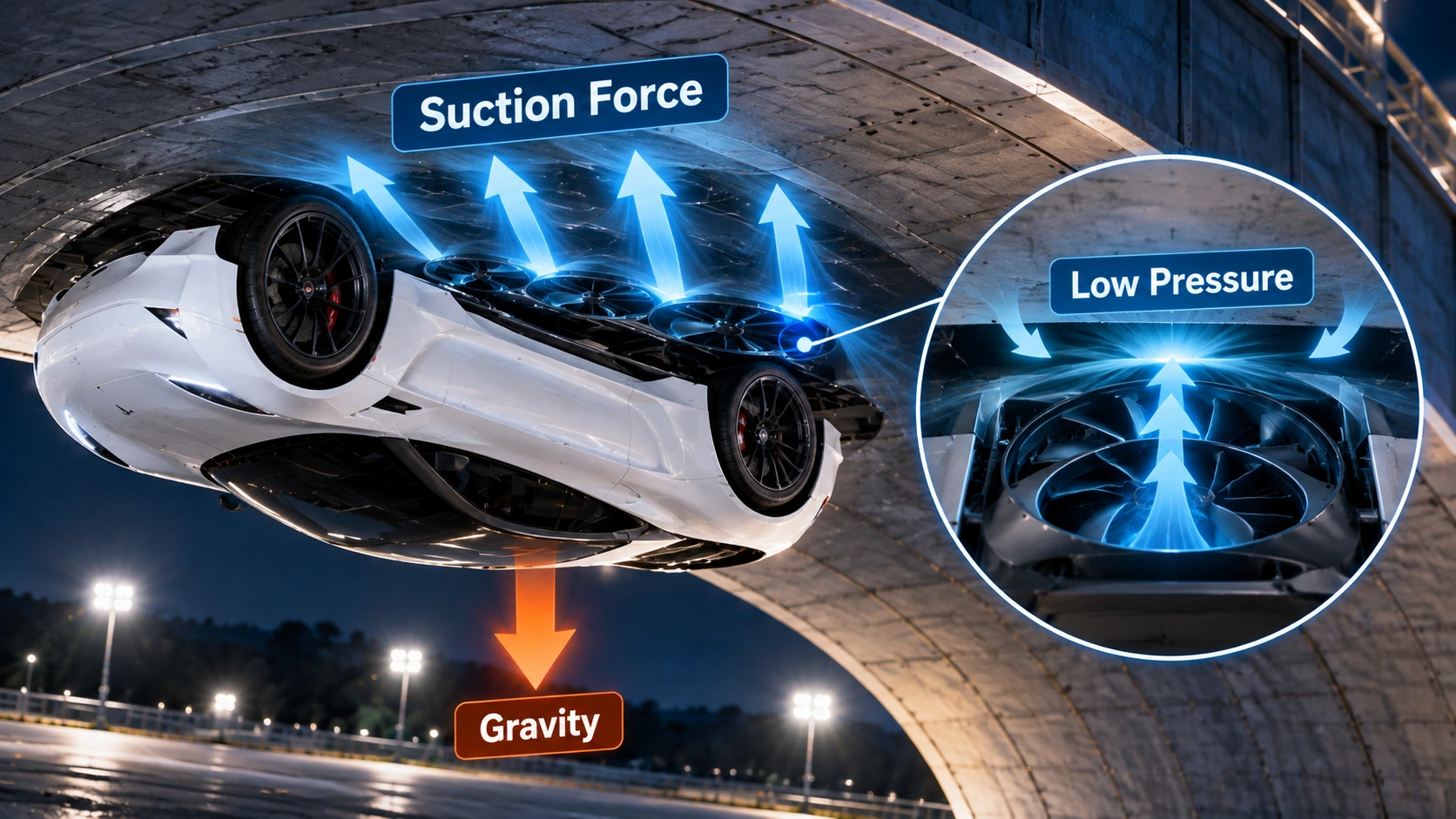
The Roadster stayed attached to the inverted ramp using a fan-generated suction system, not magnets or some mysterious anti-gravity device.
The idea is surprisingly straightforward.
Most cars depend on their tires, suspension, and aerodynamic design to maintain contact with the road. Racing cars can also use wings and airflow to generate downforce, which presses the tires against the driving surface.
Tesla’s Roadster takes that concept further.
Powerful fans draw air from beneath the vehicle, creating a lower-pressure region between the car and the surface underneath it. The resulting pressure difference pushes the vehicle toward that surface.
Tesla vehicle engineering executive Lars Moravy said the system could generate suction equivalent to approximately twice the vehicle’s weight, commonly described as 2 g of downforce. (Car and Driver)
When a car is upside down, gravity pulls it away from the roadway. If another system produces enough force toward the roadway, the vehicle can remain attached despite gravity.
The crucial difference from ordinary aerodynamic wings is that powered fans can potentially produce significant downforce even when the car is moving slowly.
This is not entirely a new idea. Fan-assisted downforce has appeared in specialized race-car engineering. Tesla’s demonstration applies the principle to a dramatically different vehicle design.
There is an important limitation, though.
Driving upside down on a specially engineered ramp does not mean the Roadster can climb any ordinary wall. The system’s effectiveness depends on factors such as surface geometry, pressure control, available grip, and the ability to manage airflow beneath the vehicle.
The inverted ramp showed what was possible under controlled conditions. It did not demonstrate that the car could travel along the ceiling of a regular parking garage.
But staying attached to the ramp explains only the first part of the stunt. Once the Roadster left the surface, another technology took over.
What Are SpaceX Cold-Gas Thrusters, and How Do They Make a Car Move in Midair?
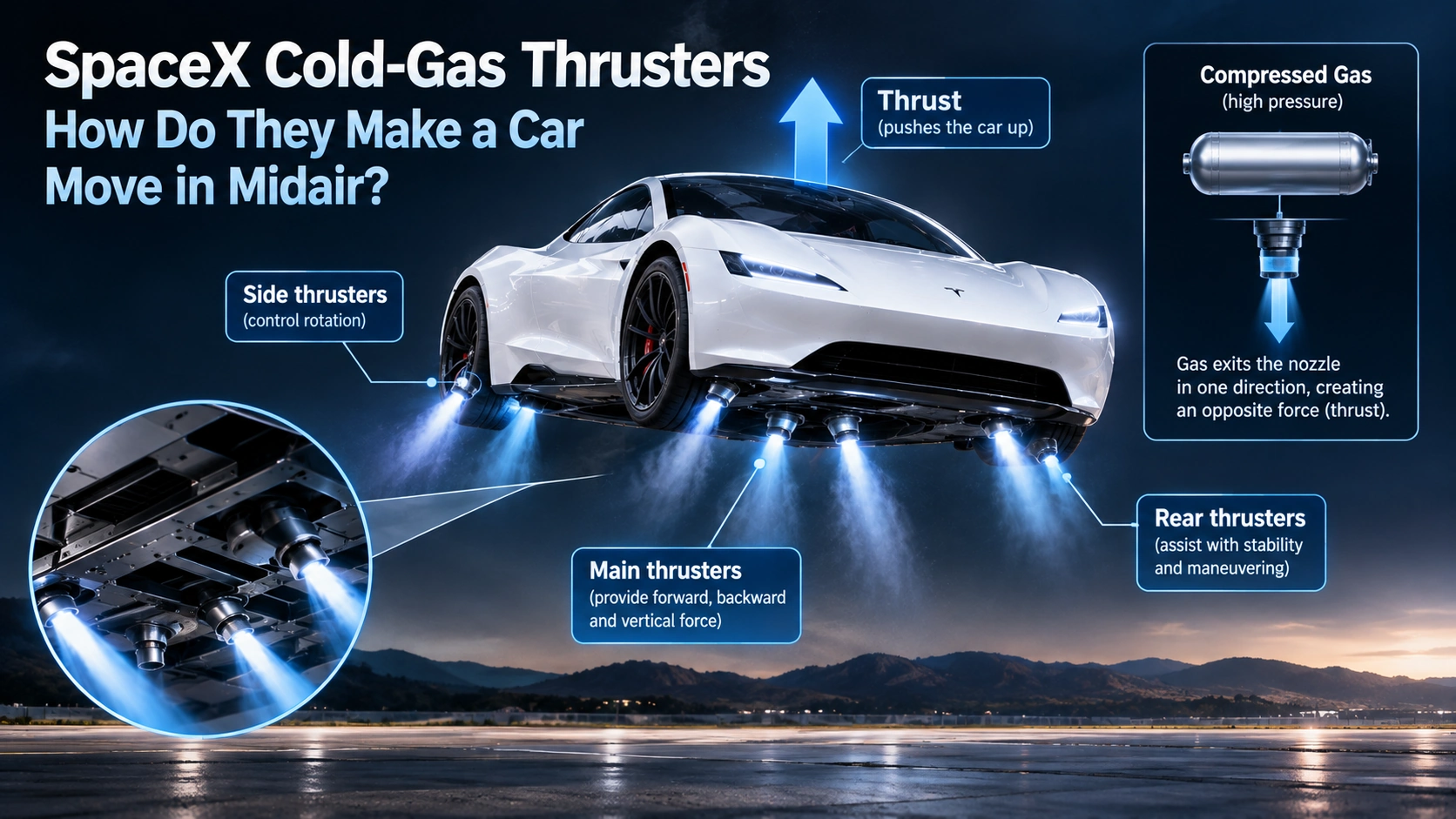
The Roadster’s cold-gas thrusters work by releasing highly pressurized gas through specially positioned nozzles.
Unlike conventional car propulsion, which transfers power through the tires, a thruster creates force directly by expelling gas.
The principle follows Newton’s third law: when an object pushes something in one direction, it experiences an opposing force.
Imagine standing on a skateboard while holding a powerful device that ejects air backward. The escaping air produces a reaction force that pushes you forward.
A cold-gas thruster uses the same basic principle, although the engineering needed to control a vehicle weighing thousands of pounds is far more complicated.
Tesla and SpaceX developed the Roadster’s propulsion technology together. The system uses high-pressure gas storage and multiple thrusters to influence the vehicle’s movement while airborne. (TechCrunch · Financial Times)
Why are multiple thrusters needed?
A car flying through the air has a different control problem from one driving along pavement.
On the road, the driver steers through the tires. In the air, the tires cannot provide the same control forces.
Different thruster positions can generate forces and turning effects that help control the vehicle’s orientation.
For example, gas expelled downward can create upward force. Jets positioned away from the vehicle’s center of mass can also generate a turning effect, allowing the vehicle to rotate.
Tesla’s most extreme proposed Roadster configuration, called Rocket, is described as having multiple cold-gas thrusters distributed around the vehicle. The exact production hardware has not been independently verified.
This is closer to the principle used by spacecraft attitude-control systems than to an ordinary automotive drivetrain.
However, the word rocket can create a misleading impression.
Cold-gas thrusters do not need to burn conventional rocket propellant to produce thrust. They rely on stored gas pressure, making them different from the flame-producing engines most people associate with space launches.
That distinction helps explain how Tesla achieved a controlled aerial maneuver without turning the car into a conventional airplane.
Does This Mean Tesla Has Created a Real Flying Car?
Tesla demonstrated a vehicle capable of briefly leaving the ground and controlling its movement through the air. It has not demonstrated an everyday flying car capable of sustained transportation between destinations.
That difference may sound obvious, but it is central to understanding the announcement.
The Roadster’s demonstration involved specialized propulsion and short aerial maneuvers. It was not a conventional aircraft flight with an established route, passenger service, or independently verified endurance.
| What Tesla demonstrated | What remains unproven |
|---|---|
| Driving on an inverted ramp | Driving upside down on arbitrary real-world surfaces |
| Briefly becoming airborne | Sustained flight over meaningful travel distances |
| Controlled midair rotation and landing | Routine passenger-safe aerial operation |
| Thruster-assisted vehicle jumps | Practical airborne transportation on public streets |
| A working prototype demonstration | Certified, delivered production vehicles with the same capabilities |
This is not to dismiss the engineering. A vehicle using its own propulsion system to rotate, stabilize, and control its descent is a meaningful technical achievement.
But it is a different achievement from building a vehicle people can routinely use to fly to work.
Think of a motorcycle that can perform an extraordinary jump at a professional stunt event. The demonstration may reveal remarkable engineering and control, but it does not make the motorcycle an aircraft.
Tesla’s Roadster is more technically unusual because it uses onboard thrust to control its aerial behavior.
Still, the important distinction is between performing a controlled flight maneuver and providing practical flying transportation.
And Tesla’s own vehicle lineup makes that distinction even clearer.
What Is the Difference Between the Performance, Thrust, and Rocket Roadsters?
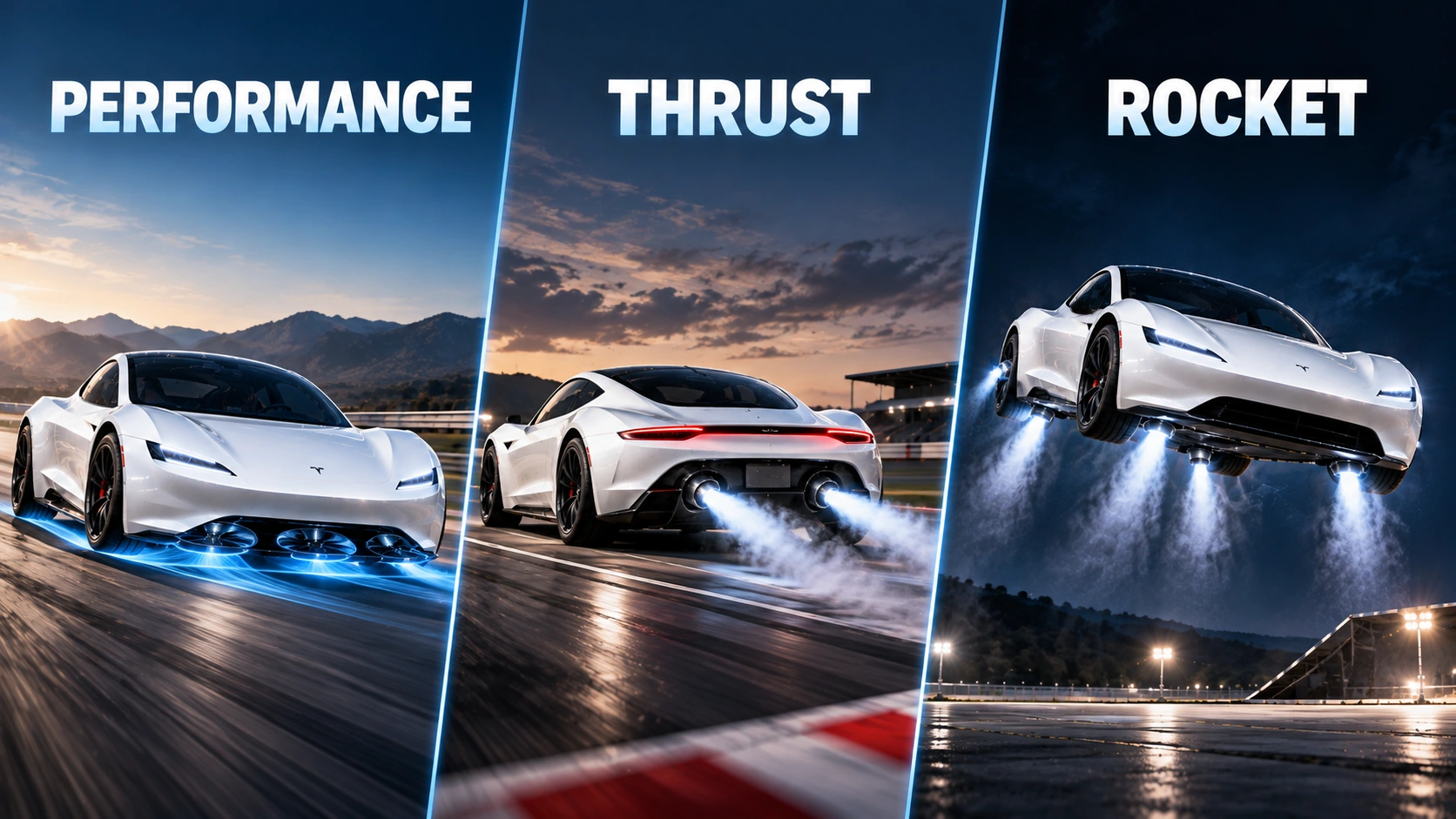
Not every Roadster Tesla plans to offer has the same capabilities. The company outlined three configurations, each with a different emphasis.
| Version | Main distinguishing feature | Seats | Reservation information |
|---|---|---|---|
| Performance | Active aerodynamics and fan-based suction; road-focused | 2 | $50,000 total U.S. reservation deposit |
| Thrust | Rear cold-gas thrusters for extreme acceleration; track-focused | 2 | $250,000 reported total U.S. reservation deposit |
| Rocket | Full perimeter-thruster system for aerial maneuvers | 1 | Invitation only; not approved for public-road use |
These configurations, reservation terms, and the Rocket version’s public-road restriction were reported following the October 15 unveiling. (TechCrunch · Reuters)
The Performance version is the closest to a conventional high-performance electric sports car, although its aerodynamic and suction systems remain unusual.
The Thrust version adds gas propulsion intended to deliver acceleration beyond what the tires alone can achieve.
The Rocket version is the extreme interpretation of the idea, with additional thrusters positioned to control aerial movement. Its single-seat layout also underscores how different it is from a practical family car.
Does the $250,000 figure mean the Roadster costs $250,000?
No. The amounts reported for Performance and Thrust are reservation deposits, not confirmed final purchase prices. Tesla did not announce definitive retail prices during the unveiling.
The company had previously discussed a roughly $200,000 base price when the Roadster concept appeared in 2017, but that old figure should not be treated as the price of the redesigned 2026 vehicle. (Reuters)
For anyone considering a reservation, the important questions are not only how much money must be deposited, but also the current cancellation terms, the final purchase agreement, and whether the intended version will actually be available in their jurisdiction.
Another frequently misunderstood point concerns the Roadster’s extraordinary performance claims.
Can the Roadster Really Accelerate From 0 to 60 MPH in 0.81 Seconds?
Tesla presented a 0–60 mph time of 0.81 seconds during the unveiling, but that figure comes from the company’s demonstration rather than an independent production-vehicle road test.
That is an extraordinary number. A car accelerating from rest to 60 mph in less than a second would generate acceleration forces far beyond those experienced in ordinary passenger vehicles.
The reason Tesla is exploring thrusters becomes easier to understand here.
Even a powerful electric motor cannot create unlimited acceleration through its tires. Tire grip sets an important physical limit on how much driving force can be transmitted to the pavement.
Thrusters offer a different route. By pushing against expelled gas rather than relying exclusively on tire contact, the vehicle can generate additional forward force.
Tesla also discussed a top speed exceeding 230 mph and a projected driving range of more than 300 miles for the redesigned Roadster. These remain manufacturer-reported targets, not independently established production specifications. The highest performance figures apply to specific configurations rather than every Roadster. (The Verge · TechCrunch)
There are several important distinctions between a spectacular demonstration and a verified performance record:
- A company-controlled acceleration demonstration is not the same as a standardized independent test.
- A prototype’s performance does not establish that a retail production model will achieve the same result.
- A stated range is not necessarily an independently certified or EPA-rated driving range.
- The ability to use thrusters once does not establish how frequently they can operate before the compressed-gas supply must be replenished.
That final question is especially interesting.
Electric vehicles already face trade-offs among weight, battery capacity, performance, and range. A vehicle using a powerful gas-propulsion system adds pressure-storage equipment, additional control hardware, and other engineering considerations.
Tesla has demonstrated that its technology can produce exceptional short-duration behavior. How those capabilities affect day-to-day usability remains a separate matter.
And anyone familiar with the Roadster’s history will recognize another reason for caution.
Why Has Tesla’s New Roadster Taken Almost Nine Years?
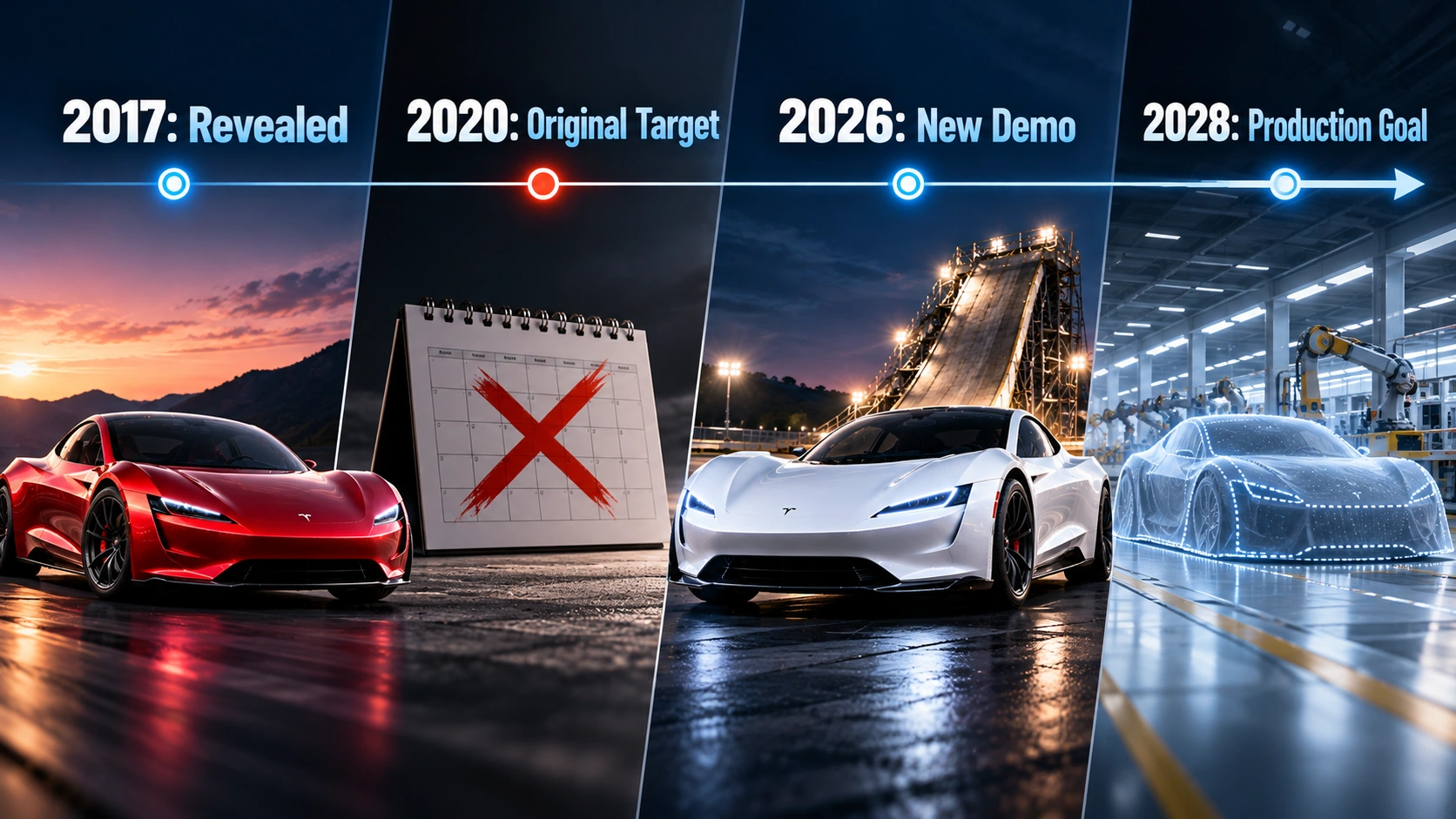
Tesla first revealed the second-generation Roadster in November 2017, with an original production target of 2020.
That deadline passed without the redesigned car reaching customers.
Several subsequent schedules also slipped. The October 2026 unveiling finally provided a new physical demonstration, but Tesla’s latest production target is now 2028. (Reuters · Car and Driver)
| Year | What happened | Why it matters |
|---|---|---|
| 2017 | Tesla unveiled the second-generation Roadster concept | Customers were introduced to an ambitious future sports car |
| 2020 | Original targeted production year | The expected launch did not materialize |
| 2026 | Redesigned Roadster demonstrated in Texas | Tesla showed prototype capabilities, including aerial maneuvers |
| 2028 | Current stated production goal | Manufacturing and customer deliveries remain ahead |
The extended timeline reflects a broader change in Tesla’s business priorities.
In 2017, the idea of an extremely fast electric sports car was an important statement. It challenged the assumption that high-performance automobiles needed gasoline engines.
By 2026, that competitive landscape had changed dramatically. Electric vehicles from multiple manufacturers had already established that battery-powered cars can achieve remarkable acceleration.
Tesla, meanwhile, had devoted growing attention to self-driving technology, robotaxis, artificial intelligence, and humanoid robotics.
The redesigned Roadster therefore needed more than impressive acceleration to stand out. Its airborne maneuvers created a spectacle that an ordinary performance upgrade could not easily match.
What happened to the earlier Roadster specifications?
The changes go beyond timing.
Tesla’s earlier Roadster promotional materials described a four-seat concept with a projected 620-mile driving range. The redesigned versions presented in 2026 emphasize one- and two-seat layouts, with contemporary launch reporting describing a range of more than 300 miles.
These figures come from different stages of the vehicle’s development, and neither should be mistaken for a final independently verified specification for a delivered car. (TechCrunch · Car and Driver)
This evolution illustrates how the Roadster has shifted from a fast electric grand tourer toward a more specialized engineering showcase.
That makes the production schedule important—but it also makes the question of road legality unavoidable.
Would Tesla’s Flying Roadster Be Legal on American Roads?
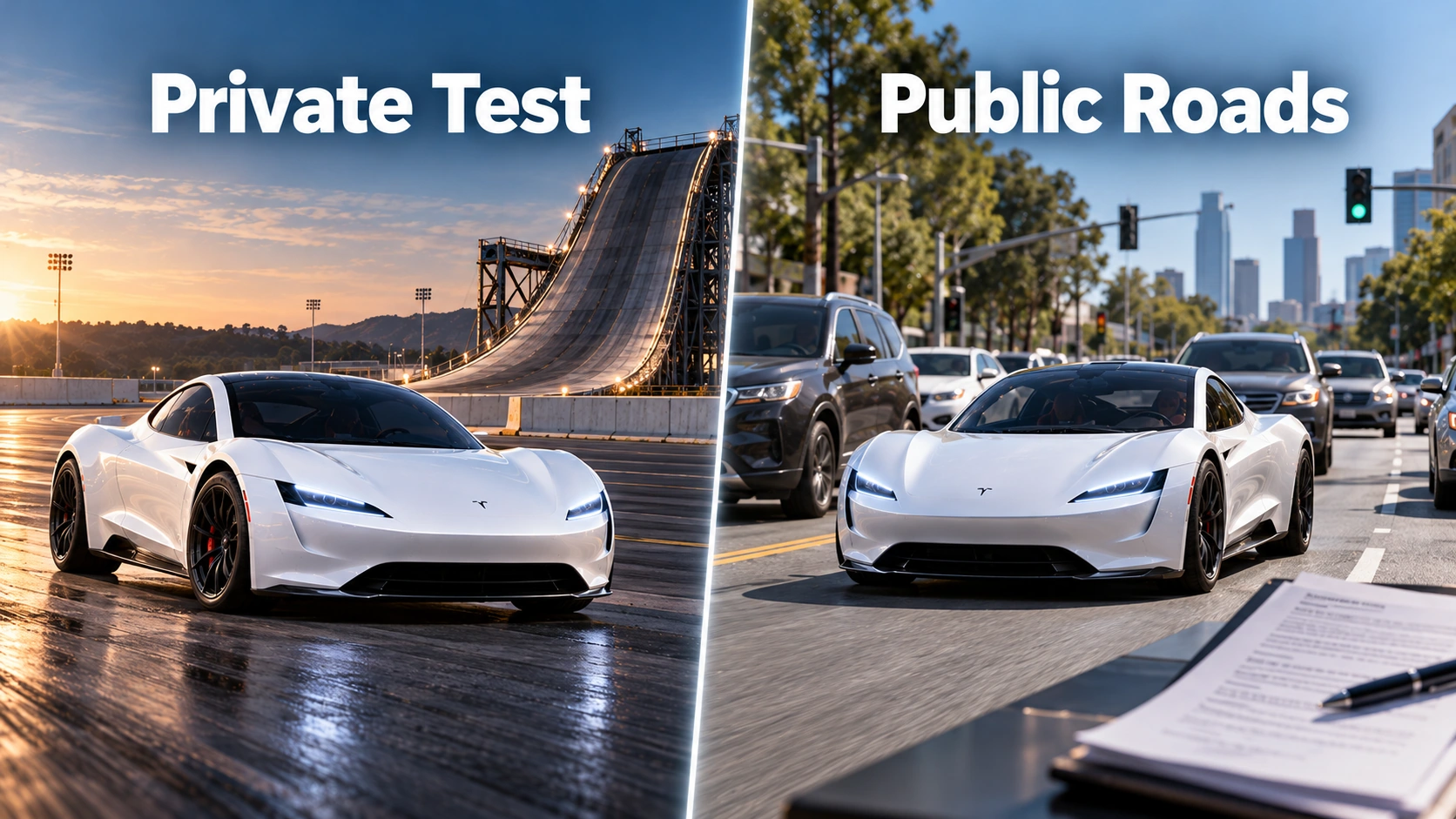
The single-seat Rocket version is not approved for public-road use. Tesla describes its basic Performance configuration as road-ready, but that distinction does not establish that every specialized maneuver would be lawful on ordinary streets. (TechCrunch)
There are two different questions here.
The first is whether a vehicle can be manufactured and sold for normal road use. The second is whether a driver can legally activate equipment that makes the vehicle jump or leave the pavement while operating in traffic.
Those are not the same.
In the United States, automakers must certify that new vehicles comply with applicable Federal Motor Vehicle Safety Standards.
An important detail is that the National Highway Traffic Safety Administration, or NHTSA, generally does not grant individual vehicle models a pre-sale approval certificate. Instead, manufacturers self-certify compliance, subject to federal enforcement and oversight. (NHTSA)
States also enforce rules governing how vehicles may be operated on public roads.
A production Roadster might therefore be road-compliant in one configuration without that automatically making every available aerial maneuver lawful or safe in public traffic.
Questions about passenger protection, crash behavior, propulsion equipment, and control-system reliability would also have to be addressed in the relevant safety framework.
A private demonstration establishes what a prototype can do. It does not grant permission to perform the same maneuver among ordinary drivers.
That is particularly important for the Rocket configuration, which is being positioned as a highly specialized, single-seat vehicle rather than a street-approved flying car.
Why Is Tesla Spending So Much Attention on a Car That Few People Will Buy?
A low-volume supercar does not have to generate large sales to be valuable to its manufacturer.
In the auto industry, there is a concept known as a halo car.
A halo car is designed partly to strengthen the reputation of an entire brand. Its technology, performance, or appearance draws attention that can extend far beyond the number of units sold.
The Roadster fits that description.
Tesla is increasingly associated not only with electric vehicles but also with autonomous driving, software, robotics, and artificial intelligence. Yet there is a particular kind of public excitement that a technical demonstration can create.
Watching a sports car perform an aerial maneuver offers an immediate, visually understandable example of unusual engineering.
Musk acknowledged that the Roadster itself would have limited financial importance compared with Tesla’s broader business. The demonstration nevertheless offered the company a way to emphasize its technological ambitions. (Reuters · The Verge)
There is another dimension.
The new Roadster prominently combines work from Tesla and SpaceX, two companies led by Musk. That has fueled speculation about how closely his businesses might work together in the future.
But the Roadster collaboration is not itself evidence that Tesla and SpaceX have agreed to merge. The confirmed story is the engineering cooperation; any larger corporate transaction requires separate evidence and announcements.
What does the demonstration mean for ordinary Tesla buyers?
For most drivers, the direct effect is limited.
Someone shopping for a family vehicle is unlikely to need cold-gas thrusters, an inverted-roadway suction system, or the ability to perform aerial rolls.
The broader question is whether some of the Roadster’s engineering might eventually influence other vehicle designs.
Aerodynamic control, active downforce, lightweight materials, and advanced vehicle-control systems can have applications beyond specialized supercars. But Tesla has not demonstrated that the entire Roadster propulsion package will become part of mainstream electric vehicles.
Any such transfer would require further engineering, cost analysis, and safety validation.
The Roadster may therefore be more important as a statement about Tesla’s engineering capabilities than as a product that substantially changes how Americans drive.
When Will the New Roadster Actually Be Available?
Tesla is targeting 2028 for the start of production, but that is a company goal rather than a guaranteed customer delivery date. (Reuters)
The distinction matters because the Roadster has already missed several earlier schedules.
Even if production begins in 2028, the date when customers receive individual configurations could depend on manufacturing readiness, testing, regulatory compliance, and Tesla’s final rollout plans.
There are four things worth watching after the October 2026 demonstration:
- Whether Tesla provides independently verifiable performance information for a production-intent vehicle.
- Whether the company announces definitive pricing and final specifications for each version.
- Whether Tesla explains the legal and operational limitations of the Thrust and Rocket systems.
- Whether the company reaches measurable manufacturing milestones toward its 2028 production target.
Those developments will tell buyers far more than another spectacular stunt.
Because after nearly nine years of waiting, the question is no longer whether Tesla can make a prototype perform something extraordinary.
It is whether the company can turn that prototype into a vehicle customers can actually own and use.
Bottom Line: What This Story Really Means
Tesla’s October 15, 2026, Roadster demonstration was a real and unusually ambitious display of automotive engineering.
The vehicle drove upside down using fan-generated suction, then used compressed-gas thrusters developed with SpaceX to control its movement in the air.
That makes the demonstration impressive—but it does not mean Tesla has delivered a practical flying car.
The Roadster has not established the ability to provide routine airborne transportation. Tesla says the Rocket configuration is not approved for public-road use, while the road-focused Performance model is a different configuration.
The acceleration figures are manufacturer claims, final selling prices are not established, and production remains targeted for 2028.
Tesla has demonstrated that a car can perform extraordinary controlled aerial maneuvers. What it has not yet demonstrated is that those capabilities can become a practical, street-legal consumer product.
The Roadster’s most important achievement may ultimately be the technology it proves possible, rather than the number of cars Tesla manages to sell.
Tesla Roadster Flying Car: Key Questions Explained
Q. Was the Tesla Roadster flying video real or AI-generated?
The footage came from Tesla’s live Roadster demonstration on October 15, 2026, in Texas. The company showed a prototype driving upside down and performing controlled aerial maneuvers.
Q. Can the new Tesla Roadster actually fly?
It can perform brief airborne maneuvers using compressed-gas thrusters. Tesla has not demonstrated sustained flight comparable to that of a conventional aircraft.
Q. How did the Roadster drive upside down without falling?
A powered fan-based suction system created forces pressing the car toward the specially constructed ramp. Tesla said the system could produce approximately 2 g of downforce.
Q. What is a cold-gas thruster?
A cold-gas thruster releases pressurized gas through a nozzle to produce force in the opposite direction. It can provide propulsion or rotational control without burning conventional rocket fuel.
Q. Did Tesla really achieve 0 to 60 mph in 0.81 seconds?
Tesla presented a 0.81-second acceleration result during its demonstration. That time has not been established through an independent standardized test of a production Roadster.
Q. How much does the new Tesla Roadster cost?
Tesla did not announce definitive retail prices at the October 2026 unveiling. The reported U.S. reservation deposits total $50,000 for Performance and $250,000 for Thrust; Rocket is invitation-only.
Q. Is Tesla’s flying Roadster street legal?
Tesla says the Rocket configuration is not approved for public-road use. The company’s road-focused Performance version is distinct from the flying Rocket configuration, and a prototype stunt does not establish permission to repeat it in public traffic.
Q. When will the Tesla Roadster be released?
Tesla currently aims to start production in 2028. A confirmed customer delivery schedule has not been established.
Q. Will every new Roadster have the ability to fly?
No. Tesla has outlined distinct Performance, Thrust, and Rocket configurations. The full aerial propulsion system is associated with the specialized Rocket variant.
Q. Does the Roadster announcement mean Tesla and SpaceX are merging?
No merger was announced as part of the Roadster unveiling. The collaboration confirms joint engineering work on the vehicle, not a completed or agreed corporate merger.
Did this help make the story clearer? 🙂 WIN keeps unpacking the “why” behind the news—clearly and simply!
Sources
Official Demonstration and U.S. News Coverage
Tesla — The Ramp | Roadster (official 46-second demonstration)
ABC News — Elon Musk Unveils Tesla’s New Roadster, and It Can Fly
Associated Press — Tesla’s New Roadster Can Thrust Itself in the Air
Unveiling, Technical Design, and Performance Claims
Reuters — Tesla’s New Roadster Turns in Air With SpaceX Thrusters
TechCrunch — Tesla Reveals SpaceX-Powered Roadster That Flies and Falls With Style
Car and Driver — Revealed! New Tesla Roadster Takes Flight With SpaceX Thrusters
The Verge — The Tesla Roadster Flew, Drove Upside Down, and Hit 60 MPH in Under a Second
Safety, Compliance, and Longer-Term Context
Financial Times — Tesla Unveils Flying Sports Car With SpaceX Rocket Thrusters