Can Trump Really Use a 1930 Law to Impose 50% Tariffs on Canadian Goods?

A nearly 100-year-old law is at the center of a new fight over President Donald Trump’s tariffs on Canada.
But why would a president in 2026 need a law written during the Great Depression to impose a 50% tariff?
And why is an American company that imports Canadian cheese challenging a policy the administration says is supposed to protect American businesses?
The answer is more complicated than whether tariffs are good or bad for the economy.
The president does have authority to impose certain tariffs when Congress authorizes them. The dispute is whether this particular 1930 law actually permits the tariffs Trump has imposed.
On October 20, 2026, a U.S. food importer brought that question before a federal trade court. The outcome could determine not only whether the contested Canadian tariffs survive, but also how much freedom future presidents have to use old trade laws.
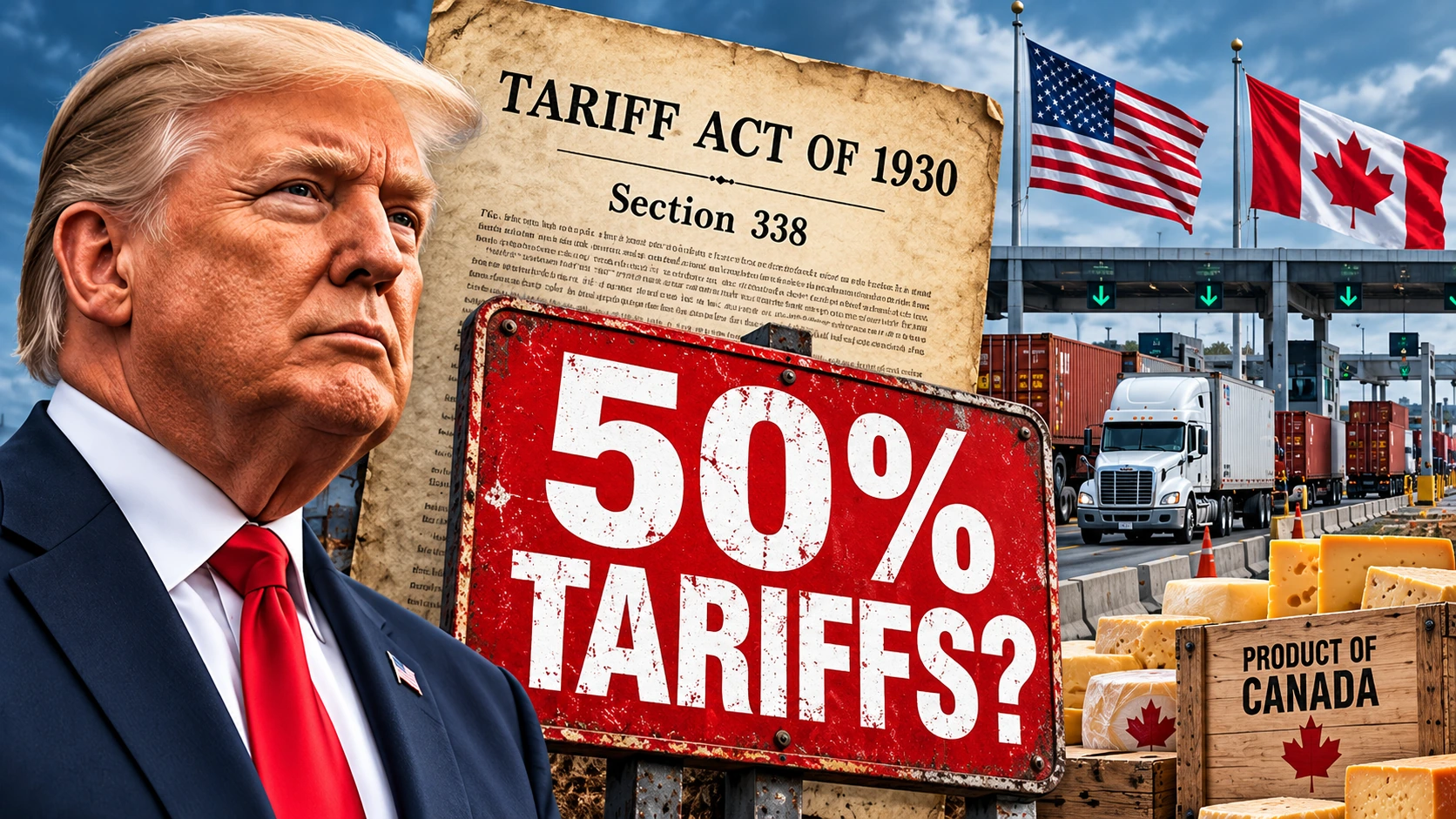
※ Images in this article are AI-generated illustrations created to help explain the story. They are not actual photographs, and depictions of people, places, or events may differ slightly from reality.
What Actually Happened on October 20?
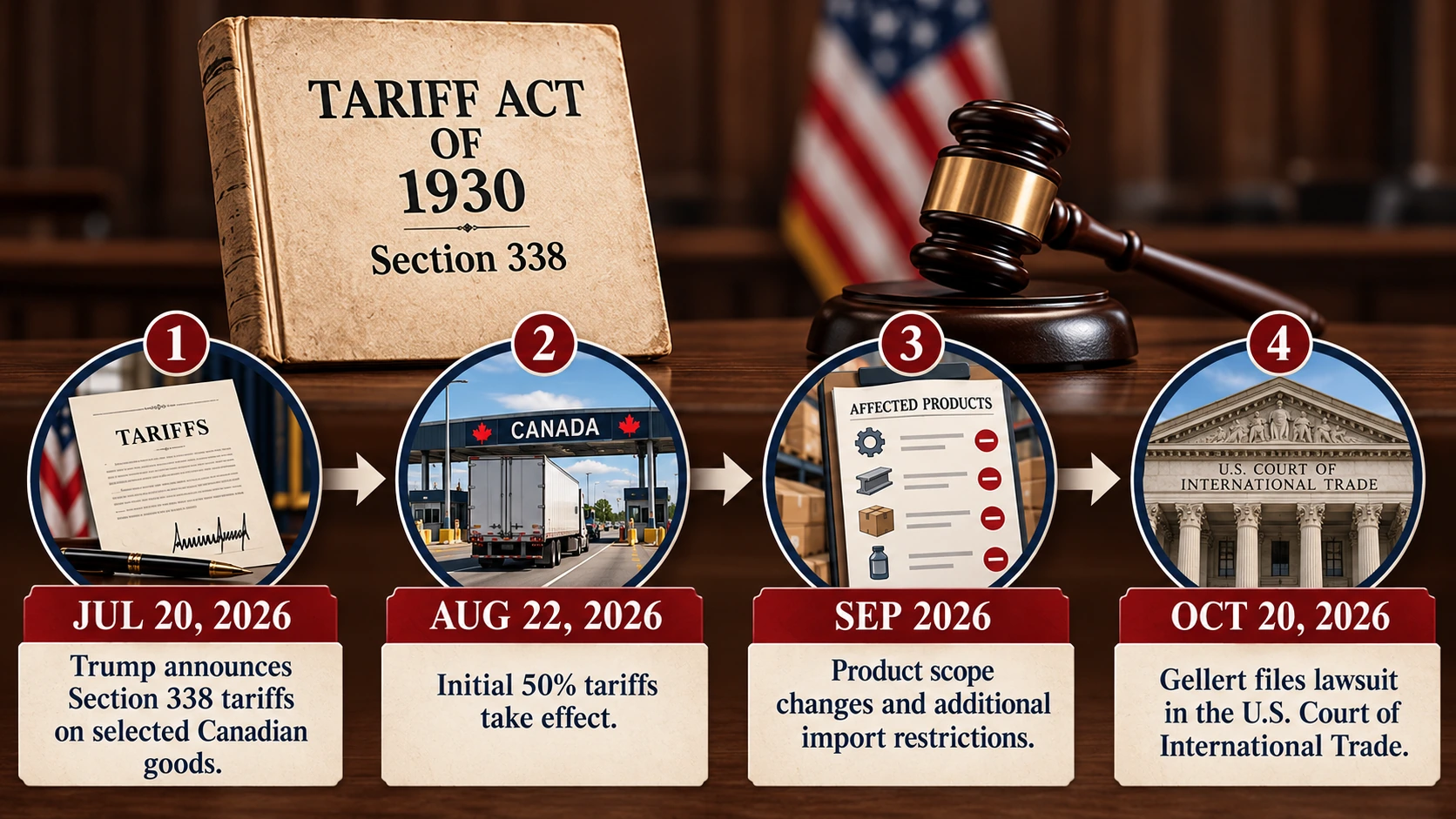
An American food importer filed a lawsuit challenging Trump’s use of Section 338 of the Tariff Act of 1930 to impose additional 50% tariffs on selected Canadian goods.
The plaintiff is Gellert Global Group, a family-run U.S. food importer and distributor based in New Jersey. The company imports Canadian cheese and says the tariffs are raising its costs and disrupting relationships with suppliers and customers.
The lawsuit was filed in the U.S. Court of International Trade, a specialized federal court in New York that handles disputes involving customs and international trade laws.
Gellert is represented by the Liberty Justice Center, a legal organization that has brought other challenges against the administration’s tariff policies. The case also seeks to represent a broader class of affected importers. (Liberty Justice Center · AP)
The tariffs themselves are not new. The administration began introducing them months earlier.
Here is how the dispute developed:
| Date | What happened |
|---|---|
| July 20, 2026 | Trump announced additional 50% tariffs on selected Canadian goods under Section 338. |
| August 18, 2026 | The administration temporarily delayed implementation by three days. |
| August 22, 2026 | The initial Section 338 tariffs took effect after the delay expired. |
| September 8, 2026 | The administration announced changes to covered products and additional import restrictions. |
| September 15, 2026 | Changes to certain tariff-covered product lists took effect. |
| September 29, 2026 | Import bans on certain Canadian products took effect. |
| October 20, 2026 | Gellert filed its lawsuit challenging the administration’s use of Section 338. |
The timeline is supported by the administration’s July tariff announcement, subsequent presidential proclamations, and the October 20 lawsuit.
According to AP, the initial tariffs covered approximately $20 billion worth of imports from Canada. (AP)
That figure describes the approximate value of goods targeted by the policy, not $20 billion in tariff revenue. Nor does the 50% rate apply to every Canadian product entering the United States.
To understand why this particular lawsuit matters, it helps to look at the unusual law behind the tariffs.
Why Does a 1930 Law Give the President a 50% Tariff Option?
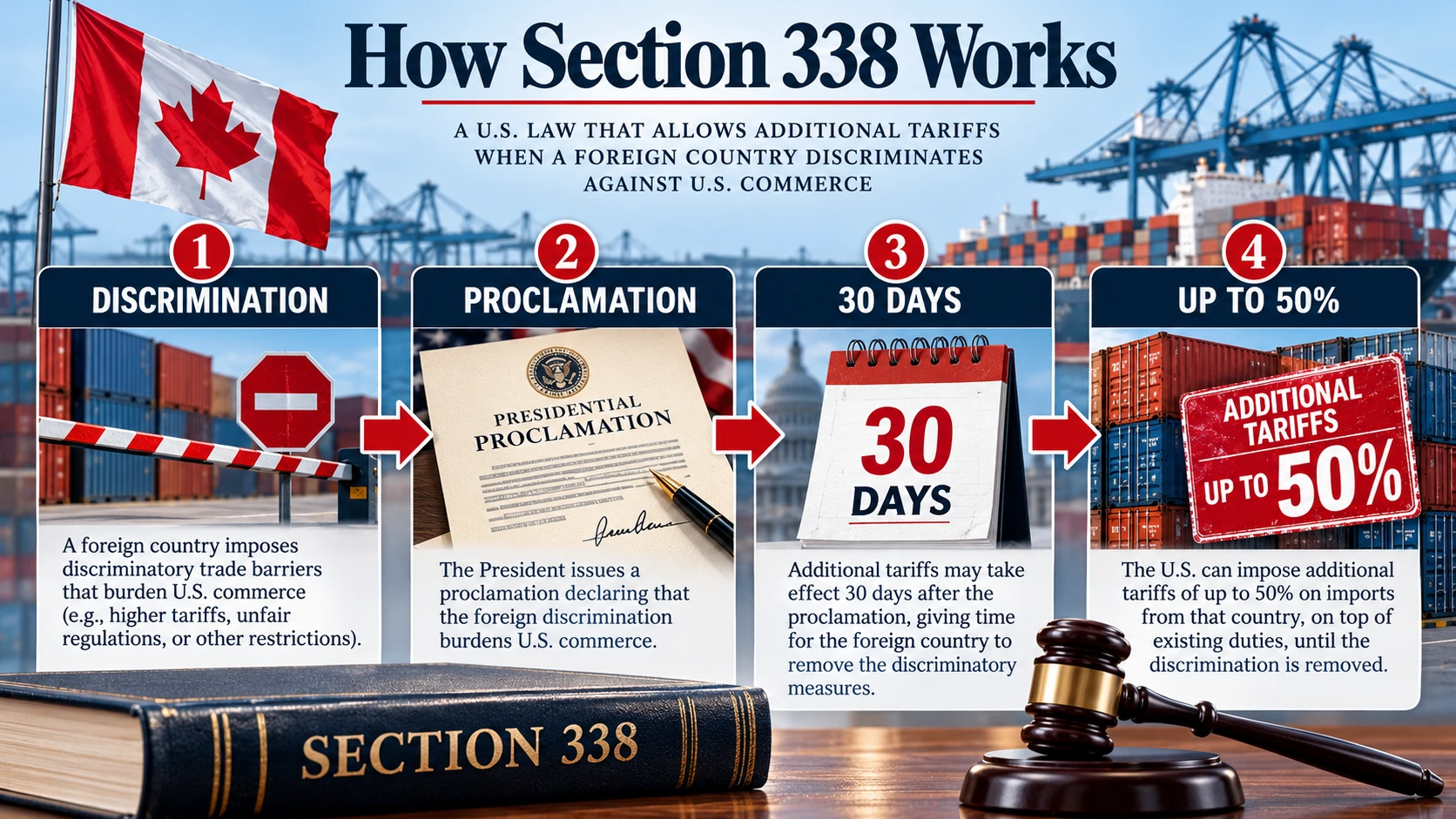
Section 338 of the Tariff Act of 1930 allows the president to impose additional tariffs of up to 50% when specified forms of foreign discrimination put U.S. commerce at a disadvantage.
That is a real authority written into federal law. The question is how far it reaches.
The provision belongs to the Smoot-Hawley Tariff Act, legislation best remembered for raising American trade barriers during the Great Depression.
Section 338 has a more specific purpose: responding to certain discriminatory treatment of American commerce by foreign countries.
Under the statutory text, 19 U.S.C. § 1338, the president can take action when the law’s conditions are met, including findings that a foreign country’s measures disadvantage U.S. commerce.
The law permits additional duties of up to 50% and provides for a 30-day period following the relevant presidential proclamation before those duties are collected. It also contains provisions addressing import exclusions and changes to proclamations.
But it does not expressly say that the president can impose any tariff, on any product, for any reason.
Why does the Constitution matter?
The U.S. Constitution gives Congress authority over taxation and foreign commerce.
That does not mean Congress must vote separately on every tariff.
Congress has passed laws delegating specific trade powers to the president or the executive branch. Those laws contain different conditions and limitations.
A president can exercise delegated authority, but the central legal question is whether a particular action stays within the boundaries Congress established.
Think of it as a company authorizing a manager to approve purchases up to a certain amount for a specific purpose.
The manager has genuine authority. But that authority does not automatically cover every purchase the manager might want to make.
Section 338 operates within a similar legal principle: a statutory grant of power is not necessarily unlimited permission to use it.
That distinction explains why the existence of a nearly century-old law does not, by itself, settle whether Trump’s Canadian tariffs are lawful.
Why Did the Trump Administration Target Canada?
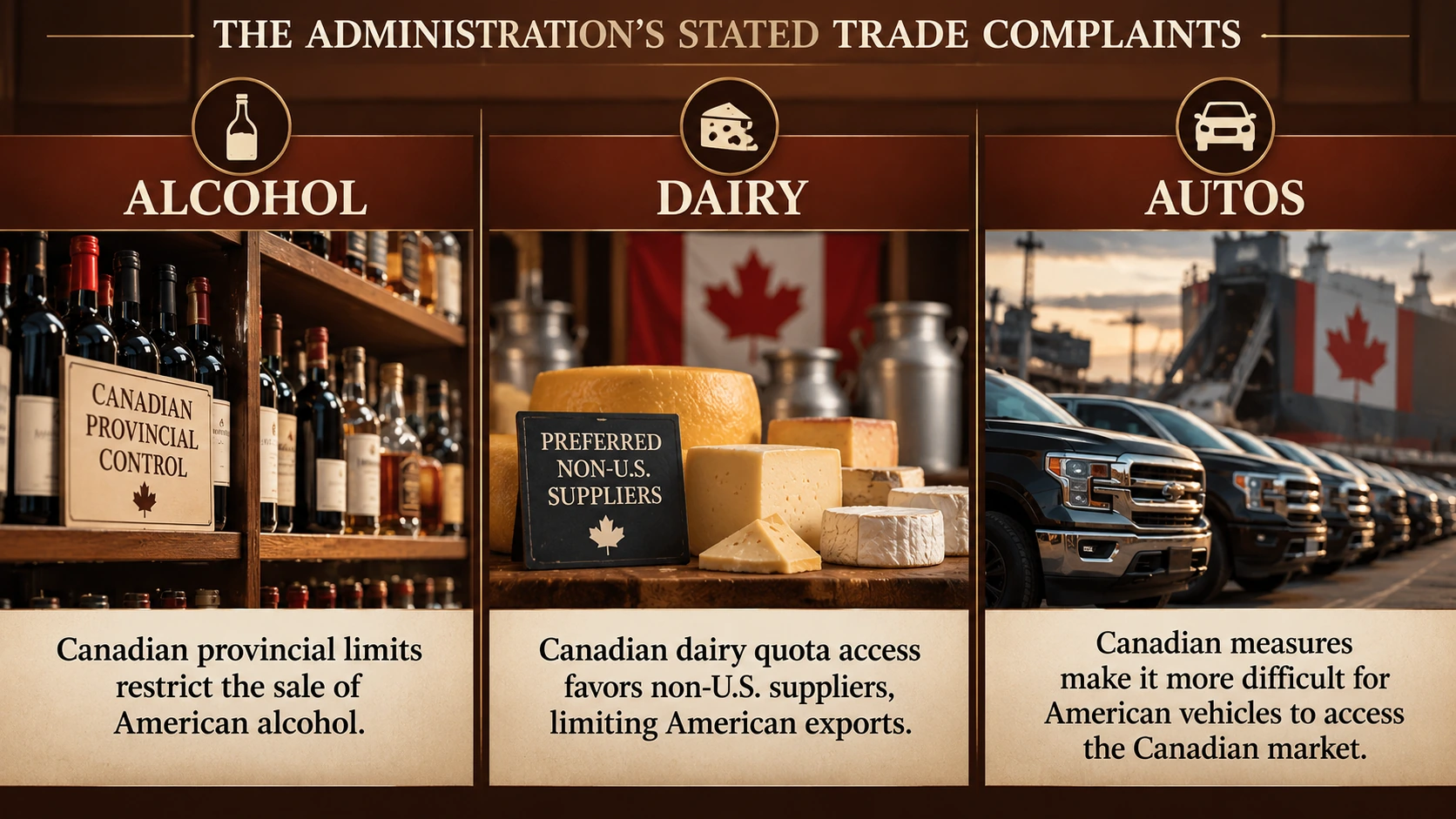
The Trump administration says it used Section 338 because Canadian policies treated certain American exports unfairly.
Its original July 20 action focused on three trade disputes: alcoholic beverages, dairy products, and motor vehicles.
U.S. Trade Representative Jamieson Greer argued that Canada was placing American businesses at a disadvantage compared with competitors from other countries.
The administration identified several practices, including provincial restrictions on American alcohol, differences in access to Canadian dairy markets, and Canadian measures affecting American vehicles. (USTR)
| Trade area | Administration’s stated concern |
|---|---|
| Alcohol | Canadian provincial policies restricted sales of American alcoholic beverages. |
| Dairy | Canadian import-quota rules allegedly gave certain European cheese suppliers more favorable access than comparable American suppliers. |
| Motor vehicles | Canadian measures allegedly treated American vehicles less favorably than vehicles from other countries. |
The White House’s position is that Section 338 provides a lawful way to respond to these disadvantages.
Its dairy proclamation, for example, specifically compared how Canada allocated import quotas to U.S. and European cheese products.
A tariff-rate quota permits a specified quantity of imports at a lower duty rate, with higher duties applying beyond that quantity.
The administration argued that differences in Canadian eligibility rules restricted opportunities for American dairy exporters. (White House)
The importer challenging the tariffs disputes whether these policies legally justify the administration’s response.
It argues that some Canadian measures were retaliation against earlier American tariffs, while the dairy disagreement involves rules already governed by the U.S.-Mexico-Canada Agreement, or USMCA.
That agreement is the trade framework governing much of the commerce among the United States, Mexico, and Canada.
The administration sees discriminatory treatment that justifies a strong tariff response. The importer argues that the government has stretched an old anti-discrimination law beyond its intended limits.
These are competing legal positions, not findings a court has yet resolved in this case.
What Is the American Food Importer Actually Arguing?
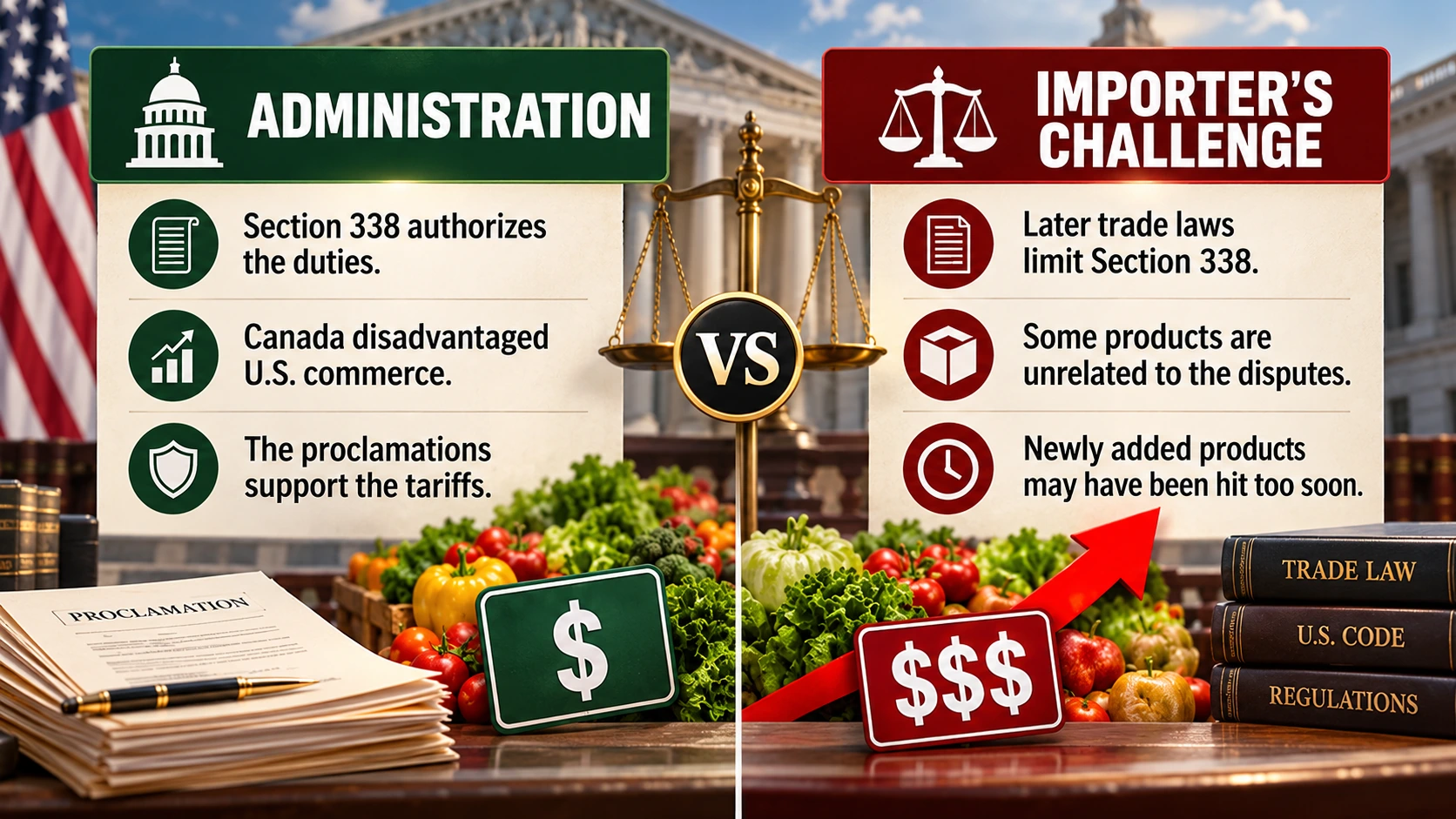
Gellert Global Group is challenging both the administration’s legal authority and how it applied the tariff law.
The lawsuit raises several distinct arguments. Three are especially important.
1. Has a newer trade law limited the old one?
The importer argues that Congress created a more comprehensive legal framework for addressing unfair foreign trade practices when it enacted the Trade Act of 1974.
In particular, Section 301 provides tools for responding to certain foreign trade practices through a process involving the Office of the U.S. Trade Representative.
That framework includes investigations and procedures for public participation.
The company’s lawyers argue that Congress did not intend a president to bypass those safeguards by relying on a broader interpretation of the older Section 338 provision.
The administration’s July proclamation, by contrast, treats Section 338 as an available source of presidential authority.
Whether the later law supersedes or limits the older provision is a legal question for the court. The plaintiff’s interpretation has not been established simply because it filed the lawsuit. (Liberty Justice Center · USTR)
2. Do the tariffs actually address the discrimination being alleged?
Gellert argues that the administration imposed tariffs on products that were not sufficiently connected to the specific Canadian policies it identified.
For example, the company says Canadian cheeses were added to tariff lists connected to disputes over alcohol and automobile policies.
That matters because Section 338 is intended to offset particular disadvantages to American commerce.
The lawsuit questions whether the administration can use a finding involving one trade dispute to impose extensive tariffs on other products.
The White House maintains that its measures are authorized by Section 338 and serve the public interest.
The legal disagreement concerns whether those findings and the resulting tariff measures satisfy the statute’s requirements. (Liberty Justice Center · White House)
3. Did the administration wait long enough before collecting the tariffs?
This is one of the lawsuit’s more concrete procedural arguments.
Section 338 contains a 30-day waiting-period requirement.
Gellert says the administration added products including Canadian cheeses to tariff lists on September 8, 2026, and began collecting the additional duties on September 15.
That was seven days later.
The company argues that the government should have observed a fresh 30-day waiting period for newly added products.
The administration’s position rests in part on Section 338’s provisions allowing presidential proclamations to be supplemented or amended.
Whether those amendment provisions permit the timing used here is part of the legal dispute. (Liberty Justice Center · White House)
The distinction between the two sides can be summarized this way:
| Question | Administration’s position | Importer’s challenge |
|---|---|---|
| Legal authority | Section 338 authorizes the duties. | Later laws limit or displace that authority. |
| Grounds for tariffs | Canada’s policies disadvantage U.S. commerce. | The cited policies do not justify the scope of the tariffs. |
| Products covered | The selected goods can be targeted under the statute. | Some tariffs reach products unrelated to the identified disputes. |
| Timing | The proclamations implement the administration’s trade measures. | Duties on newly added products began too soon. |
The lawsuit asks the court to declare the challenged measures unlawful, stop their collection, and order refunds with interest for eligible affected importers.
Those are requested remedies, not results that have already been awarded.
Why Does Cheese Matter in a Fight About Cars and Alcohol?
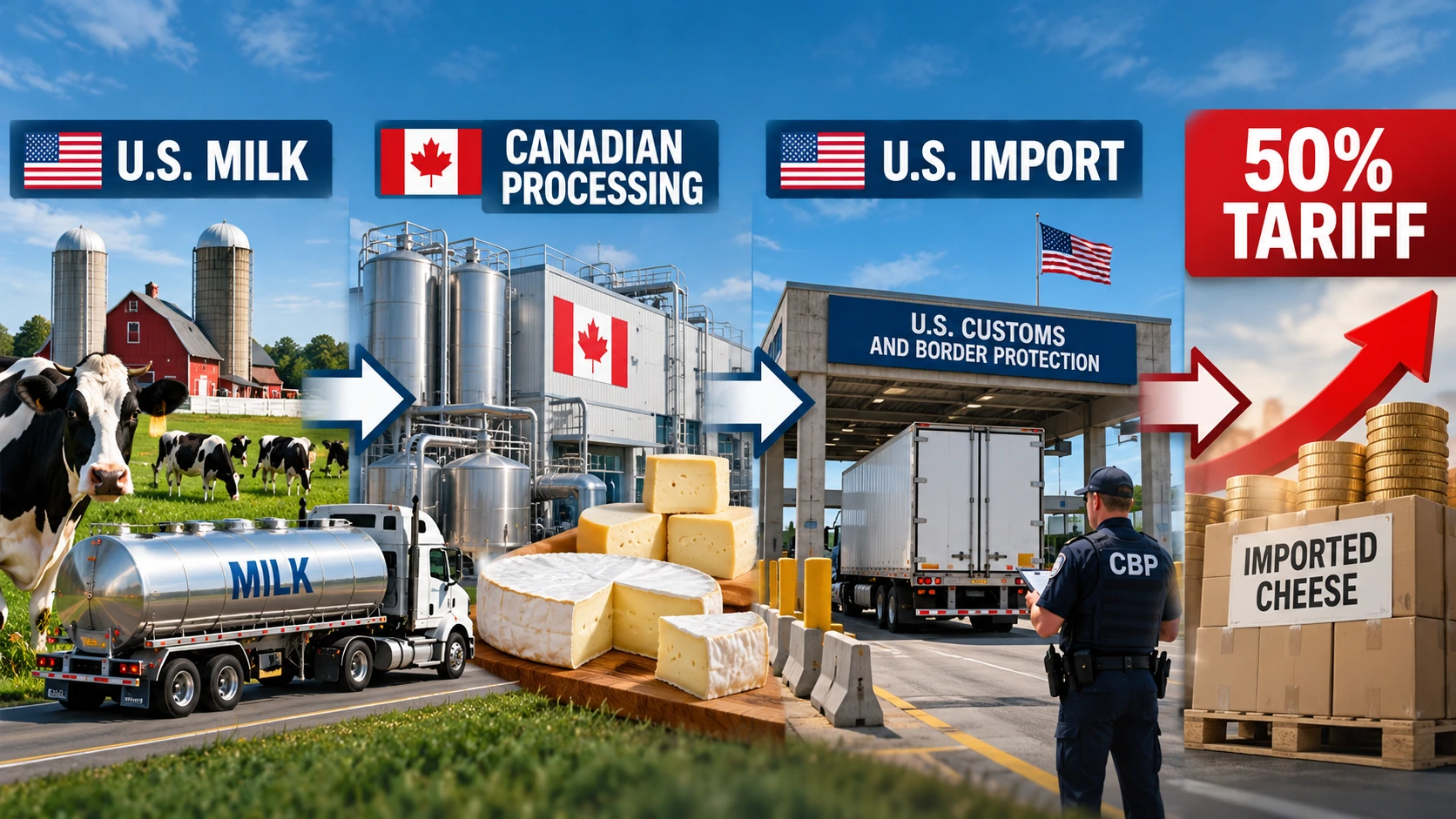
Because an international trade dispute can affect American businesses even when the goods are manufactured across the border.
Gellert provides a particularly revealing example.
According to the company’s legal representatives, one Canadian supplier buys milk from dairy farmers in upstate New York, processes it into brie cheese in Canada, and ships the finished product back to the United States.
So the chain looks like this:
American dairy farm → Canadian cheese processor → American importer → U.S. retailers and customers
A tariff on the returning cheese can increase the cost of a supply chain that begins with American agriculture.
Gellert also says Canadian retaliatory measures affect American-made cheeses sold through its Canadian operations.
That creates pressure on the business in both directions. (Liberty Justice Center)
Who actually pays a 50% tariff?
The American importer is responsible for paying the import duty to U.S. customs authorities.
The Canadian government does not directly pay that tax.
Consider a simplified example involving a shipment of cheese with a customs value of $100.
| Item | Illustrative amount |
|---|---|
| Customs value of imported cheese | $100 |
| Additional 50% tariff | $50 |
| Value plus additional tariff | $150 |
This is an illustration of how the additional tariff is calculated, not a claim about Gellert’s actual shipment costs.
Other duties, shipping costs, handling expenses, and distribution margins may also apply.
And a 50% import tariff does not automatically mean the supermarket price increases by 50%.
An importer might absorb some of the cost through lower profit margins, negotiate lower prices with suppliers, or pass part of the expense to distributors and retailers.
Consumers may ultimately face higher prices, fewer product choices, or both, depending on how businesses respond.
The unusual feature of the Gellert case is that it challenges a policy intended to protect American commerce on the grounds that the policy is itself harming American commerce.
That economic concern is separate from the question of whether the administration has legal authority to impose the tariffs.
A lawfully authorized tariff can still impose costs on businesses. And a tariff’s economic consequences alone do not establish that it is unlawful.
Didn’t the Supreme Court Already Limit Trump’s Tariff Powers?
Yes, but earlier decisions involved different statutes and do not automatically resolve the new Section 338 lawsuit.
In February 2026, the U.S. Supreme Court rejected the administration’s use of the International Emergency Economic Powers Act, or IEEPA, as authority for sweeping tariffs.
That law concerns presidential powers during certain national emergencies.
The administration subsequently relied on other trade statutes for additional tariff measures, prompting further legal challenges.
The Liberty Justice Center, which represents Gellert, was also involved in litigation over those earlier tariffs. (AP · Liberty Justice Center)
This history is important because different laws authorize different actions.
The fact that one statute did not authorize a particular tariff does not prove that another statute cannot authorize a different tariff.
Section 338 specifically mentions additional duties of up to 50%.
That gives the administration a different textual basis to defend its actions than it had under IEEPA.
The new lawsuit therefore asks a more focused question: even when Congress has expressly permitted tariffs under certain circumstances, did the administration satisfy those circumstances?
The distinction also explains why an earlier court victory against tariffs does not automatically cancel every subsequent tariff the government imposes.
Each measure must be evaluated under the legal authority actually used to establish it.
Does the Lawsuit Mean Trump’s Canadian Tariffs Are Gone?
No. Filing a lawsuit does not automatically suspend or cancel a tariff.
As of October 21, 2026, the Gellert case is a pending legal challenge. The company’s requests for relief have not become a final judgment invalidating the measures.
Gellert has sought a preliminary injunction, which would temporarily stop collection of the challenged duties if granted.
It has also requested summary judgment, asking the court to resolve the legal dispute without a full trial if the applicable standards are met. (Liberty Justice Center)
Those two requests serve different purposes.
| Court action | What it would mean |
|---|---|
| Filing a lawsuit | Starts the legal challenge; does not itself cancel tariffs. |
| Preliminary injunction | Could temporarily block collection while the case proceeds. |
| Summary judgment | Could resolve the merits without a full trial if granted. |
| Final judgment and further review | Determines the parties’ legal rights, subject to applicable appeals. |
A court could agree with some of Gellert’s arguments and reject others.
It could also decide that certain measures are unlawful without necessarily invalidating every tariff imposed on Canadian products under other authorities.
That makes the details of any court order important.
A broad headline saying that a tariff was blocked may not tell importers which product categories, payment periods, or legal claims were actually affected.
What Happens Next—and Could Importers Get Their Money Back?
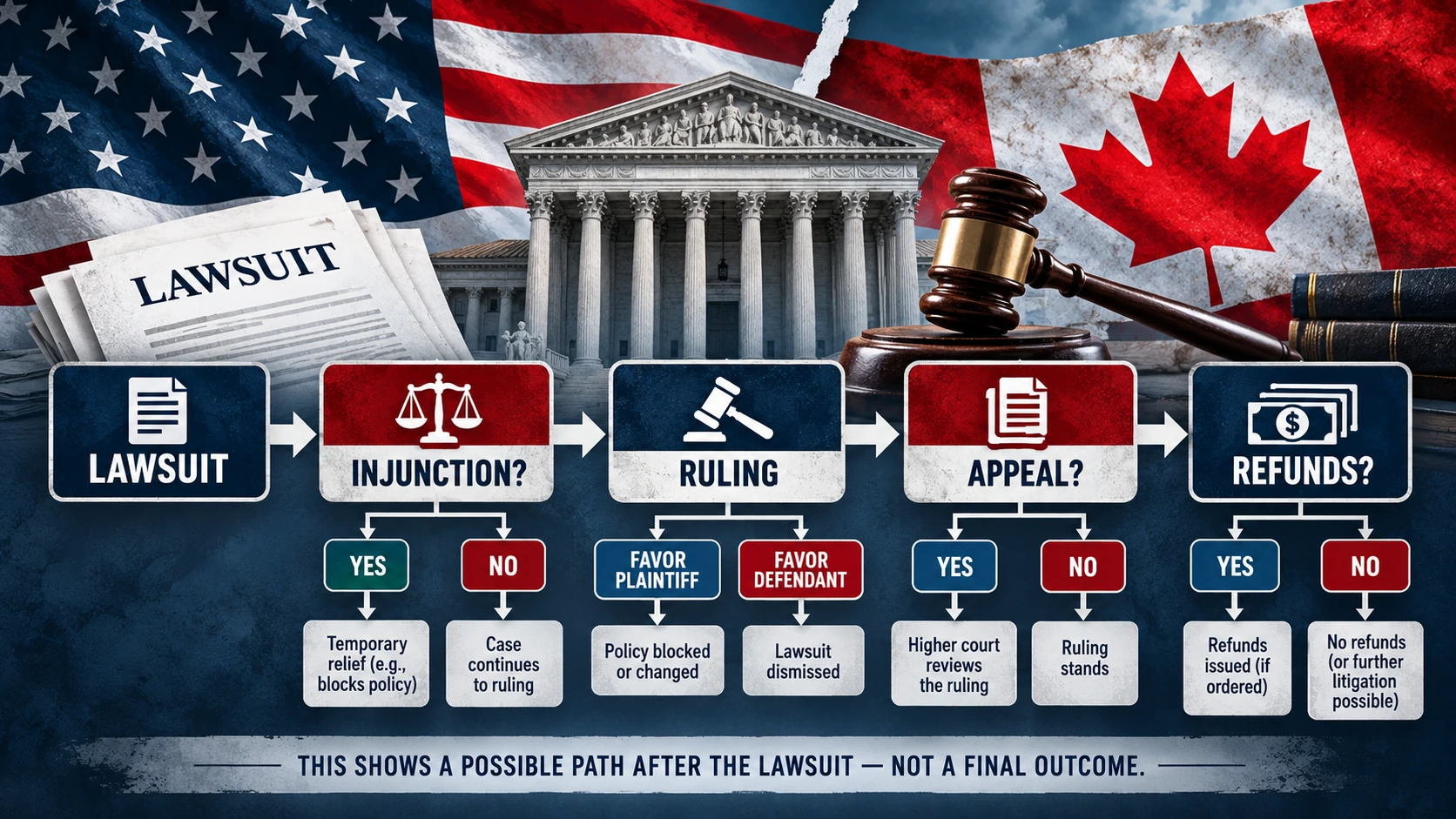
The immediate questions are whether the court will temporarily block the contested tariffs and how it will interpret Section 338.
A preliminary injunction could provide relief while the case continues. But the court would have to decide whether the legal requirements for that remedy are satisfied.
The broader case will require a determination of whether the administration’s actions fall within the authority granted by Congress.
A ruling may also have to address whether the challenged product-list changes complied with the law’s procedural requirements.
Could companies receive refunds?
Potentially, but refunds are not guaranteed.
Gellert is asking for refunds, with interest, of duties collected under measures it considers unlawful.
Whether refunds are available, who qualifies, and which payments are covered would depend on the legal outcome and applicable customs procedures.
Importers affected by the tariffs would need to pay close attention to the scope of any order, particularly if the court rules only on certain products or periods.
Could this affect tariffs on other countries?
The immediate case concerns the administration’s use of Section 338 against Canada.
But the court’s reasoning could be relevant beyond this dispute.
If a court adopts a narrow interpretation of Section 338, future administrations could face tighter limits when trying to use the same statute.
If a court accepts a broader interpretation, the provision could remain an available tool in future trade conflicts that meet its legal requirements.
Neither result would, by itself, determine the legality of every other tariff program.
For American businesses, the next developments to watch are the court’s response to the preliminary injunction request, its interpretation of Section 338, and any subsequent orders addressing tariffs already collected.
Bottom Line: What This Story Really Means
President Trump did not invent the power to impose tariffs under Section 338. Congress wrote that authority into the Tariff Act of 1930.
But the existence of tariff authority and the lawful use of that authority are two different questions.
The Trump administration argues that Canada’s treatment of American exports justified additional 50% duties on selected Canadian products.
An American food importer argues that the administration relied on an outdated and legally limited provision, targeted products too broadly, and failed to observe statutory safeguards.
For businesses importing Canadian goods, the dispute involves immediate costs and uncertainty. For consumers, those costs may filter through to prices and product availability.
For the courts, the central issue is whether the president acted within the powers Congress delegated.
The decision could clarify how an almost century-old trade provision fits into the modern U.S. legal system.
And that is why a lawsuit brought by an American cheese importer may become an important test of presidential tariff authority.
Trump Canada Tariffs: Key Questions Explained
Q. Are all Canadian imports subject to a 50% U.S. tariff?
No. The Section 338 measures at issue impose additional 50% duties on designated Canadian products. Other Canadian goods may be subject to different tariff rules, rates, or exemptions.
Q. What is Section 338 of the Tariff Act of 1930?
It is a federal law permitting specified presidential responses to certain forms of foreign discrimination against U.S. commerce, including additional tariffs of up to 50%, subject to statutory requirements.
Q. Why is Gellert Global Group suing Trump?
The American food importer argues that the administration exceeded its legal authority when imposing tariffs on Canadian goods and failed to comply with required procedures.
Q. Can a president impose tariffs without a new vote by Congress?
Yes, when existing legislation authorizes the action and the legal requirements are satisfied. Whether this particular exercise of authority was lawful is the dispute in the Gellert case.
Q. How does Section 338 differ from Section 301?
Section 338 is a 1930 statute addressing specified foreign discrimination against U.S. commerce. Section 301 is part of a later trade-enforcement framework that includes investigations and procedural requirements. The lawsuit argues that the later framework limits the older provision.
Q. Why is the 30-day waiting period important?
Section 338 includes a waiting-period requirement. Gellert argues that newly added products were subjected to duties after only seven days, while the legal effect of the administration’s amendments remains disputed.
Q. Does a 50% tariff mean Canadian cheese becomes 50% more expensive in stores?
Not necessarily. The additional tariff applies to the covered import’s customs value. Retail prices depend on how importers, suppliers, distributors, and retailers respond to the higher cost.
Q. Has a court already canceled these Canadian tariffs?
No. As of October 21, 2026, Gellert’s lawsuit is pending. Filing the case does not automatically invalidate or suspend the measures.
Q. Will importers automatically receive refunds if they win?
Not automatically. Any refund would depend on the court’s ruling, the relief ordered, and the customs procedures applicable to the importer and payments involved.
Q. Why could this case matter beyond U.S.-Canada trade?
A ruling interpreting Section 338 could influence how future presidents use the same law. The broader significance concerns the limits of executive authority over trade.
Did this help make the story clearer? 🙂
WIN keeps unpacking the “why” behind the news—clearly and simply!
Sources
October 20 Lawsuit and Legal Arguments
Liberty Justice Center — Gellert Global Group Corp. v. Trump: Case Details and Legal Claims
Liberty Justice Center — October 20, 2026, Lawsuit Announcement
Associated Press — New Jersey Food Importer Challenges Trump’s 50% Tariffs on Canadian Goods
Statutory Authority and Original Tariff Actions
U.S. Code — 19 U.S.C. § 1338: Discrimination by Foreign Countries
U.S. Trade Representative — July 20, 2026, Section 338 Tariff Announcement
White House — July 20, 2026, Proclamation Regarding Canadian Dairy
Subsequent Tariff Changes and Broader Legal Context
White House — September 8, 2026, Modification of Canadian Product Tariffs
U.S. Trade Representative — Section 301 Investigations and Trade Enforcement