Russell Brand Convicted of Rape: Why Did the Case Take So Long?

How can someone be convicted of rape when the events happened nearly two decades ago?
That is one of the biggest questions surrounding Russell Brand, the British comedian and actor who became familiar to American audiences through movies such as Forgetting Sarah Marshall and Get Him to the Greek.
On November 5, 2026, a London jury found Brand guilty of one count of rape and three counts of sexual assault. The offenses that resulted in convictions occurred between 2004 and 2009. Yet the police investigation did not begin until 2023. (Crown Prosecution Service · Reuters)
So what happened during those intervening years?
The answer involves delayed reporting, an investigative documentary, an extensive police inquiry and an important difference between British and American criminal law.
It also raises another question that can get lost in the headlines: If Brand faced seven criminal charges, why was he convicted of four but acquitted of three?
※ Images in this article are AI-generated illustrations created to help explain the story. They are not actual photographs, and depictions of people, places, or events may differ slightly from reality.
What Did the Russell Brand Jury Actually Decide?
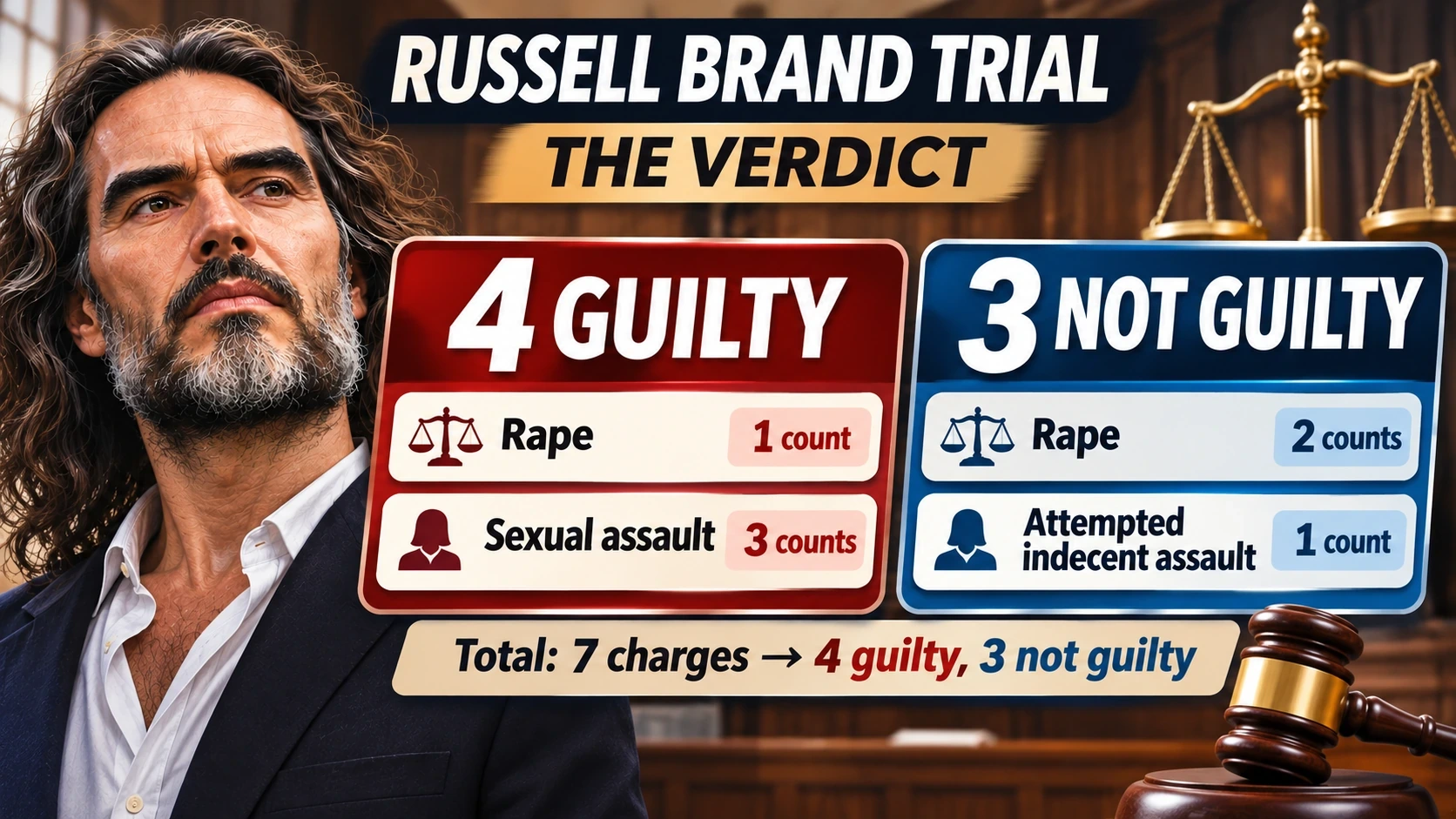
Russell Brand was convicted on four of seven charges and acquitted on the remaining three. That distinction matters because the jury evaluated separate accusations involving different incidents.
Following a four-week trial at Southwark Crown Court in London, the jury returned the following verdicts on November 5:
| Charge | Verdict | Number |
|---|---|---|
| Rape | Guilty | 1 |
| Sexual assault | Guilty | 3 |
| Rape | Not guilty | 2 |
| Attempted indecent assault | Not guilty | 1 |
| Total | 4 guilty, 3 not guilty | 7 |
The convictions involved four women and offenses committed between 2004 and 2009. The three acquittals related to separate accusations, including an alleged incident dating to 1999. (Metropolitan Police · CBS News)
Brand had pleaded not guilty to every charge.
During the trial, he acknowledged having lived a sexually promiscuous life but maintained that his encounters were consensual. His defense argued that a history of sexual behavior, however objectionable others might find it, did not establish criminal wrongdoing. (Reuters · AP)
The jury nevertheless found the prosecution had proved four offenses.
After the verdicts, Judge Joel Bennathan denied Brand bail and ordered him held in custody pending sentencing on November 9.
The judge indicated that a substantial prison term would follow, but the length of the sentence had not yet been determined as of November 7. (AP)
Why Did Allegations From Years Ago Reach Court Only Now?
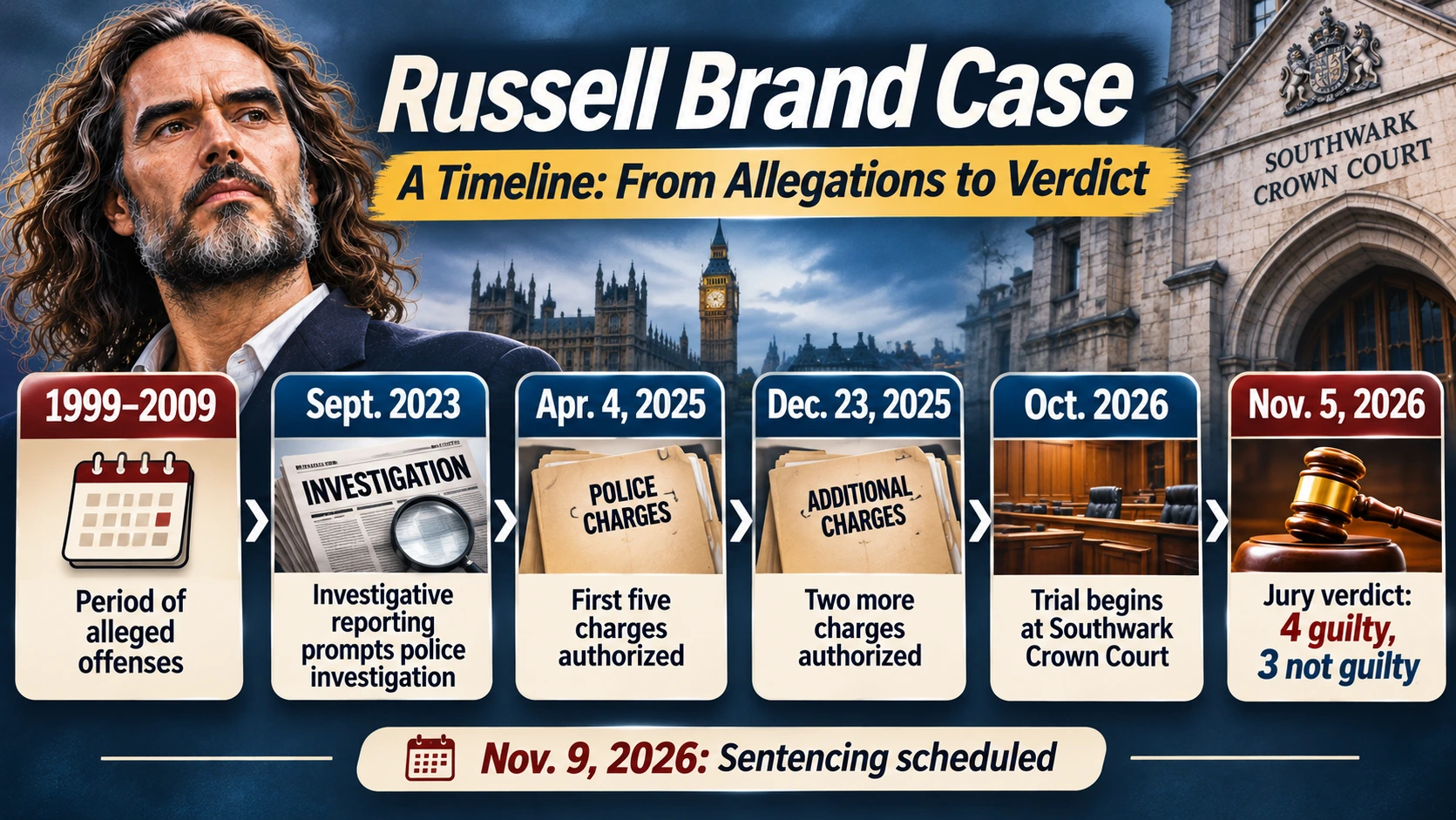
The case reached court so much later primarily because the allegations were reported to police years after the events, following a major media investigation in 2023.
That September, The Sunday Times, The Times and Channel 4’s Dispatches published and broadcast investigations into allegations against Brand.
According to British prosecutors, the documentary prompted women to approach the authorities independently. Metropolitan Police detectives began investigating that same month. (Crown Prosecution Service)
The criminal case then developed over several years.
| Date | Development | Why it mattered |
|---|---|---|
| 1999–2009 | Period covered by the accusations presented at trial | Established the historical events under examination |
| September 2023 | Investigative reporting was followed by police complaints | Triggered the criminal investigation |
| April 4, 2025 | Prosecutors authorized the first five charges | Formally brought the initial allegations into the criminal justice system |
| December 23, 2025 | Two additional charges were authorized | Expanded the case to allegations involving two more women |
| October 2026 | Trial began at Southwark Crown Court | Witnesses and the defendant gave evidence |
| November 5, 2026 | Jury returned four guilty and three not-guilty verdicts | Established the outcome of the seven charges |
| November 9, 2026 | Sentencing scheduled | The judge is expected to determine the punishment |
The charging dates are documented in the Crown Prosecution Service’s April 2025 announcement and December 2025 announcement. The verdict and sentencing date were confirmed in its November 5 statement.
There is an important distinction in this timeline.
The reported incidents were old, but the police investigation and criminal charges were relatively recent.
The fact that accusations concern earlier events does not mean investigators had been examining the same case continuously for 20 years.
Nor does it establish that every woman experienced or responded to the alleged incidents in the same way. British prosecutors specifically emphasized that the women came forward for their own reasons and that reactions to sexual offenses vary.
How Can British Courts Prosecute Crimes From 20 Years Ago?
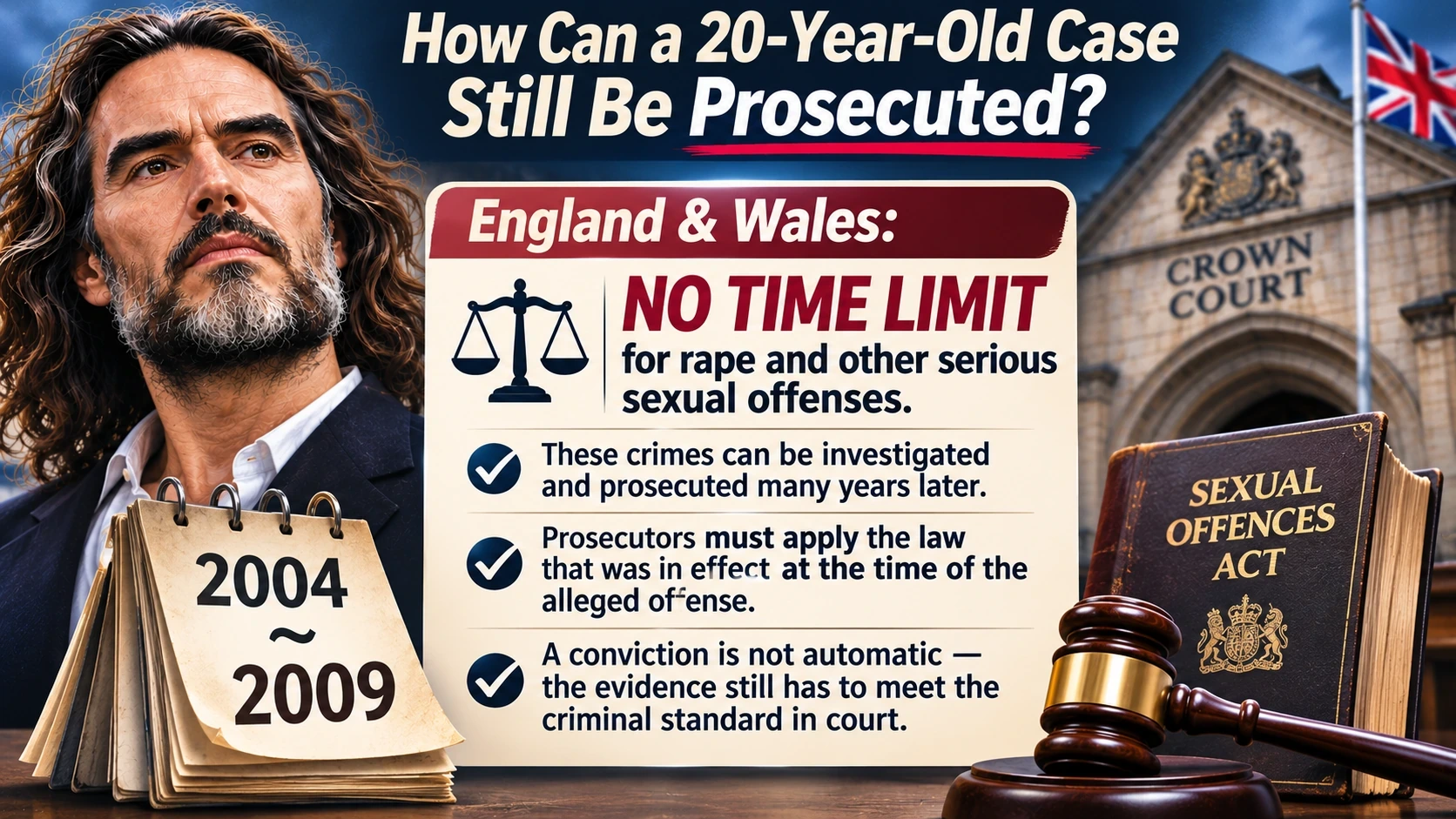
Because the criminal justice system in England and Wales does not impose a general time limit on prosecuting rape and other serious sexual offenses.
In the United States, readers often hear about a statute of limitations—a legal deadline after which certain criminal charges can no longer be brought.
American rules vary by state, offense and circumstances. Some serious crimes have no time limit, while others do.
But Brand’s prosecution took place under the law of England and Wales.
The Crown Prosecution Service states that rape allegations can be investigated and prosecuted even when the reported offense occurred decades earlier. (Crown Prosecution Service)
That does not make a conviction automatic.
It means the passage of time alone does not prevent prosecutors from pursuing the case.
What if the law was different when the incident happened?
That creates another important legal distinction.
England and Wales changed their sexual-offense legislation when the Sexual Offences Act 2003 came into force on May 1, 2004.
For allegations concerning conduct before that date, prosecutors must apply the legislation relevant to the time of the alleged offense, including provisions of the Sexual Offences Act 1956.
This can affect how a charge is legally classified. (Crown Prosecution Service)
The distinction helps explain why historical criminal cases can involve different legal terms for conduct alleged in different years.
A prosecutor cannot simply apply today’s offense definitions retroactively without considering the law that governed the conduct when it occurred.
And even when prosecution remains legally possible, another problem gets harder with each passing year: proving what happened.
How Did Prosecutors Build a Case After So Much Time Had Passed?
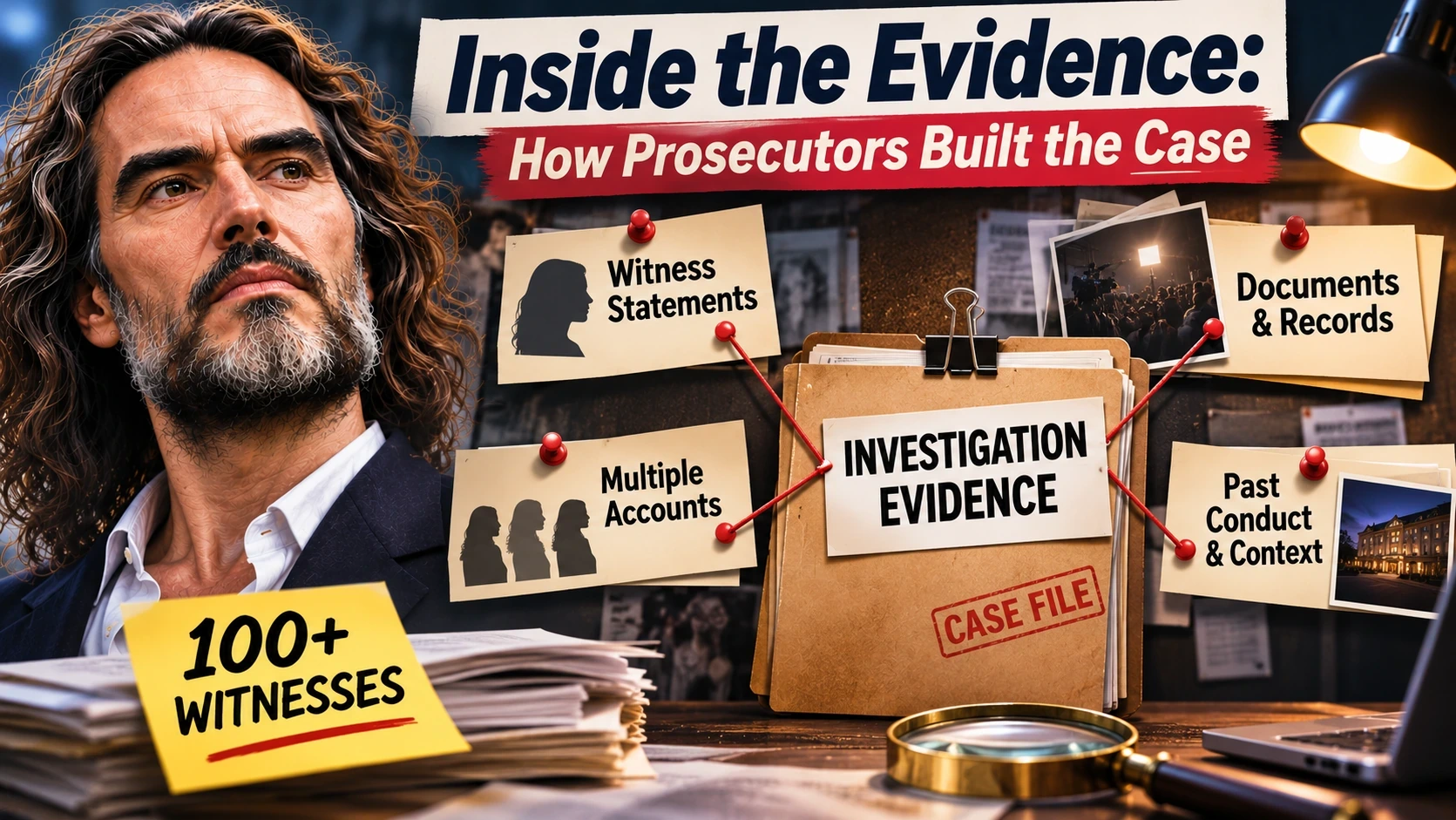
The investigators relied on witness testimony, complainants’ accounts and documentary evidence to reconstruct events from many years earlier.
According to the Metropolitan Police, detectives gathered evidence from more than 100 witnesses and reviewed thousands of documents during the investigation. (Metropolitan Police)
That is significant because historical cases often cannot rely on evidence that might have existed immediately after an incident.
Physical evidence may be unavailable. Records may be incomplete. Memories may have changed. People who witnessed relevant circumstances may be difficult to locate.
Prosecutors therefore had to build a case using the evidence that could still be located and tested in court.
The Crown Prosecution Service said it sought to examine patterns of behavior through accounts from women who did not know one another, supported by testimony from other witnesses.
Prosecutors argued that Brand exploited his increasing fame and influence to pursue sexual encounters without regard for consent. (Crown Prosecution Service)
Did delayed reporting make the accusations less credible?
A delay does not, by itself, establish whether an allegation is true or false.
The relevant question for a jury is whether the evidence presented in court proves the particular criminal charge to the required standard.
British prosecutors’ guidance recognizes that people may delay reporting sexual offenses for many reasons and cautions against assuming that everyone responds to traumatic events in the same way.
The guidance also emphasizes examining the suspect’s conduct rather than relying on stereotypes about how a victim should behave. (Crown Prosecution Service)
That principle does not eliminate the defendant’s right to challenge evidence.
Brand’s lawyers disputed the accusations and questioned the reliability of allegations raised years after the events. The jury heard both sides before returning its decisions.
Why Was Brand Acquitted of Three Charges?
The jury returned not-guilty verdicts on three counts because it did not convict him on those specific charges.
That is not inconsistent with finding him guilty on four others.
A criminal trial does not require jurors to accept or reject every allegation about a defendant as a single package. Each charge must be evaluated individually.
That is especially important in a case involving different incidents, witnesses and alleged conduct across a decade.
A guilty verdict establishes that the jury found the evidence sufficient to prove that specific charge. A not-guilty verdict means the legal threshold for conviction was not met; it does not necessarily establish that an allegation was fabricated.
Here is how the distinctions fit together:
| Legal outcome | What it means |
|---|---|
| Allegation | Someone reports or claims that an offense occurred |
| Criminal charge | Prosecutors formally bring an accusation to court |
| Guilty verdict | The jury finds the charge proved to the required criminal standard |
| Not-guilty verdict | The jury does not convict on that particular charge |
| Sentencing | The judge determines the punishment for the offenses of conviction |
The Crown Prosecution Service explains that its charging decision requires a realistic prospect of conviction, while a trial jury must be sure of guilt before convicting. Those are different stages with different legal tests. (Crown Prosecution Service)
In Brand’s case, the four convictions stand as the legal result of the trial. The three acquittals must be reported with equal accuracy.
Why Has the Verdict Raised Questions About the Entertainment Industry?
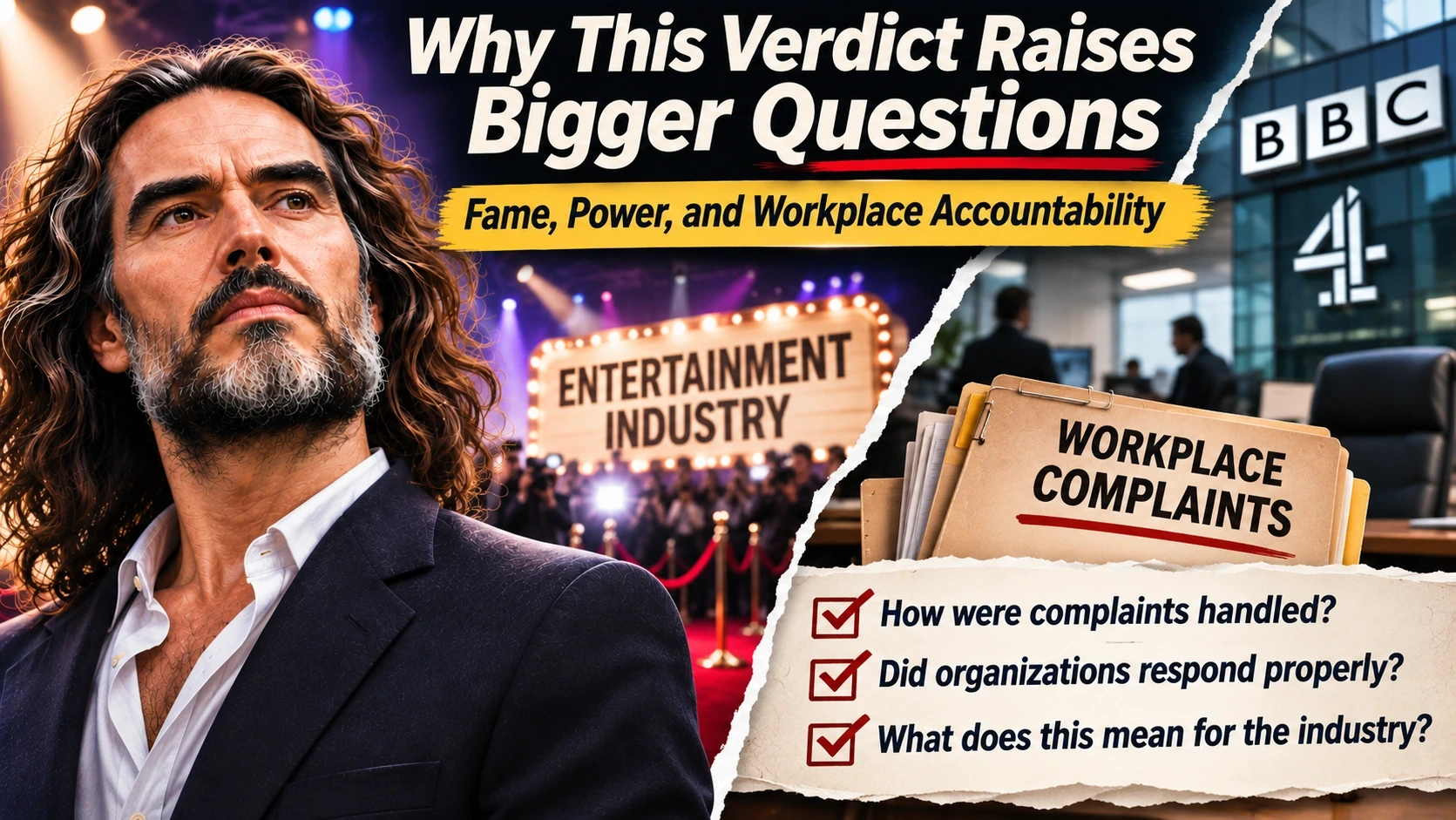
The verdict has renewed questions about how broadcasters and entertainment companies handled concerns about influential personalities.
Brand built his career as a stand-up comedian, radio host and television presenter before becoming a Hollywood actor.
His fame also gave him access to workplaces, audiences and professional environments in which allegations later emerged.
Prosecutors argued that this growing status helped him exploit situations involving women who encountered him through work or entertainment events.
The case has also brought attention back to organizations that employed him.
Following the conviction, the BBC’s earlier review of Brand’s time at the broadcaster received renewed scrutiny. The broadcaster had acknowledged a workplace culture in which some staff members felt unable to raise concerns. Channel 4 had also acknowledged failures in its handling of a serious complaint. (AP)
These institutional questions are distinct from the criminal verdicts.
The jury decided whether Brand committed the offenses charged against him. It did not issue a blanket judgment on every organization that employed him or everyone who worked with him.
Still, the case illustrates why workplace complaint procedures matter even when the individual involved is popular, successful or commercially valuable.
Fame can make a person highly visible to the public while making it harder for colleagues to question their conduct inside an organization.
That tension is one reason the story extends beyond a celebrity courtroom drama.
What Happens Next to Russell Brand?
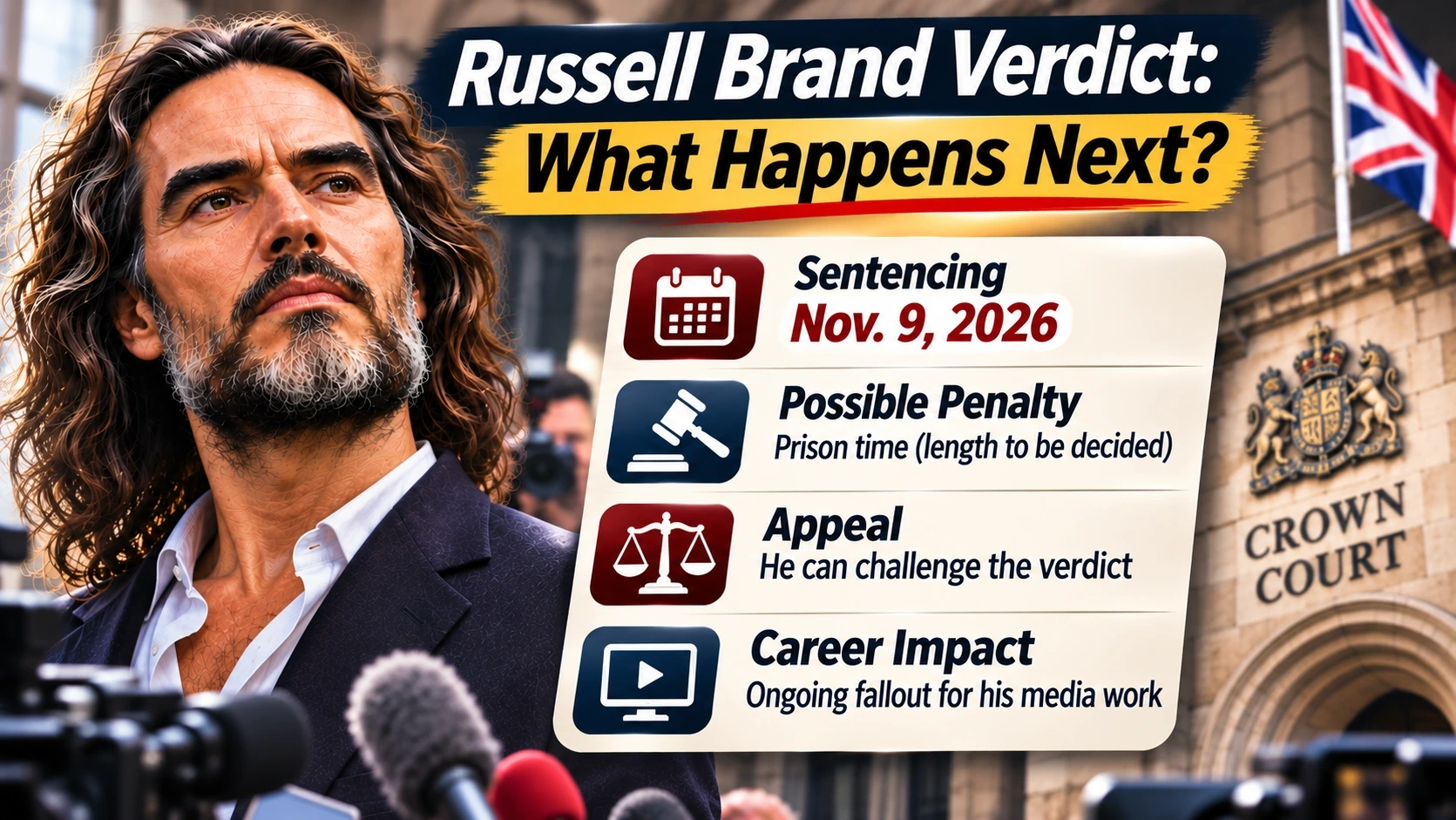
The immediate next step is sentencing, scheduled for Monday, November 9, 2026, at Southwark Crown Court.
Brand was remanded in custody after the November 5 verdicts. Judge Joel Bennathan declined to release him on bail before sentencing and indicated that a significant prison term was expected. (AP · Sky News)
At sentencing, the court will determine the punishment for the four convictions.
The judge’s comments should not be mistaken for a sentence already imposed.
Are there additional allegations?
Yes, but they are separate from the four convictions.
British police have confirmed that they are investigating further rape allegations involving two other women. Brand has been questioned about those complaints, and the investigation remains ongoing.
Those allegations have not been established by the November 5 verdicts. (Reuters · Sky News)
That creates two legal tracks worth keeping separate:
- The completed trial, which produced four convictions and three acquittals.
- The separate police investigation, in which further allegations remain under examination.
An investigation does not amount to a new conviction, and no outcome in that separate matter should be assumed.
An appeal of the convictions may also be pursued through the appropriate legal process, but no appeal result should be treated as established before one exists.
Bottom Line: What This Story Really Means
Russell Brand’s conviction on November 5 was the result of a criminal investigation that began in 2023, even though the offenses proved at trial dated back to 2004–2009.
The long gap did not prevent prosecution because rape and other serious sexual offenses can be pursued many years later under the law of England and Wales.
Investigators gathered witness testimony and documentary evidence, prosecutors presented their case, and the jury decided each charge separately.
The outcome was four convictions, three acquittals and a sentencing hearing scheduled for November 9.
The wider lesson is about the distinction between time, evidence and legal responsibility. An accusation does not become true simply because it is made, nor does it become legally impossible to examine simply because many years have passed.
And celebrity status does not change the criminal standard that prosecutors must meet.
Russell Brand: Key Questions Explained
Q. When was Russell Brand found guilty?
A jury at Southwark Crown Court in London returned its verdicts on November 5, 2026, after a four-week trial.
Q. How many charges was Russell Brand convicted of?
He was convicted of four charges: one count of rape and three counts of sexual assault involving four women.
Q. Was Russell Brand acquitted of any charges?
Yes. He was found not guilty of two additional rape charges and one count of attempted indecent assault.
Q. When did the offenses that resulted in convictions occur?
The offenses for which Brand was convicted occurred between 2004 and 2009. The broader trial included allegations dating back to 1999.
Q. What started the Russell Brand police investigation?
Investigative reporting by The Sunday Times, The Times and Channel 4’s Dispatches in September 2023 was followed by complaints to British police, who began investigating that month.
Q. Is there a statute of limitations for rape in England and Wales?
There is no general prosecution time limit for rape. Historical cases can still proceed, although prosecutors must apply the law relevant to when the alleged offense occurred and prove the charges in court.
Q. Did Russell Brand admit the allegations?
No. Brand pleaded not guilty and maintained that his sexual encounters were consensual. He acknowledged a past of promiscuous sexual behavior but denied committing the charged offenses.
Q. Has Russell Brand already been sentenced to prison?
As of November 7, 2026, no final sentence had been imposed. The judge indicated that a substantial prison term was expected, with sentencing scheduled for November 9.
Q. Is Russell Brand currently in custody?
Yes. Following the guilty verdicts, the judge denied bail and ordered Brand held in custody pending sentencing.
Q. Does Russell Brand face any further investigations?
British police have confirmed a separate ongoing investigation involving additional rape allegations. Those allegations are not part of the four convictions and have not been established by the November 5 verdicts.
Did this help make the story clearer? 🙂
WIN keeps unpacking the “why” behind the news—clearly and simply!
Sources
November 5 Verdict and Court Proceedings
Metropolitan Police — Russell Brand Convicted of Rape and Other Sexual Offences, November 5, 2026
Associated Press — Russell Brand Convicted of Rape and Sexual Assault, November 5, 2026
Investigation and Criminal Charges
Crown Prosecution Service — Initial Charges Authorized Against Russell Brand, April 4, 2025
Crown Prosecution Service — Further Charges Authorized Against Russell Brand, December 23, 2025
Historical Sexual Offenses and Legal Standards
Crown Prosecution Service — How the CPS Charges and Prosecutes Rape Cases
Crown Prosecution Service — How Prosecutors Assess Evidence and Historical Sexual Offenses
Sentencing, Further Investigation and Institutional Response
Sky News — Russell Brand Faces Significant Prison Term After Conviction, November 6, 2026
Reuters — Russell Brand Conviction Could Bring Further Allegations, Police Say, November 6, 2026
Associated Press — Russell Brand’s Convictions Renew Scrutiny of the Entertainment Industry
Keep Reading
How Can a Sexual Assault Conviction Be Overturned Without Ending the Case?
Russell Brand’s verdict raises questions about the different stages of criminal proceedings. A separate American case involving Harvey Weinstein illustrates why a conviction, an appeal, an acquittal and a new sentence are not interchangeable legal outcomes.
Why Was Harvey Weinstein Sentenced Again After His New York Conviction Was Overturned?