Why Is Pope Leo XIV Warning About a “Paradise of Machines”—and What Does He Mean?

Is the pope actually saying artificial intelligence is bad?
If not, what is a “paradise of machines” supposed to mean?
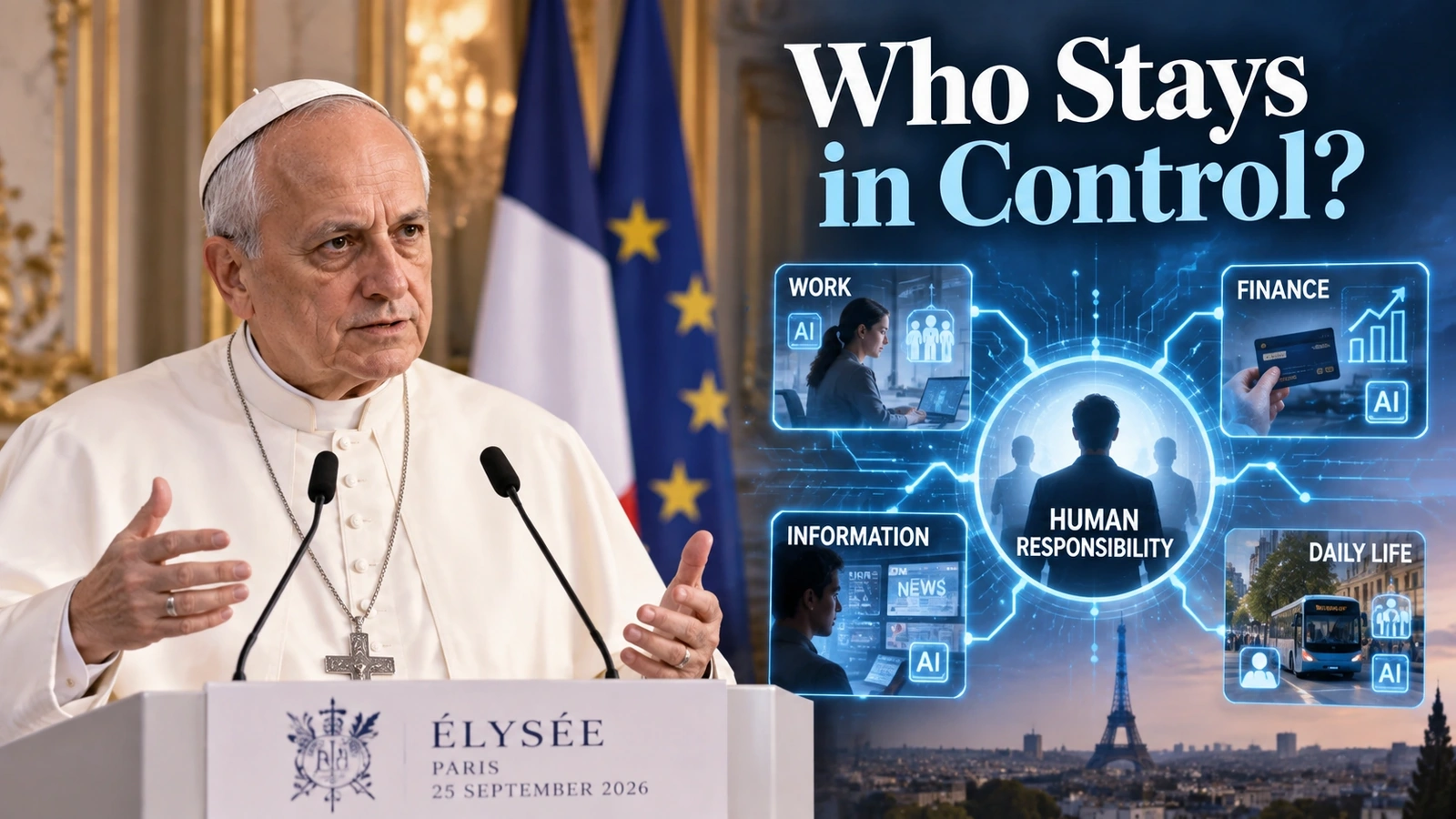
Pope Leo XIV used that phrase in a September 25 address at the Élysée Palace in Paris, where he warned that people could lose something distinctly human if machines increasingly shape daily life without enough ethical discernment or human responsibility. (Vatican)
But the phrase can sound more apocalyptic than the argument behind it.
Leo is not calling for AI to disappear. His concern is about who remains responsible when AI systems influence work, credit, information, public services, relationships, and other high-stakes decisions. (Vatican)

※ Images in this article are AI-generated illustrations created to help explain the story. They are not actual photographs, and depictions of people, places, or events may differ slightly from reality.
And that distinction explains why artificial intelligence has become unusually important to this pope.
What Did Pope Leo XIV Actually Say in Paris?
The immediate message was simpler than the dramatic phrase suggests.
Leo said technological progress has improved human life, but argued that powerful tools can also cause harm when people stop asking what those tools should be used for. He linked the challenge to human dignity, freedom, personal responsibility, and the ability to distinguish what is technically possible from what is morally acceptable. (Vatican)
That means his concern is not merely that AI might become more intelligent.
It is that people and institutions may gradually become accustomed to letting automated systems decide matters for which a human being still needs to take responsibility.
That concern was already much more fully developed in Magnifica Humanitas, Leo’s first encyclical, signed on May 15 and presented publicly on May 25, 2026, on safeguarding the human person in the age of artificial intelligence. (Vatican · Vatican presentation)
So the Paris speech was not a sudden change of direction.
It was a short, public version of an argument Leo has been building for months.
Where Did the Phrase “Paradise of Machines” Come From?
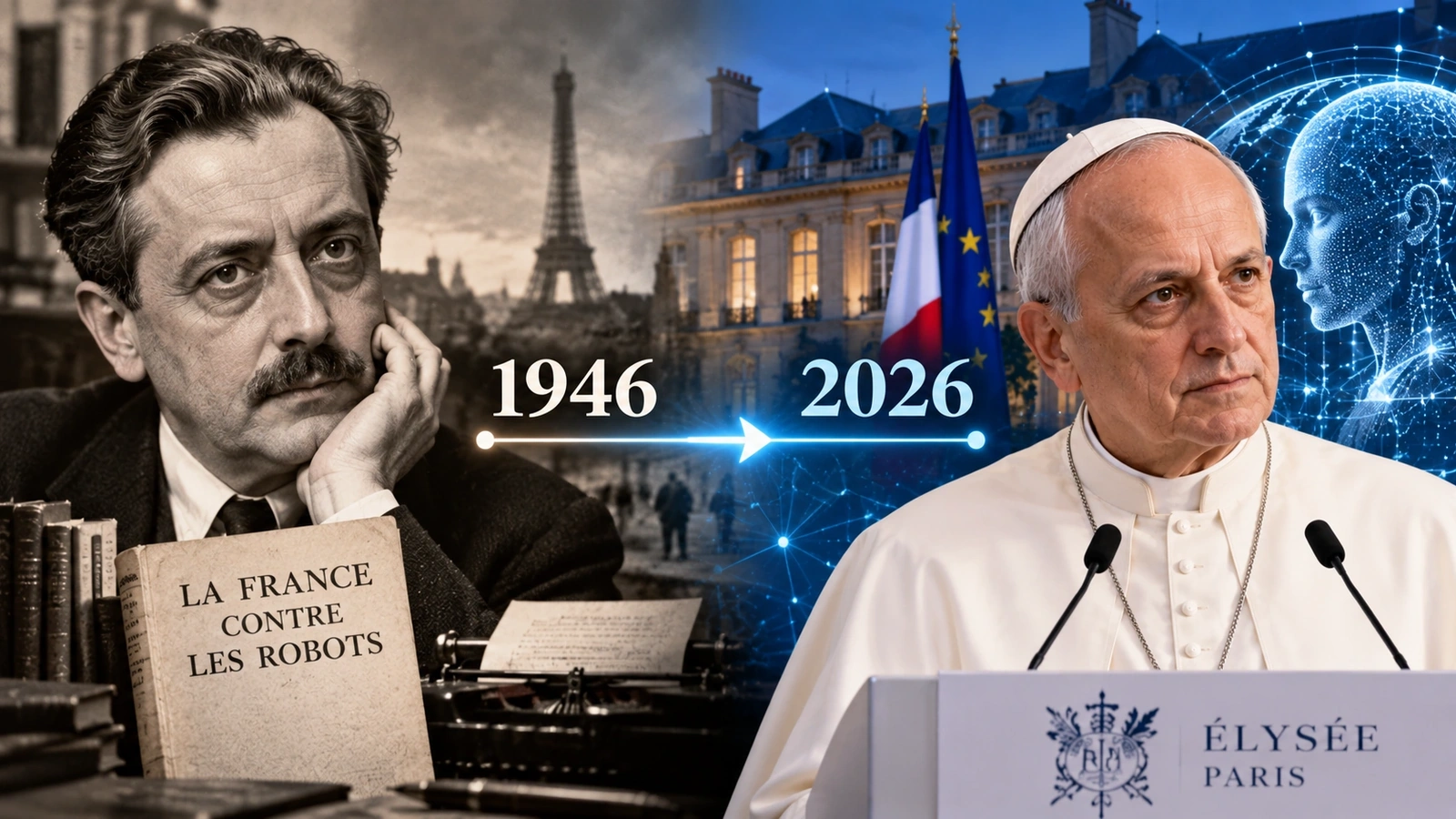
Leo did not invent the image.
In the Élysée speech, he referred to French writer Georges Bernanos, whose 1946 work La France contre les robots warned about a society in which technology, efficiency, conformity, and irresponsibility could overpower human freedom.
Leo used Bernanos’s “paradise of machines” image to connect that older industrial-age concern with today’s artificial-intelligence systems. (Vatican)
That historical connection matters because Leo’s argument is broader than a fear that one future superintelligence might suddenly become uncontrollable.
He is also concerned about a quieter possibility:
A society can remain completely functional while gradually surrendering more judgment to systems that optimize speed, productivity, prediction, or profit.
The machines do not need to “rebel” for that to become a problem.
People only need to stop asking who made the decision, why it was made, whether it can be challenged, and who is accountable when it harms someone.
Is Pope Leo XIV Actually Against Artificial Intelligence?
No.
That is one of the easiest ways to misread his position.
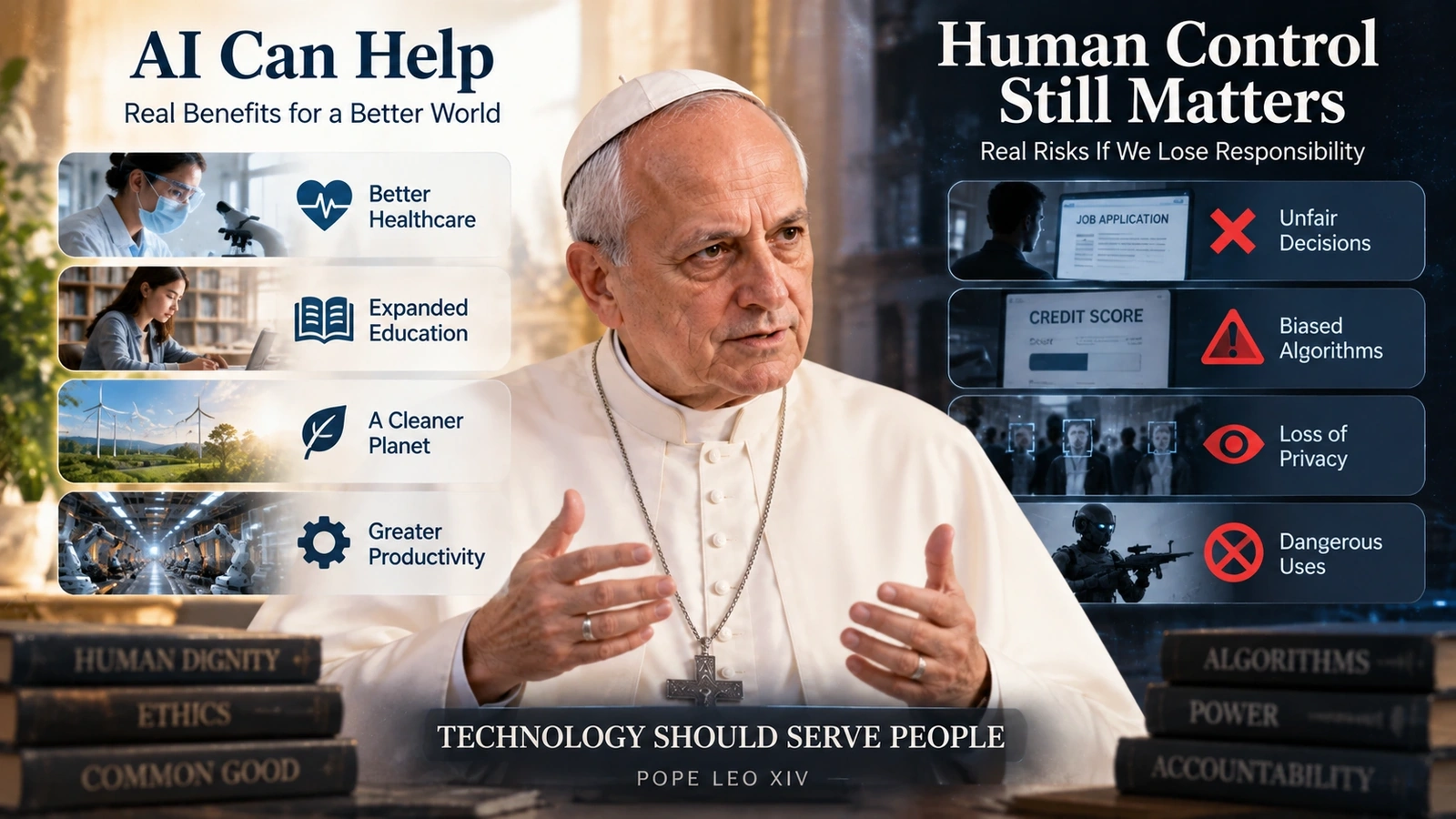
In Magnifica Humanitas, Leo explicitly treats technology as something capable of improving human life. He points to AI’s potential benefits while arguing that powerful technologies need ethical, political, and social safeguards because they increasingly affect decisions that shape real people’s opportunities. (Vatican)
A useful way to separate the two sides of his argument is this:
| What Leo is not saying | What he is arguing |
|---|---|
| Stop developing AI | Make AI serve human purposes rather than define them |
| AI has no useful applications | AI can provide major benefits |
| Every automated decision is wrong | High-impact decisions need clear human responsibility |
| Technology itself is the enemy | Power without adequate accountability is the danger |
| Humans must personally perform every task | Humans must remain morally accountable for outcomes |
| Regulation alone solves everything | Law, oversight, education, transparency, and ethical judgment all matter |
The distinction becomes especially important in decisions involving employment, credit, public services, reputation, or other opportunities.
Leo’s encyclical argues that when algorithms influence those areas, people should be able to identify who is responsible, understand how important decisions are made, challenge them, and seek a remedy when something goes wrong. (Vatican)
That is much closer to an accountability argument than an anti-AI argument.
Why Has AI Become Such a Big Issue for This Pope?
The clue is in his name.
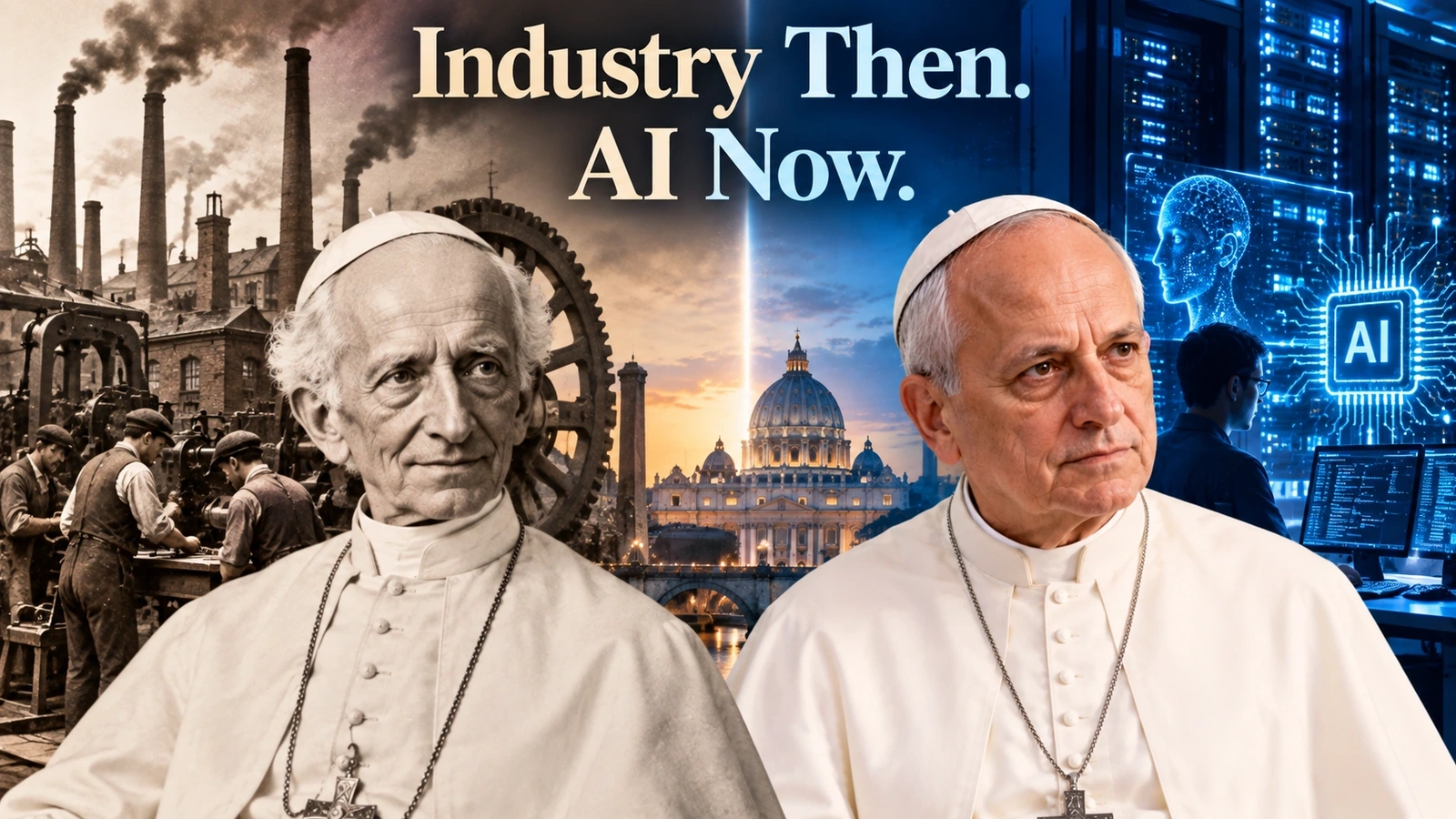
Shortly after becoming pope, Leo XIV explained that he chose the name partly because Pope Leo XIII had responded to the upheaval of the Industrial Revolution with the 1891 encyclical Rerum Novarum.
Leo XIV said today’s Church faces another large social transformation, this time driven in part by artificial intelligence and its effects on human dignity, justice, and work. (Vatican)
The comparison is not that a steam engine and an AI model are the same kind of technology.
It is about what happens when technology changes society faster than institutions, workers, laws, and cultural expectations can adjust.
The first industrial revolution created enormous new productive capacity. It also raised questions about working conditions, wages, ownership, power, and the treatment of labor.
Leo’s view is that AI may create a comparable set of social questions:
Who owns the systems?
Who owns the data?
Who benefits from increased productivity?
Whose jobs or opportunities change?
Who can challenge an automated decision?
Who bears responsibility when a machine-assisted decision causes harm?
That is why AI is not a side issue in his papacy.
He has deliberately tied it to the older Catholic tradition of asking what economic and technological change does to the dignity and freedom of ordinary people.
What Does He Think Is Uniquely Human?
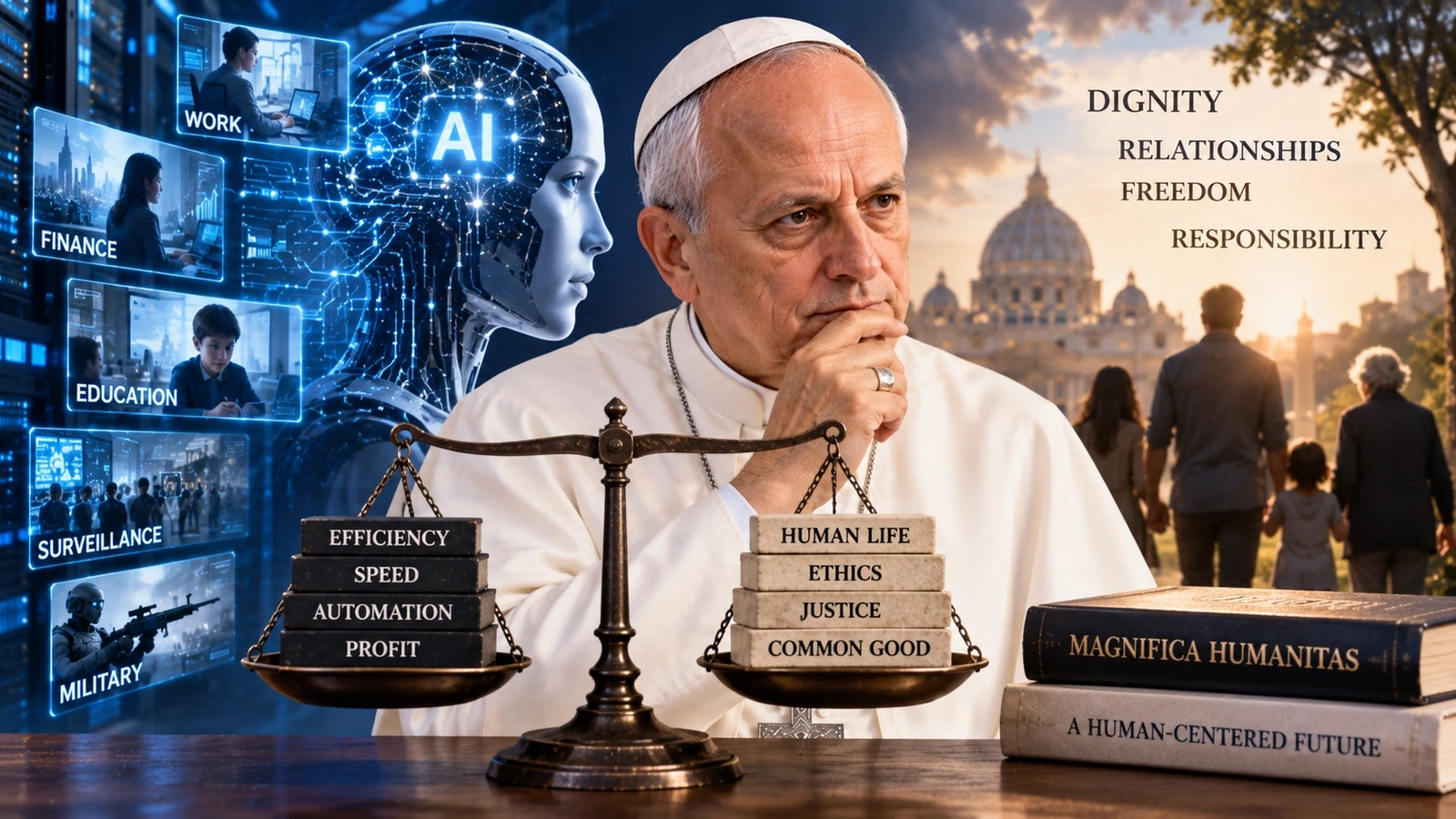
This is probably the most important philosophical part of Leo’s AI argument.
An AI system can analyze enormous amounts of information, identify patterns, generate language, make predictions, and sometimes outperform people at narrowly defined tasks.
Leo does not dispute that.
His argument is that those capabilities should not be confused with human moral agency.
In Magnifica Humanitas, he distinguishes machine processing from human experience, conscience, relationships, and responsibility. The system may produce an answer, but the system does not bear moral responsibility for choosing that answer or living with its consequences. (Vatican)
That distinction becomes practical very quickly.
Imagine an AI system recommending that someone be denied a loan.
Several different questions exist:
- Was the prediction statistically accurate?
- Was the underlying data biased or incomplete?
- Was the criterion itself fair?
- Can the applicant challenge the decision?
- Who has authority to reverse it?
- Who is responsible if the system systematically disadvantages a group of people?
An algorithm can help answer the first question.
The others are questions about governance, values, law, responsibility, and human judgment.
That is the line Leo is trying to preserve.
What Does He Mean When He Says AI Should Be “Disarmed”?
This is another phrase that can sound more radical than its intended meaning.
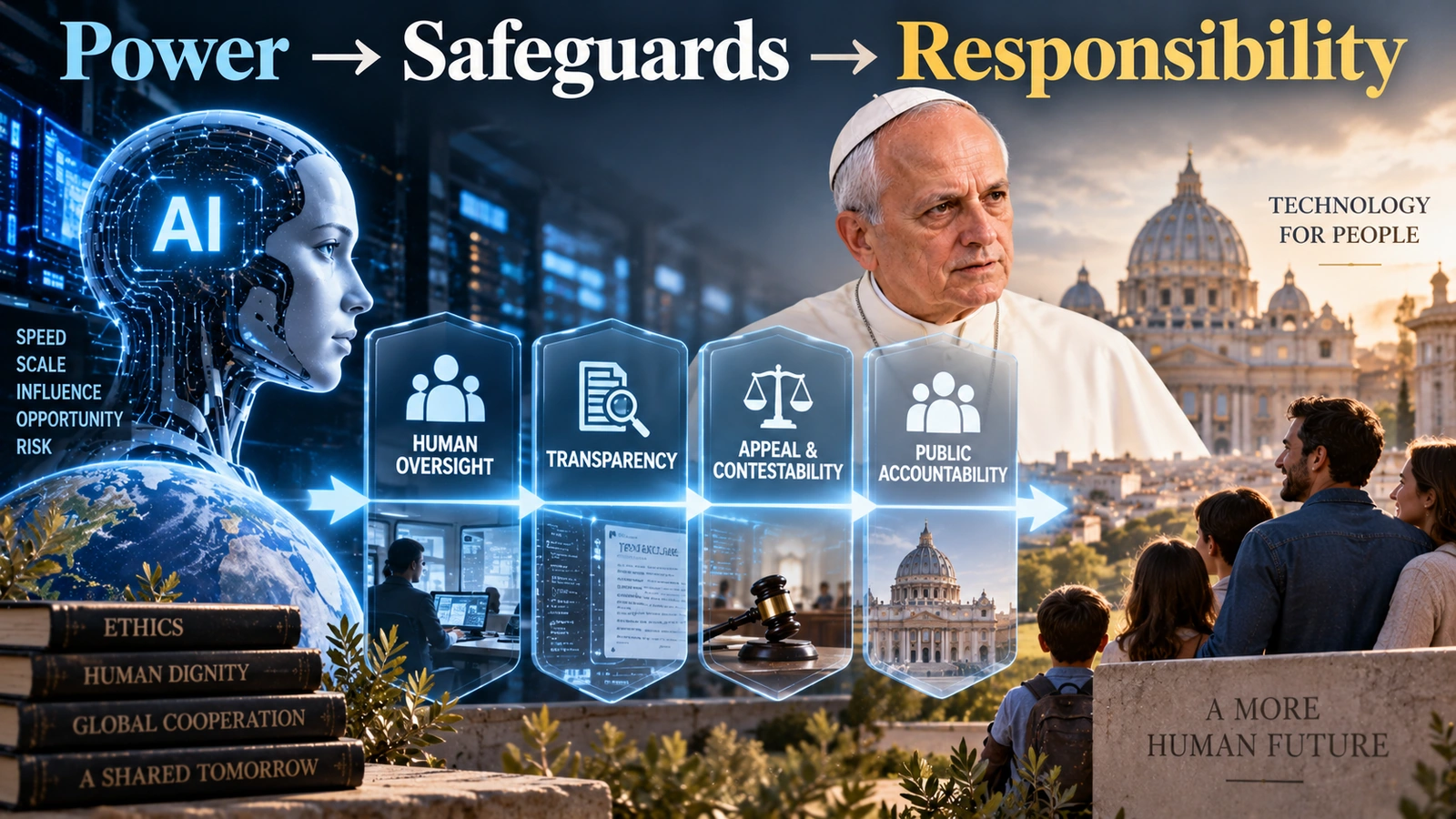
When Leo presented Magnifica Humanitas in May, he said AI needed to be “disarmed.” But he immediately explained the idea as freeing AI from uses and structures that turn technological power into domination, exclusion, or death. (Vatican)
In practical terms, the encyclical points toward several safeguards:
| Safeguard | The basic question |
|---|---|
| Human responsibility | Who is accountable for the decision? |
| Transparency | Can people understand how an important decision was reached? |
| Contestability | Can someone challenge an automated decision? |
| Oversight | Is an institution actually watching how the system is used? |
| Inclusion | Are the benefits and risks distributed fairly? |
| Data governance | Who controls the information used to build and operate the system? |
| Limits on high-risk uses | Are some decisions too consequential to delegate entirely to machines? |
Leo also argues that AI power is increasingly concentrated among companies that control massive amounts of data, computing infrastructure, and digital platforms.
That changes the governance question.
A technology can be privately developed while still affecting millions of people who never agreed on the rules under which it operates.
The concern, in other words, is not just:
“What can the model do?”
It is also:
“Who gets to decide what the model is allowed to do to everyone else?”
Why Does “Ethical Discernment” Matter If Governments Can Just Regulate AI?
Law matters in Leo’s framework, but he does not think law can solve the entire problem.
That is because regulation usually establishes boundaries: what is allowed, what is prohibited, what must be disclosed, and who can be held liable.
But many everyday choices happen long before a court or regulator becomes involved.
Should a school allow students to rely on AI for certain assignments?
Should a doctor follow an AI recommendation that conflicts with clinical judgment?
Should an employer automatically reject candidates flagged by a screening model?
Should people treat an AI companion as a substitute for human relationships?
Should a military commander allow an autonomous system to make an irreversible decision?
These are not all the same kind of question, and one law cannot supply a simple answer to all of them.
That is why Leo repeatedly returns to education, judgment, responsibility, and what he calls ethical discernment. His September 25 speech argued that society needs people capable of evaluating not merely whether a technology works, but whether a particular use respects human freedom and dignity. (Vatican)
The distinction can be put simply:
Regulation asks, “What are we legally permitted to do?”
Ethical judgment asks, “Even if we can do it, should we?”
Leo thinks an AI society needs both questions.
Why Does This Debate Matter Outside the Catholic Church?
You do not have to accept Catholic theology to recognize the policy problem Leo is pointing toward.
Similar questions are already appearing in technology, business, law, medicine, education, cybersecurity, and government:
- How transparent should automated decisions be?
- Who is responsible when AI causes measurable harm?
- When should a human be required to remain in the decision loop?
- Can an automated decision be appealed?
- How much power should a small number of AI companies hold?
- Should some AI capabilities be slowed until safeguards improve?
- How should society divide the economic gains created by automation?
Those debates use different language from the Vatican.
But the structure is often remarkably similar.
The question is no longer simply whether AI can perform a task.
It is whether institutions can deploy increasingly capable systems without allowing technical efficiency to quietly replace accountability.
That helps explain why Leo’s argument resonates beyond religious circles—and why AI has become one of the defining themes of his papacy. Reuters reported on September 21 that addressing the possible dangers of AI had become a major theme of his 16-month-old papacy. (Reuters)
What Should Americans Watch Next?
The most important thing to watch is whether this conversation moves from broad principles into specific rules.
Leo’s encyclical calls for stronger accountability, oversight, protections surrounding high-impact automated decisions, and international cooperation as AI systems become more powerful. (Vatican)
The Vatican has also established an Inter-Dicasterial Commission on Artificial Intelligence to coordinate work across several Holy See institutions, including policies on AI use within the Holy See. (Holy See Press Office)
But the Vatican does not regulate American technology companies.
Its influence is different.
A pope can help turn a technical debate into a wider social debate about labor, power, inequality, responsibility, war, human relationships, and who gets to make decisions in an automated society.
That may be the lasting significance of the “paradise of machines” phrase.
The real warning is not that people will wake up one morning to discover machines have seized control.
It is that humans could gradually surrender control one convenient decision at a time—and stop noticing that responsibility has moved with it.
Why It Matters in One Sentence
Pope Leo XIV’s “paradise of machines” warning is not a demand to stop artificial intelligence; it is a warning that AI should remain a tool under meaningful human responsibility rather than become a system that quietly determines people’s opportunities, choices, and lives.
Pope Leo AI Ethics: Key Questions Explained
Q. What did Pope Leo XIV mean by a “paradise of machines”?
He was warning about a society in which technology increasingly conditions daily life while people surrender responsibility and moral judgment. The phrase draws on an older warning by French writer Georges Bernanos rather than describing a literal future ruled by robots. (Vatican)
Q. Is Pope Leo XIV against artificial intelligence?
No. His encyclical recognizes that technology and AI can produce major benefits. His argument is that powerful systems need human oversight, accountability, and safeguards when they affect people’s rights and opportunities. (Vatican)
Q. What is Magnifica Humanitas?
Magnifica Humanitas is Pope Leo XIV’s first encyclical, signed on May 15 and presented publicly on May 25, 2026, focused on safeguarding the human person in the age of artificial intelligence. (Vatican · Vatican presentation)
Q. Why did Pope Leo XIV make AI such an important issue?
Leo has compared the social disruption caused by AI with the kind of transformation that accompanied the Industrial Revolution. He has said his choice of the name Leo partly reflects Pope Leo XIII’s response to that earlier transformation. (Vatican)
Q. Does Pope Leo XIV believe AI is as intelligent as a human being?
He distinguishes computational capability from human conscience and moral responsibility. In his framework, an AI system may outperform people at specific tasks without possessing human experience, moral agency, or responsibility for the consequences of its outputs. (Vatican)
Q. What does Pope Leo mean when he says AI should be “disarmed”?
He is not calling for every AI system to be shut down. He uses “disarmed” to describe removing or constraining uses of AI that enable domination, exclusion, violence, or unchecked concentrations of power. (Vatican)
Q. What kinds of AI decisions concern the Vatican most?
Leo’s encyclical specifically raises concerns about automated decisions affecting areas such as employment, credit, access to services, reputation, privacy, information, and other important opportunities when responsibility and the ability to appeal are unclear. (Vatican)
Q. Does Pope Leo support regulating AI?
Yes, his AI framework calls for effective oversight and regulatory protections, including international cooperation. But he argues that regulation alone is not enough; education, responsibility, ethical judgment, and transparent institutions also matter. (Vatican)
Q. Why was the September 25 speech important?
It brought Leo’s months-long AI argument into a major diplomatic setting at the Élysée Palace, where artificial intelligence was also discussed during his meeting with French President Emmanuel Macron. (Vatican · Élysée)
Did this help make the story clearer? 🙂
WIN keeps unpacking the “why” behind the news—clearly and simply!
Sources
September 25 Speech and France Visit
Vatican — Address at the Élysée Palace on September 25, 2026
Holy See Press Office — Courtesy Visit and Meeting with Authorities at the Élysée Palace
Élysée — Official account of Pope Leo XIV’s September 25 meeting with President Emmanuel Macron
Associated Press via OPB — Pope warns a “paradise of machines” could undermine humanity
AI Framework and Governance
Vatican — Presentation and promulgation of Magnifica Humanitas
Holy See Press Office — Establishment of the Inter-Dicasterial Commission on Artificial Intelligence
Reuters — Pope Leo calls for AI systems that don’t foster divisions
Why the Name “Leo” Matters
Vatican — Address to the College of Cardinals on May 10, 2025
Keep Reading
Why Are AI Companies Themselves Talking About Slowing the Race?
Leo’s concern that technological capability can outrun safeguards overlaps with a debate now taking place inside the AI industry itself over testing, monitoring, and the pace of frontier-model development.
What Does AI’s Rapid Growth Require From the Physical World?
Leo’s encyclical also raises questions about the energy, water, infrastructure, and human labor behind AI. The debate in Texas and California shows how those costs are already becoming a practical policy issue.
Why Are Texas and California Putting New Limits on Data Centers—and Who Pays for the Power?