Could AI Data Centers Raise Your Electric Bill—and Why Is Ohio Fighting Over It?

You keep hearing that artificial intelligence needs more data centers.
Fine. But why is a building full of computer servers suddenly showing up in conversations about your electric bill, farmland, tax breaks, and a U.S. Senate election?
That is the question now playing out in Ohio.
President Donald Trump traveled to Vandalia on October 3 and defended continued data-center construction, arguing that the United States cannot simply turn away infrastructure needed to compete in AI. The issue is especially sensitive in Ohio because Republican Sen. Jon Husted, whom Trump was campaigning for, helped promote data-center investment while serving as lieutenant governor and is now campaigning on a proposal meant to keep the industry’s infrastructure costs from landing on ordinary ratepayers. (AP · Reuters)
Here is the important distinction:
A data center does not automatically make your electric bill go up.
The fight is over what happens when a data center needs so much new electricity that utilities must add generation, transmission lines, substations, or other infrastructure—and who gets charged for those investments.
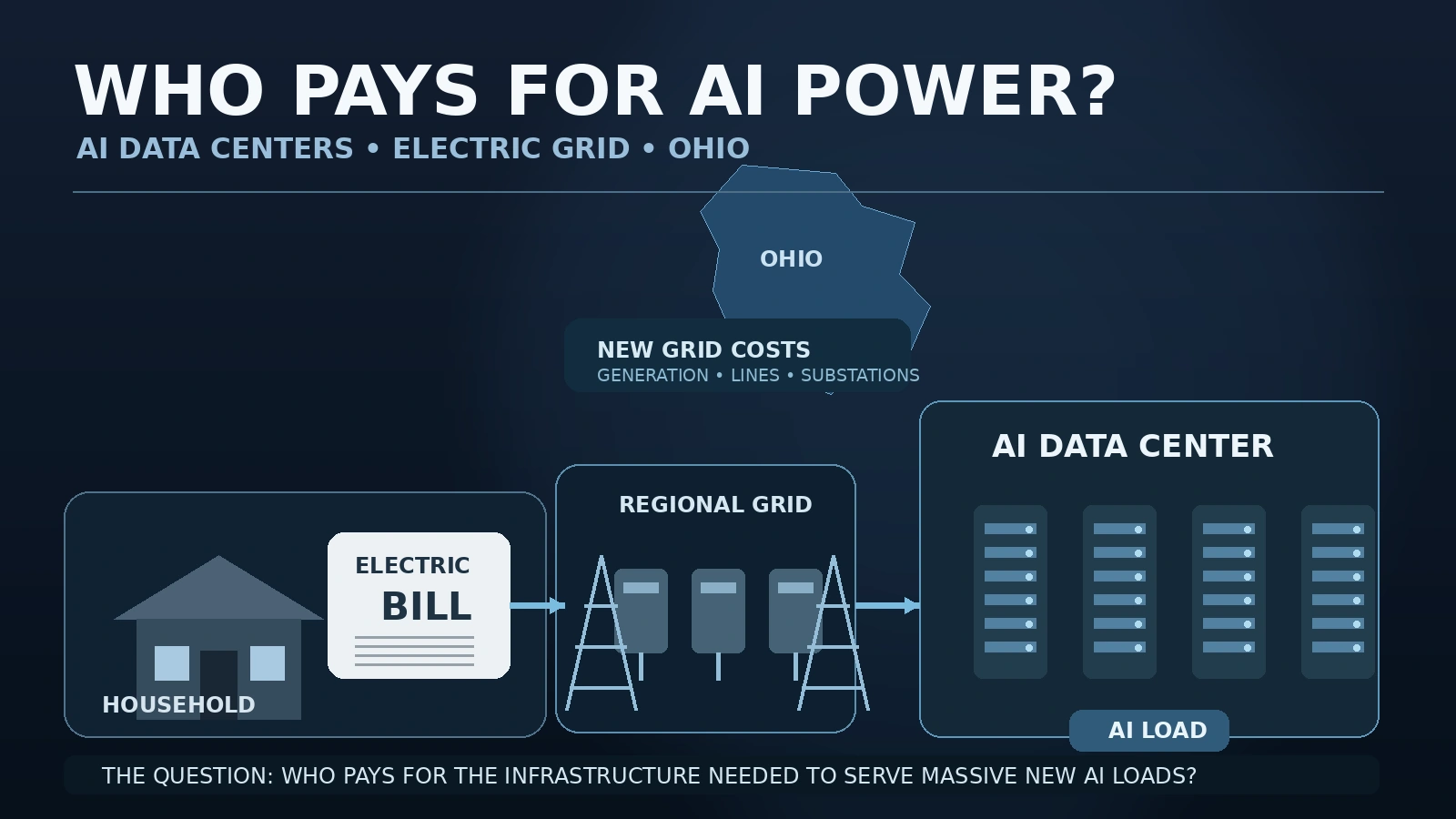
※ Images in this article are AI-generated illustrations created to help explain the story. They are not actual photographs, and depictions of people, places, or events may differ slightly from reality.
And once that question reaches the monthly power bill, an argument about AI infrastructure stops being only a Silicon Valley story.
It becomes a kitchen-table issue.
What Happened in Ohio—and Why Did Data Centers Enter the Campaign?
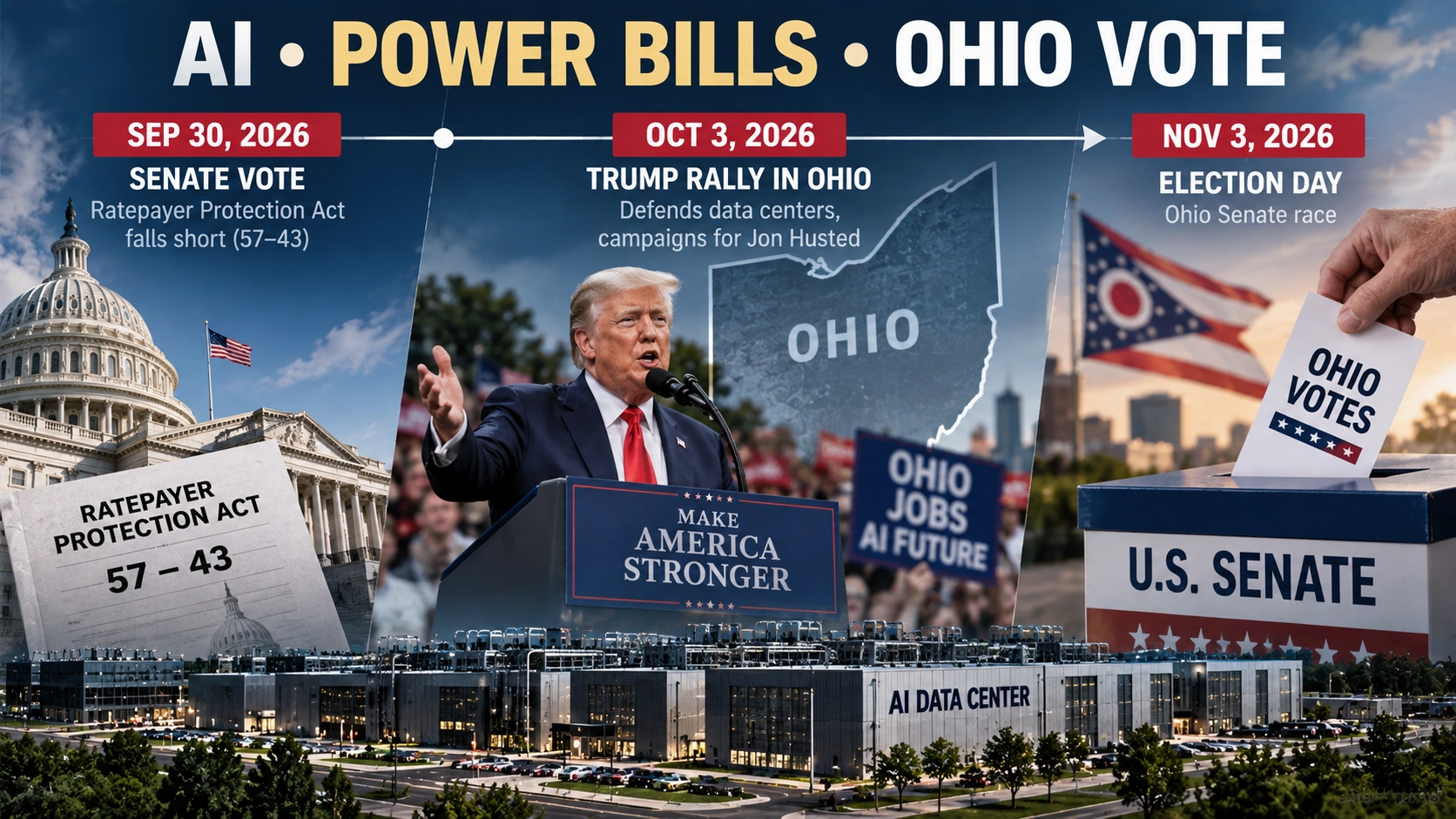
Three days before Trump’s rally, the Senate tried to advance the Ratepayer Protection Act, legislation backed by Husted that addresses who should pay when very large electricity users connect to the grid.
The bill received 57 votes to advance on September 30 but needed 60, so the procedural motion failed. The House had previously passed the measure 417–3. (Congressional Record · Reuters)
That vote gave both parties a ready-made campaign argument.
Husted could tell voters that he was trying to prevent large technology companies from shifting infrastructure costs onto households and small businesses. Democrats could answer that his proposal did not go far enough.
Then Trump arrived in Ohio and defended data-center development itself, arguing that turning projects away could weaken the United States in its AI competition with China. (AP)
So the political argument is not simply:
For AI or against AI?
It is increasingly:
Build the data centers—but under what rules, on whose land, using whose electricity, and at whose financial risk?
How Can an AI Data Center Affect an Ordinary Electric Bill?
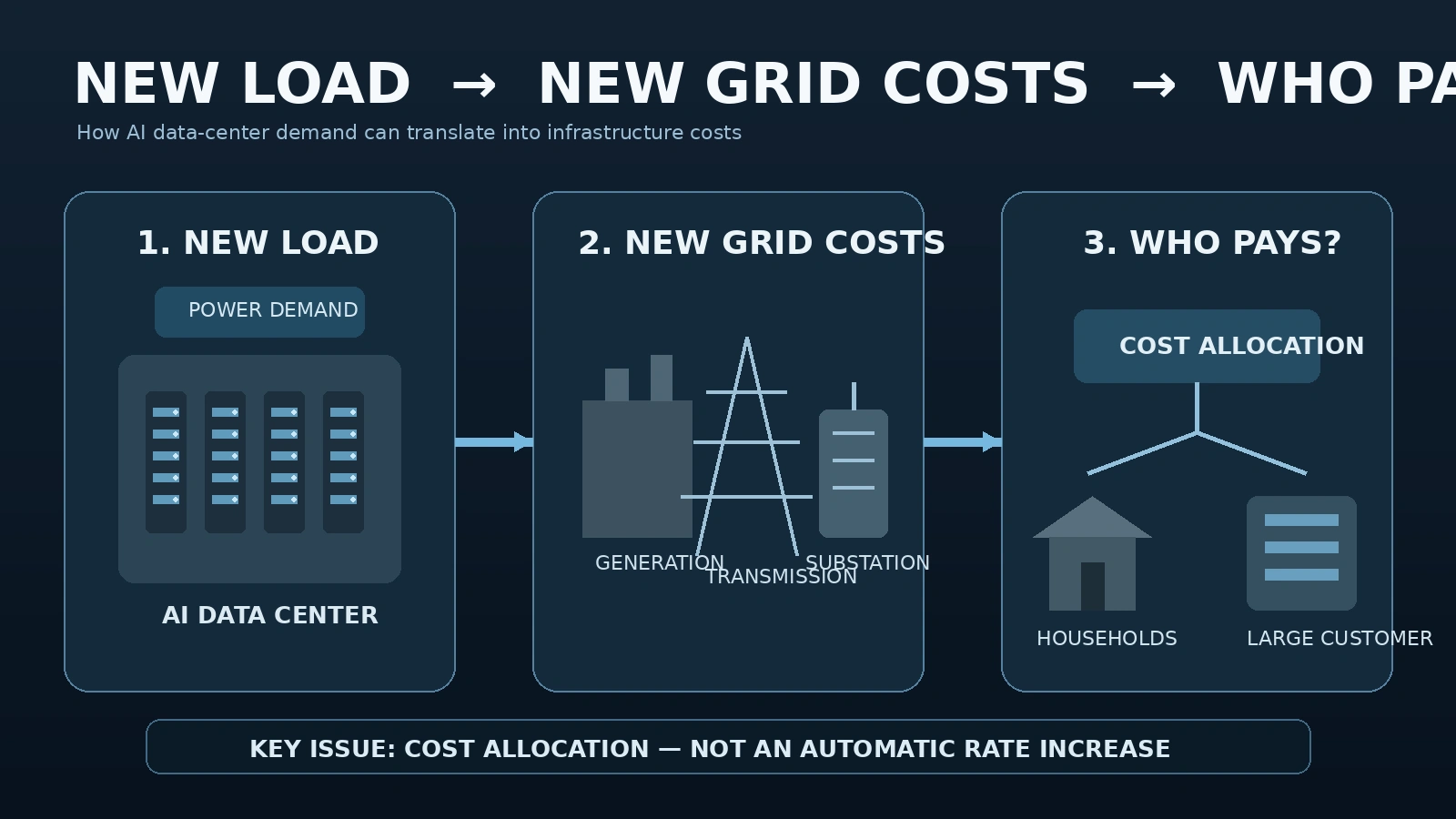
The direct electricity used by a data center is not the hardest part of this debate. The operator gets a power bill too.
The harder question is what had to be built so that enormous amount of electricity could be delivered in the first place.
A large computing campus may require additional generation, upgraded transmission lines, new substations, and other equipment. Federal and state policymakers now routinely treat facilities with demand of 100 megawatts or more as a distinct large-load category because a single project can be far larger than an ordinary commercial customer. (Sen. Jon Husted)
Think of the basic chain this way:
| Step | What happens |
|---|---|
| 1. New data center arrives | A huge new block of electricity demand appears |
| 2. Existing grid may be insufficient | More generation, transmission, or substation capacity may be needed |
| 3. Utilities and grid operators invest | New infrastructure can require major long-term spending |
| 4. Regulators decide who pays | Costs can be assigned to the large customer, spread more broadly, or divided |
| 5. The rate design matters | Households are better protected when the customer creating the new demand carries the related cost and risk |
The danger becomes clearer if a data center asks the system to prepare for enormous future demand and then the project is delayed, scaled down, or abandoned.
Imagine a utility spending heavily on infrastructure for a giant new customer that never uses as much electricity as expected.
Someone still has to pay for the infrastructure.
That is why special rates, minimum payments, long-term commitments, deposits, and exit protections have become central to the data-center debate.
Ohio’s official consumer advocate, the Office of the Ohio Consumers’ Counsel, says growing data-center demand is putting pressure on the state’s electric grid and water supply and has pushed for rules designed to keep data-center-related utility costs from being shifted to residential customers. (Ohio Consumers’ Counsel)
The pressure is already visible beyond households. Reuters reported in July that Belden Brick in Sugarcreek, Ohio, saw a monthly capacity charge rise from about $1,600 to $12,000 as regional electricity-market costs surged. Reuters linked the broader rise in PJM capacity costs in part to rapidly growing data-center demand alongside tight supply. (Reuters)
That does not mean every increase on an Ohio power bill can be blamed on AI.
Fuel prices, plant retirements, transmission spending, weather, regulation, and other factors can also affect electricity prices.
But data centers have become large enough that their demand can no longer be treated as background noise.
What Does It Mean When Politicians Say Data Centers Should “Pay Their Own Way”?
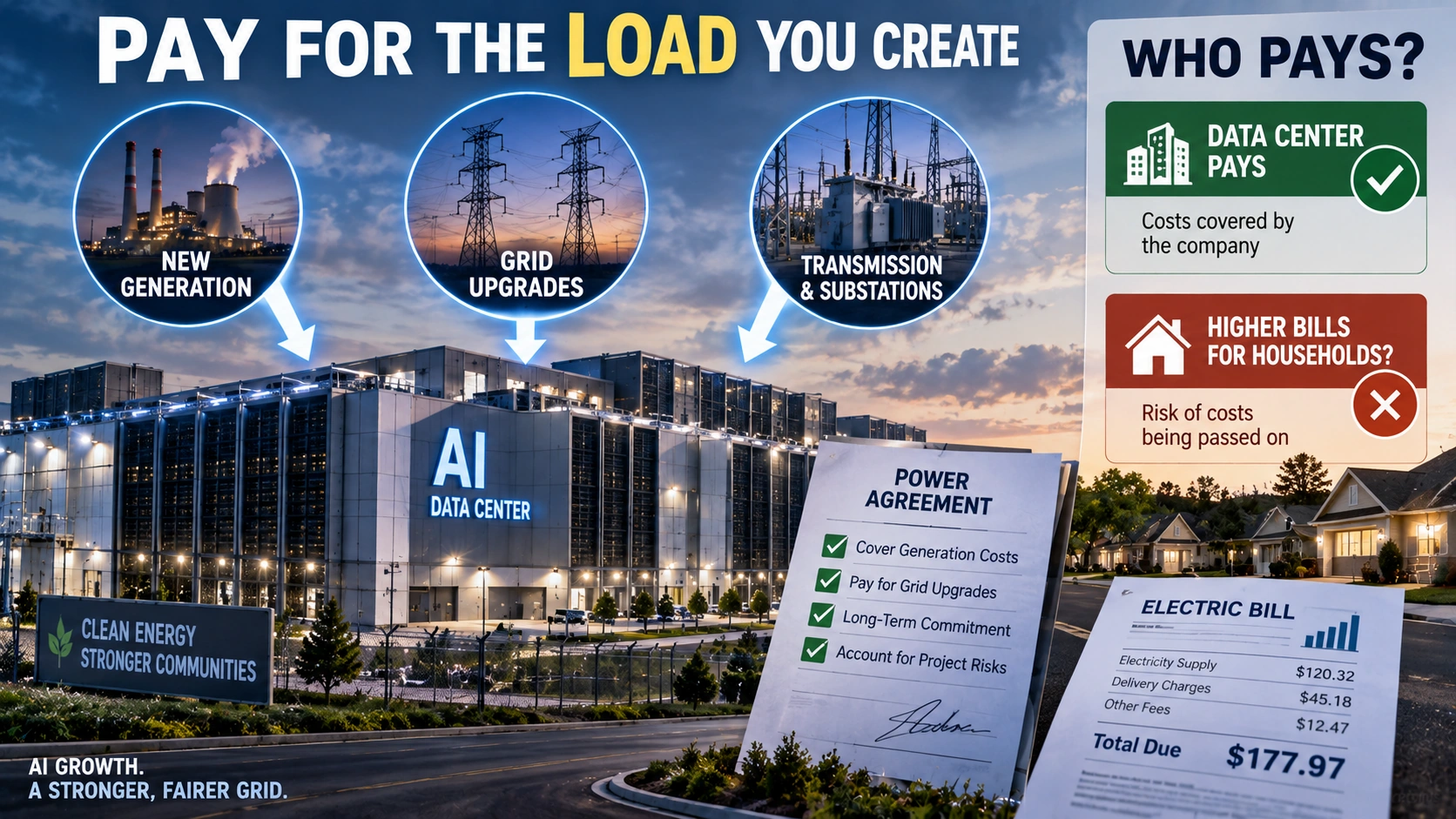
It means more than paying for the electricity coming through the meter.
President Trump’s Ratepayer Protection Pledge, announced in March, asks major technology companies to build, bring, or buy the new electricity supply their data centers require, cover new power-delivery upgrades, and accept separate rate structures that keep them financially responsible even if they later use less power than expected. Amazon, Google, Meta, Microsoft, OpenAI, Oracle, and xAI were the seven initial technology-company signatories. (White House · White House Fact Sheet)
That creates three different buckets that are easy to confuse:
| Cost | Simple example | Core question |
|---|---|---|
| Electricity supply | More generating capacity | Who pays to create the additional power? |
| Grid connection | Transmission lines and substations | Who pays for facilities required specifically for the new load? |
| Project risk | Data center later shrinks or leaves | Who pays if infrastructure was built but demand disappears? |
Husted’s Ratepayer Protection Act applies to large-load customers with demand of 100 megawatts or more. It would create a federal standard that states would have to consider when setting rules for those customers, including recovery of the full incremental cost of upgrades and financial assurances tied to generation, transmission, and other infrastructure needed to serve the load. (Sen. Jon Husted)
That sounds straightforward.
The political disagreement is over whether “consider these standards” is strong enough.
Sen. Martin Heinrich of New Mexico and other Democrats have argued that federal law should more directly require large data-center customers to pay for grid upgrades rather than relying on a standard that states only have to consider. Heinrich has promoted the GRID Savings Act as a stronger alternative. (Sen. Martin Heinrich · Reuters)
So lawmakers who disagree sharply over the legislation are increasingly starting from the same political assumption:
Voters do not want their household power bills subsidizing a giant technology company’s expansion.
The fight is about how binding that protection should be.
Why Has Ohio Become Such a Flash Point?
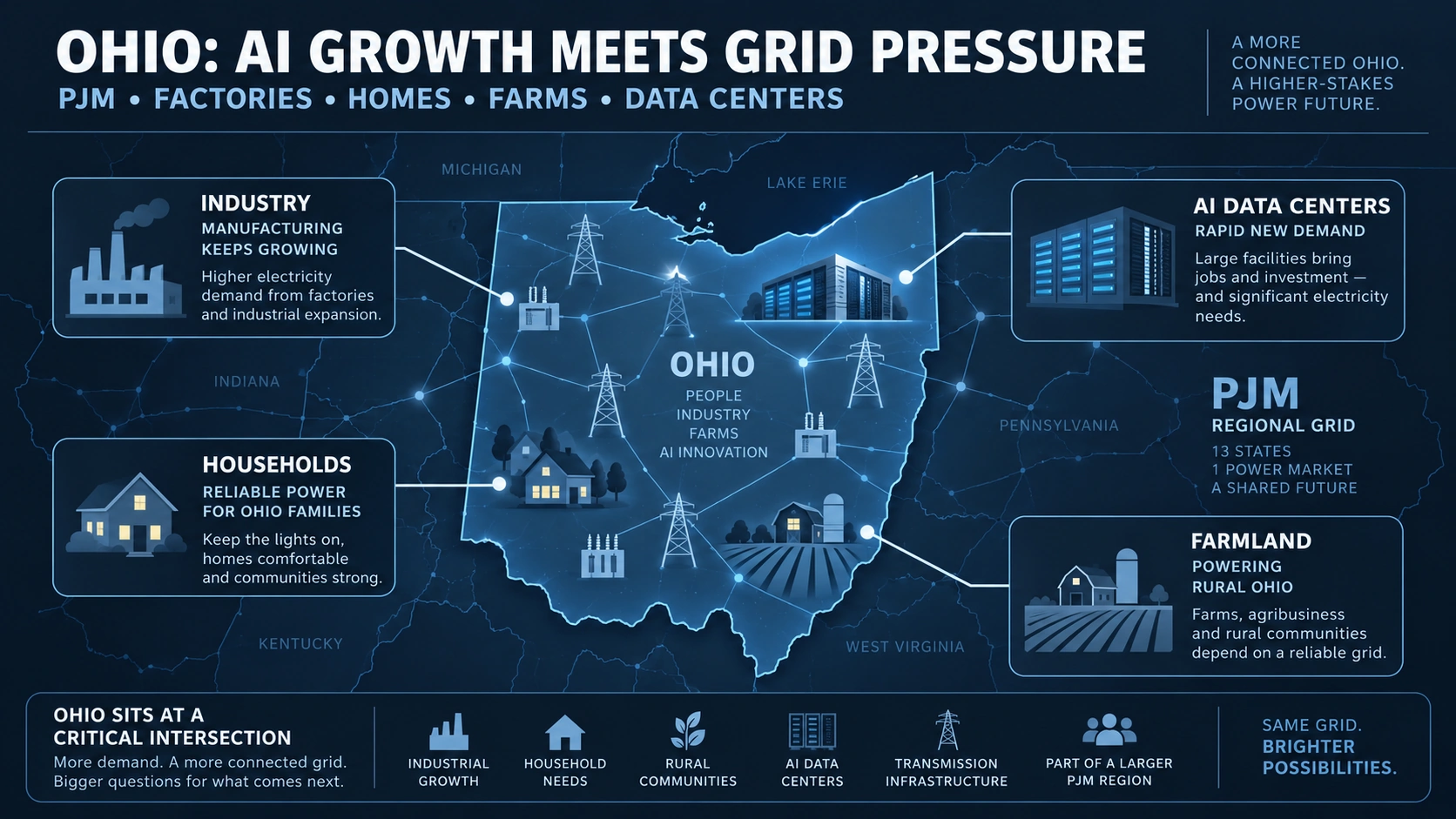
Because several different tensions are colliding there at the same time.
First, Ohio is part of PJM Interconnection, the regional power system that coordinates wholesale electricity across all or parts of 13 states and Washington, D.C.
PJM is facing unusually fast growth in electricity demand, much of it associated with data centers. In a September 29 order involving PJM’s proposed reliability backstop, Federal Energy Regulatory Commission member David Rosner said revised cost allocation should follow “cost causation” and assign costs to the zones responsible for data-center-driven resource shortfalls. He also emphasized that states and retail regulators must play a major role in setting large-load tariffs and collateral requirements. (FERC · Reuters)
Second, Ohio has spent years trying to attract major data-center investment.
The state has offered sales-tax exemptions on qualifying computer data-center equipment. But the cost of those incentives became politically explosive as AI investment accelerated.
On May 27, Gov. Mike DeWine directed the Ohio Tax Credit Authority to pause consideration of new data-center tax-exemption requests while a joint legislative committee studies the industry’s effects. The state said previously approved data centers had reported $27.2 billion in capital investment during 2025. AP separately reported that the projected 2025 cost of the tax exemption had climbed from an earlier estimate of $136 million to nearly $1.6 billion. (Ohio Governor’s Office · AP)
That changed the political question.
A few years ago, a giant technology investment could be presented mostly as economic development.
Now voters are asking for the other side of the ledger:
How much tax revenue is being given up?
How much electricity will the facility need?
What new infrastructure must be built?
Who pays for it?
And what does the surrounding community actually get in return?
Why Are Farmland and Water Part of an AI Debate?
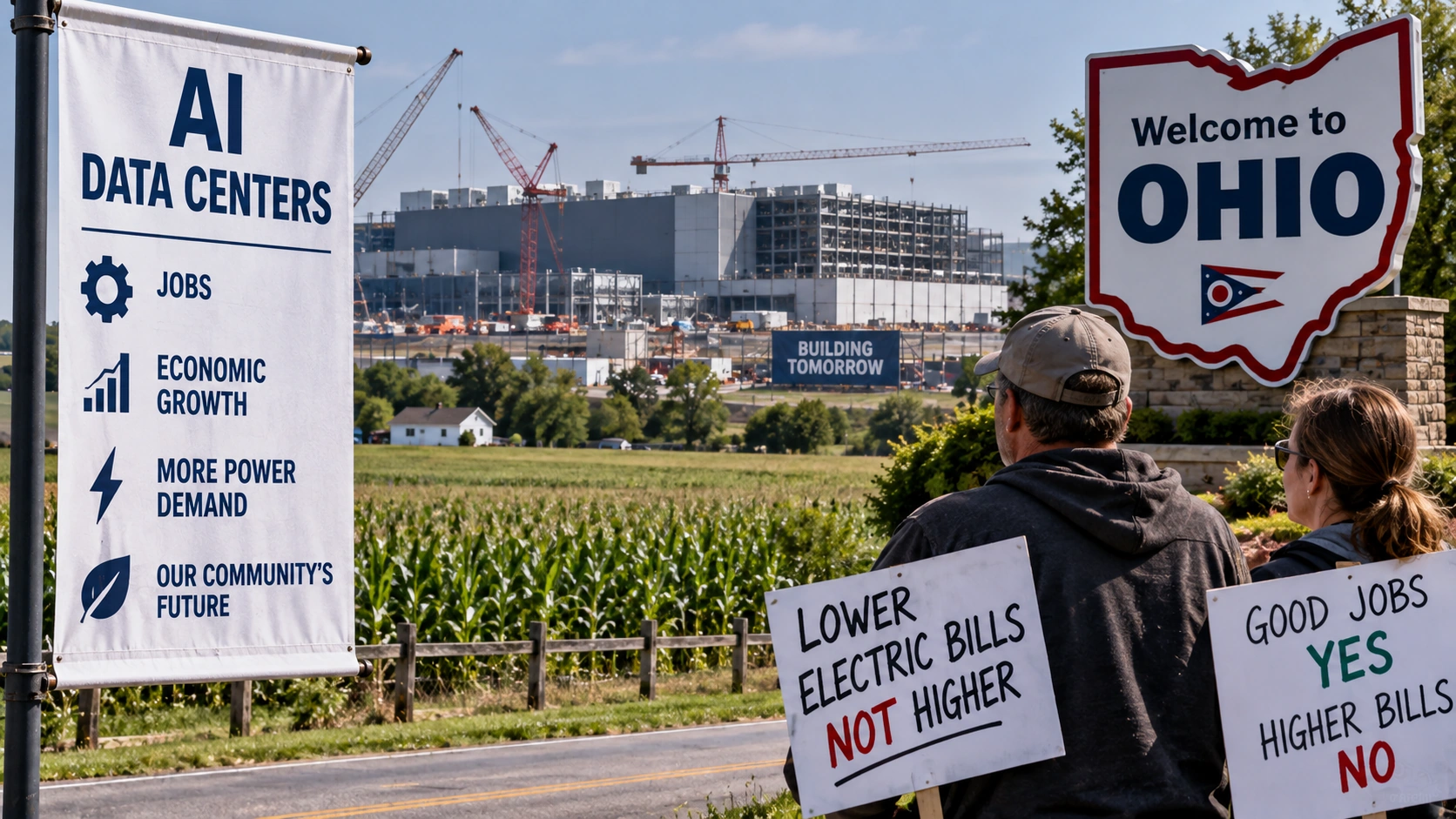
Because the “cloud” is not actually floating somewhere above us.
It sits in physical buildings.
Those buildings need land. They need power connections. Depending on the cooling system, they may also require significant water resources and water infrastructure. New campuses can require roads, substations, transmission corridors, and other local development.
That physical footprint is especially visible in rural communities where a proposed hyperscale campus may replace agricultural or undeveloped land.
Reuters reported in September that data-center backlash had become an election issue in rural northwestern Ohio, including Defiance, where residents were organizing around concerns involving farmland, electric-grid pressure, and tax incentives. (Reuters)
That does not mean every rural community opposes data centers.
Some residents welcome construction spending, local investment, tax revenue, and potential jobs. At Trump’s Vandalia rally, Reuters interviewed supporters on both sides of the issue: one voter said he was not enthusiastic about AI data centers, while another held a sign urging development of a data center in South Lorain. (Reuters)
That is exactly why the politics are becoming complicated.
The dividing line is no longer cleanly Republican versus Democrat.
A person can strongly support American leadership in artificial intelligence and still oppose a particular data center near their town.
Another person can worry about electricity prices but support a project if it brings enough investment and pays for the infrastructure it needs.
The local question is increasingly transactional:
What is this project bringing, what resources will it consume, and who carries the downside if the promises do not materialize?
Why Are Both Parties Saying Data Centers Should Pay—Yet Still Fighting?
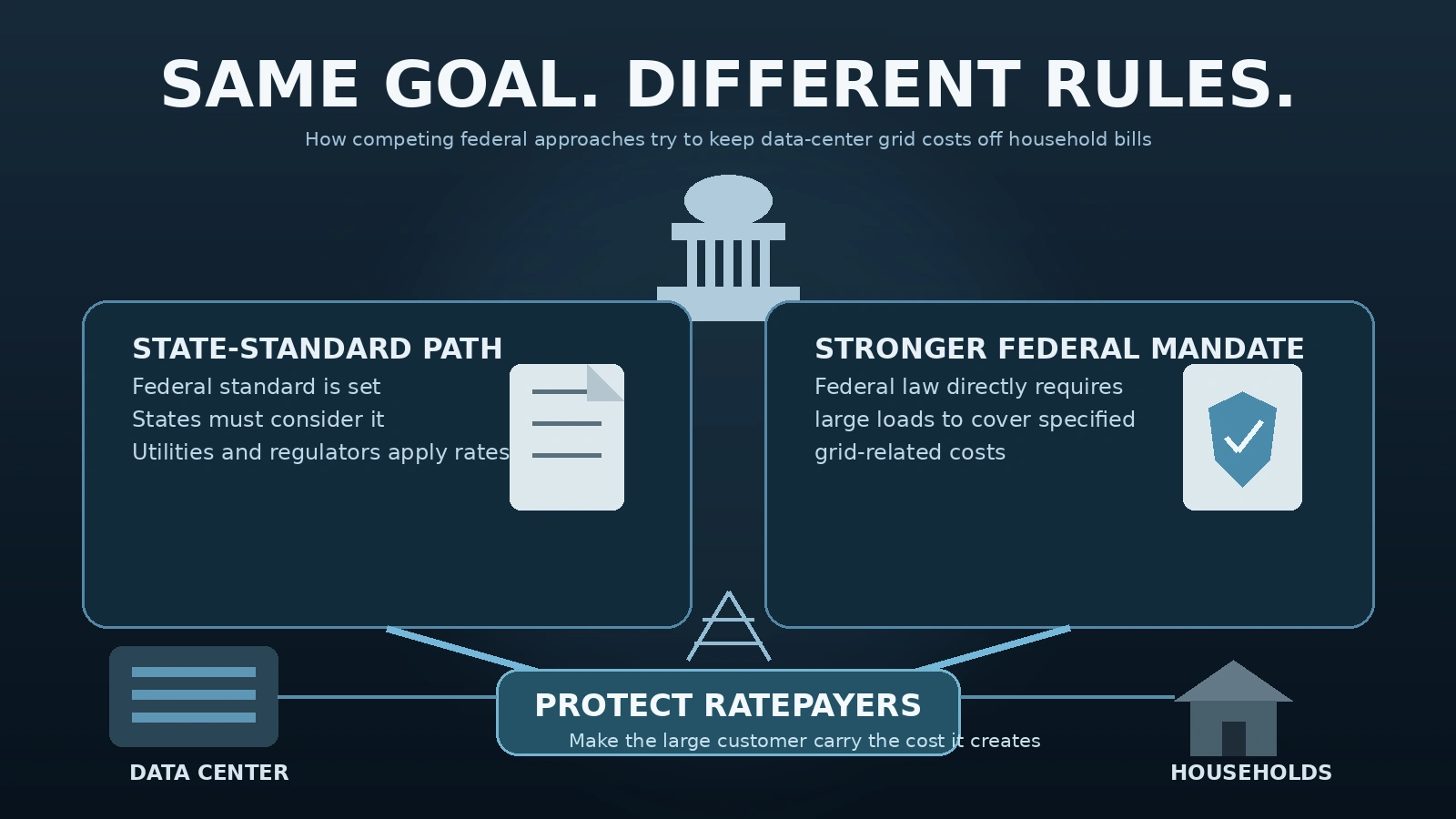
Because they agree more on the problem than the campaign rhetoric makes it sound.
Trump’s White House says data centers should supply or purchase the additional power they need and cover related infrastructure costs.
Husted’s legislation is built around the same basic principle.
Democrats including Heinrich also say large data centers should cover the grid costs they create.
The disagreement is over the legal machinery.
| Approach | Basic idea | Main dispute |
|---|---|---|
| White House Ratepayer Protection Pledge | Companies voluntarily commit to pay for power and infrastructure tied to new data centers | A pledge depends on participating companies, utilities, states, and negotiated rate structures |
| Husted’s Ratepayer Protection Act | States would have to consider a federal standard for very large electricity customers | Critics say “consider” does not guarantee the standards will be imposed |
| Stronger federal proposals | Require large-load customers to pay specified grid costs | Supporters want more enforceable national requirements; the details remain politically contested |
That helps explain why the September 30 Senate vote looked strange at first glance.
Democrats were voting against a bill called the Ratepayer Protection Act while simultaneously saying that data centers should pay more of their own infrastructure costs.
Their argument was not that ordinary customers should pay instead.
Their argument was that Husted’s mechanism was too weak.
Husted and Republicans, in turn, argued that Democrats had blocked an immediately available bipartisan House-passed measure that would have moved protections forward. (Reuters · Sen. Martin Heinrich)
That is the policy disagreement voters have to look through when they hear both sides say almost the same slogan.
Is This Really About AI—or About the Electric Grid?
Both.
AI is accelerating the demand.
But the underlying problem is older and more physical: America has to build electricity infrastructure much faster if enormous new loads are going to connect to the grid.
The servers may be sophisticated. The bottleneck can still be a power plant, transformer, transmission line, or substation.
That is also why Trump frames the issue as international competition.
His argument is that the United States needs domestic data-center capacity to remain ahead in AI, particularly against China. Turning away projects, he says, could mean giving up investment and technological leadership. (AP)
The local counterargument is not necessarily that America should stop building AI infrastructure.
It is that national AI policy does not erase local economics.
A town still has to decide what happens to land.
A utility still has to determine how new infrastructure gets financed.
A regulator still has to decide which customers pay which costs.
And a voter still sees one number at the end of all of this:
the monthly bill.
What Happens Next?
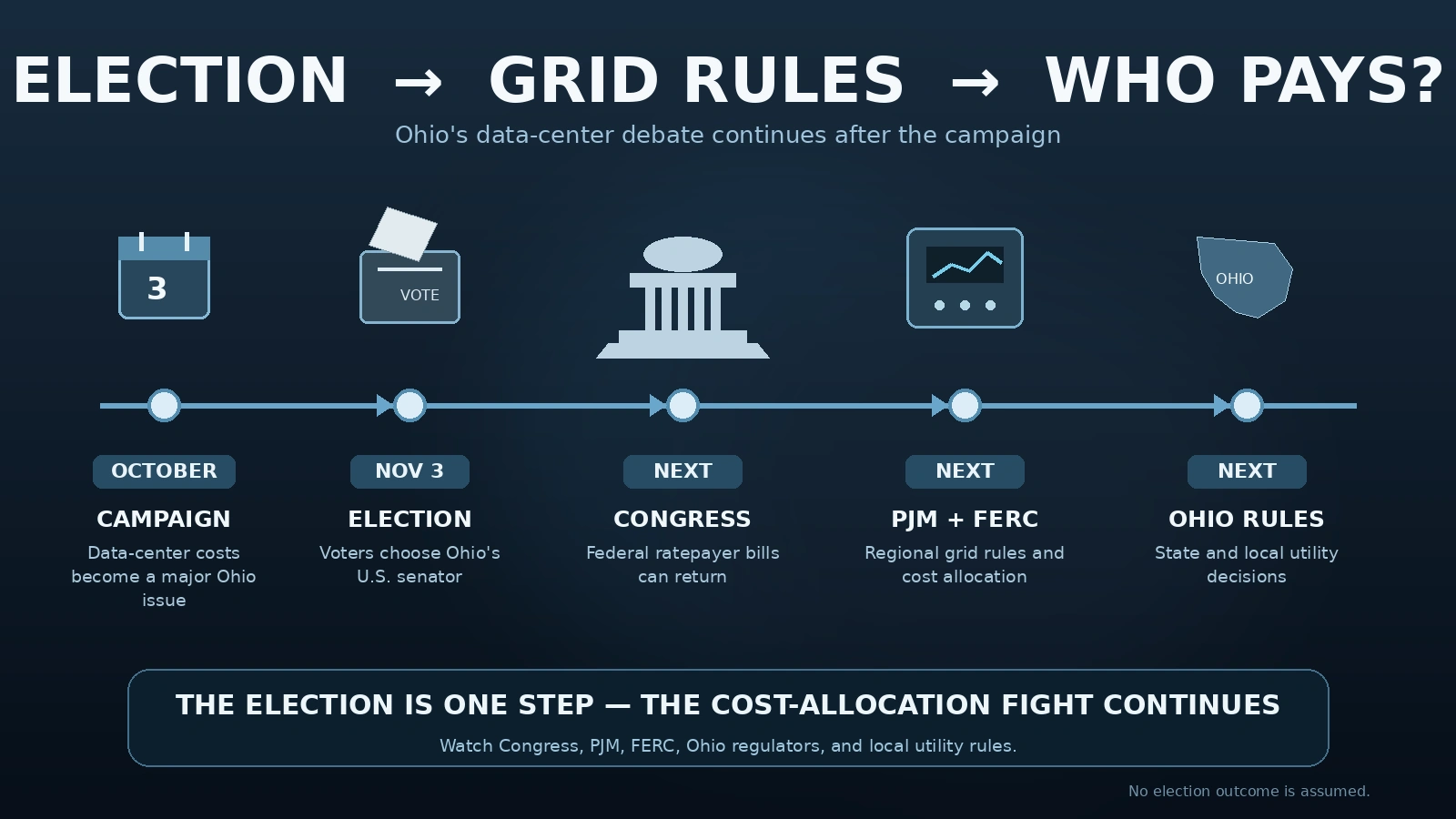
The first date is November 3, 2026.
Husted is trying to keep the Ohio Senate seat against Democrat Sherrod Brown, and the data-center issue gives both campaigns a way to turn AI policy into an affordability argument. Trump has placed himself firmly on the side of continued development while also backing policies intended to keep project-specific power costs off household bills. (AP · Reuters)
But the election will not settle the underlying issue.
Congress can revisit legislation after the midterms.
FERC and PJM still have to determine how enormous new electricity loads should be incorporated into a regional market without undermining reliability or unfairly shifting costs.
Ohio utility regulators will continue deciding how large customers are charged.
Local governments will keep making land-use decisions.
And technology companies will have to show whether promises to finance their own energy infrastructure work when individual projects are built.
That last part may matter most.
The AI boom will be much easier politically if communities believe the companies creating extraordinary new electricity demand are also paying the extraordinary costs required to serve it.
If households instead see higher bills, lost tax revenue, land-use conflicts, and benefits they cannot identify, opposition will become much harder to contain.
Bottom Line: What This Story Really Means
AI data centers have become an election issue because they are no longer just technology projects.
They are electricity projects, infrastructure projects, land-use projects, and increasingly household-cost issues.
A data center does not automatically raise your electric bill. What matters is whether the utility system must spend heavily to serve that facility—and whether regulators make the company creating the new demand pay an appropriate share of those costs and risks.
That is why Ohio has become such an important test.
Trump wants the United States to keep building infrastructure needed to compete in AI. Husted says data centers should grow without forcing ordinary customers to finance them. Democrats say they agree with the basic goal but want stronger mandatory protections.
The political argument sounds complicated.
The question underneath it is not:
If a giant AI company needs a giant new power system, who gets the bill?
AI Data Centers: Key Questions Explained
Q. Do AI data centers automatically increase household electricity bills?
No. A data center can contribute to higher electricity costs, but the effect depends heavily on how new generation, transmission, substations, and other infrastructure are financed and allocated among customers.
Q. Why do AI data centers use so much electricity?
Modern AI systems rely on large numbers of high-performance processors running in enormous server facilities. Those processors, networking systems, storage equipment, and cooling systems can create electricity demand on an industrial scale.
Q. What does “data centers should pay their own way” mean?
It generally means the company creating the large new electricity demand should bear the incremental cost of the generation and grid infrastructure needed to serve it rather than shifting those costs to existing households and businesses.
Q. What is the Ratepayer Protection Act?
It is legislation backed in the Senate by Sen. Jon Husted that would require states to consider a federal standard for allocating the incremental infrastructure costs of customers using 100 megawatts or more. The House passed the measure 417–3, but the Senate failed to advance it on September 30 after a 57–43 cloture vote fell short of the required 60 votes.
Q. Why did Democrats oppose a bill that says it protects ratepayers?
Democratic critics said the proposal was not enforceable enough because it requires states to consider standards rather than directly imposing them. They have supported stronger approaches that would require large data-center customers to pay specified grid-related costs.
Q. Why is Ohio particularly important in the data-center debate?
Ohio combines rapid data-center development, major industrial electricity users, participation in the PJM regional power market, controversial tax incentives, rural land-use disputes, and one of the country’s competitive 2026 Senate races.
Q. Why are farmers and rural residents involved?
Large data-center campuses are physical developments requiring substantial land and infrastructure. In parts of Ohio, residents have raised concerns about farmland, electricity demand, water, tax incentives, and whether local benefits justify the project’s footprint.
Q. Is Trump opposing rules that make data centers pay their own costs?
No. Trump has strongly supported data-center expansion while also promoting the Ratepayer Protection Pledge, under which participating technology companies commit to cover new electricity supply and infrastructure costs tied to their facilities.
Q. What should electricity customers watch next?
Watch utility rate structures, PJM and FERC cost-allocation decisions, state rules for very large power users, and whether companies actually finance the generation and grid upgrades promised for new data-center projects.
Did this help make the story clearer? 🙂 WIN keeps unpacking the “why” behind the news—clearly and simply!
Sources
Ohio Rally and the 2026 Election Fight
AP — Trump Defends Data Centers in Ohio as He Rallies to Boost Jon Husted
Reuters — Trump Campaigns in Ohio as Data Centers Become an Election Issue
Reuters — Data Center Backlash Spreads Through Rural Ohio and the Midwest
Electricity Costs and Grid Infrastructure
Federal Energy Regulatory Commission — Commissioner Rosner on PJM’s Reliability Backstop Procurement
Reuters — FERC Tells PJM to Rework Data Center Cost Protections
Reuters — Big Tech Data Centers Drive Up Power Costs for Rust Belt Manufacturers
Ohio Consumers’ Counsel — The Cost of Your Cloud: Data Centers in Ohio
Ratepayer Protection and the Congressional Debate
White House — Ratepayer Protection Pledge
Sen. Jon Husted — Ratepayer Protection Act
Congressional Record — September 30, 2026 Senate Proceedings
Sen. Martin Heinrich — Statement on the Ratepayer Protection Act Vote
Ohio Tax Incentives and Data Center Expansion
Ohio Governor’s Office — Governor DeWine Announces Pause of Data Center Tax Exemption
AP — Ohio Suspends Data Center Tax Break as Tech Firms Face Pressure Over AI Power Costs
Keep Reading
How are other states trying to stop data-center costs from reaching households?
Ohio is not alone. Texas and California have taken very different political approaches but are wrestling with the same basic problem: how to let data centers expand without transferring project-specific power and water costs to everyone else.
Why Are Texas and California Putting New Limits on Data Centers—and Who Pays for the Power?
What happens when an AI campus is so large that it needs its own power system?
The Ohio fight is largely about how giant new loads connect to the existing grid. A Texas project shows another model: pairing a multi-gigawatt computing campus with an enormous new power complex built beside it.