Why Is Yemen’s War Escalating Again—and Why Does the Bab el-Mandeb Strait Matter to Americans?

Wasn’t Yemen’s war supposed to have calmed down?
For several years, the front lines were much quieter than during the worst period of the civil war. A U.N.-brokered truce in 2022 formally expired but largely held for years. Then the fighting surged again in 2026, with Houthi forces pushing down Yemen’s Red Sea coast and the internationally recognized government launching a major counteroffensive.
The most important part of this story is not simply that another battle has begun. The fighting is centered around one of the narrow sea passages connecting Asia, the Middle East and Europe.
That passage is the Bab el-Mandeb Strait.
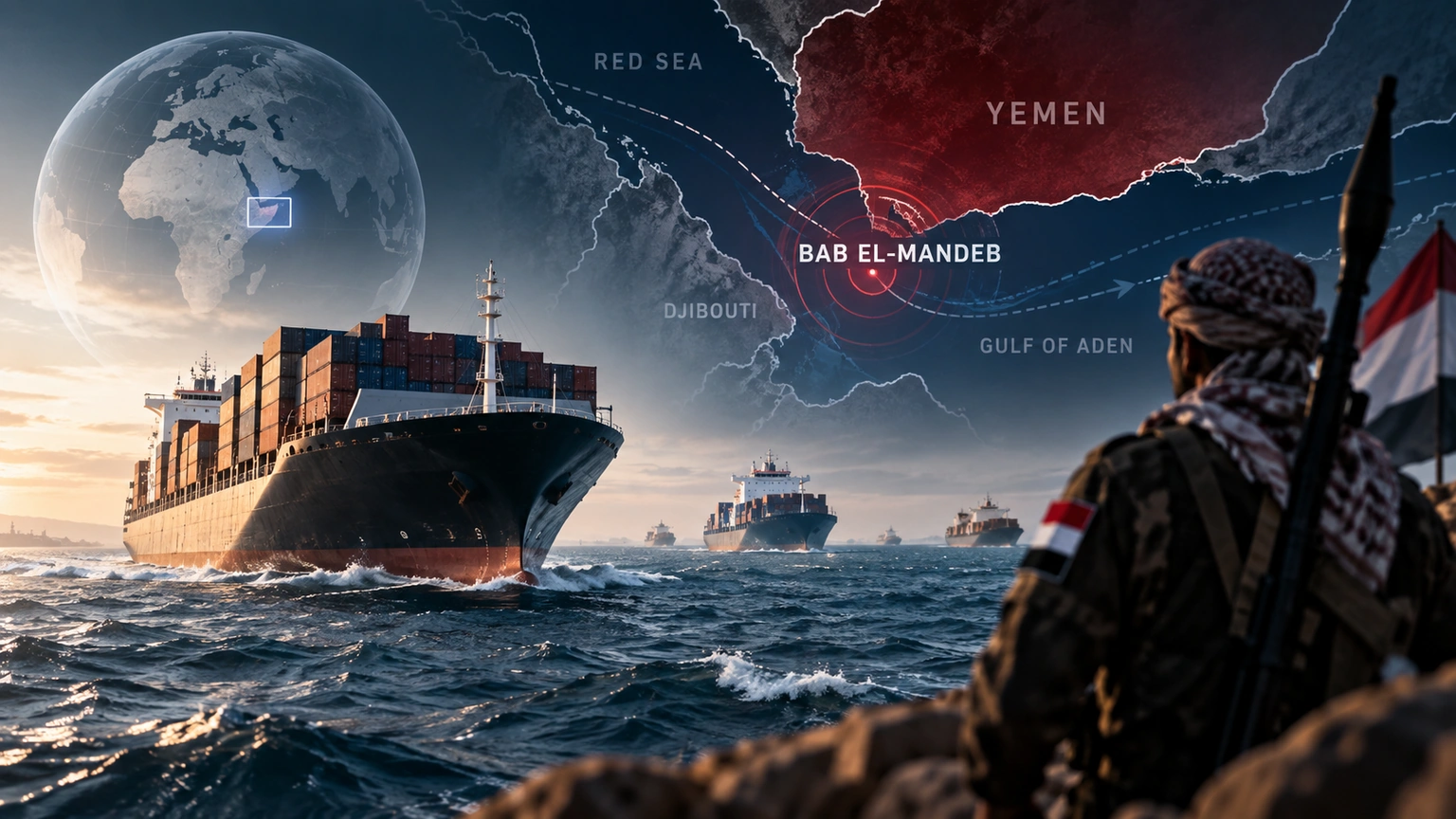
※ Images in this article are AI-generated illustrations created to help explain the story. They are not actual photographs, and depictions of people, places, or events may differ slightly from reality.
On October 4, Yemen’s Saudi-backed government announced a campaign to retake Houthi-held territory. On October 5, government-aligned forces reported rapid gains around Bab el-Mandeb and toward Mokha. By October 6, Yemen’s information minister was telling Reuters that government forces had secured “effective control” of the strait, although fighting was still continuing and the Houthis disputed the government’s account. Reuters said it could not independently verify the full extent of the gains. (Reuters, October 4 · Reuters, October 5)
So why has Yemen’s long-running war suddenly become a shipping and energy story again?
What Actually Changed on October 4 and 5?
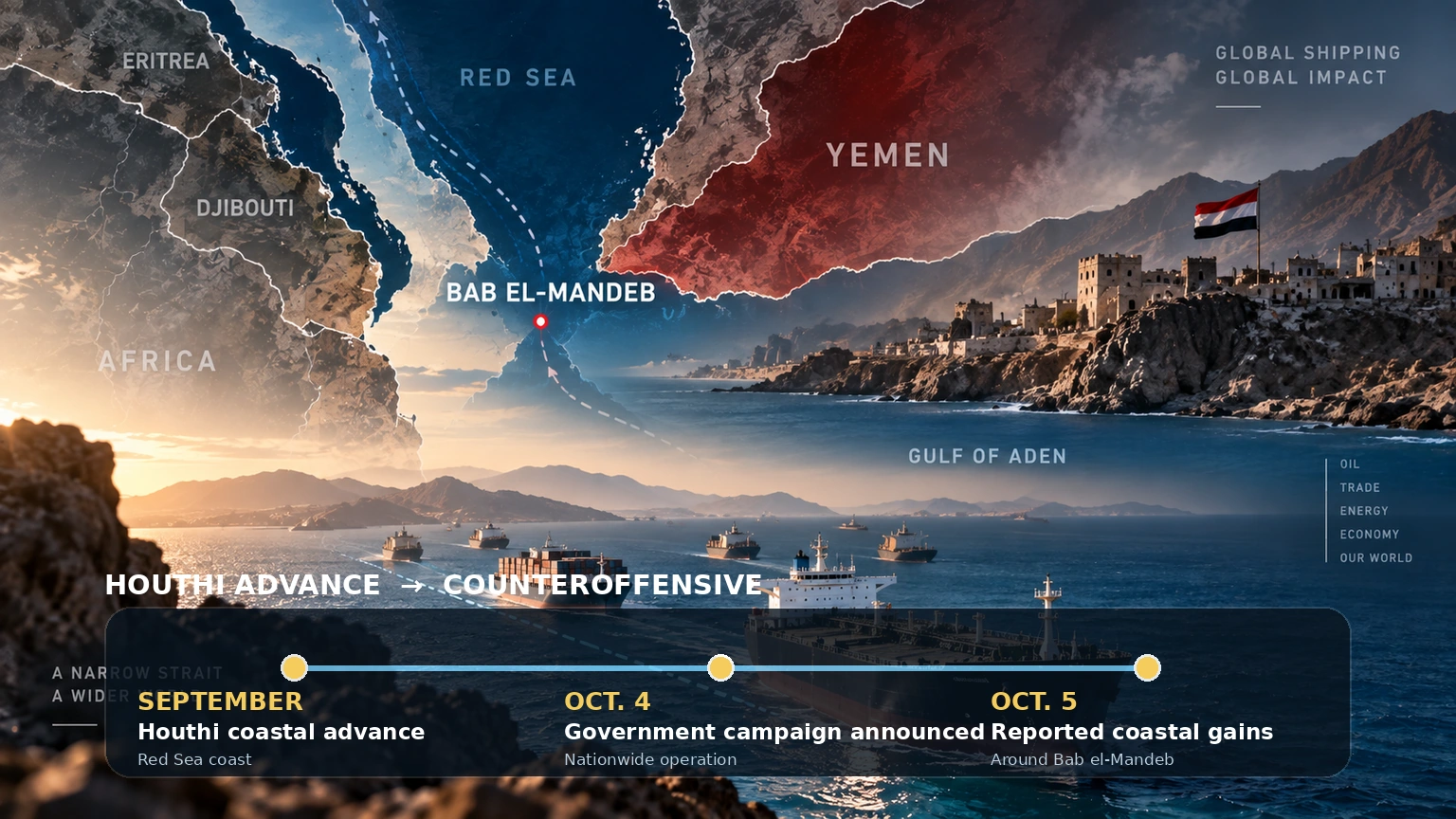
October 4 was the announcement of the nationwide campaign. October 5 brought the most visible reported ground gains around the strait.
Yemeni President Rashad al-Alimi, who heads the internationally recognized government’s Presidential Leadership Council, announced on October 4 that government forces would begin operations to retake remaining Houthi-held territory and restore state authority across the country. (Reuters)
On October 5, Saudi-backed forces said they retook Dhubab and other positions around Bab el-Mandeb under heavy Saudi air support. Associated Press reporters cited Yemeni officials and witnesses who said government forces entered Dhubab, Bab and Hadeid. Reuters later reported that government forces reached the outskirts of Mokha and that Yemen’s Defense Ministry said the city had fallen. (AP · Reuters)
But there is an important caution.
Reuters said it could not independently verify the full extent of the government’s gains, and Houthi-aligned media denied that government forces had advanced as far as claimed. The safest description is therefore that the government says it has regained effective control around the strait while fighting and competing battlefield claims continue.
| Date | What happened | Why it mattered |
|---|---|---|
| September 2026 | Houthis rapidly expanded along Yemen’s Red Sea coast and seized Mokha and other strategic positions | They gained far more leverage over the Yemeni side of Bab el-Mandeb |
| October 4 | Yemen’s government announced a major campaign to retake Houthi-held territory | Riyadh-backed forces shifted into a broad counteroffensive |
| October 5 | Government forces reported recapturing key positions around Bab el-Mandeb and advancing toward Mokha | The military balance around the shipping chokepoint changed quickly |
| October 5–6 | Government officials said they had regained effective control, while the Houthis disputed the scale of the advance | Control claims remain contested even as government forces appear to have made major gains |
The fighting is not moving in only one direction.
Reuters also reported Houthi advances around Taiz while government forces were moving along the coast. That means success around Bab el-Mandeb does not automatically translate into a broader Houthi collapse. (Reuters)
Why Did Yemen’s War Flare Up Again After Years of Relative Calm?
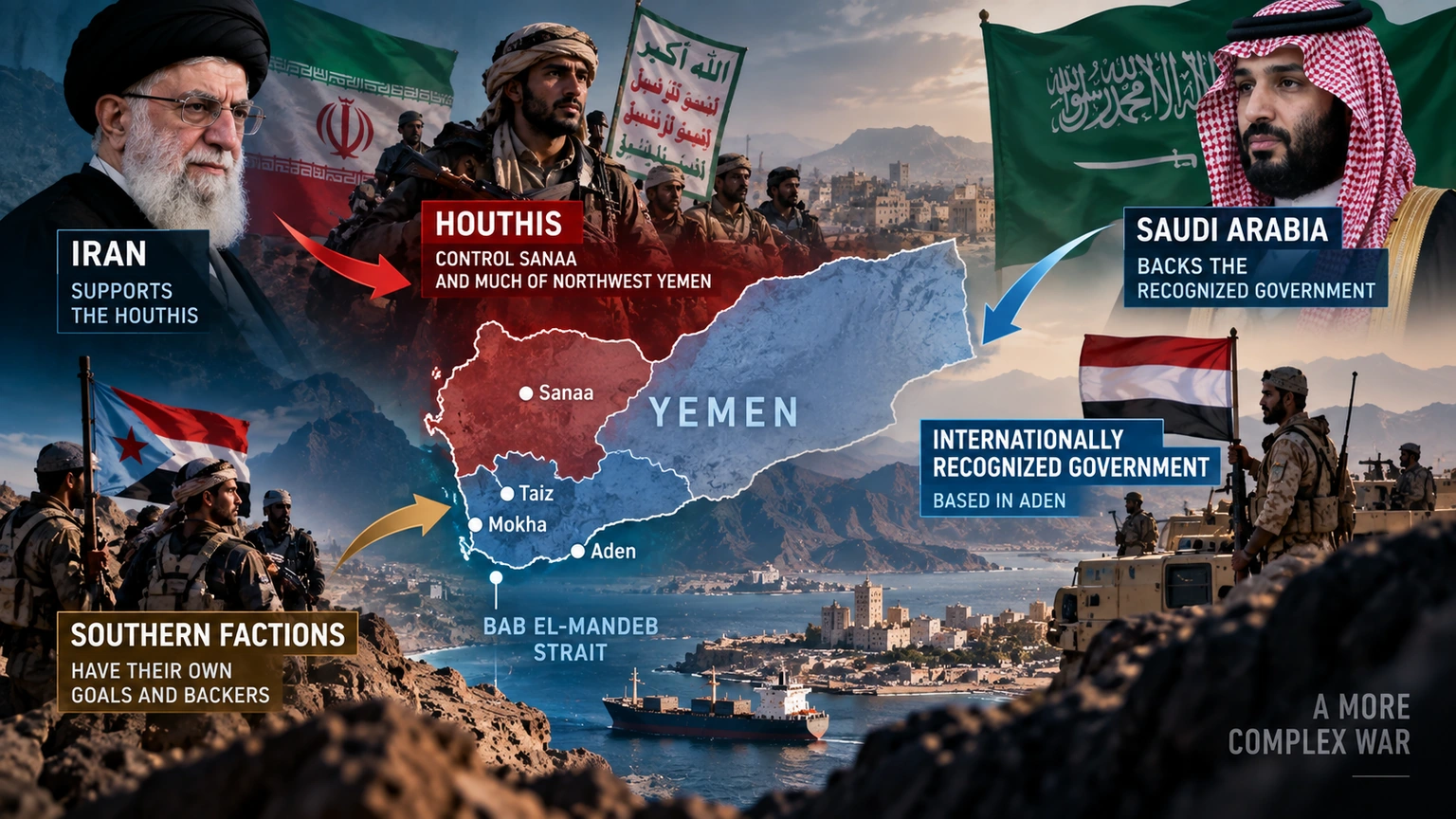
Yemen’s conflict never truly disappeared. The large-scale front lines became quieter after the 2022 U.N.-brokered truce, but the political settlement was never completed.
The Houthis, formally known as Ansar Allah, have controlled the capital, Sanaa, and much of Yemen’s populous northwest since 2014. Saudi Arabia entered the war in 2015 at the head of a coalition supporting the internationally recognized government. (Reuters)
The anti-Houthi side is not one perfectly unified bloc. Yemen’s internationally recognized government operates through the Presidential Leadership Council, while southern and regional armed factions have their own political interests and outside backers.
That weakness became especially important when the Houthis launched a fast coastal offensive in September.
Reuters reported that the Houthi advance exposed serious divisions and miscalculations among their opponents and gave the movement new leverage near Bab el-Mandeb. The advance also unfolded as the wider U.S.-Iran conflict was already disrupting Middle Eastern energy routes. (Reuters)
The new government offensive is therefore partly an attempt to reverse a sudden military setback.
But it is also about something larger: preventing the Houthis from turning control of coastal territory into long-term leverage over shipping and Saudi energy security.
Why Is the Bab el-Mandeb Strait Such a Big Deal?
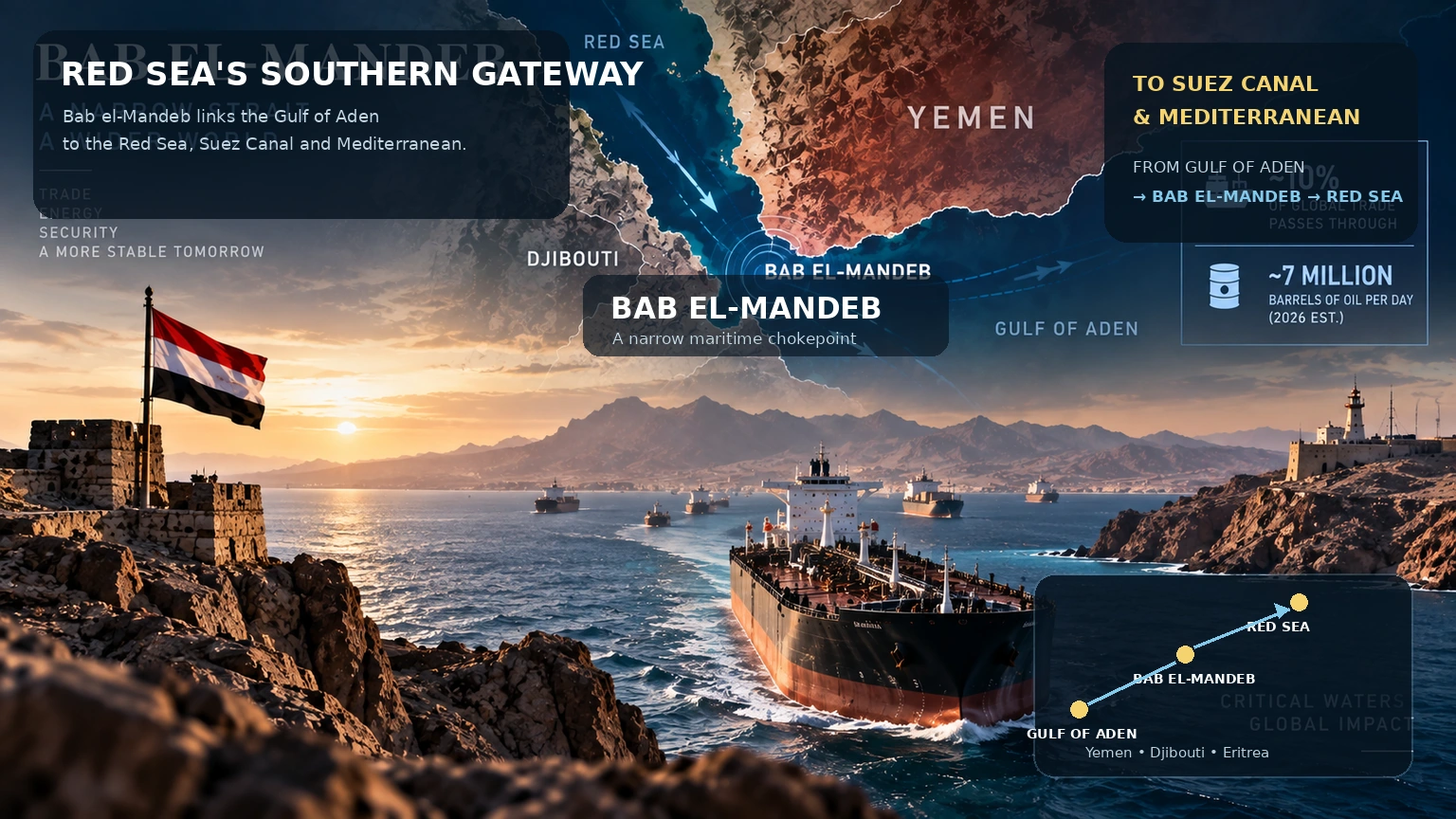
Bab el-Mandeb is the southern gateway to the Red Sea.
The strait sits between Yemen on the Arabian Peninsula and Djibouti and Eritrea on the Horn of Africa. Ships moving between the Indian Ocean and the Suez route toward Europe pass through this corridor unless they take the much longer route around the Cape of Good Hope.
That is why Bab el-Mandeb is called a maritime “chokepoint”: a large amount of trade is funneled through a relatively narrow geographic space.
The U.S. Energy Information Administration estimated that 8.1 million barrels per day of crude oil and petroleum liquids passed through Bab el-Mandeb in the second quarter of 2026, up from 5.4 million barrels per day in the fourth quarter of 2025. The increase came as traffic through the Strait of Hormuz fell sharply during the wider regional conflict, making Red Sea routes even more important. (EIA)
That makes the current fighting unusually consequential.
If ships avoid Bab el-Mandeb, many must sail around the southern tip of Africa. That adds time, fuel use, vessel demand and often insurance and freight costs.
Isn’t the Strait of Hormuz the More Important Oil Route?
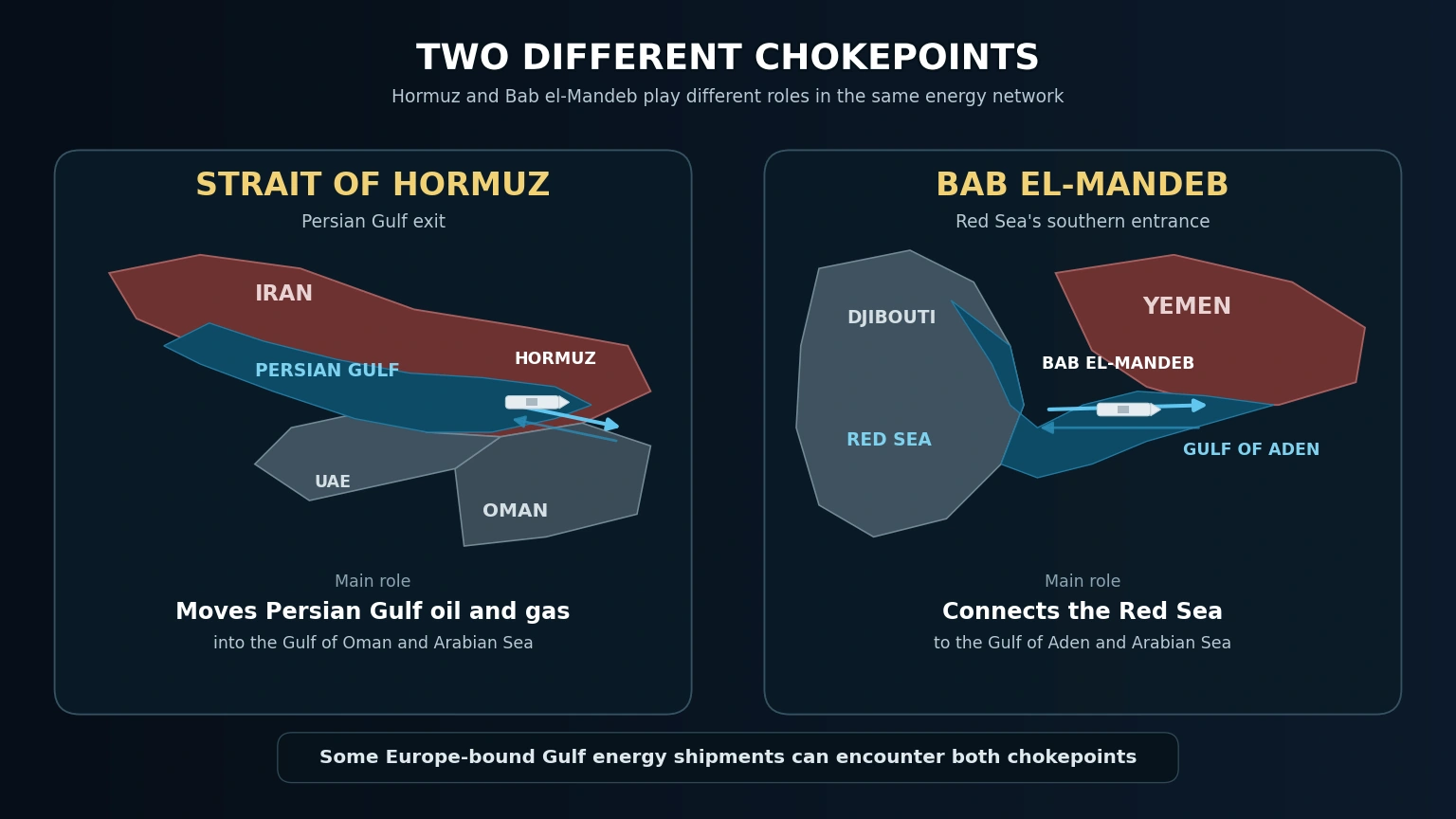
Normally, Hormuz is the larger and more famous oil chokepoint. But the 2026 conflict temporarily changed the traffic pattern so dramatically that Bab el-Mandeb carried more oil than Hormuz in the second quarter.
EIA estimated 4.9 million barrels per day moving through Hormuz in the second quarter of 2026, compared with 8.1 million barrels per day through Bab el-Mandeb. That was a crisis-driven reversal, not a permanent change in the geography of world energy trade. (EIA)
The two straits still perform different jobs.
| Chokepoint | Where it is | What it connects |
|---|---|---|
| Strait of Hormuz | Between Iran and Oman | Persian Gulf to the Gulf of Oman and Arabian Sea |
| Bab el-Mandeb Strait | Between Yemen and the Horn of Africa | Red Sea to the Gulf of Aden and Arabian Sea |
| Suez Canal | Egypt | Red Sea to the Mediterranean |
A simple way to picture it is this:
Hormuz is the Persian Gulf’s front door. Bab el-Mandeb is the Red Sea’s southern door.
Some Persian Gulf oil headed toward Europe may encounter both Hormuz and Bab el-Mandeb before continuing north through the Red Sea and Suez.
Saudi Arabia has another option. Its East-West Pipeline can move crude overland from its eastern oil fields to Yanbu on the Red Sea, allowing some exports to bypass Hormuz.
But that does not eliminate every maritime risk.
Oil leaving Yanbu for Asian markets may still need to travel south through Bab el-Mandeb. Instability anywhere along the Red Sea corridor can also affect tanker availability, insurance costs and shipping decisions.
That is what makes the current Yemen fighting unusually important: a route that became more valuable when Hormuz was disrupted is now under military pressure of its own.
Could Fighting in Yemen Really Affect U.S. Gas Prices?
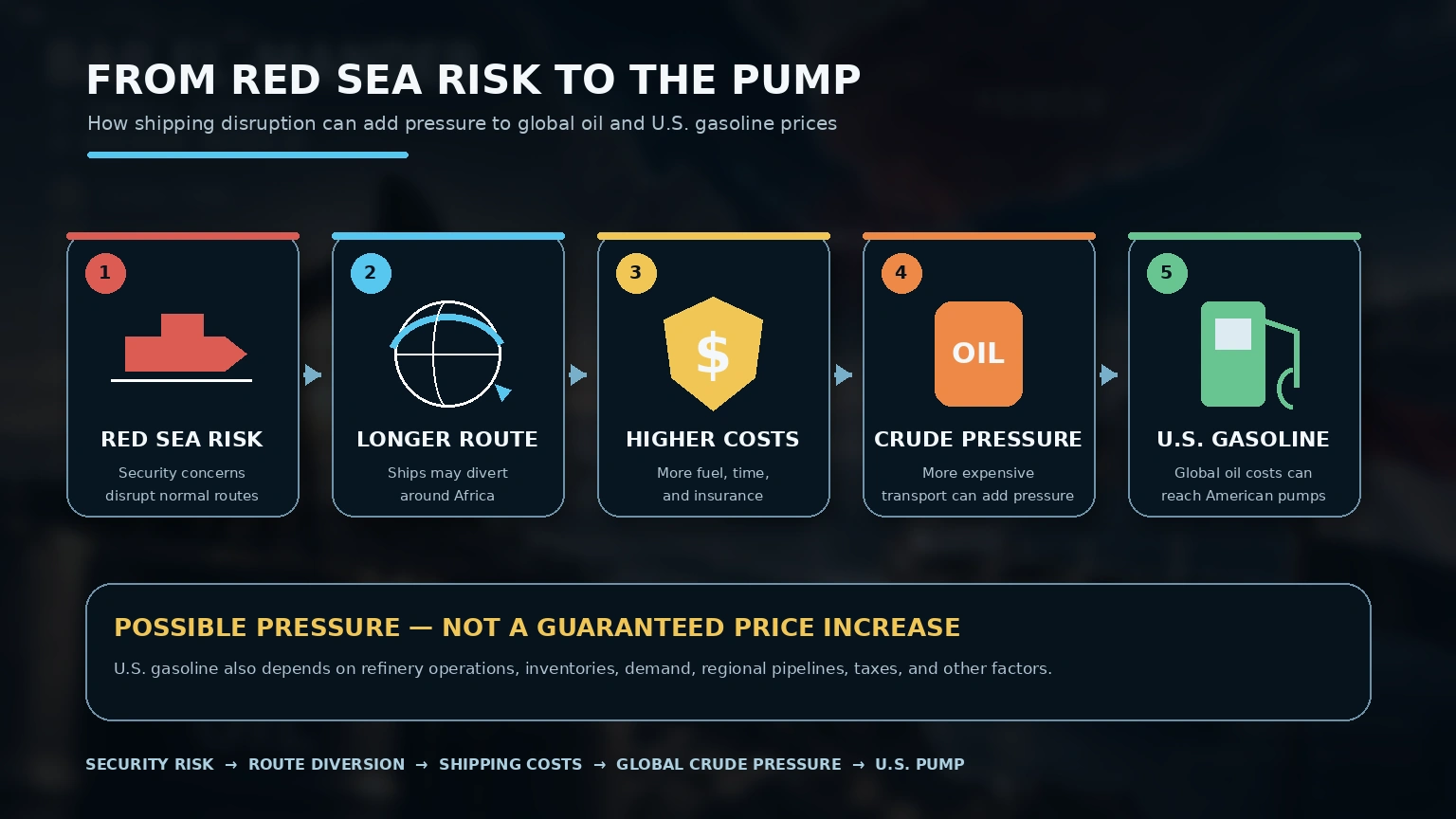
Yes—but not in the simple sense that one battle in Yemen automatically adds a certain number of cents to a gallon of gasoline.
The effect works through the global oil and shipping system.
If ships consider Bab el-Mandeb too dangerous, they can divert around the Cape of Good Hope at the southern end of Africa. That means longer trips, more fuel, fewer ships available for other routes and potentially higher freight and insurance costs.
EIA has documented how disruptions at major chokepoints can delay supply and increase shipping costs. In 2026, it also identified Bab el-Mandeb as an increasingly important alternative route while Hormuz traffic was severely disrupted. (EIA)
Those costs can feed into global petroleum prices.
And even though the United States produces large amounts of oil domestically, U.S. crude and gasoline prices are still connected to global markets. A major disruption that makes Middle Eastern barrels more expensive or difficult to deliver can therefore add pressure at American gas stations.
But the word “add” matters.
U.S. gasoline prices are also affected by refinery operations, inventories, seasonal demand, crude quality, regional pipelines, taxes and other factors.
So the correct chain is not:
Yemen fighting → U.S. gas prices automatically rise.
It is:
Yemen fighting → greater shipping risk → possible diversions and higher transportation costs → tighter or more expensive global oil supply → potential upward pressure on U.S. fuel prices.
Have Government Forces Made the Shipping Route Safe Again?
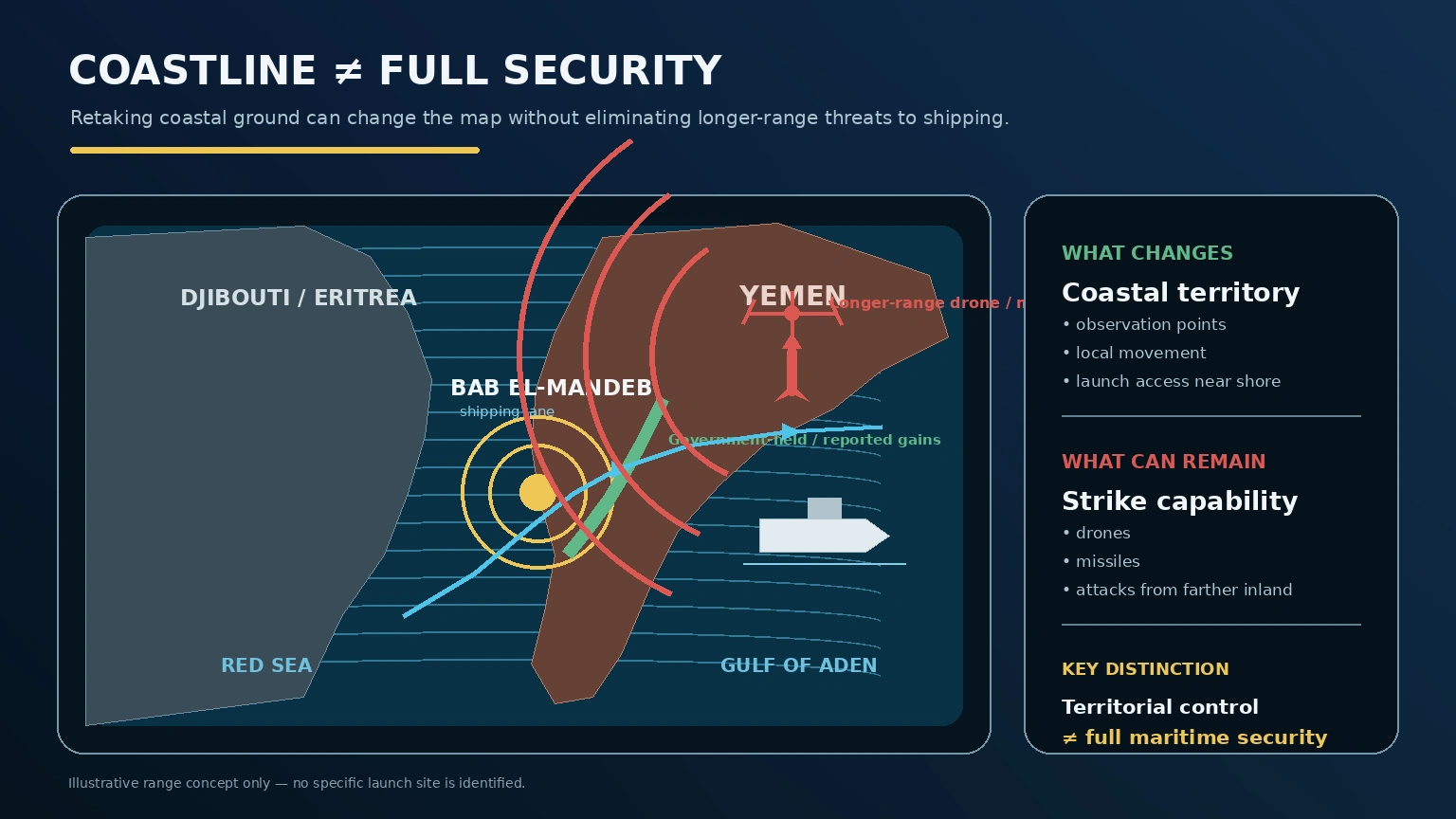
No.
Retaking ground beside a shipping lane is not the same thing as removing every threat to ships using that lane.
By October 6, Yemen’s information minister said government forces had secured effective control of Bab el-Mandeb, but Reuters reported that fighting continued nearby and that another government source said combat was still underway at a military base near the strait. The Houthis disputed the scale of the government advance. (Reuters)
Reuters also noted that even if government forces push the Houthis away from the immediate coastline, the group could still threaten vessels with drones from other positions.
This distinction matters because modern anti-ship warfare does not always require forces to stand directly beside the water.
Control of Dhubab and nearby coastal positions can make surveillance, movement and weapons deployment harder for the Houthis. But it does not erase longer-range capabilities overnight.
The situation is also fluid on land.
While Saudi-backed forces reported gains around Bab el-Mandeb and Mokha, the Houthis were simultaneously pressing around Taiz. A headline saying government forces “retook” the strait therefore should not be read as meaning:
The Red Sea shipping crisis is over.
It means the military balance around one of the region’s most sensitive corridors has changed again.
What Is This Renewed War Doing to Yemenis?
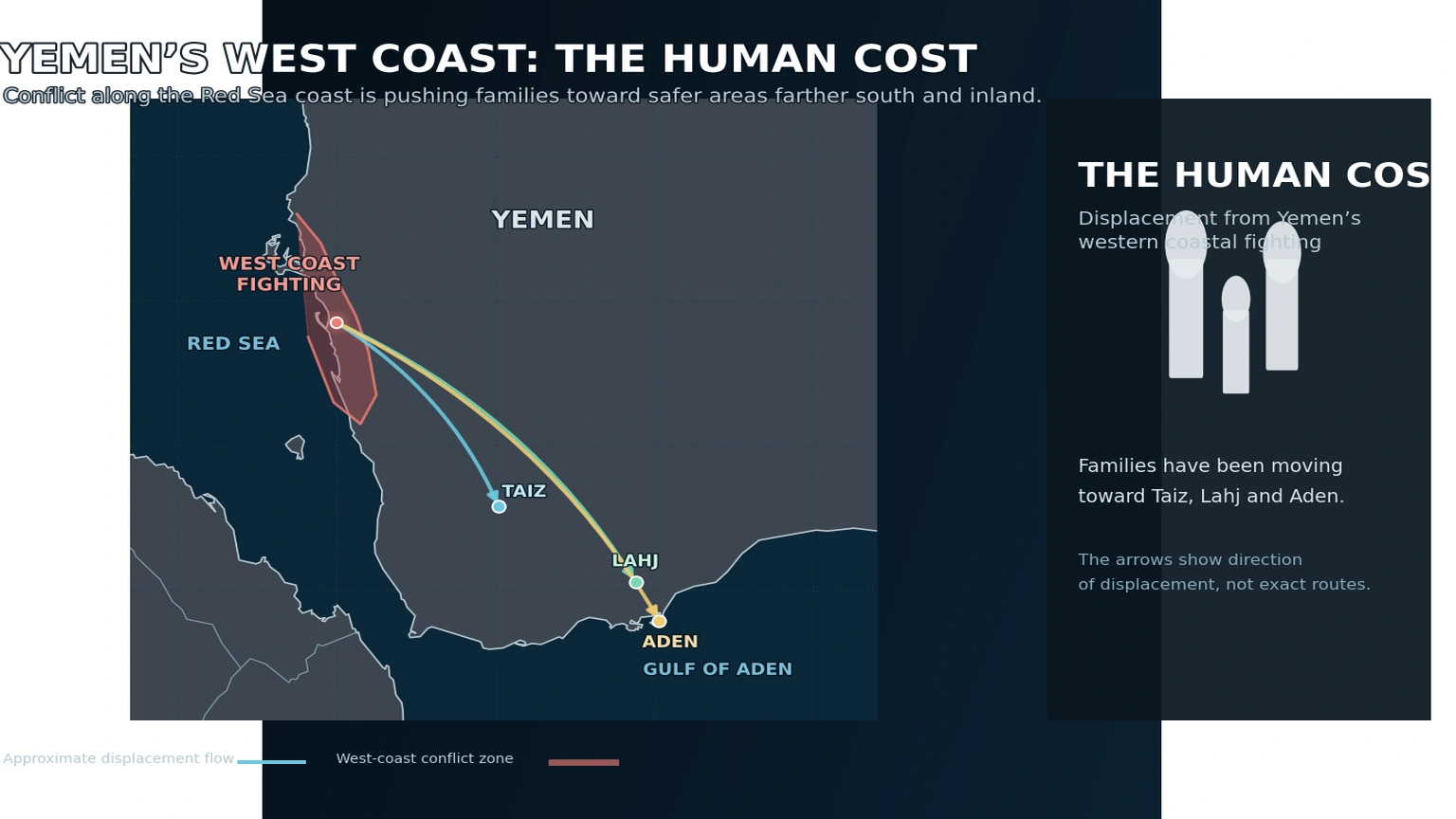
The shipping route may explain why the world is paying attention, but Yemenis are paying the direct price.
The International Organization for Migration reported that by September 29, 152,856 people had been displaced since the west-coast escalation began in June 2026, with the largest concentrations in Taiz, Lahj and Aden. (IOM)
As the fighting intensified, later news reports produced still higher snapshots. Reuters reported about 184,000 people displaced since fighting resumed, while AP reported more than 174,000 displaced, citing humanitarian officials. Those figures use different reporting moments and should not be read as one perfectly synchronized count. (Reuters · AP)
AP also reported at least 959 people killed and more than 4,200 wounded in the renewed violence, citing the World Health Organization, while health facilities in parts of Taiz province were closed or barely functioning. (AP)
Those figures are a reminder of what can disappear from an energy-market headline.
Bab el-Mandeb matters to global shipping.
For Yemenis living around the front lines, the more immediate question is whether roads remain open, hospitals can function, food can reach communities and families have somewhere safe to go.
What Should Americans Watch Next?
There are five developments that will show whether this becomes a short counterattack or a much larger regional escalation.
First, watch whether the government can hold Bab el-Mandeb and Mokha. A rapid advance matters less if positions change hands again or the government cannot secure the coast for long.
Second, watch Taiz. Houthi gains there could offset government successes on the coast and force Saudi-backed forces to fight on multiple fronts.
Third, watch Houthi attacks on Saudi Arabia. The group has claimed missile and drone attacks against Saudi infrastructure, while Saudi forces have intensified strikes inside Yemen. Further attacks on oil facilities, airports or other strategic sites would broaden the economic impact.
Fourth, watch commercial shipping behavior. The important signal is not just who controls a town on a map. It is whether shipping companies, insurers and tanker operators become more or less willing to use the Red Sea route.
Finally, watch oil prices together with Hormuz. Bab el-Mandeb became even more important in 2026 precisely because traffic through Hormuz was disrupted. Trouble at one chokepoint can sometimes be rerouted. Trouble at several routes at once is far harder to absorb.
That is why a battle in southwestern Yemen can matter far beyond Yemen.
Bottom Line: What This Story Really Means
Yemen’s latest escalation is not simply a restart of an old civil war.
The Houthis’ September advance gave them far greater leverage along Yemen’s Red Sea coast and around Bab el-Mandeb. On October 4, the internationally recognized government announced a broad campaign to reverse those gains. On October 5, Saudi-backed forces reported major advances, and by October 6 government officials were claiming effective control of the strait—claims the Houthis disputed and Reuters could not fully verify.
Bab el-Mandeb matters because it is the southern gateway to the Red Sea and the Suez route. In 2026, it became even more important as disruption at Hormuz shifted more oil traffic toward alternative routes.
If insecurity forces ships to avoid the corridor, voyages become longer and more expensive. That can add pressure to global oil and shipping costs and, indirectly, to what Americans pay for fuel and goods.
Government gains on the coast may reduce some Houthi leverage, but they do not automatically eliminate missile and drone threats—and they do not mean Yemen’s war is close to ending.
The most important thing to watch now is whether the government can turn its rapid advance into durable control of the coast without opening an even larger and longer phase of the war.
Bab el-Mandeb Strait: Key Questions Explained
Q. What is the Bab el-Mandeb Strait?
The Bab el-Mandeb Strait is the narrow waterway connecting the Red Sea with the Gulf of Aden and Arabian Sea. It sits between Yemen and the Horn of Africa and is a major route for ships traveling between Asia, the Middle East and Europe.
Q. Did the Houthis control the entire Bab el-Mandeb Strait?
Not in the sense of physically controlling every vessel or the entire waterway. The Houthis captured important coastal territory, islands and positions on the Yemeni side, giving them far greater leverage over the security of the route.
Q. What happened in Yemen on October 4, 2026?
Yemen’s internationally recognized government announced a major campaign on October 4 aimed at recapturing Houthi-held territory and restoring state authority across the country. The largest reported ground gains around Bab el-Mandeb came the following day.
Q. What did Saudi-backed forces capture on October 5?
Government-aligned forces said they retook key positions around Dhubab and advanced along the coast toward Mokha. Reuters said it could not independently verify the full extent of the government’s battlefield claims.
Q. Does Yemen’s government now control Bab el-Mandeb?
Yemen’s information minister said by October 6 that government forces had secured effective control of the strait, but fighting was still continuing nearby and the Houthis disputed the claim. The situation should therefore be treated as contested rather than fully settled.
Q. What is the difference between Bab el-Mandeb and the Strait of Hormuz?
The Strait of Hormuz is the maritime exit from the Persian Gulf. Bab el-Mandeb is the southern entrance to the Red Sea. They are separate chokepoints, but disruptions at one can make the other more important.
Q. Could fighting around Bab el-Mandeb raise U.S. gasoline prices?
It can contribute to upward pressure if shipping becomes more dangerous, slower or more expensive. But U.S. gasoline prices also depend on crude prices, refinery capacity, inventories, demand, taxes and regional supply conditions.
Q. Is Bab el-Mandeb safe now that government forces have reported major gains?
Not necessarily. Control of coastal ground can reduce one kind of threat, but Houthi drones and missiles may still be able to threaten shipping from other positions.
Q. Why is Saudi Arabia so involved in Yemen?
Saudi Arabia backs Yemen’s internationally recognized government and views the Iran-backed Houthis as a major security threat along its southern border and to regional shipping and energy infrastructure.
Q. Is Yemen’s civil war over if Bab el-Mandeb is secured?
No. Fighting continues on other fronts, including around Taiz, and Yemen’s political divisions remain unresolved. Securing the coast would change the military balance but would not by itself end the civil war.
Did this help make the story clearer? 🙂 WIN keeps unpacking the “why” behind the news—clearly and simply!
Sources
October 4 Offensive and October 5–6 Battlefield Developments
Reuters — Yemeni Government Launches Offensive to Retake Houthi-Held Territory
Reuters — Yemeni Government Forces Drive Houthis From Bab el-Mandeb Strait
Associated Press — Saudi-Backed Yemeni Forces Retake Areas Around Key Strait
Yemen’s Conflict and Regional Background
Reuters — Who Is Fighting in Yemen?
Reuters — Houthi Blitz Leaves Saudi Arabia Exposed, Iran Emboldened
Shipping Routes, Energy Significance and Humanitarian Impact
U.S. Energy Information Administration — Energy Security and Global Maritime Oil Chokepoints
IOM — Yemen West Coast Displacement Update, September 30, 2026
Keep Reading
If Saudi Arabia can bypass Hormuz, why does Bab el-Mandeb still matter?
Saudi Arabia has an overland pipeline that can move crude to the Red Sea without using the Strait of Hormuz. But getting oil to the Red Sea does not eliminate every shipping risk, which is why Bab el-Mandeb remains central to the wider energy-security story.
Saudi Arabia Built a Pipeline to Bypass Hormuz—So Why Is Its Oil Route Still at Risk?